


Not long ago, expanding into a new country meant setting up a separate ecommerce operation from scratch. Today, enterprise brands are breaking those barriers with a multi-vendor ecommerce website that connects multiple sellers, regional storefronts, and localised customer experiences on a single platform. This approach makes it possible to scale into new markets without multiplying operational complexity.
The opportunity has never been bigger. According to DHL's 2025 Cross-Border E-commerce report, 59% of online shoppers now buy from retailers outside their home country, making cross-border commerce a mainstream growth driver rather than a niche opportunity.
The world's biggest ecommerce brands were among the first to embrace this model. Instead of managing separate online stores for every market, they invested in multi store ecommerce capabilities that let them expand market by market while keeping sellers, inventory, fulfilment, and operations connected through one platform. Their success shows what it takes to build a scalable multi vendor marketplace that can support global growth while delivering localized experiences at every step.
Table of Contents
- Cross-Border Ecommerce And Growth of Multi Vendor Marketplaces
- 5 Successful Cross Border Multi Vendor Marketplaces With Multi Store Set up
- 10 Key Takeaways from Top Cross-Border Multi-Store Marketplace Websites
- 1. Invest in Technology and Infrastructure
- 2. Build An Omnichannel Presence
- 3. Make M-commerce Your Primary Sales Channel
- 4. Localise Your Multi Vendor Marketplace
- 5. Quickly Adapt to Global and Local Trends
- 6. Make Selling Easy For Vendors
- 7. Simplify Payments For Buyers
- 8. Personalise Marketing To Hack Growth
- 9. Streamline Fulfillment To Win Customers
- 10. Offer Unparalleled Support
- Conclusion
- FAQs
Cross-Border Ecommerce And Growth of Multi Vendor Marketplaces
Global ecommerce is creating new opportunities for businesses to expand beyond their home markets. The numbers below show why enterprises are increasingly going for cross-border marketplaces
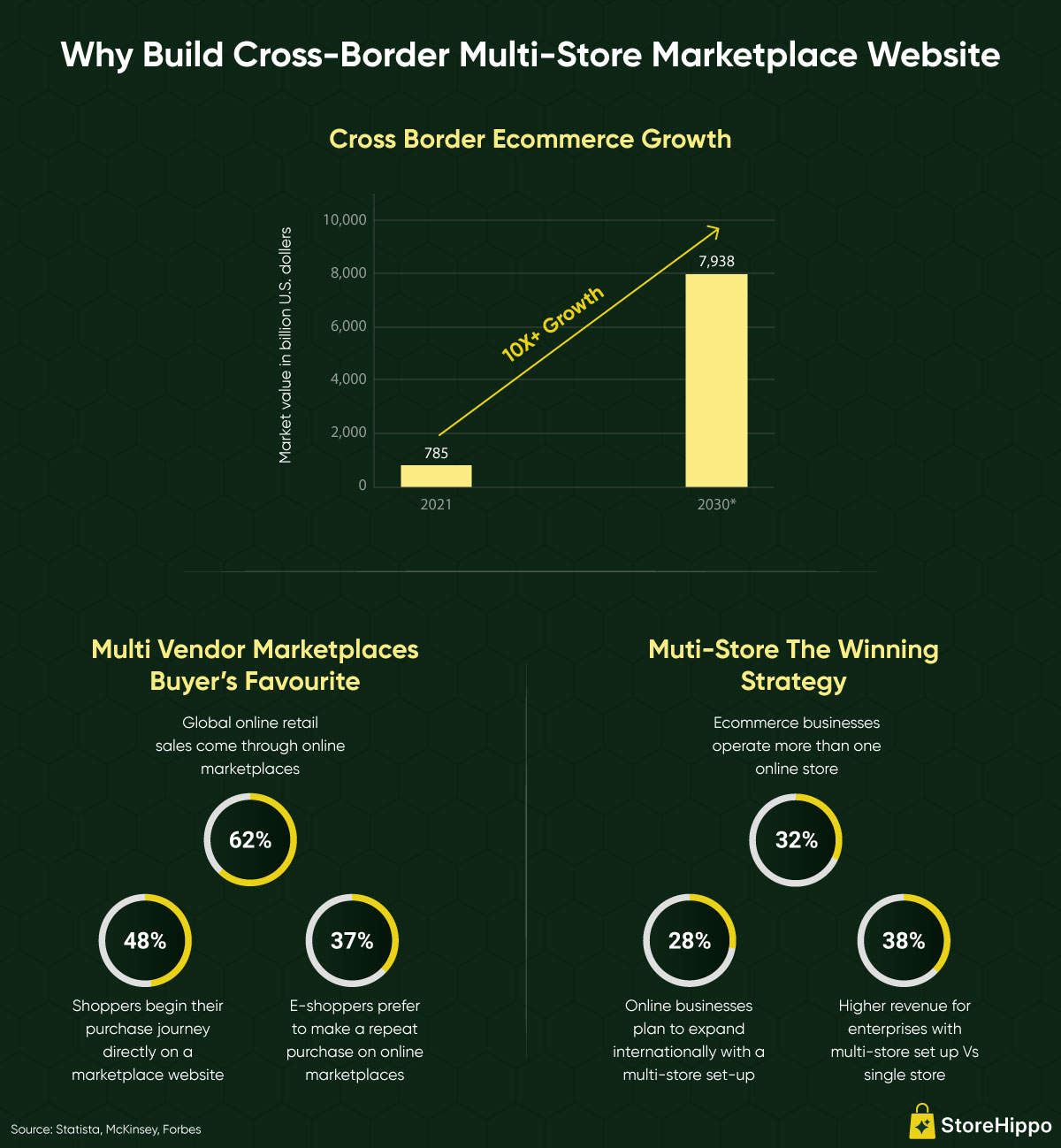
Cross Border Ecommerce Growth
- 10X+ growth in global cross border ecommerce from 2021 to 2030
- $7.93 trillion is the expected value of the cross-border B2C e-commerce market by 2030
Multi Vendor Marketplaces- Buyer’s Favourite
- 62% of global online retail sales come through online marketplaces
- 48% of shoppers begin their purchase journey directly on a marketplace website
- 37% of e-shoppers prefer to make a repeat purchase on online marketplaces
Multi-Store: The Winning Strategy
- 32% of ecommerce businesses operate more than one online store
- 28% of online businesses plan to expand internationally with a multi-store set-up
- 38% higher revenue for enterprises with multi-store set up Vs single store
Source: Statista, McKinsey, Forbes
By setting up multi vendor websites with location-based sub-stores for different countries, enterprises can implement localisation and internationalisation strategies to their advantage.
Successful brands foraying into rapidly developing ecommerce markets like Mexico, India, the Middle East etc. have witnessed significant traction and growth by implementing the location-based store network for their business.
5 Successful Cross Border Multi Vendor Marketplaces With Multi Store Set up
The success of global marketplace brands shows how cross-border ecommerce has evolved beyond simply selling products internationally. Today, the most successful multi vendor marketplaces combine localised experiences, seamless cross-border operations, and technology-driven innovation to serve buyers across multiple regions.
Let us evaluate the top 5 multi-vendor ecommerce websites with a global presence:
1. Amazon
Amazon is probably the first name that comes to mind when looking for a real-world leader to build a multi-store marketplace website.
It sets the standard by allowing sellers to manage country-specific marketplaces (Amazon.co.uk, Amazon.de, etc.) through a single unified dashboard, aggressively backing this up with AI-driven cross-border localisation tools. Available in over 180 countries, Amazon also supports cross-border selling for its vendors and enables them to sell their products to global buyers easily.
Latest Growth Figures: Amazon’s global footprint is generating over ₹70 trillion ($850B+ USD) in annual trailing revenue according to Companies Market Cap.
Lesson for businesses: Centralised management combined with localised storefronts helps marketplaces scale globally without compromising buyer experience.
2. Alibaba
Alibaba is another world famous multi-vendor ecommerce marketplaces which connects businesses and shoppers across the globe through platforms like Alibaba.com, AliExpress, and Taobao. Built for cross-border commerce, it helps sellers expand internationally with integrated logistics, customs support, and multi-currency payments, making global selling much easier.
Latest Growth: In the fiscal year March 2026, Alibaba reported $148.4 billion in revenue. Its international B2B business also grew by 11%, reflecting the company's continued expansion in global ecommerce (source:Business Wire)
Lesson for businesses: Simplifying cross-border selling attracts more international vendors.
3. eBay
eBay is a well-known multi vendor marketplace with localised sub-stores for different countries. A global ecommerce leader, eBay onboards individuals and businesses as sellers and offers a vast array of goods and services to buyers across 190 countries.
By connecting millions of buyers and sellers around the world through its multi-store marketplace network eBay enables seamless cross-border transactions.
Latest Growth: eBay generated $11.1 billion in revenue in 2025, reflecting steady year-on-year growth. The company carried this momentum into Q1 2026, reporting $3.09 billion in revenue, showing continued demand for its global marketplace (Source: WallStreetZen)
Lesson for businesses: Build localised marketplace stores while maintaining a unified platform to simplify cross-border selling and deliver consistent buyer experiences.
4. Etsy.
Etsy is one of the world's most popular multi-vendor marketplaces for handmade, vintage, and unique products. It empowers over 4 million independent sellers to reach customers worldwide with features like automatic listing translation, local currency conversion, and support for cross-border selling. These tools make it easier for small businesses and artisans to sell internationally without added complexity.
Latest Growth: Etsy generated over $2.8 billion in trailing annual revenue in 2026. The company continues to deliver steady growth, with analysts projecting around 3% annual revenue growth and 12.9% annual earnings growth, driven by its asset-light marketplace model. (Source: Simply Wall St).
Lesson for businesses: Localisation and niche positioning can build strong global communities.
5. Rakuten
The Japanese ecommerce marketplace Rakuten offers a marketplace platform with a multi-geography presence. With a presence in Asia, Europe, and the Americas, Rakuten enables sellers to sell to a wider audience base and enables buyers to order products from sellers from different countries.
Rakuten cross-border commerce is powered by multiple localised multi vendor ecommerce websites designed for easy and immersive buying experiences.
Latest Status: Rakuten continues to be one of the leading multi location ecommerce marketplaces with a strong cross-border presence. While it now competes with fast-growing global platforms like Temu and Shein, its localised marketplace strategy and loyal customer base continue to keep it competitive.
Lesson for businesses: Localised storefronts, strong regional partnerships, and market-specific strategies help marketplaces stay competitive across diverse international markets.
10 Key Takeaways from Top Cross-Border Multi-Store Marketplace Websites
The marketplace brands that have ruled global markets have a few things in common. They continue to grow by delivering exceptional buyer experiences, empowering their sellers, embracing new technologies, and adapting quickly to changing customer expectations across global markets.
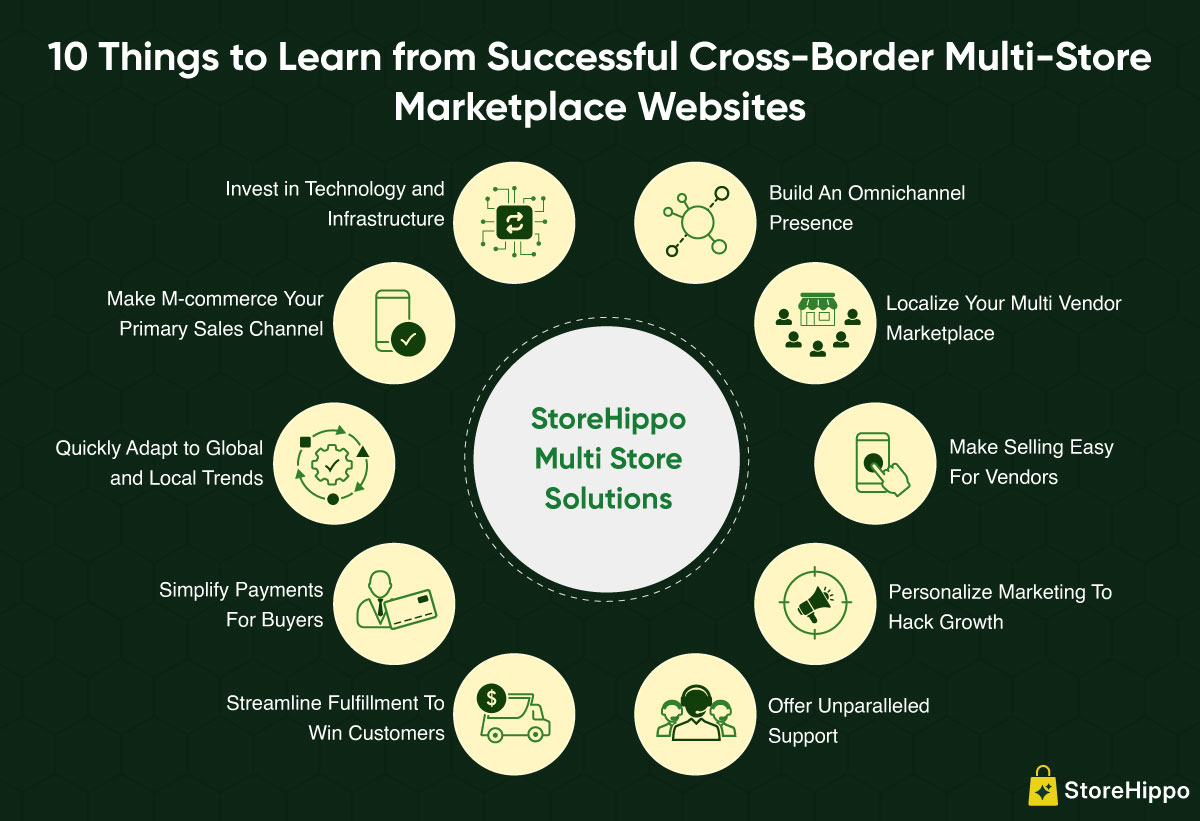
Here are 10 proven strategies that can help your enterprise build and scale a successful international multi-store multi vendor marketplace:
1. Invest in Technology and Infrastructure
To build a successful international marketplace and stay ahead of the competition, your business needs a technology and infrastructure that can support continuous growth and innovation.
As your marketplace expands across countries, sellers, and product catalogues, your platform should be able to handle increasing traffic, transactions, and operational complexity without compromising performance. Choosing the right ecommerce platform today also means looking beyond scalability to capabilities like AI-powered automation, intelligent product discovery, and seamless integrations that help your business grow faster.
To achieve this, look for a platform that offers the following:
- Power your multi-vendor ecommerce website with next-gen technologies that enable you to stay ahead of the competition.
- Choose a scalable ecommerce platform that can accommodate your expansion to diverse locations, products, vendors, buyers, etc.
- Build tailored ecosystems by integrating with the best-in-breed ERP, CRM, accounting, payment, logistics, etc for each location-based marketplace of your multi store ecommerce setup.
- Implement multi-level security to protect buyers’ and sellers’ sensitive information and build trust.
- Enhance user experiences with advanced AI-powered search, personalised product recommendations, tailored website design, and personalised shopping journey.
How StoreHippo Helps
StoreHippo not only builds your international multi store marketplace but also backs your brand with an AI-powered core, MACH architecture, inherent scalability, and a decoupled architecture that gives you creative control to build out-of-the-box solutions.
StoreHippo's AI-native capabilities, including Magic Edit, AI-powered cataloguing, and intelligent automation, help you streamline catalogue management, simplify operations, and deliver personalised buying experiences at scale. You can also build custom ai agents to automate customer support, manage business workflows, assist buyers, and improve operational efficiency.
With 300+ API endpoints, you can easily integrate with your preferred software and service providers and create your unique ecommerce system by integrating ERP, marketing, payments, logistics, marketing, accounting, and other providers of your choice.
With a built-in theme designer, advanced search, and support for multilingual themes, StoreHippo enables your multi vendor marketplace brand to build a resounding global presence.
2. Build An Omnichannel Presence
Modern buyers interact with their favorite brands across 4-6 touchpoints. Going omnichannel can boost year-on-year buyer retention by 91% and annual revenue by 9.5%.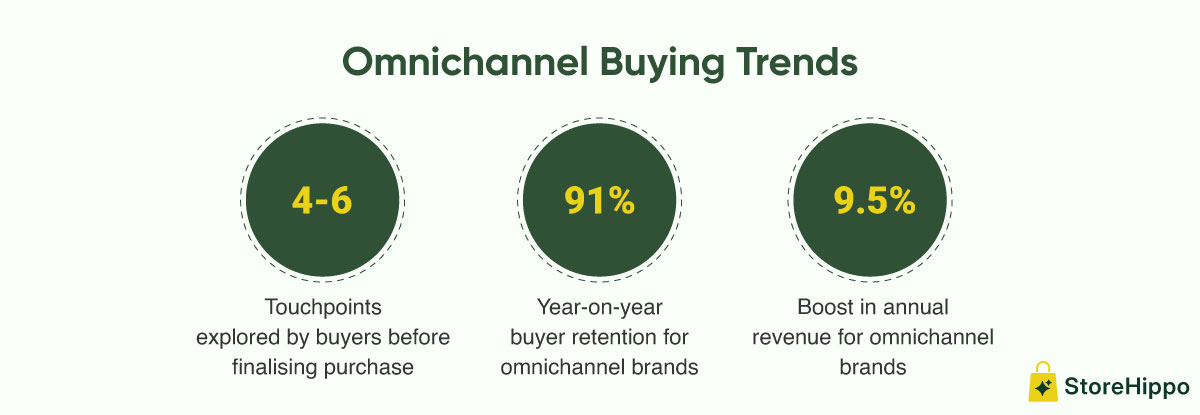
An omnichannel presence for your global multi vendor marketplace increases accessibility and convenience for your buyers, which in turn drives higher customer satisfaction and loyalty. With the omnichannel approach, your brand can boost its visibility while engaging and retaining buyers across touchpoints.
Here is what you should do to go omnichannel:
- Build a multi-store marketplace website with multiple touchpoints to connect with your buyers across channels.
- Provide consistent experiences across all touchpoints to boost engagement and retention.
- Get a central dashboard and unified inventory system to sync and manage orders, inventory, and fulfillment across all channels.
- Experiment with market-channel-product mixes to identify best-selling mixes that boost revenue.
- Implement segmented and personalised marketing across channels and markets to boost international multi vendor marketplace orders.
How StoreHippo Helps
Built on a decoupled headless architecture, StoreHippo enables enterprises to create multiple touchpoints for their international marketplace using a single backend logic . Along with location-based marketplace sub-stores, you can launch branded websites, mobile apps, Progressive Web Apps (PWAs), and conversational commerce experiences while managing everything from a unified dashboard.
StoreHippo's unified commerce architecture keeps products, inventory, orders, customers, and sellers synced across every channel, making it easier to deliver a consistent shopping experience and manage operations as the business grows globally. Its unified conversation dashboard brings together conversations from WhatsApp, chatbots, voice, SMS, email, and other channels in one place. Powered by agentic AI, it remembers previous interactions, enabling faster support and smoother buyer experiences.
3. Make M-commerce Your Primary Sales Channel
Global mobile commerce sales will reach $3.35 trillion by 2028, a whopping 62% growth from $2.07 trillion in 2024. With internet and mobile penetration increasing rapidly across the world, mobile has become the primary sales channel for international marketplace brands.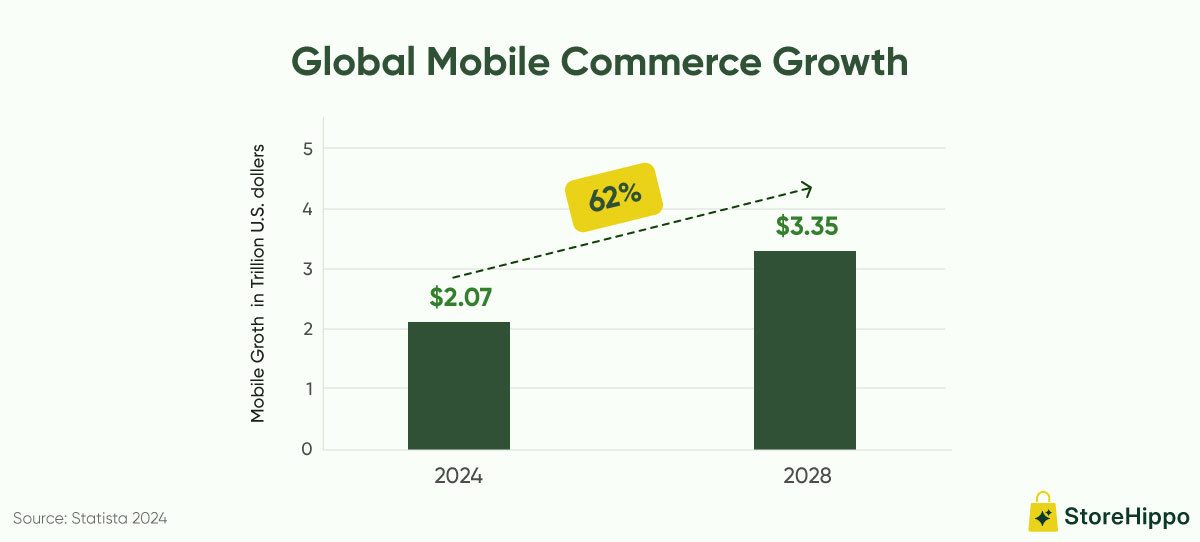
To make your business your buyers' favourite your global multi-vendor ecommerce website should have a strong mobile presence. This is what you need to do to grow your business through m-commerce:
- Build a strong m-commerce presence with PWA multi vendor marketplace and marketplace apps.
- Create conversion-oriented and device-optimized mobile apps designed to boost orders.
- Create marketplace apps for location-based marketplace sub-stores.
- Make navigation, product discovery, and checkout simple and intuitive for mobile users.
- Offer a buyer admin panel to make it easy for buyers to manage, track, reorder, or raise support tickets directly through a mobile app.
How StoreHippo Helps
StoreHippo enterprise ecommerce platform is built on a mobile-first architecture, enabling enterprises to deliver fast, seamless buying experiences across all devices. With its built-in mobile app builder, businesses can create multiple Android and iOS apps for different location-based marketplace stores directly from the admin dashboard. Enterprises can also create Progressive Web Apps (PWA), which looks, feels, and works like apps when opened in a browser.
StoreHippo also provides dedicated mobile apps for admins and vendors, and custom apps for delivery partners, making it easy to manage marketplace operations on the go. Combined with a unified commerce backend and fast mobile experiences, enterprises can deliver faster, more engaging mobile shopping experiences while simplifying day-to-day operations.
4. Localise Your Multi Vendor Marketplace
The most loved marketplace websites are those that connect with the buyers in their native language and are designed for local tastes.
Sample the stats:
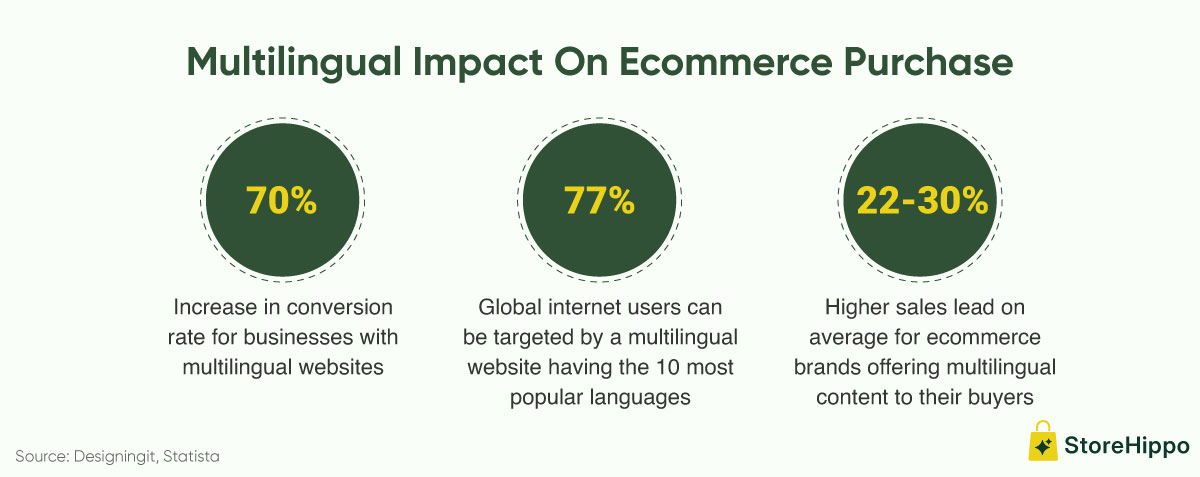
With such promising statistics, localising your multi vendor marketplace has become essential for building trust and growing across international markets. A multilingual approach, combined with region-specific experiences, can help your brand connect better with buyers in every geography.
Here is what you should do to stand out from the competition:
- Build a multi-store marketplace with multilingual feature to connect with buyers in their native language.
- Offer payments in multiple currencies to avoid additional currency conversion charges.
- Customise your marketplace with region-specific content, promotions, and themes that reflect local preferences and cultural events.
- Partner with local logistics providers to ensure faster and more reliable last-mile deliveries.
- Ensure compliance with local regulations, taxation, and other market-specific requirements.
How StoreHippo Helps
StoreHippo offers you the best ecommerce platform that comes with multilingual, multi-currency, and a powerful tax engine to help you effortlessly cater to audiences across geographies. With built-in design tools, you can even change themes and have multilingual themes ( even in RTL languages).
With the advanced tax engine and multi-currency payments, you can make it easier for your buyers to comply with local norms and pay in their preferred currency without paying for conversion rates. With automated catalogue translation tools, multilingual search, localised product discovery, and region-specific storefronts, StoreHippo helps brands deliver personalised shopping experiences to buyers worldwide.
5. Quickly Adapt to Global and Local Trends
The ecommerce landscape continues to evolve rapidly, with buyer expectations, shopping behaviors, and market trends changing faster than ever before. To stay ahead of your competitors’ strategies, it’s crucial to stay agile and responsive to the evolving needs of your multi store ecommerce marketplace buyers across different geolocations. To embrace this approach, you need to be on top of buyer expectations and offer them experiences driven not just by products and pricing but also through personalized interactions, seamless user journeys, and innovative solutions that resonate with their unique preferences and needs.
Here's how you can leverage this strategy effectively:
- Be agile in implementing new features and solutions to make buying easier for your customers
- Use analytics and buyer insights to fine-tune your products, pricing, and marketing strategies across different markets.
- Maximize ROI by applying successful strategies from one marketplace store to your stores in other locations.
- Personalise buyer journeys across channels with relevant recommendations, offers, and content.
- Work closely with local vendors and partners to understand changing customer preferences and respond faster to market trends.
How StoreHippo Helps
StoreHippo helps enterprises adapt quickly to changing business needs without disrupting ongoing operations. Its built-in discount engine, AI-powered product recommendations, integration with best in breed marketing tools enable brands to create personalised shopping experiences, increase conversions, and run targeted campaigns with ease.
Its headless architecture and built-in API connectors make it easy to integrate third-party solutions, add new capabilities, and customise both the frontend and backend. Additionally, its automation, flexible integrations, and actionable business insights help marketplace brands respond faster to changing market trends.
6. Make Selling Easy For Vendors
Every successful multi vendor marketplace owes its growth and popularity to its vendors who not only provide diverse products but also play a key role in delivering quality products, timely fulfillment, and great buyer experiences. To help your vendors give their best towards making your international marketplace a success, you need to empower them with the right tools and solutions, support systems, and streamlined processes that make it easy for them to sell and help them adapt quickly to changing buyer expectations.
Here is what your marketplace brand needs to offer its vendors to help them grow alongside your business and make it a market leader:
- Offer easy solutions to onboard vendors, manage products, and fulfill orders on your multi store ecommerce marketplace.
- Provide a user-friendly, intuitive vendor dashboard to each vendor to help them manage their orders and shipping independently.
- Offer tools to make order and inventory management effortless on your multi-vendor ecommerce website.
- Simplify catalogue management with bulk product uploads, AI-assisted product tagging, and image optimisation.
- Enable SEO-friendly product listings to improve organic discoverability across search engines and AI-powered search experiences.
- Enable bulk uploads and add provisions for SEO elements in the product listing to help vendors with organic product discoverability.
- Provide analytics about best selling products, regions, frequent buyers, etc. to help vendors.
How StoreHippo Helps
When you build a multi-store marketplace website with StoreHippo you get a comprehensive vendor management solution. From onboarding your vendors to managing their products, commissions and payouts you have complete visibility and control over the processes. At the same time, your vendors get an intuitive vendor dashboard to manage their end-to-end business. What’s more, you can even offer unique seller pages to your vendors on your marketplace website to give them undivided buyer attention.
StoreHippo also helps vendors sell smarter with AI-powered cataloguing, and an AI image editing tool. With StoreHippo’s AI image editing tool, Magic Edit, you can easily transform raw product images into stunning, market-ready visuals. With its AI cataloguing tool, you can generate SEO-ready product listings that improve product discoverability. You can automatically generate product titles, descriptions, categories, tags, etc.
7. Simplify Payments For Buyers
The best of the marketplaces cannot become successful without having a pain-free payment solution for their customers. Studies suggest that offering multiple payment options to your international multi vendor marketplace buyers can increase conversion rates by up to 30% and reduce cart abandonment by as much as 20%. Businesses that fail to provide buyers’ preferred payment channels report losing 10% of their international revenue. Additionally, businesses that provide diverse payment methods often get higher average order values. Frictionless payments make it easier for customers to complete purchases and boost your overall sales.
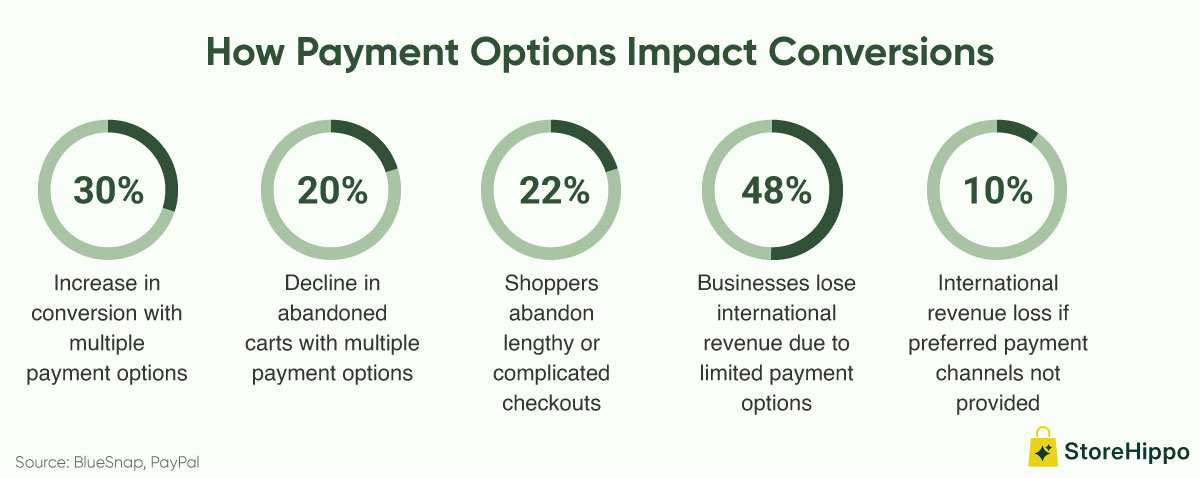
Here's what your marketplace should offer to simplify payments for buyers:
- Offer multiple secure payment options for hassle-free checkouts.
- Support local payment methods and multiple currencies for buyers across different countries.
- Enable multi-seller checkouts in a single cart.
- Collaborate with payment providers for additional discounts or cashback.
- Keep the checkout process simple, transparent, and optimised to reduce drop-offs.
How StoreHippo Helps
StoreHippo comes pre-integrated with 60+ domestic and international payment gateways that enable you to offer multiple payment options to your customers across geolocations. With support for store wallet, mobile wallets, card payments and UPI, multi-currency payments, and region-specific payment methods, you can deliver a seamless checkout experience for global customers.
You can add multiple payment gateways in checkout, customise checkouts with different payment gateways for different sub stores of your multi store ecommerce marketplace, and also implement adaptive payments to send payments to different sellers from the payment gateway level.
8. Personalise Marketing To Hack Growth
We are living in the era of hyper-personalisation, where buyers expect every interaction to be relevant to their preferences and shopping behavior. From product recommendations to personalised offers, delivering tailored experiences has become one of the biggest drivers of engagement, conversions, and customer loyalty.
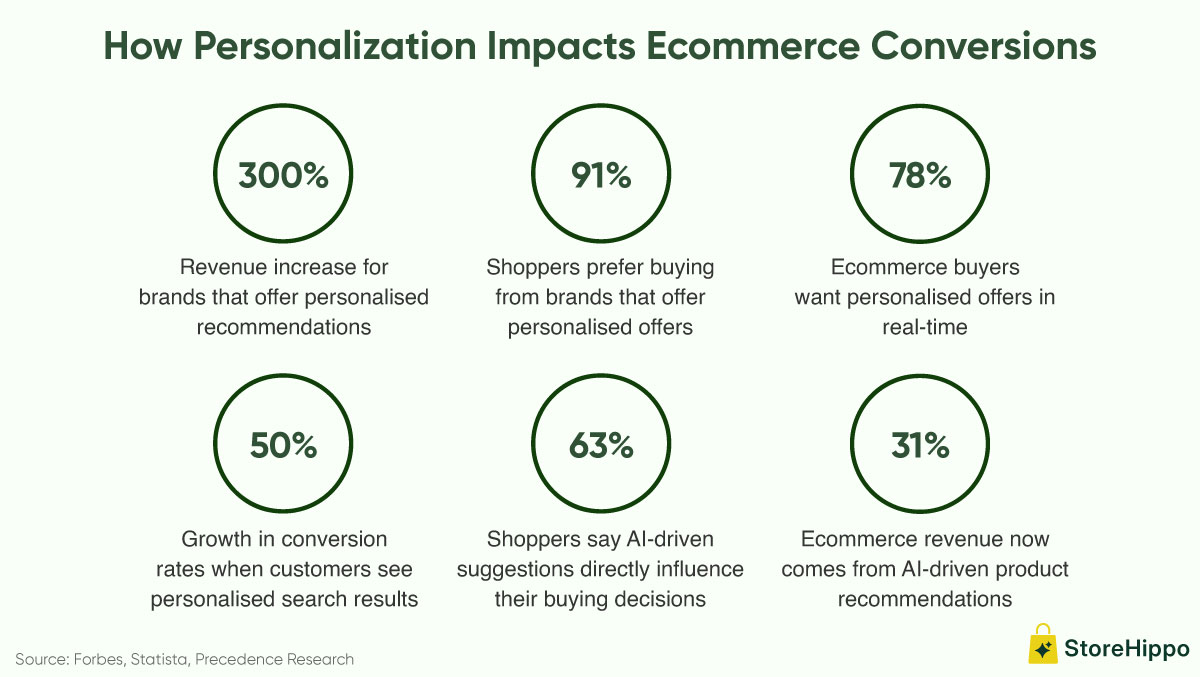
The data underlines how important it is to offer personalised buying experiences to your international multi vendor marketplace buyers. Personalising interactions and recommendations go a long way in enhancing user engagement, driving repeat purchases and fostering brand loyalty.
Here is how you can leverage personalisation strategies to boost your multi store ecommerce marketplace’s orders:
- Tailor marketing messages, discounts, and promotions based on buyer behavior insights.
- Implement AI-powered personalisation to engage buyers with relevant products at the right time.
- Implement personalised email campaigns and real-time push notifications.
- Build a multi-store marketplace website with personalised landing pages for different buyer segments.
- Re-engage abandoned cart users with automated follow-ups and relevant product recommendations.
- Leverage dynamic forms to better understand buyers and create tailored marketing strategies.
How StoreHippo Helps
StoreHippo makes it easy for enterprise brands to personalise their marketing strategies. With built-in marketing tools like the discount engine, unified notifications ( email, SMS, push), abandoned cart auto-follow-up, AI-powered personalised recommendations, and and intelligent marketing automation,, StoreHippo makes it easy for you to offer personalised marketing on the different location-based sub-stores of your international multi vendor marketplace.
You can also create dynamic landing pages for different buyer groups in no time, capture buyer insights through built-in forms, and leverage AI-driven recommendations to showcase the most relevant products to each shopper. Additionally, you can build custom AI agents to offer personalised shopping assistance, answer customer queries, and guide buyers throughout their purchase journey, helping improve engagement, conversions, and customer loyalty.
9. Streamline Fulfillment To Win Customers
Streamlined fulfillment is the backbone of a successful ecommerce business. Effective, timely, and damage-free fulfillment is the key to ensuring customer satisfaction and loyalty. A well-optimised fulfillment process has multi-pronged benefits for the vendors, business owners, and customers. By prioritising seamless fulfilment for your international multi vendor marketplace brand you can enhance your reputation, boost repeat purchases and drive overall growth.
Here is how you can streamline the logistics of your international marketplace and its location-based sub-stores:
- Integrate with multiple shipping providers to ensure faster and more flexible fulfillment.
- Leverage your vendors' delivery partners or local logistics providers to optimise last-mile deliveries.
- Enable partial fulfillment to ship products from multiple sellers or warehouses whenever required.
- Enable AI-powered order routing to automatically assign orders to the most suitable vendor for faster and more cost-effective fulfillment.
- Offer real time order tracking and keep customers informed at various steps of the order process from placement to shipping to fulfillment.
- Implement efficient returns and exchange processes to minimize grievances and keep customers happy.
How StoreHippo Helps
StoreHippo comes pre-integrated with 30+ logistics providers that deliver to 27000+ domestic pin codes and 200+ international locations. You can also leverage the API endpoints to integrate local delivery partners of your vendors for better fulfillment. StoreHippo also offers custom-built delivery boy solutions to enable vendors on your multi store ecommerce marketplace to manage their fleet of delivery agents. AI-powered order routing, partial fulfillment, and real-time shipment tracking help optimise deliveries and improve customer satisfaction. These StoreHippo features enable marketplace brands to deliver faster, more reliable fulfillment experiences across every location-based marketplace store.
10. Offer Unparalleled Support
What truly differentiates your marketplace brand from competitors is the experiences you provide to your customers. 48% of customers start their product search on a marketplace (source: Statista) because they know that they will find the desired product and have the backing of the parent brand to safeguard their money and interests.
Here is how you can offer a wow customer experience to your multi vendor marketplace buyers:
- Offer multi channel customer support to keep your customers engaged and happy
- Resolve customer queries quickly with a combination of self-service resources and live support.
- Provide as much detail as possible regarding products with FAQ and guides.
- Implement ratings and reviews to help your customers make informed decisions
- Offer dedicated support to your vendors and other partners to ensure they are aligned towards customer satisfaction.
- Leverage AI to automate and speed up regular support queries
How StoreHippo Helps
StoreHippo integrates seamlessly with your preferred CRM, helpdesk, live chat, and customer support solutions to help you deliver responsive buyer experiences. It offers a unified conversation dashboard to manage conversations across chat, WhatsApp, email, voice, SMS, and other commerce channels from a single interface while maintaining complete conversation context. With StoreHippo, you can build custom AI chatbots to offer guided buying journeys, resolve queries, and deliver personalised shopping assistance in real time.
You can also add detailed FAQs to product pages and leverage built-in ratings and reviews to help buyers make confident purchase decisions. Customer feedback not only builds trust among shoppers but also helps vendors continuously improve their products and services, enabling your marketplace to deliver consistently better buying experiences.
Conclusion
Global ecommerce continues to create immense growth opportunities, and enterprises that build a multi-store marketplace website early have the advantage of capturing new markets and establishing a strong global brand presence. By expanding into international markets with the right technology, businesses can reach new customer segments, deliver localized buying experiences, and build long-term competitive advantage.
To go to market faster, enterprises need the best ecommerce platform like StoreHippo that offers built-in AI core, next-generation technology, plug-and-play solutions, and comprehensive customisation for diverse geographies. With support for multiple business models including B2C, B2B, D2C, B2B2C, hyperlocal commerce, marketplaces, and more, StoreHippo empowers enterprises to build, manage, and scale future-ready multi-store marketplace businesses from a single platform.
Ready to launch your international multi store ecommerce journey? Build your marketplace on a strong foundation with StoreHippo and take your business global.
Book your personalised demo now.
FAQs
1. What should enterprises consider before expanding their multi-vendor ecommerce website into international markets?
Enterprises should evaluate scalability, regional customer preferences, compliance requirements, and fulfilment partners before expanding internationally. A successful multi-vendor ecommerce website should support multiple languages, currencies, payments , integrations, and localised experiences while allowing businesses to manage global operations efficiently from a unified platform.
2. Why should global enterprises use multi store ecommerce models over a single international storefront?
Global enterprises should use multi store ecommerce models because they enable localised shopping experiences while maintaining centralised control. Businesses can customise products, pricing, promotions, languages, payments, and customer journeys for different regions while efficiently managing operations, inventory, and growth through a unified ecommerce infrastructure.
3. How does an AI-powered ecommerce platform help international marketplaces grow faster?
An AI-powered ecommerce platform helps international marketplaces grow faster by automating operations, improving product discovery, enabling personalised experiences, and providing data-driven insights. It reduces manual effort, enhances customer engagement, and helps businesses scale their multi-vendor ecommerce website efficiently while adapting quickly to changing market demands.
4. How can enterprises manage multiple vendors efficiently while scaling globally?
Enterprises can manage multiple vendors efficiently by using a scalable multi vendor marketplace platform that simplifies vendor onboarding, catalogue management, inventory tracking, commissions, payouts, and order workflows. The right technology helps businesses provide vendors with self-service tools while maintaining centralised visibility and control across global marketplace operations.
5 What challenges do enterprises face when managing a multi vendor marketplace across different countries?
Enterprises face challenges such as managing diverse vendor networks, regional compliance, localised customer expectations, multiple currencies, fulfilment complexities, and technology integrations across countries. A scalable multi vendor marketplace solution helps businesses streamline these operations while maintaining consistent experiences, centralised control, and flexibility to adapt to different international markets.
Binny Joseph is Senior Vice President of Sales & Alliances with extensive experience in enterprise ecommerce, helping global brands build and scale multi-vendor marketplaces, expand into international markets, and grow multi-store ecommerce businesses.
He writes from hands-on experience, helping businesses understand what it takes to build, scale, and grow successful multi-location and multi vendor marketplaces.