


Selling beyond your home market sounds exciting, but taking an international online marketplace live across countries is not as simple as switching on international shipping.
Every market comes with its own customer expectations, preferred payment methods, currencies, languages, tax rules and delivery habits. What works smoothly in one country may create friction in another. Then there is the challenge of bringing international sellers onto the platform, keeping catalogues accurate and giving customers a consistent experience across every market.
This is where the right technology foundation makes a real difference. A scalable multi vendor marketplace can help enterprises bring sellers, products, payments, logistics and customer journeys together while keeping operations under control.
In this guide, we’ll look at the key trends shaping global marketplace growth, the essential features to consider and steps enterprises can follow to build a marketplace that is ready to grow across borders.
Before getting into the details, let’s first look at the key trends shaping the international ecommerce market.
Table of Contents
- International Online Marketplace Growth: Key Trends and Statistics
- What is an International Online Marketplace
- How Is Setting Up an International Online Marketplace Different from Building a Regular Marketplace?
- 1. Define Your Business Model and Target Markets
- 2. Choose the Right Global Marketplace Platform
- 3. Onboard International Sellers and Manage Their Catalogues
- 4. Add AI-Powered Commerce Capabilities
- 5. Enable Omnichannel Selling
- 6. Customise Your Marketplace for Different Markets
- 7. Set Up International Payments and Tax Management
- 8. Integrate Cross-Border Logistics and Fulfilment
- 9. Build a Marketing Strategy for Each Market
- 10. Test, Launch and Scale Across Markets
- How StoreHippo Helps You Build and Scale an International Online Marketplace
- 1. Built-in Multi-Vendor Marketplace Capabilities
- 2. Multi Store Management
- 3. AI-Powered Core
- 4. Unified Omnichannel Solution
- 5. Multilingual and Localised Commerce
- 6. Multi-Currency Payments and Checkout
- 7. Integrated International Logistics
- 8. Built-in Marketing and Customer Engagement
- 9. Seamless Integrations for Connected Global Operations
- 10. Support for Diverse Business Models
- Conclusion
- FAQs
International Online Marketplace Growth: Key Trends and Statistics
Cross-border shopping is making it easier for enterprises to reach customers in markets beyond their home country. As more shoppers buy from international sellers, businesses need to think beyond simply being available online. Offering localised experiences, competitive pricing, convenient payments and personalised shopping can make a real difference when entering new markets.
Here are some trends that reflect the changing international ecommerce landscape:
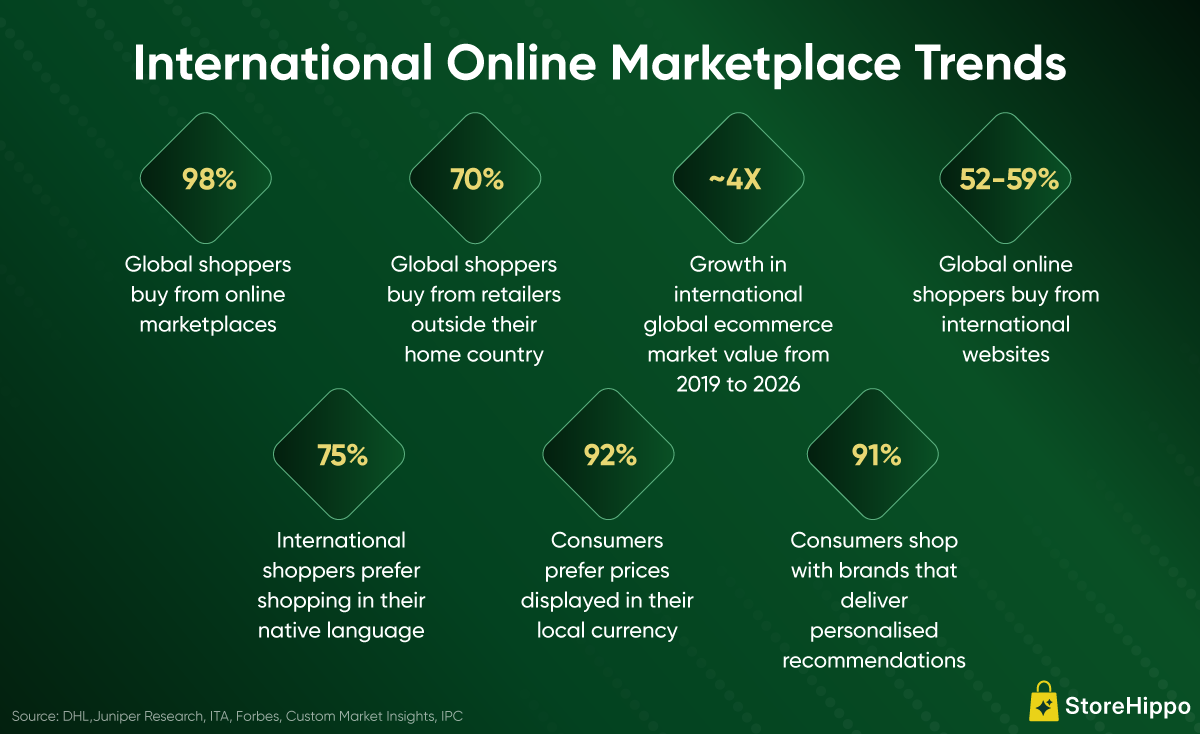
- 98% of global shoppers buy from online marketplaces
- 70% of global shoppers buy from retailers outside their home country
- ~4X growth in international global ecommerce market value from 2019 to 2026
- 52%-59% of global online shoppers buy from international websites
- 75% of international shoppers prefer shopping in their native language
- 92% of consumers prefer prices displayed in their local currency
- 91% of consumers shop with brands that deliver personalised recommendations
Source: DHL,Juniper Research, ITA, Forbes, Custom Market Insights, IPC
What it shows: Global marketplaces are growing rapidly, but winning in new markets takes more than simply going international. Enterprises that localise languages, currencies, payments and storefront experiences can connect better with customers across regions. A well-built international online marketplace can help businesses enter new markets faster, meet diverse customer needs and scale globally with greater ease.
What is an International Online Marketplace
An international online marketplace is a marketplace model that connects customers and sellers across different countries or regions through a single digital platform. Enterprises can use it to bring multiple sellers, brands, dealers, or distributors into one multi vendor marketplace while centrally managing seller onboarding, catalogues, inventory, orders, pricing, payments, currencies, and fulfilment workflows across markets.
By bringing sellers and customers from different regions onto the same platform, businesses can expand beyond their home market without having to build a separate commerce setup for every country. Localised languages, currencies, payment methods, pricing, shipping, and customer experiences can also help businesses serve customers more effectively in different markets.
Unlike a marketplace that operates within a single country or region, a global marketplace is designed to support cross-border commerce and the different requirements that come with selling internationally. An AI-powered marketplace can take this further by using AI for product discovery, recommendations, personalisation, catalogue management, and other marketplace operations, helping enterprises deliver a more relevant shopping experience as they scale across markets.
How Is Setting Up an International Online Marketplace Different from Building a Regular Marketplace?
Setting up an international online marketplace involves more than taking a regular marketplace into another country. Enterprises need to account for differences in languages, currencies, payments, taxes, shipping, seller requirements, and customer expectations across markets.
Here are the key technology and setup requirements to consider when building a global marketplace:
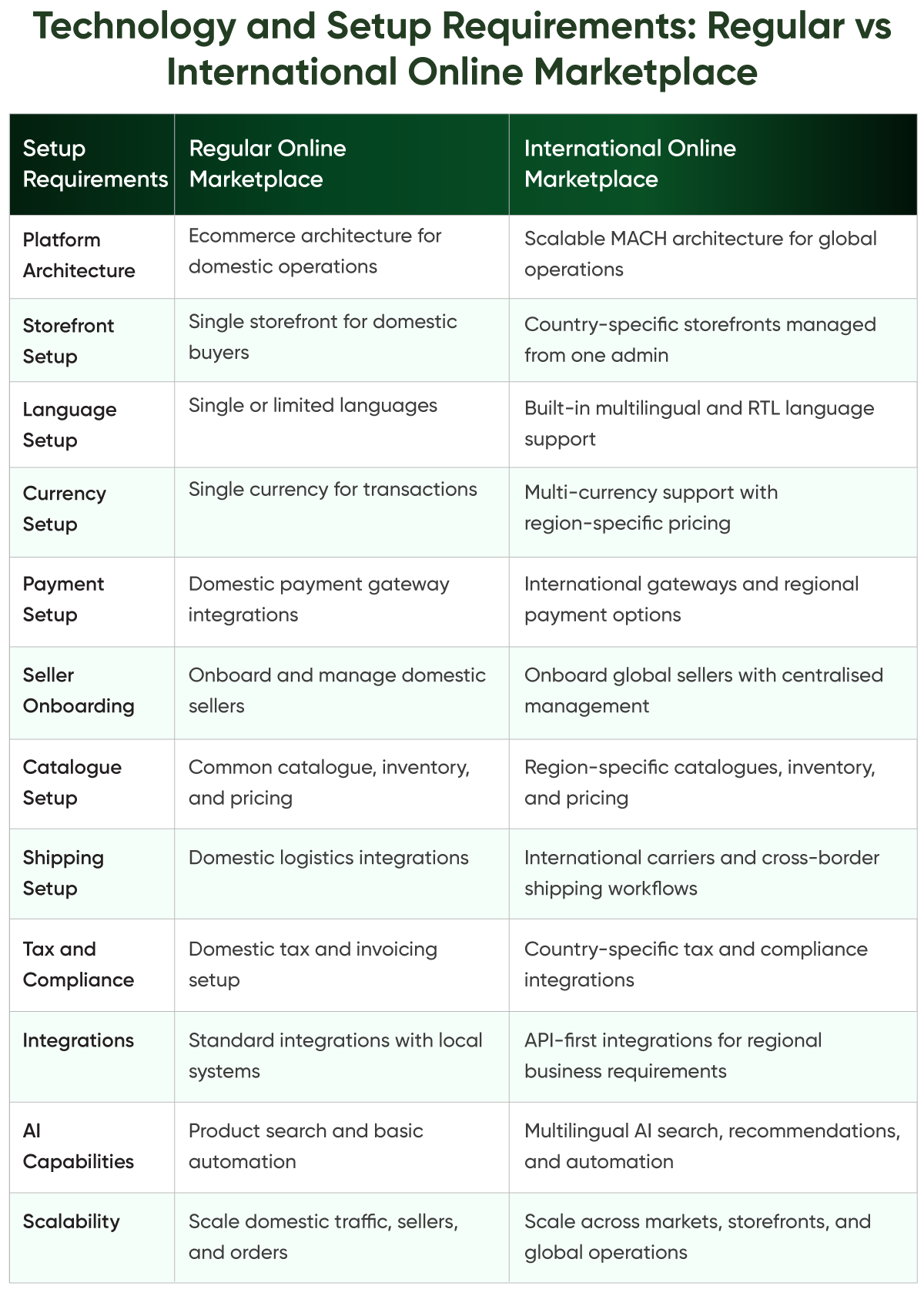
The table shows that setting up a global marketplace requires more than simply expanding a regular marketplace to new countries. From multilingual storefronts and multi-currency payments to regional compliance, shipping and AI capabilities, enterprises need a platform built to handle the requirements of multiple markets.
In comparison, a regular marketplace is mainly designed for domestic operations, while a global marketplace needs greater flexibility, scalability and centralised control to support sellers, buyers and operations across different countries.
Steps to Build a Global Marketplace
Building a successful international online marketplace takes more than making your existing ecommerce store available in another country. You need the right business model, technology, localisation, payments, logistics and compliance framework to serve buyers and sellers across markets.
Follow these steps to build a scalable online marketplace that can support international sellers, customers and transactions:
1. Define Your Business Model and Target Markets
Start by deciding what you want your global marketplace to offer, who you want to serve and where you want to expand. Define your target customers, product categories, seller types, revenue model and fulfilment approach. Decide whether you want to launch a B2B, B2C, B2B2C or hybrid multi vendor marketplace. Then research each potential market to understand customer preferences, competition, regulations, taxes, payment habits and delivery expectations. This will help you choose markets where your marketplace has real growth potential.
2. Choose the Right Global Marketplace Platform
Now that your business model and target markets are decided, the next step is to choose a global marketplace platform that grows with your business as you enter new international markets. Look for an enterprise ecommerce platform that offers built-in features and tools to manage sellers, products, orders and customers across countries. It should also support different languages, currencies, payment methods and shipping requirements, without requiring a separate system for each market.
3. Onboard International Sellers and Manage Their Catalogues
Once your global marketplace is ready, you need to bring the right sellers on board. Keep the onboarding process easy so sellers in different countries can quickly set up their stores and start listing products. Give simple workflows so they can easily add products, set prices, update inventory, manage orders and manage their business operations. A clear catalogue structure and seller verification process can also help you maintain product quality and give customers a consistent shopping experience as your seller network grows.
4. Add AI-Powered Commerce Capabilities
Make your international online marketplace more personalised and easier to navigate with AI-powered search, intelligent product discovery, and personalised recommendations. Help customers find relevant products faster with AI shopping assistants that guide them through their buying journey. Use AI-powered catalogue creation, optimisation, and image editing to reduce manual work and manage large, multilingual product catalogues across different markets.
5. Enable Omnichannel Selling
Expand your multi vendor marketplace beyond a single website by adding mobile apps, PWA, WhatsApp commerce, partner portals, AI-powered assistants, voice commerce and other channels. A unified omnichannel approach lets global customers discover and purchase products through the channels they already use and continue their shopping journey seamlessly from one channel to another. At the same time, sellers can manage their products, inventory and orders across multiple touchpoints from a central platform.
6. Customise Your Marketplace for Different Markets
Your global online marketplace should not feel like the same store simply translated into different languages. Customers in each market have different languages, currencies, shopping preferences, pricing expectations and product needs. A multistore setup can help you manage different regional storefronts while keeping core marketplace operations connected. Multilingual experiences, localised content and market-specific multi-currency pricing can then make each storefront feel relevant to its customers. This balance of local experiences and centralised control is important when expanding across countries.
7. Set Up International Payments and Tax Management
Selling across countries means dealing with different payment preferences and local tax requirements. Your international online marketplace should make checkout simple for customers while handling the tax, duty and invoicing rules that apply in each market.
Setting up the right payment and tax processes from the start helps customers complete their purchases smoothly and give marketplace teams better control over payments, refunds and settlements as transactions grow across countries.
8. Integrate Cross-Border Logistics and Fulfilment
Selling across countries also means dealing with different shipping, delivery and fulfilment requirements. Your global marketplace needs a logistics setup that can support different markets, delivery options and service expectations. Integrate your global marketplace with multiple international logistics partners, that can give you the flexibility to handle orders across regions. Reliable tracking, smooth returns and efficient customs handling can then help you deliver a consistent experience as you enter new markets.
9. Build a Marketing Strategy for Each Market
Launching your international online marketplace is just the start. You also need to reach the right customers and sellers in each market and give them a reason to choose your platform. Your marketing strategy should reflect local preferences instead of using the same approach everywhere. Localised content, relevant offers, personalised promotions, discounts and market-specific campaigns can help you build awareness and attract more customers. Track what gets the best response in each market and use those insights to improve your approach.
10. Test, Launch and Scale Across Markets
Before launching your global marketplace, test the complete buyer and seller journey across your target countries. Check product listings, currencies, payments, taxes, inventory, order processing, shipping, returns, localisation and mobile experiences. Start with a focused set of markets, track sales and customer behaviour, gather feedback and improve the experience before expanding into more countries, sellers and product categories.
How StoreHippo Helps You Build and Scale an International Online Marketplace
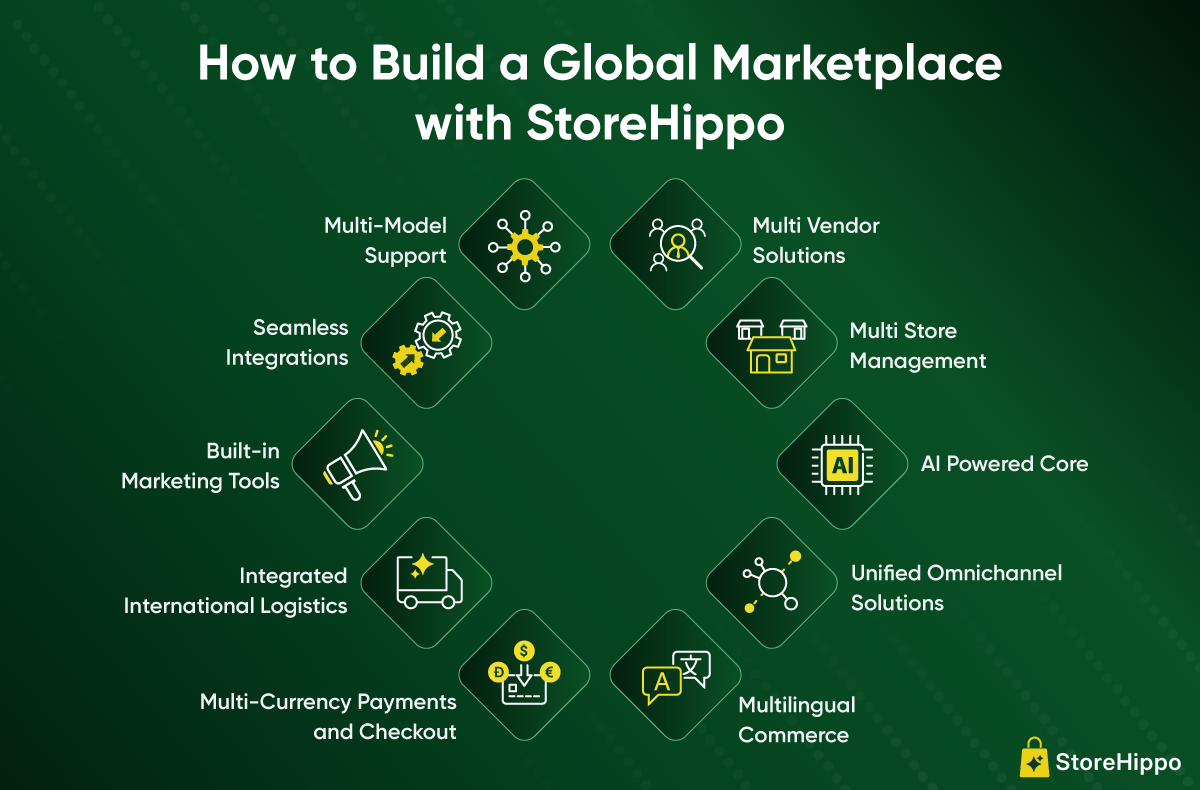
StoreHippo helps enterprises build and scale an international online marketplace that connects sellers and customers across different countries. From managing multiple vendors and localised catalogues to supporting multiple currencies, languages, payments, logistics and AI-powered shopping experiences, StoreHippo gives enterprises the tools they need to expand globally from a single platform.
Here’s how StoreHippo helps enterprises build and grow their international marketplace:
1. Built-in Multi-Vendor Marketplace Capabilities
StoreHippo provides built-in multi-vendor marketplace capabilities that make it easier for enterprises to build and manage an online global marketplace with sellers, dealers, distributors and suppliers across different countries. Enterprises can onboard vendors, create seller-specific dashboards and manage products, orders, inventory and customers from a centralised platform.
Sellers can manage their catalogues, pricing, inventory and orders independently, while marketplace owners retain central control over the overall ecommerce operations. This makes it easier to expand the seller network and enter new international markets without creating separate systems for every region.
2. Multi Store Management
Expanding into different countries does not have to mean running separate ecommerce systems. StoreHippo’s Multistore® capabilities enable enterprises to create multiple storefronts for different markets while managing them through a unified admin dashboard.
Enterprises can customise product catalogues, themes, pricing, offers, payment options, sellers and shipping rules for different markets. This gives each storefront the flexibility to meet local customer expectations while keeping the overall online global marketplace operations under centralised control.
3. AI-Powered Core
StoreHippo is an AI-powered marketplace platform where AI is built into the core of the ecommerce platform, helping enterprises reduce manual work, make shopping more intuitive and respond faster as they scale.
StoreHippo’s AI store builder helps enterprises launch storefronts faster by using brand information, product images and business details to create a storefront aligned with their requirements. This reduces the effort involved in building and updating digital storefronts.
AI-powered capabilities such as AI semantic search, AI recommendations, AI-powered cataloguing and Magic Edit help customers discover relevant products while making catalogue and content management easier for marketplace teams.
Enterprises can also create AI bots for buyers, sellers and internal teams, along with custom AI shopping assistants that guide buyers throughout their shopping journey. The Unified Conversation Dashboard brings conversations from different channels into one place, where agentic intelligence maintains context and helps teams resolve queries and complete tasks faster.
4. Unified Omnichannel Solution
An international online marketplace needs to reach customers across the channels they already use. StoreHippo helps enterprises create a unified omnichannel presence across web stores, mobile apps, PWA stores, WhatsApp Commerce, partner portals and emerging AI-powered and voice channels.
Enterprises can manage catalogues, inventory, orders, customers and conversations from a centralised platform while maintaining a consistent experience across channels. This makes it easier to expand the reach of the online marketplace without managing every channel separately.
5. Multilingual and Localised Commerce
An international online marketplace needs to feel familiar to customers in every market it serves. StoreHippo comes with built-in multilingual capabilities with support for 100+ languages, enabling enterprises to create shopping experiences that cater to customers across different regions.
Enterprises can also tailor their storefronts, catalogues, content, pricing and promotions based on individual markets. This makes it easier to create localised experiences while managing the broader international business through one ecommerce platform.
6. Multi-Currency Payments and Checkout
Customers across countries have different payment preferences, currencies and checkout expectations. StoreHippo enterprise marketplace platform supports multiple payment options (60+) and enables international brands to accept payments in multiple currencies, helping enterprises create smoother checkout experiences for international buyers.
Enterprises can offer customers their preferred payment methods while managing transactions across different markets. This makes the checkout experience more convenient and helps enterprises reduce friction when selling through their online marketplace globally.
7. Integrated International Logistics
International fulfilment involves more than simply shipping an order from one country to another. Enterprises need to manage delivery partners, serviceability, shipping costs, tracking, returns and different fulfilment requirements across markets.
StoreHippo multi vendor marketplace platform enables enterprises to integrate their preferred logistics providers and manage shipping rules based on factors such as destination, delivery location, cost and serviceability. This gives enterprises greater flexibility to manage cross-border fulfilment as they expand their online marketplace into new regions.
8. Built-in Marketing and Customer Engagement
Growing an international online marketplace requires more than attracting customers once. StoreHippo provides built-in marketing tools including discount engine, abandoned cart discovery, coupons, personalised offers, QR-code campaigns and targeted promotions.
Enterprises can also use customer and purchase data to create more relevant product recommendations and marketing campaigns. Market-specific promotions can help businesses engage customers based on their location, preferences and shopping behaviour.
9. Seamless Integrations for Connected Global Operations
Managing a global marketplace means bringing together sellers, products, inventory, orders, payments, logistics and customer data across different systems. StoreHippo makes it easier to connect the online marketplace with ERP, CRM, accounting, payment, logistics and other business applications.
Its headless architecture and APIs give enterprises the flexibility to connect their existing systems with the marketplace. This helps businesses streamline operations, maintain centralised control and scale their global marketplace into new markets without adding unnecessary technology complexity.
10. Support for Diverse Business Models
International expansion often requires enterprises to serve different customer segments and selling models across markets. StoreHippo global marketplace platform supports multiple business models, including B2B, B2C, D2C, B2B2C, marketplace and hybrid models.
Enterprises can use the same ecommerce infrastructure to support different ways of selling, whether they are connecting brands with consumers, enabling business procurement or managing multiple sellers through a multi vendor marketplace. This flexibility makes it easier to adapt the business model as the enterprise enters new markets and grows globally.
Conclusion
Building an international online marketplace is about creating a commerce ecosystem that can adapt to different markets, customers and sellers without making operations harder to manage. From multilingual storefronts and localised experiences to multi-currency payments, cross-border logistics, AI-powered capabilities and flexible business models, enterprises need the right technology foundation to scale globally.
A well-built global marketplace can help businesses enter new markets, serve customers more effectively and grow their seller network from a central platform. StoreHippo's AI-powered marketplace platform brings these capabilities together, helping enterprises build and manage a scalable multi vendor marketplace with built-in AI and omnichannel commerce capabilities.
Ready to build a global marketplace that can grow with your business?
Book a personalised demo with StoreHippo now.
FAQs
1. What should enterprises evaluate before investing in an international online marketplace platform?
Enterprises should evaluate scalability, multi-currency and multilingual support, local payment gateways, tax and regulatory compliance, seller management, logistics integrations and marketplace security. The platform should also support multiple business models, localised storefronts, flexible pricing and seamless integrations with existing systems. Strong AI features for personalisation, search and automation can further help enterprises improve customer experience and scale their global marketplace efficiently.
2. How can enterprises personalise a global marketplace for different countries at scale?
Enterprises can personalise a global marketplace by localising storefronts, languages, currencies, payment methods, product catalogues and promotions for each country. AI-powered recommendations and customer segmentation can tailor product discovery and offers based on local preferences and behaviour. A centralised marketplace platform with flexible configurations allows enterprises to manage these regional experiences from one system while maintaining consistent branding, operations and governance across markets.
3. What technology challenges can enterprises face when scaling a global marketplace across countries?
Enterprises may face challenges such as integrating multiple payment gateways, currencies, tax systems, languages, logistics providers and regional regulations. Managing high traffic, data security, platform performance and different customer experiences can also become complex as the marketplace expands. Legacy systems and disconnected technology stacks may further slow expansion. A scalable, API-driven platform can help enterprises manage these complexities through centralised operations and flexible integrations.
4. How can enterprises manage different seller requirements across international markets?
Enterprises can manage different seller requirements by offering flexible onboarding, seller dashboards, pricing rules, commission structures and compliance workflows for each market. The platform should support local tax regulations, currencies, languages, payment methods and shipping options while maintaining centralised control. Role-based access and configurable seller policies can help enterprises accommodate regional needs without creating separate systems for every country.
5. How can AI help enterprises grow their international marketplace?
AI can help enterprises grow their global marketplace by improving product discovery, personalising recommendations and automating repetitive tasks. It can analyse customer behaviour to deliver relevant products, AI-powered search, conversational shopping assistants to improve customer experience and conversions. This enables enterprises to built an AI-powered marketplace that can serve diverse audiences more effectively while scaling operations across countries.
6. How can marketing teams improve customer acquisition for an international online marketplace?
Marketing teams can improve customer acquisition by creating localised campaigns based on each market’s language, preferences and shopping behaviour. SEO, personalised offers and referral programmes can help attract relevant customers. Teams should also analyse campaign performance and customer data to refine their strategies. This market-specific approach can increase visibility, engagement and conversions for an international online marketplace.
7. How can enterprises future-proof their international marketplace strategy?
Enterprises can future-proof their international marketplace strategy by investing in a scalable, API-driven platform that can adapt to new markets, technologies and business models. They should prioritise AI, mobile commerce, automation, data security and flexible integrations. Regularly tracking customer expectations, market trends and regulatory changes can help enterprises update their marketplace strategy, stay competitive and support sustainable global growth.