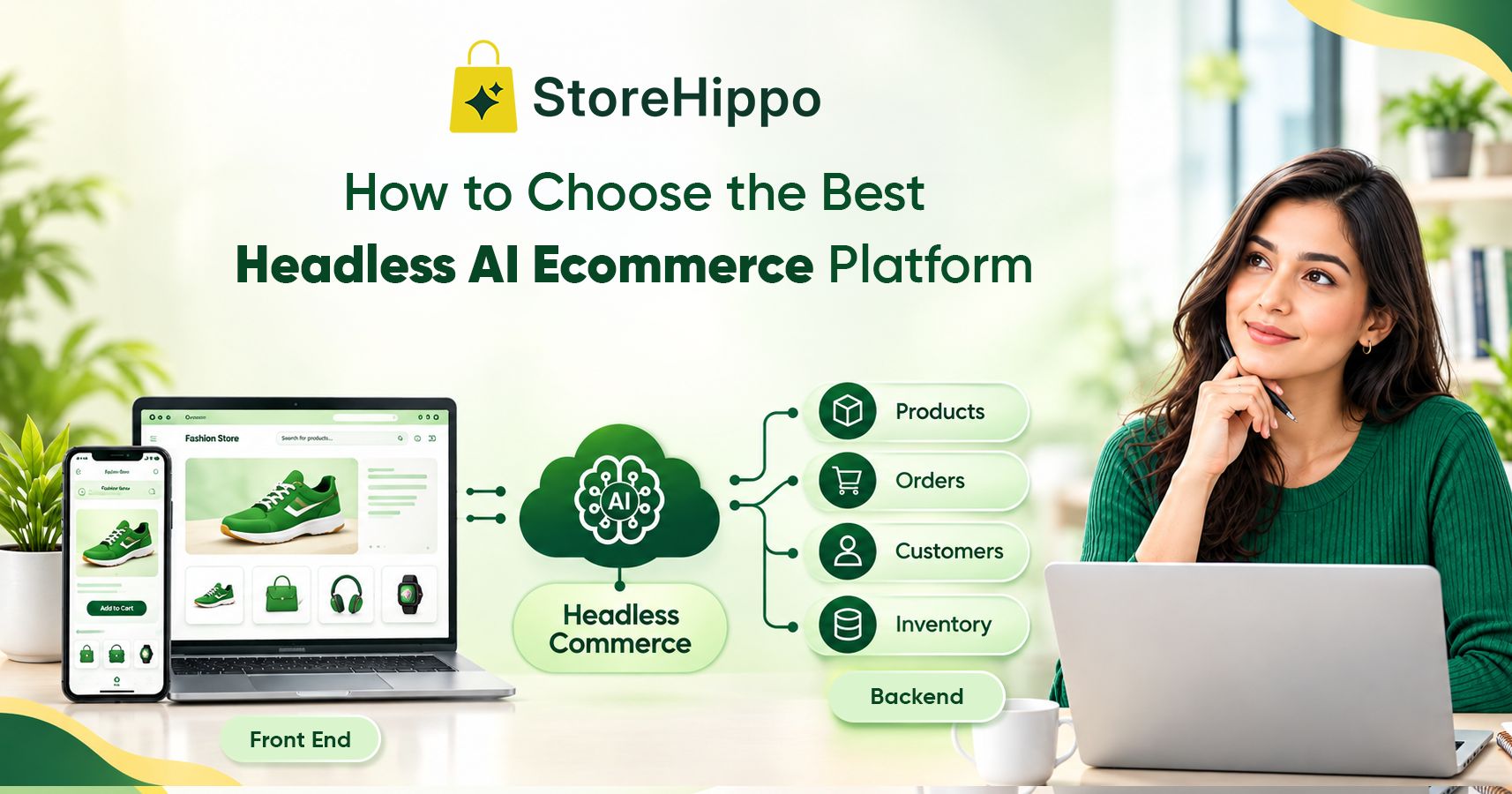



Is your headless AI ecommerce platform really built to scale, or will growth start exposing the gaps?
As your business expands into new markets, adds channels, brings in more sellers, and handles larger catalogues and order volumes, the platform has to keep up without making everyday operations harder.
That is where headless architecture and AI can make a real difference. Headless gives enterprises the flexibility to build and connect new commerce experiences, while AI can take some of the manual work out of operations, improve product discovery, and make customer journeys more relevant.
So, what should you look for in a headless AI ecommerce platform? Not just a long list of AI features and APIs. The right enterprise ecommerce platform should make it easier to support new business models, integrations, channels, and marketplace needs as the business grows.
These 10 questions can help you evaluate whether a platform is actually ready for that growth.
Before we get into the FAQs, let’s first understand how headless ecommerce and AI are shaping the future of enterprise commerce.
Table of Contents
- Why Enterprises Need A Headless AI Ecommerce Platform
- 10 FAQs Enterprises Must Ask Before Choosing a Headless AI Ecommerce Platform
- 1. What makes a headless AI ecommerce platform different from traditional platforms?
- 2. How does AI improve both customer experience and operational efficiency in enterprise ecommerce?
- 3. What should enterprises evaluate when choosing a headless AI ecommerce platform?
- 4. Why is headless architecture critical for scaling when brands are building an enterprise marketplace?
- 5. How does headless API-first architecture help enterprises expand without rebuilding their commerce stack?
- 6. Can headless AI ecommerce platforms support multiple business models simultaneously?
- 7. What security and compliance capabilities should enterprises expect from a headless AI ecommerce platform?
- 8. How quickly can enterprises launch and scale with a headless AI ecommerce platform?
- 9. When should enterprises consider moving from a traditional ecommerce platform to a headless AI ecommerce platform?
- 10. How does a headless AI ecommerce platform create connected omnichannel experiences?
- Conclusion
Why Enterprises Need A Headless AI Ecommerce Platform
As enterprises look to scale faster and deliver more personalised experiences, headless AI ecommerce platforms are becoming a strategic choice rather than just a technology upgrade. The combination of headless architecture and AI helps businesses build flexible commerce ecosystems, automate operations, and adapt quickly to changing customer and market needs.
The following trends show how headless commerce and AI are influencing enterprise growth, from faster development and better personalisation to more intelligent, scalable ecommerce experiences.
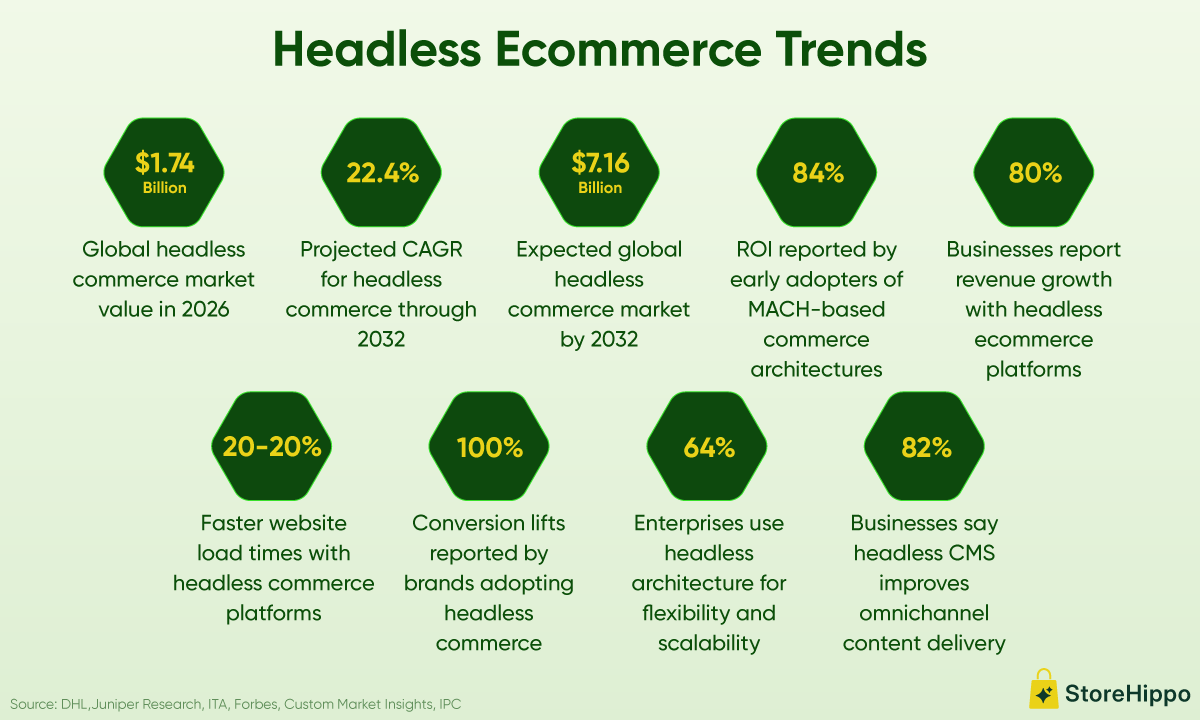
- $1.74 bn is the global headless commerce market value in 2026
- 22.4% is the projected CAGR for the headless commerce market for 2026-2032
- $7.16 bn is the expected value of the global headless commerce market by 2032
- 84% ROI is reported by early retail adopters of MACH-based composable architectures
- 80% of businesses report revenue gains with headless ecommerce platforms
- 20-50% faster load times for websites built on headless ecommerce platforms
- 100% conversion lifts reported for brands adopting headless ecommerce platforms
- 64% of enterprises have adopted headless architecture for greater flexibility and growth
- 82% of businesses say headless CMS simplifies omnichannel content delivery
Source: Global Insight Services
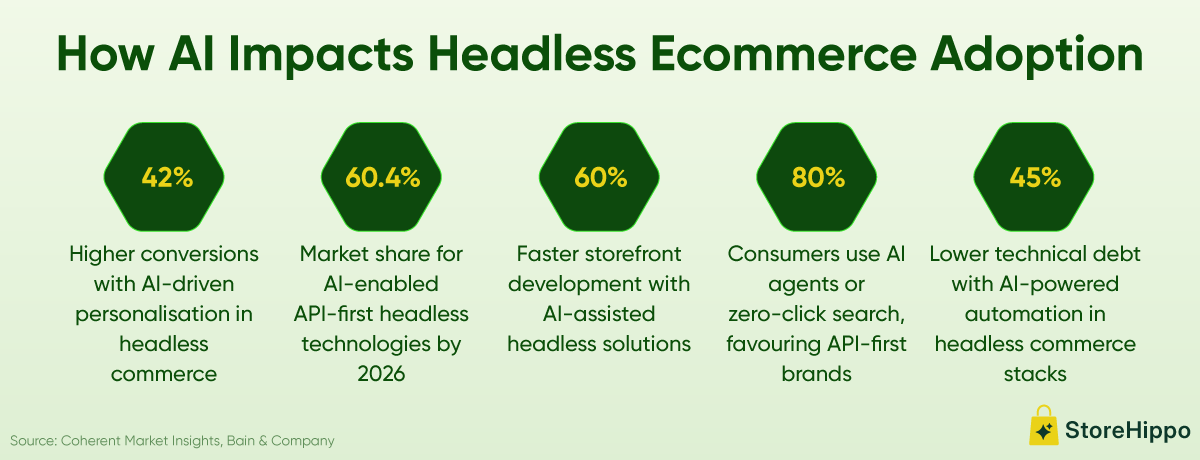
- 42% higher conversion increase for brands that integrate AI-driven personalisation into a headless architecture
- 60.4% market dominance of AI-enabled API-first backend technologies in headless commerce by 2026
- 60% faster storefront development using AI-assisted solutions to build headless frontends
- 80% of consumers now use AI agents or zero-click search, favouring brands with headless API accessibility
- 45% reduction in technical debt through AI-powered testing and automation in headless composable stacks
Source : Coherent Market Insights, Bain & Company,
The picture is clear: headless AI ecommerce platforms are moving beyond just flexible storefronts. They are helping enterprises build smarter, more scalable commerce experiences while keeping operations agile as the business grows.
That’s why enterprises need to look beyond features and evaluate whether a platform can truly support faster innovation, personalised customer experiences, and sustainable growth.
10 FAQs Enterprises Must Ask Before Choosing a Headless AI Ecommerce Platform
Choosing the right headless AI ecommerce platform requires more than comparing features. Enterprises should consider how well the platform can scale with their business, support evolving needs, and help them build an enterprise marketplace.
Here are 10 FAQs to help enterprises choose the right headless AI ecommerce platform.
1. What makes a headless AI ecommerce platform different from traditional platforms?
A headless AI ecommerce platform separates the frontend from the backend while adding AI across key ecommerce operations. This gives enterprises greater flexibility to create customised shopping experiences across web, mobile, marketplaces, and other channels without changing the systems that manage core commerce operations. Unlike traditional enterprise ecommerce platforms that may rely on fixed templates and plugins, headless AI platforms give businesses more freedom to innovate and adapt as their needs change.
For example, a BPC multi vendor marketplace may want to redesign its mobile storefront for a new customer segment while keeping its existing product, inventory, and order management systems unchanged. A headless architecture allows the frontend team to introduce the new experience independently, without disrupting the backend operations that keep the marketplace running.
Enterprises should evaluate whether the enterprise ecommerce platform:
- Lets frontend teams make changes without affecting backend operations
- Supports customised experiences across web, mobile, marketplaces, and other channels
- Allows businesses to introduce new customer-facing experiences without rebuilding core commerce systems
- Uses AI across search, recommendations, cataloguing, and other ecommerce operations
- Supports experimentation and continuous frontend innovation
- Keeps core commerce operations stable as customer experiences evolve
2. How does AI improve both customer experience and operational efficiency in enterprise ecommerce?
AI can improve enterprise ecommerce on both sides of the business: helping customers find and buy products more easily while helping teams manage large-scale commerce operations with less manual work.
On the customer side, AI-powered semantic search can understand buyer intent, personalised recommendations can surface more relevant products, and AI-powered shopping assistants can guide customers through discovery, comparison, and purchase decisions. Agentic AI can go further by assisting with actions across the buying journey rather than simply answering questions.
Behind the scenes, AI can automate catalogue creation, product tagging, merchandising tasks, support workflows, and other repetitive operations. This becomes particularly valuable for a multi vendor marketplace or enterprise with thousands of SKUs, sellers, and frequent catalogue updates.
For example, a large fashion marketplace could use semantic search to understand a shopper looking for “something light for a beach wedding” while simultaneously using AI to classify new seller products, generate catalogue information, and reduce manual merchandising work.
Enterprises should evaluate whether the headless AI ecommerce platform:
- Uses semantic search to understand shopper intent, not just keywords
- Personalises product discovery and recommendations using relevant commerce data
- Enables building AI shopping assistants that guide discovery and purchase decisions
- Supports agentic AI for contextual customer interactions and commerce actions
- Automates catalogue creation, tagging, enrichment, and other repetitive workflows
- Reduces support workload through faster, context-aware customer assistance
- Helps teams manage growing catalogues, customers, and sellers efficiently
- Connects customer-facing AI with underlying commerce data and operations
3. What should enterprises evaluate when choosing a headless AI ecommerce platform?
Enterprises should evaluate how well the platform can support their current commerce requirements and how easily it can adapt as those requirements change. That means looking beyond individual features to the underlying architecture, AI capabilities, integrations, customisation, scalability, security, and long-term cost of running the platform.
The real test is whether the platform can support new business models, markets, customer journeys, and integrations without forcing teams to keep adding plugins, middleware, or heavy custom development.
For example, an enterprise planning to build an enterprise marketplace may already have an ERP, CRM, payment stack, logistics partners, and internal business systems in place. A strong enterprise ecommerce platform should connect with these systems while still giving the business enough flexibility to add sellers, introduce new workflows, expand into new markets, and use AI across customer and operational journeys.
Enterprises should evaluate whether the enterprise ecommerce platform:
- Provides core enterprise capabilities without excessive plugin dependency
- Uses AI across customer journeys and backend commerce operations
- Connects smoothly with ERP, CRM, payments, logistics, and other systems
- Scales across growing traffic, orders, catalogues, sellers, and markets
- Supports multiple business models from a connected commerce backend
- Allows custom workflows without requiring heavy development for every change
- Gives teams flexibility to launch new channels and experiences faster
- Keeps implementation, integration, and ongoing platform costs predictable
4. Why is headless architecture critical for scaling when brands are building an enterprise marketplace?
Headless architecture helps enterprises scale their marketplace by separating the storefront from the backend, enabling teams to update customer-facing experiences without disrupting core operations. It also makes it easier for enterprise marketplaces to connect new channels, integrate business systems, and introduce new features as requirements change. It also gives enterprises the flexibility to build an enterprise marketplace that can grow across regions, sellers, and customer segments.
For example, an enterprise may run separate marketplace storefronts for local and international customers, with both storefronts requiring a different design and customer experience. A marketplace built on a decoupled enterprise ecommerce platform can enable enterprises to build multiple new storefronts connected to common backend and business logic.
Enterprises should evaluate if their headless enterprise ecommerce platform:
- Allows frontend and backend systems to scale independently
- Supports multiple storefronts from a central unified backend
- Handles increasing traffic, users, and transactions without performance issues
- Keeps product, inventory, order, and customer data centrally managed
- Supports regional or segment-specific storefront experiences
- Makes it easier to expand into new markets and digital touchpoints
- Maintains reliable performance as the business grows
5. How does headless API-first architecture help enterprises expand without rebuilding their commerce stack?
A headless AI ecommerce platform with API-first architecture separates the customer-facing experience from the core commerce backend. This gives enterprises the flexibility to add new channels, connect existing business systems, and build custom experiences without recreating product, customer, order, pricing, or inventory systems for every new touchpoint.
For example, an enterprise running a web store may later add mobile apps, a multi vendor marketplace, dealer storefronts, or conversational commerce. With a headless, API-first setup, these channels can connect to the same underlying commerce services and data through APIs instead of operating on separate backends.
This also makes it easier to integrate ERP, CRM, payments, logistics, tax systems, and other enterprise applications while keeping the commerce stack more connected as the business expands.
Enterprises should evaluate whether the enterprise ecommerce platform they are evaluating:
- Provides APIs across core commerce functions and business workflows
- Supports web, mobile, marketplace, and emerging digital channels
- Connects easily with ERP, CRM, payments, logistics, and other systems
- Lets developers build custom workflows and experiences using APIs
- Reuses the same commerce backend across multiple customer touchpoints
- Makes it easier to add new channels without duplicating backend systems
- Provides clear API documentation, webhooks, and developer tools
6. Can headless AI ecommerce platforms support multiple business models simultaneously?
Yes, a headless AI ecommerce platform can support business models such as B2B, B2C, D2C, B2B2C, multi-vendor marketplace, and quick commerce from a common platform. A headless decoupled architecture offers enterprises the flexibility to configure different pricing, workflows, catalogues, and customer experiences for each model while managing core commerce operations centrally.
For example, an automobile company may sell spare parts directly to consumers through a D2C store while supplying workshops through a B2B channel. Consumers may purchase individual products at retail prices, while workshops may need bulk pricing, different payment terms, and specific ordering rules. A platform supporting multiple business models can manage these distinct requirements without forcing the company to operate separate ecommerce systems.
Enterprises should evaluate whether the enterprise ecommerce platform:
- Supports B2B, B2C, D2C, hyperlocal, and multivendor marketplace models from one platform
- Keeps product catalogues and inventory in sync across different business models
- Lets enterprises set different prices, discounts, and order processes for different customer groups
- Makes it easy to launch new business models without rebuilding the entire platform
- Keeps product, inventory, customer, and order data connected across all business models and channels
7. What security and compliance capabilities should enterprises expect from a headless AI ecommerce platform?
A headless AI ecommerce platform should provide strong security and compliance capabilities, including PCI-DSS compliance and globally recognised standards such as ISO and SOC certifications. It should also offer role-based access control and data encryption to protect sensitive customer and business data. Together, these measures help enterprises secure transactions, meet compliance requirements, and maintain a reliable cloud infrastructure.
For example, an enterprise marketplace may have separate teams managing finance, seller operations, customer support, and catalogue management. These teams do not need access to the same information. Role-based access controls enable the enterprise to restrict sensitive payment and customer information to authorised users while giving each team access to the data required for its role.
Enterprises should evaluate whether the enterprise ecommerce platform:
- Meets relevant PCI-DSS, ISO, and other security standards
- Provides role-based access controls for different teams and users
- Encrypts sensitive customer, business, and transaction data
- Protects payment information through secure transaction processing
- Provides a secure cloud infrastructure for enterprise operations
- Supports regional and industry-specific compliance requirements
- Maintains security controls as users, sellers, transactions, and data volumes increase
8. How quickly can enterprises launch and scale with a headless AI ecommerce platform?
A headless AI ecommerce platform can help enterprises launch faster by separating frontend development from backend commerce operations and providing ready-to-use APIs, integrations, and AI capabilities. Enterprises can introduce new storefronts, channels, and features without rebuilding the core system. As the business grows, the platform can scale to support higher traffic, larger catalogues, new markets, and evolving customer needs.
For example, a D2C brand preparing for a festive season may need to launch a new storefront, upload a large product catalogue, introduce promotional offers, and prepare its fulfilment operations within a short timeframe. A platform with ready-to-use ecommerce capabilities can reduce development work and help the brand go live faster, allowing its team to focus on the campaign rather than building basic commerce functionality.
Enterprises should evaluate whether the headless AI ecommerce platform:
- Helps teams launch faster with ready-to-use features that reduce development work
- Makes it easier to set up storefronts and catalogues without lengthy configurations
- Connects easily with existing business systems without disrupting current operations
- Helps enterprises launch in new regions and channels without unnecessary delays
- Scales with the business without requiring a complete system rebuild
- Keeps the platform stable and responsive as traffic and order volumes grow
- Makes it easier to roll out updates and improvements without disrupting live operations
9. When should enterprises consider moving from a traditional ecommerce platform to a headless AI ecommerce platform?
Enterprises should consider a headless AI ecommerce platform when their existing setup starts slowing down business changes rather than supporting them. Common signs include heavy plugin dependency, too much developer involvement in routine updates, difficulty adding new business models, disconnected systems, and growing operational effort as the business expands.
The issue is not simply whether the existing platform still works. It is whether teams can launch, change, integrate, and scale fast enough without creating more technical and operational overhead.
For example, an enterprise retailer may need to update prices, manage large product catalogues, set up approval processes, or create new shopping experiences as the business grows. If every change depends on custom development or multiple plugins, even small updates can take time. A headless, AI-powered enterprise ecommerce platform gives teams more flexibility and helps automate routine tasks, so they can focus on growing the business.
Enterprises should evaluate whether the headless AI ecommerce platform:
- Reduces developer dependency for routine commerce changes
- Minimises reliance on multiple plugins and disconnected tools
- Supports B2B, multi vendor marketplace, hyperlocal, and other models
- Makes pricing, catalogue, workflow, and storefront changes easier to manage
- Supports new channels without rebuilding core commerce systems
- Uses AI to automate repetitive operational and catalogue tasks
- Allows integrations and workflows to evolve without disrupting existing operations
- Remains manageable as markets, channels, products, and business requirements grow
10. How does a headless AI ecommerce platform create connected omnichannel experiences?
A headless AI ecommerce platform can connect web, mobile apps, marketplaces, WhatsApp Commerce, and offline touchpoints to the same commerce backend logic. This keeps product, pricing, inventory, customer, and order data consistent while allowing each channel to deliver an experience suited to its audience.
Headless architecture makes it easier to build and manage different frontends without creating separate commerce systems for each one. AI can add another layer by using shared customer and commerce data to improve search, recommendations, assistance, and personalisation across these touchpoints.
For example, a customer might discover a product on a brand’s website, check it out on the mobile app, ask a few questions on WhatsApp, and place the order through another channel. When everything stays connected, customers get consistent prices, accurate stock updates, and a smoother shopping experience wherever they choose to buy.
Enterprises should evaluate whether the headless AI ecommerce platform:
- Connects web, mobile apps, marketplaces, WhatsApp, and offline channels
- Keeps product, pricing, inventory, customer, and order data synchronised
- Supports channel-specific experiences from a shared commerce backend
- Maintains customer and purchase context across different touchpoints
- Uses shared commerce data to power AI search and recommendations
- Provides consistent inventory and order visibility across channels
- Gives teams central control over omnichannel commerce operations
- Makes it easier to introduce new customer touchpoints without creating separate backends
Conclusion
Choosing the right headless AI ecommerce platform can make a real difference in how easily an enterprise scales, adapts, and keeps up with changing customer expectations. From supporting multiple business models and simplifying integrations to using AI to improve everyday operations, the right platform can bring greater flexibility and efficiency to enterprise commerce.
But the decision shouldn’t be based only on what an enterprise ecommerce platform can offer at launch. Enterprises need a platform that can grow alongside the business, support new markets and channels, and adapt as customer expectations change. The right platform makes it easier to build a connected, agile commerce ecosystem without adding unnecessary operational overhead..
Ready to build an enterprise marketplace with a smarter, more scalable, headless AI-powered ecommerce platform?
Book a demo with StoreHippo now.
Rajiv Kumar Aggarwal is an ecommerce veteran, seasoned technology leader and Founder of Hippo Innovations, with over 25 years of experience building enterprise-grade digital commerce AI-powered solutions for brands. He shares practical insights on how enterprises can use AI and headless commerce to build flexible, scalable ecommerce solutions.