


An AI-Powered B2B2C Marketplace is fast becoming a strong growth model for enterprises looking to connect brands, distributors, dealers, sellers, and end buyers through one digital ecosystem.
But making the B2B2C model work at scale involves much more than onboarding partners and giving customers another way to buy.
Enterprises need to manage B2B and B2C journeys together, handle large and distributed catalogues, support location-based inventory and fulfilment, apply different pricing and buyer rules, manage multiple sellers and still deliver a consistent experience across channels.
This is where AI in ecommerce can take a lot of operational weight off the business. The right AI-powered marketplace platform can automate catalogue and seller workflows, improve product discovery, personalise buying journeys and help teams manage marketplace operations more efficiently. With agentic commerce, AI agents can go further by assisting buyers, sellers and internal teams using live commerce data and workflows.
Table of Contents
- Why AI Is Becoming Essential to B2B2C Marketplace Growth
- Building an AI-Powered B2B2C Marketplace for Scalable Growth
- 1. Define Your B2B2C Marketplace Model
- 2. Choose an AI-Powered Marketplace Platform
- 3. Build a Centralised Product Catalogue
- 4. Add AI-Powered Product Discovery
- 5. Introduce AI Shopping Assistants
- 6. Automate Marketplace Operations
- 7. Create Omnichannel Presence
- 8. Connect Payments, Logistics and Integrations
- 9. Create Personalised Experiences
- 10. Test, Measure and Scale
- 10 Must-Have Features in an AI-Powered B2B2C Marketplace
- 1. Unified AI Core
- 2. Faster Creation Of Marketplace Storefront Experiences
- 3. AI-Connected Omnichannel Buying Journeys
- 4. Automated Catalogue Onboarding
- 5. Intelligent Search and Product Discovery
- 6. AI-Powered Personalised Buying Experiences
- 7. AI Guided Buying
- 8. Faster Vendor and Marketplace Operations with AI
- 9. marter Fulfilment Across Sellers, Dealers and Locations
- 10. Agentic Support Across the Buying Journey
- Conclusion
- FAQs
Why AI Is Becoming Essential to B2B2C Marketplace Growth
The opportunity is already visible in the numbers. B2B2C adoption is growing, while AI is changing how marketplaces manage operations, discovery and customer journeys.
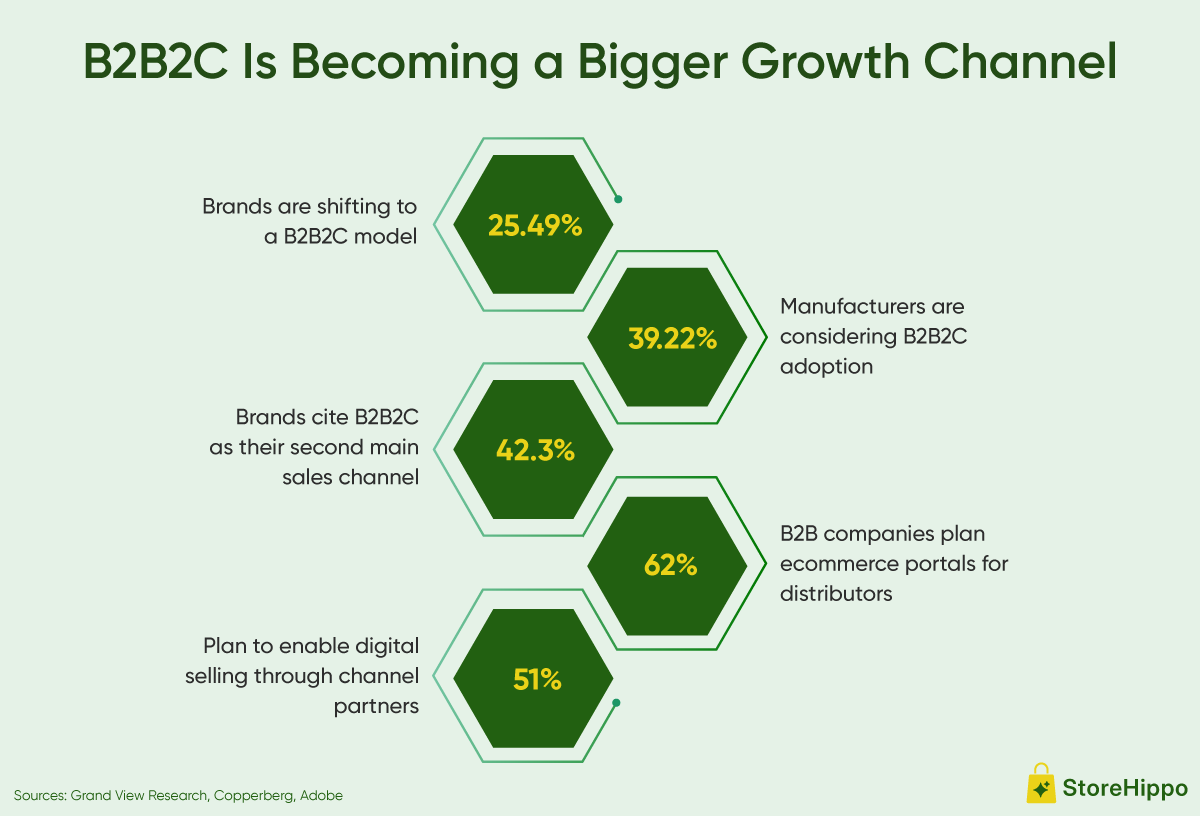
- 25.49% of brands are shifting to a B2B2C model
- 39.22% of manufacturers are considering B2B2C adoption
- 42.3% of brands cite B2B2C as their second main sales channel
- 62% of B2B companies plan ecommerce portals for distributors
- 51% plan to enable digital selling through channel partners
Sources: Grand View Research, Copperberg, Adobe
What it shows: Enterprises are increasingly using distributors, dealers and other channel partners not just for distribution, but as part of their digital selling strategy.
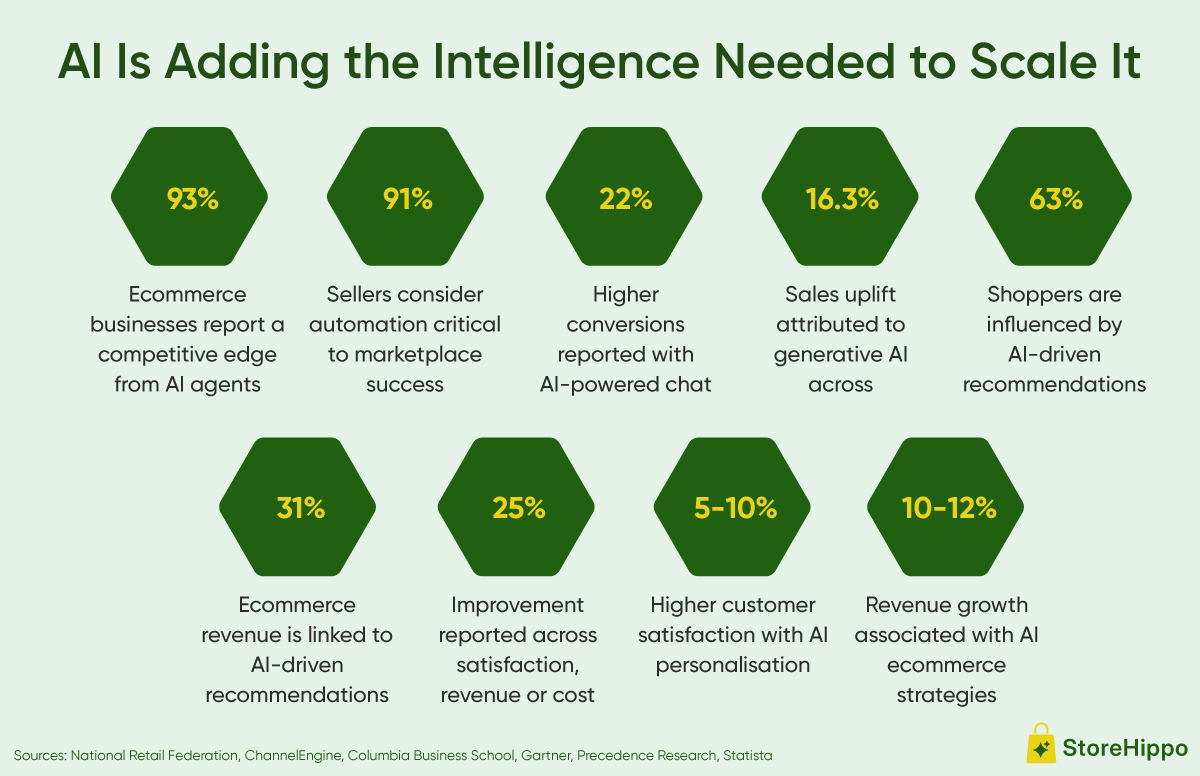
- 93% of ecommerce businesses report a competitive edge from AI agents
- 91% of sellers consider automation critical to marketplace success
- 22% higher conversions reported with AI-powered chat
- 16.3% sales uplift attributed to generative AI across marketplace activities
- 63% of shoppers are influenced by AI-driven recommendations
- 31% of ecommerce revenue is linked to AI-driven recommendations
- 25% improvement reported across satisfaction, revenue or cost reduction
- 5–10% higher customer satisfaction with AI personalisation
- 10–12% revenue growth associated with AI ecommerce strategies
Sources: National Retail Federation, ChannelEngine, Columbia Business School, Gartner, Precedence Research, Statista
What it shows: As B2B2C ecosystems grow, AI can help enterprises handle more sellers, products, buyers and workflows without increasing manual effort at the same pace.
That is what makes an AI-powered B2B2C marketplace different from a conventional marketplace setup. The question is no longer just how many partners or buyers the platform can support, but how intelligently it can manage that growth.
So, what capabilities should enterprises build for from the start? Let’s look at the 10 that matter most.
Building an AI-Powered B2B2C Marketplace for Scalable Growth
Building an AI-powered B2B2C marketplace is not simply about adding AI features to an existing online marketplace. You need a commerce architecture that connects businesses, distributors, retailers and end customers while using AI to improve discovery, selling, operations and customer experiences.
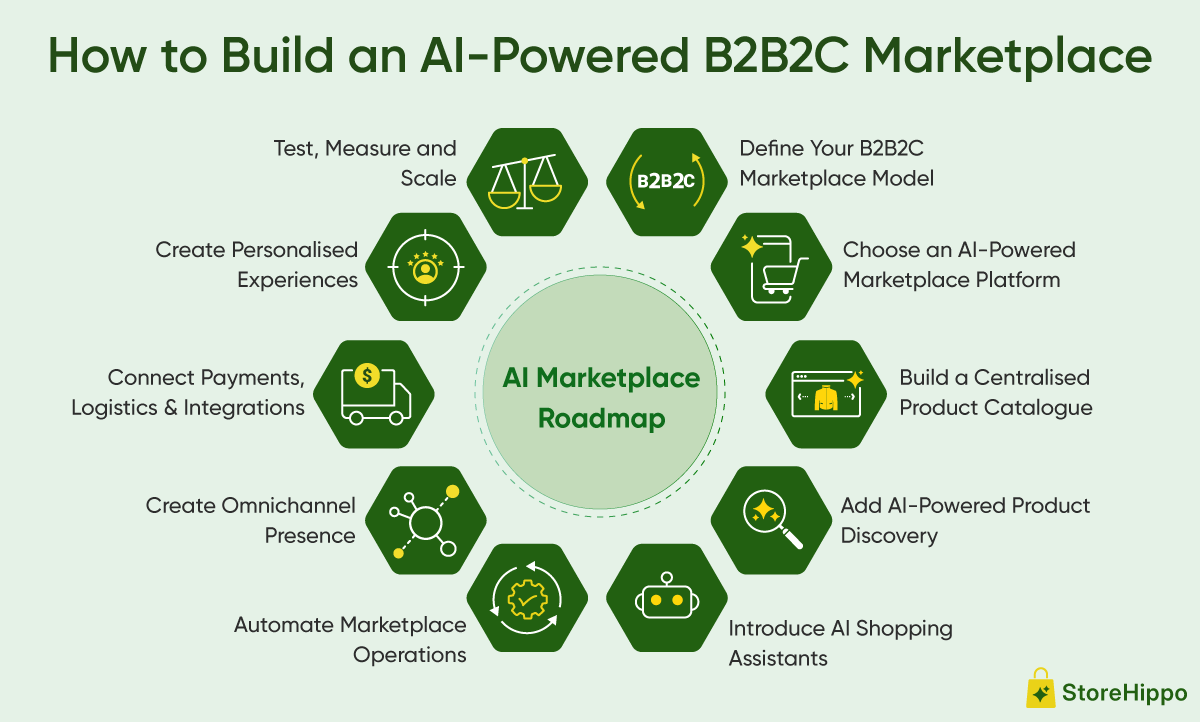
Here are the key steps to build a scalable AI-powered B2B2C marketplace :
1. Define Your B2B2C Marketplace Model
Start by deciding how businesses will interact with each other and with end customers. Define your seller types, distribution model, pricing structure, commissions, fulfilment process and customer journey.
A clear model helps you determine which marketplace capabilities and AI use cases you actually need.
2. Choose an AI-Powered Marketplace Platform
Select an AI-powered marketplace platform that supports multiple sellers, catalogues, inventory, orders, payments, commissions and role-based access from a single system.
Look beyond basic marketplace functionality. The platform should provide APIs, automation, integrations and AI capabilities that can scale as your ecosystem grows.
3. Build a Centralised Product Catalogue
A B2B2C online marketplace can involve thousands of products from multiple suppliers. Create a central catalogue that standardises product information, attributes, categories, images and pricing.
This is where AI in ecommerce can reduce manual work by helping businesses create, enrich, organise and optimise product listings at scale.
4. Add AI-Powered Product Discovery
Customers should be able to find relevant products without relying only on exact keyword searches. Use AI to understand intent, context and buying behaviour.
Semantic search, personalised recommendations and conversational product discovery can make the buying journey faster and more relevant.
5. Introduce AI Shopping Assistants
Add an AI assistant that can answer product questions, compare options, recommend products and guide buyers towards purchase.
For B2B buyers, the assistant can also help with product specifications, bulk requirements and repeat purchases. This moves the marketplace towards agentic commerce, where AI can actively support buying decisions instead of simply responding to queries.
6. Automate Marketplace Operations
Use AI and automation for repetitive activities such as catalogue enhancement, customer queries, order updates, inventory alerts and seller support.
The goal is not to automate everything. It is to remove repetitive manual work so marketplace teams can focus on growth, seller relationships and customer experience.
7. Create Omnichannel Presence
Make your AI-powered B2B2C marketplace available across the channels your buyers prefer, such as websites, mobile apps, WhatsApp, voice commerce and AI shopping channels. Different buyers may prefer different channels, so your online marketplace should provide a connected experience across all of them.
Ensure that these channels are connected to the same product catalogue, inventory, customer and order data. This allows buyers to switch between channels easily while helping businesses manage their marketplace operations from a central system.
8. Connect Payments, Logistics and Integrations
Integrate payment gateways, logistics providers, ERP, CRM, inventory systems and other business tools. A B2B2C marketplace needs these connections to keep information flowing between different participants.
APIs and headless architecture can make it easier to add new channels and integrations as the marketplace expands.
9. Create Personalised Experiences
Use AI tools to personalise product recommendations, pricing experiences, content and offers based on customer behaviour and context.
For sellers, AI in ecommerce can also surface useful insights around demand, products and customer activity, helping them make faster decisions.
10. Test, Measure and Scale
Launch with a focused set of categories, sellers and AI use cases. Track conversion rates, search success, average order value, repeat purchases, seller performance and automation outcomes. Use these insights to improve the marketplace continuously rather than launching a large set of AI tools without measuring their impact.
These steps help you use AI to improve buyer experiences, support sellers and simplify marketplace operations. Start with the use cases that matter most, measure their impact and scale what works as your marketplace grows.
10 Must-Have Features in an AI-Powered B2B2C Marketplace
So, what should an AI-powered B2B2C marketplace actually be able to do?
Here are 10 capabilities enterprises should build for:
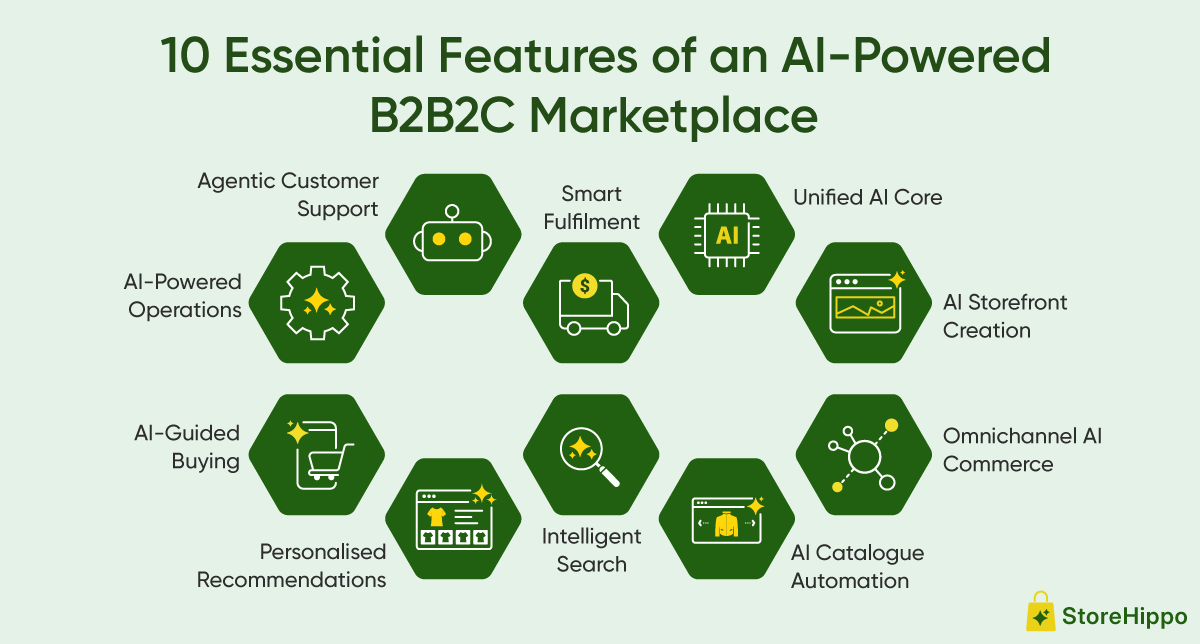
1. Unified AI Core
An AI-powered B2B2C marketplace can have several layers working together. Manufacturers and distributors manage products and inventory, buyers place orders, consumers browse and purchase, and support and fulfilment teams keep everything moving. When each AI capability uses a different set of information, it becomes harder to deliver a consistent experience across these journeys.
For example, when a consumer asks about an order, the assistant may need more than basic product information. It needs to understand the order status, payment, and fulfilment details to provide a useful answer. Similarly, a distributor may need access to different information about inventory, pricing or orders.
This is where a unified AI core becomes important for a B2B2C marketplace. Instead of running separate AI tools for search, recommendations, support and operations, enterprises can connect them to the same relevant commerce information and workflows.
How StoreHippo Powers a Unified AI Core:
StoreHippo connects channels, AI agents, commerce data, integrations and workflows through a unified AI core. Enterprises can use AI across different channels, build custom AI chatbots around their business data and connect these experiences with marketplace operations.
For a B2B2C business, this keeps manufacturers, distributors and end consumers connected while giving each of them the information and experience they need.
2. Faster Creation Of Marketplace Storefront Experiences
A B2B2C marketplace needs a storefront that looks professional, reflects the brand and makes it easy for different buyers to explore products. As the marketplace grows, it may need new category pages, landing pages or storefront experiences for different buyer segments, markets and business requirements. Creating every page and design element manually can slow down the marketplace team.
An AI-powered B2B2C marketplace can use AI to speed up the creation of these storefront experiences. Based on the marketplace’s brand guidelines, product catalogue and business requirements, AI can help generate relevant storefront structures, themes and content. Marketplace teams can then customise these elements to create experiences that suit different products, buyer groups and campaigns.
For example, consider a home appliances B2B2C marketplace connecting manufacturers and distributors with retailers and end customers. The marketplace may need different layouts for large appliances, kitchen appliances and consumer electronics, along with dedicated pages for new launches or seasonal offers. AI can help create these storefront experiences faster, while the enterprise can refine the themes, layouts and content to match its brand.
How StoreHippo Simplifies Storefront Creation:
StoreHippo’s AI-powered storefront builder uses brand guidelines, product catalogue and business context to create the storefront structure, theme and content. Enterprises can start with an AI-generated storefront and customise layouts, visual elements, content and customer journeys to match their brand identity.
For an AI-powered B2B2C marketplace, this makes it easier to launch branded storefronts, category experiences and campaign pages faster without building every experience from scratch.
3. AI-Connected Omnichannel Buying Journeys
A B2B2C marketplace does not have just one type of buyer or one way of selling. Distributors may use dedicated portals, retailers may prefer mobile apps, while end customers may discover products through websites, WhatsApp, voice or AI shopping assistants. When these channels operate independently, keeping product, inventory, order and customer information consistent becomes difficult.
This is why the B2B2C marketplace should bring different commerce channels together through a unified system. Instead of managing every channel separately, enterprises can connect their selling and engagement touchpoints to the same commerce data, AI capabilities and workflows.
For example, consider an AI-powered B2B2C marketplace connecting electronics manufacturers with distributors, retailers and consumers. A distributor could place a bulk order through a business portal, a retailer could manage purchases through a mobile app, and a consumer could discover a product through an AI shopping assistant on the website or WhatsApp. Each buyer may have a different journey, but the underlying commerce information needs to stay connected.
This connected approach also becomes important as enterprises move towards agentic commerce. AI assistants need access to relevant catalogue, customer, order and inventory information to provide useful assistance across different channels.
How StoreHippo Enables Unified Omnichannel Commerce:
StoreHippo connects commerce channels, AI agents, data and workflows through a unified platform. Enterprises can create connected experiences across websites, mobile apps, WhatsApp, voice and AI-powered interactions while managing their commerce operations from a central system.
For an AI-powered B2B2C marketplace, this helps manufacturers, distributors, sellers and end customers interact through the channels that suit them while keeping the underlying commerce experience connected.
4. Automated Catalogue Onboarding
As a B2B2C marketplace grows, managing product images and catalogue information across manufacturers, distributors and dealers can become a time-consuming task. Different businesses may provide product information in different formats, while product images may need editing before they are ready to go live.
Modern enterprises use AI tools to automate repetitive catalogue and image-related tasks on their AI-powered B2B2C marketplaces, saving time and effort while helping them create product listings faster and maintain consistency across a large catalogue.
For example, consider an automotive parts B2B2C marketplace that brings manufacturers, distributors and vehicle owners onto one platform. Manufacturers might share product images and basic specifications, while distributors add pricing and availability. Instead of putting together every listing manually, AI can help the marketplace team clean up product images, organise catalogue details and get listings ready to go live faster.
How StoreHippo Simplifies Product Cataloguing:
StoreHippo's AI image enhancement tool, Magic Edit, helps businesses refine and edit product images to create cleaner, more consistent marketplace-ready visuals.
Its AI-powered cataloguing helps businesses upload product images and automatically identifies the product, assigns the right category, generates relevant attributes, titles and descriptions, and fetches the appropriate HSN code. Teams can review the details and edit them if required before publishing.
Enterprise with AI-powered B2B2C marketplaces can easily upload products from different business partners while keeping the catalogue organised and consistent.
5. Intelligent Search and Product Discovery
A B2B2C marketplace can have thousands of products supplied through different manufacturers, distributors and dealers. Buyers may also search for the same product in very different ways depending on whether they are purchasing for their business or personal use.
Intelligent search can make product discovery easier. Instead of relying only on exact keywords, AI-powered search can understand the intent and context behind a buyer's query and help surface more relevant products.
Imagine there is a consumer electronics B2B2C marketplace that connects brands with distributors and retail partners. A distributor may search for “bulk 55-inch smart TVs for retail stores,” while a consumer may search for “55-inch smart TV for watching movies.” Both are looking for a similar product, but their requirements are different. An intelligent search experience can understand the context of these searches and help each buyer find more relevant products.
Therefore, an AI-powered marketplace should have an intelligent search feature to make search more intuitive for different types of buyers instead of expecting everyone to use the same product keywords.
How StoreHippo Simplifies Product Discovery:
StoreHippo’s AI semantic search helps buyers find what they’re looking for even when they don’t use the exact product keywords. It understands the intent behind a search and uses the context of the query to surface more relevant products.
For a B2B2C marketplace this AI feature can help different buyer groups find relevant products more naturally, even when their search terms do not exactly match the product information in the catalogue.
6. AI-Powered Personalised Buying Experiences
Different buyers browsing the same product catalogues does not mean they are looking for the same products. Different buyers can have completely different needs. A distributor may regularly purchase products in bulk, while an end consumer may be looking for a product for personal use. In such a scenario, if a B2B2C marketplace shows the same recommendations to both, it may not deliver much value. B2B2C marketplaces should have AI-powered product recommendation tools to analyse buyer behaviour, preferences and purchase history to suggest relevant products and surface recommendations based on each buyer’s specific needs, buying intent and context.
For example, consider a B2B2C marketplace selling mobile phones. A retailer who frequently buys smartphones may see recommendations for phone cases, chargers and screen protectors that they can purchase along with their regular stock. An individual customer who buys a phone for personal use may instead see recommendations based on the phone they are viewing, such as a compatible case, earbuds or a power bank.
How StoreHippo Personalises Product Recommendations:
StoreHippo offers AI-powered personalised recommendations that can analyse buyer behaviour, preferences and past purchases to suggest more relevant products. These recommendations can also support cross-selling and upselling by helping buyers discover related products and useful add-ons.
For an AI-powered B2B2C marketplace, this can make product discovery more relevant while creating additional opportunities to increase order value across different buyer journeys.
7. AI Guided Buying
Sometimes buyers know exactly what they need. At other times, they know their budget, quantity or purpose but are not sure which products to choose. A retailer may be looking for 50 shirts in specific sizes and colours, while an individual shopper may simply want a few casual shirts for an upcoming trip.
This is where agentic commerce can make the buying journey easier. Instead of making buyers search through pages of products on their own, a shopping assistant can understand what they need, narrow down the options, compare suitable products and help them decide what to do next.
For example, imagine a fashion marketplace serving both retailers and individual shoppers. A retailer could say, “I need 50 cotton shirts in different sizes for my store.” The assistant can help find suitable options based on the quantity and requirements. An individual shopper could ask, “I need two comfortable shirts for a summer vacation.” The assistant can recommend options based on a completely different need.
The value is simple: different buyers can get help based on what they actually want to accomplish, rather than being pushed through the same shopping journey.
How StoreHippo Enables Agentic Shopping:
StoreHippo AI-powered marketplace platform offers assisted conversational buying journeys through custom AI shopping assistant. It enables enterprises to build custom AI shopping assistants for buyers. These assistants can use relevant commerce context to provide personalised guidance and help buyers move from discovering products to making a purchase. Enterprises can make these assistants multilingual and voice-enabled, making it easier for buyers to search for products, ask questions and get guided assistance in a way that feels natural to them.
For an AI-powered B2B2C marketplace, this can make shopping feel less like searching through a catalogue and more like having someone guide buyers towards the products that fit their needs.
8. Faster Vendor and Marketplace Operations with AI
AI can do more than improve the customer-facing shopping experience. The teams managing the marketplace also have to deal with repetitive questions, data searches and everyday operational tasks that can take up valuable time.
An AI assistant can help distributors and sellers understand catalogue requirements, find information and get quick answers about marketplace processes. It can also help internal teams find details about products, orders, vendors and customer queries without searching through multiple systems.
For example, imagine a B2B2C marketplace connecting appliance manufacturers with distributors and consumers. A distributor could ask an AI assistant, “What information do I need to add a new refrigerator to the catalogue?” At the same time, an operations team member could ask, “Show me the pending orders from this distributor.” Instead of depending on manual support for every query, AI can help both sides get information faster.
The real value of AI in ecommerce is not adding AI everywhere. It is using it where it can reduce repetitive work and help vendors and internal teams get things done faster.
How StoreHippo Helps Enterprises Build Custom AI Assistants
StoreHippo’s AI-powered marketplace platform enables enterprises to build custom AI assistants for sellers, vendors and internal teams. These assistants can be tailored to specific business rules, data and workflows, helping teams handle everyday tasks and get the information they need faster.
Enterprises can build assistants for use cases such as seller support, catalogue assistance, order-related queries and internal operations. This allows AI to become part of day-to-day marketplace workflows instead of being limited to the buyer experience.
For a growing marketplace, this means vendors and internal teams can get faster support, find relevant information more easily and spend less time on repetitive tasks.
9. marter Fulfilment Across Sellers, Dealers and Locations
When a B2B2C marketplace grows, fulfilment becomes a shared responsibility across manufacturers, distributors, dealers, logistics providers and marketplace teams. A single order may involve multiple decisions around seller assignment, delivery location, carrier selection and shipment tracking. Managing every exception manually can put pressure on operations teams as order volumes increase.
This is where AI for ecommerce can help B2B2C marketplace make logistics operations more responsive. Instead of waiting for customers or teams to identify every delivery issue, the marketplace can use available order and shipment information to identify exceptions, apply predefined rules and trigger the right workflows.
For example, imagine a B2B2C marketplace handling thousands of orders during a festive sale. Some shipments may face delays, while others may need to be assigned to a different logistics provider or dealer based on business rules. Automated workflows can help identify these cases and route them for appropriate action instead of requiring teams to check every shipment manually.
AI-powered logistics can also improve the customer experience by keeping buyers informed about shipment progress. Automated updates can reduce repetitive “Where is my order?” queries and give customers more visibility without requiring support teams to intervene every time.
How StoreHippo Supports Smarter Marketplace Logistics:
StoreHippo supports rule-based carrier and dealer assignment, helping enterprises route shipments to the appropriate logistics provider or dealer based on configured business rules. Its automated workflows can also help identify shipping issues, create tickets and keep teams updated so that delivery exceptions can be addressed faster.
For a growing AI-powered B2B2C marketplace, this can reduce manual effort around shipment routing, issue management and order updates while helping enterprises deliver a smoother fulfilment experience.
10. Agentic Support Across the Buying Journey
As a B2B2C marketplace grows, the number of customer queries grows with it. Customers may ask about products, payments, returns, delivery or order status. Many of these questions are simple and repeated, but support teams still have to spend time answering them.
AI-powered customer support can handle these routine questions, quickly find the right information and guide customers through common requests. This means customers get help faster, while support teams can focus on issues that need human attention.
For example, imagine a B2B2C marketplace selling beauty and personal care products. A customer may ask, “Can I return this shampoo if I haven’t opened it?” or “When will my order arrive?” The AI support assistant can check the relevant return policy or order details and provide an immediate response. If the query needs further investigation, it can be passed to a support team member.
How StoreHippo Enables AI-Powered Support:
StoreHippo AI-powered marketplace platform helps enterprises provide AI-powered customer support that can handle routine queries, find relevant information and assist customers with common requests. The support assistant can use business and commerce data to provide more relevant responses, while complex issues can be handed over to the support team for further assistance.
For a growing AI-powered B2B2C marketplace, this can help reduce the load of repetitive support queries and make it easier for customers to get quick, consistent help.
Conclusion
Building an AI-powered B2B2C marketplace is no longer just about bringing multiple sellers and buyers onto one platform. The real opportunity lies in creating a connected commerce ecosystem where AI helps every participant discover products, make decisions, manage operations and deliver better experiences.
From a unified AI core and intelligent discovery to agentic commerce, personalised recommendations, AI-powered logistics and support, the right capabilities can help enterprises scale their marketplace while keeping everyday operations efficient. The key is to choose an AI-powered marketplace platform that can bring these capabilities together rather than adding disconnected AI tools as the business grows.
Ready to build the next generation of B2B2C commerce?
Book your personalised demo with StoreHippo now.
FAQs
1. How can enterprises know if an AI-Powered B2B2C Marketplace will deliver a good return on their investment?
Enterprises can measure ROI by comparing AI investment with outcomes such as higher conversions, lower operating costs, faster seller onboarding, increased average order value and better customer retention. The best approach is to start with specific use cases, set measurable targets and track performance against existing benchmarks. This gives decision-makers a clear view of where AI is creating business value.
2. What should businesses have in place before adopting an AI-powered marketplace platform?
Businesses should have structured commerce data, clearly defined processes and connected systems before adopting an AI-powered marketplace platform. Product, seller, customer, inventory and order information should be accurate and accessible. Enterprises should also define their AI goals, user permissions and governance rules. Good data and clear processes give AI the context it needs to deliver useful results.
3. How can enterprises keep control over AI decisions across sellers in an AI-Powered B2B2C Marketplace?
Enterprises can keep control by setting clear business rules, user permissions and approval requirements for AI-driven actions. AI can handle routine decisions, while sensitive activities such as pricing changes, refunds or seller management can require human approval. Regular monitoring and performance reviews can also help enterprises identify inaccurate recommendations and ensure AI continues to operate within defined business guidelines.
4. What security and compliance checks should enterprises make before using AI in ecommerce?
Enterprises should check how AI systems access, process, and protect customer, seller and business data. They should review authentication, permissions, encryption, data storage, audit trails and applicable privacy requirements. Businesses should also ensure that AI only accesses information required for its specific purpose. These checks help enterprises introduce AI in ecommerce without compromising data security or regulatory responsibilities.
5. How can an AI-powered marketplace platform handle different pricing and promotions for B2B and B2C buyers?
An AI-powered marketplace platform can manage different pricing and promotional rules by segmenting buyers according to their role, business relationship, order volume or purchasing behaviour. B2B buyers can receive negotiated prices, volume discounts or partner-specific offers, while B2C customers can see retail pricing and consumer promotions. Centralised rules help enterprises manage these differences without creating separate commerce systems.
6. How can enterprises get their marketplace ready for AI-driven buying?
Enterprises can get their marketplace ready for AI-driven buying by keeping product, pricing, inventory, customer and order data accurate, structured and accessible. They should also support AI assistants, conversational search and connected checkout workflows so AI agents can help buyers discover, compare and purchase products smoothly.
Pallavee Kumar brings over 20 years of hands-on ecommerce experience, having helped enterprise brands scale through strong operations and clear storytelling.
She brings deep industry expertise and a practical understanding of how AI can help businesses simplify commerce, improve efficiency, and drive sustainable growth.