


Is your headless ecommerce platform truly scalable, or just hiding behind plugins?
You launch a new region, onboard a few more vendors, add a custom checkout flow, and suddenly things start breaking. A plugin update conflicts with another. Shipping logic needs a workaround. Your team is juggling patches instead of building forward. What looked “flexible” at the start now feels stitched together.
This is the reality with many so-called headless platforms. While the frontend is decoupled, the backend still leans heavily on plugins for core workflows, adding hidden complexity as you scale.
That’s why enterprises are moving toward plugin-free headless ecommerce platforms built with native capabilities at the core. Everything from catalog to checkout to fulfilment works as a unified system, with AI-driven automation reducing manual effort as scale increases.
Before we get into the FAQs, let’s first understand why headless and composable enterprise ecommerce platforms are seeing rapid enterprise adoption across industries.
Table of Contents
- Why No-Plugin Headless Ecommerce Is Critical for Modern Enterprise Marketplaces
- 10 FAQs Enterprises Must Ask Before Choosing a Headless E-Commerce Platform
- 1. How can you identify if a headless ecommerce platform is truly plugin-free or just API-driven with hidden dependencies?
- 2. What core capabilities should be native in a headless ecommerce platform to eliminate plugin dependency?
- 3. How does a unified, plugin-free backend in an enterprise ecommerce platform improve operational efficiency across teams?
- 4. What role does automation play in reducing dependency on plugins in a headless commerce platform?
- 5. How does AI-native architecture reduce dependency on plugins in a headless ecommerce platform?
- 6. Can a headless ecommerce platform deliver full creative control without relying on frontend plugins or themes?
- 7. Why is plugin-free architecture critical for scaling multi-model commerce (B2B, B2C, B2B2C) with AI?
- 8. How does a headless ecommerce platform ensure operational scalability without adding layers of integrations?
- 9. What impact does plugin dependency have on maintaining consistent customer experiences across channels in a headless ecommerce platform?
- 10. How does a plugin-free, AI-powered headless ecommerce platform future-proof enterprise ecommerce operations?
- Why StoreHippo Is the Best Plugin-Free Headless Ecommerce Platform for Enterprises
- Conclusion
Why No-Plugin Headless Ecommerce Is Critical for Modern Enterprise Marketplaces
As commerce expands across channels, regions, and business models, enterprises need modern ecommerce solutions that can support faster execution, seamless integrations, and AI-driven experiences without relying on fragmented plugin layers.
The following trends highlight how headless and AI-native commerce architectures are driving faster innovation, better performance, and more scalable enterprise operations.
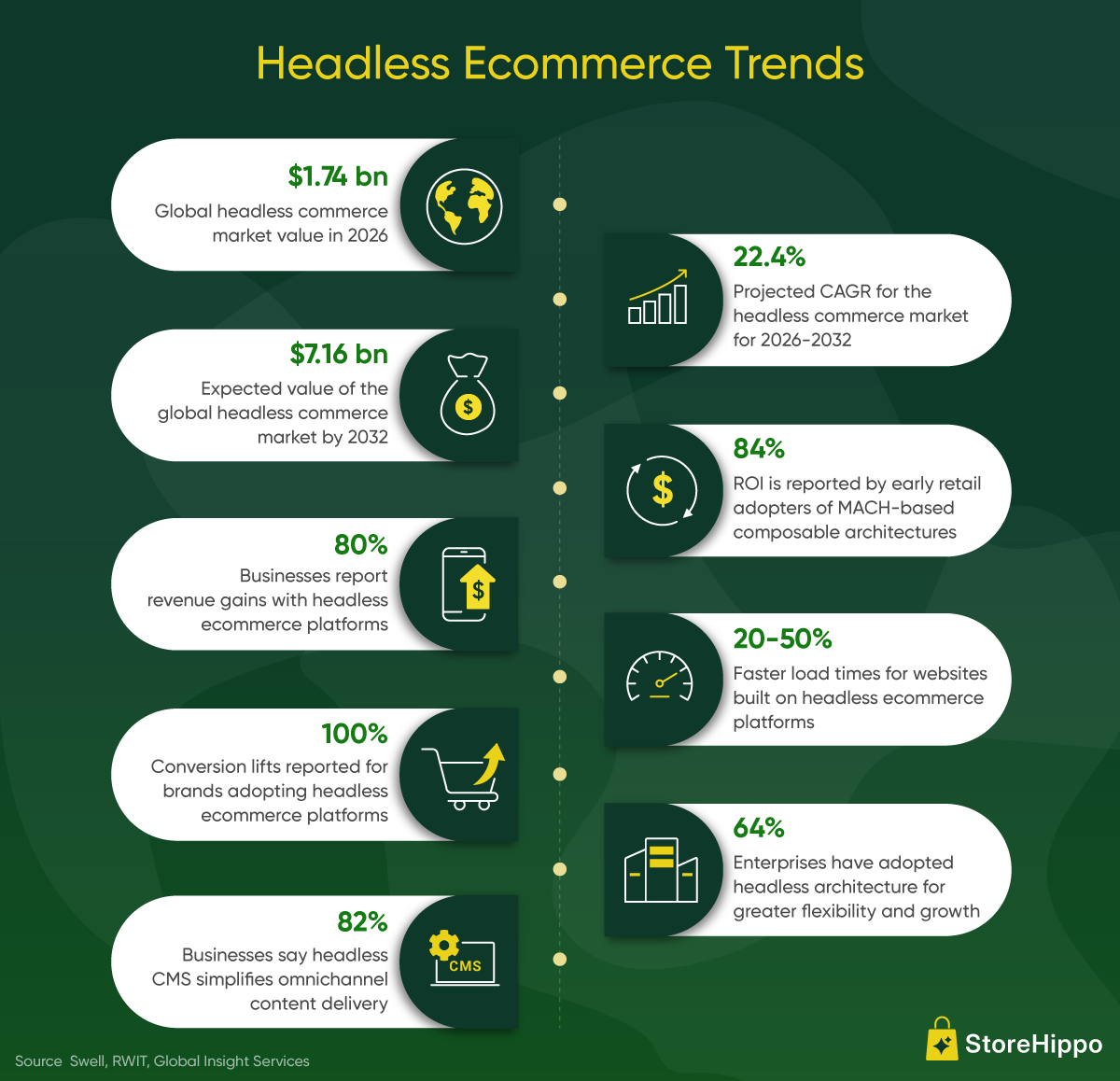
- $1.74 bn is the global headless commerce market value in 2026
- 22.4% is the projected CAGR for the headless commerce market for 2026-2032
- $7.16 bn is the expected value of the global headless commerce market by 2032
- 84% ROI is reported by early retail adopters of MACH-based composable architectures
- 80% of businesses report revenue gains with headless ecommerce platforms
- 20-50% faster load times for websites built on headless ecommerce platforms
- 100% conversion lifts reported for brands adopting headless ecommerce platforms
- 64% of enterprises have adopted headless architecture for greater flexibility and growth
- 82% of businesses say headless CMS simplifies omnichannel content delivery.
Source: Global Insight Services
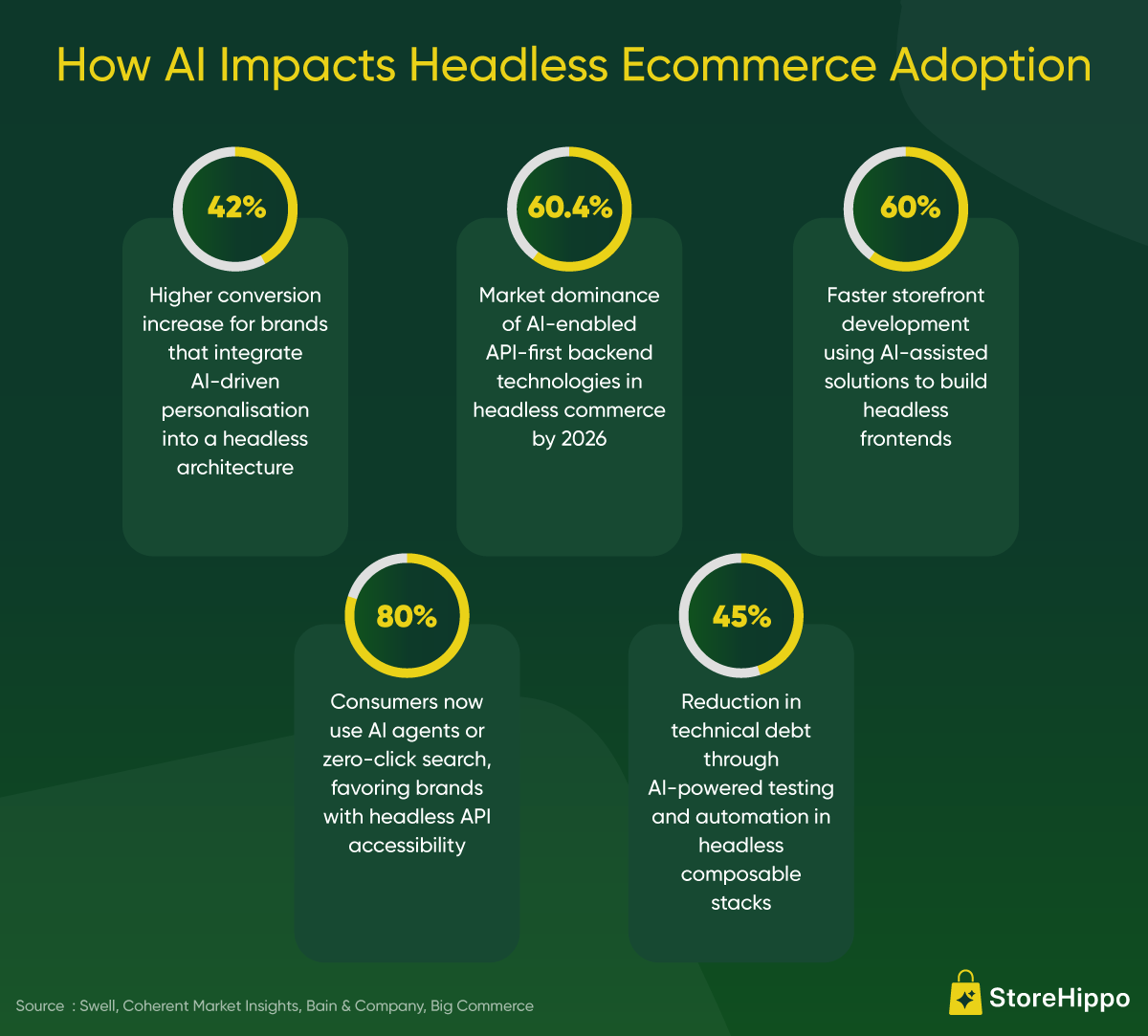
- 42% higher conversions for brands that integrate AI-driven personalisation into a headless architecture
- 60.4% market dominance of AI-enabled API-first backend technologies in headless commerce by 2026
- 60% faster storefront development using AI-assisted solutions to build headless frontends
- 45% reduction in technical debt through AI-powered testing and automation in headless composable stacks
Source: Coherent Market Insights, Bain & Company,
The picture is clear: plugin-free headless ecommerce platforms have evolved beyond frontend flexibility. They have become the foundation for scalable, AI-powered, and operationally efficient enterprise commerce.
In such a scenario, enterprises must evaluate platforms not just for current business needs, but for their ability to support continuous innovation, faster execution, and operational stability
10 FAQs Enterprises Must Ask Before Choosing a Headless E-Commerce Platform
Here are 10 must-ask questions for enterprises to choose the right no plugin headless ecommerce platform for delivering consistent, market-specific customer experiences at scale.
1. How can you identify if a headless ecommerce platform is truly plugin-free or just API-driven with hidden dependencies?
Many enterprise ecommerce platforms claim to be headless but still depend heavily on third-party plugins for core business functions. A truly plugin-free headless ecommerce platform offers built-in, enterprise-grade capabilities so that key operations run within the system itself, not through external tools.
For example, in a large online electronics marketplace, if catalogue updates or pricing changes depend on external plugins, even a small update can break search or checkout during high-traffic sales. An ecommerce system with native enterprise-grade tools can handle pricing, inventory, and catalogue updates internally, ensuring stable operations even during peak demand.
Enterprises should evaluate whether the headless ecommerce platform:
- Offers native ecommerce capabilities for core business operations instead of relying on third-party plugins
- Runs critical workflows within the platform rather than across multiple external tools
- Minimises dependency on fragmented integrations for essential business functions
- Is built on an API-first architecture to enable seamless integrations, flexibility, and faster scalability
- Reduces long-term maintenance and upgrade complexity by offering fully hosted and managed solutions in a unified ecommerce ecosystem
2. What core capabilities should be native in a headless ecommerce platform to eliminate plugin dependency?
A robust headless ecommerce platform should come with built-in support for key business functions so enterprises do not need to depend on multiple external tools. This includes capabilities like catalogue management, order management, workflows, pricing logic, integrations, and automation, all working together within one system.
For example, in a B2B automotive parts distribution network, pricing, stock, and order rules vary by dealer and location. If these rely on separate plugins, it can lead to incorrect pricing or delayed fulfilment due to unsynced inventory. A native system keeps pricing, inventory, and orders updated in real time within one platform, ensuring accurate pricing and reliable stock availability for workshops, while helping sellers manage fulfilment efficiently.
Enterprises should evaluate whether the headless ecommerce platform:
- Includes native catalogue, pricing, inventory, and order management capabilities
- Supports multi-vendor, multi-store, and multi-model commerce operations natively
- Comes with ready integrations for payments, logistics, marketing, and other business-critical systems
- Provides built-in automation for workflows, fulfilment, and operational processes
- Enables centralised management of catalogues, orders, customers, and inventory from one system
- Supports scalable operations without relying on multiple external tools or plugins
3. How does a unified, plugin-free backend in an enterprise ecommerce platform improve operational efficiency across teams?
An enterprise ecommerce platform with no-plugin enterprise solutions enables enterprises to manage catalogues, orders, customers, and workflows from a single system. This removes the need to switch between multiple tools, making day-to-day operations faster and easier to manage.
For example, in a fashion retail brand, when inventory is updated manually by different teams like warehouse, ecommerce, and store teams at different times, it often leads to stock mismatches, such as products showing available online but already sold out offline. A unified system syncs inventory and orders in real time, avoiding errors and reducing coordination delays.
Enterprises should evaluate whether the enterprise ecommerce platform:
- Provides a single backend to manage catalogues, orders, customers, inventory, and workflows
- Reduces dependency on multiple disconnected tools and systems
- Improves data accuracy and operational coordination across teams
- Enables real-time visibility into orders, inventory, customers, and business operations
- Supports faster decision-making with unified, real-time data
- Simplifies day-to-day operations through centralised management and workflows
4. What role does automation play in reducing dependency on plugins in a headless commerce platform?
Automation in a headless ecommerce platform helps enterprises streamline complex operations, reduce manual effort, and improve execution speed. Instead of depending on teams to manage repetitive tasks manually, built-in automation enables enterprises to manage workflows faster, more accurately, and with greater consistency at scale.
For example, in a grocery marketplace handling high order volumes, manual routing or separate plugins for delivery and inventory, updates can slow operations during peak hours. Automation can assign orders to the nearest fulfilment center, update stock instantly, and send delivery updates in real time without external tools.
Enterprises should evaluate whether the headless ecommerce platform:
- Automates repetitive operational tasks like catalogue updates and order processing to reduce manual effort
- Supports automated inventory, order routing, and fulfilment workflows for smoother operations
- Improves operational speed and accuracy across day-to-day business processes
- Reduces delays and errors caused by manual intervention and disconnected workflows
- Enables automation across multiple teams, channels, and business operations
- Helps teams focus more on business growth instead of repetitive operational tasks
5. How does AI-native architecture reduce dependency on plugins in a headless ecommerce platform?
An AI-native ecommerce platform embeds intelligence across cataloguing, product discovery, personalisation, and operations within the core. This eliminates the need for separate tools or plugins for enterprises to manage search, recommendations, tagging, and other AI-driven workflows externally. This ensures faster execution, consistent data flow, and unified automation without fragmented integrations.
For example, a multi-vendor fashion marketplace managing lakhs of products can use built-in AI tools to automatically tag products, optimise catalogues, personalise recommendations for different buyers, and handle customer support queries in real time through custom AI agents. This allows the marketplace to manage large-scale operations, improve product discovery, and deliver faster buyer experiences without depending on multiple external AI plugins or disconnected systems.
Enterprises should evaluate whether the headless ecommerce platform:
- Has AI built into core workflows such as search, recommendations, and discovery to improve product relevance and customer experience
- Automates cataloguing, tagging, and categorisation at scale to reduce manual effort and improve catalogue accuracy
- Provides AI-powered support for buyers, sellers, and internal teams through intelligent agents for queries and operational assistance
- Reduces dependency on third-party AI plugins and fragmented AI tools by unifying capabilities within a single system
6. Can a headless ecommerce platform deliver full creative control without relying on frontend plugins or themes?
Yes, a true plugin-free headless ecommerce platform decouples the frontend completely, allowing teams to build custom storefronts, experiences, and journeys using APIs. This gives brands complete creative freedom to design and build frontend experiences across channels without being restricted by templates, themes, or plugin-based UI limitations.
For example, a D2C beauty and personal care brand may want to show a different homepage during a festive sale and a different layout for users coming from social media ads. In traditional plugin-based systems, these changes are often limited by fixed themes or require extra tools. A headless enterprise ecommerce platform without plugin dependencies enables teams to build and update experiences independently without affecting backend operations.
Enterprises should evaluate whether the headless ecommerce platform:
- Allows complete frontend customisation using APIs to build tailored storefronts, user journeys, and digital experiences across channels.
- Enables multiple independent storefronts across web, mobile apps, and digital channels with unique design and user experiences.
- Eliminates dependency on pre-built themes or plugins, enabling seamless experimentation with UI/UX
- Enables independent frontend development and rapid iteration without affecting backend systems
- Enables consistent design systems and branding across all frontend experiences
7. Why is plugin-free architecture critical for scaling multi-model commerce (B2B, B2C, B2B2C) with AI?
Scaling across business models requires complex workflows, pricing logic, and user journeys. Plugin-based systems struggle to maintain consistency, while an enterprise ecommerce platform with no plugin ecommerce solutions ensures all models can run seamlessly within one system, reducing complexity and improving execution speed.
For example, a brand may sell directly to customers through a D2C store, manage wholesale orders via a B2B marketplace, and run a hyperlocal network through a dealer-powered marketplace. When each model operates on separate systems, teams often face scattered data, inconsistent pricing, and operational delays. Over time, this fragmentation makes it increasingly difficult for enterprises to manage and scale efficiently.
Enterprises should evaluate whether the headless ecommerce platform:
- Supports B2B, B2C, and marketplace models out of the box within a single system
- Enables shared catalogues, pricing, and inventory across all business models in real time
- Allows flexible pricing and customer segmentation across different business models
- Removes the need to manage separate backend systems for each model
- Supports flexible workflows for different commerce models and operational needs
- Provides a single unified view for reporting and day-to-day business operations
8. How does a headless ecommerce platform ensure operational scalability without adding layers of integrations?
A headless ecommerce platform with built-in workflows and automation helps enterprises scale operations without depending on multiple external tools. As order volumes, users, and catalogues increase, the system can handle the load within a single unified setup, keeping operations smooth and manageable. This keeps operations streamlined and avoids the exponential complexity that comes with adding integrations at scale.
For example, during major festive sale events on a large online marketplace, order volumes can spike drastically within minutes. If the marketplace is built on a plugin-based platform, teams need to add extra tools for inventory sync, order routing, or fulfilment scaling, which increases complexity and slows response time. On the other hand, if the marketplace is built on an inherently scalable enterprise ecommerce platform with native features, the team can easily handle these spikes internally by automatically managing order distribution, inventory updates, and fulfilment workflows without adding new integrations.
Enterprises should evaluate whether the headless ecommerce platform:
- Handles high-order volumes without performance issues, even during peak traffic events
- Scales workflows without dependency on external integrations or third-party tools
- Maintains stable system performance as operations, catalogue size, and users grow
- Supports automation for large-scale operations such as order routing, inventory, and fulfilment
- Reduces operational complexity while enabling seamless business scaling
9. What impact does plugin dependency have on maintaining consistent customer experiences across channels in a headless ecommerce platform?
Plugin dependency often leads to disconnected systems, where each tool manages a part of the customer journey. This creates gaps in data and results in inconsistent experiences across channels.
For example, in a retail brand selling through both its website and mobile app, a customer may see one price or offer on the website and a different one on the app, or receive delayed updates on order status after purchase. This usually happens when systems are not properly synced across channels. Over time, such inconsistencies reduce customer trust and create a poor shopping experience. A unified enterprise ecommerce platform keeps pricing, orders, and inventory updated in real time across all channels.
Enterprises should evaluate whether the headless ecommerce platform:
- Maintains consistent real-time data across all channels and touchpoints
- Delivers a unified and seamless customer experience across all digital touchpoints
- Avoids fragmentation caused by multiple plugins and disconnected backend systems
- Syncs inventory, pricing, and orders instantly and accurately across all channels
- Supports true omnichannel consistency without relying on external tools or integrations
10. How does a plugin-free, AI-powered headless ecommerce platform future-proof enterprise ecommerce operations?
By combining headless flexibility with native AI and built-in enterprise-grade tools, plugin-free, AI-powered headless ecommerce platforms eliminate the need for constant reconfiguration. This enables businesses to scale, expand, and adapt to new channels, models, or geographies without rebuilding their tech stack or adding complexity.
For example, a D2C electronics brand expanding into international markets and launching new sales channels like multi vendor marketplaces and a hyperlocal business model needs frequent changes in pricing, catalog structure, and customer experience. In plugin-based systems, each change often requires new integrations or system updates. Over time, this creates delays, higher costs, and operational challenges. A plugin-free headless ecommerce platform avoids this by allowing businesses to evolve without rebuilding their tech stack.
Enterprises should evaluate whether the headless ecommerce platform:
- Combines headless architecture with built-in AI capabilities for intelligent business operations
- Supports expansion into new markets, channels, and business models with ease
- Adapts to changing business requirements without disrupting existing systems
- Reduces the need for frequent replatforming as the business grows
- Enables long-term scalability with minimal operational complexity
Why StoreHippo Is the Best Plugin-Free Headless Ecommerce Platform for Enterprises
Enterprises looking to move away from plugin-heavy systems need a platform that brings everything together in one place. StoreHippo is built as a plugin-free, headless ecommerce platform with native enterprise capabilities, so businesses can manage and scale operations without relying on multiple external tools.
With a unified architecture, built-in features, and AI-powered capabilities, StoreHippo enables enterprises to run complex commerce operations smoothly while reducing system dependency and long-term maintenance effort.
Enterprises can leverage StoreHippo to:
1. Leverage pure headless solutions: Fully decoupled frontend and backend give brands complete flexibility, faster development cycles, and full control over customer experiences across channels.
2. Automate workflows with AI-powered capabilities: AI helps automate catalogue management, product tagging, search, recommendations, and support workflows to reduce manual effort.
3. Deliver consistent omnichannel experiences: Build omnichannel presence by building unified commerce solutions and connecting web, mobile apps, marketplaces, and other channels while keeping data, pricing, and inventory in sync.
4. Simplify operations with a unified backend: Manage catalogues, inventory, orders, customers, and workflows from one centralised system with real-time visibility.
5. Eliminate plugin dependency with native features: Built-in catalogue, order, vendor, pricing, and workflow management reduce reliance on third-party plugins.
6. Run all business models from one platform: Manage B2B, D2C, B2B2C, multi-vendor marketplaces, hyperlocal, and international commerce from a single backend without separate systems.
7. Launch and manage multiple storefronts easily: Multi-store architecture allows enterprises to create and manage multiple regional or segment-specific stores from one admin.
8. Scale globally with built-in localisation: Supports multi-currency, multilingual storefronts, and region-specific configurations for seamless global expansion.
9. Support complex enterprise workflows natively: Handles tiered pricing, bulk orders, custom fulfilment logic, and multi-level approvals without additional development.
10. Reduce total cost of ownership: Eliminates the need for multiple tools, repeated integrations, and high maintenance costs with a fully managed infrastructure.
11. Enable faster decision-making with real-time data: Provides complete visibility into orders, inventory, customers, and performance, helping teams act quickly and confidently.
12. Integrate with multiple Payments & Logistics partners: 150+ pre-integrated domestic and international payment gateways and 40+ logistics solutions enable secure transactions, seamless payment processing, and faster, reliable order fulfilment across channels.
By combining headless flexibility with a plugin-free, AI-powered backend, StoreHippo gives enterprises a stable and scalable foundation to grow without operational complexity or hidden dependencies.
Conclusion
A headless ecommerce platform is no longer just about separating frontend and backend, it is about building a system that can scale without friction, plugins, or operational bottlenecks.
As AI and API-first architectures reshape digital commerce, enterprises need platforms that support speed, flexibility, and seamless integration without adding hidden complexity over time. The right choice directly impacts how fast you can innovate, expand, and deliver consistent experiences across channels.
These FAQs help enterprises move beyond surface-level evaluation and identify truly no plugin ecommerce solutions built for long-term scalability and AI-driven growth.
If you’re evaluating the right plugin-free headless ecommerce platform to grow your large-scale brand, it’s time to explore what StoreHippo has to offer.
Book a demo with StoreHippo today.