


Enterprise commerce doesn’t run on a single channel anymore. Most brands today manage distributors, partners, and direct customers at the same time, while still trying to keep the buying experience smooth and consistent everywhere.
This is why the B2B2C marketplace model is growing fast. It brings vendors, partners, and customers into one connected system instead of spreading them across separate tools. Businesses get better reach, faster expansion, and tighter control over how sales and fulfilment actually work.
But as things scale, complexity starts to show. Different pricing rules, fulfilment setups, inventory sources, and partner workflows can get hard to track when they sit in different systems. Without one clear setup, growth often creates more confusion than control.
That’s why enterprises are now shifting toward unified B2B2C multi vendor marketplace platforms that bring operations, partners, and customer journeys into one connected system. Instead of managing complexity through layers of tools, they build on a single foundation that keeps everything in sync as they scale.
Before we get into the FAQs, let’s first understand why the B2B2C model is becoming a core enterprise growth strategy across industries.
Table of Contents
- Why Building an AI Powered B2B2C Marketplace Is the Smart Move for Enterprise Brands
- 10 FAQs to Evaluate the Best B2B2C Marketplace Platform for Enterprise Brands
- 1. What platform features are essential to build a unified B2B2C marketplace?
- 2. Can one enterprise ecommerce platform manage pricing, orders, and fulfilment across B2B and B2C without duplicating systems or processes?
- 3. How does the B2B2C marketplace platform ensure scalability for fast-growing vendor networks, catalogues, and transaction volumes?
- 4. How quickly can enterprises launch and scale new models, marketplaces, or regional stores on a B2B2C marketplace platform without technical limitations?
- 5. Does the enterprise ecommerce platform offer built-in AI tools to improve product discovery, personalisation, and automate operational workflows at scale?
- 6. How efficiently can the enterprise ecommerce platform manage B2B and B2C vendors, inventory, orders, and commissions from a single dashboard?
- 7. Can the B2B2C marketplace platform deliver a smooth omnichannel experience across all sales channels without data inconsistencies?
- 8. How effectively can the B2B2C marketplace platform support global expansion with localised stores, currencies, and compliance?
- 9. Can the B2B2C marketplace platform easily integrate with existing enterprise systems like ERP, CRM, payments and logistics without extensive custom development?
- 10. What are the long-term costs of pivoting the B2B2C marketplace to new hybrid business models in domestic and international markets?
- Conclusion
Why Building an AI Powered B2B2C Marketplace Is the Smart Move for Enterprise Brands
B2B2C commerce is transforming how enterprise brands expand reach, engage customers, and drive digital growth. Combined with AI capabilities, modern B2B2C marketplaces are enabling faster, smarter, and more scalable commerce experiences.
The following insights highlight how B2B2C and AI-powered ecommerce are helping enterprises accelerate growth, improve customer experiences, and scale marketplace operations more efficiently.
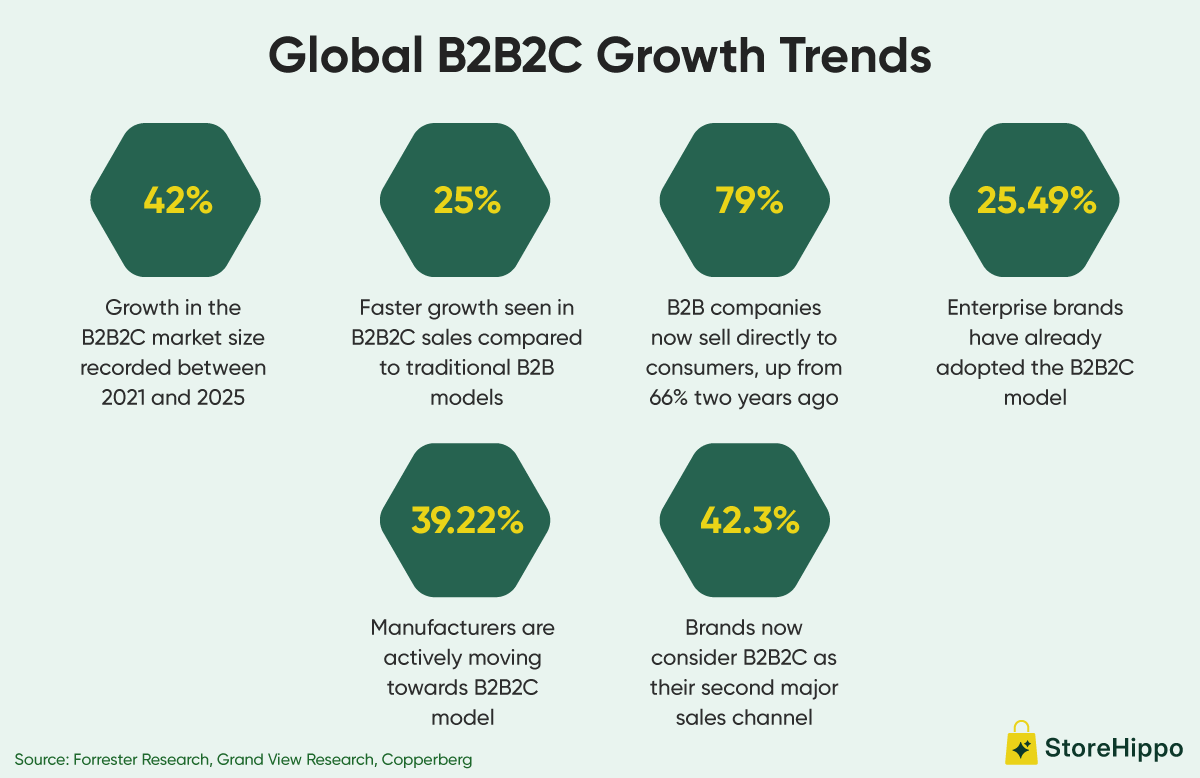
- 42% growth in the B2B2C market size recorded between 2021 and 2025
- 25% faster growth seen in B2B2C sales compared to traditional B2B models
- 79% of B2B companies now sell directly to consumers, up from 66% two years ago
- 25.49% of enterprise brands have already adopted the B2B2C model
- 39.22% of manufacturers are actively moving towards B2B2C model
- 42.3% of brands now consider B2B2C as their second major sales channel
Source: Forrester Research, Grand View Research, Copperberg
Key Takeaway: B2B2C ecommerce is rapidly growing, helping brands expand market reach, build direct customer relationships, and create more diversified revenue channels.
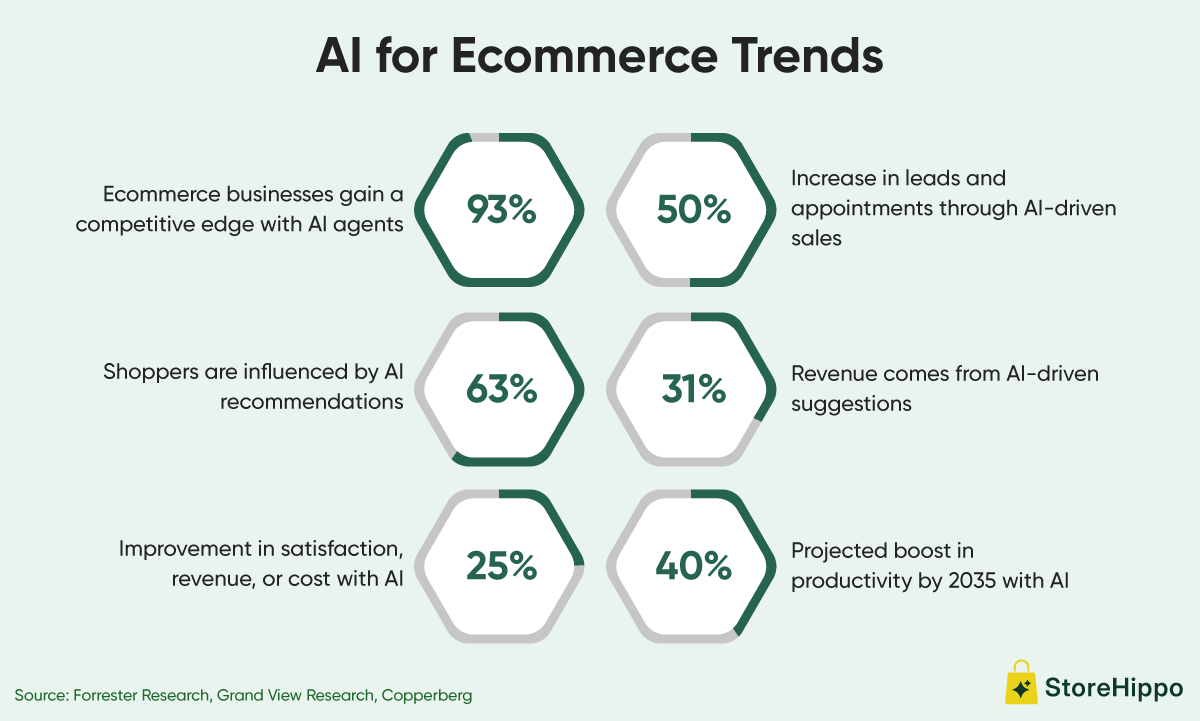
- 93% of ecommerce businesses gain a competitive edge with AI agents
- 50% increase in leads and appointments through AI-driven sales
- 63% of shoppers are influenced by AI recommendations
- 31% of revenue comes from AI-driven suggestions
- 25% improvement in satisfaction, revenue, or cost with AI
- 40% projected boost in productivity by 2035 with AI
Source: Gartner, Persana AI, Statista, Precedence Research
Key Takeaway: AI has now become the operational engine behind modern ecommerce growth, enabling enterprises to improve buyer experiences, automate decision-making, and scale marketplace operations more efficiently.
Building an AI powered B2B2C Marketplace enables enterprise brands to combine direct customer access with intelligent automation, creating faster, more scalable commerce ecosystems. As buyer expectations and digital competition continue to rise, AI-driven B2B2C marketplaces are emerging as a long-term growth strategy for enterprise commerce.
10 FAQs to Evaluate the Best B2B2C Marketplace Platform for Enterprise Brands
Here are 10 essential questions enterprises should ask before choosing a B2B2C marketplace platform to ensure long-term scalability, better customer experiences, and efficient marketplace operations:
1. What platform features are essential to build a unified B2B2C marketplace?
To build a unified B2B2C marketplace, enterprises must have multivendor management, support B2B and B2C business models from the same backend, have centralised inventory, role-based pricing, omnichannel commerce, multi-store capability, workflow automation, and personalised buyer journeys.
You should choose an enterprise ecommerce platform that can connect distributors, vendors, service partners, resellers, and end customers within one unified commerce ecosystem. The platform should help you manage partner-based commerce operations smoothly while delivering a consistent customer experience across all touchpoints.
For example, an electronics enterprise brand can onboard distributors, sellers, and installation partners into one ecosystem where customers can browse, buy, and request services from a single platform while inventory and fulfilment stay synchronised.
StoreHippo multi-vendor marketplace platform helps you build and scale large B2B2C ecosystems with its MultiStore® capabilities, built-in B2B and B2C support, and omnichannel commerce infrastructure. You can onboard and manage sellers, distributors, fulfilment partners, and service providers centrally while delivering unified customer experiences across multiple partner networks.
2. Can one enterprise ecommerce platform manage pricing, orders, and fulfilment across B2B and B2C without duplicating systems or processes?
Yes, a single enterprise ecommerce platform can manage B2B and B2C pricing, orders, and fulfilment if it is built on a unified backend. Instead of managing separate systems, a unifiedenterprise ecommerce platform enables you to manage multiple buyer types, such as distributors, wholesalers, and retail customers, while keeping inventory, pricing rules, and order workflows synchronised in real time.
For example, a building materials multi vendor marketplace platform can offer negotiated pricing for contractors while allowing retail customers to place direct orders, all managed through the same backend system.
StoreHippo helps you manage complex B2B2C operations by supporting RFQs, bulk orders, negotiated pricing, and partner-specific catalogues, all from one place. It also gives you clear, centralised visibility of all orders so your distributors, vendors, and fulfilment partners can work together smoothly without systems getting fragmented or disconnected.
3. How does the B2B2C marketplace platform ensure scalability for fast-growing vendor networks, catalogues, and transaction volumes?
A B2B2C marketplace ensures scalability by using a cloud-native, microservices-based architecture that can handle increasing vendor numbers, catalogue size, and transaction volume without performance issues. As the B2B2C marketplace grows, it must support rapid onboarding of sellers, expansion of SKUs, and high-traffic transactions while maintaining speed and stability across all operations.
For example, a fashion marketplace expands its network by onboarding thousands of regional sellers and distributors across different states. During peak sale periods, the platform handles heavy traffic, large product catalogues, and multiple partner operations at the same time without slowing down. This helps the business scale confidently while keeping fulfilment smooth and delivering a consistent shopping experience for customers across all regions.
StoreHippo is built on a MACH architecture with cloud-native microservices and a headless architecture designed specifically for large-scale B2B2C ecosystem growth. Its scalable infrastructure, 350+ APIs, and flexible commerce solutions enable enterprises to expand partner networks, storefronts, catalogues, and regional operations without operational bottlenecks.
4. How quickly can enterprises launch and scale new models, marketplaces, or regional stores on a B2B2C marketplace platform without technical limitations?
It depends on whether the B2B2C marketplace platform you choose is built to support flexible, multi-model commerce from the start. If yes, then you can quickly launch new business models, onboard new vendors, and build multiple stores to scale across regions.
For example, a beauty and personal care brand expands into new regions by onboarding salon partners, local distributors, and regional resellers. Each region needs different product assortments, pricing, language, and fulfilment models. Since the platform already supports multi-store operations, the brand launches new regional marketplaces quickly without rebuilding its core setup for every expansion.
StoreHippo enterprise ecommerce platform natively supports multiple business models, including multivendor marketplace, B2B, B2C, D2C, hyperlocal, and hybrid models from one backend logic. It also comes with built-in MultiStore® and multilingual features, so you can easily launch region-specific stores with different languages, catalogues, pricing, and offers. At the same time, you manage everything from one central system without switching between tools.
5. Does the enterprise ecommerce platform offer built-in AI tools to improve product discovery, personalisation, and automate operational workflows at scale?
Yes, but only if the B2B2C marketplace platform has AI built into its core, not added later as separate tools.
As your B2B2C setup grows, managing product data, partner catalogues, recommendations, and customer experiences manually becomes harder. AI helps simplify this by improving product discovery, making recommendations more relevant, and reducing the effort needed to manage day-to-day operations, while also giving buyers a smoother, more useful experience.
For example, a large marketplace managing lakhs of products across multiple sellers struggled with inconsistent product tagging and poor search relevance across partner catalogues. Buyers often faced difficulty finding the right products because discovery depended heavily on exact keywords and inconsistent vendor data. AI helps fix this by automatically creating catalogue details and showing results based on what the buyer actually means, not just the keywords they type. This makes it easier for buyers to find products, improves engagement, and helps the marketplace run more smoothly.
StoreHippo is an AI powered B2B2C marketplace platform where AI drives core business functions. Its AI-powered cataloguing automates catalogue generation across large partner ecosystems, while Magic Edit helps generate clear professional images directly from product images. Its AI semantic search improves discovery by understanding buyer intent instead of relying only on keywords. You can also build custom AI assistants to offer a personalised shopping experience to buyers.
6. How efficiently can the enterprise ecommerce platform manage B2B and B2C vendors, inventory, orders, and commissions from a single dashboard?
You can manage all ecosystem partners efficiently only if your ecommerce platform gives you a single, unified view of operations across B2B and B2C vendors instead of splitting control across multiple systems.
In B2B2C commerce, multiple independent partners like vendors, distributors, and service providers operate under one enterprise brand. Without central visibility, it becomes difficult for you to track inventory, commissions, fulfilment, and order flow as the ecosystem grows.
For example, a hyperlocal grocery marketplace works with hundreds of local sellers and delivery partners across cities. Sellers manage their own inventory and fulfilment, but the enterprise still tracks orders, commissions, and delivery performance from one system to ensure consistency for customers.
StoreHippo comes with built-in inventory and order management solutions that keep your entire commerce operation running smoothly from a single system. It offers separate dashboards for vendors to manage daily business operations efficiently, while you get centralised access to inventory, commissions, settlements, and orders, helping you coordinate the entire ecosystem without operational gaps.
7. Can the B2B2C marketplace platform deliver a smooth omnichannel experience across all sales channels without data inconsistencies?
Yes. If your B2B2C marketplace platform is built on a unified ecommerce architecture, it can offer omnichannel experiences across multiple touchpoints. A unified backend enables you to deliver consistent buying experiences across every sales channel by synchronising products, inventory, pricing, orders, and customer experiences across websites, mobile apps, marketplaces, social channels, and conversational commerce touchpoints.
For example, a buyer browsing products on a mobile app later completed the purchase through WhatsApp after interacting with the brand across multiple channels. Since inventory, customer data, and order workflows stayed synchronised across all touchpoints, the customer gets a smooth and consistent experience without any gaps.
StoreHippo is built on an omnichannel commerce architecture that enables you to manage all channels from one unified backend. It offers a built-in no-code mobile app builder to build Android and iOS mobile apps and PWA stores from the admin dashboard, enables you to sell through WhatsApp and chat interfaces, and manages data across all channels from a unified dashboard.
8. How effectively can the B2B2C marketplace platform support global expansion with localised stores, currencies, and compliance?
You can scale globally only if your enterprise ecommerce platform offers built-in multistore, multilingual, multicurrency, region-specific tax compliance, supports international payment gateways, and offers international fulfilment partners. If you need to add external plugins and third-party systems to manage global features, it creates extra complexity, slows down operations, and makes it harder for you to manage everything in one place as you expand.
For example, a B2B2C enterprise expanding into multiple countries launches region-specific storefronts with different pricing, payment methods, languages, and fulfilment workflows. Since the platform already supports localisation and multistore operations, the enterprise can expand its B2B2C marketplace globally without creating fragmented operations.
StoreHippo’s MultiStore® architecture enables you to launch multiple regional storefronts from one admin dashboard. With support for 100+ languages, multicurrency, built-in localisation features, and integrations with global payment and logistics providers, StoreHippo helps you scale globally while maintaining centralised operational control.
9. Can the B2B2C marketplace platform easily integrate with existing enterprise systems like ERP, CRM, payments and logistics without extensive custom development?
Yes. Choose an API-first ecommerce platform that can integrate seamlessly with ERP, CRM, accounting, logistics, payment, and other operational systems. This helps you avoid disconnected workflows, manual data handling, and dependency on heavy custom development.
In B2B2C ecosystems, enterprises work with multiple stakeholders like suppliers, distributors, fulfilment partners, and internal teams. Without proper integration, data stays fragmented, and businesses lose real-time visibility across inventory, orders, and fulfilment.
For example, a manufacturing enterprise using ERP software for inventory and accounting integrated its existing systems with the ecommerce platform to automate inventory updates, invoices, and order tracking. This helped the business improve operational visibility and reduce manual coordination across teams.
StoreHippo is built on an API-first architecture with 150+ pre-integrated solutions across payments, logistics, ERP, CRM, accounting, and marketing tools. Its 350+ API connectors help you easily connect with your preferred third-party systems and build a fully connected, scalable commerce infrastructure with smoother workflows and real-time operational visibility.
10. What are the long-term costs of pivoting the B2B2C marketplace to new hybrid business models in domestic and international markets?
The long-term cost of a B2B2C marketplace depends on how easily the platform can support new business models, regions, and operational requirements without expensive redevelopment or fragmented systems. Platforms with limited flexibility often increase costs through plugins, custom development, maintenance, and operational complexity as the business scales.
For example, a B2B2C enterprise expanding into D2C, hyperlocal, and international commerce needed new storefronts, fulfilment models, and pricing structures for different markets. Since the platform already supported multiple business models from one backend, the business scaled efficiently without rebuilding operations for every expansion.
StoreHippo is built to support multiple business models, including B2B, B2C, D2C, hyperlocal, and hybrid commerce from one platform. Its fully managed infrastructure, built-in enterprise capabilities, and transparent pricing help businesses scale across markets without rising operational overhead or dependency on fragmented systems.
Conclusion
Building a successful B2B2C marketplace is not just about adding new channels or partners, it’s about creating a unified ecosystem where vendors, distributors, and customers can interact seamlessly.
The right enterprise ecommerce platform plays a critical role in making this possible. From managing complex workflows and vendor operations to enabling global expansion and AI-driven experiences, the platform you choose directly impacts your ability to scale efficiently.
StoreHippo brings together everything enterprises need to run and grow a B2B2C marketplace, including multi vendor capabilities, unified commerce, built-in AI, and scalable architecture, all within a single platform.
For enterprise brands looking to simplify complexity, improve efficiency, and unlock new growth opportunities, investing in a future-ready B2B2C marketplace platform is the next logical step.
Ready to explore how StoreHippo can help you build and scale your B2B2C marketplace?
Book your personalised demo now.