


Fashion shopping has become much more than visiting a store or checking a few clothing websites. Shoppers today want variety, better prices and the freedom to compare different brands and styles before they buy. And they expect to do all of this without jumping between multiple platforms.
That is exactly where a fashion marketplace comes in. Platforms like Myntra, AJIO, Amazon Fashion and more have made it easier for shoppers to discover products from hundreds of brands and sellers in one place.
But having a large product catalogue is not enough. The marketplaces that stand out are the ones that make product discovery easier, keep sellers well managed and give shoppers a smooth experience from search to delivery.
So, what makes the leading fashion multi vendor marketplaces in India successful? And what can businesses take away from their approach? If you’re planning to build a specialised marketplace in the fashion space, now is a good time to explore the opportunity and learn from the platforms already leading the way.
Table of Contents
How India’s Online Fashion Marketplaces are Evolving
India’s online fashion marketplace has moved well beyond metro cities. Shoppers in Tier-2 and smaller cities are increasingly comfortable buying clothing, footwear and lifestyle products online, giving businesses with clothing websites a much wider customer base to serve.
The following numbers show why fashion remains one of the most attractive categories for online marketplace businesses:
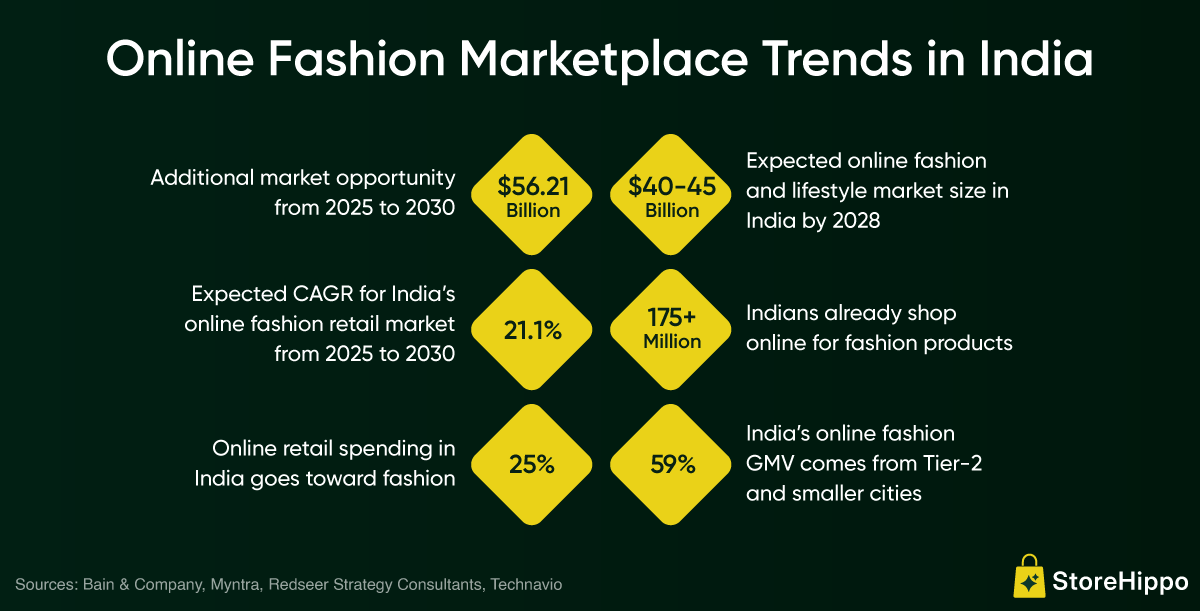
- $40-45 bn is the expected online fashion and lifestyle market size in India by 2028
- 175+ million Indians already shop online for fashion products
- 59% of India’s online fashion GMV comes from Tier-2 and smaller cities
- 25% of online retail spending in India goes toward fashion
- 21.1% expected CAGR for India’s online fashion retail market from 2025 to 2030
- $56.21 bn additional market opportunity from 2025 to 2030
Sources: Bain & Company, Myntra, Redseer Strategy Consultants, Technavio
These numbers make one thing clear: online fashion in India is no longer limited to big cities or a handful of large platforms. With shoppers across the country looking for more choice and convenience, there is plenty of room for marketplaces that bring the right fashion brands and products to the right audiences.
The growing opportunity is already creating successful fashion marketplaces across India. Let’s look at five platforms and the strategies they use to stand out.
List of Top 5 Fashion Multi Vendor Marketplaces In India
Here are five successful multi vendor marketplaces in India's fashion sector and the strategies that have helped them build strong positions in a highly competitive market.
1. Myntra
Myntra is one of India’s best-known online fashion marketplaces, bringing together a wide range of Indian and international brands across clothing, footwear, accessories and beauty. Myntra brings together thousands of brands and a massive product range on its multi vendor marketplace, giving shoppers plenty of choice across categories and price points.
Success Strategies of Myntra
- Wide collection of Indian and international fashion brands that gives shoppers plenty of styles and labels to choose from.
- Discounts, offers and seasonal sales that keep shoppers coming back for better deals.
- AI-powered fashion discovery and personalised search that helps shoppers find products that match their interests more easily.
- Easy navigation across categories, brands and fashion stores so shoppers can quickly find what they are looking for.
- A large seller and brand ecosystem that keeps the catalogue fresh with new products, styles and collections.
2. Ajio
AJIO is a fashion and lifestyle multi vendor marketplace from Reliance Retail that has built its identity around trend-based fashion, international labels and its own private-label portfolio. It brings together Indian and global brands, giving shoppers access to a broad mix of everyday, premium and contemporary styles.
Success Strategies of AJIO
- Curated mix of Indian and international fashion brands that gives shoppers a good balance of familiar names and fresh labels.
- Strong focus on trend-led and contemporary styles that keeps the platform aligned with what shoppers are looking for right now.
- AJIO OWN private label that gives the platform its own range of styles and helps it stand apart from other fashion marketplaces.
- Exclusive international labels that give shoppers access to brands and styles they may not easily find on other Indian fashion platforms.
- Easy product discovery through categories, collections and brand-led shopping that helps shoppers browse and find styles they like without much effort.
- Omnichannel retail experience that connects AJIO’s digital shopping experience with Reliance Retail’s wider physical and digital presence.
3. Nykaa Fashion
Nykaa Fashion has grown from its beauty roots into a wider fashion destination, covering women’s, men’s and kids’ fashion, accessories and lifestyle categories. A stronger mix of established and emerging brands has helped fuel its growth. In FY2026, its fashion business recorded ₹4,954 crore in GMV, up 30% year on year, while adding more than 1,280 brands.
Success Strategies Used by Nykaa Fashion
- Strong focus on premium and aspirational fashion that appeals to shoppers looking for stylish and elevated fashion choices.
- Partnerships with established brands such as H&M, Nike, Gap, Snitch and Guess that bring well-known names and more choice to the platform.
- Expanding collection across women’s, men’s, kids’ and accessories so shoppers can find fashion for different needs and age groups in one place.
- AI-powered personalisation and conversational commerce that make it easier for shoppers to discover products and get recommendations that feel more relevant.
- Curated brand and product mix that gives Nykaa Fashion a distinct identity instead of simply offering a large catalogue.
4. Amazon Fashion
Amazon Fashion brings Amazon’s huge multi vendor marketplace to clothing, footwear, accessories and more. Shoppers can choose from a wide range of sellers and brands, making it easy to find everything from everyday clothes to popular Indian and international fashion brands in one place.
Success Strategies of Amazon Fashion
- Large and diverse selection of fashion sellers and brands that gives shoppers plenty of options across styles, categories and budgets.
- Easy product discovery through search, filters, recommendations and customer reviews that helps shoppers narrow down their choices and find what suits them.
- Wide fulfilment and delivery network that makes it easier for shoppers across India to receive their orders.
- Competitive pricing, deals and major shopping events that give shoppers more opportunities to save on their favourite products.
- AI-powered shopping assistance and conversational product discovery through tools such as Rufus, helping shoppers find products through more natural and personalised interactions.
5. Tata CLiQ
Tata CLiQ has built a strong presence in fashion and lifestyle by bringing well-known brands across womenswear, menswear, kidswear, footwear, watches and accessories onto one platform. Its focus on genuine products, dedicated brand stores and a mix of online and offline shopping gives it a distinct place among India’s fashion marketplaces.
5 Success Strategies of Tata CLiQ
- Strong portfolio of Indian and international fashion brands that gives shoppers plenty of trusted names and styles to choose from.
- Dedicated brand stores that make it easy for shoppers to explore collections from their favourite labels in one place.
- Focus on genuine and authentic products that helps build trust and gives shoppers confidence in what they buy.
- Omnichannel online-to-offline shopping through services such as CLiQ and PIQ, giving customers the option to order online and pick up from partner stores.
- Curated fashion experiences such as its Gen-Z store that bring together a wide range of styles and brands for shoppers looking for something new and on-trend.
Looking across these five fashion multi vendor marketplaces, one thing becomes clear: successful fashion marketplaces are not winning simply because they have thousands of products. They are winning because they make those products easier to discover, compare and purchase.
For businesses looking to build a fashion multi vendor marketplace of their own, the right ecommerce technology can bring these capabilities together while making it easier to onboard sellers, manage large fashion catalogues, personalise shopping experiences, handle orders and fulfilment, and scale across India.
How to Build a Fashion Multi Vendor Marketplace
Building a successful multi vendor marketplace for fashion is about more than giving sellers a place to upload their products. Fashion comes with thousands of SKUs, multiple sizes and variants, seasonal collections and trends that can change quickly. So, the marketplace needs to make it easy for sellers and admins to keep everything updated and organised.
A good marketplace platform should bring seller management, catalogues, inventory, orders, payments and fulfilment together in one place. This makes day-to-day operations easier to manage, even as the number of sellers and products grows.
But there is another side to getting the marketplace right: the customer experience. Shoppers want quick search, relevant recommendations, easy mobile shopping, flexible payment options and hassle-free delivery. With AI becoming a bigger part of online shopping, an AI-powered marketplace can also help customers discover the right products faster while taking care of repetitive tasks in the background.
That is why choosing the right marketplace technology from the start can make it much easier to build, manage and grow a fashion marketplace.
How StoreHippo Helps You Build a Feature-Rich Fashion Multi Vendor Marketplace
StoreHippo enables businesses to build customised and AI-powered marketplaces that bring multiple fashion brands, sellers and product categories together on a single platform. Its enterprise-grade features and marketplace capabilities, including AI tools, mobile-first architecture, unified omnichannel commerce, marketing and integrations, enable businesses to build scalable fashion marketplaces with personalised shopping experiences, streamlined seller operations and the flexibility to expand across channels, categories and markets.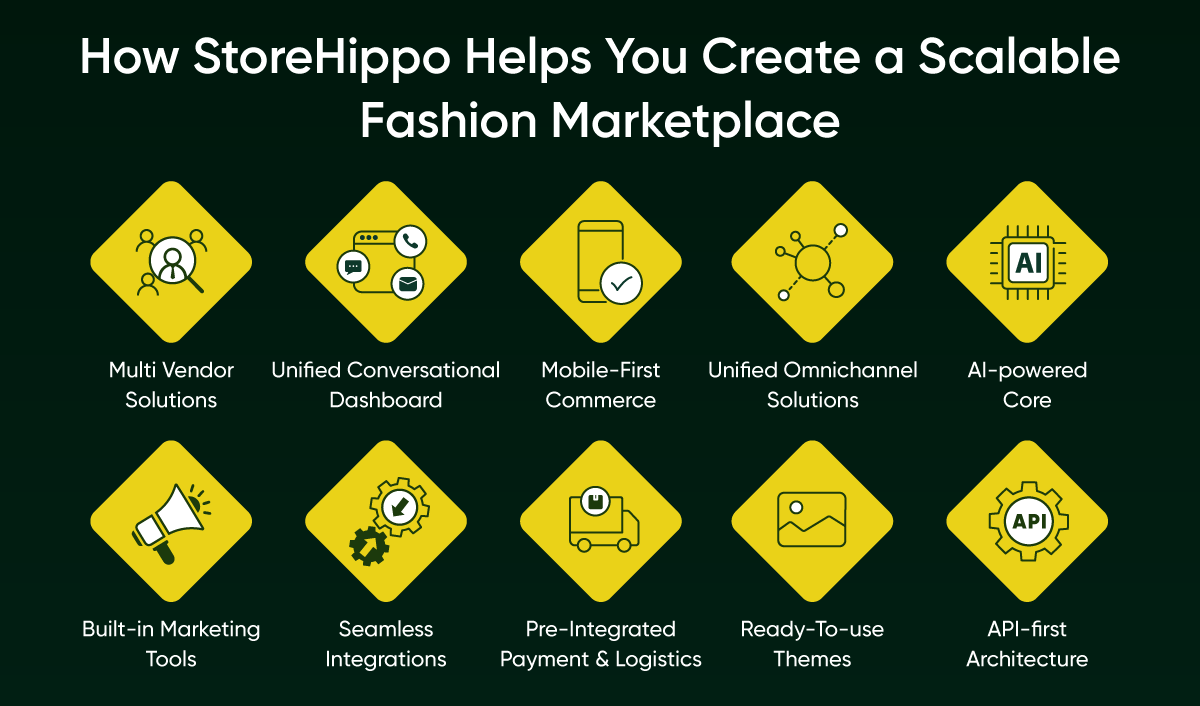
Here is what businesses can use to build and scale a fashion marketplace with StoreHippo:
- Complete multi-vendor marketplace solutions: Onboard and manage multiple fashion brands, retailers, designers and sellers from one platform. Sellers can manage their products, inventory and orders through dedicated dashboards while marketplace owners retain centralised control.
- AI-powered ecommerce capabilities: Use AI-powered product discovery, semantic search, automated catalogue creation, image editing, personalised recommendations and custom AI bots to make fashion discovery faster and more relevant.
- AI-powered marketplace experiences: Build smarter buying journeys where AI can understand shopper intent and help customers discover relevant clothing, footwear, accessories and lifestyle products.
- Mobile-first commerce: Offers a built-in mobile app builder to launch Android and iOS mobile apps and PWA storefronts so customers can browse and purchase from their preferred devices.
- Unified omnichannel commerce: Connect websites, mobile apps, WhatsApp, conversational commerce, voice commerce and other touchpoints through a common commerce ecosystem.
- Unified conversational dashboard: Manage, monitor and act on conversations across multiple channels from an AI-powered unified dashboard, with agents automating responses, routing complex queries to teams and doing majority of support heavy lifting.
- Personalised product discovery: Help shoppers find products based on intent, preferences and browsing behaviour. This becomes particularly useful when customers are navigating large fashion catalogues with thousands of styles and variants.
- Built-in marketing tools: Use SEO tools, discount engines, loyalty programmes, personalised promotions, abandoned cart recovery and push notifications to attract customers and encourage repeat purchases.
- Seamless integrations: Connect essential business systems and third-party tools through 120+ APIs, giving enterprises the flexibility to extend marketplace functionality as they grow.
- Pre-integrated payment solutions: Support secure and convenient checkout experiences with 60+ payment gateways.
- Integrated logistics: Connect with 30+ pre-integrated logistics providers to simplify fulfilment and provide reliable shipping experiences across locations.
- Easy storefront customisation: Use ready-to-use themes and a drag-and-drop theme editor to create a distinctive storefront without depending heavily on technical teams.
- Flexible headless and API-first architecture: Built on MACH architecture, StoreHippo gives enterprises the flexibility to connect commerce with existing systems and create tailored customer experiences.
- Scalable marketplace operations: Start with a focused fashion category and expand into new sellers, brands, categories, channels and markets without having to migrate to another platform.
For businesses building a fashion-focused marketplace, these capabilities can help bring together the two sides of the equation: a strong seller ecosystem behind the scenes and a smooth shopping experience for customers.
Whether you want to create a specialised clothing websites or a multi vendor marketplace for ethnic wear, designer fashion, footwear or accessories, or a broader platform covering multiple fashion categories, the underlying technology needs to support the model from day one.
Conclusion
The success of these multi vendor marketplaces shows how much the Indian fashion market has evolved. Customers now expect more than a large catalogue. They want relevant discovery, trusted brands, convenient payments, flexible fulfilment and shopping experiences that feel increasingly personalised.
For businesses entering this market, the opportunity is equally broad. A robust and future-ready fashion marketplace can bring together multiple sellers, expand product choice and serve customers across geographies without the limitations of a traditional single-brand online clothing websites. StoreHippo gives enterprises the tools to build, manage and scale a feature-rich multi vendor marketplace with AI capabilities, flexible architecture, integrated commerce tools and support for multiple sales channels.
If you are planning to build your own fashion marketplace, the next step is to choose technology that can support where your business is going, not just where it is today.
Want to build a future-ready fashion marketplace?
Book a demo with StoreHippo today.
FAQs
1. How can enterprises build a fashion multi vendor marketplace like Myntra?
Enterprises can build a fashion multi vendor marketplace like Myntra by choosing a scalable marketplace platform with comprehensive vendor management solutions, AI-powered product discovery and recommendations, mobile-friendly experiences, omnichannel commerce, vendor and catalogue management, secure payments, integrated logistics and personalised shopping capabilities.
2. How can enterprises manage products across hundreds of vendors?
Enterprises can manage products across hundreds of vendors through a centralised marketplace platform that enables vendors to independently manage product listings, pricing, inventory, variants and orders while administrators maintain centralised control and visibility.
3. How can enterprises manage multiple vendors efficiently?
Enterprises can manage multiple vendors efficiently with a multi vendor marketplace platform that provides dedicated vendor dashboards, centralised vendor management, automated workflows, performance tracking and role-based access controls.
4. How can AI improve product discovery on a fashion multi vendor marketplace?
AI can improve product discovery on a fashion multi vendor marketplace by understanding shopper intent, preferences and behaviour to deliver smarter search results, personalised recommendations, relevant product suggestions and conversational shopping assistance.
5. How can a fashion multi vendor marketplace create a seamless omnichannel shopping experience?
Enterprises can create a seamless omnichannel experience by choosing a multi vendor marketplace platform with built-in omnichannel capabilities that connect websites, mobile apps, PWAs, WhatsApp, voice commerce and other sales channels through a unified system. This helps maintain consistent product, inventory, customer and order information across every channel.
4. How can enterprises make deliveries faster and easier to manage on a fashion multi vendor marketplace?
Enterprises can streamline fashion marketplace deliveries by integrating multiple logistics partners, automating order fulfilment, tracking shipments in real time and managing delivery operations through a centralised system.
5. How can a fashion multi vendor marketplace offer a better shopping experience on mobile devices?
A fashion multi vendor marketplace can offer a better mobile shopping experience with responsive storefronts, fast-loading PWAs, dedicated Android and iOS apps, easy navigation, mobile-friendly checkout and personalised product discovery.
6. What security measures are important for a fashion multi vendor marketplace?
A fashion multi vendor marketplace should use PCI DSS-compliant payment processing, data encryption, secure authentication, role-based access controls, regular security monitoring and secure API integrations to protect customer, seller and transaction data.
Binny Joseph is a seasoned ecommerce and enterprise growth leader, serving as Senior Vice President of Sales & Alliances with deep experience helping global brands adopt modern commerce solutions.
He shares practical insights and strategies to help businesses build an online marketplace and create a smooth experience for sellers and customers.