



If your enterprise is growing, you're probably adding new sales channels, entering new markets, or launching new business models. Growth is exciting, but without unified commerce, it often creates more operational headaches than opportunities. Before long, your teams are juggling disconnected systems, duplicate data, inventory mismatches, and processes that become harder to manage with every new expansion.
But the growth shouldn't make your business feel slower. It should make it stronger. The right technology should help every new channel, like a new website, mobile apps, WhatsApp commerce, or voice and chat-based channels, fit naturally into your existing operations instead of creating another silo.
That's exactly where choosing a unified commerce platform for enterprises changes the game. By bringing products, inventory, orders, customers, and fulfilment onto a single connected platform, it gives businesses the visibility, agility, and control they need to scale with confidence.
Lets explore how unified commerce removes the operational barriers that hold enterprises back and why it has become core for building an AI-powered enterprise ecommerce platform that's ready for long-term growth.
Table of Contents
- How Unified Commerce Is Transforming Enterprise Growth
- How Unified Commerce Powers Scalable Enterprise Growth
- 1. Shared Commerce Foundation for Every Channel
- 2. Inventory Availability Across the Business
- 3. Prevents Order Management From Becoming a Bottleneck
- 4. Enables Faster Launch In New Markets
- 5. Support Every Business Model on One Platform
- 6. Eliminate Manual Reconciliation Across Teams
- 7. Consistent View of the Customer
- 8. Lowers the Cost of Adding New Capabilities
- 9. Gives Business Teams More Operational Control
- 10. Creates the Data Foundation Required for AI
- What Should Enterprises Look for in a Unified Commerce Platform
- How StoreHippo Unified Commerce Platform Helps Enterprises Remove Operational Barriers To Growth.
- Conclusion
- FAQs
How Unified Commerce Is Transforming Enterprise Growth
Growing an enterprise isn't just about adding more sales channels or launching new business models. It's about keeping everything connected as your business expands. That's exactly why unified commerce has become a business priority for enterprises.
The numbers below show how businesses are using it to grow faster, simplify operations, and scale more efficiently.
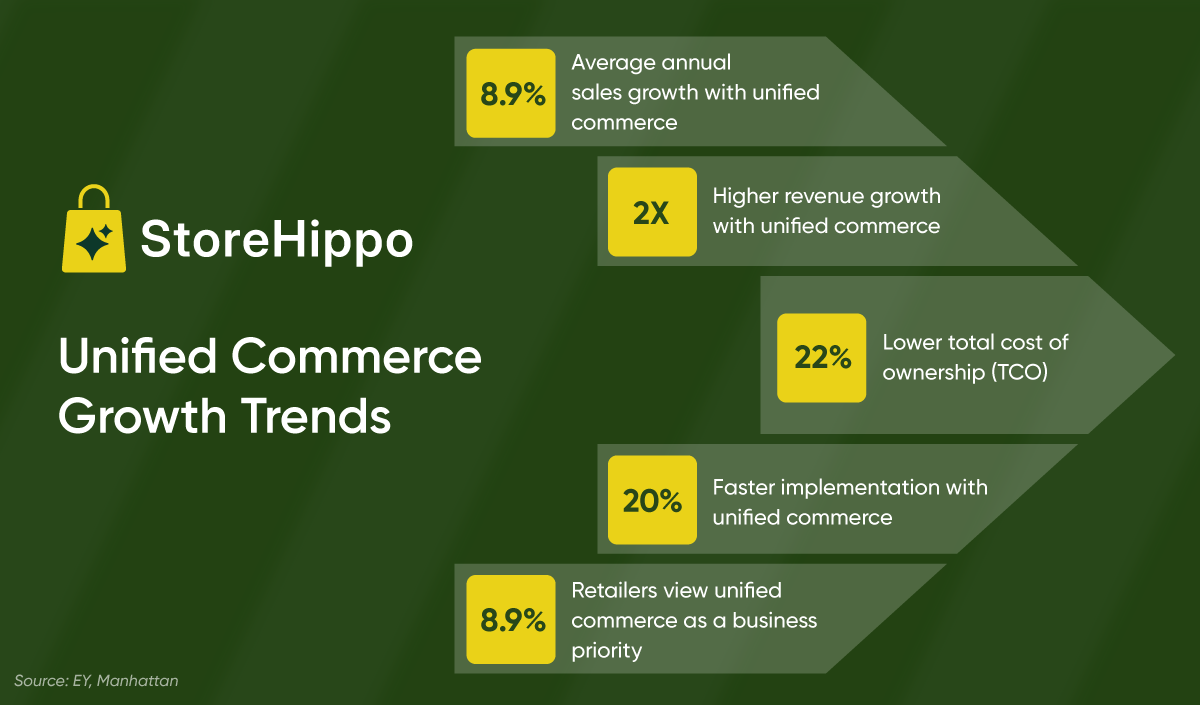
- 8.9% average annual sales growth with unified commerce
- 2X higher revenue growth with unified commerce
- 22% lower total cost of ownership (TCO)
- 20% faster implementation with unified commerce
- 88% of retailers view unified commerce as a business priority
Source: EY, Manhattan
The numbers clearly show how unified commerce has transformed the way enterprises scale, making growth faster, more connected, and easier to manage.
Let's now explore how unified commerce delivers these business outcomes by simplifying enterprise operations at every stage of growth.
How Unified Commerce Powers Scalable Enterprise Growth
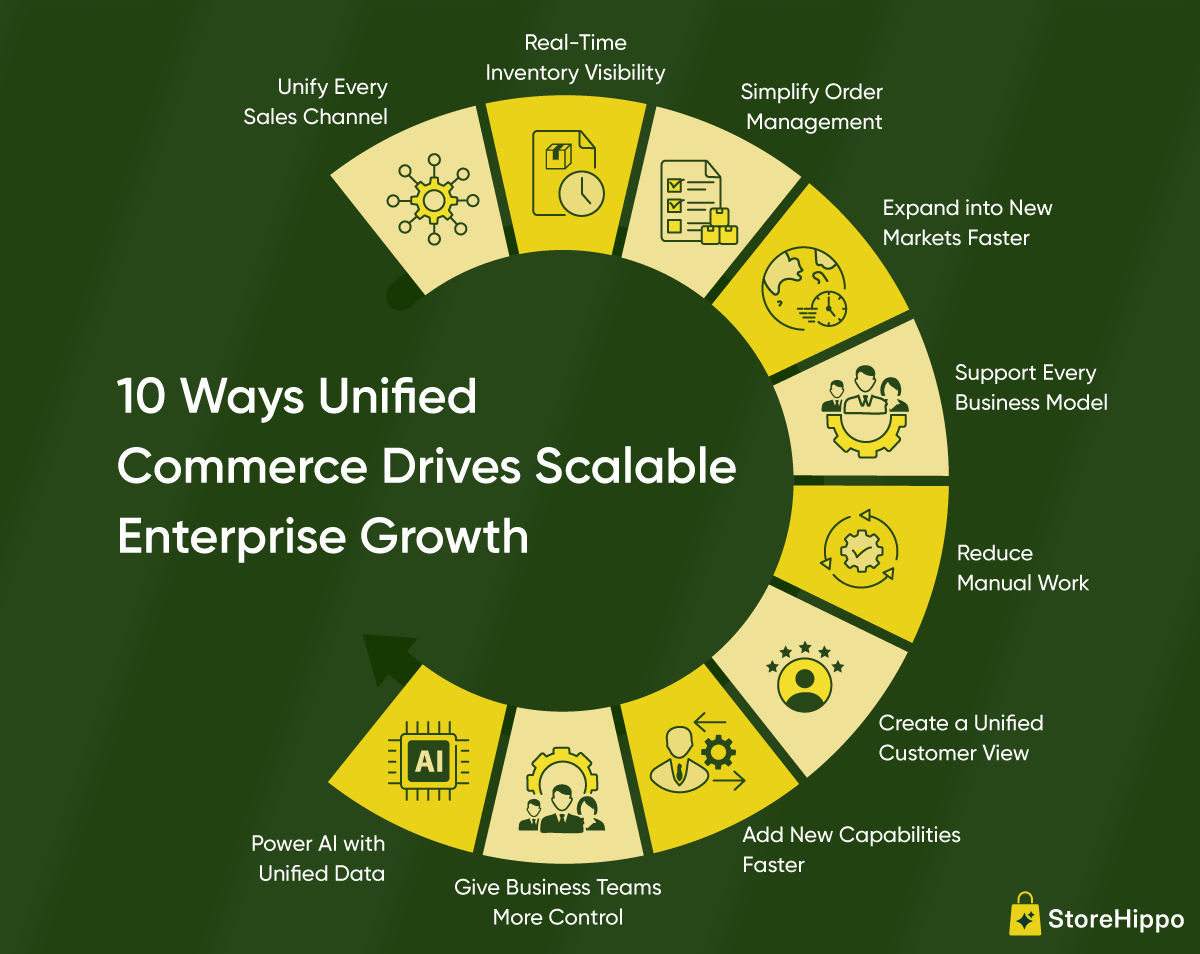
Growth becomes much easier when your technology grows with your business instead of holding it back. Here are ten ways unified commerce removes operational barriers and helps enterprises scale with greater speed, visibility, and control.
1. Shared Commerce Foundation for Every Channel
Every time you launch a new sales channel, the business should become easier to scale, not harder to manage. Yet, for many enterprises, that's not what happens. Each new channel ends up running on a separate system. A mobile app gets its own backend, a multi-vendor marketplace needs separate seller management, B2B commerce runs on another portal, while physical stores continue using a different order or inventory system.
This approach may work when the business is small or just starting to expand. But as the business grows, managing these disconnected systems becomes difficult. Teams spend more time updating the same product information in multiple places, matching inventory across systems, and switching between different dashboards just to handle everyday operations. Instead of supporting growth, these disconnected systems begin to slow the business down.
This is where unified commerce makes a difference. It brings websites, mobile apps, marketplaces, whatsapp and other channels onto a single commerce platform. Products, inventory, pricing, orders, and customer data stay connected, while every channel can still offer a buying experience that suits its customers.
The real advantage isn't just having fewer systems to manage. It's being able to launch new channels without rebuilding everything from scratch. A unified commerce platform for enterprises lets businesses expand faster while keeping operations simple, connected, and easy to manage.
2. Inventory Availability Across the Business
If you run an enterprise business, you know how difficult it is to manage inventory manually across multiple sales channels. The bigger the business grows, the harder it becomes to keep inventory updated everywhere in real time. And when inventory data falls out of sync, it doesn't take long for things to turn chaotic.
Take a simple example. A product goes out of stock, but your team hasn't updated the website in time, and a customer may place an order for it. Now your team has to explain the situation, process cancellations or refunds, and deal with an unhappy customer.
As the business expands, these situations become more frequent. Teams spend more time checking stock manually, resolving order conflicts, and maintaining extra inventory just to avoid overselling or stockouts. Instead of helping the business scale, disconnected inventory starts slowing it down.
This is where businesses should stop relying on manual inventory updates and choose a platform built on a unified commerce architecture, where inventory data stays synced across every sales channel. Everyone works with the same inventory data, making it easier to know exactly what's available and where.
With accurate inventory visibility, businesses can fulfil orders from the best location based on stock availability, customer location, delivery timelines, or business rules. It also becomes easier to support fulfilment models like ship-from-store, click and collect, local dealer fulfilment, and split shipments without adding operational complexity.
3. Prevents Order Management From Becoming a Bottleneck
Running just a website until now and planning to expand your sales channels by launching a mobile app and connecting WhatsApp? That's a great step for your enterprise's growth.
But the order management that felt easy when you were selling only through your website won't stay that simple anymore. Once orders start flowing in from your website, mobile app, WhatsApp, marketplaces, and other channels, managing everything at the same time becomes much more challenging.
Imagine a festive sale. Within a few hours, thousands of orders start coming in from different channels. Your website team is handling one set of orders, your marketplace team is managing another, and your store team has its own queue. Meanwhile, a customer calls to check the status of an order, but your support team has to switch between multiple systems just to find the right information. Instead of processing orders quickly, teams spend valuable time tracking orders, coordinating across departments, and resolving avoidable issues.
So, how do you avoid this kind of situation?
Choosing a multi-model enterprise ecommerce platform built on unified architecture is one of the smartest decisions you can make before these challenges start affecting your operations. A unified commerce platform for enterprises gives every team access to the same real-time order information. It can also automate order routing based on inventory availability, customer location, warehouse capacity, delivery timelines, or business rules. If an order can't be fulfilled from one location, the system automatically routes it to the next best fulfilment centre without manual intervention. Even returns, cancellations, and fulfilment exceptions can be managed from a single interface.
4. Enables Faster Launch In New Markets
Your business is doing well in one region, and now you're ready to expand into a new city or even a new country. But the moment you start planning, you realise it's much more than simply launching another website.
Every new market comes with its own requirements. You may need to support a different language, currency, tax structure, payment methods, shipping partners, product catalogue, and pricing strategy. If your sales channels run on disconnected systems, your team has to configure and manage each of these changes separately. What should be an exciting growth opportunity soon turns into a long and complex technology project.
This is where a unified commerce platform makes all the difference. Instead of rebuilding everything from scratch for each new market, it gives you a connected dashboard where you can manage multiple storefronts, products, inventory, orders, payments, and fulfilment from one place.
With a unified commerce platform for enterprises, you can quickly launch region-specific storefronts with local languages, currencies, pricing, payment methods, product assortments, and fulfilment options. While every market delivers a localised customer experience, your catalogue, order management, integrations, and operational workflows continue to run on the same connected platform.
The result? Launching in new markets becomes faster and far less complex. Your teams spend less time setting up technology and more time building your brand presence, serving new customers, and driving growth.
5. Support Every Business Model on One Platform
Enterprise brands keep adapting their business model to changing markets and buyers' needs. As your business grows, you may want to expand from B2B to D2C, launch a B2B2C model, build a marketplace for dealers and partners, or even run all of them together. Every new business model opens up new growth opportunities, but it also brings new operational challenges.
This is where many enterprises make their biggest mistake: managing each business model on a separate platform, which leads to duplicate product catalogues, disconnected integrations, and separate reporting structures.
The consequence? Instead of growing efficiently, teams spend more time managing disconnected systems than serving customers and driving business growth.
A unified commerce platform for enterprises removes this complexity by giving businesses the flexibility to run B2B, B2C, D2C, B2B2C, and marketplace models from a single platform. Each business model can have its own buying journey without requiring a separate commerce ecosystem.
For example, a B2B buyer can access negotiated pricing, account-specific catalogues, and approval workflows, while a retail customer enjoys personalised offers and a faster checkout. Dealers can receive orders based on their assigned territory or inventory availability. Every user gets an experience tailored to their needs, while the business manages products, inventory, orders, and operations from one connected platform.
As your business evolves, your technology should evolve with it. Instead of investing in a new platform every time you introduce a new business model, you can launch and manage them all from the same commerce ecosystem, making growth simpler, faster, and much easier to manage.
6. Eliminate Manual Reconciliation Across Teams
Think about how many times your teams manually update the same information in a day. A product price changes, so the team updates it across different sales channels. A payment is received, and the finance team has to match records from multiple systems. A customer calls about an order, but the support team checks several dashboards before finding the right update. These may seem like small tasks, but together they take hours of valuable time every single day.
As your business grows, so does this hidden workload. Instead of focusing on customers, strategy, or business growth, skilled teams end up comparing spreadsheets, correcting mismatched data, and manually reconciling information across disconnected systems. The problem isn't the work itself, it's that the same work is being repeated because the systems don't communicate with each other.
A unified commerce platform for enterprises eliminates much of this manual effort by connecting every part of the business through a single commerce ecosystem. Product updates are automatically reflected across sales channels, inventory adjusts in real time as orders are placed, order status changes are visible to customers instantly, and reports are generated from a single, consistent data source.
The biggest benefit isn't just saving time. It allows every team to spend less time fixing data and more time making decisions that help the business grow.
7. Consistent View of the Customer
Your customers don't care which channel they're shopping on; they simply expect your brand to remember them.
If someone has already purchased from your website, they don't expect to explain everything again when they contact you on Mobile app or WhatsApp channel. They expect your business to know who they are, what they've bought before, and where they are in their buying journey.
Unfortunately, that's not how many enterprises work. Customer information often sits across different systems, so every team sees only a small part of the picture. Marketing sends offers without knowing recent purchases, support asks customers to repeat information, and loyalty rewards don't always reflect a customer's complete relationship with the brand.
A unified commerce platform for enterprises brings all these interactions together, giving every authorised team access to a complete customer profile instead of fragmented records. Purchases, returns, enquiries, preferences, and engagement remain connected, regardless of where the customer interacts with the business.
The difference is visible in every interaction. Customers receive more relevant recommendations, support teams resolve issues faster, and every touchpoint feels like part of the same brand experience instead of separate conversations.
8. Lowers the Cost of Adding New Capabilities
As your business grows, adding new features shouldn't become harder. But for many enterprises, that's exactly what happens.
Let's say you want to launch a loyalty program, introduce a new payment option, or run a new promotion. It sounds like a simple update. But if your website, mobile app, marketplaces, and other channels all run on separate systems, your technology team ends up making the same changes over and over again. What should take days can easily stretch into weeks.
A unified commerce platform for enterprises changes that. Instead of building every new capability separately for each channel, you can introduce it once and make it available wherever it's needed. Whether it's a payment gateway, loyalty program, CRM, ERP, or logistics integration, the work happens on a shared commerce platform rather than being repeated across multiple systems.
The result is fewer duplicate integrations, faster rollouts, and lower development costs. More importantly, your teams can spend less time maintaining disconnected systems and more time building features that help your business grow.
9. Gives Business Teams More Operational Control
If you run an enterprise business, you've probably experienced this at some point. A pricing update is ready, a new product needs to go live, or a festive offer has been approved, but nothing happens until the development team has time to make the changes.
Over time, these small requests start piling up. Technology teams spend their time handling routine business updates instead of focusing on innovation, while sales, marketing, merchandising, and operations teams are left waiting to move their plans forward.
A unified commerce platform for enterprises helps break this dependency by giving business users the tools to manage the tasks they own. Teams can update catalogues, sales teams can configure buyer groups and pricing rules, operations teams can fine-tune fulfilment workflows, and marketing teams can launch promotions across multiple storefronts, all without relying on developers for every routine change.
With low-code capabilities and configurable workflows, teams can work faster while staying within predefined business rules and approval processes. IT still retains control over architecture, security, and integrations, but day-to-day commerce operations no longer come to a standstill because of a small change request.
When the right teams have the right level of control, decisions are implemented faster, campaigns launch on time, and the business becomes far more agile without sacrificing governance.
10. Creates the Data Foundation Required for AI
Everyone is talking about AI, but here's the reality: AI can only make smart decisions when it has access to reliable data.
Whether it's helping customers discover products through intelligent search, delivering personalised recommendations, automating routine tasks, answering customer queries, or routing orders to the right fulfilment location, AI works best when it can access connected and consistent business information. If product data, customer profiles, pricing, and orders exist in separate systems, AI has to work with incomplete information, leading to inconsistent results.
A unified commerce platform for enterprises gives AI access to connected business data. By bringing together product information, customer profiles, orders, pricing, and transactions on a single platform, it enables AI to work with complete business context instead of fragmented data.
This enables businesses to unlock the full potential of an AI-powered enterprise ecommerce platform. From intelligent product recommendations and automated catalogue management to faster customer support, etc, AI can deliver better outcomes because it works with consistent, real-time information.
As AI and agentic commerce continue to evolve, this unified system will become even more valuable. AI agents that search for products, compare options, or complete purchases on behalf of customers can only act confidently when pricing, availability, and product information remain accurate across every sales channel.
By now, you've seen why unified commerce is no longer optional for enterprises that want to scale without operational complexity. Let's now explore how to choose a unified commerce platform that can support your business today and grow with it tomorrow.
What Should Enterprises Look for in a Unified Commerce Platform
Enterprises should choose a unified commerce platform that connects every aspect of their commerce operations while giving them the flexibility to scale without adding operational complexity. Let's take a closer look at the capabilities that make this possible.
- Manage multiple storefronts and sales channels from a single backend
- Control products, pricing, inventory, and orders centrally
- Support B2B, B2C, D2C, B2B2C, and marketplace business models
- Deliver a unified view of customers, orders, and fulfilment
- Connect warehouses, physical stores, dealers, sellers, and logistics partners
- Launch market-specific storefronts without duplicating infrastructure
- Integrate seamlessly with ERP, CRM, payment gateways, and other enterprise systems through APIs
- Enable business teams to manage routine updates without depending on developers
- Scale transaction volumes, users, and channels without replacing the platform
- Provide connected business data to power automation, analytics, and AI
The best platform isn't necessarily the one with the longest feature list. It's the one that fits your business model, supports your growth strategy, and keeps your operations connected as you expand.
Before making your decision, you should evaluate how well the platform can connect the workflows that matter most to your business, not just how many channels it claims to support.
How StoreHippo Unified Commerce Platform Helps Enterprises Remove Operational Barriers To Growth.
StoreHippo is built to help enterprises overcome the operational challenges that come with growth. With its AI-native, unified commerce architecture, businesses can manage multiple channels, business models, and workflows from a single platform while staying ready for future expansion.
Here are some of the key capabilities that help enterprises build and scale a unified commerce ecosystem with StoreHippo:
1. Manage every business model on one platform: Run B2B, B2C, D2C, B2B2C, multi-vendor marketplaces, and hybrid commerce models from a single AI-powered enterprise ecommerce platform.
2. Launch and manage multiple commerce channels: Build websites, mobile apps, PWAs, AI voice and chat-based channels, WhatsApp commerce, partner portals, marketplaces, and other sales channels while managing everything through one unified backend.
3. Keep operations connected: Manage products, inventory, pricing, orders, customers, and fulfilment from a central platform to eliminate disconnected systems and manual processes.
4. Scale without rebuilding your technology stack: Expand into new markets, launch new business models, or add new sales channels without replacing your existing commerce infrastructure.
5. Leverage AI across your commerce operations: Use AI-powered catalogue and content management, Magic Edit for image editing, intelligent search and recommendations, conversational buying experiences, a unified dashboard to manage support across channels, and custom AI assistants for buyers, sellers, and internal teams.
6. Integrate seamlessly with your enterprise ecosystem: Connect ERP, CRM, payment gateways, logistics providers, and other business systems using StoreHippo's API-first, headless architecture.
7. Customise workflows with enterprise-ready capabilities: Streamline complex business processes using 300+ built-in enterprise features and low-code workflow customisation.
8. Build a future-ready unified commerce ecosystem: Remove operational complexity, improve business agility, and create a scalable commerce platform that grows with your enterprise.
9. Centralise logistics across every sales channel: Process and manage orders from all commerce channels through a single logistics dashboard. Automate shipping, tracking, returns, and fulfilment with integrated logistics partners to ensure faster deliveries and consistent customer experiences.
10. Drive growth with built-in marketing tools: Launch personalised promotions using a powerful discount engine, coupons, loyalty programs, product recommendations, QR codes, SEO tools, and automated marketing campaigns without relying on multiple third-party applications.
Conclusion
Enterprise growth should help your business reach more customers, increase revenue, and expand into new markets, not make your operations more difficult to manage.
That's where unified commerce makes a difference. By bringing your sales channels, inventory, orders, customers, and fulfilment together on one platform, it helps you launch faster, work more efficiently, and stay in control as your business grows.
The real strength of unified commerce is its flexibility. Every sales channel can deliver a different customer experience while your teams continue to work from the same connected system.
Looking to grow across channels, markets, or business models without adding operational complexity? Book a demo to see how StoreHippo helps enterprises build and scale unified commerce from a single platform.
FAQs
1. How does unified commerce improve the omnichannel customer experience?
Unified commerce improves the omnichannel customer experience by connecting every sales channel through a single platform. This ensures customers get a consistent experience, accurate inventory information, seamless order fulfilment, and personalised interactions wherever they choose to shop.
2. What should enterprises evaluate before choosing a unified commerce platform?
Enterprises should evaluate whether the unified commerce platform can connect all sales channels, centralise products, inventory, orders, customers, and fulfilment, support multiple business models, integrate with existing enterprise systems, scale as the business grows, and provide AI capabilities to automate operations and improve decision-making.
3. Can unified commerce support multiple business models on one platform?
Yes. A unified commerce platform can support multiple business models such as B2B, B2C, D2C, B2B2C, marketplaces, and hybrid commerce from a single platform while allowing each model to have its own workflows, pricing, and customer experience.
4. How can a unified commerce platform simplify inventory and order management?
A unified commerce platform simplifies inventory and order management by keeping inventory, orders, and fulfilment data synchronised across all sales channels. This improves inventory visibility, automates order routing, reduces manual effort, and enables faster, more accurate order fulfilment.
5. How does AI help enterprises maximise the benefits of unified commerce?
AI helps enterprises get more value from unified commerce by turning connected business data into smarter actions. It can automate routine tasks, deliver personalised shopping experiences, improve inventory and fulfilment decisions, recommend the right products, and help teams make faster, more informed decisions across the business.
6. How does unified commerce help enterprises expand into new markets?
Unified commerce helps enterprises expand into new markets by enabling them to launch region-specific storefronts, support multiple languages, currencies, pricing, payment methods, and fulfilment options while managing all operations from a single platform.
Binny Joseph is a seasoned ecommerce and enterprise growth leader serving as Senior Vice President of Sales & Alliances, with extensive experience in driving digital commerce transformation for global brands.
He shares practical insights on unified commerce strategies, AI-driven commerce, and the key steps enterprises need to unify operations, channels, and customer experiences.