


Enterprise AI has quickly moved from something businesses were experimenting with to an important part of ecommerce growth. Businesses are already using AI to improve product discovery, automate operations, personalise customer experiences and make faster commerce decisions.
But as AI adoption grows, adding more tools does not necessarily mean your ecommerce platform is ready for what comes next. When every new use case needs a separate integration, manual processes remain unchanged or AI cannot work with the right business context, scaling its impact becomes difficult.
That shift matters for businesses looking to build an AI-powered ecommerce platform, modernise an AI-powered marketplace, or introduce agentic commerce across their operations.
So, Before we move to identifying whether your ecommerce platform is truly ready for enterprise AI, let’s first check how AI in ecommerce is already reshaping growth, customer experiences and day-to-day operations.
Table of Contents
- How AI in Ecommerce Is Reshaping Ecommerce Growth in 2026
- How to Identify Your Ecommerce Platform is Not Ready for Enterprise AI
- Conclusion
- FAQs
How AI in Ecommerce Is Reshaping Ecommerce Growth in 2026
AI has quickly moved from an emerging technology to a practical growth driver for ecommerce businesses. From personalisation and customer support to marketplace automation and logistics, businesses are already seeing measurable results from AI in ecommerce.
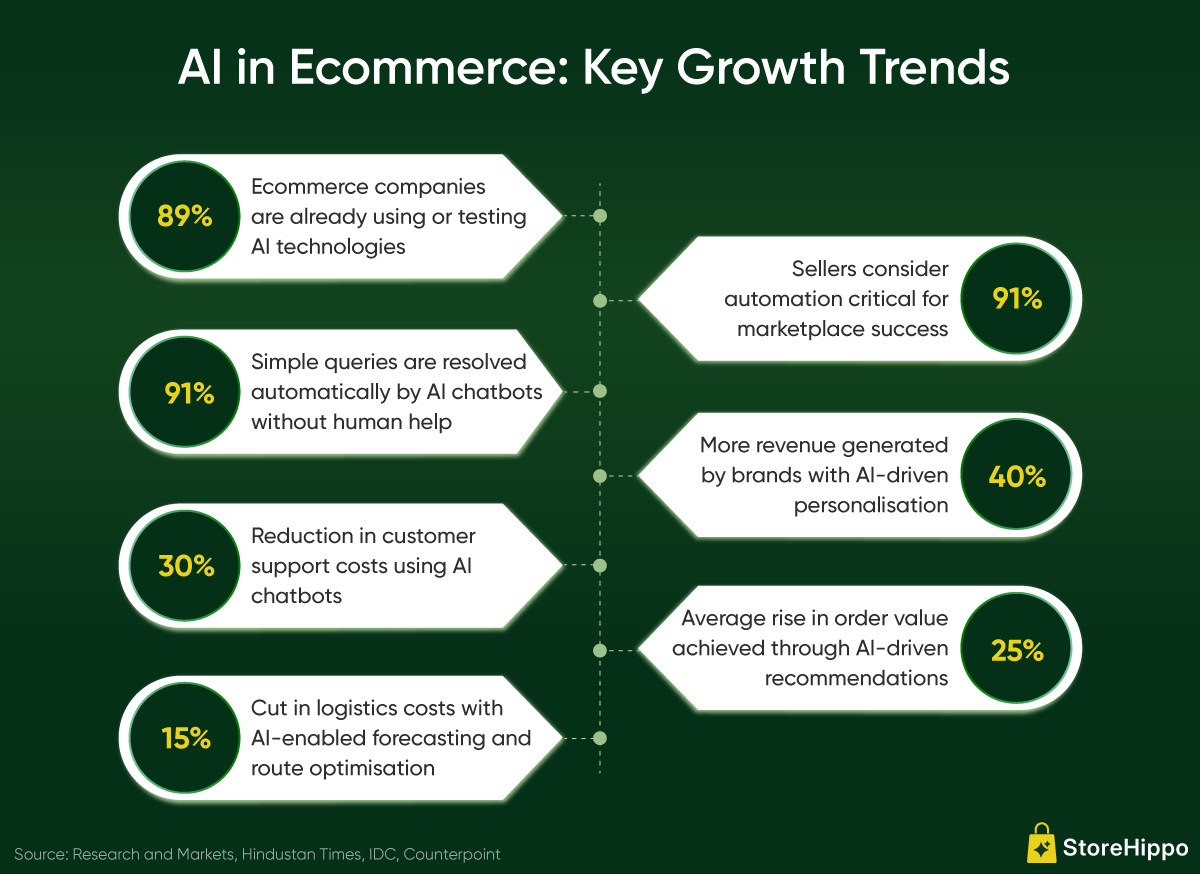
- 89% of ecommerce companies are already using or testing AI technologies
- 91% of sellers consider automation critical for marketplace success
- 91% of simple queries are resolved automatically by AI chatbots without human help
- 40% more revenue generated by brands with AI-driven personalisation
- 30% reduction in customer support costs using AI chatbots
- 25% average rise in order value achieved through AI-driven recommendations
- 15% cut in logistics costs with AI-enabled forecasting and route optimisation
Source: NVIDIA, Precedence Research, McKinsey, Emerge, Smartsupp
The benefits of AI are clear, but adding more AI features does not automatically make an ecommerce platform enterprise-ready. As your ecommerce business grows, your AI-powered ecommerce platform must be able to handle more data, users, channels and AI workloads without slowing down.
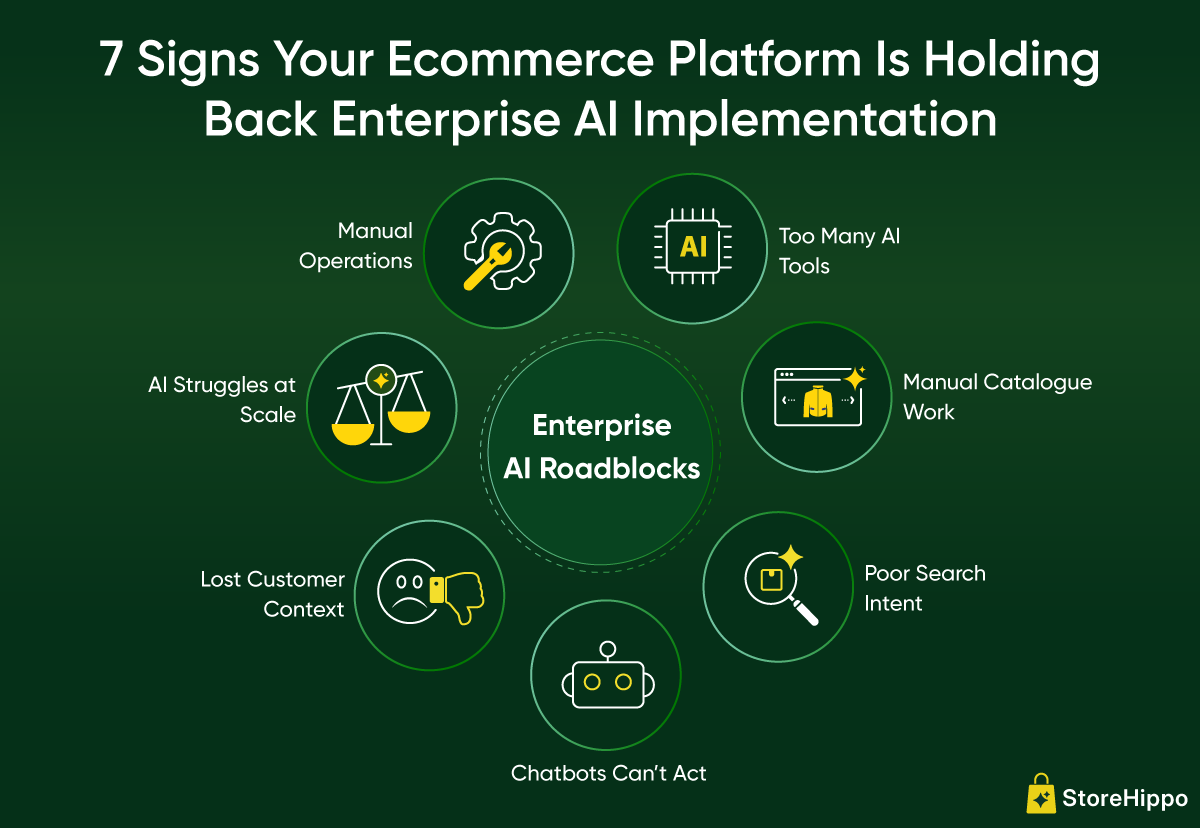
So, how do you know whether your platform is ready for that growth or already showing signs of its limits? The following seven signs can help you find out.
How to Identify Your Ecommerce Platform is Not Ready for Enterprise AI
As AI in ecommerce becomes core to everyday business, your platform needs to do more than simply offer a few AI features. It should bring AI closer to your products, customers and operations, helping your business use it in ways that actually support growth.
If your ecommerce platform is struggling to keep up with these changes, these seven signs can help you see where it may be falling short.
1. Every Workflow Needs a New AI
Imagine you run a large AI-powered fashion marketplace with hundreds of sellers. Your product team introduces AI-powered search to help shoppers find products faster. A few months later, the marketing team adds an AI tool for personalised recommendations, while customer support brings in a separate chatbot.
Individually, these tools seem useful. But they may not be using the same product or customer data. Your search tool could know that a dress is in stock, while the recommendation engine is working with older catalogue information. The support chatbot may have access to order details but no context about what the shopper has been browsing.
As more AI use cases are added, the technology stack becomes harder to manage. Teams have to maintain multiple integrations, vendors and data connections just to keep these experiences working together. What was meant to make the business smarter can end up creating more work behind the scenes.
This is a clear sign that your enterprise AI needs a different approach. Instead of adding a separate AI tool every time a new requirement comes up, your teams need to work with a connected commerce data and shared intelligence layer to create, connect and scale AI use cases across the entire commerce journey.
How StoreHippo helps
StoreHippo's AI-powered ecommerce platform is built on a unified AI core where every AI tool works together on the same business logic and data. By bringing intelligence into the commerce engine itself, it connects catalogue, discovery, operations and support together, allowing businesses to build different AI use cases without creating a disconnected AI stack.
2. Manual Effort In Cataloging and Product Launches
A platform may offer AI-powered recommendations or search, but that does not necessarily mean it is ready for enterprise AI. Look at what happens when your team adds new products. If they still have to categorise SKUs, write descriptions, add attributes and prepare images manually, your platform may not be using AI where it can create the most operational value.
As your catalogue grows, this manual work can quickly become a bottleneck. Teams spend more time preparing listings, product launches take longer and adding more sellers or SKUs means adding more operational effort.
For example, a distributor onboarding products from multiple suppliers may receive thousands of SKUs with inconsistent names, attributes and images. The team then has to clean, organise and enrich the data before publishing each listing. If your platform cannot help automate this process, scaling the catalogue will continue to depend heavily on manual effort.
A truly AI-powered ecommerce platform should bring AI into catalogue operations too. It should help teams create, classify, enrich and organise product information instead of limiting AI to what shoppers see on the storefront.
If your teams still handle most of this work manually, it is a sign that your ecommerce platform may not be fully ready for enterprise AI.
How StoreHippo helps
StoreHippo helps businesses simplify product content creation with AI-powered tagging and optimisation tools. Its AI image tool, Magic Edit, helps businesses transform raw product images into stunning and engaging visuals. Magic Edit automatically clear the background, adjusts lighting and standardises aspect ratio and more. Its AI-powered cataloguing automatically creates product content, including titles, descriptions, categories, tagging, HSN coding, etc directly from images. This brings AI into everyday catalogue operations, helping businesses reduce manual work instead of limiting AI to the customer-facing experience.
3. Search Doesn’t Understand Buyer Intent
A search bar can return results without really understanding what the buyer is looking for. The problem starts when buyers use their own words to describe what they want instead of typing the exact product name or keywords used in your catalogue.
For example, someone looking for a moisturiser for dry skin might simply type, “cream for dry and flaky skin.” But if your product listing uses words like, hydrating moisturiser instead, a basic search may not understand that the customer is looking for the same thing. They could end up scrolling through unrelated products or leave without finding the right one.
When your search only matches keywords, it can miss the meaning behind the query. The buyer then gets products that look related but do not actually solve the requirement.
A truly AI-powered ecommerce platform should do more than add AI to the search bar. It should understand what buyers mean and use your product, catalogue and inventory data to show them the most relevant results.
That is a key sign of enterprise AI readiness. When semantic, conversational and multilingual search works with your commerce data, buyers can find the right products faster without trying multiple searches or scrolling through irrelevant results.
How StoreHippo helps
StoreHippo’s AI-powered marketplace platform offers AI-powered semantic search that understands the natural language and context behind search queries instead of relying only on basic keyword matching. Its AI-powered recommendations use factors such as past purchases and browsing behaviour to suggest more relevant products. Together, these capabilities help buyers discover products that better match what they actually need.
4. Your Chatbot Can’t Complete the Job
Imagine a customer wants to change the delivery address for an order on your AI-powered marketplace. They open your chatbot, explain the issue and get clear instructions on how to make the change. But when they ask the bot to do it for them, it simply directs them to another page or asks them to contact support.
This is a small but clear sign that your AI is good at answering questions but not taking action. It can understand what the customer needs, but it cannot actually complete the task or resolve the issue for them.
If you see the same gap with returns, cancellations, refunds or delayed orders, and your customer still has to complete the task manually or repeat the issue to a human agent, then its high time you need to upgrade your ecommerce platform to implement enterprise AI. Enterprise-ready AI should connect conversations with the systems and workflows that actually get the job done.
How StoreHippo helps
StoreHippo enables enterprises to build custom agentic AI assistants that go beyond answering questions and support real commerce actions. These agents can connect with business data, APIs and workflows to help handle tasks such as order updates, refunds, support requests and other authorised actions, helping businesses move closer to true agentic commerce.
5. Customer Context Gets Lost Across Channels
Customer journeys span across 4-6 channels on average. A customer may start their buying journey on one channel and finish it somewhere completely different. The problem starts when your ecommerce platform cannot carry their context with them.
Consider a business buyer ordering packaging supplies from a B2B marketplace. They have bought the same cartons several times, usually in bulk, and have negotiated a special price with their sales representative. When they return through the mobile app, however, they see the regular price and generic product recommendations. The AI has no idea about their previous orders, negotiated pricing or buying patterns.
The same thing can happen in B2C. A customer spends time browsing running shoes on your website, asks your WhatsApp assistant about the right size and then opens your app to complete the purchase. If these channels do not share context, the app starts from scratch instead of continuing the journey.
This becomes a bigger problem as you add more AI-powered experiences. A recommendation engine may suggest products without knowing what the customer already purchased. A support assistant may ask questions the customer has already answered. A sales agent may not see what the customer has been exploring online.
That is a sign your enterprise AI is working with disconnected customer data rather than a complete commerce context. An AI-powered ecommerce platform should allow AI to understand relevant customer activity across channels and use that context to make the next interaction more useful.
How StoreHippo helps
StoreHippo’s AI-powered marketplace platform connects web, mobile apps, WhatsApp, partner portals, marketplaces and AI channels through a unified omnichannel commerce ecosystem. Its shared intelligence layer brings catalogue, discovery, operations and support together, allowing AI to work with relevant customer and commerce context across channels. This helps businesses deliver more connected experiences, whether customers are discovering products, seeking support or completing purchases on another channel.
6. AI Struggles When Business Grows
An AI feature can work perfectly during a pilot and still struggle when your business starts operating at a much larger scale.
Imagine an AI-powered marketplace testing personalised recommendations with a few thousand products. The results look promising. Then hundreds of sellers join, the catalogue grows rapidly and traffic spikes during a festive sale. Suddenly, recommendations take longer to load, search performance slows down and AI workloads start putting pressure on other parts of the platform.
This is when you find out whether your platform can really handle AI at scale.
The issue may not be the AI itself. Your ecommerce platform may simply not be built to handle growing AI workloads alongside search, checkout, catalogue management and marketplace operations.
For enterprise AI, your platform needs to scale as your business grows. It should handle increasing AI workloads without slowing down search, checkout, catalogue management or other commerce operations.
How StoreHippo helps
StoreHippo AI-powered marketplace platform takes a different approach by making AI a core part of its commerce architecture rather than treating it as a separate add-on. Its AI-native commerce engine provides a shared intelligence layer across catalogue, discovery, operations and support, so enterprises can introduce and scale AI use cases without building disconnected systems for each one.
Its composable, API-first architecture also gives enterprises the flexibility to extend commerce capabilities as their business grows. Whether the catalogue expands, more sellers come onboard, traffic increases or new AI use cases are introduced, businesses can scale their commerce ecosystem without having to rebuild the entire platform.
7. Operations Still Depend on Manual Work
This is the point when businesses realise their AI is only helping customers, but not doing enough for their teams.
An AI-powered marketplace platform may offer AI-powered recommendations and intelligent search, while sellers are still manually updating thousands of SKUs, support teams are switching between systems to resolve order issues and operations teams are chasing fulfilment exceptions.
Lets consider a seller on your marketplace receiving hundreds of new products every month. If their team still has to manually clean, categorise and enrich every listing, the business is not getting the full value from its AI investment.
That is a sign your enterprise AI strategy is focused more on customer-facing features than on the work that keeps your business running.
For an AI-powered marketplace, AI should go beyond creating a smarter buying experience. It should help sellers, support teams and operations teams work faster, reduce repetitive tasks and manage everyday commerce more efficiently.
How StoreHippo helps
StoreHippo brings AI into the workflows that keep an ecommerce business running, not just the customer-facing experience. Its shared unified intelligence layer connects catalogue, discovery, operations and support, giving AI access to the context it needs across these functions.
With its AI-native commerce engine, businesses can automate catalogue and content creation, , and use intelligent discovery and recommendations to reduce repetitive work. Custom agentic AI assistants can also support buyers, sellers and internal teams with everyday tasks and workflows.
This helps enterprises move from using AI for individual customer interactions to embedding intelligence across day-to-day commerce operations, making teams more productive as the business scales.
Conclusion
AI is quickly becoming part of how ecommerce businesses sell, serve customers and run day-to-day operations. But adding AI tools is not enough. As your business grows, disconnected AI, manual processes, poor customer context and limited scalability can hold back the value of your AI investment.
The right AI-powered ecommerce platform should bring intelligence into the core of commerce, connect data across channels and help both customers and teams work smarter. From intelligent discovery and agentic commerce to AI-powered cataloguing, omnichannel experiences and operational automation, your platform should be ready to support AI as your business evolves.
If your ecommerce platform is showing these warning signs, it may be time to rethink your AI strategy.
Want to build an ecommerce business that is ready for enterprise AI?
Book your personalised demo with StoreHippo now.
FAQs
1. How should enterprises evaluate the ROI of investing in enterprise AI for ecommerce?
Enterprises should evaluate enterprise AI ROI by looking beyond immediate cost savings and measuring its impact on revenue, conversion, productivity and customer experience. Track metrics such as increased average order value, faster catalogue launches, lower support costs, improved search-to-purchase rates and reduced manual effort. Comparing these gains against implementation, integration and operating costs gives enterprises a clearer picture of AI’s actual business value.
2. What should enterprises consider before adopting an AI-powered ecommerce platform?
Before adopting an AI-powered ecommerce platform, enterprises should evaluate its scalability, built-in tools, integration capabilities, security, unified omnichannel support and AI capabilities. The platform should work with existing commerce systems, handle growing product and transaction volumes, support multiple business models and connect AI across catalogue, discovery, operations and customer support. It should also make it easy to introduce new AI use cases without rebuilding the technology stack each time.
3. How can enterprises introduce AI in ecommerce without disrupting existing business operations?
Enterprises can introduce AI in ecommerce without disruption by starting with high-impact use cases and integrating AI into existing commerce workflows rather than replacing them at once. A scalable, API-first platform allows businesses to roll out AI across cataloguing, search, recommendations, support and operations gradually while keeping core ecommerce processes running.
4. How can enterprises use AI in ecommerce to create consistent experiences across multiple ecommerce channels?
Enterprises can use AI in ecommerce to create consistent experiences by connecting customer, catalogue and commerce data across every channel. A unified AI layer can use the same product information, customer context and business rules across websites, mobile apps, WhatsApp, marketplaces and partner portals, ensuring customers receive relevant recommendations, pricing, support and interactions wherever they shop.
5. How can an AI-powered marketplace support different customer segments and business models at scale?
An AI-powered marketplace can support different customer segments and business models by using a shared AI layer to adapt experiences, recommendations, pricing and workflows based on customer, seller and business context. This allows enterprises to serve B2B, B2C, D2C and B2B2C models from the same commerce ecosystem while scaling products, sellers, customers and AI use cases without creating separate systems.
6. What should enterprises look for when comparing AI capabilities across ecommerce platforms?
Enterprises should compare whether an ecommerce platform offers AI across the entire commerce journey, not just standalone features. Look for capabilities such as AI-powered cataloguing, semantic search, recommendations, conversational buying, agentic AI, automation and customer support. Also check whether these capabilities share a common intelligence layer, scale with business growth and integrate smoothly with existing systems and channels.
7. How can enterprises use enterprise AI to create more relevant customer journeys while maintaining brand consistency?
Enterprises can use enterprise AI to personalise customer journeys by using customer behaviour, preferences, purchase history and real-time context to tailor recommendations, search results and interactions. At the same time, shared business rules, product data and brand guidelines help ensure these personalised experiences remain consistent across every channel.
8. When should an enterprise ecommerce business consider adopting agentic commerce?
An enterprise ecommerce business should consider agentic commerce when customers and teams need AI to do more than answer questions or make recommendations. It makes sense when AI can securely handle tasks such as product discovery, order updates, returns, reorders or support actions, helping customers complete their buying journey with less manual intervention.
9. How can enterprises make their ecommerce stack ready for future AI innovations?
Enterprises can make their ecommerce stack ready for future AI innovations by choosing a scalable, API-first architecture with connected data and AI built into the core commerce ecosystem. The stack should support new AI use cases without major rework, integrate easily with existing systems, and scale across products, customers, channels and operations as the business grows.
10. What should enterprises ask vendors before choosing an AI-powered ecommerce platform?
Enterprises should ask vendors about the platform’s AI capabilities, scalability, integrations, data architecture, security and support for future AI use cases. They should also understand whether AI is built into the core platform or added through separate tools, how easily it can scale across channels and business models, and what measurable business outcomes it can deliver.
Kriti Aggarwal is the Co-Founder of StoreHippo and Mystore, with 20+ years of experience across business strategy, product development, brand positioning, and marketing for enterprise brands, MSMEs, and first-time digital adopters across B2B, D2C, and B2B2C models. She has a strong track record of building and scaling digital commerce initiatives through product leadership and go-to-market execution.
She shares experience-based insights on AI-powered commerce, digital transformation, and scalable ecommerce platforms, helping businesses use technology to simplify operations, enhance customer experiences, and drive sustainable growth.