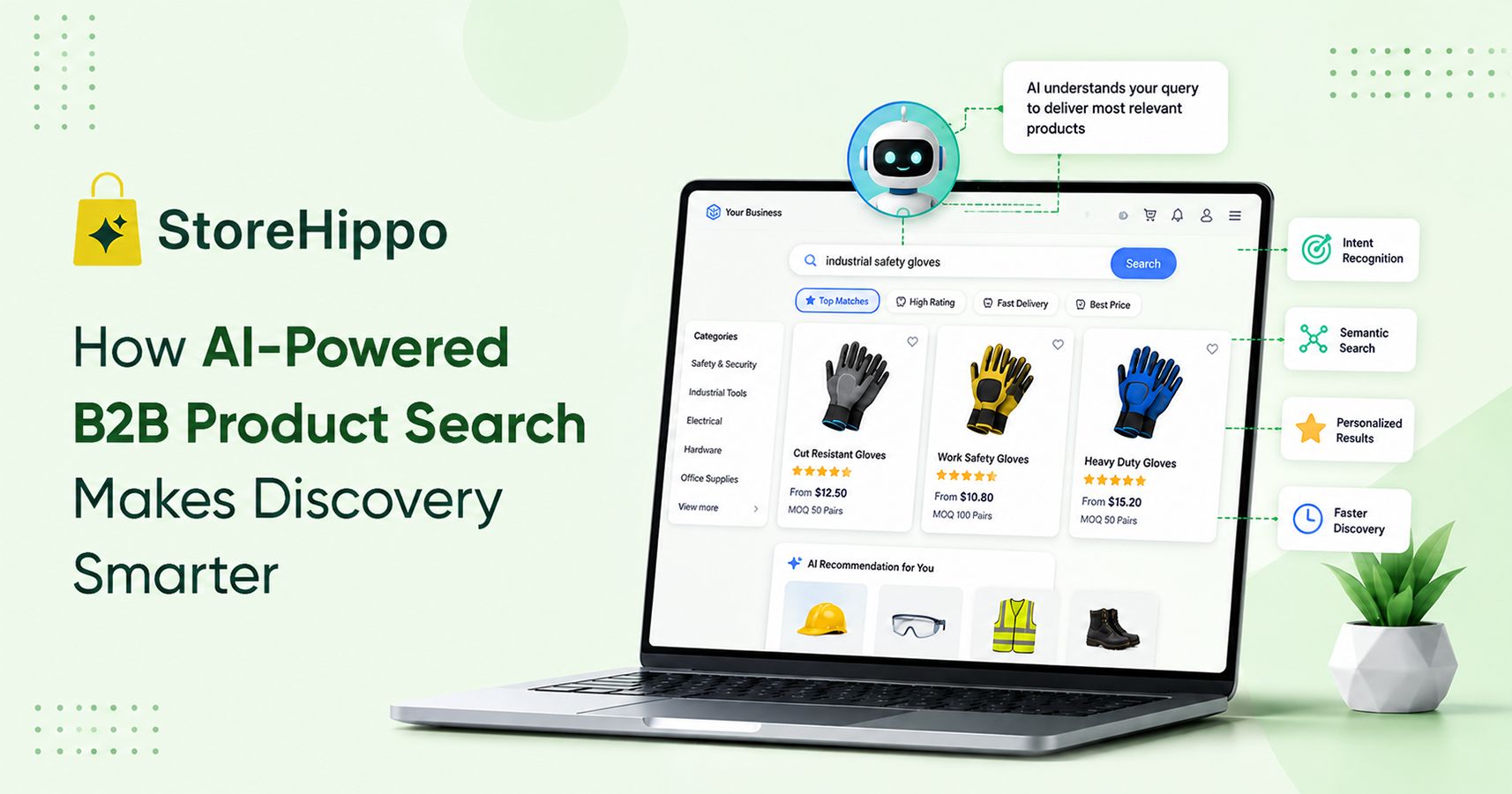



B2B buyers, conditioned by the ease of their B2C experiences, increasingly expect the same simplicity when buying from large wholesale catalogues. What was difficult to deliver a few years ago can now be handled far more effectively with AI-Powered B2B Product Search.
For enterprises, the challenge is not just helping buyers find a product. Search has to work across thousands of SKUs, technical specifications, variants, customer-specific catalogues, negotiated pricing and business rules. Buyers may search by use case, attribute, part number or everyday terminology rather than the exact language used in the catalogue.
An AI-powered B2B ecommerce platform can bridge that gap by making search more intent-aware and context-driven. With semantic search for B2B ecommerce, enterprises can make large catalogues easier to navigate while still preserving the pricing, access and purchasing logic that makes B2B commerce fundamentally different from B2C.
Table of Contents
- Why Large Enterprise Brands Need An AI-Powered B2B Ecommerce Platform
- Why Is Product Search Difficult in Large B2B Catalogues Without AI-Powered Search?
- How Can AI-powered B2B product search Help With Faster Search and Sales?
- 1. Find Relevant Products Faster With Intent-Based Search
- 2. Search Products Naturally Without Knowing Exact SKUs
- 3. Get Relevant Results Even With Misspellings and Industry Terms
- 4. Discover Compatible Products and Alternatives Faster
- 5. See More Relevant Products Based on Buyer Context
- 6. Get Guided Product Recommendations Through Conversational AI
- 7. Turn Better Product Discovery Into Faster Sales
- Real-World Use Cases of AI-Powered Product Discovery in B2B Ecommerce
- How StoreHippo Accelerates AI-Powered Search for B2B Ecommerce
- Conclusion
- FAQs
Why Large Enterprise Brands Need An AI-Powered B2B Ecommerce Platform
AI is changing the way B2B buyers search, evaluate, and purchase products. Buyers now expect faster responses, relevant recommendations, personalised experiences, and smoother shopping journeys, rather than the one-size-fits-all buying experience that traditional B2B ecommerce offered. For large enterprises, an AI-powered B2B ecommerce platform helps bring these expectations into everyday buying while making sales and operations more efficient.
The shift is not just about adding AI features to an existing ecommerce setup. It is about using AI to make every stage of the B2B buying journey smarter, from product discovery and personalisation to sales support, conversion and customer retention.
Here are a few numbers that show how AI is influencing B2B ecommerce growth:
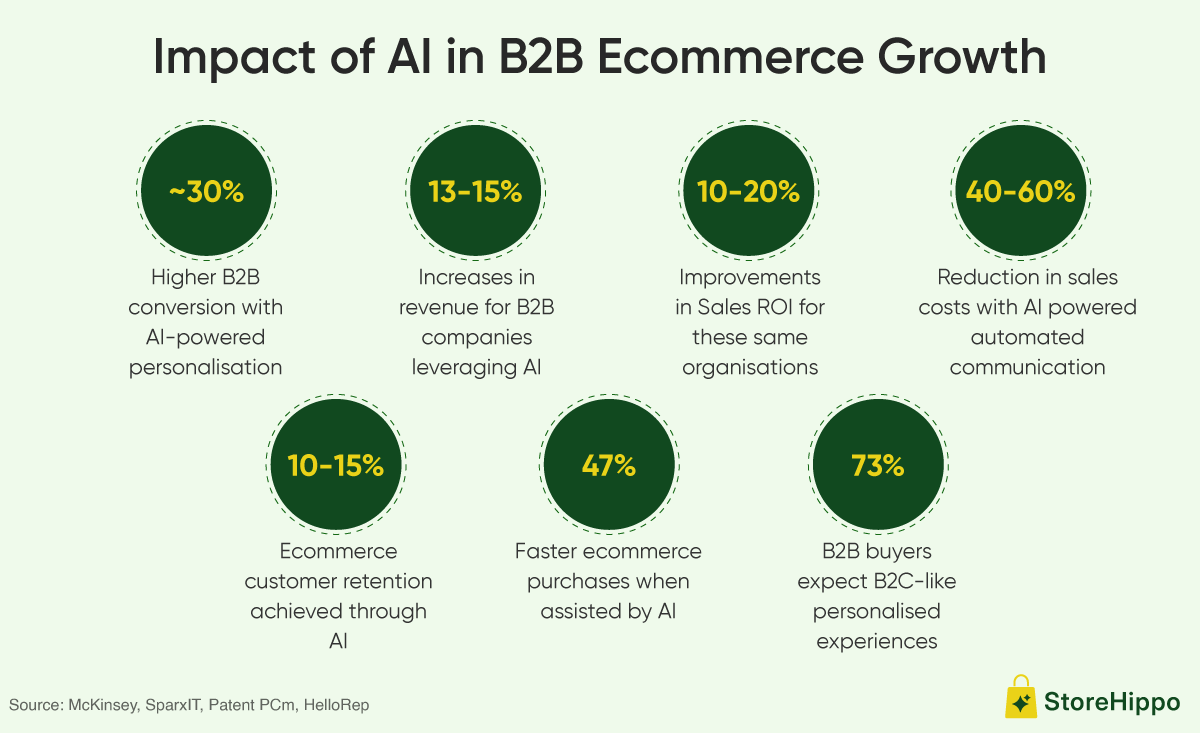
- ~30% higher B2B conversion with AI-powered personalisation
- 13-15% increases in revenue for B2B companies leveraging AI
- 10-20% improvements in Sales ROI for these same organisations
- 40-60% reduction in sales costs with AI-powered automated communication
- 10% to 15% e-commerce customer retention achieved through AI
- 47% faster ecommerce purchases when assisted by AI
- 73% of B2B buyers expect B2C-like personalised experiences
Source: McKinsey, SparxIT, Patent PCm, HelloRep
The numbers point to a clear shift: AI has become a core growth driver for B2B enterprises, not just another technology trend. From improving conversions and revenue to reducing sales costs and speeding up purchases, AI can help large brands build more responsive buying journeys while giving sales teams and customers a smarter way to do business.
Why Is Product Search Difficult in Large B2B Catalogues Without AI-Powered Search?
Finding a product in a B2B catalogue isn’t always as easy as typing its name and hitting search. With thousands of SKUs, technical specifications, variants and buyer-specific rules, buyers can quickly end up scrolling through pages of irrelevant results.
Here are some common challenges enterprises can face when buyers search through large B2B catalogues without AI-powered search:
1. Thousands of Similar Products and Variants
In a large B2B catalogue, “almost right” simply doesn’t work. Imagine a buyer For example, a buyer searching for an industrial bolt may find dozens of similar products, but the required size, material or grade could be different. One small mismatch can mean the product doesn’t work for the intended application.
2. Buyers Search Using Different Terminology
B2B buyers don’t always search for products using the same words. A manufacturer may use a technical term, a distributor may use an industry name, while a procurement manager might use the term they’re familiar with internally. When the same product is described in different ways, basic keyword search can easily miss the buyer’s intent.
3. Buyers May Not Know the Exact SKU
A B2B buyer may not know the exact product name or SKU when they start searching. They might type what they need the product to do, where they plan to use it or even describe the problem they’re facing. If search only looks for exact keywords, it can easily miss what the buyer actually wants.
4. Catalogue Access May Vary by Buyer
Enterprise B2B catalogues are rarely one-size-fits-all. One buyer may have access to specific products, negotiated prices and pack sizes that another buyer cannot see. Search therefore needs to consider customer-specific catalogues, MOQs, inventory, pricing and regional availability before showing results.
Without intelligent search, these gaps can make product discovery slower, frustrating and more likely to lead to missed sales.
How Can AI-powered B2B product search Help With Faster Search and Sales?
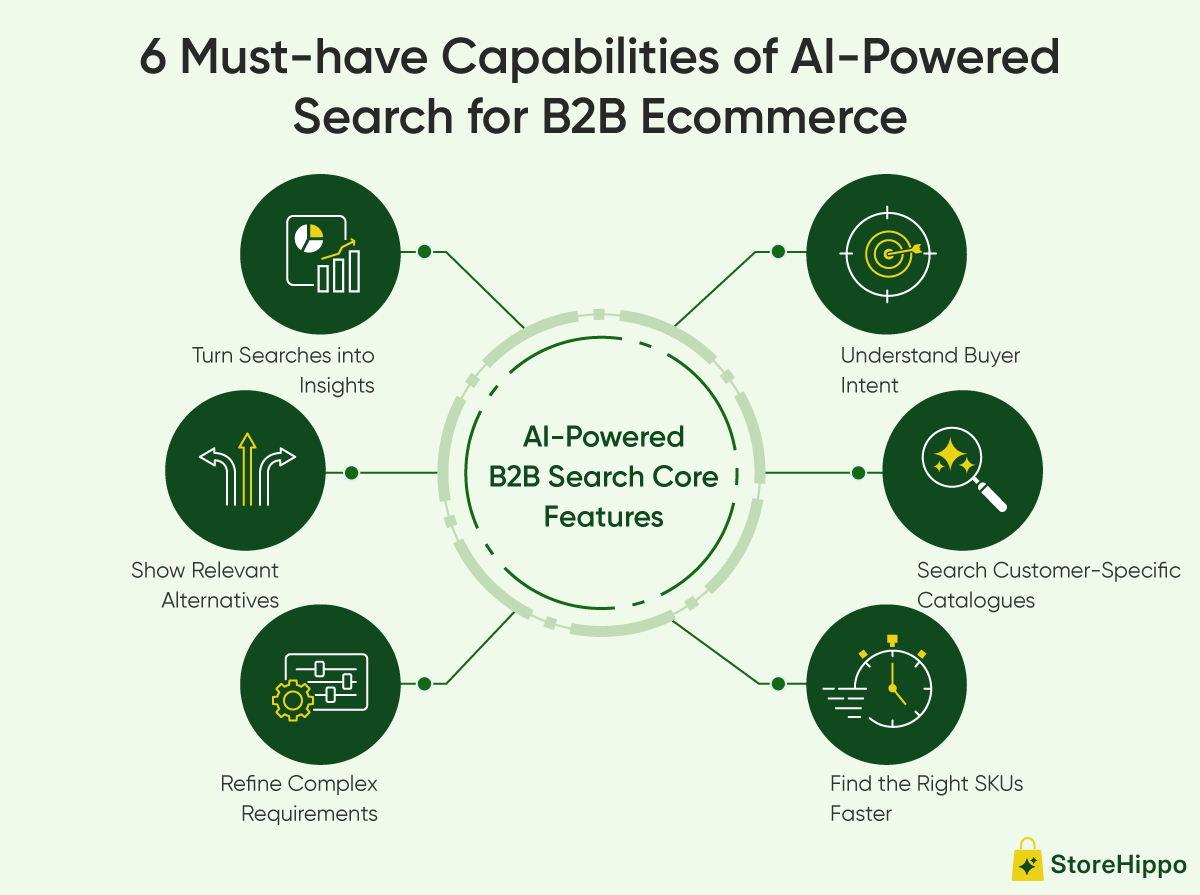
For enterprise B2B businesses, every extra search, filter and product page adds friction to the buying journey. AI-Powered B2B Product Search makes the journey easier by understanding what they’re looking for and helping them find the right products faster.
Here’s how AI-Powered B2B Product Search can make B2B buying faster and easier:
1. Find Relevant Products Faster With Intent-Based Search
B2B buyers rarely search in the exact language used in a product catalogue. They may search by application, use case, specification or the problem they need to solve. This is where AI-Powered B2B Product Search can go beyond keyword matching and understand the intent behind the query.
For example, instead of searching for the technical name of a specific protective glove, a buyer may enter “gloves for chemical handling.” AI can interpret the application, connect it with relevant catalogue attributes and surface products designed for that use. The result is a shorter path from a broad requirement to a relevant product.
2. Search Products Naturally Without Knowing Exact SKUs
Large B2B catalogues can contain thousands of SKUs, product codes and technical variations. Expecting buyers to remember those codes or navigate through multiple catalogue levels is hardly an efficient buying experience. AI allows buyers to describe what they need in the language they naturally use.
For instance, a distributor searching for “25 kg rice bags for wholesale supply” does not need to know the exact SKU or catalogue classification. The AI-powered search can interpret the product type, pack size and buying context to bring relevant options to the surface. That can significantly reduce the time spent navigating a large catalogue.
3. Get Relevant Results Even With Misspellings and Industry Terms
B2B buyers often use the term they are familiar with. A distributor may use a short form, a sales representative may use an industry term, or a buyer may simply make a spelling mistake while searching. A traditional search may fail when the words don’t exactly match the catalogue. AI-powered B2B ecommerce platforms can understand these variations and connect them with relevant products.
Consider a buyer who searches using a commonly used industry term while the catalogue uses a formal product name. An AI-powered search engine can recognise the relationship between the two and still surface relevant products. This makes the catalogue easier to navigate without forcing buyers to learn the seller’s product terminology first.
4. Discover Compatible Products and Alternatives Faster
In B2B, finding one product is often only the first part of the purchase. Buyers may also need accessories, replacement parts or products that work with the item they have selected. AI-Powered B2B Product Search can make these connections easier to discover.
For example, an electrical distributor searching for a particular switch may also need compatible plates and accessories. Instead of searching for each item separately, AI can surface related products along the way. This saves time and makes it easier for buyers to put together a complete order.
5. See More Relevant Products Based on Buyer Context
B2B businesses often sell differently to different customers. One buyer may have negotiated pricing, another may have access to specific brands, while a third may have different MOQs or product availability based on their location. A good AI-powered search experience should take these differences into account.
Let’s imagine a distributor has negotiated pricing and exclusive access to a particular brand. The search can prioritise products available under that agreement, instead of showing products the buyer cannot purchase or prices that don’t apply to their account. This keeps product discovery relevant to the buyer’s actual account and makes the buying journey much smoother.
6. Get Guided Product Recommendations Through Conversational AI
Some B2B requirements cannot be explained with just two or three search words. A buyer may need to consider several things such as application, quantity, size, specifications, compatibility or certification before selecting a product. A conversational AI assistant can make this process easier by asking questions and guiding the buyer step by step.
Let’s imagine a procurement team is sourcing 50 laptops for a new office. They need to stay within a set budget and have specific configuration requirements. Instead of going through dozens of product pages and comparing specifications manually, they can share these requirements with an AI assistant. The assistant can understand the context, narrow down relevant options and help the team get to the right products faster.
7. Turn Better Product Discovery Into Faster Sales
Better B2B search isn’t just about helping buyers find products. When they can quickly find the right SKU, compare relevant options and get useful recommendations, they can move from product discovery to an enquiry, RFQ or purchase much sooner.
For example, imagine a procurement manager looking for 500 units of a specific industrial component. Instead of spending time browsing multiple product pages, the buyer can use AI-powered search to describe the required specifications, quantity and application. The system can surface the most relevant products, compatible alternatives and available options, helping the buyer move to an RFQ much faster.
For B2B sellers, this means helping more buyers quickly find the products they need and move smoothly towards the next step in their purchase journey. An AI-powered B2B ecommerce platform can make product search faster, simplify RFQs and help buyers move confidently from product discovery to purchase.
The difference becomes clearer when you compare how traditional catalogue search handles product discovery versus what an AI-powered approach can do.
The table below highlights how AI-Powered B2B Product Discovery can make search more relevant, personalised and easier for buyers.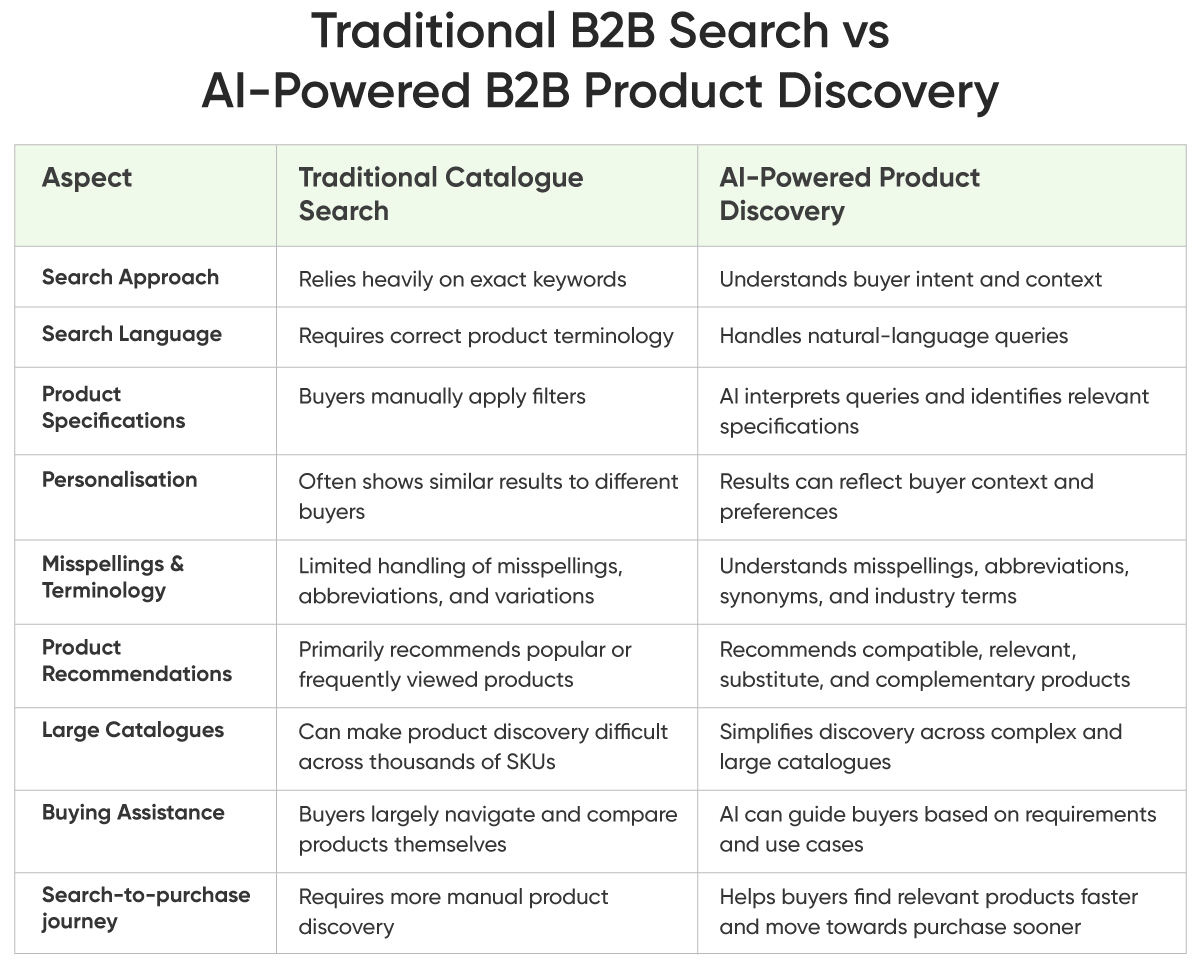
Faster product search can have a direct impact on the B2B buying journey. By understanding buyer intent, context and requirements, AI-Powered B2B Product Search can help buyers reach the right products with fewer steps.
For B2B businesses, this means a smoother path from search to enquiry, RFQ and purchase, while creating more opportunities to convert high-intent buyers into sales.
Real-World Use Cases of AI-Powered Product Discovery in B2B Ecommerce
From machinery and spare parts to hospitality supplies, business buyers often search for products using detailed requirements rather than simple product names. AI-powered product discovery helps turn these requirements into faster, more relevant product searches.
Here are some real-world use cases that show how AI can improve product discovery across B2B industries:
1. Industrial Equipment and Machinery
Industrial buyers often need equipment that meets specific requirements such as machine capacity, size or operating conditions. AI-powered product discovery can understand these requirements and help buyers find suitable equipment faster.
Here’s how AI can simplify equipment search:
- Search by machine specifications and operating conditions
- Find equipment based on compatibility requirements
- Narrow down thousands of similar products faster
- Discover suitable alternatives when a preferred product is unavailable
2. Automotive Spare Parts
Finding the right spare part often depends on details such as the vehicle model, year, variant or part number. Semantic search for B2B commerce can understand these details and help buyers find the right parts without searching through a large catalogue.
Here’s how AI can simplify spare parts search:
- Search by vehicle model, year and variant
- Match products using part numbers
- Find suitable alternatives and compatible parts
- Use product images to help identify the required part
3. Electrical and Electronic Components
A small difference in voltage, capacity or dimensions can make an electronic component unsuitable. AI-powered search helps buyers find products that match their technical requirements more accurately.
Here’s how AI can simplify electronic component search:
- Search by voltage, capacity and dimensions
- Find components based on compatibility
- Filter products by required certifications
- Quickly narrow down similar components and variants
4. Construction Materials
Construction materials buyers usually search for materials based on what a project needs, rather than just the product name. AI can understand requirements such as material type, grade and quantity and bring relevant products together.
Here’s how AI can simplify construction material search:
- Search by material type and grade
- Find products based on required quantities
- Match materials with project-specific requirements
- Discover relevant alternatives across the catalogue
5. Medical and Laboratory Supplies
Medical and laboratory procurement often requires buyers to meet specific technical and compliance requirements. AI-powered search can make it easier to find suitable products while keeping approved brands and requirements in view.
Here’s how AI can simplify medical and laboratory product search:
- Search using technical product requirements
- Find products from approved brands
- Discover products based on compliance information
- Narrow down suitable supplies faster for procurement teams
6. Hospitality Procurement
Hotel franchise networks often need to source a wide range of products from verified suppliers while keeping pricing, catalogues and procurement workflows organised. AI can help buyers find relevant hospitality products faster across a centralised catalogue.
Here’s how AI can simplify hospitality procurement search:
- Search across products from multiple verified suppliers
- Find products based on specific procurement requirements
- Compare relevant products and supplier options faster
- Discover suitable products across a centralised hospitality catalogue
7. Chemicals and Construction Materials
B2B buyers often need to source products across different categories, user requirements and sales channels. AI can help them discover relevant products faster while making it easier to navigate a large and diverse catalogue.
Here’s how AI can simplify construction material search:
- Search by product type, application and technical requirements
- Find suitable products across multiple categories and sellers
- Discover relevant options based on specific project needs
- Narrow down products faster across a large catalogue
Across these industries, AI makes it easier for buyers to find, compare and shortlist products without spending hours navigating large catalogues. For B2B businesses, this can create a smoother buying journey while helping buyers reach the right products faster.
How StoreHippo Accelerates AI-Powered Search for B2B Ecommerce
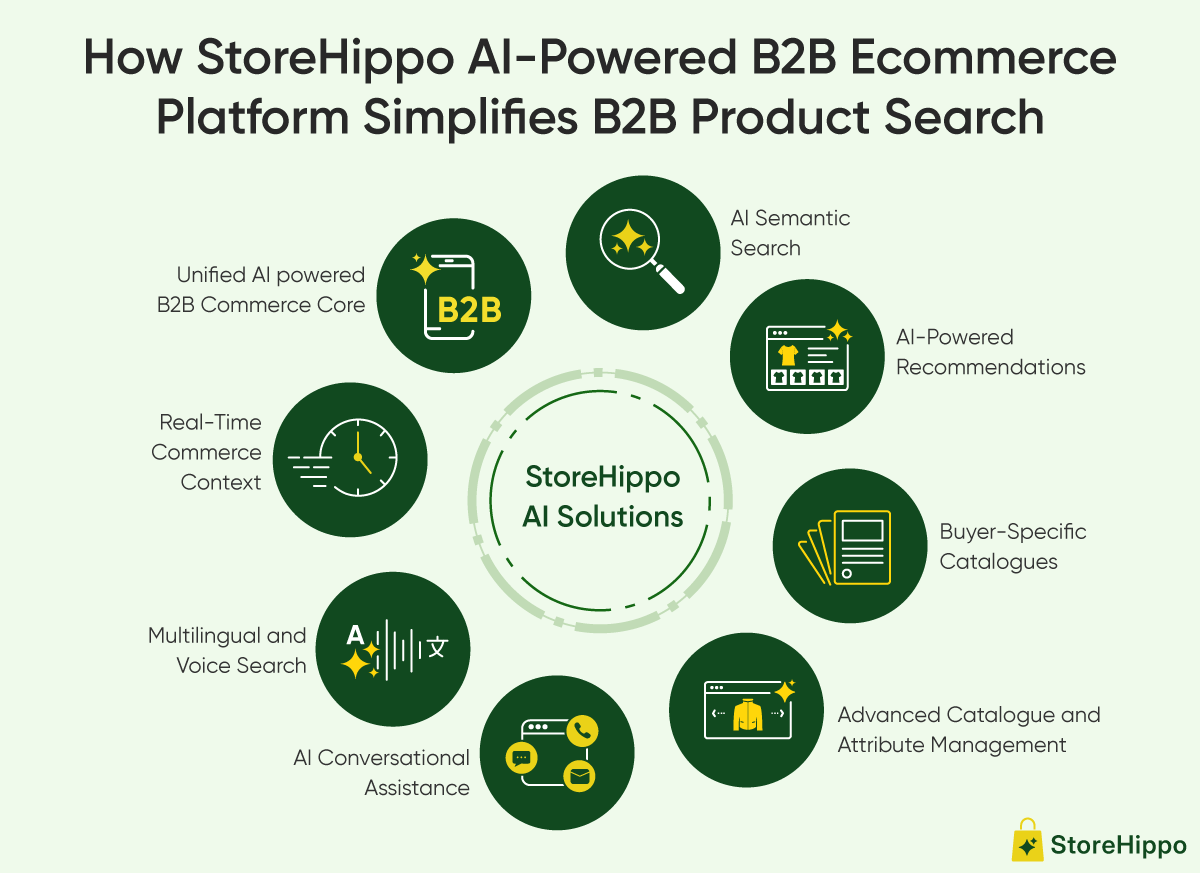
Finding the right product is only one part of the B2B buying journey. Search also needs to understand the catalogue, buyer-specific rules, product availability and purchasing requirements behind that search. StoreHippo AI-powered B2B ecommerce platform brings these elements together to help B2B businesses make product discovery faster, more relevant and easier to manage.
1. AI Semantic Search
B2B buyers may know what they need without knowing the exact terminology used in your catalogue. StoreHippo’s AI semantic search for B2B commerce helps connect their natural-language queries with relevant products, making large catalogues easier to explore and reducing the effort needed to find the right SKU.
2. AI-Powered Recommendations
Once a buyer finds a product, they may still need an alternative, a related item or something that completes the order. StoreHippo’s AI-powered recommendations help businesses bring these products into the buying journey, giving buyers more useful choices without making them search from scratch.
3. Buyer-Specific Catalogues
B2B businesses rarely sell to every customer under the same terms. StoreHippo AI-powered B2B ecommerce platform supports buyer-specific catalogues, allowing businesses to manage different products, pricing, MOQs and access rules for different customer groups. Buyers can therefore work with the catalogue and purchasing terms that apply to their business.
4. Advanced AI-powered Catalogue and Attribute Management
As the number of SKUs grows, keeping product information organised becomes increasingly important. StoreHippo’s advanced AI-powered catalogue and attribute management helps businesses structure specifications, variants, categories and product details automatically from a product image, giving buyers cleaner information to work with and teams a more manageable catalogue.
5. AI Conversational Assistance
Some buyers know what they need but may not know which product to choose or how to search for it. With StoreHippo, businesses can build custom AI bots that understand buyer requirements, answer product-related questions and help narrow down suitable products. This allows buyers to get guided product assistance and move ahead in their buying journey without relying on sales teams for every query.
6. Multilingual and Voice Search
B2B businesses often serve buyers across different regions and language preferences. StoreHippo’s multilingual and voice search capabilities can make it easier for buyers to interact with large catalogues in ways that feel natural to them, helping businesses serve a wider range of customers.
7. Real-Time Commerce Context
Showing a product that is out of stock or unavailable to a particular buyer can quickly create frustration. StoreHippo AI-powered B2B ecommerce platform connects search with inventory, pricing and availability, helping businesses give buyers a more accurate view of what they can actually purchase at the time of search.
8. Unified AI powered B2B Commerce Core
Product search works best when it is connected with pricing, catalogues, orders and buyer workflows. StoreHippo brings these capabilities together through a unified AI-powered B2B commerce core, helping businesses manage product discovery and the wider buying journey through one connected platform.
Conclusion
The next stage of B2B ecommerce will not be about making buyers work harder to understand a catalogue. It will be about making the catalogue understand the buyer. As product ranges grow and buying journeys become more digital, AI-Powered B2B Product Search can become an important part of how enterprises stay competitive.
For businesses planning their next phase of digital commerce, investing in an AI-powered B2B ecommerce platform is less about adding another search feature and more about building a buying experience that can keep up with changing buyer expectations.
Ready to build a smarter B2B buying experience? Book a personalised demo with StoreHippo now.
FAQs
1. What is AI-powered B2B product search?
AI-powered B2B product search uses semantic search for B2B commerce and contextual understanding to interpret buyer intent, product specifications, synonyms and natural-language queries. Unlike traditional keyword search, it can help buyers find relevant products even when they don’t use the exact product name or terminology used in the catalogue.
2. How Does AI-Powered Search Improve Product Discovery in Large B2B Catalogues?
AI-powered search improves product discovery by understanding buyer intent, natural-language queries, product specifications and industry terminology. It helps buyers find relevant products faster across large B2B catalogues, even when they do not know the exact product name, SKU or terminology used by the seller.
3. What is the difference between traditional search and AI-powered search in B2B ecommerce?
Traditional B2B ecommerce search primarily depends on exact keywords, product names and predefined filters. AI search can understand synonyms, context, specifications and natural-language queries, making it easier for buyers to discover products even when their search terms do not exactly match the catalogue data.
4. Can AI-powered search work with buyer-specific pricing and B2B catalogues?
Yes, provided the AI search layer is connected to the underlying B2B commerce platform. Search results can then respect buyer groups, restricted catalogues, negotiated pricing, MOQ rules, inventory availability and access permissions, so each buyer sees products relevant to their account and purchasing terms.
5. How does StoreHippo support AI-powered search for B2B ecommerce?
StoreHippo AI-powered B2B ecommerce platform supports AI-powered product discovery for B2B ecommerce through AI semantic search, AI-powered recommendations, conversational assistance, buyer-specific catalogues and advanced catalogue management. These capabilities help buyers find relevant products faster while businesses manage large catalogues, customer-specific pricing, product attributes and purchasing rules more efficiently.
Pallavee Kumar brings over 20 years of hands-on ecommerce experience, having helped enterprise brands scale through strong operations and clear storytelling.
She combines operational expertise with strategic storytelling to translate complex B2B commerce and AI concepts into actionable insights, enabling businesses to scale efficiently and achieve meaningful outcomes.