


Every week, I speak with enterprise brands evaluating enterprise ecommerce solutions. Some are moving away from platforms they've simply outgrown. Others are rebuilding after discovering that what looked like the right decision during implementation became increasingly difficult to manage as the business expanded.
What's interesting is how these conversations have changed.
In 2024, most discussions focused on scalability, integrations, performance, and cost. By mid-2026, the questions became far more strategic. Today, enterprise leaders want to know how AI fits into the platform, how much can be automated, how quickly new business models can be launched, and whether the technology can keep up with change.
Because, enterprise commerce is literally changing every quarter. New channels emerge. Dealer networks expand. Business models evolve. Customer expectations shift. And to top it all, AI is changing how buyers discover, evaluate, and purchase products.
The brands that make the best decisions aren't usually looking for the longest feature list. They're looking for a platform that can support the business they'll become three years from now, not just the one they run today.
The real test of an enterprise ecommerce solution isn't what it can demo. It's how well it adapts when the business inevitably changes.
Here are ten things enterprise brands are already looking for in an enterprise ecommerce solution for 2027. Some of these questions come up during evaluations. Others usually surface much later, after teams have already experienced the consequences of choosing the wrong foundation.
- Kriti Aggarwal, Co-Founder & CPO, StoreHippo & Mystore
Table of Contents
- 10 Questions Every Enterprise Brand Should Be Asking Their Solution Provider
- 1. "How do we know your enterprise AI is actually smart, or are you just using the same standard plug-ins as everyone else?"
- 2. "If our business model changes next year, can the B2B ecommerce platform accommodate it or will we need a complete overhaul? "
- 3. "Our buyers move across mobile, desktop, and WhatsApp during their purchase journey. Will their cart and profile actually follow them across channels?"
- 4. "Does 'mobile-first' mean our site looks okay on a phone or can we actually build and manage apps people will download?"
- 5. "Our B2B pricing is complex, personalised and tiered by customer, region, and contract. Can the platform handle this natively without plugins?"
- 6. "We run multiple regional websites and brand stores for our B2B marketplace. Can one team manage all of them from a single login?"
- 7. "How does the platform handle international currencies and local tax rules, natively, or through add-ons we'll pay for separately?"
- 8. "As more buyers start using AI to discover products and place orders, how do we make sure our business is ready?"
- 9. "Beyond the subscription price, what will we actually end up paying for our enterprise ecommerce solutions?"
- 10. "If we add a D2C marketplace to our wholesale business next year, will the same B2B ecommerce platform work?"
- Conclusion
- FREQUENTLY ASKED QUESTIONS
10 Questions Every Enterprise Brand Should Be Asking Their Solution Provider
Based on hundreds of actual client conversations around platform evaluations,and digital transformations, here are 10 critical questions every enterprise brand should be asking before making a long-term technology decision:
1. "How do we know your enterprise AI is actually smart, or are you just using the same standard plug-ins as everyone else?"
Real enterprise AI must be integrated directly into your platform's core data layer, allowing it to process live catalogs, order histories, and buyer behaviors simultaneously. While platforms use trusted foundational models, the differentiator is structural orchestration. Native data alignment prevents the sync lags and generic results caused by uncoordinated, third-party plugin stacks.
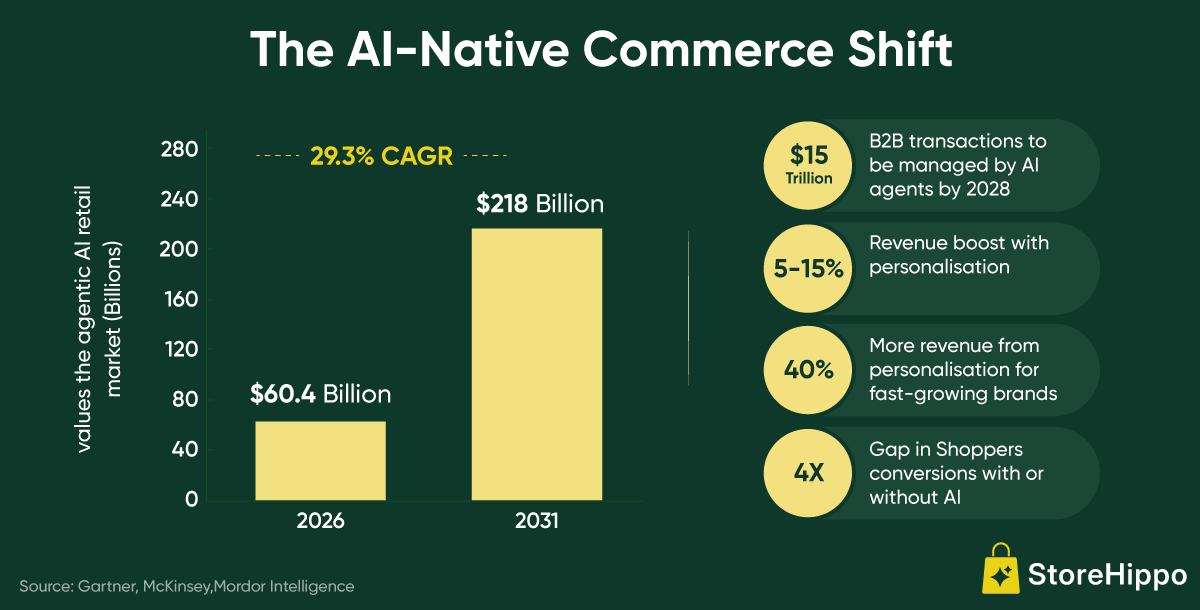
- Gartner projects AI agents will manage over $15 trillion in B2B transactions by 2028 platform AI is now a direct revenue lever, not a search widget.
- McKinsey puts the personalisation revenue boost at 5-15%, with fast-growing brands drawing 40% more revenue from personalisation than their slower peers.
- Mordor Intelligence values the agentic AI retail market at $60.4 billion in 2026, growing to $218 billion by 2031 at 29.3% CAGR, mainstream adoption, not a pilot phase.
- Shoppers who engage with AI convert at 12.3% versus 3.1% for those who don't, a 4x gap that compounds fast at enterprise scale.
Cutting Through the Buzzword
If you're evaluating AI-powered enterprise ecommerce platforms for some time now, you've probably heard every vendor claim to be "AI-powered." The phrase has become so overused that it tells you almost nothing about how the technology actually works.It has become a meaningless marketing checkbox, making it the very first thing you must interrogate to separate real tech from corporate hype.
The differentiator isn't using third-party AI models, almost everyone leverages trusted global foundations. The true test is integration depth. Most platforms rely on superficial, bolt-on plugins that fetch data across separate, fragmented APIs with every click. This disjointed setup causes noticeable sync lags, spikes your page load times, and serves your buyers completely generic product recommendations.
How StoreHippo Solves It
At StoreHippo, AI isn't treated as a separate feature layer. It's embedded into the platform's core architecture, allowing catalogs, customer behavior, orders, inventory, and operational workflows to work together in real time. The result is faster automation, more relevant recommendations, better search experiences, and more intelligent commerce operations. We combine powerful infrastructure like MongoDB Atlas, Google Gemini and trusted foundational models to achieve these results. Because the system orchestrates this data synchronously, it reads true customer intent instead of just guessing based on isolated keyword matches.
When evaluating an AI-powered enterprise ecommerce platform, it helps to look past the generic presentation script. Use these targeted, architectural questions to understand exactly how a vendor's software orchestrates its data under the hood:
- "Does your AI semantic search query our platform's live database to analyze historical buying patterns, or is it just scanning basic product titles?"
- "Are your digital shopping assistants hooked into up-to-the-second transaction and inventory data, or are they pulling from stale, cached product feeds?"
- "Can the platform natively automate catalog creation, HSN tagging, and product categorisation via AI, or does it require external data middleware to connect the pieces?"
If a vendor cannot clearly explain the data flow between their AI features and your core inventory, it usually means the intelligence is a superficial add-on rather than a native part of their platform workflow.
2. "If our business model changes next year, can the B2B ecommerce platform accommodate it or will we need a complete overhaul? "
Modern enterprise platforms must decouple your backend business logic from your frontend customer touchpoints. If your platform is built as a rigid monolith, even small changes can become expensive projects. The best enterprise ecommerce platform is one with a flexible, API-first architecture that gives you the freedom to evolve without rebuilding your entire commerce operation and overhauling your ecosystem.
The Reality of Change
One thing I've learned from working with enterprise brands is that growth rarely follows the original plan.
A new geography opens up. A distributor network needs its own portal. A D2C business expands into B2B. A marketplace becomes a strategic priority. These aren't exceptions. They're part of growth.
That's why choosing an enterprise ecommerce platform isn't just about today's requirements. It's about how easily the platform adapts when the business changes.
A simple question to ask every vendor: If we launch a new distributor portal next quarter, how much of our existing setup needs to change?
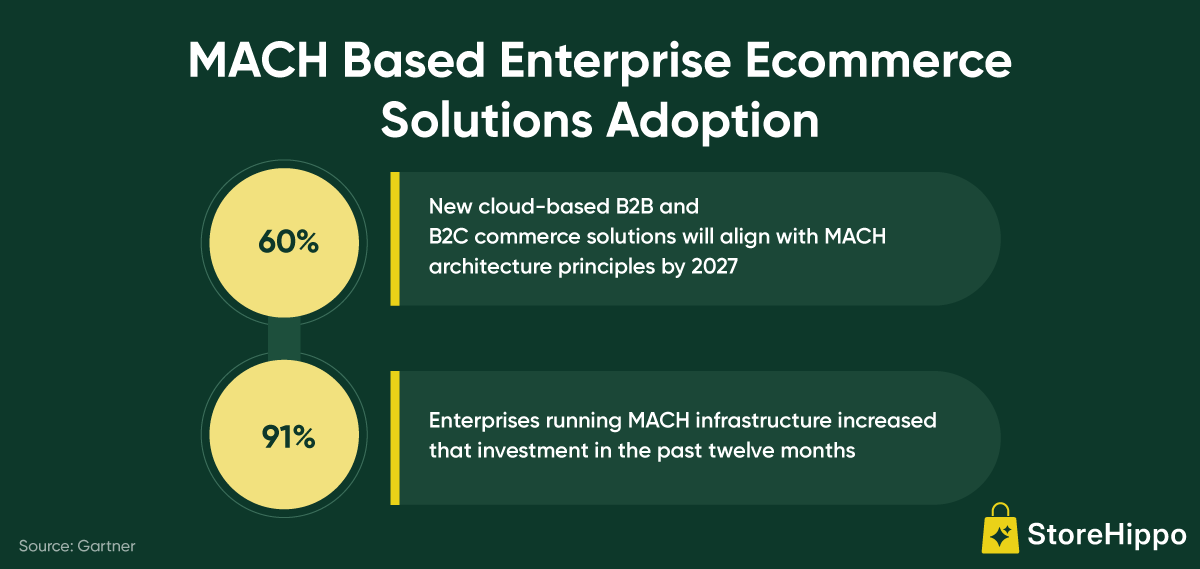
On a monolithic platform, the answer is often "far too much." New initiatives trigger longer testing cycles, higher costs, and greater operational risk. That's why more enterprises are moving toward composable, headless, MACH-based architecture. The goal isn't to follow a technology trend. It's to make change faster, safer, and less disruptive as the business evolves.
The difference is easy to see: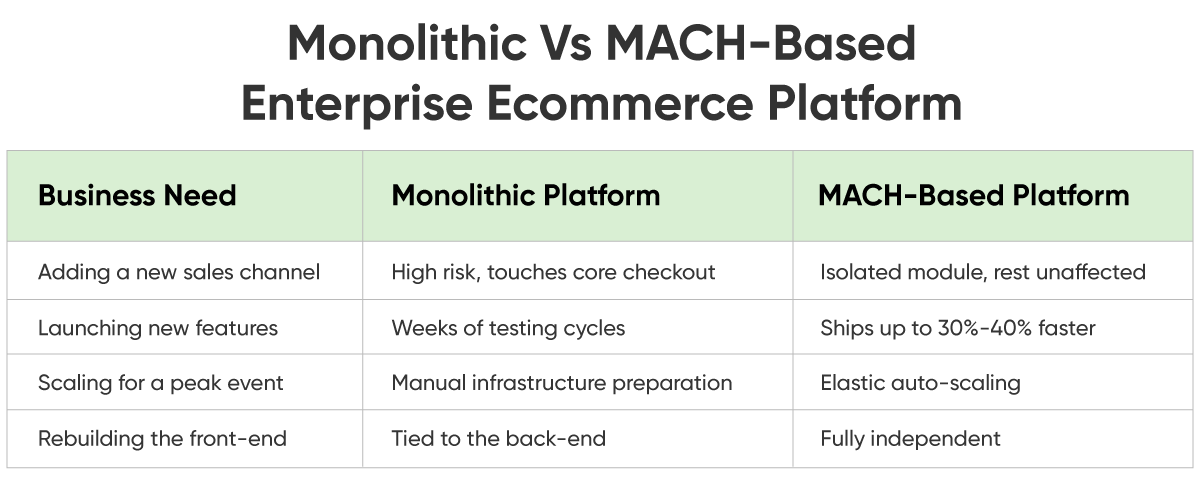
How StoreHippo Solves This
StoreHippo AI-powered enterprise ecommerce platform is built on a native headless, cloud-native architecture that separates business logic from customer experiences. The plugin platform comes with 300+ native features and native support for diverse business models like B2B, B2B/D2C, hyperlocal, cross border global enterprises, marketplaces, multi store, hyperlocal and hybrid busines models. This means you can launch new storefronts, distributor portals, B2B channels, or marketplaces without rebuilding your existing foundation.
Instead of stitching together multiple third-party plugins, you get a composable, enterprise-grade platform with the flexibility to evolve as your business grows. Whether you're entering a new region, adding a new business model, or expanding channels, your platform is designed to adapt without starting over.
3. "Our buyers move across mobile, desktop, and WhatsApp during their purchase journey. Will their cart and profile actually follow them across channels?"
A true omnichannel commerce platform for enterprise brands should maintain a single, real-time view of the customer across every touchpoint. Buyers should be able to switch between mobile, desktop, WhatsApp, sales-assisted ordering, or even offline interactions without losing their cart, pricing, preferences, order history, or account context. If customer data needs to be synced between separate systems, the experience is not truly unified.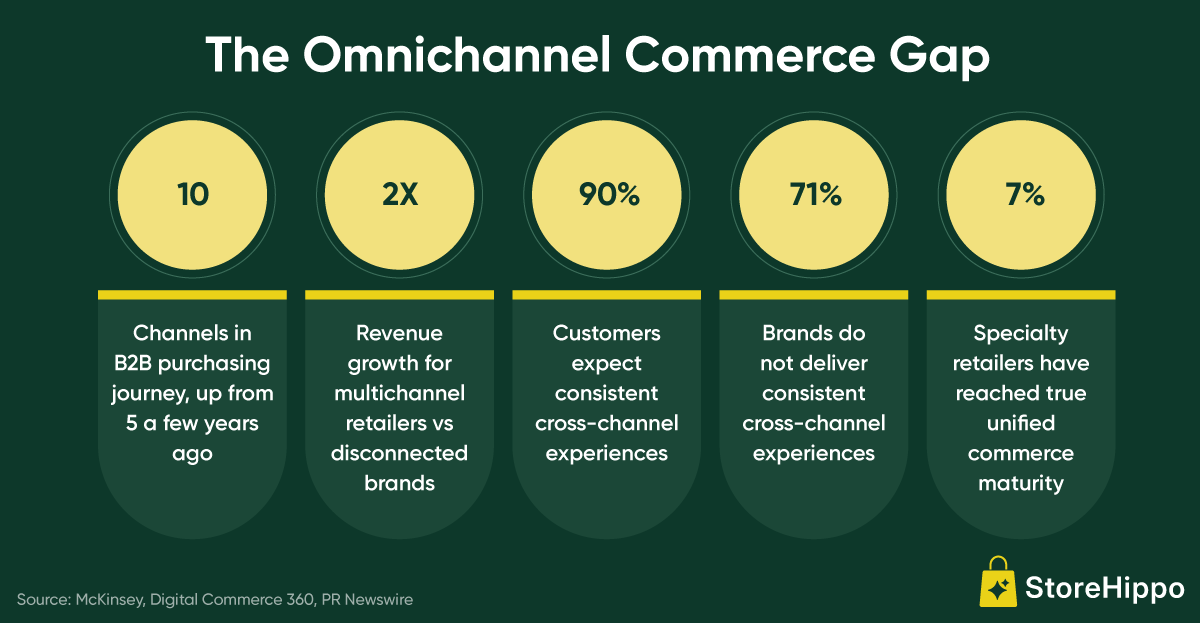
- McKinsey’s latest Global B2B Pulse data shows that the average B2B buyer now uses 10 distinct channels throughout their purchasing journey, 2X of what they used just a few years ago. If you can't orchestrate a seamless cross-channel experience, they switch.
- Omnichannel shoppers spend nearly 60% more per month than single-channel buyers. Brands with mature omnichannel capability grow at nearly twice the rate of disconnected ones.
- 90% of customers expect consistent cross-channel experiences. Only 29% of businesses actually deliver them.
- Only 7% of specialty retailers have reached true unified commerce maturity despite it being a stated priority for most.
The gap between claiming to be an omnichannel enterprise ecommerce solution and actually being omnichannel is enormous.
True unified commerce means a wholesale buyer who browses on mobile during a commute, asks a question on WhatsApp, and finishes on their desktop at the office sees the exact same pricing tier, cart, order history, and live stock levels at every step, on every channel. No syncing delays. No "please log back in." No inconsistent price.
Well, the ground reality is that many businesses still run separate systems for each channel, leading to inconsistent pricing, missing carts, duplicate customer records, and fragmented experiences.
True unified commerce means every channel works from the same customer, inventory, pricing, and order data in real time. Buyers see the same information wherever they engage, and teams manage everything from one system.
When finalising the best enterprise ecommerce platform for your brand, ask questions that expose real-world complexity:
- Does a pricing change update instantly across channels?
- Can buyers continue the same cart across devices?
- Can sales teams access and assist with live customer carts?
- Is customer data unified or synced between multiple systems?
If the answer involves middleware, batch processing, or delayed updates, unified omnichannel commerce is still a promise rather than a reality.
How StoreHippo Solves This
StoreHippo decoupled headless architecture and AI-powered core maintains a single source of truth for customers, products, pricing, inventory, and orders across websites, mobile apps, PWAs, WhatsApp, marketplaces, and AI assisted sales channels. Buyers can move between touchpoints without losing context, while businesses manage every channel from one unified platform. The result is a seamless omnichannel experience for customers and simplified operations for teams.
4. "Does 'mobile-first' mean our site looks okay on a phone or can we actually build and manage apps people will download?"
A truly mobile-first enterprise ecommerce platform should do much more than make your website responsive. It should enable you to build, manage, and scale mobile apps, PWAs, and mobile buying experiences from the same backend. If mobile requires a separate technology stack, agency, or development roadmap, you're not really mobile-first.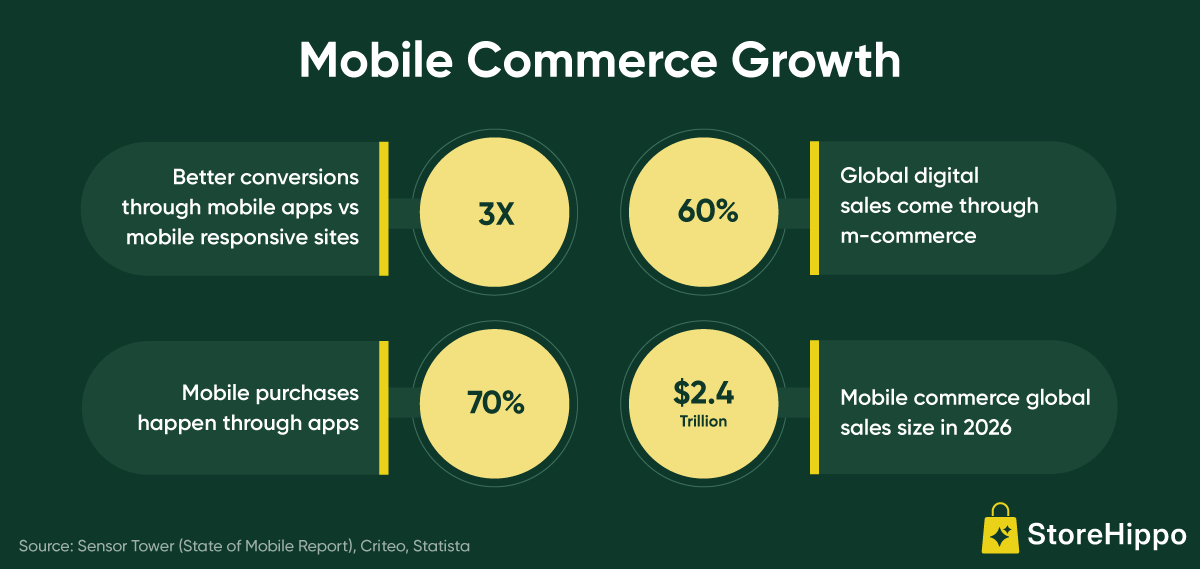
Source: Sensor Tower (State of Mobile Report), Criteo, Statista
Mobile accounts for more than 60% of global digital sales, tracking towards $2.4 trillion in 2026. But the number enterprise teams consistently miss is conversion efficiency: shopping apps convert at 6.1% versus 2.0% for mobile-responsive websites. That's a 3x gap. And 70% of mobile purchases now happen through apps, not browsers.
Source: Sensor Tower (State of Mobile Report), Criteo, Statista
Beyond Responsive Design
Most enterprise buyers today discover, research, and engage with brands on their phones long before they ever open a desktop site. Yet many platforms still treat mobile-first as simply making a website fit a smaller screen.
In reality, buyers expect much more. They expect fast, intuitive experiences that feel natural on mobile. That's why mobile apps continue to drive stronger engagement, higher retention, and better conversions than mobile websites. Progressive Web Apps (PWAs) take this a step further by delivering app-like experiences through the browser itself, helping brands offer fast, reliable access even when connectivity isn't ideal.
When evaluating a B2B ecommerce platform for mobile commerce, don't focus only on how the homepage looks on a phone. The better question to ask are:
- Can buyers complete complex B2B purchases entirely from mobile?
- Can you launch Android and iOS apps without maintaining separate codebases?
- Are apps, websites, and PWAs managed from one dashboard?
- Can field sales teams and buyers complete transactions without switching devices?
If mobile experiences depend on separate systems or development teams, mobile is still being treated as an add-on rather than a core channel.
How StoreHippo Solves This
StoreHippo wholesale ecommerce platform is built with a mobile-first architecture that enables businesses to launch PWAs, Android apps, and iOS apps from the same platform and backend. Brands can launch mobile apps without writing any code using the no-code mobile apps builder. Product catalogs, pricing, inventory, orders, and customer data remain unified across every touchpoint. This allows brands to deliver fast, app-like experiences while managing websites, apps, and mobile commerce operations from a single dashboard.
5. "Our B2B pricing is complex, personalised and tiered by customer, region, and contract. Can the platform handle this natively without plugins?"
A robust B2B ecommerce platform should support customer-specific pricing, contract-based catalogs, approval workflows, RFQs, credit terms, and account hierarchies as native capabilities. If core B2B processes depend on multiple plugins or custom workarounds, complexity increases, upgrades become riskier, and long-term scalability suffers.
Why This Matters
This is where many enterprise ecommerce platform evaluations go wrong.
Most B2B ecommerce platforms were originally designed for retail commerce, where every customer sees the same products, pricing, and checkout flow. B2B commerce works very differently. Every buyer relationship can have unique pricing agreements, payment terms, approval processes, product visibility rules, and purchasing limits.
A true B2B ecommerce platform should handle these complexities out of the box:
- Corporate account hierarchies with multiple users, branches, and approval levels.
- Customer-specific catalogs and pricing based on contracts, regions, or buyer groups.
- RFQ-to-order workflows for negotiated purchases.
- Credit limits, payment terms, and purchase approvals.
- Role-based access and purchasing controls.
When evaluating vendors, don't ask whether these features are available. Ask whether they're native to the platform.
- Can different customers see different prices instantly after login?
- Can buyers request quotes and place negotiated orders online?
- Can multiple users operate under a single corporate account?
- Does this work without plugins or custom integrations?
If the answer involves third-party extensions, it's worth digging deeper. Features that sit outside the platform core often become the first source of performance issues, upgrade challenges, and operational complexity as the business scales.
How StoreHippo Solves This
StoreHippo wholesale ecommerce platform comes with native B2B commerce capabilities built into the platform architecture. Businesses can create customer-specific pricing, contract catalogs, buyer groups, approval workflows, RFQ journeys, store wallets and credit-based purchasing, and multi-user corporate accounts without relying on external plugins. This enables enterprises to manage complex B2B, D2C, marketplace, and hybrid commerce models from a single platform while maintaining complete control over pricing, purchasing rules, and customer experiences.
6. "We run multiple regional websites and brand stores for our B2B marketplace. Can one team manage all of them from a single login?"
A scalable enterprise ecommerce platform should allow teams to manage multiple brands, regions, storefronts, and customer segments from a single backend. Products, pricing, inventory, promotions, and operational workflows should be centrally controlled while allowing each storefront to maintain its own identity, language, pricing, and customer experience.
The Multi-Store Management Challenge
Growth often brings complexity.
A brand launches in a new geography. A business acquires another brand. Different regions need different pricing, languages, currencies, catalogs, or compliance requirements. Before long, teams find themselves managing multiple storefronts across multiple systems.
The problem isn't launching another website. It's managing five, ten, or twenty of them efficiently.
A true multi-store ecommerce platform for enterprises should allow a central team to control everything from one login while giving each storefront the flexibility to operate independently where needed. Product updates, inventory changes, promotions, and business rules should flow automatically to the relevant stores without duplicate effort.
When evaluating a B2B ecommerce platform, ask to see the admin dashboard rather than the storefront.
- Can one catalogue power multiple storefronts?
- Can different stores have unique pricing, languages, and customer experiences?
- Can teams manage everything from a single login?
- Can new stores be launched without adding a new subscription?
If managing a new region means deploying and maintaining another ecommerce system, operational complexity will increase with every market you add.
How StoreHippo Solves This
StoreHippo' enterprise ecommerce solutions native Multistore® feature enables enterprises to manage multiple brands, regions, business models, and storefronts from a single backend. Teams can control products, inventory, pricing, promotions, orders, and workflows centrally while configuring store-specific catalogs, languages, pricing rules, and customer experiences. This allows businesses to expand into new markets faster and localise each store using built-in theme designer, multilingual, and master catalog features without multiplying operational overhead or technology management costs.
7. "How does the platform handle international currencies and local tax rules, natively, or through add-ons we'll pay for separately?"
A global enterprise ecommerce solution should support multi-currency pricing, local taxation, regional payment methods, and country-specific business rules as part of its core architecture. Expanding into a new market shouldn't require multiple integrations, custom development, or separate software purchases every time you launch in a new region.
The Global Expansion Reality
Launching in a new country is relatively easy. Operating efficiently across multiple countries is where complexity starts to appear.
Different markets bring different currencies, tax structures, payment preferences, shipping rules, and compliance requirements. The challenge is not simply displaying prices in another currency. It's ensuring customers see the right pricing, taxes, payment options, and checkout experience based on where they are buying.
When evaluating a platform, involve your finance and compliance teams early and ask practical questions:
- Can buyers see local currencies automatically?
- Are taxes, VAT, GST, and regional duties calculated natively at checkout?
- Can different countries have different pricing and business rules?
- Are local payment methods supported or can be integrated seamlessly?
- How much effort does it take to launch a new market?
If every new geography requires additional plugins, middleware, or development projects, global expansion becomes slower and more expensive with each market you add.
How StoreHippo Solves This
StoreHippo AI powered enterprise ecommerce platform comes with native support for multi-tier taxes, GST support and taxation rules, multiple currencies, country-specific or IP-based pricing, 60+ pre-integrated payment methods, and regional storefronts from a single backend. Businesses can configure localised buying experiences while maintaining centralised control over products, inventory, orders, and operations. This helps brands expand into new markets faster without creating additional technology complexity for every region they launch.
8. "As more buyers start using AI to discover products and place orders, how do we make sure our business is ready?"
Buyers are increasingly using AI assistants to discover products, compare options, and even place orders. When evaluating an AI-powered enterprise ecommerce platform, ask whether it can support these emerging buying journeys. The right platform should help you adapt to AI-driven commerce without requiring a major rebuild every time customer behavior evolves.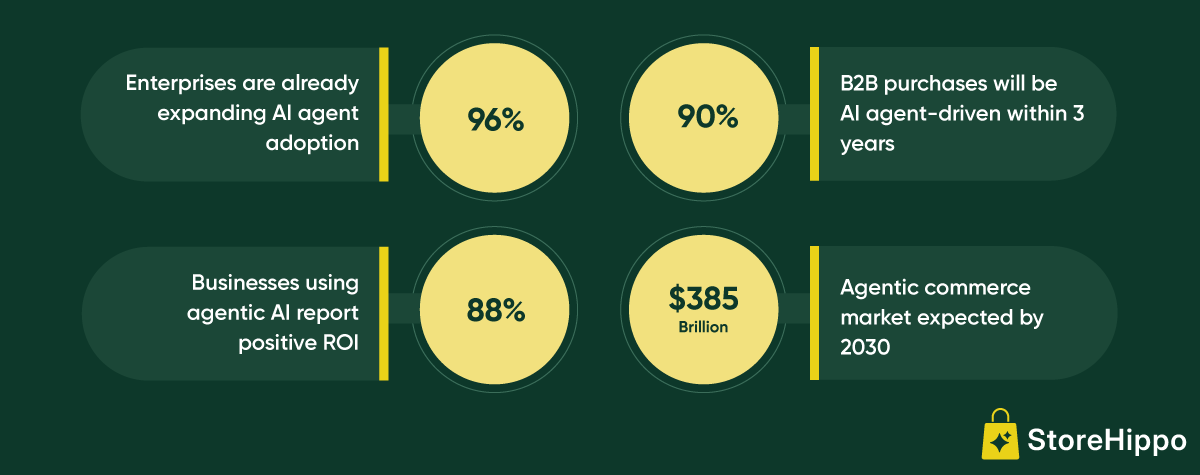
Agentic Commerce Is Rapidly Changing Ecommerce
Conventional B2B shopping and product discovery by browsing websites, clicking categories, and filling out forms is changing.
Buyers are now increasingly trusting AI tools for recommendations, comparing products through conversations, and expecting faster, more personalised buying experiences.
For enterprise brands, this raises an important question: if customers start interacting with AI before they ever reach your website, will your products, pricing, inventory, and business workflows be ready for that shift?
When evaluating a platform, ask practical questions:
- Can we launch custom AI shopping or support assistant on our wholesale ecommerce platform?
- Can buyers discover products using natural language instead of navigating complex menus?
- Can AI access live catalog, pricing, and inventory information?
- Can routine buying and support journeys be automated through AI?
The goal isn't to replace your website. It's to ensure your business can participate in the next generation of commerce as customer behaviour evolves.
How StoreHippo Solves This
StoreHippo AI-powered ecommerce platform helps enterprises build their own AI-powered shopping assistants, support assistants, and conversational buying experiences using live business data. These assistants can guide product discovery, answer questions, assist buyers and sellers, and automate routine tasks while staying connected to real-time catalogs, inventory, pricing, and orders. As buying journeys become more conversational, businesses can extend their commerce experience beyond websites and apps without changing their core platform.
9. "Beyond the subscription price, what will we actually end up paying for our enterprise ecommerce solutions?"
A platform's subscription fee is rarely the full cost of ownership. Before signing, you need to understand what additional software, plugins, integrations, development work, support, and maintenance will be required to run the business at scale. The real cost often appears after implementation, not before it.
Here's the honest TCO formula:
True 3-Year Cost = Base subscription fees + Plugin subscriptions + Integration middleware + inhouse developer maintenance costs + Opportunity cost of slower releases
The TCO That Show Up Later
Most B2B ecommerce platform evaluations start with pricing discussions. The smarter ones quickly move beyond them.
Because the question isn't what the platform costs today. It's what it will cost once your business starts growing.
A platform may look affordable until you need advanced B2B pricing, multi-store management, loyalty programs, subscriptions, marketplace capabilities, workflow automation, or AI features. That's often where additional plugins, integrations, and developer dependencies start to appear.
The problem isn't any single cost. It's the accumulation of them over time.
When evaluating B2B solution providers, ask straightforward questions:
- Which features require additional plugins?
- What third-party software will we need to operate the platform?
- How much developer involvement is typically required after launch?
- What happens when plugins or integrations break after an upgrade?
- How long does it take to launch a new feature or business model?
One thing I've seen repeatedly: the biggest hidden cost isn't the software itself. It's the time your team spends maintaining technology instead of improving the business. Every sprint spent fixing integrations, managing plugins, or coordinating vendors is a sprint that isn't spent launching new capabilities, improving customer experience, or driving growth.
How StoreHippo Solves This
StoreHippo no-plugin enterprise ecommerce solutions reduce technology sprawl by providing enterprise capabilities such as B2B commerce, multi-store management, marketplaces, workflows, mobile apps, AI-powered commerce, and omnichannel operations within a unified platform. It also comes with native marketing solutions, 150+ pre integrations for ERP, CRM, marketing, payments and logistics. This helps businesses avoid the growing costs and operational overhead that often come from managing multiple plugins, vendors, and disconnected systems as they scale.
10. "If we add a D2C marketplace to our wholesale business next year, will the same B2B ecommerce platform work?"
It should. Growth shouldn't force you to replace your technology stack every time you launch a new business model. A modern B2B ecommerce platform should support wholesale, D2C, marketplaces, and hybrid commerce from the same foundation, without requiring another platform, another implementation, or another operations team.
Growth Shouldn't Mean Starting Over
This is one of the simplest ways to evaluate whether a platform is built for the business you have today or the business you'll have tomorrow.
Many companies start with wholesale commerce and later add a D2C store, dealer-powered marketplace, multi store dealer or partner network. The challenge isn't launching the new channel. The challenge is managing it.
Too often, businesses end up running separate systems for each model. One set up for wholesale. Another for D2C. A third for marketplace operations. Over time, inventory gets harder to manage, reporting becomes fragmented, and teams spend more time moving between systems than serving customers.
That's why this question matters.
When evaluating enterprise ecommerce solutions, ask vendors to show exactly what happens when a business adds a new revenue model.
When evaluating a platform, ask a simple question:
- Can B2B, D2C, and marketplace commerce run from the same backend?
- Is inventory shared across all business models?
- Can we manage everything from a single admin dashboard?
- Will adding a new business model require another platform?
The goal isn't just consolidation. It's creating a single source of truth for the entire business.
How StoreHippo Solves This
StoreHippo comes with native solutions to enable businesses to run wholesale commerce, D2C stores, multi-vendor marketplaces, dealer networks, and hybrid commerce models from a single platform. Products, inventory, orders, customers, and workflows remain connected through one AI powered backend and a central amster catalog, giving teams complete visibility across the business. As your business evolves, you can add new channels and business models using the same backend logic without replacing your existing system or introducing new operational silos.
Conclusion
One thing I've learned from working with enterprise brands is that growth rarely follows the original plan.
The challenge isn't predicting every change your business will face, it's choosing a B2B ecommerce platform that can adapt when those changes inevitably arrive.
As you evaluate enterprise ecommerce solutions, look beyond your brand’s immediate requirements. The more important question is whether the platform can support the business you'll be running three years from now.
If you'd like to explore what that looks like in practice, book a demo with StoreHippo.
FREQUENTLY ASKED QUESTIONS
Q: How do we know we've actually outgrown our current enterprise ecommerce software?
You have probably outgrown your enterprise ecommerce software when your team spends more time managing the platform than growing the business. Common signs include increasing reliance on plugins, slow or risky updates, frequent integration issues, and lengthy development cycles for launching new channels, features, or business models. At that point, the platform starts limiting growth instead of enabling it.
Q: How long should it realistically take to go live on a new enterprise B2B platform?
4-8 weeks for a mid-complexity enterprise deployment on a well-built, low-code platform. However, the answer depends on the complexity of your business, but a modern B2B ecommerce platform should not take many months to launch. More importantly, ask vendors to clearly explain what happens during each phase. A realistic timeline is usually backed by experience, proven processes, and native capabilities, not extensive custom development.
Q: Can a single enterprise ecommerce solution genuinely run both wholesale B2B and retail customers at the same time?
Yes, a modern enterprise ecommerce solution can support both B2B and retail customers on the same platform. The key is whether it can manage different catalogues, pricing, checkout experiences, and customer groups from a single backend. If supporting multiple business models requires separate systems or extensive workarounds, scaling operations usually becomes far more complex over time.
Q: What is agentic commerce, and should it factor into my platform decision right now?
Agentic commerce refers to AI agents that can help buyers discover products, compare options, make recommendations, and even complete purchases on their behalf. While adoption is still evolving, it's already influencing how customers interact with brands. When evaluating an AI-powered enterprise ecommerce platform, it's worth considering whether the platform can support custom AI-driven buying journeys for your business.