


The hardest part of building a D2C brand isn't launching it. It's reaching the point where your business is consistently growing, and you're ready for the next phase.
For many brands, that next phase is international expansion.
The global cross-border ecommerce market is projected to reach $7.9 trillion by 2030, while AI is making it easier for businesses to launch, localise, and manage operations across multiple countries.
The challenge is no longer whether you can sell globally. It's whether your business is prepared to do it efficiently and at scale.
If you're considering taking your D2C business global, this guide will help you understand where to start and how to build a you build a successful cross-border brand.
Table of Contents
- The Global D2C Ecommerce Boom
- Smart Strategies to Grow Your D2C Ecommerce Business to Global Markets in 2027
- 1. Build a Multilingual D2C Website
- 2. Launch D2C Mobile Apps
- 3. Take Your Brand Omnichannel
- 4. AI-Powered Personalisation for Global Growth
- 5. Multi-Location Inventory and Global Fulfilment
- 6. Detailed Product Information to Sell More
- 7. Offer Multiple Payment Options for Global Buyers
- 8. Make Buying Easy with Frictionless Checkouts
- 9. Global Marketing Strategies
- 10. Improving Delivery Efficiency for D2C Success
- Take A Global Leap with StoreHippo D2C Ecommerce Solutions
- FAQs
The Global D2C Ecommerce Boom
The D2C sector is booming globally, resulting in a major shift in brand strategies. But what's driving this growing interest in the D2C model? Well, it all comes down to control.
Going direct-to-consumer helps brands connect directly with their buyers, accelerate sales, and get strategic insights into customer behaviour. This, in turn, helps them create a more personalized shopping experience for their customers.
This is evident from recent reports from Statista that - the global D2C market reached approx $151 billion in 2022, and is expected to grow at a CAGR of 26.1%, to surpass $700 billion by 2030.
With the global cross-border retail ecommerce expected to be 10X+ between 2021 and 2030, D2C brands have a huge opportunity to explore business beyond borders. Selling directly to customers worldwide can enable direct-to-consumer brands to reach new customers, cut out the middlemen, control their brand image, and build stronger customer relationships for sustained business growth across geographies.
Smart Strategies to Grow Your D2C Ecommerce Business to Global Markets in 2027
D2C brands like Mamaearth, BoAt, The Man Company, and Bewakoof are leading the way and setting new industry standards to redefine the Indian D2C landscape. After building a strong domestic presence, these brands have also registered a brand presence in several global markets.
This proves that D2C isn't just local- it's global!
Eager to build a similar growth trajectory for your brand?
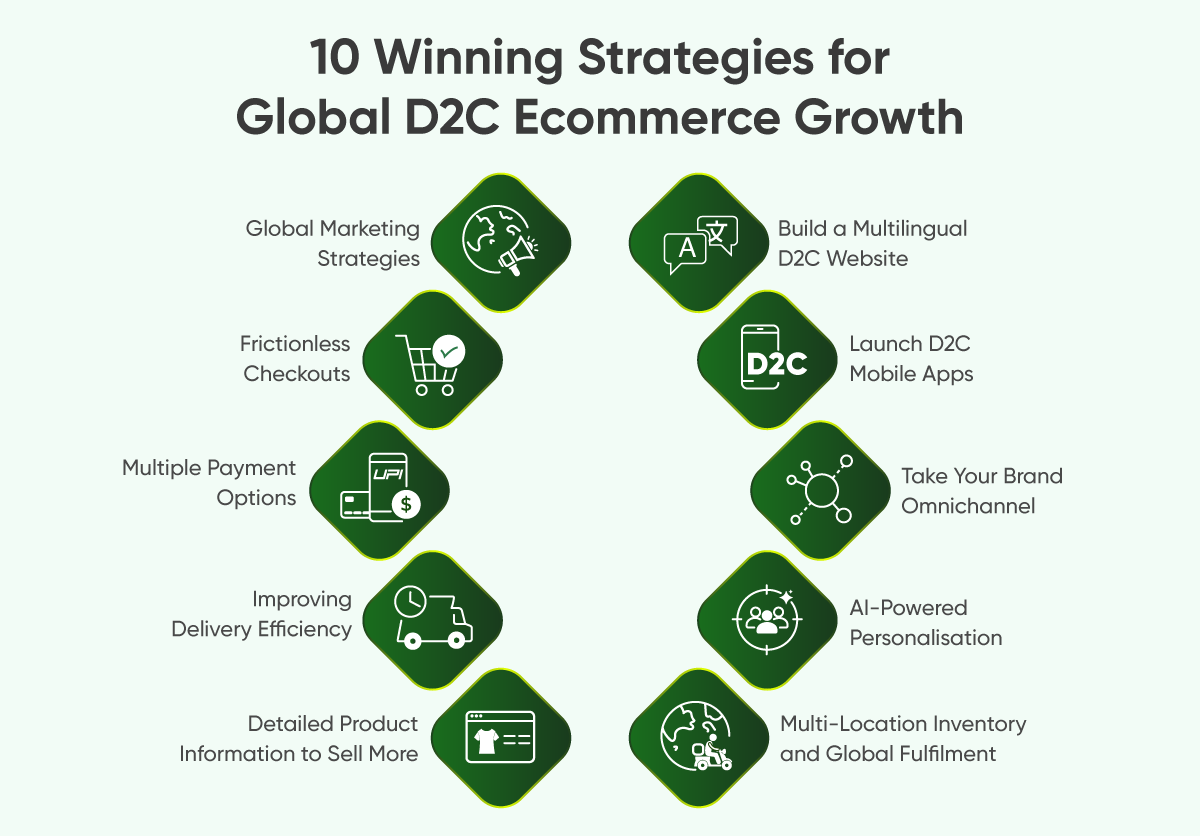
Let’s discuss the key strategies to take your D2C ecommerce business to global markets in 2027.
1. Build a Multilingual D2C Website
If you want to sell products internationally, a multilingual store is a must. As a global market owner, you might know how important it is to speak your customers' language; it enhances their shopping experience and helps build trust.
In short, a multilingual store helps break language barriers that ultimately help customers to navigate your website, better understand your products, and hence, make an informed purchasing decision.
Is that all? No, wait!
Besides language barriers, handling multiple currencies and updating prices for international markets also pose some challenges. But with the right D2C ecommerce platform, like StoreHippo, you can easily automate and simplify these processes.
Here’s how:
- StoreHippo supports 100+ languages to reach a global audience
- Offers automatic and manual translations with location/device-based language selection
- Supports RTL languages like Arabic and Hebrew for Middle Eastern markets
- Allows bulk translations via CSV and app language support for quick setup
- IP-based switching displays prices in local currencies
- Customers can manually select their preferred currency
- Automates daily exchange rate updates for accurate pricing
- Supports invoices in local currencies
- Set region-based sub-store currencies and pricing rules
- Easily manage tax compliance and pricing adjustments with location-based sub-stores
- Automates GST, CGST, SGST, and IGST calculations, providing GST-compliant invoices
- Supports tax grouping, tax-based rules, and inclusive/exclusive pricing. Integrates with QuickBooks and Xero for seamless accounting
- Handles multi-vendor tax rules based on location, simplifying tax management for local and international vendors
These features altogether make your global D2C ecommerce expansion much easier than before.
2. Launch D2C Mobile Apps
In 2027, a mobile app for your D2C business is no longer an option- but a necessity. As mobile commerce has become the primary channel for online shopping, brands looking to expand globally need both a mobile-optimised online store and a mobile app.
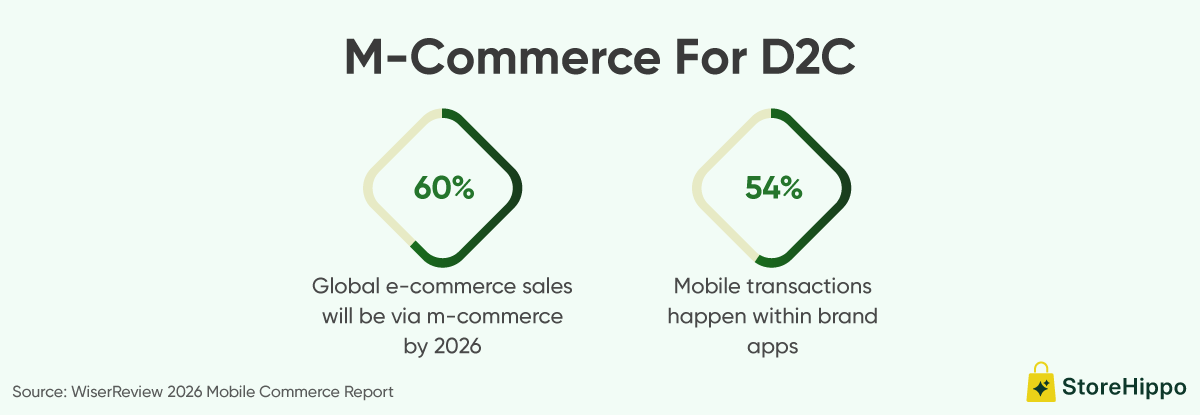
- 60% of global e-commerce sales will be via m-commerce by 2026
- 54% mobile transactions happen within brand apps
Source: WiserReview 2026 Mobile Commerce Report
Having your D2C ecommerce app adds to your brand appeal by offering a faster, smoother, and more personalized shopping experience than just the website.
A mobile app gives you the flexibility to customise shopping for specific regions. For example, you can customise products, prices, languages, and promotions for customers in India Vs the UAE, boosting engagement and conversions.
Moreover, with platforms like StoreHippo, creating Android and iOS apps is faster and more cost-effective. StoreHippo comes with a built-in no-code mobile app builder that lets you create mobile apps directly from your admin dashboard, without any coding. You can also launch PWA stores to offer fast, smooth, and app-like shopping experiences even in low-bandwidth and unstable network conditions.
Its standout features help you:
- Alert customers about offers and new arrivals
- Reduce cart abandonment with a simple buying process
- Provide a consistent look across all devices
- Send targeted push notifications based on customer behaviour
- Increase conversions with faster app performance and load times
- Build stronger customer relationships through direct communication channels
3. Take Your Brand Omnichannel
Modern customers interact with their favourite brands across 4-6 channels on average before making a purchase. They may discover products on the website, browse your app, ask questions on WhatsApp, and complete the purchase through the channel they find most convenient.
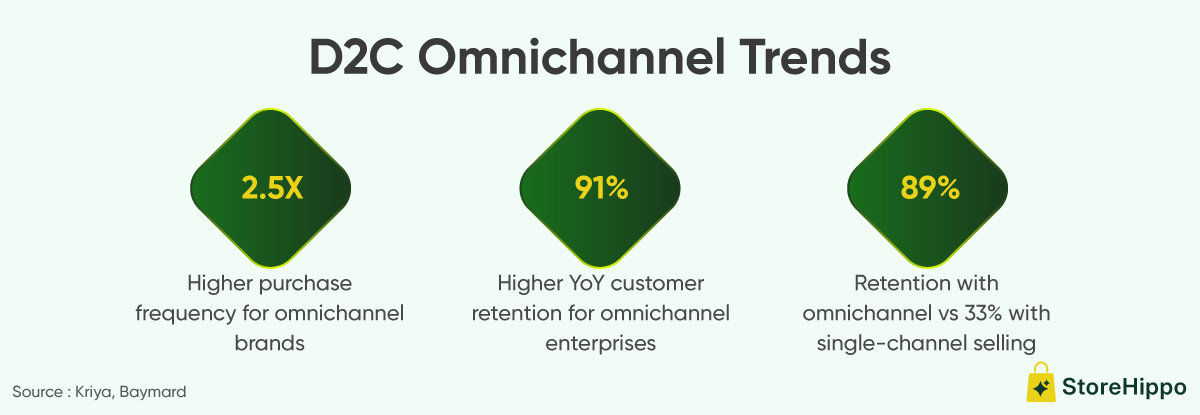
- 2.5x higher purchase frequency for omnichannel brands
- 91% higher YoY customer retention for omnichannel enterprises
- 89% retention with omnichannel vs 33% with single-channel selling
Source:WiserReview 2026 Omnichannel Statistics, Smart Survey
This is why having a presence across multiple channels has become essential for D2C brands selling products internationally. However, managing products, inventory, orders, pricing, and customer data separately across channels can quickly become complicated.
With the right D2C ecommerce platform with built in omnichannel capabilities, you can centralise and streamline operations across all your sales channels.
StoreHippo offers built in omnichannel solutions to sell across multiple channels from a single backend.
With StoreHippo omnichannel ecommerce solutions, you can :
- Create and manage websites, mobile apps, WhatsApp, social, AI, and other channels from a single platform
- Centralise inventory, orders, products, and customer data across channels
- Launch new sales channels quickly using the same backend logic and headless architecture
- Ensure consistent pricing, promotions, and product information everywhere
- Build custom agentic AI interfaces for smart selling
- Offer seamless shopping experiences regardless of where customers engage with your brand
These capabilities help you create a unified brand experience, improve operational efficiency, and reach customers wherever they choose to shop.
4. AI-Powered Personalisation for Global Growth
As your D2C ecommercce brand expands into new countries, delivering relevant shopping experiences becomes much more challenging. Customers across different regions often have unique preferences, shopping habits, and purchase behaviours. Trying to personalise experiences for every market manually can quickly become difficult to manage.
This is where AI can make a significant difference.
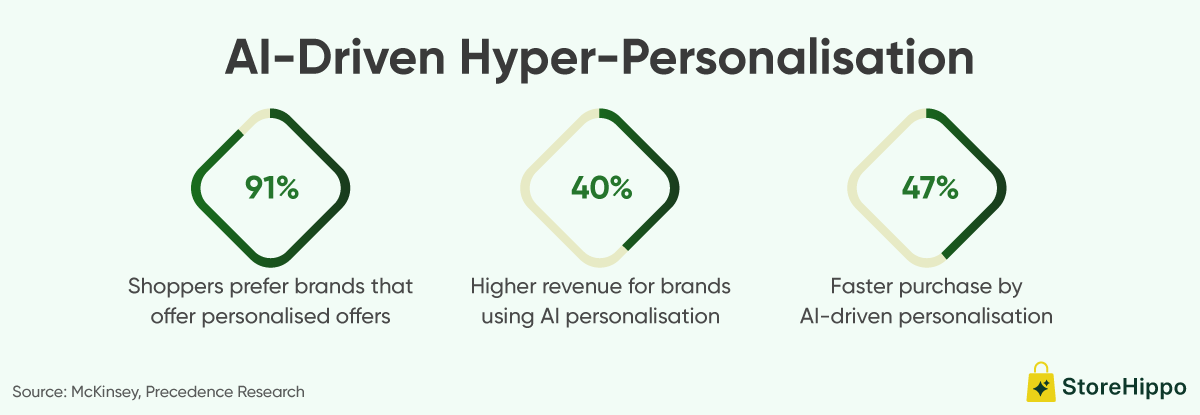
- 91% of shoppers prefer brands that offer personalised offers
- 40% higher revenue for brands using AI personalisation
- 47% faster purchase by AI-driven personalisation
Source: McKinsey, Precedence Research
AI-powered personalisation helps you understand what customers are looking for, recommend relevant products, personalise search results, and guide shoppers towards the right purchase decisions. Instead of offering the same experience to every visitor, AI can help you create shopping journeys that feel more relevant to each customer, regardless of where they are shopping from.
With StoreHippo's AI-powered ecommerce platform capabilities, you can:
- Offer personalised product recommendations based on customer behaviour and preferences
- Improve product discovery with AI semantic search
- Build custom AI chatbots to offer conversational shopping journeys and resolve routine customer queries
- Build enterprise-grade conversational AI agents to offer contextual shopping experiences across websites, mobile apps, WhatsApp, email and AI chat and other channels
- Increase engagement and conversions with personalised buying journeys
By delivering more relevant experiences at every touchpoint, StoreHippo AI solutions help global D2C brands improve customer satisfaction, drive conversions, and scale personalisation across multiple markets with ease.
5. Multi-Location Inventory and Global Fulfilment
As your D2C brand expands into cross-border markets, managing inventory across multiple warehouses, fulfilment centres, distributors, and retail locations can quickly become challenging. Without clear inventory visibility, you can risk stockouts, delayed deliveries, excess inventory, and rising operational costs.
To sell products internationally, you need a D2C ecommerce platform that gives you complete visibility and control over inventory across all locations from a single dashboard. It should also intelligently route orders to the nearest fulfilment location based on stock availability and customer proximity.
This helps you fulfil orders faster, optimise inventory utilisation, reduce shipping costs, and deliver a more consistent customer experience across markets.
With StoreHippo's built in inventory and order management solutions, you can:
- Manage inventory across multiple regional online stores and fulfilment centres from a single dashboard
- Get real-time inventory visibility across all locations
- Route orders automatically based on stock availability and customer proximity
- Centralised inventory management to reduce stockouts and overselling
- Integrate with multiple international logistics partners for seamless order fulfilment
- Track inventory movement and stock levels in real time
6. Detailed Product Information to Sell More
In today's competitive market, if your product descriptions don’t clearly explain what your product is and why it matters, customers will simply skip them. Thus, to successfully sell products internationally, your products need to connect with the global audience and be easy to understand for everyone.
Hence, a well-written, detailed product description is the key to getting noticed and boosting sales. It must include information about:
- what the product does
- its features, and
- how to use it
When you offer clear and detailed information, it shows that your brand cares about its customers. Detailed information helps buyers make informed decisions, too. This transparency builds trust, leading to happier customers who are more likely to return. You can also use AI to generate high quality products information and then translate it into multiple languages for a wider reach across international markets. This can improve product discoverability and maintain content consistency across large catalogues.
StoreHipo’s e-commerce solutions offer robust product management tools that help you list and manage products effectively.
Here’s what you get with StoreHippo:
- 360-degree product views with images and videos to give customers a complete look at your products
- Detailed, visually appealing product pages to showcase your offerings effectively
- Built-in tools to add meta details and descriptions for better product discoverability and conversion
- AI image editing tool, Magic Edit, to transform raw product images into high-quality, market-ready visuals
- AI-powered cataloguing to automatically generate product information like title, descrition, category, tagging, etc to launch new products faster
- Review and rating features to help buyers make informed decisions
With StoreHippo, you can create a customer-centric, transparent experience that builds trust and drives conversions.
7. Offer Multiple Payment Options for Global Buyers
When selling internationally, offering the right payment options can make a huge difference to your conversion rates. Customers are more likely to complete a purchase when they can pay using familiar and trusted payment methods available in their region.
To cater to a global audience, D2C brands need to support multiple payment methods, currencies, and region-specific payment preferences. This not only improves customer convenience but also helps reduce payment-related drop-offs during the buying journey.
StoreHippo simplifies global payments with:
- Seamless payment solutions with 60+ pre-integrated payment gateways
- Support for UPI, credit/debit cards, net banking, store wallets, Cash on Delivery (COD), and more
- Easy integration with preferred payment gateways
- Local payment options for diverse geographies
- Multi-currency support with automatic currency conversion for easier accounting
These capabilities help customers pay the way they prefer, creating a smoother buying experience across international markets.
8. Make Buying Easy with Frictionless Checkouts
Are your customers tired of slow checkouts and unclear shipping updates? Then it's time to upgrade!
In the D2C ecommerce world, approximately 61% of customers abandon their carts due to complex checkout processes. So, you need to pay attention to a seamless checkout experience for your customers that helps improve conversion rates for your business.
See how checkout experiences impact D2C sales.
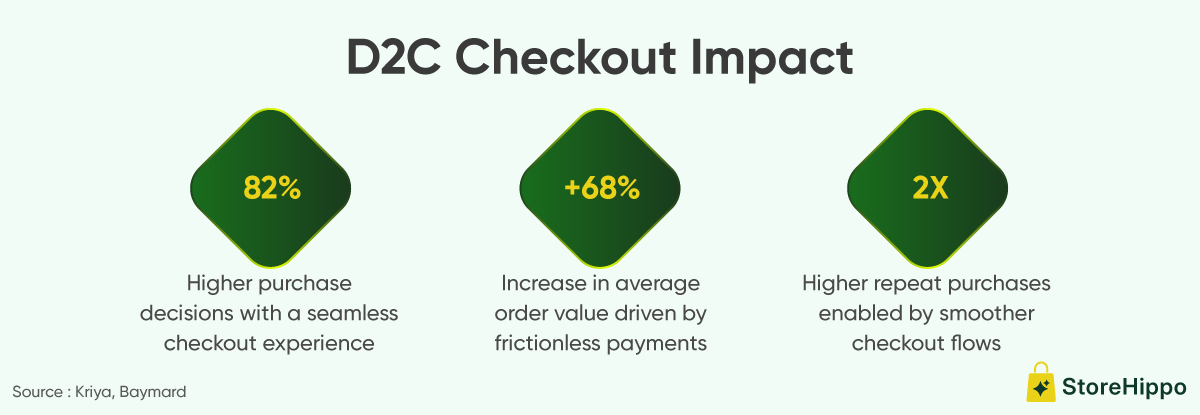
- 82% higher purchase decisions with a seamless checkout experience
- 68%+ increase in average order value driven by frictionless payments
- 2× higher repeat purchases enabled by smoother checkout flows
Source : Kriya, Baymard
What's next?
Implement speedier checkout solutions such as:
- A simple and mobile-friendly checkout process
- Faster order completion with fewer checkout steps
- Transparent pricing and shipping information
- Easy access to saved addresses and customer information
- Consistent checkout experiences across devices
These improvements help reduce cart abandonment, increase customer satisfaction, and boost conversions.
StoreHippo helps simplify checkout with:
- Mobile-first checkout experiences optimised for every device
- Fast-loading storefronts and PWAs for smoother purchases
- No plugin, AI powered core managing end-to-end buyer journey, inventory,carts, orders, and customer data
- Seamless integration of checkout and payment workflows
- Consistent buying experiences across web, mobile, and app channels
9. Global Marketing Strategies
To take your D2C ecommerce business global, smart marketing is a must!
Digital marketing helps you connect with customers around the world, which in turn boosts your brand's visibility. You can start by placing customised targeted ads on Google, Facebook, and other Social Media channels that appeal to local likes and preferences. Besides, don’t forget to use SEO and AEO to make sure your website ranks better in local search engines and answer engine results, so customers can easily find you.
Some winning strategies include teaming up with local influencers to build trust, sending personalised emails to update customers about new products or offers, and creating region-specific social media content and ads. These easy but powerful moves can help you attract more customers, increase sales, and grow your brand across the globe.
The best part? StoreHippo can help you achieve these goals effortlessly. It offers:
- An advanced marketing suite featuring dynamic pages, push notifications, abandoned cart recovery, and smooth email marketing integrations
- A powerful discount engine that allows product-level, device-specific, group-based, and time-sensitive discounts ( which can be used by influencers to promote your brand) with bulk import/export for effective promotions
- A feature-rich blog engine to create an unlimited number of posts, categorise content, improve visibility through SEO tools, and provide social sharing for better reach
- Easy integration with Mailchimp, SendGrid, Google Analytics, Google Tag Manager, Meta Pixel, and other leading marketing tools
- Dynamic marketing pages to create region-specific campaigns based on geography, customer segments, devices, and promotional events
In addition to this, StoreHippo allows seamless integration with the best-in-breed marketing tools, which make it easier to run targeted campaigns for specific regions.
10. Improving Delivery Efficiency for D2C Success
If you want to stand out in the D2C market, speed matters!
According to research, 77% of consumers say that fast, reliable delivery is one of the most important factors in making an online purchase decision.
In the world of D2C e-commerce, delivering orders quickly is one of the best ways to stay ahead.
How to achieve that?
Well, you can do this by combining smart inventory management with fast, local delivery solutions. Setting up a network of strategically placed warehouses helps you fulfill orders quickly in smaller, specific areas. This makes sure that customers get what they want faster.
You can leverage local warehouses to expedite shipping, making sure your customers receive products more quickly. This leads to happier customers, stronger brand loyalty, and more success in a busy market.
With that said, you must utilise local delivery networks and technologies to optimise routes. This helps you achieve faster delivery times and keep customers happy.
StoreHippo enhances this by helping you:
- Optimise delivery cost and time with over 40 logistics partners for smooth and efficient delivery management
- Seamlessly manage carriers and delivery boys, ensuring timely deliveries
- Assign orders to delivery boys with just a few clicks for quick fulfillment
- Keep customers informed with real-time order status updates
- Add an extra layer of security with OTP verification for safe deliveries
- Optimise delivery routes for faster and more efficient service
- Collect valuable feedback from delivery boys to continuously improve service
- Easily manage and track delivery agents from a single platform
- Streamline processes for faster and more accurate deliveries
With these tools, businesses can easily stay ahead of the competition and enhance their customer experience.
Take A Global Leap with StoreHippo D2C Ecommerce Solutions
Ecommerce is evolving at a fast speed, with D2C firms leading the way. And to stay ahead in such fierce competition, it's important to expand your business globally. However, this global expansion requires much more than just ambition. You need the right mix of smart strategies, right tools, and advanced technologies to support your vision.
What if you could get all this in a single platform?
That’s where StoreHippo steps in!
StoreHippo is a platform that lets you create a future-ready, fully customizable D2C ecommerce store without any hassle.
With StoreHippo, you get everything you need to expand globally- from one-click checkout and easy payment integration to real-time shipping tracking and multi-language support. Plus, its mobile-first omnichannel architecture ensures your customers have a seamless experience across all devices. With built-in AI-powered ecommerce solutions, StoreHippo also helps automate catalogue management, optimise product content and images, deliver personalised product recommendations, and create intelligent buying journeys for customers across global markets.
Why wait for?
Partner with StoreHippo and build an online store for your D2C brand that captivates the world.
Give your ideas the power of StoreHippo, request a demo now.
FAQs
1. How can AI help D2C ecommerce brands expand into international markets?
AI helps D2C ecommerce brands expand internationally by automating catalogue management, generating and optimising product content, personalising shopping experiences, improving product discovery, and streamlining operations. This enables brands to scale faster, deliver more relevant customer journeys, and drive higher conversions across global markets with greater efficiency.
2. What payment capabilities are essential for global D2C ecommerce?
Global D2C brands should support multiple currencies, local payment methods, digital wallets, region-specific payment preferences, and secure checkout experiences. Offering familiar payment options improves trust, reduces cart abandonment, and increases international conversions.
3. How can D2C ecommerce brands manage multiple countries from a single ecommerce platform?
D2C ecommerce brands can manage multiple countries from a single platform by centralising products, inventory, orders, customers, and operations in one place. This enables businesses to run region-specific storefronts, pricing, currencies, languages, and fulfilment processes while maintaining complete visibility and control across all international markets.
4. Why is conversational commerce important for global D2C ecommerce brands?
Conversational commerce helps brands engage customers through chat, voice, WhatsApp, and AI shopping assistants. It simplifies product discovery, answers buyer questions instantly, and creates more personalised shopping journeys across different markets and languages.
5. What role does localisation play in global D2C ecommerce success?
Localisation goes beyond language translation. It includes local currencies, payment methods, tax rules, shipping options, cultural preferences, and region-specific promotions. Effective localisation helps build trust and improve conversion rates in international markets.
6. How can D2C ecommerce brands manage inventory across multiple countries and fulfilment locations?
D2C brands can manage global inventory through a centralised ecommerce platform that provides real-time visibility across warehouses, distributors, stores, and fulfilment centres. This enables better stock control, intelligent order routing, faster deliveries, and more efficient inventory utilisation across international markets.
7. Why is distributed inventory important for global D2C ecommerce growth?
Distributed inventory enables brands to store products closer to customers across different regions. This reduces shipping times, lowers fulfilment costs, improves delivery reliability, and helps brands meet customer expectations while scaling internationally.