


Brands rarely fail at enterprise commerce logistics overnight. It happens gradually, one misrouted B2B shipment, one unexpected reverse logistics spike eating into quarterly margins, one carrier SLA that worked at 2,000 orders a month but starts falling apart at 20,000.
The core pain points in ecommerce logistics are not new. What changes at enterprise scale is the impact. Small operational gaps turn into costly bottlenecks when thousands of orders move daily across B2B, D2C, and marketplace channels at the same time. The carrier selected for reach may no longer offer the rate intelligence needed at scale. A returns process built for speed may lack proper reconciliation. Shipping teams still assigning couriers manually while the order management system logs hundreds of dispatches before noon, which is more common than most brands admit.
This is not another guide to ecommerce logistics basics. It is a closer look at the operational cracks that start appearing as enterprise commerce scales and what businesses actually need to fix them before they start affecting margins, customer experience, and growth.
Table of Contents
- 5 Ecommerce Logistics Pain Points Every Enterprise Brand Has Lived Through - And How To Finally Fix Them
- Why is choosing the right fulfilment partner the costliest ecommerce logistics mistake enterprise brands make?
- How Much Does Reverse Logistics Actually Cost Enterprise Operations at Scale?
- How can enterprise brands solve multi-channel ecommerce logistics across B2B, D2C, and Marketplace operations?
- Why is automated shipping management a structural requirement above 10,000 orders a Month?
- What Does Unpredictable Shipping Cost Look Like at Enterprise Scale and How Do You Control It?
- Conclusion
- FAQ
5 Ecommerce Logistics Pain Points Every Enterprise Brand Has Lived Through - And How To Finally Fix Them
If you’ve scaled ecommerce, you’ve already run into these questions, often more than once.
Here are five logistics pain points framed the way they show up in real operations and how to finally fix them.
Why is choosing the right fulfilment partner the costliest ecommerce logistics mistake enterprise brands make?
Choosing a fulfilment partner based on coverage alone is the costliest mistake because unintegrated carriers hide massive operational friction, accounting for over half of total supply chain costs through unmanaged last-mile delivery.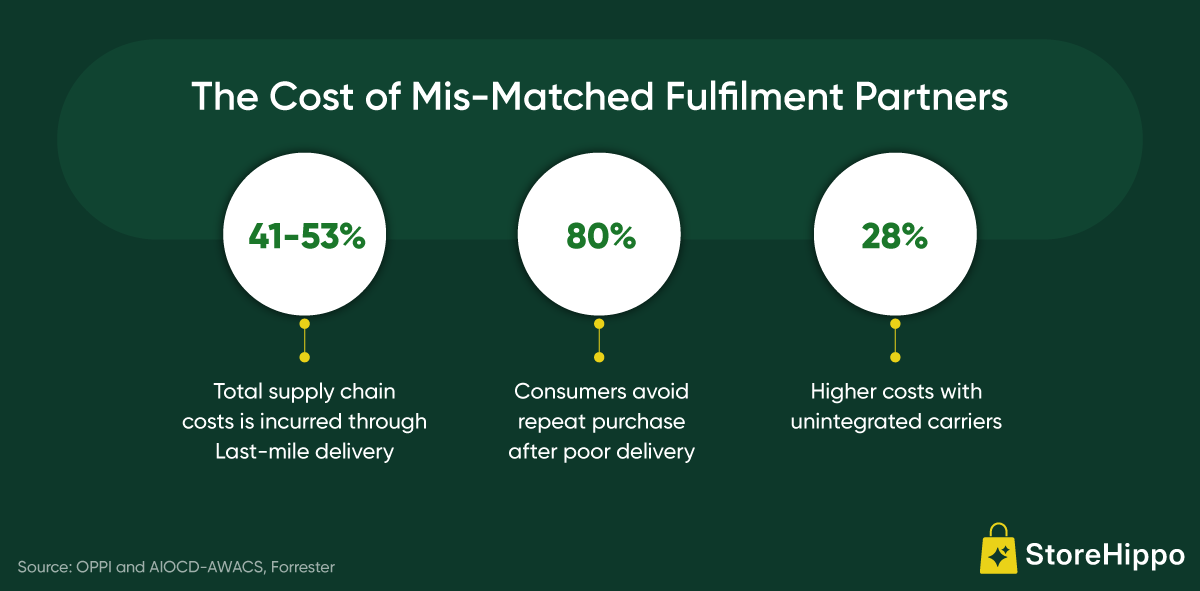
- Last-mile delivery accounts for 41–53% of total supply chain costs, according to Capgemini, meaning carrier selection is a margin decision, not just an operational one.
- 79% of consumers report that a poor delivery experience significantly reduces likelihood of repeat purchase, making carrier quality a direct retention variable at scale. (Source Radial)
- Enterprises managing more than three unintegrated carriers experience up to 28% higher logistics operational costs than those running unified carrier management, according to Gartner.
Consider a large FMCG brand scaling its D2C channel alongside a multi-state distributor network. On paper, it has four courier partners, each selected for a specific corridor, each negotiated separately. In practice, it has four dashboards, four billing cycles, four SLA frameworks, and no unified view of which carrier is actually performing. When a campaign drives a 3x order spike, the operations team is manually deciding which carrier gets which pincode cluster, often getting it wrong on cost and sometimes on coverage.
The problem is not having multiple carriers, which is often necessary for enterprise ecommerce logistics at scale. The problem is running them without a unified intelligence layer: one that compares real-time rates across all partners, automatically assigns shipments based on configurable rules- zone, weight, cost ceiling, SLA commitment - and gives the ops team a single view of performance rather than four separate logins.
StoreHippo's ecommerce logistics management brings 30+ pre-integrated domestic, hyperlocal, and global partners under a single admin layer with rule-based automatic shipping assignment and a real-time rate engine that surfaces the best-cost option at order creation, without manual intervention. This is how multi-carrier shipping management moves from a daily operations headache to a configured, self-running system.
How Much Does Reverse Logistics Actually Cost Enterprise Operations at Scale?
At enterprise scale, reverse logistics costs an average of 66% of the original item’s price, transforming unstructured returns into a severe margin erosion problem. This hidden cost compounds quarterly by trapping working capital and bloating operational processing time by up to 35% without a centralized, automated tracking workflow.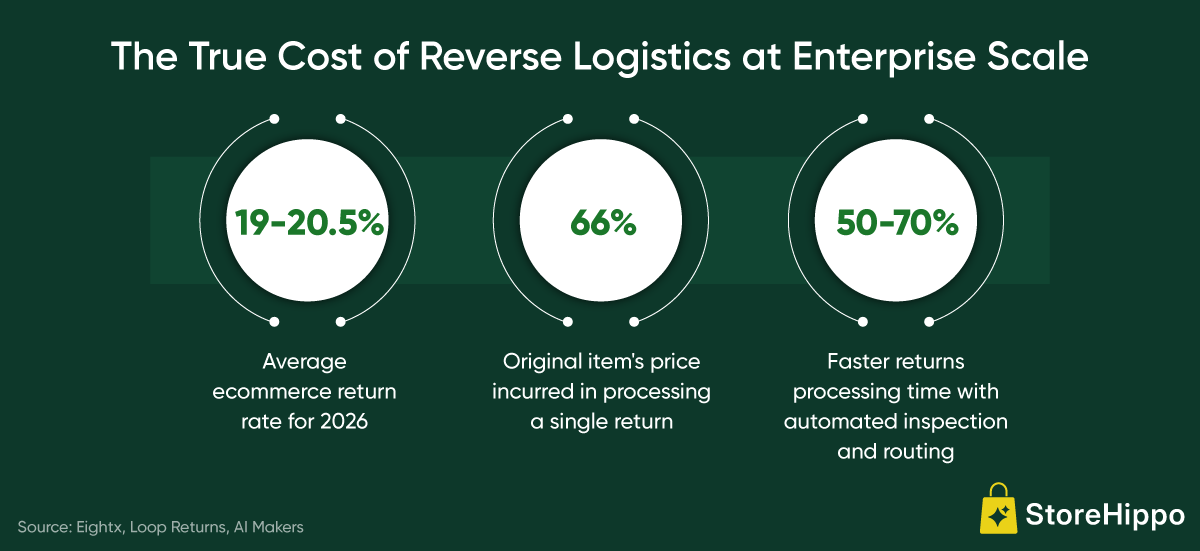
- The Eightx reported an average ecommerce return rate of 19-20.5% in 2026 for an enterprise brand processing 100,000 orders monthly, which is 17,600 return shipments to manage every 30 days.
- Processing a single return costs retailers an average of 66% of the original item's price, a cost that rarely surfaces visibly in P&L until scale forces it into view. (Source: Loop Returns)
- 50-70% faster returns processing time with automated inspection and routing versus automated, rule-driven returns management, translating directly into slower working capital recovery. (Source: AI Makers)
Source: Eightx, Loop Returns, AI Makers
An automotive parts distributor with a B2B ecommerce channel understands this scenario. A regional dealer places a bulk order. Three items arrived with transit damage. The dealer raises a return request. In a manual workflow, the request lands in a general support inbox, gets escalated to the logistics team, who contacts the carrier, negotiates a pickup window, and logs the return in a separate system. Four touchpoints, two to four business days, and a reconciliation exercise that runs independently of the original order record.
At 200 such requests a month, this is a support overhead. At 2,000, it is a finance and operations problem with a compounding cost structure.
Reverse logistics will exist at any order volume, the operational imperative is to make it fast, trackable, and reconciled within the same system that processed the original shipment.
Integrating reverse logistics directly into the order management workflow with automated return pickup triggers, real-time status visibility, and carrier-coordinated scheduling converts what was an escalation chain into a managed, auditable event. The cost impact shrinks not because returns disappear, but because each return consumes a fraction of the time and effort it previously did.
How can enterprise brands solve multi-channel ecommerce logistics across B2B, D2C, and Marketplace operations?
Enterprise brands can solve multi-channel logistics by unifying B2B compliance, D2C speed, and marketplace-specific SLAs under a single operational infrastructure layer. Consolidating separate fulfilment workflows into one platform removes data silos, eliminates manual reconciliation gaps, and automates distinct dispatch rules for diverse channel requirements simultaneously.
Consider an agri-tech brand operating a distributor network, a branded D2C storefront for farm products, and a multi-vendor marketplace for farm input across 15 states, which is not running one ecommerce logistics operation. It is running three with different SLAs, different order compositions, different compliance requirements, and often different warehouse locations. The structural challenge is not that these channels coexist; it is that they must be managed from a single operational layer to remain sustainable at scale.
A B2B consignment to a regional distributor involves bulk packaging, an e-waybill for inter-state GST compliance, a 3–5 day delivery window, and proof-of-delivery for invoice reconciliation. A D2C order from the same brand's storefront needs same-day or next-day hyperlocal delivery, consumer-grade tracking, and a WhatsApp status update. A marketplace order has its own seller-specific SLA and may require assignment to a dedicated last-mile delivery agent.
Running these three fulfilment models through separate tools, a logistics aggregator for D2C, a manual process for B2B logistics management, and a seller dashboard for the marketplace, creates operational silos that break under volume, generate reconciliation gaps, and make exception handling a daily fire-fighting exercise.
StoreHippo addresses this through native support for B2B and D2C commerce solutions in a single platform, with distinct fulfilment workflows configurable from one admin panel. The multi-package feature splits multi-product orders across different logistics partners for faster dispatch. Built-in e-waybill support keeps B2B inter-state shipments GST-compliant without a separate documentation tool. For marketplace and hyperlocal operations, a custom delivery boy management module can be built that lets sellers assign, schedule, and track their own delivery agents directly from the seller dashboard with real-time confirmation and customer feedback captured in the same system. This is what consolidated enterprise ecommerce logistics infrastructure looks like in practice: one platform managing three operating models without three separate stacks.
Why is automated shipping management a structural requirement above 10,000 orders a Month?
Automated shipping management becomes a structural requirement at scale because manual carrier selection and label generation inevitably collapse during high-volume peak periods, threatening brand reputation. Implementing end-to-end automation removes human error, routes exceptions instantly, and reduces order-to-dispatch processing times by 25-35% without requiring a proportional increase in headcount.
At 500 orders a day, manual shipping assignment is inefficient. At 5,000 orders a day, it is operationally untenable, and during peak periods, it becomes a brand risk.
Consider a multi-vendor fashion marketplace approaching Diwali peak season. Orders spike 4x in 72 hours. Each seller has different carrier preferences and product categories. Shipping labels must be generated, pickups scheduled across multiple seller locations, and tracking IDs communicated to customers, all without a proportional increase in the operations team. A manual workflow, however well-designed for normal volume, breaks under this load in ways that are immediately visible to customers: delayed dispatch confirmations, missed pickup windows, and a support queue filling with status queries.
McKinsey has found that companies deploying end-to-end supply chain automation reduce order-to-dispatch processing times by 25–35%, with the greatest gains during high-volume periods precisely when the cost of manual error is highest.
Automated shipping management removes decisions that should not require human judgment, such as carrier assignment, label generation, and pickup scheduling, so that operations teams can focus on exceptions that genuinely need intervention.
StoreHippo's automatic shipping assignment rules apply configurable logic based on zone, weight, delivery SLA, and cost thresholds to every incoming order in milliseconds. Teams can also manage pickup coordination and shipment updates directly through WhatsApp, keeping internal teams and customers informed throughout the delivery process without constant manual follow-ups. The platform’s AI-powered ticketing system and Intelligent Grievance Management (IGM) automatically identify, categorise, and route shipping issues, damaged consignments, delayed pickups, and failed deliveries, reducing mean time to resolution without requiring a team member to review each case. A built-in AI bot handles instant shipment status queries without support intervention. For brands running omnichannel operations, this automated shipping management layer means peak season no longer demands proportional scaling of the logistics team.
What Does Unpredictable Shipping Cost Look Like at Enterprise Scale and How Do You Control It?
Unpredictable enterprise ecommerce logistics cost is not a single number. It manifests as thousands of micro-inefficiencies, such as hidden zone surcharges, failed delivery fees, and dimensional weight errors that quietly erode 3–8% of an enterprise's revenue. Brands can control these leakages by embedding real-time cost intelligence engines at the exact point of order creation, rather than auditing backwards from retrospective shipping invoices.
An enterprise with ₹50 crore in monthly GMV and undisciplined shipping cost management may be leaving ₹1.5–4 crore on the table monthly, not from one failure, but from thousands of micro-inefficiencies in carrier selection, cost visibility, and rate negotiation spread across channels, carriers, and time periods in a way that makes them nearly invisible until someone builds a consolidated view.
The fix is real-time cost intelligence at the point of order creation, not a weekly shipping cost report generated after the decisions have already been made. Knowing that Carrier A costs ₹48 and Carrier B costs ₹61 for the same zone and weight class, before the shipment is assigned, is the intervention that compounds into meaningful savings at volume.
StoreHippo's unified shipping dashboard delivers exactly this: real-time rate calculation across all integrated partners simultaneously, discounted courier rates unlocked through pre-integrated partnerships, and bulk shipping tools that streamline high-volume dispatch without compromising cost oversight. The integrations layer also supports adding custom logistics providers within the same platform, ensuring preferred 3PL contracts or regional carriers remain part of the same cost comparison engine, not a parallel manually managed channel outside it.
Conclusion
Ecommerce logistics challenges are a constant phenomenon. No matter how well you plan, disruptions find their way in. What has changed is the compounding cost of tolerating them at enterprise scale. Brands that built their fulfilment infrastructure for one channel, one carrier, and one geography are now managing multi-model operations with tools that were never designed for that level of enterprise ecommerce logistics complexity. Adding another carrier or another tool to an already-fragmented stack does not resolve the structural problem; it defers it to the next growth threshold.
The harder question for an enterprise commerce leader is not which carrier to add next. It is whether the ecommerce logistics infrastructure beneath the operation has the architecture to stop generating the same problems at each new stage of scale. That is worth answering before the next peak season forces it.
Running multi-carrier shipping maangement across B2B, D2C, and marketplace channels from disconnected infrastructure is a solvable problem, but solving it requires an AI-powered logistics automation platform built for that operational complexity from the ground up.
See how StoreHippo's unified, AI-powered ecommerce logistics infrastructure works in practice. Schedule a personalised demo today.
FAQ
1. What is the primary challenge of ecommerce logistics management for enterprise brands?
The core challenge is not any single pain point but the compounding of multiple ones operating simultaneously: fragmented carrier management, unstructured reverse logistics, manual workflows that break at volume, multi-channel fulfilment complexity, and unpredictable shipping costs. At enterprise scale these operate in parallel, each eroding margin independently. The fix requires unified infrastructure, a single platform that handles carrier selection, automated shipping management, returns, compliance, and cost visibility from one admin layer.
2. How does rule-based shipping assignment work and why does it matter at scale?
Rule-based shipping assignment is automated logic that evaluates each order against pre-configured criteria destination zone, package weight, delivery SLA, cost ceiling and assigns the appropriate courier without manual input. For enterprise operations, this eliminates per-order decision-making, removes mis-assignment errors, and applies consistent selection logic uniformly across thousands of daily shipments including during peak volume periods when manual review is not viable.
3. Can a single platform manage both B2B bulk shipments and D2C last-mile delivery enterprise ecommerce logistics?
Yes, provided the platform has native support for both models rather than a D2C-first system stretched to cover B2B logistics management requirements. B2B shipments involve bulk consignments, multi-package splitting, e-waybill documentation, and longer delivery windows. D2C last-mile requires hyperlocal delivery options and real-time consumer-grade tracking. A platform with unified ecommerce logistics infrastructure manages both from one admin layer through separate, configurable fulfilment workflows for each model.
4. How do enterprise brands handle e-waybill compliance for B2B interstate shipments at scale?
E-waybill is mandatory under GST for the interstate movement of goods valued above ₹50,000. For enterprise B2B brands managing high daily dispatch volumes, manual e-waybill generation is a compliance risk and operational bottleneck. StoreHippo, with its built-in e-waybill support, generates and attaches waybills automatically at shipment creation, keeping B2B logistics management compliant without a separate documentation step or third-party tool.
5. How does AI improve ecommerce logistics operations for high-volume enterprise brands?
AI improves ecommerce logistics primarily through proactive issue detection and automated resolution routing. An AI-powered ticketing system identifies, categorises, and prioritises shipping issues, delivery failures, pickup delays, etc., without human review of each case. AI-powered logistics automation and custom agentic support bots for enterprises provides instant, accurate shipment status to customers and operations teams, reducing support load while maintaining visibility. Together, these tools reduce mean time to resolution on logistics issues without adding headcount.
6. What tools does StoreHippo provide for managing bulk shipping at enterprise scale?
StoreHippo provides bulk processing tools for order management, shipping label generation, and dispatch handling. Combined with automated shipping management rules and a centralised dashboard, these tools help enterprise brands mark multiple orders ready for shipment, update statuses in bulk, and streamline dispatch workflows, maintaining speed and accuracy through peak volumes and large-scale fulfilment runs.