


In more than two decades of working in commerce, I’ve seen enterprise ecommerce platforms, channels, and customer journeys change completely. One thing, however, has remained the same: enterprises rarely stay with one business model for long.
A manufacturer selling through distributors may decide to launch D2C. A retail brand may add a marketplace. Another may bring dealers, partners and end customers together through a B2B2C model.
Statista’s data reflects the same shift. Established brands moving into D2C were expected to generate nearly 3X the ecommerce sales of digitally native businesses.
So multi-model brands no longer want an enterprise ecommerce platform that supports just one way of selling. They need a unified ecommerce platform that can handle different pricing, buyer experiences and workflows without splitting the business across separate systems.
That is what this article looks at: whether B2B, B2C, D2C and B2B2C can genuinely run from the same foundation, and what enterprises should check before choosing the platform that will support them.
Table of Contents
- Why Do Enterprises End Up Running Separate Ecommerce Platforms for Multi-Model Businesses?
- Why Do Enterprise Ecommerce Platforms Feel Hard to Run Day to Day?
- Can One Platform Really Support B2B, B2C, D2C and B2B2C at the Same Time?
- What Changes When B2B, B2C, D2C and B2B2C Run on the Same Platform?
- How Can Enterprises Make Sure an Ecommerce Platform Is Truly Built for Multi-Model Commerce?
- How Do You Know the Enterprise Ecommerce Platform Will Be Easy to Run After Launch?
- Does Low-Code Architecture Make an Enterprise Ecommerce Platform Easy to Use?
- How Long Does It Take to Launch a New Business Model on a Multi-Model Enterprise Ecommerce Platform?
- Does A Headless Commerce Platform Trade Ease of Use for Flexibility?
- What Should an Enterprise Ecommerce Platform Be Able to Handle as the Business Evolves?
- How Can an AI-Powered Enterprise Ecommerce Platform Make Multi-Model Commerce Easier to Scale?
- Conclusion
- Frequently Asked Questions
Why Do Enterprises End Up Running Separate Ecommerce Platforms for Multi-Model Businesses?
Of the many enterprise brands we've worked with at StoreHippo, a surprising number came to us with the same problem. They weren't looking for another enterprise ecommerce platform. They were looking for one platform that could support the business they had already built, and the new business models they planned to launch over the next few years.
Most were already selling through B2B, D2C, retail, distributor networks, marketplaces, or a combination of them. Revenue wasn't the challenge, neither was growth. The real challenge came from managing each business model on a different system. Separate storefronts, separate catalogues, separate integrations, separate admin panels. Every expansion solved one business problem but inadvertently created another operational one.
That's why I don't think the real question is whether an enterprise ecommerce platform can support B2B, B2C, D2C, and B2B2C commerce. Many platforms can, often with plugins, custom development, or additional applications. The question I'd ask instead is much simpler: can all those business models run on the same foundation? Can one catalogue, one integration layer, and one operations team support every customer, partner, and sales channel without turning every new launch into a fresh implementation project?
From what we've seen across enterprise implementations, that's where the biggest difference lies. Features help you launch. Architecture determines how easily you can add a new business model, enter a new market, or add another sales channel two years later. If you're evaluating an enterprise ecommerce platform today, that's the decision that will have the biggest impact on your business long after the implementation is complete.
Why Do Enterprise Ecommerce Platforms Feel Hard to Run Day to Day?
If you ask an ecommerce or IT team why their enterprise ecommerce platform feels difficult to manage, the answer is almost never, "We sell to B2B, B2C and D2C."
It's usually much simpler.
It's the pricing update waiting in the IT queue. The plugin that stopped working after yesterday's release. The inventory shows three different numbers because three systems are trying to keep it in sync. None of those problems sound dramatic. Yet they quietly become part of everyday work.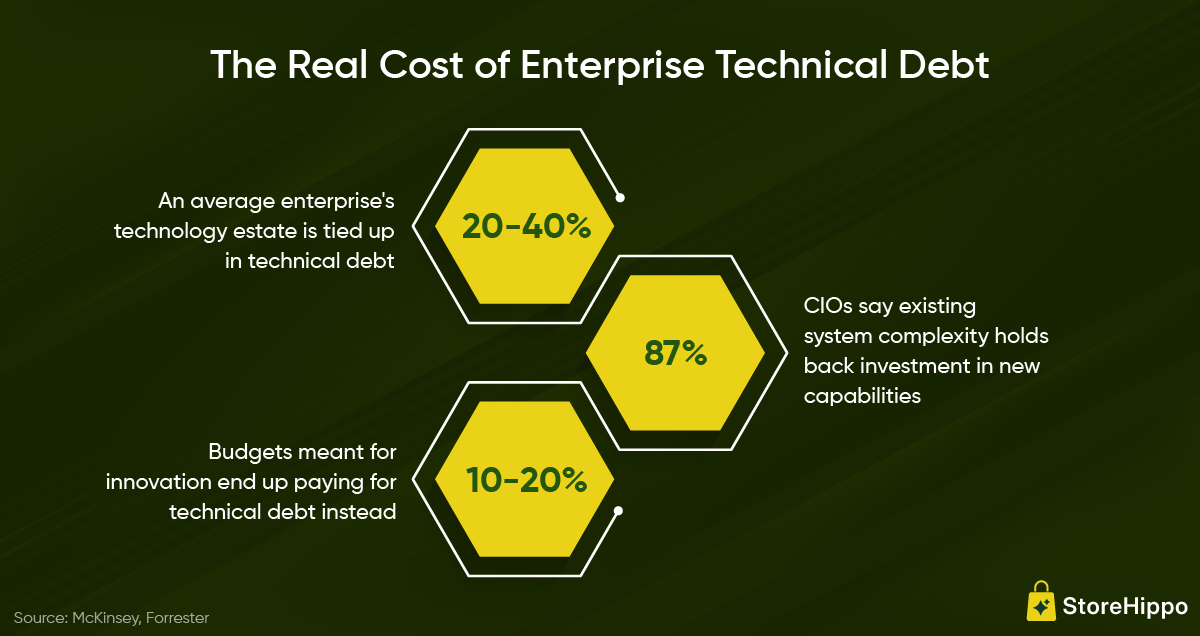
- 20–40% of an average enterprise's technology estate is tied up in technical debt (McKinsey).
- 87% of CIOs say existing system complexity holds back investment in new capabilities (McKinsey).
- 10–20% of budgets meant for innovation end up paying for technical debt instead (Forrester).
In my experience, that doesn't happen because a business decided to sell through B2B, B2C, D2C or B2B2C. It happens because every new requirement was solved separately. One more plugin. One more integration. One more custom workflow.
After a few years, while the business keeps growing, the technology powering it just keeps getting more complicated.
Can One Platform Really Support B2B, B2C, D2C and B2B2C at the Same Time?
Take a mid-sized manufacturer already running a B2B distributor portal with tiered pricing, RFQs and dealer logins. Then comes the request for a D2C storefront. A few months later, a large retail partner wants a co-branded store with its own catalogue, pricing and checkout rules.
On a patchwork stack, these usually become three separate projects. Three backends. Three logins for the operations team. And three places where pricing, inventory or order rules can fall out of sync.
On a composable ecommerce platform, the core systems remain the same. The product catalogue, order management, taxes, discounts and integrations are shared, while each storefront is configured for a different buyer journey.
That means the D2C business can launch on existing infrastructure instead of starting another platform implementation. The B2B2C storefront can use a selected catalogue and its own commercial rules without duplicating the entire commerce stack.
That is the practical difference between multi-store being listed as a feature and a multi-model enterprise ecommerce platform being built to run different business models from the same foundation.
What Changes When B2B, B2C, D2C and B2B2C Run on the Same Platform?
When multiple business models run on the same enterprise ecommerce platform, teams stop rebuilding the same commerce operations for every storefront. Catalogues, inventory, orders, integrations and customer data stay connected, while pricing, checkout and workflows can still be configured for each buyer group.
In practical terms, that means:
- One product catalogue can serve consumers, distributors, dealers and partners.
- Pricing can change by buyer group without duplicating product data.
- Inventory and orders remain visible across every storefront.
- Existing payment, logistics and ERP integrations can support new launches.
- Promotions and workflows can be configured for each business model.
- Teams get one operational view instead of switching between separate backends.
The biggest change is not simply having fewer systems. It is being able to extend on the work that has already been done for setting up the base system. A new D2C store can use the same fulfillment setup as the B2B marketplace. A distributor that supplies both wholesale and retail on their storefront can use selected products and its own pricing rules without needing another set up.
The industry data also shares insights on the benefits of this shared-platform approach:
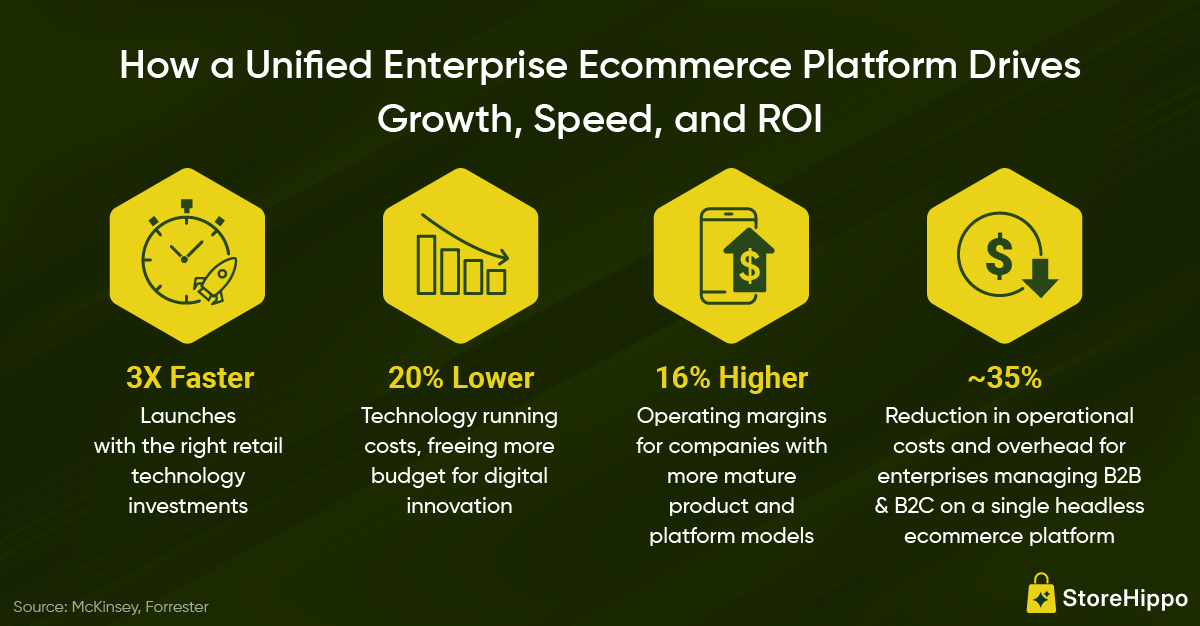
- 3× faster launches with the right retail technology investments (McKinsey)
- Up to 20% lower technology running costs, freeing more budget for digital innovation (McKinsey reports)
- 16% higher operating margins for companies with more mature product and platform models (McKinsey)
- ~35% reduction in operational costs and overhead for enterprises managing B2B & B2C on a single headless ecommerce platform (McKinsey)
These figures clearly reveal a pattern - reusing the same foundation reduces repeated work and makes the next launch easier than the last.
That is what a multi-model enterprise ecommerce platform should change. B2B, B2C, D2C, and B2B2C still have different buying journeys, but teams no longer need a different technology stack behind each one.
How Can Enterprises Make Sure an Ecommerce Platform Is Truly Built for Multi-Model Commerce?
For every enterprise, this test will look slightly different. The features a platform promises matter, but what matters more is how they hold up against the brand’s real requirements.
At the core, the platform should give teams enough flexibility, agility and control to launch new storefronts, experiences and business models without rebuilding everything all over again for each new model.
Let us suppose a B2B manufacturer wants to launch a D2C mobile app. Will the team need to create a separate catalogue, set up inventory again and rebuild payment, logistics and tax integrations for the app set-up? Or can it reuse the existing foundation and simply configure a new customer experience?
The same test applies when launching a dealer portal, regional storefront or co-branded B2B2C store. Can the business change pricing, catalogues, workflows and checkout rules without creating another backend or starting a fresh implementation?
That is where the gap between what a platform promises and what it actually delivers becomes clear. A multi-model enterprise ecommerce platform should not only support different business models. It should make each new launch faster and easier because the core systems are already in place.
How Do You Know the Enterprise Ecommerce Platform Will Be Easy to Run After Launch?
The easiest way to judge is to look at what everyday changes will require once the implementation team steps away.
Can catalogue teams update products without a deployment? Can marketing launch promotions without waiting for a developer? Can operations onboard dealers, change pricing rules or open a new storefront without raising another IT ticket?
That is what “easy to use” should mean at an enterprise level. Not just a clean dashboard, but fewer dependencies between the team that needs a change and the team that has to build it.
A low-code ecommerce platform gives business teams more control over routine work, while IT continues to manage integrations, security and genuinely custom requirements. A unified ecommerce platform that combines decoupled headless architecture with low-code capabilities enables the right teams to manage everyday operations and changes without relying on developers.
The real test is simple: after launch, does every small change still enter the development queue, or can the business keep moving without waiting for one?
Does Low-Code Architecture Make an Enterprise Ecommerce Platform Easy to Use?
Low-code architecture can make an enterprise ecommerce platform easier to use, but it is only part of the answer. It allows business teams to configure workflows, storefront logic and routine integrations without depending on custom development for every change.
No-plugin architecture addresses a different problem. It means essential capabilities are built into the platform instead of being added through separate apps that teams must install, update and maintain.
Together, low-code and native capabilities allow a headless ecommerce platform for enterprises to remain composable underneath without becoming difficult to operate every day.
We have seen this with a large manufacturer using StoreHippo for a hybrid distributor-led business. The platform supports distributors, dealers, internal teams and end customers, each with different catalogues, pricing and access rules. Business teams can manage routine storefront and user-level changes, while IT focuses on integrations and requirements that genuinely need custom development.
That is what makes enterprise commerce both powerful and usable. The architecture remains flexible, but everyday control stays with the teams running the business rather than only with the developers maintaining the technology.
How Long Does It Take to Launch a New Business Model on a Multi-Model Enterprise Ecommerce Platform?
The launch timeline is often the clearest sign of whether “one platform for multiple business models” is real or only a positioning claim.
On a plugin-heavy stack, starting from scratch or adding a new business model can easily become a project requiring several months of implementation. The catalogue will have to be recreated, integrations rebuilt, workflows tested and operational teams trained on another system.
With an composable ecommerce platform with multi-model support, much of that work is already done. For a mid-complexity enterprise setup, a new storefront, pricing model or market can typically go live in around 4–6 weeks, depending on the integrations and custom workflows involved. The timeline is shorter because the catalogue, payments, order management and fulfilment setup do not need to be rebuilt.
We have seen this with StoreHippo implementations where an existing B2B setup was extended to support new buyer groups, distributor storefronts and a D2C channel. The new experience still needed its own pricing, access and workflows, but it could build on the same commerce foundation.
That is the real advantage of a multi-model enterprise ecommerce platform. Each new launch should become easier than the previous one because more of the foundation is already in place. On a stitched stack, every addition risks becoming another first implementation.
Does A Headless Commerce Platform Trade Ease of Use for Flexibility?
Not necessarily. A headless ecommerce platform for enterprises becomes difficult to use when the business has to manage several separately sourced tools, not simply because the architecture is headless.
The problem usually starts when the storefront is built by connecting a separate CMS, search engine, payment system and frontend framework. Each tool brings another integration, admin panel and learning curve. The business gets flexibility, but teams also inherit the work of keeping the stack together.
A platform that is headless by design works differently. Teams can build custom storefronts and buyer journeys while managing catalogues, pricing, inventory and orders from the same operational backend.
We have seen this with StoreHippo implementations where different storefronts serve distributors, dealers and end customers, but the teams managing products and orders do not have to switch between separate systems for each one. The core platform and backend logic remains the same and new frontends for different buyer groups or channels are easily and quickly built on the same platform
So the real trade-off is not flexibility versus ease of use. It is a unified enterprise ecommerce platform versus a fragmented stack that makes teams manage several systems as one.
What Should an Enterprise Ecommerce Platform Be Able to Handle as the Business Evolves?
By this stage, the question is no longer whether a platform has B2B, D2C, marketplace or multi-store features. It is whether the same platform can keep adapting as the business asks for something it was not running at launch.
Across StoreHippo implementations, that has meant very different things: a dairy brand launching regional D2C stores, an automotive company using its dealer network to serve both businesses and consumers, and a manufacturer bringing distributors, dealers, internal teams and retail buyers onto one hybrid B2B+B2C marketplace.
The requirements may look different, but the test underneath is the same.
- Can the brand add a new storefront without rebuilding its catalogue?
- Can dealers or distributors run their own stores while the enterprise retains central control?
- Can pricing, access and workflows change for each buyer group?
- Can the same foundation support mobile apps, marketplaces, regional stores and direct commerce as the business expands?
In such cases, brands have been able to launch new storefronts in far less time, reduce customisation effort by nearly half, and expand into new models without creating another commerce stack for each one.
For me, that is the final test of a multi-model enterprise ecommerce platform. It should support the business you are running today without limiting what you may need to launch next.
How Can an AI-Powered Enterprise Ecommerce Platform Make Multi-Model Commerce Easier to Scale?
AI becomes useful in multi-model commerce when it removes the repetitive work that comes with adding new markets, sellers, channels and customer groups.
Take catalogue expansion. When a brand enters a new region or onboards more vendors, teams often spend weeks creating product titles, descriptions, attributes, categories and images. StoreHippo’s AI-assisted cataloguing can generate much of this information from uploaded product images, helping teams prepare large catalogues and onboard new sellers faster.
The same principle applies after the store goes live. Orders can be routed to the nearest eligible seller or fulfilment location based on predefined business rules, reducing manual allocation across dealer, marketplace or hyperlocal models. Conversations arriving through WhatsApp, chatbots, voice, SMS and email can also be managed from one dashboard, where teams can retain context, assign queries and step in when human judgement is needed.
This does not mean AI runs the entire business on its own. It means teams spend less time creating catalogues, sorting conversations and coordinating routine workflows as the commerce network grows.
For a brand running B2B, D2C, marketplaces and dealer-led commerce together, that practical support matters. StoreHippo’s AI-powered enterprise ecommerce platform helps the business add more sellers, locations and channels without increasing manual work at the same pace.
For requirements that go beyond ready-to-use AI capabilities, enterprises can also build their own agentic AI solutions for customer support, vendor assistance or internal teams, with AI-led journeys configured around the way their commerce operations already work.
Conclusion
For brands, choosing the right enterprise ecommerce platform ultimately comes down to one thing: how much room the business will have to change later.
The platform may go live for one immediate requirement, but its real value shows up when the next market, channel, partner model or customer journey can be added without forcing the business to rethink its entire technology setup.
That is the standard I would use while evaluating any modern enterprise solution, especially an AI-powered enterprise ecommerce platform. It should not only support what the business needs today, but also give teams enough control and intelligence to keep building what comes next.
The strongest platform choice is rarely the one with the longest feature list. It is the one that lets the business evolve without making every new idea feel like another replatforming decision.
Planning to run B2B, B2C, D2C or B2B2C from one platform? Book a StoreHippo demo to see how it can work for your business.
Frequently Asked Questions
1. How do I know if my business has outgrown its enterprise ecommerce platform?
Your enterprise ecommerce platform may be holding the business back if every new launch takes longer, routine changes require IT support, data sits across multiple systems, or new business models need fresh integrations. The clearest sign is when growth adds more operational effort than business value. At that point, the issue is usually not missing features, but the platform architecture underneath them.
2. Can enterprises migrate to a unified ecommerce platform in phases?
Yes. Enterprises can begin with one region, business unit, storefront or sales channel before moving the rest. A phased migration reduces risk, gives teams time to validate workflows and integrations, and avoids disrupting the entire business at once. The important part is ensuring each phase moves toward one shared foundation rather than creating another temporary system.
3. What should enterprises check before choosing a composable ecommerce platform?
Enterprises should check how easily the platform can adapt when requirements change. That includes adding new storefronts, buyer groups, integrations, workflows or regional experiences without rebuilding the core setup. A composable platform should give the business flexibility without forcing internal teams to assemble and maintain a complicated stack of separate services.
4. Can a headless ecommerce platform for enterprises support both web and mobile commerce?
Yes. A headless setup allows enterprises to build different frontends for websites, mobile apps, dealer portals or other channels while keeping the commerce backend connected. The important question is whether catalogue, pricing, inventory, orders and customer data remain centrally managed. If they do, teams can create new experiences without duplicating core operations.
5. How does an AI-powered enterprise ecommerce platform help with catalogue growth?
An AI-powered platform can reduce the manual work involved in creating and enriching large catalogues. Product images can be used to generate titles, descriptions, attributes, categories or SEO information, helping teams onboard more products, sellers or regional assortments faster. Human review still matters, but AI can remove much of the repetitive work that slows catalogue expansion.
6. Can an AI-powered enterprise ecommerce platform support customer and vendor operations?
Yes, if AI is connected to actual commerce workflows rather than added only as a chatbot. Enterprises can use AI for guided product discovery, customer support, vendor assistance, message assignment and predefined buying journeys. They can also build customised agentic solutions around their own support, seller or operational processes while keeping human teams in control of exceptions.
7. What is the difference between a multi-store setup and a multi-model enterprise ecommerce platform?
A multi-store setup lets a business run several storefronts, but those stores may still operate as separate configurations. A multi-model platform goes further by supporting B2B, B2C, D2C, B2B2C and marketplace models on a shared commerce foundation. Each experience can differ, while catalogues, integrations, orders and operational controls remain connected.
8. Can a low-code ecommerce platform reduce dependency on developers?
Yes. Low-code tools let business teams manage routine tasks such as catalogue updates, promotions, pricing rules, storefront settings and workflows without waiting for a development sprint. Developers are still needed for complex integrations, security and custom logic, but they no longer have to handle every everyday change the business wants to make.
9. Can an enterprise ecommerce platform for multiple business models support global expansion?
Yes, provided it can manage multiple currencies, languages, tax rules, catalogues, pricing structures and regional storefronts from one backend. Global teams should retain central control, while regional teams get enough flexibility to manage local requirements. This makes it easier to enter new markets without setting up a completely separate commerce system for each country.
Binny Joseph is a seasoned ecommerce and enterprise growth leader serving as Senior Vice President of Sales & Alliances, with extensive experience in driving digital commerce transformation for global brands.
He helps multi-model brands choose the right enterprise ecommerce platform to run B2B, B2C, D2C and B2B2C from one connected foundation, without adding unnecessary operational complexity.