


Building an online marketplace is no longer just another ecommerce strategy. It has become one of the fastest ways for businesses to expand product offerings, onboard new sellers, enter new markets, and create multiple revenue streams without managing inventory at scale.
The world's leading B2C multi vendor marketplaces have raised the bar by combining AI-powered shopping, mobile-first experiences, omnichannel selling, and seamless seller management. Businesses looking to build a successful marketplace can learn a great deal from how these platforms attract customers, support sellers, and continue to grow.
Explore 10 of the world's leading B2C online marketplaces, the strategies behind their success, and the key capabilities you'll need to build a marketplace that can grow globally.
Table of Contents
- Key Trends Driving the Global B2C Multi Vendor Marketplace Growth
- Top 10 Global B2C Multi Vendor Marketplaces
- Top B2C Multi Vendor Marketplaces: Features and Strengths
- How to Build a Successful B2C Online Marketplace for Global Growth
- Why StoreHippo Is the Best Marketplace Website Builder for Your B2C Multi Vendor Marketplace
- Conclusion
- FAQ
Key Trends Driving the Global B2C Multi Vendor Marketplace Growth
The rapid growth of online marketplaces is changing how people discover, compare, and buy products across the world. As more shoppers choose marketplace platforms over standalone online stores, businesses are investing in technologies that help them onboard sellers faster, deliver better buying experiences, and expand into new markets.
The following trends highlight how global B2C marketplaces are evolving and what businesses should keep in mind while building platforms for long-term growth.
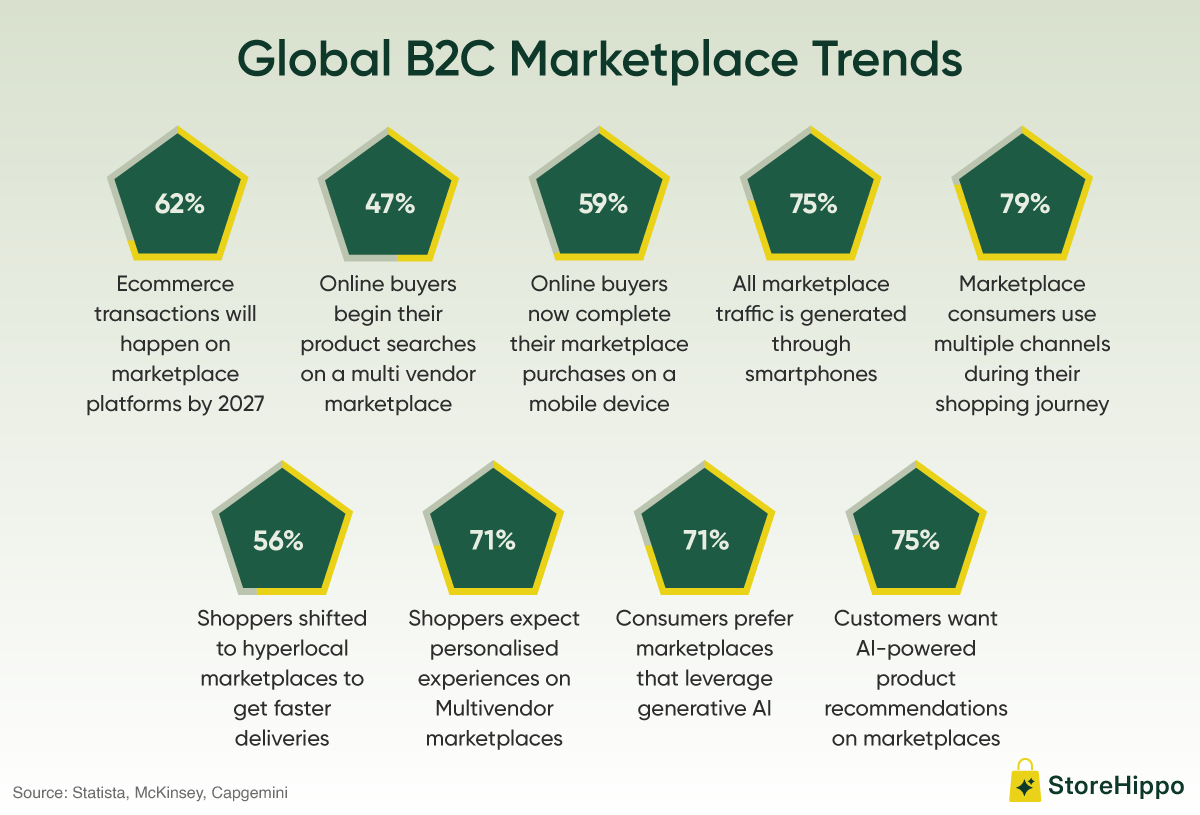
- 62% of ecommerce transactions will happen on marketplace platforms by 2027
- 47% of online buyers begin their product searches on a multi vendor marketplace
- 59% of online buyers now complete their marketplace purchases on a mobile device
- 75% of all marketplace traffic is generated through smartphones
- 79% of marketplace consumers use multiple channels during their shopping journey
- 56% of shoppers shifted to hyperlocal marketplaces to get faster deliveries
- 71% of shoppers expect personalised experiences on Multivendor marketplaces
- 71% of consumers prefer marketplaces that leverage generative AI
- 75% of customers want AI-powered product recommendations on marketplaces
Source: Statista, McKinsey, Capgemini
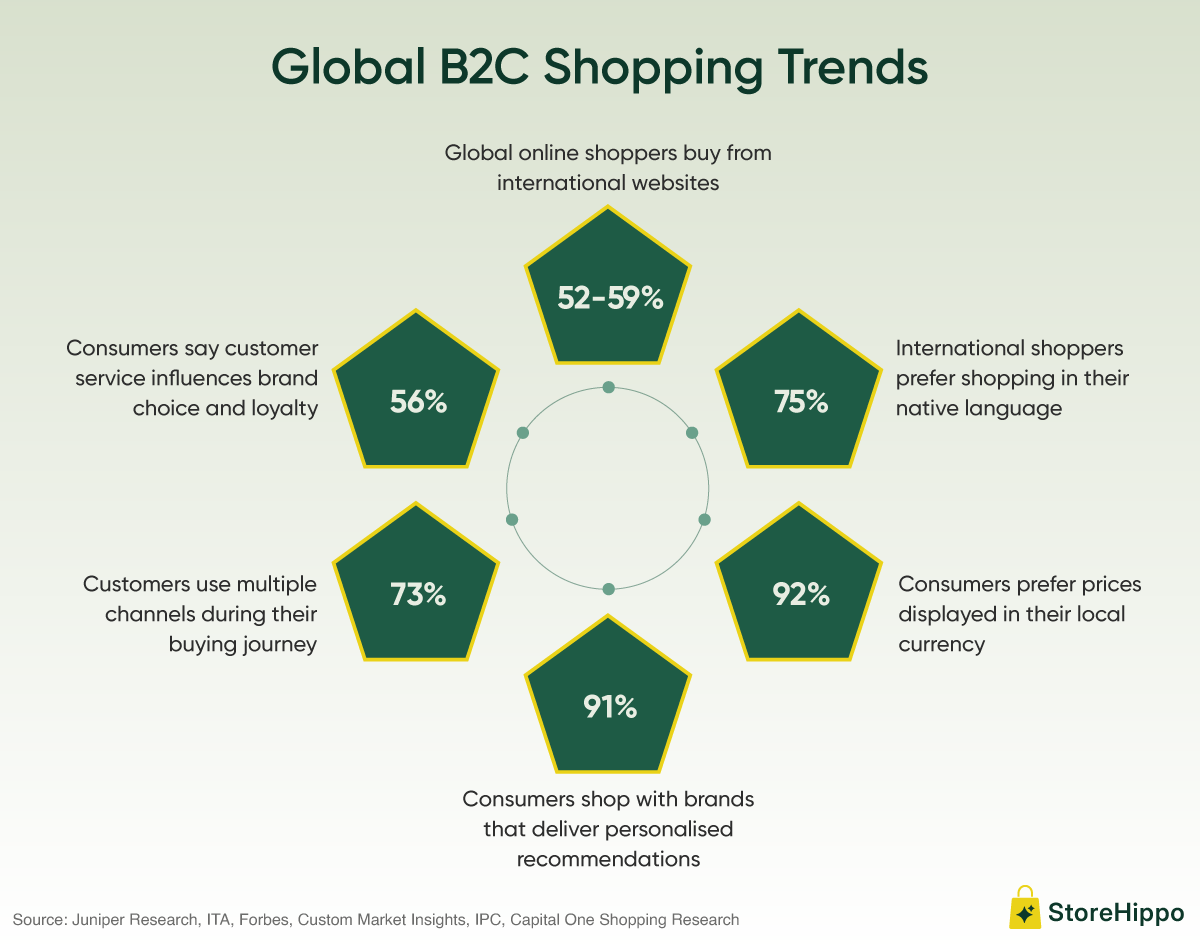
- 52%–59% of global online shoppers buy from international websites
- 75% of international shoppers prefer shopping in their native language
- 92% of consumers prefer prices displayed in their local currency
- 91% of consumers shop with brands that deliver personalised recommendations
- 73% of customers use multiple channels during their buying journey.
- 56% of consumers say customer service influences brand choice and loyalty
Source: Juniper Research, ITA, Forbes, Custom Market Insights, IPC, Capital One Shopping Research
The rapid growth of global online marketplaces shows that success today depends on creating experiences that benefit both buyers and sellers. From AI-powered shopping and mobile-first commerce to seamless seller management and cross-border capabilities, the world's leading marketplaces continue to raise the bar for digital commerce.
Let's explore some of the world's leading B2C multi vendor marketplaces, the strategies behind their success, and the capabilities you'll need to build a marketplace that can scale globally.}
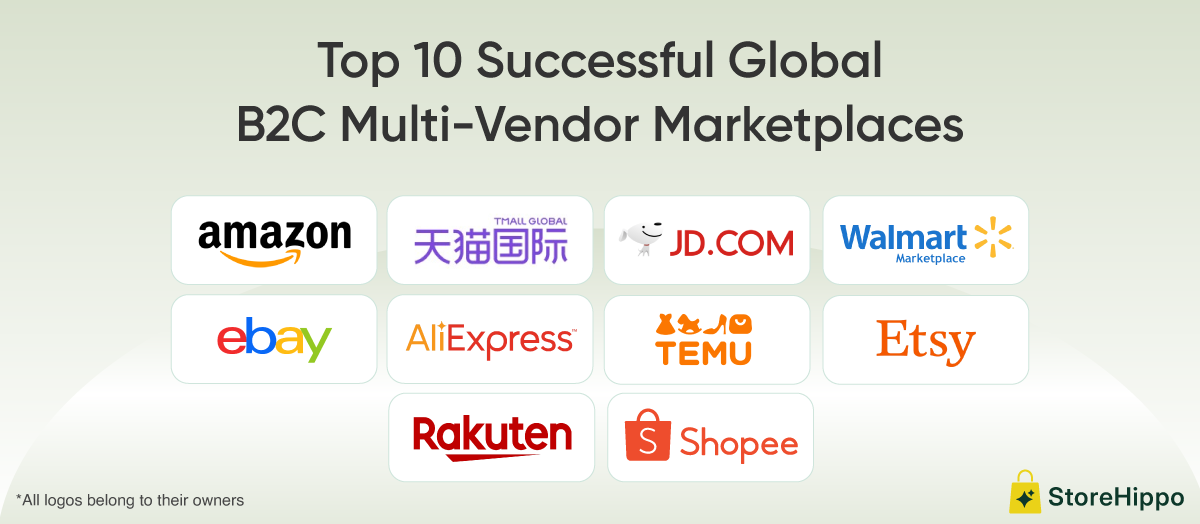
Top 10 Global B2C Multi Vendor Marketplaces
The world's biggest B2C marketplaces have set high standards for online shopping, but the market continues to create opportunities for new players. Let's look at 10 successful global B2C marketplaces and the ideas behind their growth.
1. Amazon
Amazon is the world's largest B2C multi vendor marketplace, offering millions of products across categories such as electronics, fashion, grocery, beauty, books, and home essentials. Across its global marketplaces, Amazon attracts around 5.5 billion monthly visits and connects shoppers with over 1.5 million active sellers, making it the largest ecommerce marketplace by traffic worldwide. ( Source Marketplace Pulse)
2. Tmall Global
Tmall Global, launched by Alibaba Group, is one of the largest cross-border ecommerce B2C marketplaces connecting international brands with Chinese consumers. This online marketplace offers products from thousands of international brands across thousands of product categories from more than 90 countries and regions.
3. JD.com
JD.com is one world famous B2C multi vendor marketplaces, known for its strong focus on technology, authentic products, and fast fulfilment. The company serves more than 600 million active customers annually and operates one of the world's largest self-owned logistics networks, enabling same-day and next-day delivery across much of China.
4. Walmart Marketplace
Walmart has transformed from a traditional retail giant into a powerful omnichannel marketplace connecting millions of customers with third-party sellers. Walmart Marketplace combines online shopping with its extensive store network, enabling faster fulfilment, pickup options, and integrated retail experiences. Customers can shop across groceries, electronics, fashion, home essentials, and more while benefiting from online delivery and in-store pickup. In fiscal 2025, Walmart reported US$681 billion in global revenue, while its ecommerce business generated around US$121 billion in sales, highlighting its growing online presence.
5. eBay
eBay is one of the world's largest B2C online marketplaces, offering products across electronics, collectibles, fashion, automotive parts, refurbished goods, and more. In 2025, eBay had 135 million active buyers, 2.5 billion live listings, and generated nearly US$80 billion in Gross Merchandise Volume (GMV) across more than 190 markets worldwide. (source SEC)
6. AliExpress
AliExpress is a leading global B2C marketplace connecting consumers with sellers and manufacturers, especially across cross-border ecommerce markets. The platform offers millions of products across categories such as electronics, fashion, beauty, home, and accessories. Its global reach across 200+ countries and competitive pricing have made it a popular choice for international shoppers.
7. Temu
Temu is one of the fastest-growing global B2C multi vendor marketplaces, known for its low-cost products, wide selection, and mobile-first shopping experience. The platform connects consumers directly with manufacturers and sellers while using data-driven recommendations and promotional strategies to drive customer engagement. In 2025, Temu reached over 400 million monthly active users globally and generated an estimated US$92 billion in GMV, reflecting its rapid international expansion.
8. Etsy
Etsy has built a strong niche by connecting shoppers with independent creators, artisans, and small businesses selling handmade, vintage, and personalised products. The marketplace focuses on unique product discovery, helping sellers reach customers looking for one-of-a-kind items. As of the end of 2025, Etsy had 86.5 million active buyers, 5.6 million active sellers, and more than 100 million products listed on its marketplace. (Source: Etsy)
9. Rakuten
Rakuten is one of Japan’s leading B2C Multi vendor marketplaces, offering sellers greater control over their storefronts, branding, and customer relationships. Beyond ecommerce, Rakuten offers digital payments, banking, travel, and loyalty services through its integrated ecosystem. Today, Rakuten serves more than 100 million members in Japan and operates businesses across 30+ countries and regions.
10. Shopee
Shopee is one of the fastest-growing B2C online marketplaces in Southeast Asia and several other international markets. The platform brings together online shopping, live shopping, secure digital payments, and seller-friendly tools to make buying and selling easier. It offers a wide range of products across categories like fashion, electronics, beauty, home, and lifestyle. Shopee processed more than 10 billion orders in 2025, making it one of the world's largest ecommerce platforms by order volume.
These global B2C online marketplaces have built successful businesses in different ways, but they all focus on delivering great customer experiences, supporting their sellers, and using technology to keep improving.
Top B2C Multi Vendor Marketplaces: Features and Strengths
Here's a quick comparison of the top B2C marketplaces and what makes each one successful.
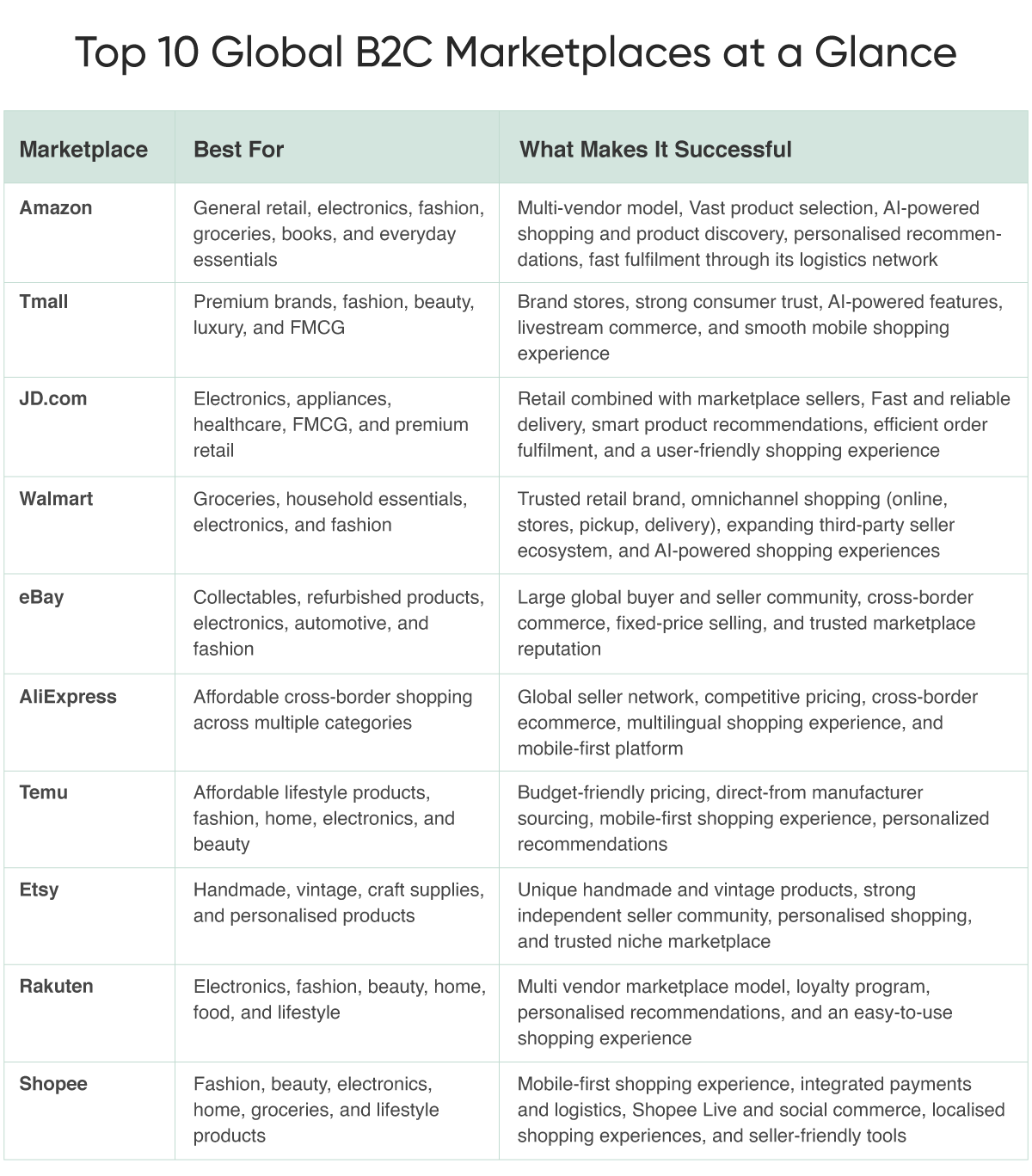
Now that you've seen what makes the world's leading B2C online marketplaces successful, the next step is understanding what you'll need to build one of your own. Let's explore the key capabilities every successful B2C online marketplace should have.
How to Build a Successful B2C Online Marketplace for Global Growth
Building a successful global B2C online marketplace starts with choosing an enterprise ecommerce platform that can scale across markets, deliver seamless customer experiences, and simplify business operations. As your marketplace grows, you'll need to manage multiple vendors, serve customers across different countries, support multiple languages and currencies, and ensure fast, reliable shopping experiences on every device. At the same time, the platform you chose should be flexible enough to adapt to changing customer expectations, new sales channels, and evolving business models without requiring frequent replatforming.
The right marketplace website builder should also help you automate day-to-day operations, streamline vendor management, support global payments and fulfilment, and provide the tools needed to attract, engage, and retain customers. Investing in these capabilities from the beginning creates a strong foundation for sustainable global growth.
StoreHippo brings all these capabilities together in a single enterprise marketplace platform. With built-in AI-powered commerce, mobile-first architecture, multi-vendor management, omnichannel selling, and global commerce features, StoreHippo makes it easy to build, launch, and scale a successful B2C online marketplace worldwide.
Why StoreHippo Is the Best Marketplace Website Builder for Your B2C Multi Vendor Marketplace
StoreHippo offers an intuitive, easy-to-use platform with native features that help businesses launch quickly and start selling faster. By simplifying day-to-day ecommerce operations, it enables teams to spend less time managing technology and more time growing their business. Whether you're launching a new marketplace or expanding an existing one, StoreHippo provides everything you need to build, manage, and scale your B2C multi vendor marketplace.
Here are the key StoreHippo features that make it easier to create a marketplace website and scale it for a global audience: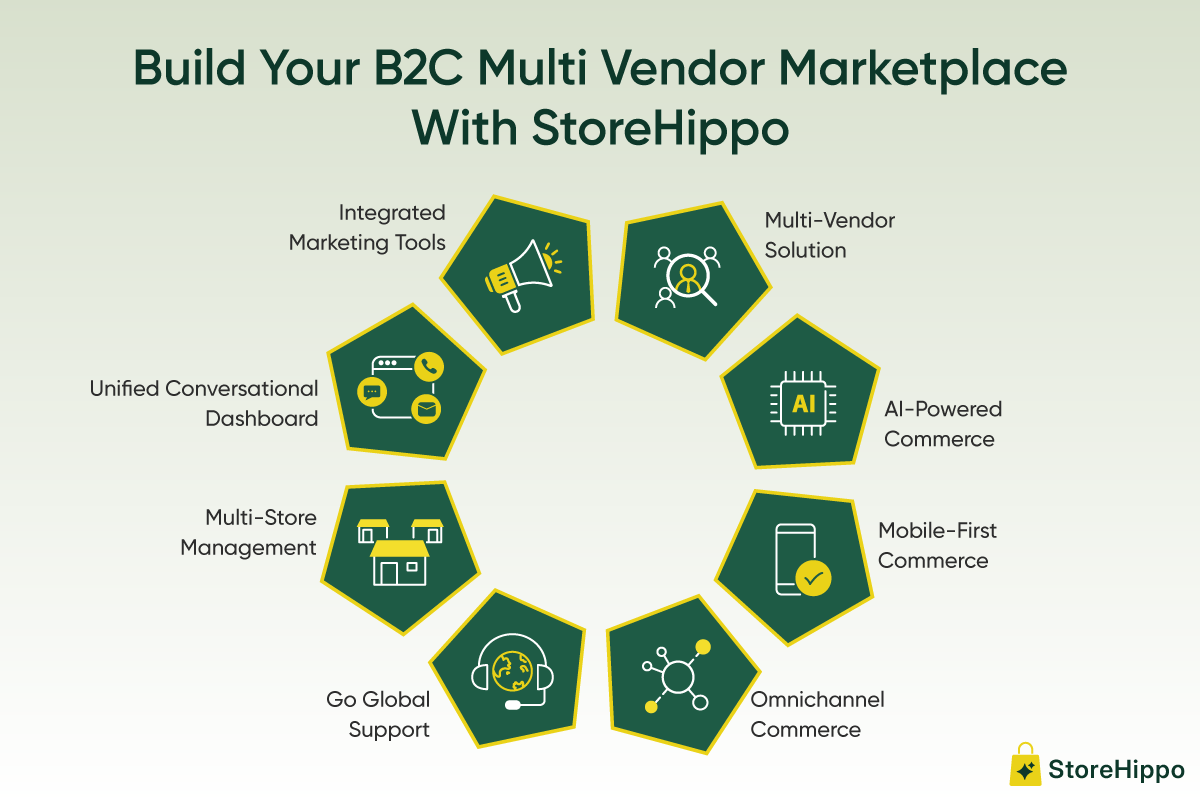
1. Multi-Vendor Solution
When you build a marketplace for your global business, you bring together thousands of vendors on the platform. And to manage them seamlessly, you need automated solutions that can help you streamline your day-to-day business activities.
StoreHippo enables you to not only quickly onboard multiple vendors but also manage them right from the dashboard of your online marketplace. The store admin can view and keep track of the vendor-specific sales, revenue, best-selling products etc via the admin dashboard. The admin also holds the power to approve or reject the vendor’s products before they are visible to the end customers.
2. AI-Powered Commerce
Shoppers now expect marketplaces to help them find the right products quickly instead of searching through endless listings. Businesses also need faster ways to manage large product catalogues and deliver personalised shopping experiences at scale.
StoreHippo brings AI-powered commerce capabilities that improve product discovery with semantic search, personalised recommendations, and intelligent search results. It also helps automate catalogue creation, product content generation, and enables enterprises to build custom AI agents for buyers, sellers, and internal teams.
3. Mobile-First Commerce
Given that almost 80% of the online orders take place via smartphones, we all know how important it is to sell on mobile channels today. StoreHippo helps businesses leverage m-commerce to their advantage.
StoreHippo is built on mobile-first technology that helps enterprises build Android and iOS mobile apps right from your admin dashboard. When you create a marketplace website with StoreHippo, you also get Progressive Web Apps (PWAs) that look, feel, and work like native mobile apps, even on entry-level devices and low internet connections.
4. Omnichannel Commerce
Modern customers shop through multiple channels and expect connected, seamless experiences across every touchpoint. They may discover products on the website, check product details on WhatsApp, and complete their purchase on a mobile app. In this omnichannel-first world, having a presence across multiple sales channels while delivering a consistent buying experience has become essential for business growth.
StoreHippo helps businesses build a marketplace and sell through online stores, mobile apps, PWAs, conversational AI channels, and voice commerce while managing products, inventory, customers, and orders from a single dashboard. This ensures customers enjoy a consistent buying experience across every touchpoint, making it easier to browse products, complete purchases, and track orders seamlessly, no matter which channel they use.
5. Go Global Support
Expanding into international markets means serving customers with different languages, currencies, payment preferences, and delivery requirements. Managing all these manually can quickly become challenging as your business grows.
StoreHippo comes with built-in global commerce capabilities that help businesses build a marketplace and expand into multiple countries with ease. It supports 100+ languages, including RTL languages like Arabic, multiple currencies, international payment gateways, global shipping partners, location-based pricing, and a built-in tax engine to simplify cross-border selling.
6. Multi-Store Management
As businesses expand into new regions, brands, or customer segments, managing multiple online stores separately can become complex and time-consuming. You need a solution that lets you operate multiple storefronts efficiently while keeping your business centrally managed.
StoreHippo's built-in multi-store management solutions enable businesses to launch and manage multiple storefronts from a single admin dashboard. Whether you're running region-specific stores, brand stores, B2B and B2C stores, or international storefronts, you can centrally manage products, inventory, orders, customers, pricing, and promotions while delivering customised shopping experiences for every market.
7. Unified Conversational Dashboard
Customers today interact with businesses across multiple communication channels and expect quick, contextual responses wherever they reach out. Managing these conversations separately can lead to delayed responses and inconsistent customer experiences.
StoreHippo's Unified Conversational Dashboard brings customer interactions from WhatsApp, chat, voice, email, and AI-powered conversations into a single interface. Businesses can manage, monitor, and act on conversations across every channel from a central command center powered by agentic AI, enabling faster support, personalised assistance, and a seamless buying experience across every communication channel.
8. Integrated Marketing Tools
Launching your B2C multi vendor marketplace is only the beginning. To keep customers coming back, you need marketing tools that help you engage shoppers, improve conversions, and build long-term loyalty without relying on multiple third-party applications.
StoreHippo comes with a comprehensive set of built-in marketing tools, including a discount engine, loyalty programmes, coupons, personalised offers, AI-powered recommendations, abandoned cart recovery, push notifications, landing pages, and customer segmentation. These features help businesses attract new customers, encourage repeat purchases, and grow revenue more efficiently.
Conclusion
The world's leading B2C marketplaces have one thing in common: they continuously evolve with changing customer expectations and embrace technologies that deliver faster, smarter, and more personalised shopping experiences. Whether it's AI-powered product discovery, mobile-first commerce, omnichannel selling, or global expansion, these capabilities are becoming essential for building a successful online marketplace.
If you're planning to launch or scale your own B2C multi vendor marketplace, choosing the right technology partner is just as important as your business idea. StoreHippo provides an enterprise-ready marketplace platform with built-in AI-powered commerce, mobile-first architecture, multi-vendor management, omnichannel capabilities, and global commerce features to help you launch faster and scale with confidence.
Ready to build your global B2C online marketplace?
Book a demo with StoreHippo now.
FAQ
1. How can enterprises choose the right B2C multi vendor marketplace builder for long-term growth?
Enterprises should choose a B2C multi vendor marketplace builder that can scale with business growth, support multiple business models, and reduce the need for future replatforming. A cloud-native, API-first platform with built-in enterprise features is the best choice for long-term success.
StoreHippo is built on cloud-native infrastructure with elastic scalability and auto-provisioning capabilities to handle peak traffic and rapid business growth. As enterprises build a marketplace with StoreHippo, they can onboard more sellers, expand product catalogues, enter new markets, and launch new business models without worrying about migrating to another platform.
2. How can an enterprise tailor its marketplace website for different global regions?
An enterprise can tailor its marketplace website for different global regions by offering localised shopping experiences, including multiple languages, currencies, payment methods, pricing, and shipping options. Choosing a marketplace platform with built-in global commerce capabilities makes it easier to expand into new markets while delivering a seamless customer experience.
StoreHippo helps enterprises create region-specific marketplace experiences with support for 100+ languages, including RTL languages like Arabic, multiple currencies, international payment gateways, location-based pricing, and customizable storefronts. Its API-first headless architecture also enables businesses to build unique buying experiences for different markets.
3. How can a global online marketplace builder help enterprises attract and retain more customers?
A global online marketplace builder can help enterprises attract and retain more customers by offering built-in marketing tools, personalised shopping experiences, and customer engagement features. These capabilities help businesses increase visibility, improve conversions, encourage repeat purchases, and build long-term customer loyalty without relying on multiple third-party solutions.
StoreHippo offers a host of built-in marketing tools including an discount engine, loyalty programmes, coupons, abandoned cart recovery, push notifications, landing pages, SEO tools, and AI-powered recommendations. Enterprises can also integrate additional marketing solutions using StoreHippo's API-first architecture.
4. How can enterprises integrate local shipping partners in different countries on their B2C marketplace ?
Enterprises can integrate local shipping partners in different countries by choosing a marketplace platform that supports multiple logistics providers and flexible shipping configurations. This helps optimise delivery costs, improve shipping speed, and provide a better customer experience across different regions.
StoreHippo comes pre-integrated with 30+ logistics providers and allows enterprises to integrate additional regional shipping partners as needed. It also includes custom built delivery boy management capabilities to help businesses manage their own delivery fleet and streamline fulfilment operations.
5. What additional software costs should an enterprise expect when running an online marketplace?
The additional software costs depend on the marketplace platform an enterprise chooses. A platform with built-in features for inventory, order management, marketing, payments, and logistics can significantly reduce the need for third-party apps, lowering both software costs and operational complexity.
StoreHippo B2C multi vendor marketplace platform offers a fully hosted and managed ecommerce platform with built-in capabilities for inventory management, order management, seller management, marketing, payments, and logistics. This reduces dependency on multiple third-party applications while centralising operations through a single admin dashboard.
6. How can a global online marketplace support payments in multiple currencies?
A global online marketplace can support payments in multiple currencies by using a platform that offers multi-currency capabilities and integrates with international payment gateways. This allows customers to view prices and complete purchases in their preferred currency, creating a smoother checkout experience and improving global conversions.
StoreHippo supports multiple currencies along with 60+ domestic and international payment gateways. Enterprises can enable location-based currency switching or allow customers to choose their preferred currency during checkout, making international transactions easier.
7. How can an enterprise manage product catalogues from multiple countries on their B2C multi vendor marketplace?
Enterprises can efficiently manage product catalogues across multiple countries by using a centralised marketplace platform with built-in catalogue, inventory, and order management. This enables them to organise products, manage regional inventories, and maintain accurate product information across different markets from a single dashboard.
StoreHippo provides built-in order and inventory management tools that allow enterprises to manage products, inventories, warehouses, and regional storefronts from a single dashboard. This helps streamline catalogue management while maintaining accurate inventory across multiple markets.
8. How can enterprises deliver seamless customer support on a B2C multi vendor marketplace?
Enterprises can deliver seamless customer support on a B2C multi vendor marketplace by offering multiple support channels, multilingual assistance, and timely order updates. A marketplace platform with built-in communication tools and easy integrations helps businesses resolve customer queries faster and provide a consistent support experience across regions.
StoreHippo integrates with leading customer support solutions and offers built-in communication tools such as email, SMS, push notifications, live chat, and chatbots. With support for over 100 languages, enterprises can also deliver localised customer experiences across global markets.
Binny Joseph is a seasoned ecommerce leader and Senior Vice President of Sales & Alliances with extensive experience helping businesses adopt modern commerce solutions.
He shares practical insights on building and scaling B2C multi vendor marketplaces that drive growth in India's evolving digital commerce landscape.