


Online marketplaces have moved far beyond being simple websites where buyers and sellers meet. Now, they have become the powerful digital ecosystems that connect customers, brands, manufacturers, suppliers, and retailers across markets, categories, and geographies.
From consumer shopping and global product discovery to business sourcing and bulk procurement, leading B2B and B2C marketplaces are changing how people buy and sell. They bring together large seller networks, diverse product catalogues, seamless payments, logistics, personalised experiences, and increasingly, AI-powered discovery on a single platform.
As more businesses look beyond traditional channels to reach new customers and markets, the marketplace model is becoming an important part of the global ecommerce growth story. But what makes some marketplaces stand out while others struggle to scale?
Let us look at 10 of the world’s leading B2B and B2C online marketplaces, understand what makes each one successful, and explore the key capabilities businesses need to build a marketplace that can grow and compete globally
Table of Contents
Key Trends Driving Global Online Marketplace Growth
The rapid growth of online marketplaces is changing how people and businesses discover, compare, and buy products. From B2C platforms that make everyday shopping easier to B2B marketplaces that simplify business purchases, online marketplaces have changed the way people buy and sell online.
The following trends highlight how B2B and B2C marketplaces are evolving, from mobile-first shopping and omnichannel journeys to AI-powered discovery, personalised experiences, and the growing adoption of digital B2B buying.
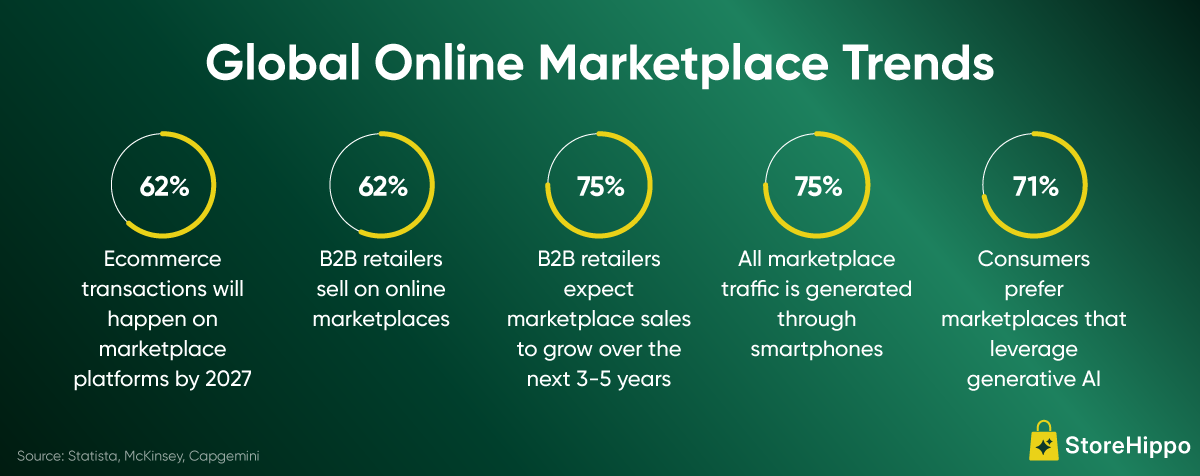
- 62% of ecommerce transactions will happen on marketplace platforms by 2027
- 56% of B2B retailers sell on online marketplaces
- 75% of B2B retailers expect marketplace sales to grow over the next 3-5 years
- 75% of all marketplace traffic is generated through smartphones
- 71% of consumers prefer marketplaces that leverage generative AI
Source: Statista, McKinsey, Capgemini
Key takeaway: The growing adoption of marketplaces is giving businesses new ways to reach customers and expand across markets. Strong seller networks, mobile commerce, and a wider product selection have become important drivers of marketplace growth.
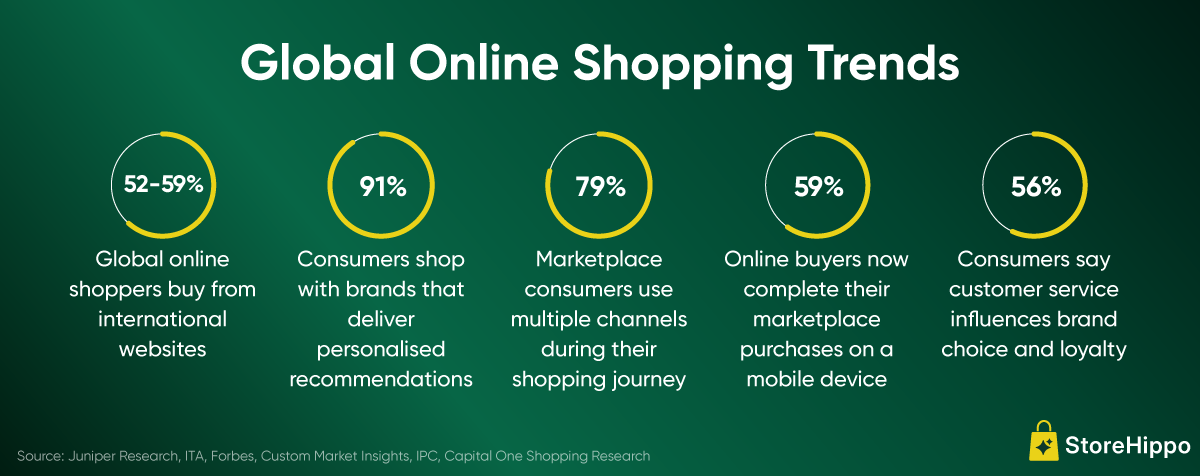
- 52%-59% of global online shoppers buy from international websites
- 91% of consumers shop with brands that deliver personalised recommendations
- 79% of marketplace consumers use multiple channels during their shopping journey
- 59% of online buyers now complete their marketplace purchases on a mobile device
- 56% of consumers say customer service influences brand choice and loyalty
Source: Juniper Research, ITA, Forbes, Custom Market Insights, IPC, Capital One Shopping Research
Key takeaway: Online shoppers now expect more flexibility, personalisation, and seamless experiences across channels. Marketplaces that make buying easier across devices, markets, and touchpoints can better engage customers and drive repeat purchases.
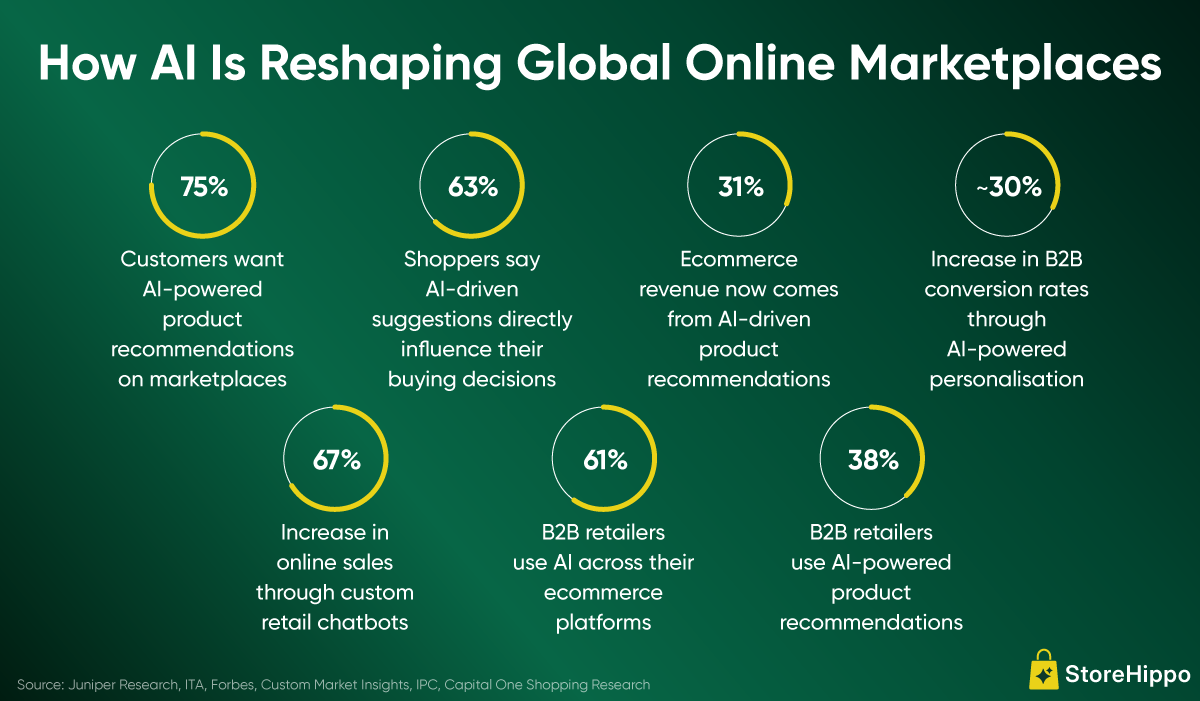
- 75% of customers want AI-powered product recommendations on marketplaces
- 63% of shoppers say AI-driven suggestions directly influence their buying decisions
- 31% of ecommerce revenue now comes from AI-driven product recommendations
- ~ 30% increase in B2B conversion rates through AI-powered personalisation
- 67% increase in online sales through custom retail chatbots
- 61% of B2B retailers use AI across their ecommerce platforms
- 38% of B2B retailers use AI-powered product recommendations
Source: Statista, DHL, McKinsey
Key Takeaway: AI has become a competitive advantage for online marketplaces, helping businesses respond better to changing buyer expectations. Marketplaces that invest in AI early can gain an edge in customer engagement, conversions, and long-term growth.
Together, these trends show how global online marketplaces are evolving to meet changing customer expectations. From AI-powered product discovery and personalised experiences to mobile commerce, omnichannel shopping, and simpler B2B buying journeys, successful marketplaces are finding better ways to serve buyers and sellers. Strong seller networks and the right technology further help them expand across categories and markets.
So, what does this look like in practice? Let’s explore some of the world’s leading B2B and B2C online marketplaces, the strategies behind their growth, and what enterprises can learn when they want to build a marketplace that can compete and scale globally.
Top 10 Global Online Marketplaces (B2B+B2C)
Online marketplaces have grown far beyond platforms where consumers simply shop for products. Now, they also help businesses find products, connect with suppliers, and manage large-scale purchases.
Let's look at 10 successful global online marketplaces and the strategies that have helped them build strong positions across B2B, B2C, or both.
1. Amazon
Amazon is one of the world's leading online marketplaces, serving both B2B and B2C customers across global markets. It brings millions of products and sellers together across categories such as electronics, fashion, grocery, beauty, and home essentials. Amazon Business extends its marketplace to organisations, while fulfilment, payments, advertising, and seller tools help create a seamless buying and selling experience.
Amazon Growth Stats
- $716.9 billion in net sales in 2025, up 12% YoY
- International sales grew 13% YoY to $161.9 billion in 2025
- More than 60% of sales in Amazon’s store came from independent sellers
- 75,000+ independent sellers surpassed $1 million in sales in 2025
- Amazon operates across multiple international markets through its global marketplace ecosystem
Source: Amazon
What Enterprises Can Learn From Its Success:
- Build a broad seller ecosystem and continuously expand product selection to give customers more choice across categories and price points.
- Make AI part of the shopping journey through conversational discovery, personalised recommendations, visual search, and agentic shopping.
- Create a consistent shopping experience across website, mobile app, fulfilment, payments, and other customer touchpoints rather than treating each channel separately.
- Give sellers technology and marketing tools that help them manage catalogues, reach customers, advertise products, and grow within the marketplace.
- Keep evolving the marketplace around changing customer behaviour, including AI-assisted shopping, faster delivery, personalised experiences, and mobile commerce.
2. Alibaba.com
Alibaba is one of the world's leading B2B online marketplaces, connecting businesses with manufacturers, wholesalers, suppliers, and distributors across global markets. Buyers can discover products, compare suppliers, request quotes, and connect with sellers directly through the platform. Its focus on global sourcing has made it a major destination for businesses looking to purchase products at scale.
Alibaba.com Growth Stats
- 47 million+ buyers from 190+ countries in FY26
- 240,000+ paying members globally as of March 2026
- International Commerce Wholesale revenue grew 11% YoY in FY26
- Alibaba.com launched AI-enabled procurement and agentic business tools in FY26
Source: Companies Market Cap
What Enterprises Can Learn From Its Success:
- Support every stage of the B2B buying process, from finding suppliers and comparing products to sending enquiries, requesting quotations, and placing orders.
- Help sellers connect with buyers in international markets through tools that make cross-border selling, product discovery, and business communication easier.
- Build buyer trust by providing clear supplier information, verification details, and accurate product listings that help businesses make informed decisions.
- Make the online marketplace easy to access across digital channels and keep improving how buyers search, discover products, and complete purchases with the help of technology.
3. eBay
eBay is a globally recognised online marketplace that serves both B2B and B2C buyers and sellers across more than 190 markets. It offers everything from electronics and fashion to collectibles, automotive parts, and refurbished products. Its wide product selection, seller ecosystem, and personalised discovery features continue to keep the marketplace relevant to both consumers and businesses.
eBay Growth Stats
- $79.6 billion GMV in 2025, up 7% YoY
- $11.1 billion revenue in 2025, up 8% YoY
- 135 million active buyers worldwide at the end of 2025
- 2.5 billion live listings globally at the end of 2025
Source: eBay Investors
What Enterprises Can Learn From Its Success:
- Build a diverse marketplace that supports mainstream products as well as specialised categories, refurbished products, collectables, etc.
- Use agentic AI to make product discovery more conversational and personalised.
- Make selling easier with mobile-friendly tools and AI-assisted listing creation that can turn product images into ready-to-use listing information.
- Give sellers simple, flexible tools to list products, manage their stores, promote their offerings, and grow their business without adding unnecessary complexity.
- Build trust through ratings, reviews, buyer protection, secure payments, and consistent experiences across the marketplace's digital touchpoints.
4. Walmart Marketplace
Walmart Marketplace is a major B2B and B2C online marketplace that combines Walmart's extensive physical retail network with digital commerce. Third-party sellers can reach millions of customers across categories such as grocery, electronics, fashion, and home essentials, while customers can choose delivery or store pickup. This combination of online and offline retail gives Walmart a distinctive enterprise marketplace model.
Walmart Marketplace Growth Stats
- Global eCommerce sales grew 24% in FY26
- Walmart U.S. eCommerce sales grew 27% in Q4 FY26
- Walmart International eCommerce sales grew 17% in Q4 FY26
- Global advertising business grew 37% in Q4 FY26
- Walmart International net sales reached $130.4 billion in FY26, up 7% YoY
Source: Walmart
What Enterprises Can Learn From Its Success:
- Connect online and offline commerce so customers can move smoothly between digital shopping, stores, delivery, and pickup.
- Bring AI directly into the shopping experience through tools such as Sparky, Walmart's generative AI shopping assistant, which helps customers discover, compare, and personalise product choices.
- Build a unified commerce experience around inventory, fulfilment, stores, mobile shopping, and delivery instead of operating these channels independently.
- Give third-party sellers access to a large customer ecosystem while maintaining consistent marketplace standards and service quality.
- Explore emerging commerce channels, including conversational shopping through AI platforms.
5. Mercado Libre
Mercado Libre is one of Latin America's leading online marketplaces, serving both B2B and B2C customers across the region. The platform connects buyers and sellers across multiple product categories while integrating payments through Mercado Pago and fulfilment through its logistics network. This connected ecosystem makes Mercado Libre more than a marketplace website and gives buyers and sellers a complete digital commerce experience.
Mercado Libre Growth Stats
- $65.0 billion GMV in 2025, up 26% YoY
- 121 million unique active buyers in 2025, up 21% YoY
- 2.43 billion items sold in 2025, up 36% YoY
- 78 million fintech monthly active users in 2025, up 28% YoY
- $277.8 billion total payment volume in 2025, up 41% YoY
Source: Mercado Libre
What Enterprises Can Learn From Its Success:
- Build an interconnected ecosystem where marketplace, payments, logistics, advertising, and seller services reinforce one another.
- Build an AI-powered marketplace to improve product discovery and search.
- Give sellers AI-powered tools that help them manage listings, pricing, advertising, and day-to-day marketplace operations across desktop and mobile.
- Make it easier for sellers to reach buyers by offering shopping and selling tools on familiar channels like WhatsApp.
- Build a unified ecosystem where customers can move naturally between shopping, payments, fulfilment, and other services instead of treating each interaction as a separate transaction.
6. Shopee
Shopee is a leading B2C online marketplace with a strong presence across Southeast Asia and several international markets. Shopee combines product discovery with mobile shopping, promotions, digital payments, live shopping, and social features. Its mobile-first approach makes it easy for shoppers to discover products while giving sellers simple tools to list, promote, and manage their stores.
Shopee Growth Stats
- GMV grew 27% YoY in 2025
- Monthly active buyers grew 15% YoY
- Average monthly purchase frequency increased 10% YoY
- Ad-paying sellers increased more than 20% YoY in Q4 2025
- Shopee VIP subscribers surpassed 7 million by the end of 2025
Source: Sea
What Enterprises Can Learn From Its Success:
- Build a mobile-friendly online marketplace where buyers can easily find products, shop, make payments, and access promotions, while sellers can manage their stores directly from their smartphones.
- Use AI to make selling easier with tools for product photography, virtual try-ons, advertising, and other day-to-day seller tasks.
- Help customers discover products through conversational channels.
- Give sellers easy access to advertising, promotions, order fulfilment, content creation, and store management tools in one place, so they can spend less time switching between different systems.
- Make shopping more engaging by bringing together videos, live shopping, social features, special offers, and personalised product recommendations.
7. Taobao
Taobao is one of the world’s largest B2C online marketplaces, offering an enormous range of products across categories and price points. The platform combines shopping with personalised recommendations, content, promotions, and social interactions to make product discovery more engaging. Its use of intelligent recommendations and personalised experiences makes Taobao a strong example of an AI-powered marketplace.
Taobao Growth Stats
- Taobao and Tmall's customer management revenue reached RMB343.9 billion in FY26, up 5% YoY
- Taobao and Tmall remained part of Alibaba's core China ecommerce business, which generated RMB449.4 billion from ecommerce in FY26
- 88VIP membership exceeded 62 million in 2026
- Brands generating more than RMB100 million in annual sales on Tmall grew 15% YoY
Source: PublicNow
What Enterprises Can Learn From Its Success:
- Make AI and personalisation a core part of product discovery, helping shoppers find products that match their needs and preferences.
- Let customers search for products, compare options, get recommendations, make purchases, and track orders through simple conversations.
- Use AI throughout the shopping journey, from finding the right products and discovering relevant offers to completing payments, managing deliveries, and handling after-sales queries.
- Help sellers save time with AI tools for creating product listings, managing their stores, running marketing campaigns, and responding to customer queries.
Bring search, content, social discovery, personalised recommendations, and shopping together in one connected marketplace experience, making it easier for customers to move from discovering products to placing orders.
8. Etsy
Etsy is a global B2C online marketplace that connects shoppers with independent creators and small businesses selling handmade, vintage, personalised, and creative products. Its niche focus helps sellers reach customers looking for products that are different from mass-market offerings. As of December 2025, Etsy had 86.5 million active buyers and 5.6 million active sellers, making it one of the world's largest specialised marketplaces.
Etsy Growth Stats
- $10.5 billion Etsy marketplace GMS in 2025
- 86.5 million active buyers globally
- 5.6 million active sellers
- 100 million+ items listed on the marketplace
Source: Etsy
What Enterprises Can Learn From Its Success:
- Focus on a clear customer need or niche to give the online marketplace a distinct identity, rather than competing only on product variety and price.
- Use AI to help shoppers find relevant products while keeping the marketplace's unique character intact.
- Help sellers reach customers through new shopping channels, so their products can be discovered beyond the marketplace's own website and app.
- Combine personalised recommendations with carefully selected products to help shoppers find what they need while preserving the marketplace's unique appeal.
- Give independent sellers the tools they need to adapt to changing shopping habits and reach customers through new ways of discovering and buying products.
9. JD.com
JD.com is a leading global online marketplace serving both B2B and B2C customers through its ecommerce and business commerce ecosystem. It offers products across categories such as electronics, appliances, groceries, and fashion while combining ecommerce with its extensive logistics and fulfilment infrastructure. This combination helps JD.com provide faster delivery and greater control over the customer experience.
JD.com Growth Stats
- RMB1.31 trillion ($187.2 billion) net revenue in 2025, up 13% YoY
- Marketplace and marketing revenue grew 18.9% YoY in 2025
- Logistics and other service revenue grew 26.6% YoY
- Annual active customers surpassed 700 million in October 2025
- JD Retail revenue grew 11.4% YoY in Q3 2025
Source: JD Investors Relations
What Enterprises Can Learn From Its Success:
- Make logistics, order fulfilment, inventory management, and technology a priority, as they play a big role in delivering a smooth shopping experience.
- Use AI to improve both shopping and everyday business operations.
- Make shopping easier through mobile apps and conversational tools that help customers compare products, check prices, get recommendations, and place orders with less effort.
- Use AI beyond product discovery to help sellers manage daily operations, create product content, respond to customer queries, handle procurement, and improve order fulfilment.
- Connect commerce and logistics into one operational ecosystem so that improvements in technology can directly translate into faster and more reliable fulfilment.
10. IndiaMART
IndiaMART is one of India's leading B2B online marketplaces, connecting businesses with manufacturers, wholesalers, suppliers, and service providers. Buyers can discover products, compare suppliers, request information, and initiate business enquiries through the platform. Its focus on supplier discovery and business sourcing has made IndiaMART an important digital destination for businesses looking to expand their supplier networks.
IndiaMART Growth Stats
- ₹13,201 million revenue from operations in FY25, up 16% YoY
- 211 million registered buyers as of March 2025
- 8.4 million registered suppliers
- 217,000 paying suppliers
- 119 million products listed across 98,000 categories
Source: India Infoline
What Enterprises Can Learn From Its Success:
- Build the marketplace around specific B2B needs, such as finding reliable suppliers, sourcing products, sending enquiries, and connecting with the right business partners.
- Help buyers find suitable suppliers, compare their offerings, share requirements, and get in touch with sellers without unnecessary steps.
- Bring together a wide range of suppliers across product categories and locations, giving buyers more options to meet their business needs.
- Focus on generating genuine business enquiries and helping buyers connect with the right sellers, rather than judging success only by the number of completed orders.
- Keep the buying process simple and easy to follow, especially for businesses that are moving from traditional offline sourcing to online platforms.
These global online marketplaces have built their success around different strengths, from Amazon's scale and Alibaba.com's global sourcing network to Etsy's niche community and IndiaMART's B2B focus. Together, they show how the marketplace model can serve very different customer needs while continuing to evolve with technology.
For businesses planning to build a marketplace website, these platforms offer valuable examples of what works in the real world. They show how features such as seller management, product discovery, payments, logistics, personalisation, and AI can make buying and selling easierThe next generation of enterprise marketplaces will need to bring these capabilities together to create flexible experiences for both B2B and B2C buyers.
Top Global Online Marketplaces in 2026: Quick Comparison
Here's a quick comparison of the top online marketplaces and what makes each one successful.
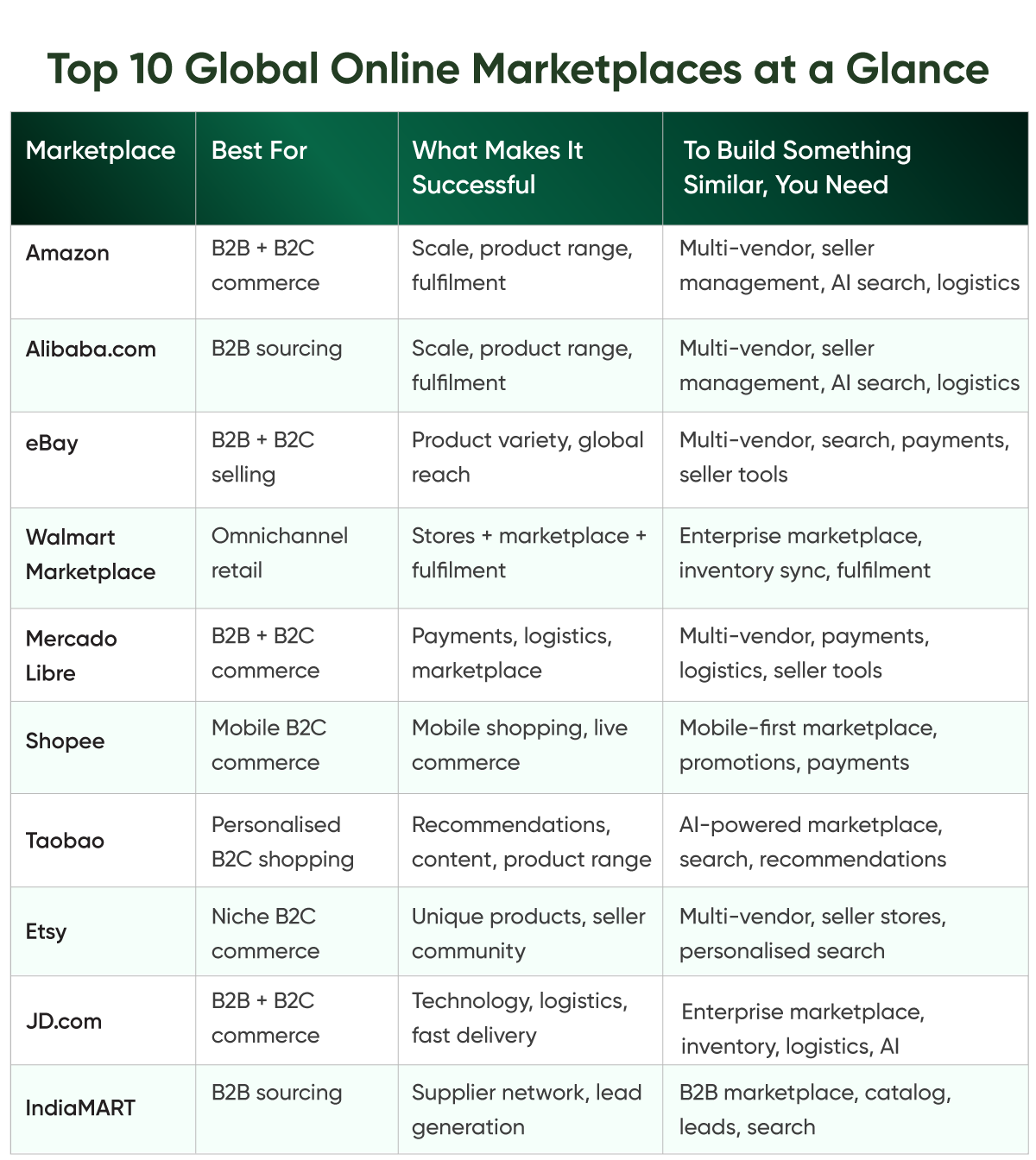
Now that we've looked at what makes the world's leading B2B and B2C online marketplaces successful, the next step is understanding what it takes to build one that can compete and scale. Let's explore the key features and capabilities every successful online marketplace should have.
How to Build a Successful Global Online Marketplace
To build a successful online marketplace, enterprises should choose a future-ready marketplace platform that fits their business model, target buyers, seller ecosystem, and global growth plans. The right enterprise ecommerce platform should help them attract buyers and sellers, simplify marketplace operations, and scale smoothly as their business expands across categories, geographies, and channels.
Here is the simple step-by-step process to build a successful global online marketplace:
- Define Your Business Model: Decide whether you want to build a B2B, B2C, B2B2C, D2C, multi store or hybrid marketplace.
- Choose a Scalable Platform: Select an enterprise marketplace platform with flexible architecture, APIs, integrations, and multi-vendor capabilities.
- Onboard Sellers: Make seller registration, verification, catalogue creation, commissions, and payouts simple.
- Add AI-Powered Capabilities: Use AI for search, recommendations, catalogue management, personalisation, and conversational commerce.
- Create an Omnichannel Experience: Connect your website, mobile app, WhatsApp, social channels, and partner portals.
- Build Your Catalogue: Centralise products, inventory, pricing, search, and filters for easier product discovery.
- Enable Global Commerce: Support multiple languages, currencies, payment methods, taxes, and localised experiences.
- Integrate Payments and Logistics: Connect secure payment gateways and logistics partners for smooth order fulfilment.
- Automate Operations: Automate inventory, orders, pricing, commissions, marketing, and routine marketplace tasks.
- Plan for Future Growth: Choose a enterprise platform that can support new markets, channels, business models, and technologies.
How StoreHippo Helps Enterprises Build Their Own Global Online Marketplace
Building a global marketplace means bringing buyers, sellers, products, payments, orders, and different sales channels together in one place. But as the marketplace grows, managing all of this can quickly become difficult. StoreHippo’s ai-powered marketplace platform helps enterprises manage these operations from one intuitive platform while giving them the flexibility to expand into new categories, markets, and business models as they grow.
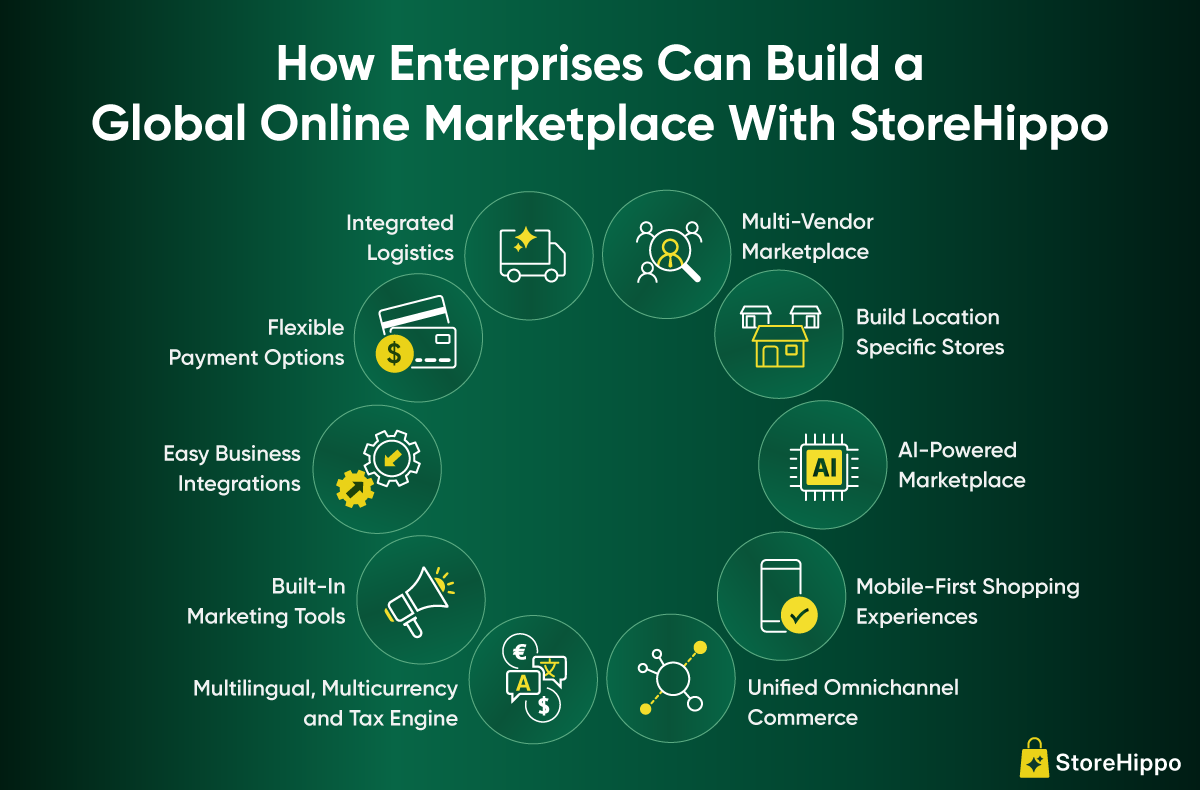
1. Multi-Vendor Marketplace Management
StoreHippo provides built in multi-vendor marketplace solutions to help enterprises onboard and manage multiple sellers Sellers get dedicated dashboards to manage products, inventory, and orders, while marketplace owners retain centralised control through the admin panel. This makes it easier to grow the seller network without adding extra operational overhead or manual work for the marketplace team.
2. Multi Store to build Location Specific Stores
StoreHippo’s multi-store solutions help enterprises create and manage separate storefronts for different countries, regions, or markets from a central admin panel. Businesses can customise each store’s language, product catalogue, pricing, and customer experience to match local requirements while managing operations from one place. This makes it easier to expand into new markets without managing each storefront independently.
3. AI-Powered Marketplace Capabilities
StoreHippo is an AI-powered marketplace platform with AI built into its core. Its offers built in AI tools AI semantic search, personalised recommendations, catalogue creation, image editing with Magic Edit, and enables enterprises to built custom AI shopping and support assistants.
StoreHippo also offers AI Store Builder to helps enterprises create storefronts faster using pre-built designs, content, and brand-aligned experiences. Businesses can provide their brand information, product images, and business details to generate a storefront that fits their requirements, reducing manual work and speeding up marketplace launches.
4. Mobile-First Shopping Experiences
StoreHippo offers built-in no code app builder which enables enterprises to create Android and iOS marketplace apps as well as PWA stores directly from admin dashboard. This gives buyers a convenient way to browse products, compare options, discover recommendations, and complete purchases from their mobile devices.
5. Unified Omnichannel Commerce
StoreHippo enterprise marketplace platform connects websites, marketplace apps, WhatsApp, conversational commerce, voice commerce, and other sales channels through a unified commerce setup. Enterprises can manage products, orders, customers, and marketplace operations from a central dashboard instead of maintaining separate systems for every channel. This creates a more consistent experience as the marketplace expands.
6. Built-in Multilingual, Multicurrency and Tax Engine
StoreHippo helps enterprises to tailor their global marketplace to local market requirements with built-in multilingual, multicurrency, and tax management capabilities. Businesses can offer regional language options, display prices in local currencies, and configure taxes based on market-specific requirements. This helps customers browse and shop in a familiar environment while making it easier for enterprises to manage sales across different countries.
7. Built-In Marketing Tools
StoreHippo offers built-in SEO tools, a discount engine, loyalty programmes, personalised promotions, abandoned cart recovery, and push notifications. Enterprises can use these marketing tools to attract new buyers, promote products, improve conversions, and encourage repeat purchases without depending on multiple third-party marketing systems.
8.Easy Business Integrations
With 150+ APIs and integrations, StoreHippo enterprise marketplace platform makes it easier to connect their marketplace website with existing business systems and software. This enables businesses to extend marketplace functionality as their seller network, catalogue, order volumes, and customer base grow without replacing their entire technology stack.
9.Flexible Payment Options
StoreHippo supports 60+ payment gateways, giving buyers more ways to pay while making payment management easier for marketplace owners and sellers. Enterprises can offer payment options suited to different markets and customer preferences, helping reduce checkout friction as they expand globally.
10. Integrated Logistics
With 30+ pre-integrated logistics providers, StoreHippo helps enterprises streamline shipping and fulfilment across markets. Businesses can connect delivery partners, manage fulfilment more efficiently, and provide reliable delivery experiences without building logistics integrations from scratch.
Together, these capabilities help enterprises move from launching a marketplace to continuously growing it. With multi-vendor management, AI, omnichannel commerce, flexible integrations, payments, logistics, and support for multiple business models, StoreHippo gives businesses the technology foundation to build and scale a global online marketplace.
Conclusion
The global marketplace landscape is moving fast, and the biggest platforms show that long-term success depends on more than bringing buyers and sellers together. A strong online marketplace needs the right mix of scalability, AI, omnichannel commerce, seller management, payments, logistics, and personalised experiences.
For enterprises planning to enter new markets or expand an existing marketplace, choosing the right technology can make that journey much easier. With 300+ enterprise-grade features, 150+ integrations, 350+ APIs, built-in AI tools, unified omnichannel commerce, and a flexible unified architecture, StoreHippo’s ai-powered marketplace platform help businesses launch flexible marketplace experiences, support multiple business models, and scale across markets and channels.
Ready to build your global online marketplace?
Book a demo with StoreHippo now.
FAQs
1. What should enterprises evaluate before investing in an online marketplace?
Enterprises should evaluate scalability, multi-vendor management, payment and logistics options, omnichannel capabilities, integrations, security, AI features, and ease of customisation before investing in an online marketplace. The platform should also support different business models, international expansion, and growing product and seller volumes without creating unnecessary operational complexity. A flexible, API-first architecture can further help enterprises adapt as their marketplace evolves.
2. How can enterprises attract high-quality sellers to a new online marketplace?
Enterprises can attract high-quality sellers by offering easy onboarding, dedicated seller dashboards, flexible payment options, reliable logistics, strong marketplace visibility, and useful marketing tools. Clear seller policies, competitive commissions, timely payouts, and responsive support also help build trust. As the online marketplace grows, enterprises can use seller performance data to identify and retain reliable sellers who consistently meet customer expectations.
3. How can enterprises differentiate their online marketplace from established global platforms?
Enterprises can make their online marketplace stand out by focusing on a clear niche, offering a better customer experience, and providing products or services that larger platforms may not specialise in. Faster delivery, personalised recommendations, flexible payment options, localised experiences, and strong seller support can also create a competitive edge. The goal is to give buyers and sellers clear reasons to choose the marketplace over larger alternatives.
4. How can enterprises improve buyer conversion on their marketplace website?
Enterprises can improve buyer conversion by making product discovery simple, pages easy to navigate, and checkout quick and friction-free. Clear product information, personalised recommendations, multiple payment options, transparent shipping costs, and visible customer reviews can help buyers make decisions with confidence. A mobile-friendly experience, relevant offers, and abandoned-cart recovery can further encourage shoppers to complete their purchases on the marketplace website.
5. How can enterprises expand their marketplace internationally without building separate systems?
An enterprise marketplace can support international expansion through a single scalable platform that manages multiple regions, currencies, languages, catalogues, payment methods, and business rules. Centralised administration allows enterprises to launch new markets without creating separate technology stacks. APIs and modular architecture can also connect regional logistics, ERP, CRM, and payment systems while keeping core marketplace operations unified, reducing duplication and technology overhead.
6. What role does AI play in online marketplace growth beyond product recommendations?
AI can support online marketplace growth in many areas beyond product recommendations. It can help automate catalogue creation, improve product content and images, power semantic search, assist customer support, analyse buyer behaviour, and streamline repetitive marketplace tasks. AI-powered shopping assistants can also guide buyers through their purchase journey. For enterprises, these capabilities can improve operational efficiency while creating more personalised and convenient experiences for buyers and sellers.
7. How can enterprises scale online marketplace growth without increasing technology dependency?
Enterprises can scale online marketplace growth by choosing a flexible enterprise marketplace platform that reduces reliance on constant development support. Built-in tools for vendor management, catalogues, AI-powered automation, integrations, analytics, and marketing allow teams to manage growth with less technical intervention. A scalable enterprise marketplace platform should also support APIs, automation, and modular architecture, making it easier to add new capabilities without rebuilding the technology stack.
8. How can enterprises future-proof an online marketplace for changing customer expectations?
Enterprises can future-proof their marketplace by prioritising flexible architecture, API extensibility, AI capabilities, personalisation, data-driven decision-making, and support for emerging commerce channels. The technology should make experimentation and integration easier rather than locking the business into rigid workflows. This allows an online marketplace to adapt as buyer expectations, digital behaviours, AI capabilities, and new commerce channels continue to evolve.
Binny Joseph is a seasoned ecommerce leader and Senior Vice President of Sales & Alliances with extensive experience helping businesses adopt modern commerce solutions.
He shares practical insights on building and scaling multi-vendor marketplaces that drive growth in the evolving global digital commerce landscape.