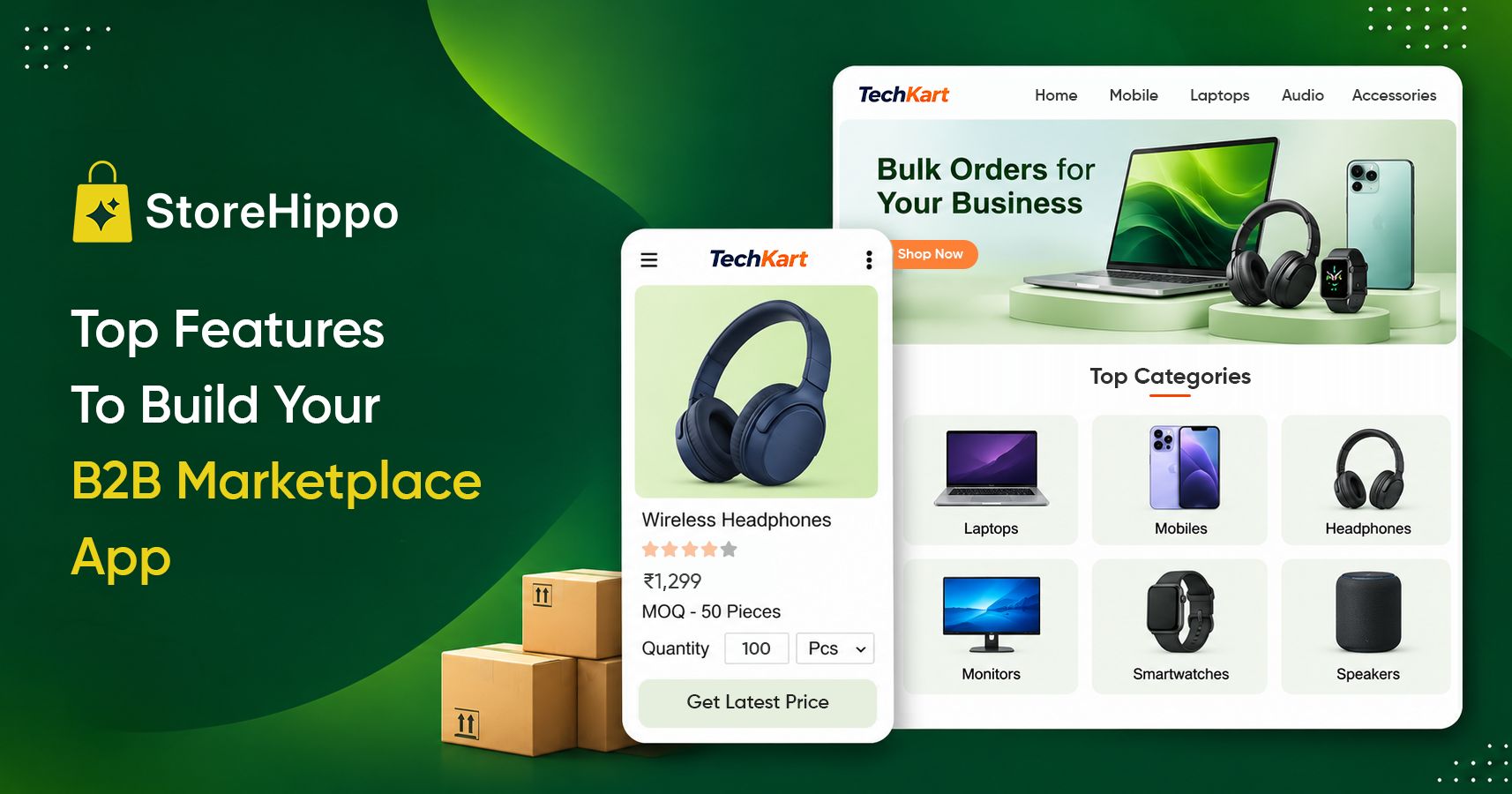



A B2B marketplace app needs to do much more than let buyers browse products and place orders. When business buyers have to depend on sales teams for bulk purchases, negotiated prices, stock updates, or order status, even routine procurement can become time-consuming. And as your business grows, managing these interactions manually becomes harder to sustain.
Buyers now expect the convenience of consumer shopping apps, but with the flexibility that business purchasing demands. They want quick reordering, customised pricing, easy access to product information, and greater control over their purchases. This makes having the right marketplace app a business decision, not just a technology upgrade.
Mobile commerce is already changing how B2B buyers research products, interact with suppliers, and place orders. Let's look at some key statistics before exploring the seven features that can help you build a B2B enterprise marketplace app that meets evolving buyer expectations and supports your business as it scales.
Table of Contents
- Why Every Growing B2B Business Needs a Smarter Marketplace App
- What are the Benefits of Having Marketplace Apps for your B2B Business
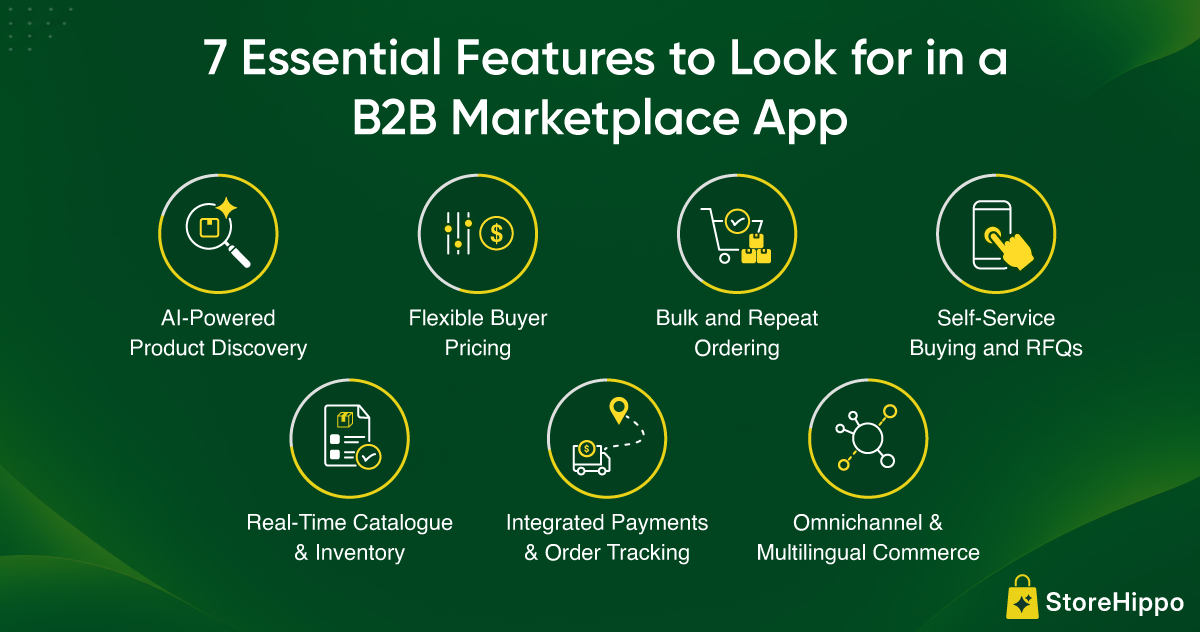
- 7 Must-Have Features in Your B2B Marketplace Apps
- 1. AI-Powered Product Discovery and Recommendations
- 2. Buyer-Specific Pricing and Discounts
- 3. Bulk Ordering and Quick Reordering
- 4. Self-Service Buying, RFQs and Buyer Dashboards
- 5. Real-Time Catalogue and Inventory Management
- 6. Integrated Payments, Order Management and Tracking
- 7. Omnichannel Commerce and Multilingual Mobile Experience
- Conclusion
- FAQs
Why Every Growing B2B Business Needs a Smarter Marketplace App
Modern B2B buyers expect the same speed, convenience, and flexibility from business purchases that they get from consumer shopping apps. They no longer use mobile phones just to check product information. They search suppliers, compare products, place repeat orders, and even make purchase decisions through B2B marketplace apps. This shift is changing how buyers interact with businesses and how sellers need to approach digital sales. The numbers below show how mobile commerce is shaping B2B purchasing.
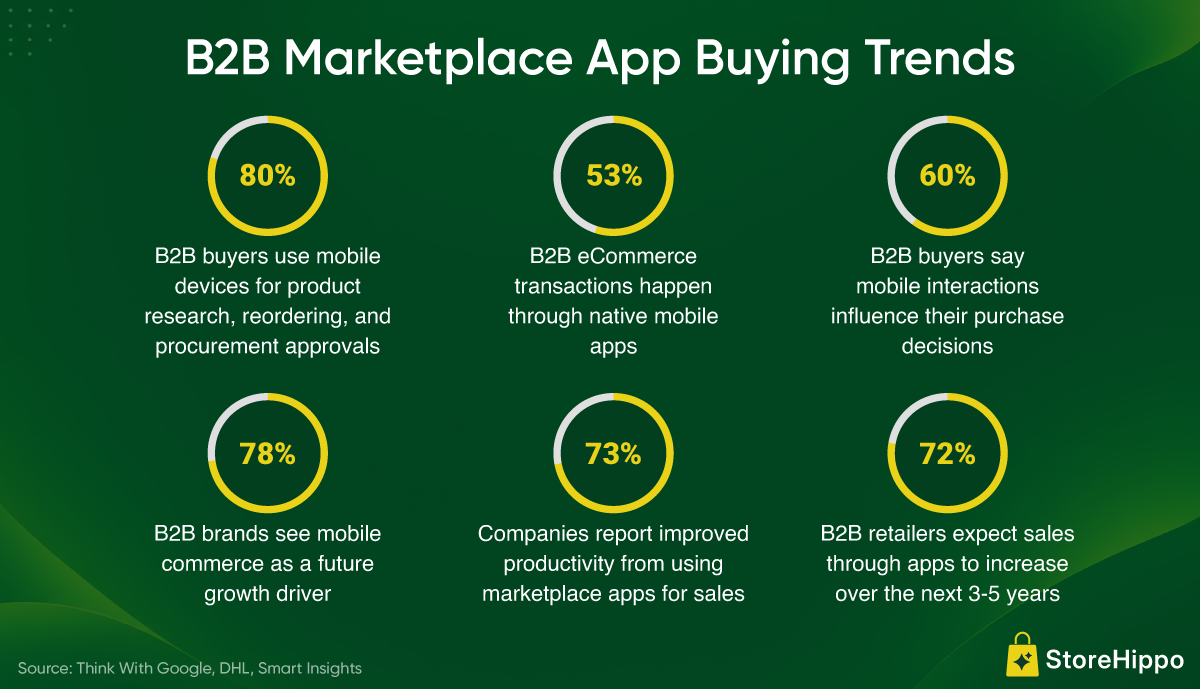
- 80% of B2B buyers use mobile devices for product research, reordering, and procurement approvals
- 53% of B2B eCommerce transactions happen through native mobile apps
- 60% of B2B buyers say mobile interactions influence their purchase decisions
- 78% of B2B brands see mobile commerce as a future growth driver
- 73% of companies report improved productivity from using marketplace apps for sales
- 72% of B2B retailers expect sales through apps to increase over the next 3-5 years
Source: Think With Google, DHL, Smart Insights
The growing adoption of mobile commerce presents a clear opportunity for B2B enterprises to rethink how they engage with buyers. Investing in the right B2B marketplace app can help sellers strengthen buyer relationships, improve ordering efficiency, and build a more connected sales ecosystem that supports long-term business growth.
What are the Benefits of Having Marketplace Apps for your B2B Business
Having a B2B marketplace app makes it easier for businesses to connect with buyers, simplify bulk ordering, and manage sales on the go. Buyers can browse product catalogues, check availability, access customised pricing, place orders, and track deliveries from their smartphones. For sellers, building a B2B enterprise marketplace app can create more opportunities to reach new buyers, encourage repeat purchases and make everyday sales operations more efficient.
Here are the benefits you will get when you build a B2B enterprise marketplace app for your business:
- Reach More Buyers: Connect with dealers, distributors, retailers and institutional buyers across wider geographical markets.
- Increase Sales Opportunities: Make it easier for buyers to discover your products and place orders, even outside regular business hours.
- Reduce Order Processing Costs: Minimise manual order handling and repetitive sales interactions through digital ordering.
- Improve Buyer Convenience: Give buyers the flexibility to browse products, compare prices and manage purchases from their smartphones.
- Drive More Repeat Orders: Make reordering simpler and encourage existing buyers to purchase from your business more frequently.
- Strengthen Buyer Relationships: Build stronger connections through personalised offers, relevant recommendations, and timely order updates.
- Improve Customer Retention: Deliver a consistent and convenient buying experience that gives customers more reasons to stay with your business.
- Make Better Business Decisions: Use buyer and sales insights to understand demand, identify popular products, and plan inventory more effectively.
- Create Consistent Omnichannel Experiences: Keep buyers connected across mobile apps, websites and other sales channels while maintaining a unified buying experience.
7 Must-Have Features in Your B2B Marketplace Apps
The right features can make your B2B marketplace app much easier for buyers to use and for your business to manage. Whether it's helping buyers find the right products, place orders without hassle, or stay connected with your business, here are seven features that can make a real difference:
1. AI-Powered Product Discovery and Recommendations
When your B2B marketplace app has thousands of products, helping buyers find exactly what they need can be challenging. Buyers may search using product names, technical specifications, dimensions, or even everyday descriptions of what they are looking for. A basic search function may not always understand these different queries or return the most relevant results. This is where AI-powered product discovery becomes important. It helps buyers find relevant products faster by understanding the intent behind their searches rather than relying only on exact keyword matches.
For example, a retailer looking for industrial equipment may know the required capacity, dimensions, and technical specifications but may not know the exact product name. Instead of trying multiple search terms or browsing through hundreds of listings, the buyer can describe the requirements and find relevant products. AI-powered recommendations can further help by suggesting complementary products based on search history, buying behaviour and previous purchases.
StoreHippo's AI-powered B2B marketplace platform makes product discovery easier with AI Semantic Search, AI Recommendations and multilingual voice search. Its AI Semantic Search understands natural language queries and search intent to surface relevant results, while AI Recommendations suggest products based on buyer behaviour, search history and past purchases. Businesses can also build custom AI shopping assistants to help buyers explore catalogues, find products, and get relevant suggestions through conversational interactions. Together, these capabilities make product discovery easier for buyers, even when businesses manage large and diverse product catalogues.
2. Buyer-Specific Pricing and Discounts
Unlike regular online shopping, B2B purchases doesnot follow a single pricing structure. A retailer placing a small order, a distributor purchasing in bulk, and an institutional buyer with a negotiated agreement may all have different prices for the same product. This makes flexible pricing a must-have feature in a B2B marketplace app. Your app should be able to support these variations without requiring the sales team to manage every pricing request manually.
For example, an electronics wholesaler selling to local retailers and regional distributors may charge different prices based on who is buying and how much they order. A retailer buying 20 units may get the regular wholesale price, while a distributor ordering 500 units may receive a bigger discount. Setting up these pricing rules in the B2B marketplace app makes it easier to offer the right price to each buyer without having to work out every deal manually.
StoreHippo's B2B ecommerce solutions support customer-group based pricing, login-based pricing, tiered pricing, volume-based discounts and pricing overrides. Businesses can also configure minimum order quantities (MOQs) and manage negotiated prices through RFQs. These capabilities make it easier to offer the right pricing to different buyers, making flexible pricing an essential feature for businesses looking to build a B2B enterprise marketplace.
3. Bulk Ordering and Quick Reordering
B2B buyers rarely shop for one product at a time. They often need to order multiple products in bulk, manage different quantities and replenish stock regularly. Your B2B marketplace app should make this process simple, allowing buyers to place large orders, adjust quantities and reorder frequently purchased products without going through the entire catalogue every time. The easier you make bulk purchasing and repeat ordering, the less time buyers spend placing orders and the more smoothly they can manage their regular procurement.
Consider a retail store owner who orders products from a B2B marketplace app regularly. They may need to restock groceries, personal care products and household essentials every week, often purchasing the same products in different quantities. Instead of searching for each item and adding it to the cart again, they should be able to quickly reorder from their previous purchases, adjust quantities and place the order in just a few steps.
A B2B marketplace app should therefore offer features such as bulk ordering, minimum order quantities (MOQs), tiered pricing and access to previous orders. StoreHippo's B2B ecommerce platform supports these capabilities along with dedicated B2B customer accounts and buyer self-service. These features make it easier for enterprises to handle high-volume purchases and simplify everyday procurement for their buyers.
4. Self-Service Buying, RFQs and Buyer Dashboards
B2B buyers don't always want to depend on sales representatives for routine purchasing activities. They may need to check product availability, request quotations, review previous orders or track an existing purchase. When every small interaction requires a call or email, even simple buying tasks can take longer than necessary. So, when you build a B2B enterprise marketplace, make sure your app offers self-service tools that let buyers handle everyday activities independently while making it easy for them to reach your team whenever they need assistance.
Consider a restaurant owner who regularly purchases ingredients, beverages and kitchen supplies from different suppliers through a B2B marketplace app. Before placing an order, they may need to check product availability, request quotations for bulk purchases or compare previously negotiated prices. They may also want to review past orders or track an ongoing delivery. Self-service tools let them manage these activities directly through the app without having to call or email suppliers for every update.
StoreHippo B2B ecommerce solutions help businesses make these buying activities easier with dedicated buyer dashboards, RFQ and enquiry forms, and real-time admin-buyer-vendor chat. Buyers can request quotations, revisit previous orders, and track purchases from their dashboards, while chat and enquiry options make it easier to discuss pricing, clarify requirements, and resolve queries with suppliers. This reduces the need for repeated follow-ups and gives buyers a more convenient way to manage their day-to-day purchases.
5. Real-Time Catalogue and Inventory Management
Managing product catalogues and inventory becomes increasingly challenging when your business sells through multiple vendors, warehouses or sales channels. Stock levels can change throughout the day as orders come in, products move between warehouses, and new inventory arrives. If these updates don't reflect in your B2B marketplace app, you risk accepting orders for products that are no longer available or showing buyers incorrect product information. Your app should therefore connect with a centralised catalogue and inventory system that keeps product details and stock levels updated as your business operations change.
Consider a wholesale distributor who supplies products to retailers across different cities. The same product may have varying stock levels depending on local demand, incoming supplies, and ongoing orders. When retailers place orders through the marketplace app, the distributor needs to ensure that the displayed availability reflects the actual inventory. Without synchronised stock updates, the business may end up accepting orders for products that are no longer available, leading to cancellations, delayed deliveries and unnecessary coordination with buyers.
StoreHippo B2B ecommerce solutions help businesses keep their product catalogues and inventory aligned through a centrally managed master catalogue, inventory management, multi-warehouse support and multi-store capabilities. This makes it easier for distributors to update product information, track stock across their commerce operations and ensure that buyers see more accurate availability when placing orders. As the business expands its supplier network and product range, it can manage inventory more efficiently without losing control over catalogue accuracy.
6. Integrated Payments, Order Management and Tracking
Placing an order is only one part of the B2B buying journey. Buyers also need convenient payment options, access to order information, and visibility into fulfilment. For businesses handling large orders across multiple locations, managing payments and tracking shipments through separate systems can create unnecessary work for both buyers and sellers. So, when you build a B2B enterprise marketplace, make sure your app connects these activities to make the entire buying process easier to manage.
For example, a distributor ordering electronic goods from a wholesaler may want to pay for the order, download the invoice, and check the expected delivery date, all from the same app. If the order includes products from multiple sellers, they should also be able to see when each shipment is expected to arrive. Having these options in one place saves buyers the trouble of contacting different sellers for payment confirmations, invoices, or delivery updates.
StoreHippo helps businesses manage payments, orders, and fulfilment from one platform. With 60+ integrated payment gateways and support for UPI, cards, wallets, and COD, B2B enterprises can offer buyers multiple ways to pay. Its order management system simplifies order processing, while built-in and custom invoice options make GST-compliant billing easier to manage. Buyers can track their orders and check shipment progress, while sellers can manage shipments, access shipment details, and update shipping information through their dashboards. This gives both buyers and sellers better visibility into the order journey and reduces the need for repeated follow-ups.
7. Omnichannel Commerce and Multilingual Mobile Experience
Your B2B buyers may not always use the same channel to interact with your business. One might browse products through your mobile app, another may prefer your website, while some may find it easier to place orders through WhatsApp. The challenge is making sure they get the same smooth buying experience wherever they choose to shop. If these channels work separately, buyers may come across different product details, outdated prices, or disconnected order information. Your B2B marketplace app should be connected with your other sales channels, enabling buyers to switch between them easily without disrupting their purchasing journey.
For example, a distributor selling products across different countries may have buyers who speak different languages and prefer different ways of shopping. Some may find it easier to order through a mobile app, while others may prefer using a website or WhatsApp. Offering multiple language options and shopping channels helps the distributor serve all these buyers more easily.
StoreHippo helps businesses serve buyers across these different channels without managing each one separately. Its built-in mobile app builder lets enterprises create Android and iOS apps directly from the dashboard, without coding. Businesses can also offer multilingual shopping experiences through native language support, extend their reach through PWA storefronts and WhatsApp Commerce, and engage buyers through multilingual AI chat interfaces. This gives enterprises more ways to reach their buyers while making shopping convenient across multiple languages and channels.
Conclusion
A well-designed B2B marketplace app can make a real difference to how buyers interact with your business and how efficiently your teams manage everyday operations. From product discovery and bulk ordering to inventory updates and order tracking, each feature should address a practical need in the buying journey.
StoreHippo brings these capabilities together through its B2B ecommerce solutions, giving businesses the flexibility to create an AI-powered B2B marketplace app that fits their operations and buyer expectations.
Ready to see how StoreHippo can support your marketplace goals? Book a demo with StoreHippo now.
FAQs
1. What features should a B2B marketplace app have?
A B2B marketplace app should include AI-powered product discovery, buyer-specific pricing, bulk ordering, RFQ management, inventory synchronisation, integrated payments, and order tracking. Multilingual support and unified omnichannel capabilities also help businesses serve different buyer groups and simplify purchasing across multiple channels.
2. How can I build a B2B marketplace app without coding?
You can build a B2B marketplace app using an ecommerce platform with an inbuilt mobile app builder. StoreHippo's no-code mobile app builder enables businesses to create Android and iOS apps directly from its dashboard without coding, with centralised management of product catalogues, inventory, and orders.
3. How can AI improve product discovery in a B2B marketplace app?
AI improves product discovery in a B2B marketplace app by understanding buyer intent rather than relying only on exact keyword matches. Features like semantic search, voice search and AI-powered recommendations help buyers find relevant products using product descriptions, specifications or previous purchase behaviour. StoreHippo’s AI-powered B2B marketplace platform offers AI Semantic Search and AI Recommendations to simplify catalogue navigation and help buyers discover relevant products faster.
4. How can businesses manage a unified omnichannel experience across B2B marketplace apps and websites?
Businesses can create a unified omnichannel experience by connecting their marketplace apps, websites, WhatsApp stores and other sales channels through a centralised commerce platform. This helps maintain consistent product information, pricing, inventory and order management across channels. StoreHippo supports unified omnichannel commerce through its built-in mobile app builder, PWA storefronts, WhatsApp Commerce and centralised catalogue and inventory management.
5. Can a B2B marketplace app support different pricing for different buyers?
A B2B marketplace app can support different pricing through customer-group rules, login-based pricing, order-volume slabs, and negotiated rates. Businesses can assign specific prices and discounts to retailers, distributors, and institutional buyers based on their purchase volumes or agreements. StoreHippo supports these pricing options through customer-group pricing, tiered pricing, volume-based discounts, and pricing overrides.
6. How can a B2B marketplace app simplify bulk ordering?
A B2B marketplace app simplifies bulk ordering by enabling buyers to select products in large quantities, check minimum order requirements and place orders directly through their accounts. StoreHippo supports bulk ordering, MOQs, tiered pricing and buyer self-service capabilities to make recurring procurement easier.
7. What is the best way to manage inventory across a B2B marketplace app and website?
The best way to manage inventory across a B2B marketplace app and website is to use a centralised inventory management system that synchronises stock levels across all sales channels. This helps prevent overselling, reduces stock discrepancies, and keeps product availability accurate. StoreHippo supports centralised master catalogues, inventory management, multi-warehouse support, and multi-store capabilities to help businesses manage stock efficiently.
8. Can buyers manage orders and track shipments through a B2B marketplace app?
Yes. A B2B marketplace app can provide buyers with access to order details, invoices, payment information, and shipment updates. StoreHippo supports integrated payment gateways, customised invoice templates, order management and order tracking, helping businesses manage post-purchase activities through a connected commerce platform.