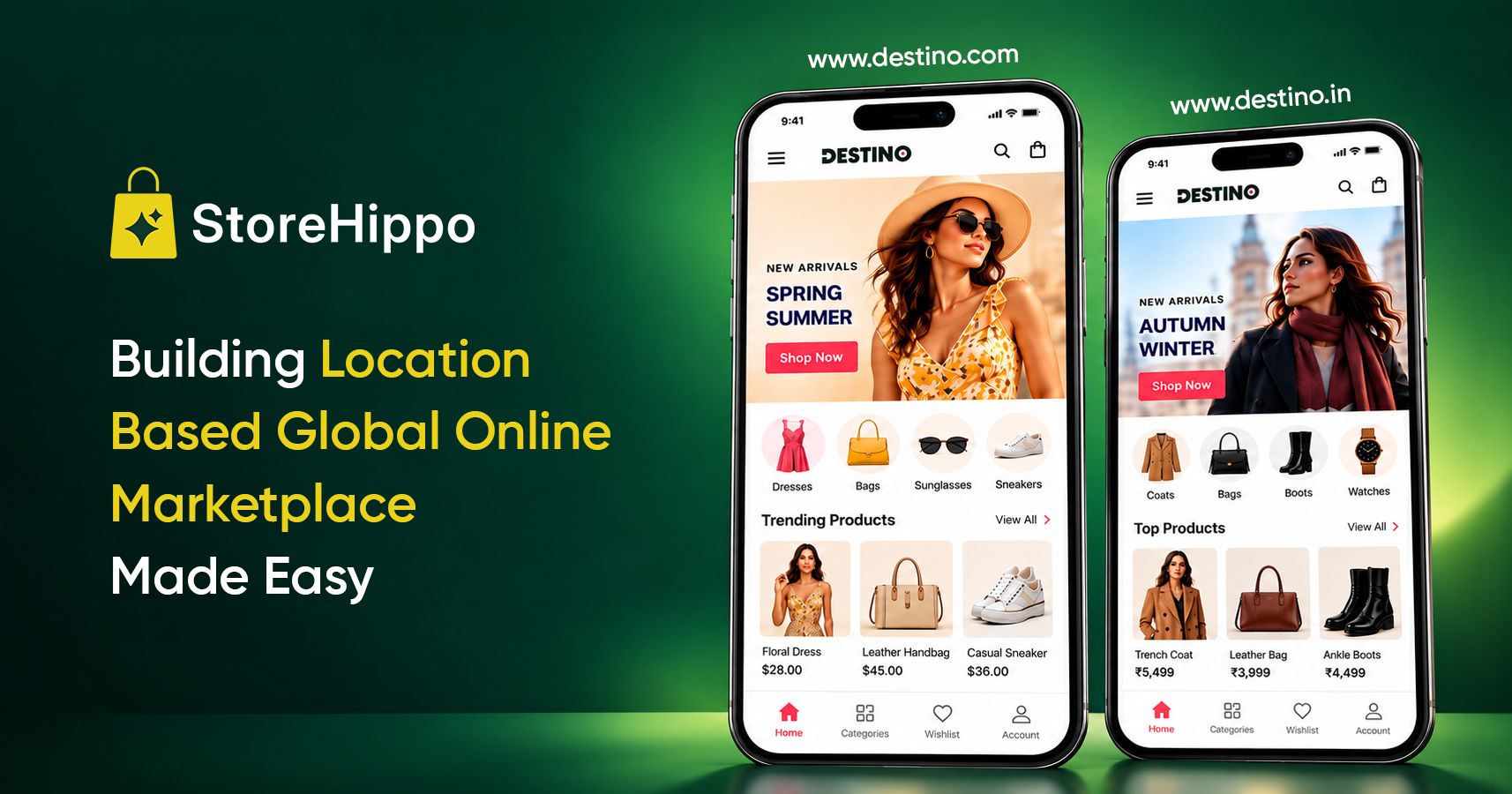



Expanding into a new country should help your business grow, not leave your team struggling to keep up with growing demands. For enterprises building a global marketplace, the real challenge is meeting the diverse needs of each market while keeping business operations running smoothly.
Customers in the UK may expect prices in pounds, while buyers in the UAE may need different payment options and delivery choices. Your sellers, product availability, inventory, and fulfilment processes must also align with the specific needs of each market. Managing separate systems to address these requirements becomes increasingly difficult as your business expands into more markets. That’s why a multi vendor marketplace serving international customers needs more than a website that simply accepts orders from different countries.
It needs location-based storefronts that cater to regional customers while keeping core operations connected. So, how do you build an online marketplace that balances local needs with central control?
Let’s explore how to build an online marketplace for international growth, manage regional storefronts, and create a scalable international marketplace with StoreHippo.
Table of Contents
- Why Location-Based Storefronts Are Non-Negotiable for Global Marketplaces
- What are the Benefits of a Location-based Global Multi Vendor Marketplace
- How to Launch Location-Based Stores For Your Global Online Marketplace
- 1. Identify Your Target Countries
- 2. Choose an AI-powered Multistore Ecommerce Platform
- 3. Set Up Location-Based Storefronts
- 4. Customise Languages, Currencies, and Regional Pricing
- 5. Configure Location-Specific Product Catalogues and Inventory
- 6. Onboard Regional Sellers and Assign Selling Territories
- 7. Integrate Local Payment Gateways and Shipping Partners
- 8. Set Up Regional Taxes, Compliance, and Fulfilment Rules
- 9. Enable Automatic Location Detection and Storefront Redirection
- 10. Test Regional Shopping Journeys and Launch Your Marketplace
- How StoreHippo Helps You Build and Manage Location-Based Stores for Your Global Marketplace
- 1. Launch Location-Based Stores with Multistore®
- 2. Localise Every Storefront with Native Go Global Features
- 3. Manage Regional Sellers, Catalogues and Inventory Centrally
- 4. Simplify Cross-Border Payments, Shipping and Taxation
- 5. Build Smarter Shopping Experiences with StoreHippo AI
- 6. Scale Your International Marketplace with MACH Architecture
- Conclusion
- FAQs
Why Location-Based Storefronts Are Non-Negotiable for Global Marketplaces
Location-based storefronts help global marketplaces meet the shopping preferences of customers across different countries. From displaying prices in local currencies and offering familiar payment methods to adapting languages and product recommendations, these storefronts make shopping more relevant to each market. Without this flexibility, enterprises risk losing customers who expect an experience tailored to their region.
Here are some key statistics that highlight why localisation matters for international marketplaces:
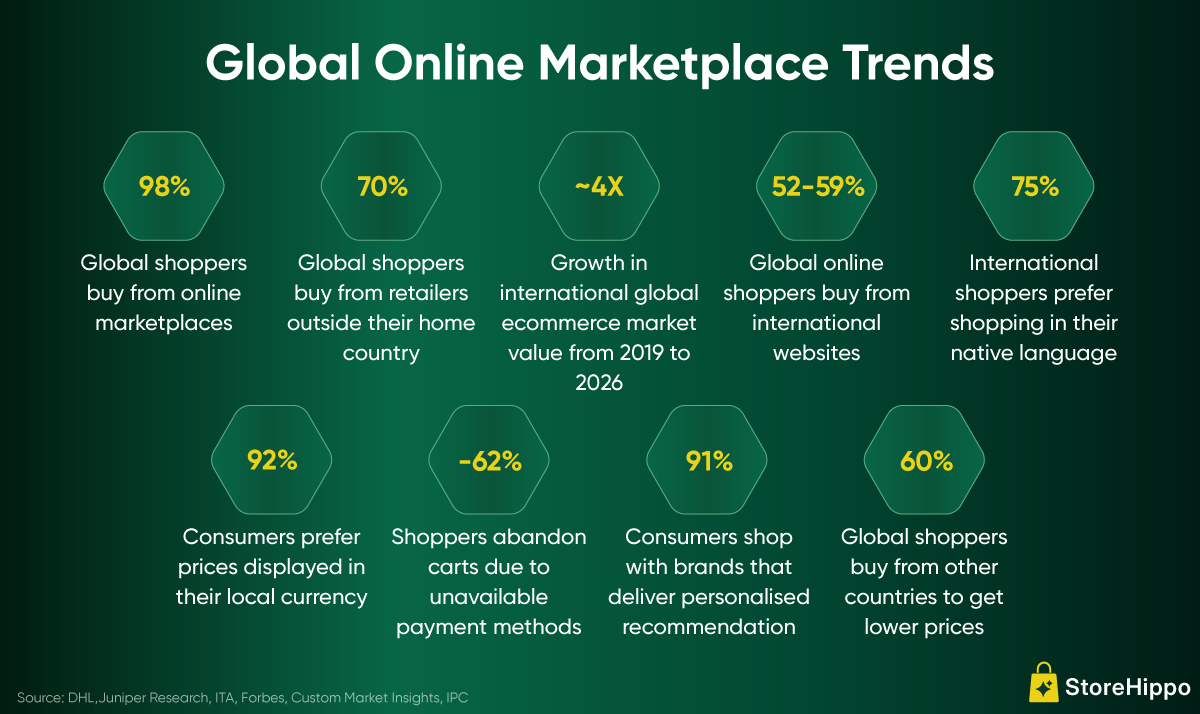
- 98% of global shoppers buy from online marketplaces
- 70% of global shoppers buy from retailers outside their home country
- ~4X growth in international global ecommerce market value from 2019 to 2026
- 52%-59% of global online shoppers buy from international websites
- 75% of international shoppers prefer shopping in their native language
- 92% of consumers prefer prices displayed in their local currency
- - 62% of shoppers abandon carts due to unavailable payment methods
- 91% of consumers shop with brands that deliver personalised recommendations
- 60% of global shoppers buy from other countries to get lower prices.
Source: DHL,Juniper Research, ITA, Forbes, Custom Market Insights, IPC
The numbers say it all. As cross-border shopping grows, customers expect global marketplaces to meet their local preferences. Enterprises that tailor storefronts to regional languages, currencies, payment methods and shopping habits can deliver more relevant experiences and compete more effectively across markets.
What are the Benefits of a Location-based Global Multi Vendor Marketplace
A location-based global multi-vendor marketplace helps businesses cater to regional customer preferences while expanding into new markets. From personalised shopping experiences to streamlined operations, here are the key benefits of having location-based storefronts:
- Deliver Localised Shopping Experiences: Create region-specific storefronts with local languages, currencies, product information, and relevant content to make shopping more familiar to customers.
- Personalise Product Discovery with AI: Use AI-powered search and recommendations to help shoppers discover products based on their preferences, browsing behaviour and regional needs.
- Offer Market-Specific Pricing and Promotions: Set regional prices, currencies, discounts and offers that align with local buying habits and market conditions.
- Support Local Payment Preferences: Offer payment methods that customers in each target market recognise and prefer, reducing friction during checkout.
- Improve Delivery and Fulfilment: Connect customers with suitable sellers, shipping options and delivery services based on their location and serviceability.
- Expand Seller and Product Selection Regionally: Showcase products from relevant local sellers alongside international offerings, giving customers more choice while helping sellers reach new audiences.
- Simplify Multi-Region Operations: Manage regional storefronts, seller catalogues, inventory, orders, and business workflows through a centralised marketplace administration system.
- Make Customer Experiences More Relevant: Tailor product recommendations, featured categories and promotional campaigns to regional shopping preferences and seasonal demand.
- Make Data-Driven Expansion Decisions: Track sales, conversions, customer behaviour and product performance across individual markets to identify growth opportunities and improve storefront performance.
- Enter New Markets with Greater Flexibility: Launch additional regional storefronts as your business expands, tailoring the shopping experience to new customer segments without building an entirely separate marketplace for every market.
A location-based global marketplace gives enterprises a way to balance local customer expectations with centralised business management. The right enterprise ecommerce platform can help businesses adapt to regional differences, make marketplace operations easier to manage, and build a stronger foundation for international growth.
How to Launch Location-Based Stores For Your Global Online Marketplace
Launching a global marketplace requires more than reaching buyers in new countries; it means creating shopping experiences that match local languages, currencies, product preferences, and delivery expectations.
Here are the key steps to set up location-based stores and scale your international marketplace efficiently:
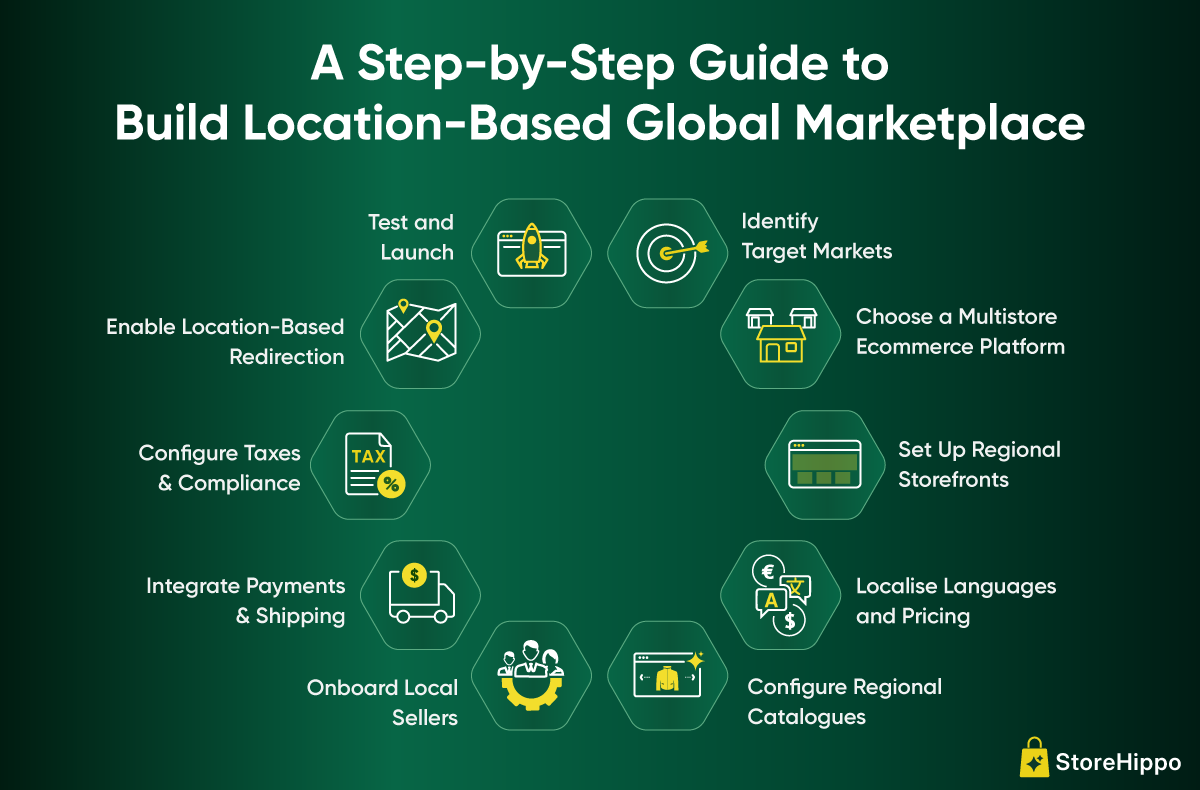
1. Identify Your Target Countries
Start by identifying the countries and regions where you want to expand your global marketplace. Research local demand, buyer preferences, competition, seller availability, and regulatory requirements. Prioritise markets where your products and business model have strong growth potential to build a scalable international marketplace.
2. Choose an AI-powered Multistore Ecommerce Platform
Select an AI-powered ecommerce platform that lets you create and manage multiple location-based stores from one central backend. For a multi vendor marketplace, look for capabilities like regional storefront management, seller onboarding, multilingual support, and seamless integrations with third-party service and solution providers.
An AI-powered marketplace platform can help make your online marketplace smarter by automating routine tasks, simplifying operations, and improving product discovery. This allows businesses to manage multiple stores more efficiently and deliver better shopping experiences.
3. Set Up Location-Based Storefronts
Create dedicated storefronts for different countries, regions, or cities based on your global marketplace expansion strategy. Each storefront can have its own domain, branding, product selection, and promotions while sharing a common commerce backend. This allows you to deliver localised shopping experiences across your international marketplace without managing separate ecommerce platforms for every region.
4. Customise Languages, Currencies, and Regional Pricing
Make your online marketplace relevant to buyers in each region by offering local languages, currencies, and pricing. Configure country-specific discounts, payment options, and product information where needed. Ensure buyers can easily browse products and understand prices before checkout.
5. Configure Location-Specific Product Catalogues and Inventory
Decide which products should be available in each region based on demand, seller coverage, and fulfilment capabilities. Set up regional catalogues, inventory visibility, and product availability rules across your multi vendor marketplace. This ensures customers see products they can actually purchase and receive at their location, while helping sellers manage stock more efficiently.
6. Onboard Regional Sellers and Assign Selling Territories
Invite local sellers to join your international marketplace and define the regions where they can sell and fulfil orders. Configure seller permissions, commissions, product approvals, and regional serviceability rules. A central seller management system helps you expand your multi vendor marketplace across new markets while maintaining control over seller operations, product listings, and order fulfilment.
7. Integrate Local Payment Gateways and Shipping Partners
Connect payment providers that support the currencies and payment methods preferred in each target market. Integrate regional logistics partners to manage domestic deliveries, international shipping, tracking, and returns. For a growing global marketplace, review payment settlement timelines, shipping costs, delivery coverage, and cross-border fulfilment requirements before launching in each region.
8. Set Up Regional Taxes, Compliance, and Fulfilment Rules
Every country has different requirements for taxes, invoicing, consumer protection, and cross-border trade. Configure applicable tax rules, shipping restrictions, customs requirements, and fulfilment workflows for each location. Verify local legal and regulatory obligations before making your international marketplace operational, as compliance requirements can affect both seller onboarding and customer purchases.
9. Enable Automatic Location Detection and Storefront Redirection
Help customers discover the most relevant storefront based on their location. Use location detection to suggest appropriate languages, currencies, products, and delivery options across your online marketplace. Enable buyers to change their preferred region manually, particularly when travelling or ordering across borders, so they can access the storefront that best matches their needs.
10. Test Regional Shopping Journeys and Launch Your Marketplace
Before launching your global marketplace, test the complete buying journey across different countries and devices. Check storefront localisation, product visibility, payment processing, order routing, shipping, and returns. Start with selected markets, monitor customer behaviour and operational performance, and expand into additional regions as your multi vendor marketplace operations stabilise.
How StoreHippo Helps You Build and Manage Location-Based Stores for Your Global Marketplace
Location-based storefronts make it easier for enterprises to enter new markets without losing control of their day-to-day operations. With StoreHippo, businesses can create separate storefronts for different regions, tailor each shopping experience to local customers, and manage sellers, catalogues, inventory, and orders from one central backend.
Here’s how StoreHippo helps enterprises build and manage location-based stores for a growing global marketplace.
1. Launch Location-Based Stores with Multistore®
When expanding into new markets, a single storefront may not be enough to meet every region’s needs. Customers in different countries, cities, or regions may expect different product choices, pricing, and shopping experiences.
StoreHippo’s built-in multistore ecommerce solution lets enterprises create and manage multiple storefronts through a unified central admin. Businesses can establish a unique presence in each target market without having to manage every store independently.
Here’s how StoreHippo’s multistore setup helps:
- Location-based sub-stores: Launch dedicated storefronts for different countries, regions, or cities, based on your business expansion plans and local market requirements.
- Unique store URLs: Create unique URLs for regional storefronts, making it easier for customers to find the right store.
- Custom storefront designs: Tailor each store’s look and feel to reflect local preferences while maintaining your overall brand identity.
- Master catalogue: Create a central master product catalogue for all storefronts instead of creating every listing from scratch.
- Centralised store management: Manage multiple storefronts from one backend, keeping core operations organised as your business expands.
For example, an enterprise entering the UK, Australian, and Indian markets can create separate storefronts for each country, customise the shopping experience for local customers, and manage the stores through a common admin dashboard. This makes it easier to maintain a consistent brand presence while adapting to individual market requirements.
2. Localise Every Storefront with Native Go Global Features
Launching a location-based storefront in a new market is only the first step. Customers also need a shopping experience that feels familiar, from browsing products in their preferred language to viewing prices in a currency they understand.
StoreHippo’s Go Global solutions help enterprises to customise their online marketplace to the needs of different markets. With multilingual capabilities, flexible currency settings, and region-specific pricing, businesses can make their storefronts more relevant to local visitors
Key localisation capabilities StoreHippo offers include:
- 100+ languages: Supports multiple international languages to create unique shopping experiences for customers across diverse linguistic markets.
- RTL language support: Supports right-to-left languages like Urdu and Hebrew to cater to customers in these locations.
- Multi-currency support: Display product prices in local currencies with automated currency conversion, reducing the manual effort of managing prices across markets.
- Pricing overrides: Adjust product prices for individual regions to account for local market conditions and pricing strategies.
- Discount engine: Run market-specific promotions and offers that align with regional shopping preferences.
Consider an enterprise running a global marketplace across India, the UK, and the UAE. Instead of presenting every customer with the same language and pricing, the business can display prices in INR, GBP, and AED, respectively, and configure each storefront with the relevant language and market-specific discounts. This helps customers shop with greater ease while enabling the business to manage regional pricing and promotions from a central backend.
3. Manage Regional Sellers, Catalogues and Inventory Centrally
As an online marketplace grows across regions, keeping track of sellers, product listings, and stock can become harder to manage. Products available in one market may not be relevant or deliverable in another, while seller operations and inventory need to remain organised across storefronts.
StoreHippo’s built-in multi vendor marketplace feature helps enterprises manage sellers, product listings, approvals, commissions, and inventory from a central admin. Sellers can use their own dashboards to manage products, orders, and stock, while businesses retain control over marketplace operations.
Here’s how StoreHippo helps simplify international marketplace operations:
- Seller Manager: Manage seller onboarding, product approvals, payouts, performance, and store-wide analytics from one place.
- Vendor dashboards: Give each seller a dedicated dashboard to manage products, track orders, and monitor inventory independently.
- Product approval workflows: Review and approve seller registrations and product listings before they go live on your marketplace.
- Seller commissions: Set flexible commission rates and marketplace fees, and track payments and seller accounts through built-in ledger management.
- Master catalogue: Bring all seller listings into one central catalogue to simplify operations and keep product management organised.
- Centralised inventory management: Track stock across sellers and automatically update product availability as items go in or out of stock.
- Seller-wise inventory: Monitor stock levels for individual sellers to keep track of product availability.
- Location-based product visibility: Set up location-specific storefronts with distinct product collections and inventory to serve customers across different markets.
- AI-powered cataloguing and AI Magic Edit: Create optimised product descriptions from images using AI-powered cataloguing tools and improve product visuals with the AI image editing tool Magic Edit.
For instance, an enterprise with sellers across several countries can maintain a shared product database while deciding which products appear in each regional store. Seller-wise inventory and location-based product visibility also help businesses organise product availability according to their operational requirements.
The result is a more manageable marketplace structure that supports regional flexibility without losing sight of central operations.
4. Simplify Cross-Border Payments, Shipping and Taxation
Selling across markets introduces operational requirements that go beyond setting up storefronts. Enterprises need to account for payment preferences, shipping costs, delivery coverage, applicable taxes, invoicing, and returns.
Here’s how StoreHippo marketplace platform simplifies cross-border commerce operations:
- 60+ payment gateway integrations: Use multiple pre-integrated domestic and international payment gateways to accept payments from customers across markets.
- Multi-currency payments: Support transactions in different currencies with automatic currency conversion and transparent pricing at checkout.
- Store-specific payment gateways: Configure different payment gateways for individual storefronts to suit regional payment requirements.
- 30+ logistics integrations: Connect with leading logistics providers to manage domestic and international shipping requirements.
- Order management and tracking: Manage order processing, shipping, and shipment updates from the platform’s order management system.
- Built-in tax engine: Calculate taxes using configurable tax rules, including support for multiple tax levels and tax-inclusive or tax-exclusive pricing.
- Multi-country tax support: Configure tax rules to address the requirements of different markets as your business expands internationally.
- Multi-currency invoicing: Generate invoices in the currency preferred by customers in different markets.
- Customisable invoice templates: Edit existing invoice templates or create your own to suit different billing and documentation needs.
- Returns and refunds management: Process full or partial refunds for eligible orders and manage the associated refund records.
For an enterprise handling orders from multiple countries, StoreHippo’s capabilities help bring essential commerce workflows under one roof. Teams can configure payment and shipping options for individual storefronts while maintaining central oversight of order processing and related operations. This connected approach helps enterprises manage the operational demands of cross-border selling as they expand their international marketplace into new markets.
5. Build Smarter Shopping Experiences with StoreHippo AI
As product catalogues grow and customer preferences vary across markets, helping shoppers find the right products on your global marketplace becomes just as important as expanding storefront presence. At the same time, maintaining product information and managing customer interactions across regions can add to the workload of enterprise teams.
StoreHippo’s AI-powered marketplace platform brings AI into catalogue creation, product discovery, recommendations, and customer support. These AI capabilities help enterprises reduce repetitive work, improve product discovery, and create more relevant shopping journeys.
Here’s how StoreHippo’s AI-powered marketplace platform offers a smarter way to expand globally:
- AI-powered catalogue and content creation: Automatically generate product titles, descriptions, tags, categories, and attributes from product images, making it easier to manage large catalogues as your marketplace grows.
- AI Store Builder: Simplify storefront creation with AI-powered tools that help businesses set up and customise their online stores faster, reducing the effort involved in building new shopping experiences.
- AI image editing with Magic Edit: Enhance product images by cleaning up backgrounds, adjusting lighting, and standardising visuals without spending hours on manual editing.
- Intelligent product discovery and recommendations: Use buyer intent, context, and behaviour to help shoppers find relevant products, explore alternatives, and discover complementary items.
- AI-assisted buying journeys: Build custom AI shopping assistants that answer product queries, recommend suitable options, and guide customers through their buying journey.
- Custom agentic AI assistants: Create AI assistants tailored to business workflows to help buyers with shopping queries, support sellers with daily tasks, and assist internal teams with operational processes.
- Unified AI intelligence: Connect catalogue creation, product discovery, operations, and customer support through a shared intelligence layer rather than relying on disconnected AI tools.
For a global marketplace serving different customer groups, these capabilities can help teams manage growing product catalogues while making product discovery more relevant. AI-assisted workflows can also reduce repetitive tasks, allowing teams to focus on merchandising, customer experience, and expansion priorities.
6. Scale Your International Marketplace with MACH Architecture
Your commerce requirements now may look very different from what you need after entering new markets, onboarding more sellers, or adding new customer touchpoints. A rigid technology setup can make these changes harder to implement, particularly when every new requirement involves extensive backend modifications.
StoreHippo’s MACH architecture, API-first approach, and headless commerce capabilities give enterprises greater flexibility to customise their commerce setup and connect business systems. This helps businesses adapt their existing infrastructure as their international marketplace expands.
Here’s how StoreHippo’s MACH architecture supports global marketplace growth:
- MACH architecture: Build a modular commerce setup that can evolve with changing business requirements.
- API-first commerce: Connect external applications and business systems through APIs, supporting integration requirements beyond native connections.
- Headless commerce: Customise storefront design and customer journeys without tightly coupling every frontend change to the backend.
- Cloud-native infrastructure: Build scalable global marketplaces with elastic infrastructure that handles peak traffic and growing business demands.
- Centralised administration: Manage multiple storefronts and business operations from one backend.
- Scalable marketplace infrastructure: Easily expand into new regions, add storefronts and sellers, and support growing business needs.
For enterprises expanding globally, this flexibility makes it easier to launch new storefronts, integrate business systems, and enter new markets without rebuilding their ecommerce infrastructure every time.
Conclusion
The success of a global marketplace depends as much on how efficiently it operates across markets as on how quickly it expands. For enterprises, the real advantage lies in building a commerce ecosystem where regional businesses can operate independently while benefiting from centralised control.
StoreHippo helps enterprises achieve this balance with a flexible, AI-powered platform designed for diverse business models and international operations. Whether launching a new international marketplace or strengthening an established global presence, businesses can focus on improving customer experiences, expanding seller networks and creating new revenue opportunities instead of repeatedly investing in technology changes.
Ready to build a global marketplace with location-based storefronts tailored to different markets?
Book your StoreHippo demo to explore global possibilities.
FAQs
1. What should enterprises look for in a platform to build a location-based global marketplace?
Enterprises should look for a platform that supports multiple storefronts, centralised management, flexible integrations, and market-specific customisation. Features such as multilingual capabilities, multi-currency support, and adaptable pricing help businesses cater to regional needs. StoreHippo’s Multistore® and Go Global solutions help enterprises manage location-based storefronts while adapting shopping experiences for different markets, all through a connected commerce ecosystem.
2. How can enterprises expand their global marketplace without rebuilding their ecommerce infrastructure?
Enterprises can expand their global marketplace by choosing a flexible, API-first ecommerce platform that supports new storefronts, integrations, and business requirements without rebuilding the entire system. StoreHippo’s MACH-based architecture enables businesses to customise their commerce setup as they enter new markets. This approach helps enterprises adapt to changing needs, connect existing business systems, and scale their operations with greater flexibility.
3. How can businesses localise their international marketplace without compromising brand consistency?
Businesses can localise their international marketplace by adapting language, product content, pricing, and shopping experiences to regional preferences while maintaining consistent brand messaging and visual identity. StoreHippo’s Go Global solutions support regional customisation, helping enterprises cater to different markets without losing their brand identity. This balance allows businesses to connect with local customers while delivering a recognisable and consistent brand experience across international storefronts.
4. What features help a multi vendor marketplace expand into new countries?
A multi vendor marketplace needs flexible seller management, centralised catalogue control, scalable infrastructure, and seamless integrations to support international growth. Features such as multilingual storefronts, regional pricing, and local payment options help businesses cater to different markets. StoreHippo combines marketplace management capabilities with flexible MACH architecture, helping enterprises onboard sellers, adapt their operations, and expand into new countries without extensive redevelopment.
5. How can enterprises personalise shopping across different markets in a global marketplace?
Enterprises can personalise shopping by analysing regional customer preferences, browsing behaviour, and purchase patterns. These insights help marketing teams tailor product recommendations, promotions, and content to local audiences. StoreHippo’s AI-powered capabilities support intelligent product discovery and personalised recommendations, helping businesses create more relevant shopping experiences across regional storefronts while catering to the diverse needs of customers in different markets.
6. How can AI help businesses manage their online marketplace?
AI can help businesses manage their online marketplace by automating repetitive tasks such as product content creation, catalogue optimisation, and image enhancement. It can also improve product discovery through intelligent search and personalised recommendations. StoreHippo’s AI-native commerce capabilities help enterprises streamline catalogue management, create more relevant shopping experiences, and reduce manual effort as their marketplace grows across products, sellers, and markets.
7. How can businesses connect new regional stores with their existing systems?
Businesses can connect new regional stores with existing systems through a platform that supports API-based integrations. This allows storefronts to work with essential tools such as ERP, CRM, inventory management, and payment systems. StoreHippo’s API-first, headless architecture gives enterprises the flexibility to integrate business applications, streamline workflows, and expand into new markets without disrupting their existing operations.
8. How can businesses prepare their international marketplace for future growth?
Businesses can prepare their international marketplace for future growth by choosing a flexible platform that supports new storefronts, sales channels, integrations, and evolving business needs. StoreHippo combines Multistore® capabilities, AI-powered commerce features, and MACH architecture to help enterprises adapt as they expand. This flexibility allows businesses to accommodate changing customer expectations, explore new opportunities, and scale their marketplace without extensive redevelopment.
Binny Joseph is a seasoned ecommerce leader and Senior Vice President of Sales & Alliances with extensive experience helping businesses adopt modern commerce solutions.
He shares practical insights on building and scaling multi-vendor marketplaces that enable businesses to expand globally and succeed in the evolving digital commerce landscape.