


Who likes to shop in a language they don’t understand?
No one.
The moment buyers land on a website that doesn’t speak their language, the chances of conversion drop instantly. No matter how strong your product or pricing is, a lack of localisation creates friction, and friction kills sales.
That’s exactly why multilingual ecommerce is no longer optional for enterprise brands expanding globally. It directly impacts how customers engage, trust, and buy across different markets.
But building a truly scalable multilingual ecommerce setup goes far beyond just translating content. It requires the right platform, one that can handle multiple languages, currencies, storefronts, and customer experiences without adding operational complexity.
So, how do you choose the right multilingual ecommerce platform for global expansion?
By asking the right questions.
In this blog, we break down the 10 most important questions you should ask before choosing a multilingual ecommerce platform for global expansion.
But before, let's have a look at some facts to understand global buyers’ language preferences.
Table of Contents
How Multilingual Ecommerce is Reshaping Global Enterprise Growth
Expanding into global markets opens up new growth opportunities, but it doesn’t have to be complex. The key lies in choosing a multilingual ecommerce platform that simplifies operations while supporting seamless cross-border experiences.
Let us look at a few statistics that highlight how language influences global buying behaviour.
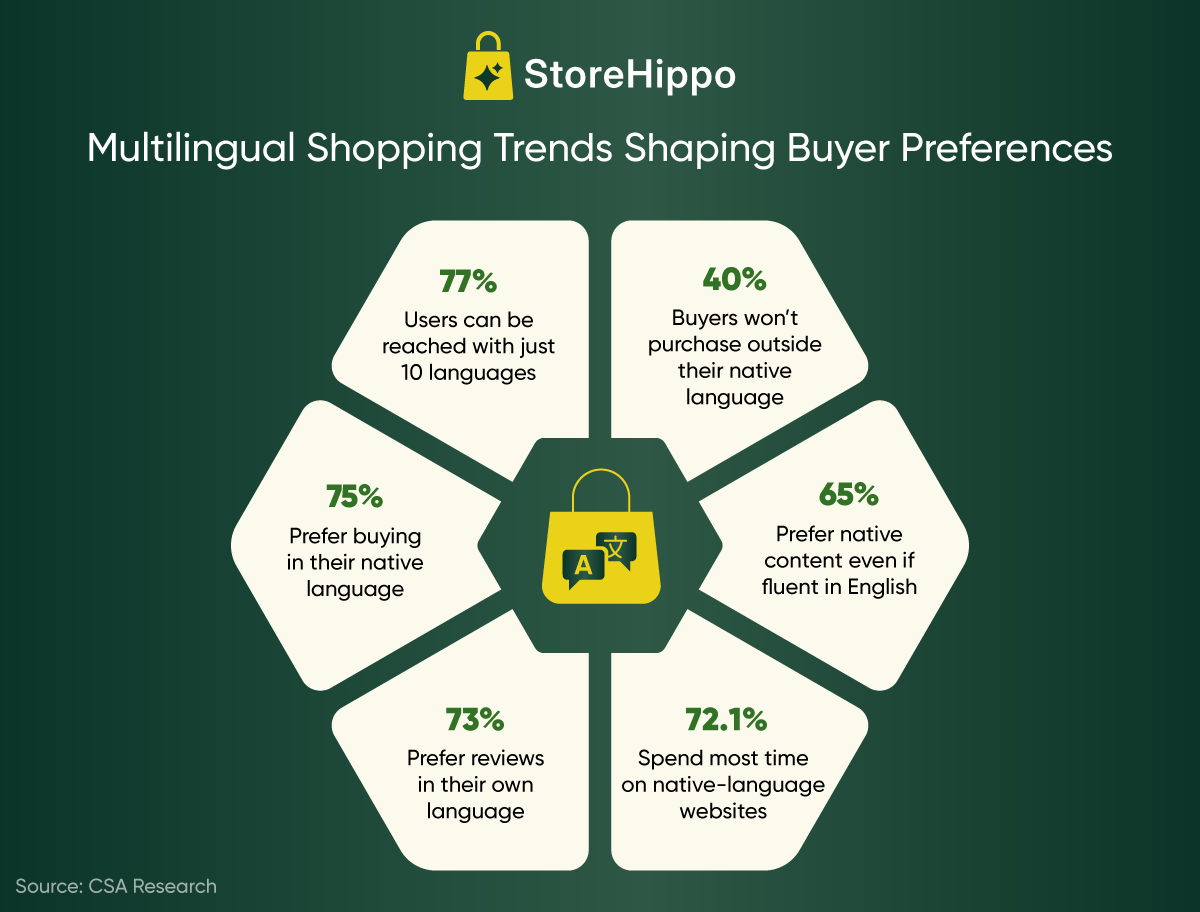
- 40% of online buyers will never buy from any website other than one in their native language
- 65% of people highly proficient in English prefer content in their native language
- 72.1% of buyers spend most or all of their time on websites in their native language
- 73% buyers prefer product reviews in their own language
- 75% of international buyers prefer to buy from websites in their native language
- 77% of global internet users can be targeted by a multilingual marketplace having the 10 most popular languages
Source: CSA Research
The rise of multilingual buying preferences makes one thing clear: language is no longer just a feature, it is a critical driver of customer engagement and conversions.
To effectively capture diverse audiences and scale globally, enterprise brands need a marketplace platform built with strong multilingual capabilities, localisation flexibility, and seamless cross-border experiences from the ground up.
10 FAQs to Choose the Best Multilingual Ecommerce Platform for Global Expansion
To navigate these evolving multilingual buying trends and make the right platform choice, enterprise decision-makers must evaluate key capabilities that directly impact global scalability and customer experience. Here are the most critical questions to ask before selecting a multilingual ecommerce platform:
1. What features should enterprises evaluate when selecting a multilingual ecommerce platform for global expansion?
Enterprises should look for an enterprise ecommerce platform that can scale seamlessly across multiple countries without requiring system rebuilds for each new market. The platform should enable unified operations, offer flexibility for different regional requirements, and provide complete visibility and access to customer data across all markets.
For global expansion, it should support seamless cross-border selling, i.e., features to sell in different countries. For hassle-free multi-country selling, that multilingual enterprise ecommerce platform must have multi-currency, taxes, catalogue variations, and logistics solutions to fulfil cross-border fulfilment.
Another key consideration is how much the enterprise ecommerce platform relies on plugins. Platforms that depend heavily on third-party extensions often create operational complexity and long-term maintenance challenges. Instead, enterprises should look for built-in capabilities such as multilingual storefronts, multi-store management, integrations with global service providers, and full ownership of business data.
StoreHippo offers a robust enterprise ecommerce platform designed for global growth. StoreHippo offers built-in multilingual support for 100+ languages, including RTL languages, multi-store capabilities to build region-specific storefronts tailored for different countries, and seamless integrations across payments, logistics, ERP, accounting, and marketing tools. StoreHippo enables enterprises to scale their global ecommerce operations smoothly without relying on plugins. StoreHippo offers 60+ pre-integrated payment gateways for multi-currency payments and has a robust tax-engine to support country-specific taxes.
2. Can one ecommerce platform handle localisation across different countries, languages, currencies, and service providers?
Yes. A modern global ecommerce platform should support multiple languages, currencies, tax rules, payment gateways, logistics partners, and regional storefronts from a single backend. This allows businesses to deliver localised shopping experiences while maintaining centralised control over products, inventory, orders, and operations across international markets.
StoreHippo is a robust enterprise ecommerce platform built for global expansion with built-in multilingual support, multi-currency payments, and a multistore feature that enables global brands to launch region-based storefronts for different cross-border markets. Each storefront can be tailored to have a unique URL, store design, catalogues, pricing, discounts, language and currency to engage and convert local customers. Enterprises can create a central master catalogue for all stores and manage each sub-store from a powerful admin panel. With 150 + integrations for global payments and logistics providers, CRM, ERP, accounting, and marketing tools, StoreHippo enables smooth and scalable operations. Its built-in capabilities for automated language translation, multi-currency support, and tax settings eliminate the need for third-party plugins, making global ecommerce management faster, more efficient, and easier to scale.
3. How can the best ecommerce platform simplify managing product information, pricing, and content across multiple global locations?
Enterprise ecommerce platforms must have a unified dashboard to centralise product data, pricing, and content across multiple global storefronts. They should offer AI tools, automated translations, bulk updates, and local pricing controls to help enterprises manage global operations faster and with less manual effort.
Managing product catalogues and pricing across international markets can be complex without the right enterprise ecommerce platform. The best ecommerce platform for global brands should centralise product information while enabling localisation for different regions. Enterprises should be able to manage product descriptions, pricing, and content across multiple languages and currencies while maintaining consistency. Automation tools like bulk updates and translation workflows can significantly simplify catalogue management for global ecommerce operations.
StoreHippo simplifies catalogue management with AI-powered cataloguing that automates categorisation, tagging, attribute mapping and creates engaging and eye catchy products titles and descriptions just by uploading images. These titles and descriptions can be further translated into different international languages using an automatic translation tool. Multistore architecture enables enterprises to manage global storefronts from a centralised dashboard while offering localised pricing, product listings, and content. This makes StoreHippo one of the best ecommerce platform choices for enterprises managing complex global ecommerce operations
4. How can an AI-powered ecommerce platform help with global ecommerce?
An AI-powered ecommerce platform helps businesses automate and optimise global ecommerce operations at scale. AI can improve product discovery, personalise shopping experiences, automate catalog management, analyse customer behaviour, and support smarter operational decisions across regions, helping brands deliver more relevant experiences while managing growth more efficiently. Enterprises can also use AI to offer conversational guided journeys to both buyers and sellers.
AI should not be treated as an add-on capability. In modern global ecommerce, it should actively improve daily operations and decision-making across markets. Without built-in AI capabilities, businesses often depend on multiple external tools, which increases operational cost and fragments data.
StoreHippo AI-powered e-commerce platform comes with an AI core enabling intelligence across every layer. It offers AI-powered cataloguing to automatically generate product titles and descriptions, automate product tagging, attribute mapping, and categorisation, etc. Its AI image editing tool, Magic Edit, transforms raw product images into high-quality, market-ready visuals by automatically removing backgrounds and optimising lighting for a polished, professional look. Its AI-powered semantic search surface search results by analysing buyer behaviour and intent, intelligent product recommendations suggest highly relevant products based on buyers' search history and buying patterns. StoreHippo enables enterprises to build custom AI agents for vendor and buyer support, helping automate queries, resolve issues faster, and deliver consistent, context-aware assistance across every touchpoint. These AI tools help enterprises deliver personalised shopping journeys, improve product discovery across global markets, and build highly engaging international ecommerce experiences.
5. Why is mobile-first omnichannel architecture critical when selecting the best ecommerce platform for modern global ecommerce businesses?
A mobile-first omnichannel architecture helps enterprises deliver seamless shopping experiences across mobile apps, PWAs, websites, marketplaces, social commerce, WhatsApp, and other digital channels. It keeps inventory, pricing, orders, and customer data synced in real time, helping businesses manage multiple sales channels smoothly from one system.
With 70-78% of global online orders driven by smartphones, mobile has become the primary commerce channel, making mobile-first infrastructure a key consideration when selecting the best ecommerce platform.
Strong enterprise ecommerce solutions bring all channels together under one system. StoreHippo offers a built-in mobile app builder, which enables enterprises to build Android and iOS apps without coding. They can also build PWA stores to reach customers in low-connectivity areas and give them a mobile app-like experience. Enterprises can connect and engage their customers through new-age sales channels like WhatsApp, voice commerce and AI-assisted commerce, enabling more interactive, convenient, and personalised buying experiences.
6. What features or plugins to look for in a multilingual ecommerce platform to ensure consistent customer experiences across mobile apps, regional storefronts, and new-age conversational AI channels?
The multilingual ecommerce platform must offer built-in omnichannel capabilities to deliver a unified and consistent customer experience across multiple channels. It should enable enterprises to build mobile apps, PWAs, WhatsApp commerce, voice commerce, and conversational AI interfaces while offering centralised control over catalogues, inventory, pricing, and orders from a single system.
Consistent product catalogues, pricing, and content across all channels help maintain a unified brand experience in global ecommerce markets. Flexible APIs and centralised content management are also essential for integrating new digital channels easily.
StoreHippo enables consistent omnichannel experiences with built-in multilingual capabilities across websites, mobile apps, and AI-powered shopping assistants. Its enterprise ecommerce platform allows businesses to deliver localised content, personalised recommendations, and conversational shopping journeys across channels without relying on external plugins, making it an ideal solution for global ecommerce brands.
7. How can enterprises ensure their multilingual ecommerce platform is capable of handling growing catalogues, multiple languages, and cross-border operations without slowing down performance?
Enterprises should choose a scalable enterprise ecommerce platform built on cloud native architecture that supports large catalogues, multilingual content, and global traffic volumes. Features like automated workflows and efficient data management help maintain performance during expansion.
Enterprises should check how well the platform performs when markets, operations, catalogues, languages, etc., expand. Enterprises should evaluate the platform’s infrastructure, architecture, and scalability features before making a decision. A cloud-native platform built on modern architecture can automatically scale resources during high traffic periods and support large volumes of product data and multilingual content efficiently.
Enterprises should also consider whether the platform supports efficient data management tools such as bulk catalogue updates, automated translation workflows, and optimised database performance for multi-region operations. These features help ensure smooth performance even as businesses expand into new international markets.
StoreHippo provides a highly scalable enterprise ecommerce platform built on cloud-native MACH architecture. It supports millions of products, multilingual catalogues, and cross-border ecommerce operations while maintaining fast loading speeds. This makes StoreHippo the best ecommerce platform for enterprises planning long-term global ecommerce expansion.
8. How can enterprises effectively manage region-specific campaigns and vendor-level discounts across global ecommerce marketplaces?
Enterprises can manage region-specific campaigns and vendor-level discounts through a centralised system that supports geo-targeted promotions, local pricing, marketplace-specific offers, and vendor-wise discount rules. A flexible discount engine can help businesses run localised campaigns across global marketplaces without increasing operational complexity.
Enterprises should evaluate how the platform handles localisation in marketing. Running global ecommerce operations means every market responds differently. Pricing, offers, and promotions need to be tailored to region-specific customer behaviour, not managed as a one-size-fits-all strategy.
Enterprises should be able to define rules based on geography, customer segments, vendors, or marketplaces, and roll out campaigns across multiple storefronts without duplicating efforts.
Strong global ecommerce platforms like StoreHippo make this process structured and scalable. It offers a powerful built-in discount engine that enables enterprises to offer multi-level personalised discounts, region-specific campaigns, manage vendor-level offers, and execute localised marketing strategies across global storefronts, all from a single system.
9. Will the multilingual ecommerce platform easily connect with the payments, logistics partners, and business systems enterprises already use?
Yes, but only if the multilingual ecommerce platform is built on an API-first architecture. Built-in API connectors enable enterprises to easily connect with the payments, logistics, ERP, CRM, accounting, and other business systems they already use.
For enterprises planning global expansion, integration flexibility should be a key consideration when choosing a multilingual ecommerce platform. If every integration needs custom development, timelines and costs will rise quickly.
StoreHippo’s API first architecture offers well-documented 350+ APIs, enabling seamless integration with existing systems. Storehippo also offers 150+ pre-integrations across payments, logistics, ERP, accounting, marketing tools, and enterprise systems. This ensures smooth international business operations and reliable order fulfilment and helps enterprises scale efficiently without facing technical roadblocks.
10. What should enterprises ensure before migrating to a multilingual ecommerce platform for long-term global growth?
Before migration, enterprises should evaluate the platform’s scalability, architecture, integration flexibility, and support for multiple business models and global operations. The right global ecommerce platform should support long-term growth without requiring major system rebuilds in the future.
Start by looking at how well the platform supports businesses that are already operating across multiple global markets. Migration is not just about solving current needs; it’s about choosing a system that can handle future expansion without creating friction.
Enterprises should evaluate whether the platform can support their long-term global strategy. This includes managing multiple languages, currencies, payment gateways and region-specific storefronts, while also supporting different business models like B2B, B2C, multivendor and hybrid models. These capabilities should be built into the platform, not dependent on external tools.
Next, they should look for the platform’s architecture and flexibility and choose a platform that is built on API- first architecture for easy integrations with existing systems without rebuilding core operations. It’s also important to understand how the platform handles data migration, ongoing updates, and evolving business requirements.
StoreHippo is a multilingual ecommerce platform built with this long-term approach in mind. It is the best enterprise ecommerce platform designed to grow with your business and make global expansion more predictable and manageable, without forcing enterprises to rethink their technology stack every few years.
Conclusion
The shift towards multilingual commerce is redefining how enterprise brands approach global ecommerce. It is no longer enough to simply enter new markets; success now depends on how effectively you can localise experiences, engage diverse audiences, and operate seamlessly across regions.
Choosing the right multilingual ecommerce platform is, therefore, a strategic growth decision. The ideal enterprise ecommerce platform should not only simplify cross-border operations but also empower enterprises to manage multiple storefronts, languages, currencies, and customer journeys from a unified system. A future-ready enterprise ecommerce platform must offer scalability, localisation, AI-driven intelligence, and omnichannel capabilities to deliver consistent and personalised experiences across markets.
If you are evaluating platforms for global ecommerce, it is worth choosing a solution that is built for this level of scale and flexibility from day one. StoreHippo offers a robust, future-ready enterprise ecommerce platform with built-in multilingual capabilities, AI-powered automation, and seamless integrations to help you build, manage, and scale your global ecommerce ecosystem with confidence.
Want to explore StoreHippo's global ecommerce solutions?
Book your demo today.
Binny Joseph is a seasoned ecommerce and enterprise growth leader, serving as Senior Vice President of Sales & Alliances with deep experience helping global brands adopt modern commerce solutions. He writes about global ecommerce, multilingual ecommerce platforms, and helping businesses choose the right enterprise ecommerce platform for international growth.