


Over the years, marketplaces have evolved from simple digital catalogues into complex ecosystems where buyers, sellers and marketplace teams are all expected to move faster. With an AI-powered marketplace, those expectations are changing again, because AI is beginning to solve the everyday marketplace challenges that once needed constant manual intervention.
Buyers expect better discovery, relevant recommendations and faster support. Sellers want easier catalogue creation, quicker onboarding and help managing routine tasks. Marketplace teams need to handle growing assortments, seller networks, conversations and operations without adding the same level of complexity.
This is where AI for ecommerce is becoming genuinely useful. Instead of adding isolated AI features, an AI-powered ecommerce platform can bring intelligence into the workflows where marketplace friction actually happens. And with agentic commerce, AI can increasingly move from simply answering questions to helping users take action. Here are eight practical use cases where that shift matters most.
Table of Contents
- How AI For Ecommerce Is Accelerating Online Marketplace Growth
- 8 Ways AI for Ecommerce Can Help Marketplaces Solve Everyday Challenges
- 1. AI Store Builder for Launching New Stores and Themes Faster
- 2. AI Cataloguing for Faster Vendor Go-Live
- 3. Semantic, Voice and Multilingual Search for Better Product Discovery
- 4. Hyper-Personalisation Through AI Recommendations
- 5. AI Shopping Assistants for Guided Buying
- 6. AI-Powered Support For Buyers and Sellers
- 7. AI-Powered Unified Commerce for Connected Marketplace Experiences
- 8. AI-Powered Logistics for Fewer Delivery Issues
- How StoreHippo Helps You Build a Smarter AI-Powered Marketplace
- 1. Build and Launch Marketplace Experiences Faster
- 2. Bring Sellers and Products Live Faster
- 3. Help Buyers Find Relevant Products
- 4. Create Custom AI Agents for Your Marketplace
- 5. Power Your Marketplace With a Unified AI Core
- 6. Keep Customer Experiences Connected Across Channels
- 7. Simplify Buyer and Seller Support With AI
- 8. Make Smarter Shipping Decisions With AI-Assisted Workflows
- Conclusion
- FAQs
How AI For Ecommerce Is Accelerating Online Marketplace Growth
AI adoption is already having a visible impact across ecommerce, from how shoppers discover products to how brands manage support, personalisation and everyday operations. As adoption grows, AI for ecommerce is moving from isolated use cases into core commerce journeys, while agentic commerce is beginning to shape how ecommerce marketplaces operate and grow.
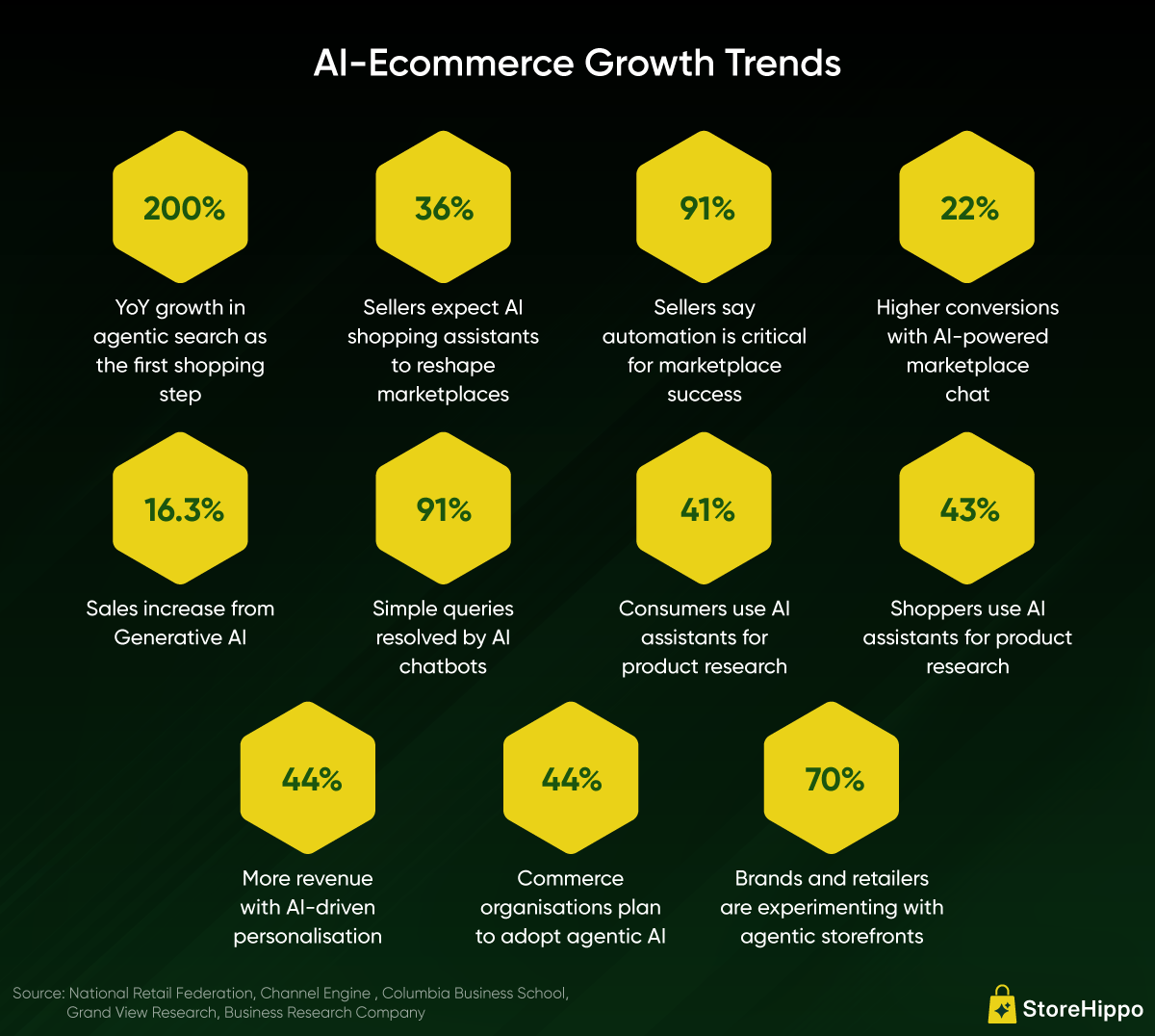
Here are few trends showing the AI impact on business growth:
AI-Ecommerce Growth Trends
- 200% YoY growth in agentic search as the first step in the shopping journey
- 36% of sellers expect AI shopping assistants to reshape marketplace selling in 2-3 years
- 91% of sellers consider automation critical for marketplace success
- 22% higher conversion rates with AI-powered chat on major online marketplaces
- 16.3% increase in sales from Generative AI across marketplace activities
- 91% of simple queries resolved automatically by AI chatbots without human help
- 41% of consumers use AI assistants to research products
- 43% of online shoppers use AI assistants for product research
- 40% more revenue generated by brands with AI-driven personalisation compared to average performers
- 44% of commerce organisations plan to adopt agentic AI within six months
- 70% of brands retailers and agencies are experimenting with or already using agentic storefronts
Source: National Retail Federation, Channel Engine , Columbia Business School
Grand View Research, Business Research Company
The shift is clear: AI is moving from an add-on feature to a core part of how modern ecommerce businesses operate and grow.
For growing businesses, the right AI capabilities can create faster experiences, smarter operations, and more opportunities to scale.
8 Ways AI for Ecommerce Can Help Marketplaces Solve Everyday Challenges
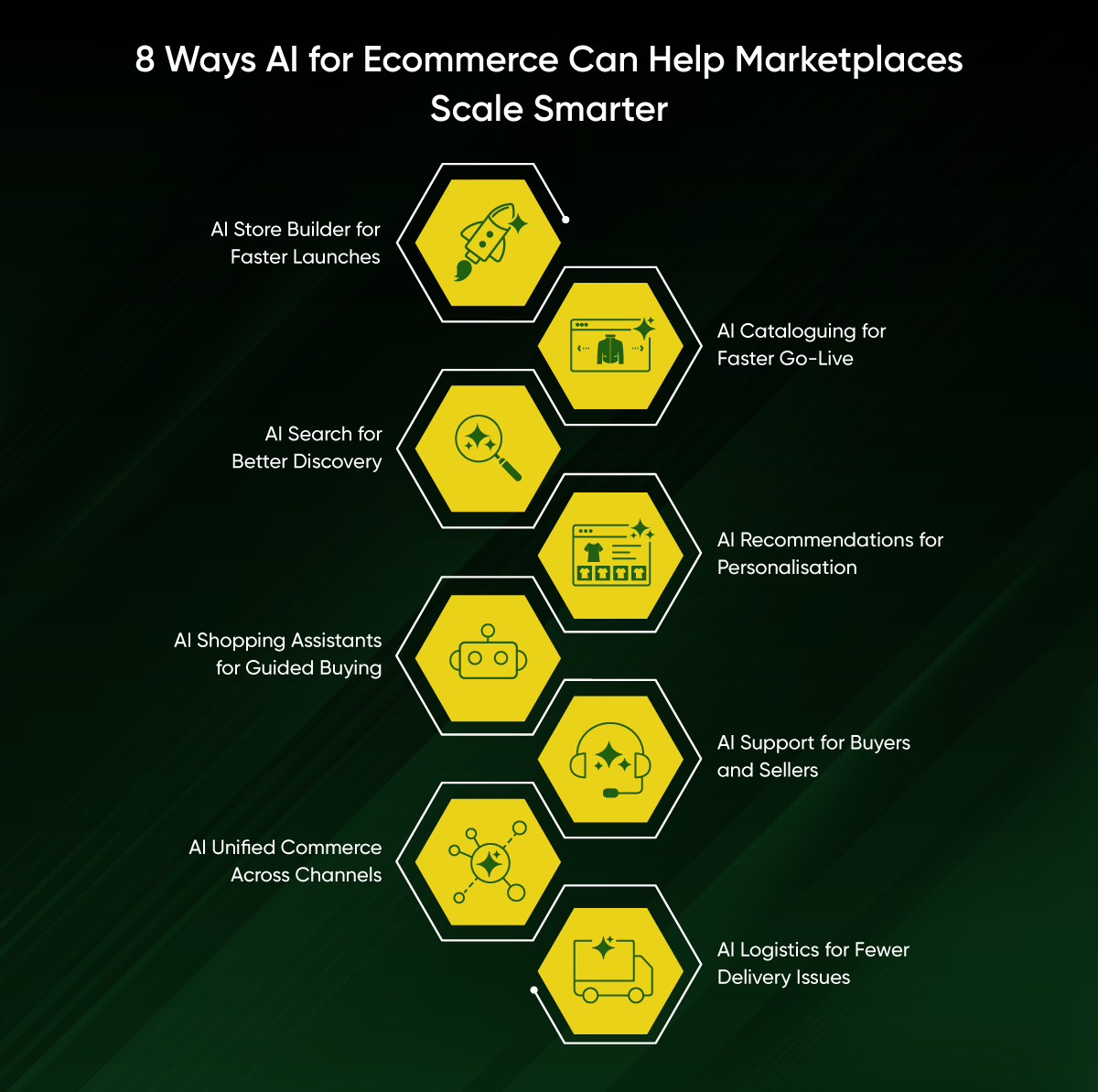
AI for ecommerce is helping marketplaces move beyond manual processes by making store launches, cataloguing, product discovery, and buyer experiences faster and more efficient. As marketplaces scale, these AI capabilities can help businesses handle everyday challenges without slowing down growth.
Here are eight practical ways AI can solve some of the most common marketplace challenges.
1. AI Store Builder for Launching New Stores and Themes Faster
If you run an online marketplace, you already know the struggle behind launching it. It’s not just about choosing a theme and uploading catalogues. Teams need to structure pages, organise categories, create content, set up navigation and make sure the experience works across devices. And when you expand your marketplace with a growing number of vendors, products and locations, manually handling these processes can quickly slow down expansion.
Now imagine having AI tools to handle all this work. An AI-powered marketplace store builder can simplify much of this manual effort by analysing your business requirements, brand guidelines and catalogue information to create the storefront structure, theme and product content automatically. Instead of building every storefront and various pages from scratch, teams can create new stores, launch new themes and adapt existing experiences much faster.
Let’s take a real-life example of a multi-vendor marketplace expanding into global markets. It may need separate storefronts with region-specific sellers, products and shopping preferences for each country. AI for ecommerce can help create the initial storefront structures and themes, which teams can then customise for each market.
The same approach can work for seasonal campaigns or new categories. A marketplace could quickly create a festive shopping storefront, launch a dedicated electronics experience or test a new category without putting every idea through a lengthy development cycle.
The bigger benefit is flexibility. With AI, marketplaces can launch new storefronts, test fresh themes and adapt their shopping experiences much faster, without making every change a long development project.
2. AI Cataloguing for Faster Vendor Go-Live
Getting a seller onboarded on your online marketplace does not mean they are ready to start selling. Their product images, titles, descriptions, categories and attributes still need to be consistent, market-ready and engaging. When your team has to check and refine all this information manually, it can quickly become a time-consuming task. A large part of their time goes into cleaning and organising product listings instead of focusing on other marketplace activities.
This is where having AI tools to manage all this can save a lot of time and effort. Modern AI-powered ecommerce platforms that offer built-in AI tools to automate image editing and cataloguing can solve this challenge easily by automating the time-taking manual product listings on AI powered marketplaces. With the right AI tools in place, image refinement for products, getting product copy, metafields, category mapping etc. can be easily automated. Imagine a fashion multi vendor marketplace bringing hundreds of sellers on board before the festive season. Preparing every product listing manually could take weeks. With AI cataloguing, sellers can get much of the listing information and image edits done automatically. The marketplace team can then review the content and publish it.
This not only helps sellers start selling sooner but also takes a lot of repetitive work off the marketplace team’s plate.
As the marketplace grows, this becomes even more useful. AI can help marketplaces bring more sellers and products live without having to grow their catalogue team at the same pace.
3. Semantic, Voice and Multilingual Search for Better Product Discovery
You may have uploaded thousands of products to your online marketplace, but have you made it easy for your customers to find what they are looking for? If not, you could be losing a huge number of potential customers. Buyers do not always search using exact product names. They may describe what they need in everyday language, use their preferred language or simply speak their query instead of typing it.
This is where an AI-powered marketplace can make a real difference. AI for ecommerce can make product discovery more natural by helping marketplaces understand what buyers actually mean, rather than just matching the exact words they type.
AI-powered semantic search can understand the meaning and intent behind a search and surface products that are relevant to the buyer's requirements. Voice and multilingual search make the experience even easier, especially for shoppers who prefer speaking or searching in their own language.
For instance, a shopper might search for “a laptop for video editing under ₹70,000.” They may not know which processor, RAM or graphics card they need. AI can understand the requirement and show products that fit the intent behind the search. A shopper from another country can can also use voice prompts in their native language to describe what they are looking for instead of typing the query in English.
This becomes even more important as agentic commerce becomes part of the shopping journey. Marketplaces need product discovery to work not only for buyers but also for AI systems helping buyers search, compare and purchase products.
4. Hyper-Personalisation Through AI Recommendations
Buyers with different shopping habits can browse your marketplace website daily. One buyer may regularly shop for sportswear, while another may be interested in electronics or home products. In such a scenario, your marketplace needs to offer personalised recommendations that make the shopping experience more relevant to each buyer.
It is not practically possible to offer personalised recommendations to each one of your buyers manually, especially when your marketplace serves thousands or millions of customers. But when you build your marketplace on an AI-powered ecommerce platform, you can leverage AI recommendations that use buyer behaviour, preferences, purchase history and live commerce data to suggest relevant products, alternatives and add-ons. Instead of showing the same popular products to everyone, AI can help you recommend products based on what each buyer is actually interested in.
Let's consider a buyer who regularly browses athleisure and sportswear. AI can recommend them shoes, workout clothing or running accessories based on their interests and previous activity. Another buyer visiting the same marketplace may see electronics or home products based on their own shopping behaviour.
As your marketplace grows, creating these personalised experiences manually becomes harder. AI for ecommerce can help you personalise product discovery across different stages of the buying journey without adding more work for your merchandising team.
The everyday challenge here is simple: how do you make every buyer feel like your marketplace understands what they are looking for? AI helps you do that by turning customer and commerce data into more relevant recommendations and shopping experiences.
5. AI Shopping Assistants for Guided Buying
Customers may know what they want but still struggle to decide which product is right for them. They may want to compare a few options, understand the differences, check alternatives or simply get some help before making a purchase. Traditional search can help them find products, but it does not always help them decide what to buy.
If you have built an AI shopping assistant on your marketplace, it can make the buying experience easier. Instead of making customers search, filter and compare products on their own, the AI assistant can understand what they are looking for and help them find suitable options through a simple conversation.
For example, a customer looking for a laptop may tell the AI assistant that they need it for video editing, want good battery life and have a budget of ₹70,000. The assistant can understand these requirements, suggest relevant products and help compare the options so the customer can make a more informed choice.
This becomes even more useful when your marketplace caters to diverse audience groups with different levels of comfort, product knowledge and digital familiarity. AI can adapt discovery and assistance to each user’s intent, helping experienced buyers move faster while giving newer or less confident shoppers the guidance they need to complete their journey.
The bigger benefit is that AI can make your marketplace feel less like a place where customers simply browse products and more like a place where they get help throughout the buying journey. On a single chat interface, buyers can discover products, compare options, ask questions, get recommendations and move all the way to checkout without constantly switching between pages or channels.a
For brands, having an AI-powered marketplace with a custom agentic shopping assistance solves a common challenge: helping more customers make confident purchase decisions without putting more pressure on your team.
6. AI-Powered Support For Buyers and Sellers
When hundreds of buyers and sellers interact with your marketplace every day, your support team has to handle many similar questions. Buyers may ask where their order is, whether a payment went through or when a product will arrive. Sellers may need help with onboarding, catalogue uploads, order management or other marketplace processes. Handling each query manually can quickly increase the workload for your support team.
AI for ecommerce can help marketplaces manage these routine interactions more efficiently. A buyer support bot can respond to common product, order, payment and delivery questions using relevant business and customer data. When an issue requires human intervention, AI can pass the conversation to the appropriate team with the necessary context.
The same approach can support sellers. A seller support bot can guide vendors through onboarding, catalogue setup, order management and other common processes, giving them help without requiring a support executive for every question.
For example, imagine a festive season sale where you have onboarded hundreds of new sellers. Many sellers may have similar questions about catalogue uploads, product information or order processing. Instead of your support team answering the same questions repeatedly, an AI seller support bot on your marketplace can guide sellers through these processes.
This creates a more scalable support model for marketplaces. AI handles routine interactions while human teams can focus on more complicated cases that require judgement or intervention.
The value is not simply reducing the number of support tickets. It is about making support available when buyers and sellers need it and giving human teams better context when they need to step in.
For marketplaces managing a growing ecosystem of buyers and sellers, AI for ecommerce therefore solves a very practical challenge: how to provide timely support at scale without continuously increasing the workload on support teams.
7. AI-Powered Unified Commerce for Connected Marketplace Experiences
If you run a marketplace across multiple channels, you already know how difficult it can be to keep every customer interaction connected. A customer may discover a product on your website, continue the conversation on WhatsApp, complete the purchase through your mobile app and later contact support about the same order. When these channels work separately, customers may have to repeat information or start their journey again.
So, how do you make these different channels work as one? AI-powered unified commerce can connect these interactions through a shared intelligence layer, allowing your marketplace to use the same customer, product and commerce context across channels.
Let’s take a real-life example of an AI-powered marketplace selling across its website, mobile app and WhatsApp. A customer may ask about a product on the website and later continue the conversation on WhatsApp. With connected commerce data, AI can use the relevant product and customer context to make the next interaction more consistent.
This also gives you more flexibility to add new touchpoints without rebuilding the entire AI experience for each one. A customer should not have to start from scratch simply because they move from one channel to another.
As marketplaces expand their digital presence, unified AI can help create a more consistent shopping journey across channels. The goal is not simply to be present on more channels, but to make those channels work together with the same customer, product and commerce context.
8. AI-Powered Logistics for Fewer Delivery Issues
Managing deliveries across multiple sellers, locations and logistics partners can create plenty of room for delays and shipping issues. Your operations team may have to track shipment exceptions, follow up on delayed orders and keep customers updated, especially during periods of high order volumes.
AI for ecommerce can help make some of these logistics processes easier to manage. For example, AI-powered issue resolution can help identify and prioritise shipping issues, while automated ticketing and workflows can help teams handle them faster. Rule-based carrier and dealer assignment can also help route shipments to the appropriate logistics provider or dealer based on your configured business rules.
Let’s take a real-life example of a marketplace handling a large festive sale. If multiple shipments face delays or other issues, your team can use automated workflows to identify these cases and take action instead of manually checking every shipment.
Automated shipment updates can also keep customers informed about their order status without requiring your team to respond to every tracking query.
The goal here is not to suggest that AI can manage your entire logistics operation. It can help you reduce some of the manual work around shipment issues, routing and updates, making day-to-day marketplace fulfilment easier to manage.
How StoreHippo Helps You Build a Smarter AI-Powered Marketplace
StoreHippo brings AI into different layers of marketplace commerce, so you can use your catalogue, customer and commerce data to create better experiences and simplify everyday operations. Instead of adding separate AI tools for every use case, you get connected AI capabilities across storefronts, discovery, support, agents and commerce workflows.
1. Build and Launch Marketplace Experiences Faster
Launching a new AI-powered marketplace experience does not have to mean starting everything from scratch. StoreHippo’s AI storefront builder can use your brand guidelines, catalogue and business requirements to create the storefront structure, theme and content.
This can help you launch new stores and shopping experiences faster while still giving your team control to customise layouts, journeys and workflows. Whether you are entering a new market, launching a new category or creating a seasonal storefront, AI can reduce the manual work involved in getting the experience ready.
2. Bring Sellers and Products Live Faster
For a multi vendor marketplace, adding more sellers only creates value when their products are ready for customers to discover and buy. StoreHippo's AI-powered ecommerce platform helps simplify this process with the AI image editing tool Magic Edit and AI-powered cataloguing.
Magic Edit helps enterprises transform ordinary product photos into more polished visuals. With AI-powered cataloguing, sellers can upload product images to automatically generate titles, descriptions and attributes, identify categories and fetch relevant HSN codes. This means your catalogue team can spend less time preparing individual listings and more time reviewing and improving the overall marketplace.
3. Help Buyers Find Relevant Products
A large catalogue is useful only when customers can find the right products quickly. StoreHippo brings semantic search, multilingual voice search and personalised recommendations together to make product discovery more relevant.
AI can understand natural-language searches beyond exact keywords, while voice search lets customers search in their preferred language. AI-powered recommendations can analyse buyer behaviour, preferences, purchase history and live commerce data to surface relevant products, alternatives and add-ons.
The result is a future-ready AI-powered marketplace where customers spend less time searching and more time discovering products that fit their needs.
4. Create Custom AI Agents for Your Marketplace
Your marketplace may have very specific workflows that a standard AI chatbot cannot handle. StoreHippo enables you to create custom AI agents for your online marketplace around your business rules, data, approval flows and use cases.
You can build AI agents for shopping assistance, seller support, buyer support and other industry-specific workflows. These agents can work with your business data and, where connected through APIs and integrations, take actions within your existing commerce processes.
This gives enterprises a practical way to use AI for ecommerce beyond simply answering questions.
5. Power Your Marketplace With a Unified AI Core
AI becomes more useful when it can work with the information your business is actually using. StoreHippo's unified AI core connects AI interactions with live catalogue, customer, order, inventory and fulfilment data.
This means AI experiences on your multi vendor marketplace can work with the same commerce context instead of operating as disconnected tools. An agent assisting a customer, a recommendation engine suggesting products or a support bot answering an order query can work with relevant business information.
For enterprises, this creates a more consistent framework for building AI-powered commerce experiences.
6. Keep Customer Experiences Connected Across Channels
Customers may move between your website, mobile app, WhatsApp, voice and support channels during a single buying journey. When these channels work separately, customers may have to repeat information or start their journey again. StoreHippo helps connect these touchpoints through a unified AI dashboard, so your marketplace can work with the same customer, product and commerce context across channels.
The same AI capabilities can support product discovery, recommendations, customer support and custom agents across these touchpoints. This helps you create a more consistent experience on your AI-powered marketplace, even as you add new channels and customer touchpoints.
7. Simplify Buyer and Seller Support With AI
With StoreHippo AI-powered ecommerce platform, marketplaces can build custom AI bots around their specific buyer and seller workflows. Instead of using the same generic support bot for every interaction, you can create bots designed for the tasks your marketplace handles every day.
A Buyer Support Bot can help customers with product, payment, order and delivery queries, while a Seller Support Bot can guide sellers through onboarding, catalogue setup and order management. These bots can be trained on your business data, policies and workflows to provide more relevant responses.
You can also connect these AI bots with your systems and workflows so they can work with relevant commerce data and take supported actions when required.
This gives marketplaces more flexibility to use AI beyond basic question-answering and build support experiences around the way their business actually works.
8. Make Smarter Shipping Decisions With AI-Assisted Workflows
StoreHippo also brings AI into selected parts of marketplace fulfilment. AI-powered issue resolution can help identify and prioritise shipping issues, while configurable rules can help assign shipments to the appropriate carrier or dealer.
Automated shipment updates can further reduce manual follow-ups by keeping teams and customers informed about delivery status. The focus is not on replacing your entire logistics operation with AI, but on making specific shipping workflows easier to manage.
Conclusion
The next phase of multi vendor marketplace growth will be shaped by how intelligently businesses use data, automation and AI to make everyday decisions. Instead of treating AI as just another technology layer, businesses can make it a meaningful part of how their marketplace understands customers, adapts to their needs and keeps up with changing buyer and seller expectations.
StoreHippo’s AI-powered ecommerce platform enables enterprises to create smarter marketplaces designed for evolving commerce needs. From AI-powered tools to agentic commerce, it gives enterprises the flexibility to create smarter, more adaptive experiences as customer expectations continue to change.
Want to build an AI-powered marketplace for the future?
Book your personalised demo with StoreHippo now.
FAQs
1. What should enterprises evaluate before investing in an AI-powered ecommerce platform?
Enterprises should evaluate AI capabilities, scalability, integration, security, customisation and measurable ROI before investing in an AI-powered marketplace. The platform should connect AI with core commerce operations and support future use cases rather than offering standalone AI features.
2. How can businesses measure the ROI of an AI-powered marketplace platform?
Businesses can measure ROI by comparing the revenue and efficiency gains generated by an AI-powered marketplace platform with its implementation and operating costs. Key indicators include higher conversion rates, average order value, customer retention, faster seller onboarding, reduced support costs and improved team productivity. Tracking these metrics before and after AI adoption shows whether the investment is delivering measurable business value.
3. When is it time for a marketplace to move from AI assistants to agentic commerce?
A marketplace should move toward agentic commerce when AI needs to do more than answer questions or make recommendations. If AI can understand buyer intent, make decisions within defined rules, initiate workflows and take supported actions, the business is ready to explore agent-led commerce.
4. What kind of data does an AI-powered marketplace need to scale effectively?
An AI-powered marketplace needs accurate, structured and accessible product, customer, seller, order, inventory and fulfilment data. Consistent data across these areas gives AI the context needed to deliver relevant recommendations, understand customer behaviour, automate workflows and support better commerce decisions as the marketplace grows.
5. Can an AI-powered marketplace expand internationally without building separate technology stacks?
An AI-powered marketplace can expand internationally without separate technology stacks when it supports reusable commerce capabilities across markets. The platform should allow businesses to adapt languages, catalogues, currencies, customer experiences and regional requirements while managing them through a common technology foundation.
6. What is the biggest mistake enterprises make when implementing AI for ecommerce?
The biggest mistake is implementing AI for ecommerce without first defining clear business goals and measurable outcomes. Enterprises may adopt multiple AI tools without considering how they fit into existing workflows, data and customer journeys. A better approach is to start with specific business problems, prioritise high-impact use cases and measure results consistently.
7. What makes an AI-powered ecommerce platform future-ready for agentic commerce?
A future-ready AI-powered ecommerce platform should have a unified commerce data layer, flexible APIs, custom AI agents, strong business-rule controls and the ability to connect AI with real-time commerce workflows. This gives enterprises the foundation to move from basic AI assistance toward more autonomous agentic commerce experiences.
8. How can StoreHippo help enterprises build and scale an AI-powered marketplace?
StoreHippo brings AI into the core commerce experience, helping enterprises build storefronts, manage catalogues, improve discovery, create custom AI agents and connect AI with customer, order, inventory and fulfilment data. This gives businesses a unified foundation to scale AI-powered commerce as their marketplace evolves.
Pallavee Kumar brings over 20 years of hands-on ecommerce experience, having helped enterprise brands scale through strong operations and clear storytelling.
She brings hands-on industry knowledge and a practical perspective on using AI to streamline commerce, strengthen efficiency, and drive long-term growth.