


Marketplace commerce is no longer an emerging trend. For many buyers, it has become the default way to discover products, compare options, and make purchasing decisions. As customer expectations evolve, enterprise brands across manufacturing, FMCG, distribution, and retail are increasingly investing in multi vendor marketplaces to expand their reach, onboard new sellers, and unlock new revenue streams.
However, many businesses quickly discover that building a successful marketplace is very different from launching a traditional ecommerce store. Challenges around vendor onboarding, catalogue management, inventory visibility, order fulfilment, operational control, and scalability often appear much earlier than expected. In many cases, these issues can be traced back to one critical decision: choosing the wrong platform.
A multi vendor marketplace is far more than a storefront with multiple sellers. It must seamlessly manage vendors, buyers, products, inventory, orders, fulfilment workflows, personalised shopping experiences, and growing transaction volumes, all from a unified system.
This is why enterprises need to look beyond feature checklists and pricing comparisons when evaluating a platform. The right enterprise ecommerce solution should be able to scale with the business, adapt to changing requirements, support AI-driven operations, improve efficiency, and handle future growth without creating operational bottlenecks.
These 10 FAQs will help you evaluate the factors that matter most when selecting a multi vendor marketplace platform for long-term success.
Table of Contents
- Why Enterprise Marketplaces Are Winning and Where Most Platforms Fall Short
- 10 FAQs Enterprises Must Ask Before Choosing a Multi Vendor Marketplace Platform
- 1. How quickly can a multi vendor marketplace go live with an AI-Powered, no-plugin ecommerce platform?
- 2. How can I ensure my multi vendor marketplace platform handles millions of transactions during high-traffic sales and promotional events?
- 3. Will an enterprise e-commerce platform still work if our Business Model pivots to global or hyperlocal multilocal marketplaces?
- 4. What makes an AI powered ecommerce marketplace platform different from a traditional marketplace platform?
- 5. How does AI transform the buyer and vendor experience on an enterprise marketplace?
- 6. What does true omnichannel presence mean for an enterprise multi-vendor marketplace in 2027?
- 7. Can a single enterprise marketplace platform support both B2B and B2C business models simultaneously?
- 8. How can I create personalised shopping experiences at scale on a multi-vendor marketplace?
- 9. What is the real cost of building and running an enterprise marketplace when using plugins vs. a native platform?
- 10. Can enterprise ecommerce solutions integrate with existing ERP, CRM, and logistics systems?
- Conclusion
Why Enterprise Marketplaces Are Winning and Where Most Platforms Fall Short
Buyers today want more than just products. They want choice, convenience, faster fulfilment, personalised recommendations, and a seamless buying experience, all on a single platform.
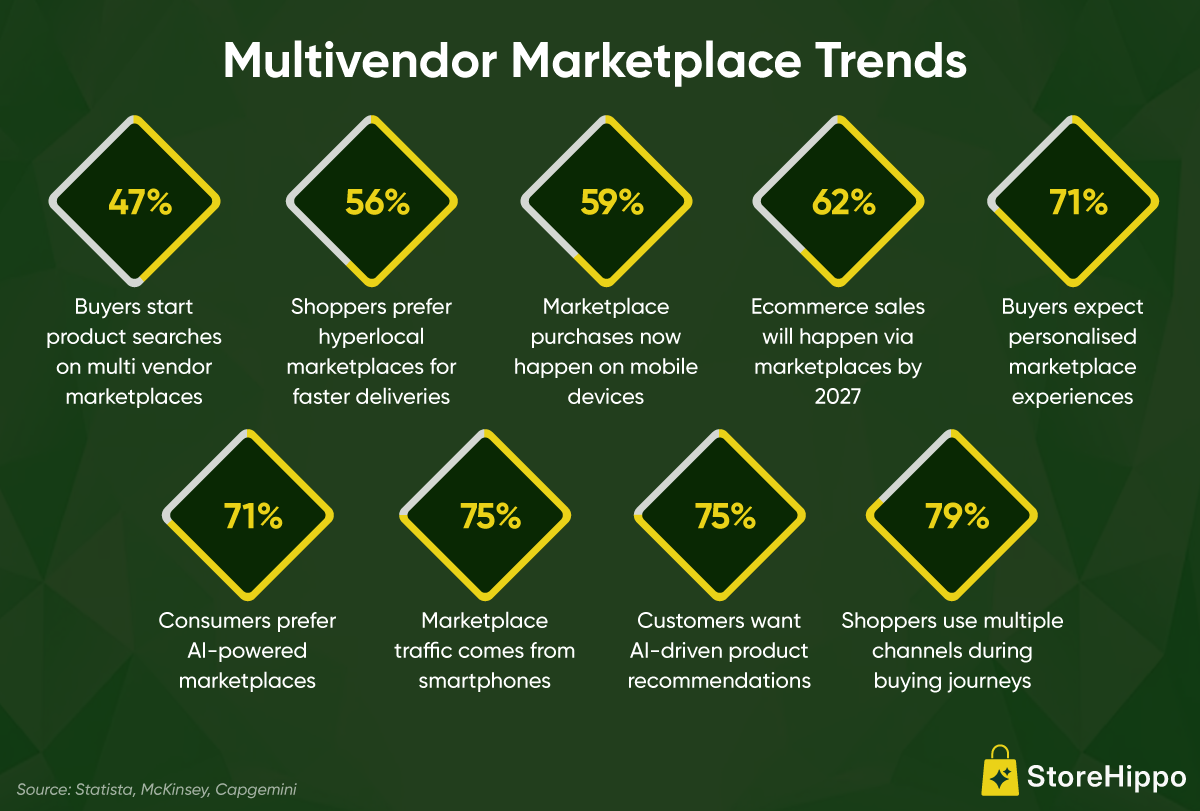
- 62% of ecommerce transactions will happen on marketplace platforms by 2027
- 47% of online buyers begin their product searches on a multi vendor marketplace
- 59% of online buyers now complete their marketplace purchases on a mobile device
- 75% of all marketplace traffic is generated through smartphones
- 79% of marketplace consumers use multiple channels during their shopping journey
- 56% of shoppers shifted to hyperlocal marketplaces to get faster deliveries
- 71% of shoppers expect personalised experiences on Multivendor marketplaces
- 71% of consumers prefer marketplaces that leverage generative AI
- 75% of customers want AI-powered product recommendations on marketplaces
Source:Statista, McKinsey, Capgemini
The picture is clear: Multi vendor marketplaces are rapidly becoming the primary model for digital commerce growth. But success in this space depends on far more than simply launching a marketplace.
As buyer expectations shift toward mobile-first, AI-powered, hyperlocal, and highly personalised experiences, enterprises need multi vendor marketplace platforms that can scale operations, manage complexity, and adapt quickly to changing commerce models.
In such a scenario, enterprises must evaluate ecommerce platforms not just for current business requirements but for their ability to support long-term scalability, seamless omnichannel experiences, AI-driven operations, and continuous business expansion.
10 FAQs Enterprises Must Ask Before Choosing a Multi Vendor Marketplace Platform
Here are 10 must-ask questions for enterprises to choose the best multi vendor marketplace platform for building scalable, AI-powered marketplace operations that can support long-term business growth:
1. How quickly can a multi vendor marketplace go live with an AI-Powered, no-plugin ecommerce platform?
An enterprise marketplace with mid-level business requirements can typically go live within 4-8 weeks on an AI-powered, no-plugin ecommerce platform. Since most essential features like vendor and catalogue management, payments, logistics, and fulfilment are already built into the platform, enterprises can avoid delays caused by multiple integrations and complex plugin setups. Low-code customisation also helps teams make faster changes without depending heavily on developers.
For example, a regional electronics distributor planning to launch a multi vendor marketplace before the festive season can onboard dealers across multiple cities quickly. Since the platform already includes vendor onboarding, catalogue management, payments, logistics, and other essential features, the business can go live within 6–8 weeks instead of spending months setting up separate tools. Internal teams can also manage workflows and updates easily without depending on developers for every small change.
StoreHippo is a no-plugin, AI powered ecommerce marketplace platform built on a decoupled headless architecture that enables enterprises to customise both frontend and backend workflows with minimal coding effort. It offers built-in multi vendor management solutions to simplify vendor onboarding, catalogue management, orders, payments, and fulfilment operations from a single platform.
StoreHippo also comes with 300+ enterprise-grade features and 150+ pre-integrated solutions for payments, logistics, marketing, and other business operations. Additionally, it offers 350+ API endpoints to seamlessly connect with external business tools, software, and enterprise systems for greater flexibility and scalability. This helps enterprises launch faster, adapt quickly to changing business needs, and achieve faster returns on their marketplace investment.
2. How can I ensure my multi vendor marketplace platform handles millions of transactions during high-traffic sales and promotional events?
Go with a cloud-based enterprise ecommerce solution with elastic scalability to ensure your multi vendor marketplace platform handles heavy traffic during sales, festive seasons, and large promotional events without slowing down or crashing.
You should also look for strong uptime commitments and security certifications to ensure the ecommerce platform you choose is reliable, secure, and capable of supporting long-term business growth.
For example, a fashion multi-vendor marketplace running an end-of-season sale may experience traffic spikes nearly eight times higher than normal within a few hours. If, the marketplace is built on a cloud-native platform, it can automatically scale during peak demand, allowing buyers to continue browsing products and completing purchases smoothly without checkout failures or slowdowns.
StoreHippo is built on a scalable cloud-native infrastructure designed to handle high traffic without relying on heavy plugins or constant manual maintenance. It offers 99.99% uptime and strong peak load handling capabilities, enabling enterprises to support large numbers of vendors, products, geographies, business models, and buyer transactions as their multi vendor marketplace scales. Additionally, StoreHippo is an ISO and SOC-certified platform, helping enterprises ensure high standards of security, reliability, compliance, and data protection as their marketplace operations scale.
3. Will an enterprise e-commerce platform still work if our Business Model pivots to global or hyperlocal multilocal marketplaces?
Yes, but only if the enterprise ecommerce solution was designed for flexibility from the start. As businesses grow, they often expand into new regions, launch multiple storefronts, onboard partners or sellers, and introduce hyperlocal fulfilment models. A multi vendor marketplace platform with native multi-store, multi-location, and marketplace capabilities makes these transitions significantly easier. Without these capabilities, a business model pivot can require costly customisations, operational workarounds, or even a complete platform migration later.
For example, a grocery and FMCG brand can start with a city-based marketplace focused on local deliveries and later expand into multiple states or even launch a separate storefront for international buyers. Since the platform natively supports multi-store operations, multiple languages, and hyperlocal delivery management, the business can scale smoothly without rebuilding the entire marketplace setup from scratch.
StoreHippo enterprise marketplace platform is natively built to support diverse business models with built-in multi-store ecommerce solutions for launching multiple location-based storefronts.
It enables businesses to customise each store with unique URLs, designs, pricing, languages, and payment methods to engage global and hyperlocal buyers while managing all stores from one unified admin dashboard. StoreHippo also supports 100+ domestic and international languages, including RTL languages like Urdu and Hebrew, along with 60+ pre-integrated global payment solutions and 30+ hyperlocal, intercity, and international logistics integrations to simplify fulfilment across regions. StoreHippo also comes with built-in global tax rules and GST compliance features to help enterprises manage regional taxation, streamline operations, and ensure smoother compliance across different markets.
4. What makes an AI powered ecommerce marketplace platform different from a traditional marketplace platform?
An AI powered ecommerce marketplace goes beyond basic marketplace operations by automating and optimising key processes. It can improve product discovery with personalised recommendations and semantic search, streamline catalogue management, automate routine tasks, and provide data-driven insights. Traditional marketplace platforms primarily manage transactions, while AI-powered platforms help businesses improve efficiency, customer experiences, and decision-making at scale.
For example, a B2B industrial marketplace with thousands of products from different vendors may struggle to help buyers find relevant products when the search depends only on exact keywords. An AI-powered marketplacecan enable buyers to search using natural phrases like “heavy-duty packaging machine” and instantly deliver more relevant product results, improving both product discovery and conversions.
StoreHippo is an AI powered ecommerce marketplace platform where intelligence works across every layer of operations. This helps enterprises reduce operational complexity, improve scalability, and maintain consistency across channels and workflows. It offers AI-powered search and recommendations, enabling enterprises to deliver intent-based results to buyers. It also offers AI tools to automate catalogue creation, enhance product images, and assist sellers and teams in daily workflows.
5. How does AI transform the buyer and vendor experience on an enterprise marketplace?
AI improves the experience for both buyers and vendors by making marketplace interactions faster, smarter, and more personalised. Buyers benefit from relevant product recommendations, intelligent search, personalised offers, and quicker support. Vendors can automate catalogue creation, product content, inventory updates, and routine operational tasks, helping them sell more efficiently while reducing manual effort.
For example, a beauty enterprise marketplace may onboard hundreds of small sellers who upload unclear product images or incomplete product information. A marketplace platform with built-in AI capabilities can automatically improve product images and generate product details directly from raw images. This helps sellers reduce manual work, keeps product information more consistent across the marketplace, and improves product discovery, which can increase buyer engagement and conversions.
StoreHippoAI-powered ecommerce marketplace platform offers AI-powered search and recommendations, helping enterprises surface intent-based personalised results. It helps buyers get accurate results so they can quickly find what they want. StoreHippo also enables enterprises to build custom AI shopping assistants to handle buyer queries and help them search, find, and buy products.
For vendors, StoreHippo offers AI cataloguing that automatically generates product details like titles, descriptions, categories, tags, and attributes directly from product images. Its AI image editing tool, Magic Edit, helps bring inconsistent vendor photography to a consistent quality standard. StoreHippo also enables enterprises to build custom AI bots to support vendors with daily workflows and queries.
6. What does true omnichannel presence mean for an enterprise multi-vendor marketplace in 2027?
True omnichannel presence means delivering a consistent buying experience across every customer touchpoint, including websites, mobile apps, marketplaces, WhatsApp, AI chat interfaces, etc. For an enterprise multi vendor marketplace, it also means synchronising products, inventory, orders, pricing, and customer data across channels so buyers can move seamlessly between them without disruption.
For example, a consumer electronics marketplace sells products through its website, mobile app, and WhatsApp channels. A customer added products to the cart on mobile but later completed the purchase through WhatsApp. Since inventory, customer data, and orders are synced across all channels in real time, they get a smooth and uninterrupted shopping experience throughout their journey.
StoreHippo is built on omnichannel ecommerce architecture that enables enterprises to manage multiple sales channels from a single unified backend. It comes with a built-in no-code mobile app builder, enabling enterprises to launch native Android and iOS apps without additional development cost. StoreHippo also enables enterprises to build PWA stores that deliver app-like experiences even in low-bandwidth and low-connectivity regions. Enterprises can also sell via WhatsApp, social and conversational AI channels while managing products, inventory, orders, vendors, and customer data from a central admin dashboard. StoreHippo offers real-time synchronisation across all channels, ensuring consistent customer experiences and smoother marketplace operations at scale.
7. Can a single enterprise marketplace platform support both B2B and B2C business models simultaneously?
Yes, provided the platform was built to support multiple business models from a single core. A robust enterprise marketplace platform can manage B2B and B2C operations simultaneously by offering separate catalogues, pricing structures, buyer journeys, approval workflows, payment options, and fulfilment processes, all while maintaining centralised control and operational visibility.
Enterprises should evaluate whether the enterprise ecommerce platform is designed to support multiple business models from the start, with role-based access, rather than being a single-model system where B2B functionality is added later through plugins.
For example, a building materials company may sell products directly to consumers while also supplying bulk orders to distributors and contractors. Instead of managing separate systems for both business models, the company can handle B2B and B2C operations from one backend. Retail buyers see standard pricing and offers, while distributors receive negotiated pricing and approval-based ordering workflows.
StoreHippo enterprise marketplace platform supports B2B and B2C operations natively from the same backend. Enterprises can manage bulk orders, RFQ flows, negotiated pricing, distributor workflows, and retail B2C storefronts simultaneously without operating separate systems.
For businesses managing distributors alongside direct customers, this removes the complexity of connecting multiple platforms later and creates a more scalable operational setup.
8. How can I create personalised shopping experiences at scale on a multi-vendor marketplace?
Personalised shopping at scale requires a combination of customer data, AI, and automation. Modern multi-vendor marketplaces use AI-powered recommendations, intelligent search, personalised offers, dynamic merchandising, and multilingual experiences to tailor journeys for different buyers. The right multi vendor marketplace platform helps enterprises to deliver relevant experiences across thousands of products, vendors, and customer segments without increasing operational complexity.
For example, a multi-category lifestyle marketplace serves customers across different regions and languages. Returning buyers see recommendations based on browsing behaviour and previous purchases, while users from different regions automatically see local-language storefronts, relevant promotions, and preferred payment options. This improves engagement and conversions without increasing operational complexity.
StoreHippo AI-powered e-commerce platform delivers deeply personalised shopping experiences that go far beyond traditional storefronts. Its AI-powered search and recommendations enable enterprises to deliver personalised product discovery to buyers. It supports 100+ domestic and international languages, enabling enterprises to build multilingual storefronts and engage buyers in their preferred languages. With StoreHipp’s built-in discount engine, enterprises can create multi-level discounts, buyer-specific promotions and personalised offers that drive higher engagement, better conversions, and stronger customer retention. StoreHippo also offers built-in design themes, enabling enterprises to create unique designs on their multi vendor marketplaces tailored to specific business needs, ensuring every visitor sees a relevant and engaging interface. StoreHippo also offers multiple payment options and multicurrency payments to engage global buyers by offering their preferred mode of payment.
On top of this, StoreHippo enables enterprises to build custom AI chatbots that guide buyers, answer queries in real time, and deliver conversational, context-aware shopping experiences, making personalisation feel effortless at every step of the journey.
9. What is the real cost of building and running an enterprise marketplace when using plugins vs. a native platform?
The real cost of an enterprise marketplace goes far beyond the platform subscription. Plugin-heavy systems often add recurring costs through third-party apps, integrations, maintenance, upgrades, and custom development. An enterprise ecommerce platform with native marketplace capabilities reduces dependency on external tools, lowers operational complexity, and typically delivers a lower total cost of ownership as the business scales.
For example, a growing marketplace initially used separate plugins for vendor management, mobile apps, multilingual support, payments, and promotions. Over time, plugin subscriptions, compatibility issues, and ongoing maintenance started increasing operational costs and slowing down business agility. After moving to a native enterprise ecommerce platform with built-in enterprise features, the business reduced technical overhead and gained more predictable operating costs.
A native enterprise ecommerce platform like StoreHippo offers built-in tools for all major business workflows in one system. It supports multivendor and multi-store management, multilingual storefronts, offers a built-in mobile app builder, AI capabilities, and multiple business models. It offers 300+ enterprise-grade features, 150+ integrations, and 350+ API connectors, enabling businesses to scale efficiently without dependency on external plugins or fragmented systems. Enterprises can check the pricing page and choose a plan based on their business requirements.
For enterprises planning long-term growth, this model makes costs more predictable and removes the ongoing uncertainty that comes with managing multiple plugins.
10. Can enterprise ecommerce solutions integrate with existing ERP, CRM, and logistics systems?
Yes. enterprise ecommerce solutions built on API-first architecture can easily integrate with any ERP, CRM, accounting, or logistics system a business uses. But the real question is how well they connect. What's the depth, reliability, and maintenance overhead of this integration? Many enterprise marketplace platforms claim to be built on API first architecture, but offer a limited connector library, which often leads to limited flexibility and more effort when business needs change. For reliable enterprise integration, the enterprise must evaluate the platform's full APIs, not just pre-built connectors.
For example, a manufacturing marketplace already uses ERP software for inventory and accounting while managing customer relationships through a CRM platform. After integrating both systems with the ecommerce platform, inventory updates, invoices, order tracking, and customer records started syncing automatically. This reduced manual work, improved data accuracy, and helped teams manage operations more efficiently from one connected ecosystem.
StoreHippo is built on an API-first architecture, enabling enterprises to connect and manage their entire commerce ecosystem with ease. Businesses can seamlessly integrate ERP, CRM, accounting, and other operational systems to create a unified and connected backend for faster decision-making and smoother workflows.
StoreHippo also supports integrations with multiple third-party logistics partners and payment service providers across local and global markets, helping enterprises streamline fulfilment, payments, and customer experiences at scale. Whether managing omnichannel operations, multi-vendor ecosystems, or complex enterprise workflows, StoreHippo offers the flexibility to integrate, automate, and scale without operational bottlenecks.
Conclusion
The multi vendor marketplace opportunity is growing fast. But the brands that will succeed in the long run are not just the ones launching early, they are the ones building with enough flexibility to grow and adapt as customer expectations and business needs change.
As your marketplace expands, adding more vendors, products, and sales channels should not make operations harder to manage. The right ecommerce marketplace platform should help your teams work faster, stay organised, and scale without constantly dealing with backend issues.
That is why choosing the right multi vendor marketplace platform is a strategic business decision. You need a platform that supports growth, keeps operations simple, and adapts easily as your business evolves.
If you are looking for an enterprise ecommerce solution built to support long-term marketplace growth, StoreHippo is worth exploring.
Book your personalised demo now.
Binny Joseph is a seasoned ecommerce and enterprise growth leader, serving as Senior Vice President of Sales & Alliances with deep experience helping global brands adopt modern commerce solutions. He writes from hands-on experience, helping businesses understand what it takes to build, scale, and grow successful enterprise multi vendor marketplaces.