


A shopper rarely thinks in terms of product categories, filters or catalogue structures. They simply know what they want, or sometimes, what they might want and expect the online store to help them get there quickly. For B2C brands managing thousands of products and millions of customer interactions, delivering that kind of experience consistently is becoming harder with conventional ecommerce tools.
This is where AI in ecommerce is starting to change the game. Instead of making shoppers do all the work, AI can understand intent, connect customer signals with product data, and make the next interaction more relevant. From smarter discovery and recommendations to personalised assistance, brands can use AI to make shopping feel less like searching through a catalogue and more like getting useful guidance.
The shift is already visible among AI-powered B2C brands, which are moving beyond isolated AI features and exploring what happens when intelligence becomes part of ecommerce core.
Let’s explore how leading B2C enterprise brands are using AI to drive growth and what their approach can teach other brands looking to build smarter, more relevant shopping experiences.
Table of Contents
Why AI in Ecommerce Is Becoming a Growth Engine for B2C Brands
AI in ecommerce is becoming a growth engine for B2C ecommerce brands because it helps them increase revenue, personalise customer experiences, improve conversions and reduce operating costs. As AI adoption grows, brands are using it to make faster, smarter decisions across the entire shopping journey.
Here are a few numbers that show how AI is already influencing B2C ecommerce growth:
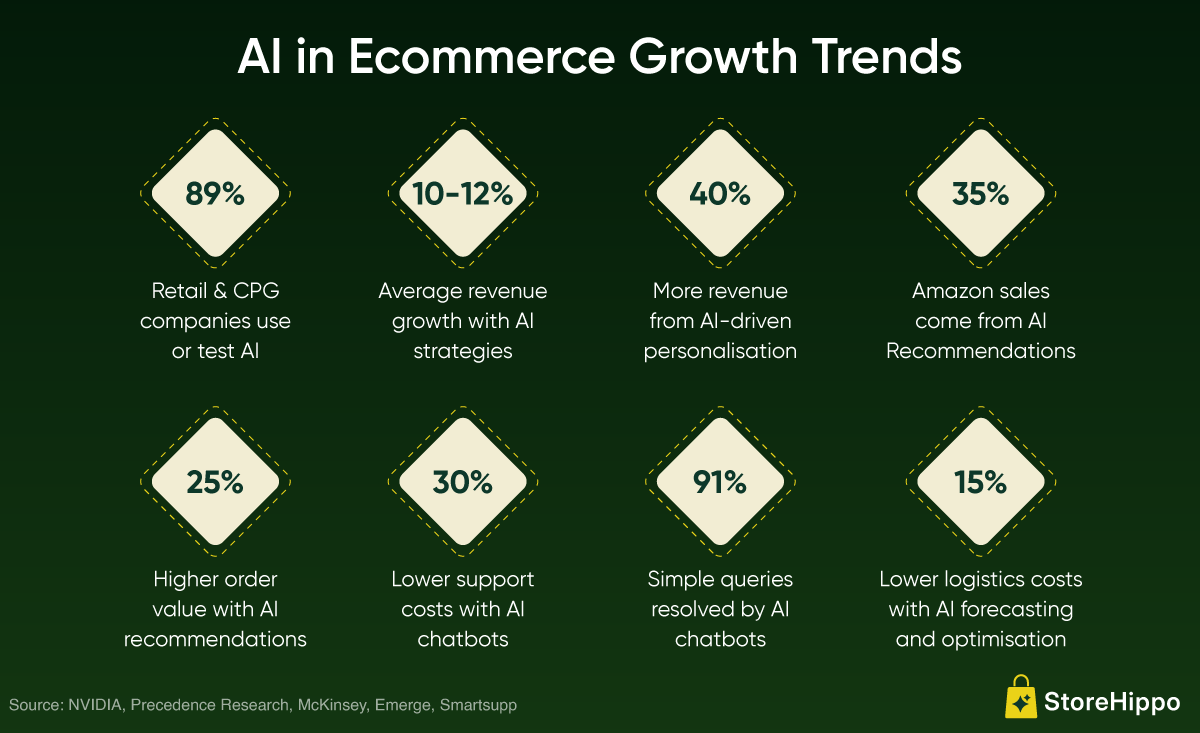
- 89% of retail and CPG companies are already using or testing AI technologies
- 10-12% average revenue increase seen by companies implementing AI strategies
- 40% more revenue generated by brands with AI-driven personalisation compared to average performers
- 35% of Amazon’s annual sales come from AI-powered product recommendations
- 25% average rise in order value achieved through AI-driven recommendations
- 30% reduction in customer support costs using AI chatbots
- 91% of simple queries resolved automatically by AI chatbots without human help
- 15% cut in logistics costs with AI-enabled forecasting and route optimisation
Source: NVIDIA, Precedence Research, McKinsey, Emerge, Smartsupp
The numbers make one thing clear: AI is already influencing the metrics that matter most to B2C brands, from revenue and order value to customer support and fulfilment costs. For brands looking to scale, the right AI-powered ecommerce platform can help turn these AI capabilities into practical growth opportunities.
5 Leading B2C Brands Using AI in Ecommerce to Grow Faster
Leading B2C brands are already using AI across the customer journey, helping shoppers discover the right products, get more relevant recommendations, compare options and make purchase decisions with less effort.
Here’s a closer look at how five well-known brands are using AI to create better shopping experiences:
1. Amazon: Turning Product Discovery Into an AI Conversation
Amazon has been using AI in ecommerce for years, but its role has grown far beyond product recommendations. Today, Amazon uses AI across different parts of the shopping journey to help customers discover relevant products, make quicker decisions, enjoy more personalised experiences and complete purchases with less effort.
Here’s how Amazon is using AI across the shopping journey:
- AI Shopping Assistant: Amazon’s Rufus, now part of its Alexa for shopping experience, helps customers ask questions, compare products, get personalised recommendations and make more informed purchase decisions.
- AI-Powered Search: Understands natural-language queries and customer intent to surface more relevant products.
- Personalised Recommendations: Uses browsing and purchase behaviour to suggest products based on individual interests.
- Generative AI for Product Content: Helps create and improve product titles, descriptions and catalogue content at scale.
- AI Visual Search: Amazon Lens allows shoppers to find products using images instead of text searches.
- Agentic AI: Moves beyond answering questions by helping shoppers complete tasks such as product comparison, list creation and purchase decisions.
- Conversational Shopping: Customers can describe what they need naturally instead of navigating multiple filters and categories.
What B2C brands can learn from Amazon
The biggest takeaway for B2C brands is simple: use AI for ecommerce to make shopping easier for customers. Whether it is helping them find the right product, compare options or make a quicker decision, AI should solve real shopping problems instead of being added just because it is the latest technology.
2. Nykaa: Using AI to Personalise Beauty Discovery
Beauty shoppers don’t always know the exact product they need. They may simply know they have dry skin, want to deal with hair fall, or need a foundation that suits their skin tone. Nykaa uses AI to understand these needs and guide shoppers towards products that are more relevant to their concerns and preferences.
Here’s how Nykaa is using AI to make beauty discovery more personalised:
- AI-Powered Virtual Skin Analyzer: Analyses customers’ skin concerns and provides personalised product recommendations based on their individual needs.
- AI-Powered Semantic Search: Uses large language models to understand user intent and surface more relevant results for complex queries.
- Personalised Recommendations: Uses customer preferences, behaviour and beauty profiles to make product recommendations more relevant.
- Nykaa Muse/AI Beauty Advisor: Acts as a personal AI stylist, helping customers discover fashion products based on their queries, preferences and occasions.
- GenAI-Powered Discovery: Brings content, education and personalisation together to help customers find answers and products more naturally.
What B2C brands can learn from Nykaa
The key takeaway for B2C brands is simple: Start with what the customer needs, not just what you want to sell. AI can help you understand those needs and turn them into product suggestions that actually feel relevant and useful.
3. Walmart: Moving From AI Assistance to Agentic Commerce
Walmart is taking AI beyond traditional product recommendations and search. Its approach increasingly focuses on helping customers complete more parts of the shopping journey through AI-powered assistance. From discovering and comparing products to creating lists and planning purchases,this AI-powered B2C brand is exploring how AI can make ecommerce more conversational and task-oriented.
Here’s how Walmart is using AI to make shopping more conversational and task-focused:
- AI Shopping Assistant: Sparky helps customers find and compare products, create lists, get personalised recommendations and plan for different occasions.
- Agentic AI: Moves beyond answering questions by supporting multiple steps of the shopping journey, from product discovery to purchase.
- AI-Powered Product Comparison: Helps shoppers evaluate different products and make more informed purchase decisions.
- Personalised Recommendations: Uses customer context to surface products and suggestions that are more relevant to individual shopping needs.
- Multi-Agent Orchestration: Walmart is developing AI capabilities that can coordinate multiple tasks and services across the shopping journey.
- Conversational Commerce: Allows customers to describe what they need naturally and receive product suggestions without relying entirely on traditional search and filters.
- AI-Powered External Discovery: Walmart is extending Sparky into conversational AI experiences such as ChatGPT and Gemini, allowing customers to move from AI-led product discovery into Walmart’s shopping experience.
What B2C brands can learn from Walmart
The key takeaway for B2C brands is to think beyond product search and recommendations. AI can take care of more steps in the buying journey, helping customers plan, compare and shop without making them do all the work themselves.
4. Sephora: Using AI to Make Beauty Recommendations More Personal
Sephora has spent years making beauty shopping more personal, especially when it comes to finding the right products and getting expert advice. Now, AI in ecommerce is helping Sephora take that experience further by giving shoppers recommendations that better match their individual needs. At the same time, the brand is bringing its digital and in-store experiences closer together.
Here’s how Sephora is using AI to make beauty discovery and recommendations more relevant:
- AI-Powered Beauty Recommendations: Uses digital tools and customer information to help shoppers discover more relevant beauty products.
- Sephora App in ChatGPT: Helps customers discover and shop for beauty products through curated advice and recommendations.
- Beauty Scan: Analyses skin characteristics and provides skin scores, shade matching and personalised product recommendations.
- Personalised Beauty Guidance: Combines technology with Beauty Advisor expertise to help customers find products suited to their individual needs.
What B2C brands can learn from Sephora
Sephora shows that technology should add value to the advice customers already want. The right AI experience can make choosing between products feel easier, more personal and less overwhelming.
5. Nike: Taking AI-Powered Product Discovery Beyond the Storefront
Nike is taking AI-powered product discovery beyond its own website and app. As shoppers increasingly discover products through conversational AI and search experiences, Nike is bringing its products into these emerging discovery channels. The goal is to make it easier for customers to move from a specific need or idea to the right product and purchase.
Here’s how Nike is using AI to make product discovery easier across new shopping channels:
- AI-Powered Shopping Experience: Enables customers to discover and purchase Nike products through Google's Gemini app and AI Mode in Google Search.
- Conversational Product Discovery: Allows shoppers to describe what they need naturally instead of navigating multiple product filters.
- AI-Powered Product Discovery: Helps customers discover relevant Nike products through conversational AI experiences based on what they are looking for.
- Conversational Shopping: Helps customers move from a specific need or product requirement to relevant Nike products through an AI-led interaction.
- AI-Enabled Purchase Journey: Reduces the steps between product discovery and purchase by bringing Nike products directly into conversational AI experiences.
What B2C brands can learn from Nike
The simple takeaway for B2C brands? Don’t wait for customers to come to you. As AI changes how people discover products, make sure your products are easy to find, understand and buy wherever the shopping journey begins.
What Do These AI-Powered B2C Brands Have in Common
While each brand has its own AI strategy, several common approaches stand out. Let’s explore the five areas where AI is making the biggest difference:
1. AI Is Moving Beyond Recommendations
All five brands are using AI for more than simply suggesting products. Amazon uses AI to answer questions and compare products, Nykaa uses it to understand beauty needs, while Walmart is using AI in ecommerce to help customers plan and complete shopping tasks. Sephora and Nike are also using AI-led experiences to make product discovery more relevant.The bigger shift is clear: AI is becoming part of the decision-making process, not just an extra recommendation layer.
2. Shopping Is Becoming More Conversational
These brands are making it easier for customers to describe what they want in their own words. Whether someone is asking Amazon for help choosing a product, telling Sephora what kind of beauty product they need or discovering Nike products through Google's conversational AI, shoppers do not always have to know the exact product name or search term. AI can understand the intent behind the request and help them get to the right products.
3. AI Is Starting to Take on More Shopping Tasks
The shift from AI that answers to AI that acts is particularly visible in Walmart and Amazon. Customers can use AI to compare products, create lists, plan purchases and handle other steps instead of doing everything themselves. This points to a bigger change in ecommerce: AI is gradually becoming a more active part of the buying journey, not just a tool on the side.
4. Better Product Data Makes Better AI Experiences Possible
Look at the different ways these brands use AI in ecommerce for discovery, recommendations and product matching, and one thing becomes clear: AI needs good product information to work well. Whether it is matching a Nykaa customer with beauty products, helping Amazon shoppers compare options or making Nike products easier to discover through AI search, accurate product information plays an important role. For B2C brands, keeping product data detailed, consistent and up to date is becoming increasingly important.
5. Personalisation Is Becoming More Relevant to the Moment
These brands are not relying only on a customer's past purchases to personalise their experience. Nykaa can use skin-related information, Sephora can use beauty needs, Amazon can use shopping behaviour, and other brands can respond to what a customer is asking for right now. The bigger shift is from “What has this customer bought before?” to “What does this customer need at this moment?” and AI is making that level of personalisation much easier to deliver.
The success of leading AI-powered B2C brands shows that AI is no longer limited to a few isolated use cases. The real advantage comes from bringing AI into the core of ecommerce, where it can work across customer experiences and day-to-day operations. That’s exactly where StoreHippo’s AI-powered ecommerce platform fits in, helping you bring similar AI-led capabilities into your own B2C business.
Why Should You Choose StoreHippo AI-Powered Ecommerce Platform to Build and Scale Your B2C Brand
StoreHippo AI-powered ecommerce platform brings AI into the core of your ecommerce setup, so that you can build a smarter shopping experience without adding disconnected tools for every new requirement. It offers a host of built-in AI tools to automate image editing, catalogue creation, product discovery, recommendations, conversational buying and agentic capabilities without any plugin need or third-party integrations.
Here’s how StoreHippo’s built-in AI capabilities can help you create better customer experiences, improve efficiency and scale your B2C brand: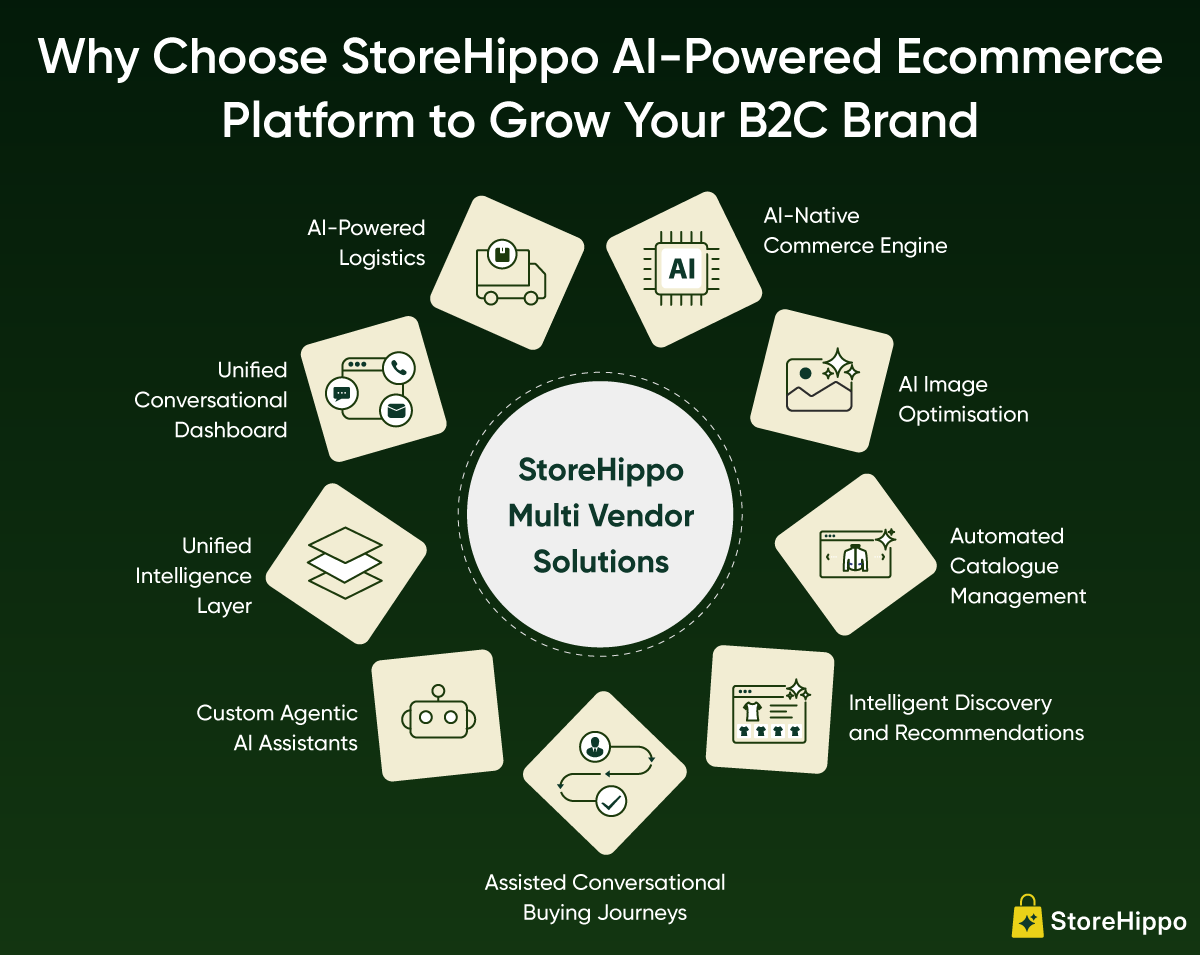
1. AI-Native Commerce Engine
Keep adding a new AI tool every time your ecommerce needs change? That can quickly leave you managing a disconnected stack of tools. In StoreHippo’s AI-powered ecommerce platform, AI is built into the core, not added as a separate feature or plugin. You can use AI across customer journeys and business operations, giving you a strong foundation to build a future-ready AI-powered B2C brand. As your business evolves, you can expand your AI use cases without rebuilding your ecommerce stack each time a new requirement comes up.
2. AI Image Optimisation
Still spending hours editing product images before they can go live? Clearing backgrounds, fixing lighting, adjusting image sizes and then trying to keep hundreds of product visuals consistent can quickly become a tedious task. StoreHippo’s Magic Edit takes care of this for you. StoreHippo AI-powered ecommerce platform offers advanced image editing tool, Magic Edit that transforms raw product images into clean, polished, market-ready visuals, so your team can spend less time editing and more time getting products ready to see.
3. Automated Catalogue Management
Catalogue creation is one of the most time-consuming parts of running a large ecommerce business. Writing product titles and descriptions, adding tags and assigning the right categories to every product can become tedious and resource-heavy when done manually. This is where StoreHippo’s AI-powered cataloguing can make a real difference. With StoreHippo’s AI-powered cataloguing tool, you can automatically generate engaging, SEO-ready product titles, descriptions, tags, categories and more directly from product images. You can then review and edit the content to align with your brand identity before publishing.
4. Intelligent Discovery and Recommendations
Customers do not always search using exact product names. Sometimes they know what they need but are unsure what to look for, while at other times, they simply want better options to choose from. StoreHippo uses intent, context and behaviour-based intelligence to make product discovery and recommendations more relevant. This helps AI-powered B2C brands guide customers towards products that are more likely to match their needs, making the shopping journey feel more useful and personalised.
5. Assisted Conversational Buying Journeys
Not every customer comes to your online marketplace knowing exactly what they want to buy. They may have questions, need help comparing products or simply want a little guidance before making a decision. With StoreHippo, you can build custom AI shopping assistants to understand customer queries, recommend relevant products, answer questions and guide shoppers through their buying journey. These assistants can maintain context throughout the conversation, helping customers move from discovery to purchase with less effort and a more natural shopping experience.
6. Custom Agentic AI Assistants
As your ecommerce business grows, buyers, sellers and internal teams need help with different tasks. With StoreHippo, you can build custom agentic AI assistants trained around your business data, rules and workflows. For buyers, these assistants can resolve product, order, payment and delivery queries for faster issue resolution, while also helping them discover products and complete their buying journey. For sellers, AI assistants can support onboarding, catalogue setup, order management and everyday business operations. Internal teams can also use custom AI agents to automate routine workflows and get work done faster.
7. One Unified Intelligence Layer
When AI capabilities work separately, every channel can end up with a different view of the customer and their buying journey. StoreHippo connects AI across web, mobile apps, WhatsApp, voice, and customer and seller support touchpoints through a shared commerce intelligence layer. This allows AI to work with the same catalogue, customer, order, inventory and other commerce data across different interactions.
For your AI-powered B2C brand, this means customers can move between channels without starting their journey from scratch. AI can use the relevant context across interactions to make product discovery, recommendations, support and buying experiences more connected. As agentic commerce continues to evolve, this shared intelligence becomes even more important for creating AI experiences that understand buyer context and respond more effectively across channels.
8. Unified Conversational Dashboard
Manage, monitor and act on conversations across multiple channels from an AI-powered unified dashboard, with agents automating responses, routing complex queries to teams and doing majority of support heavy lifting.
9. AI-Powered Logistics
Managing logistics at scale is not just about getting orders shipped. Your teams also need to assign the right carrier, handle shipping issues and keep customers updated throughout the delivery journey. With StoreHippo, you can use rule-based carrier and dealer assignment to route shipments based on your business requirements. AI-powered issue resolution can help identify, prioritise and resolve shipping issues through automated ticketing and IGM workflows. At the same time, instant shipment updates keep customers and internal teams informed without manual follow-ups.
For a large multi vendor marketplace, this can help you handle shipping issues faster, reduce repetitive coordination and give buyers better visibility after purchase. That's an important part of building an AI-powered marketplace that supports the complete buying journey, not just what happens at the storefront.
StoreHippo brings these AI capabilities together in one ecommerce platform, giving you the core to create smarter customer experiences and run your business more efficiently. With AI built into your commerce setup, you can scale your B2C brand with the flexibility to adopt new AI-led opportunities as they emerge.
Conclusion
AI is already changing how B2C brands sell online. From helping shoppers discover the right products and get personalised recommendations to making conversations and purchases easier, AI is becoming part of more stages of the shopping journey.
But adding AI tools one by one is not enough. Brands need an ecommerce setup where these capabilities can work together as customer expectations continue to change.
That is where the right AI-powered ecommerce platform can make a difference. StoreHippo helps enterprises bring AI into product discovery, personalised experiences, conversational buying and agentic workflows through one connected platform.
Ready to make AI a bigger part of your ecommerce strategy?
Book a demo with StoreHippo now.
FAQs
1. What should B2C brands evaluate before investing in an AI-powered ecommerce platform?
Enterprise brands should evaluate an AI-powered ecommerce platform based on its scalability, AI capabilities, data integration, security, customisation, and ability to support their existing business workflows. The platform should also make it easy to adopt new AI use cases without repeatedly adding disconnected tools or rebuilding the ecommerce infrastructure.
2. How can enterprises measure the business impact of AI in ecommerce?
Enterprises can measure the impact of AI in ecommerce by tracking improvements in conversion rates, average order value, repeat purchases, customer engagement and operational efficiency. The key is to connect each AI use case with a clear business goal and compare performance before and after implementation to see whether it is actually driving measurable growth.
3. Can B2C brands use agentic AI for more than just customer support?
Yes, B2C ecommerce brands can use agentic AI for much more than customer support. It can help shoppers discover products, compare options, complete purchase-related tasks and manage orders, while also helping internal teams handle repetitive workflows such as catalogue management, seller operations and routine business tasks.
4. Can an AI-powered ecommerce platform support multiple B2C brands or business units?
Yes, provided the platform has the right enterprise architecture. Businesses managing multiple brands or business units should look for capabilities such as centralised administration, shared commerce infrastructure, separate storefront experiences, configurable workflows and controlled access. This allows teams to maintain brand-level flexibility without creating completely separate technology stacks.
5. How should enterprises prioritise use cases when adopting an AI-powered ecommerce platform?
Enterprises should prioritise AI use cases based on their potential business impact, customer value, ease of implementation and availability of reliable data. They should start with areas where AI can solve a clear problem or improve an important metric, then expand to more advanced use cases as the business gains experience.
6. What challenges do AI-powered B2C brands face when scaling ecommerce operations?
AI-powered B2C brands can face challenges such as fragmented data, disconnected systems, inconsistent product information, integration issues, security concerns and difficulty maintaining consistent customer experiences at scale. They also need the right infrastructure and governance to introduce new AI capabilities without creating more disconnected tools and workflows.
7. How can AI shape the future of AI-powered B2C brands?
AI can help AI-powered B2C brands move towards more personalised, responsive and automated ecommerce experiences. It can take over repetitive tasks, support faster decision-making, improve customer interactions and help teams respond to changing buyer behaviour. Over time, AI is likely to become part of everyday ecommerce operations rather than a separate technology layer.
8. What should enterprises look for in an AI strategy to stay competitive as ecommerce evolves?
Enterprises can build a competitive AI strategy by focusing on clear business goals, strong data foundations, scalable technology and use cases that improve customer experiences or operational efficiency. They should also choose flexible platforms that allow them to adopt new AI capabilities as ecommerce evolves, rather than relying on isolated tools that may quickly become outdated.
Pallavee Kumar brings over 20 years of hands-on ecommerce experience, having helped enterprise brands scale through strong operations and clear storytelling.
She brings hands-on industry knowledge and a practical perspective on using AI to streamline commerce, strengthen efficiency, and drive long-term growth.