


The global B2B ecommerce market will cross $ 50 trillion benchmark by 2030.
This is not just growth, but a complete shift in how businesses buy and sell.
Today, B2B buyers expect the same speed, convenience, and personalisation they experience in B2C. B2B buyers now want fast, self-serve, and personalised experiences, even for complex transactions like bulk orders and negotiated pricing.
But scaling globally is not just about entering new markets. It is about managing complexity across buyers, regions, and operations without slowing down.
Choosing the best B2B ecommerce platform becomes critical here. It defines how efficiently you scale, adapt, and deliver consistent experiences across markets.
To help you evaluate what truly matters, this blog brings together 10 critical FAQs every enterprise should consider when choosing a B2B ecommerce platform for global expansion.
Table of Contents
- Why AI Powered B2B Ecommerce Platform Is Critical for Global Growth
- 10 Key Questions to Evaluate a Global B2B Ecommerce Platform
- 1. Can the enterprise ecommerce platform support complex B2B buying workflows like bulk ordering, negotiated pricing, credit terms, and approval hierarchies without heavy custom builds?
- 2. How does the best B2B ecommerce platform handle multi-country operations like currencies, taxation, compliance, and region-specific catalogues, from a single backend?
- 3. Does the enterprise ecommerce platform support running multiple business models (B2B, D2C, distributor-led, marketplaces) on the same platform without creating operational silos?
- 4. How does the B2B marketplace platform enable omnichannel B2B selling on web, mobile apps, WhatsApp, and conversational commerce from a unified system?
- 5. What level of AI capability is natively available in the B2B marketplace platform for catalogue management, search, recommendations, and buyer assistance?
- 6. Can the enterprise ecommerce platform scale to handle large product catalogues, multiple vendors/distributors, and high transaction volumes without performance trade-offs?
- 7. How deeply can we customise our B2B marketplace without becoming dependent on plugins or external development teams?
- 8. How easily does the enterprise ecommerce platform integrate with existing ERP, CRM, and logistics systems, and are there any API or rate limitations at scale?
- 9. What control do enterprises have on B2B marketplace over user roles, permissions, and enterprise-grade governance across teams, vendors, and geographies?
- 10. What is the true total cost of ownership for a B2B marketplace over 3–5 years, including customisations, integrations, scaling, and ongoing operational overheads?
- Conclusion
Why AI Powered B2B Ecommerce Platform Is Critical for Global Growth
The B2B ecommerce landscape is no longer driven by static catalogues and manual processes. It is rapidly evolving into an ecosystem where intelligence powers every interaction. Automation, personalisation, omnichannel experiences, mobile-first commerce, and real-time decision-making are no longer optional; they are essential for growth.
Let’s look at what’s shaping the future of B2B ecommerce:
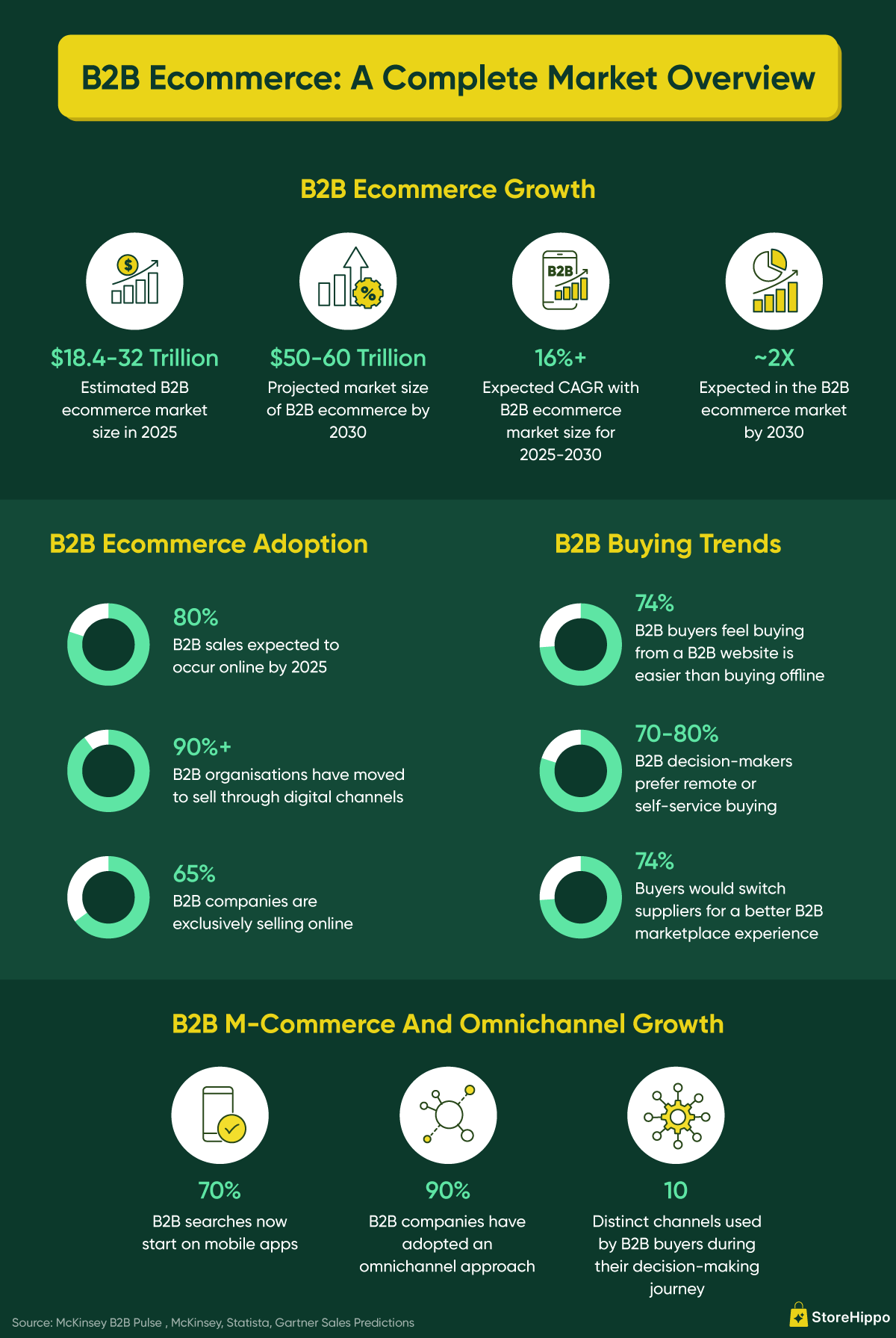
B2B Ecommerce Growth
- $ 18.4-32 trillion was the estimated B2B ecommerce market size in 2025
- $ 50- 60 trillion is the projected market size of B2B ecommerce by 2030
- 16%+ is the expected CAGR of B2B ecommerce market for 2025-2030
- ~2x growth is expected in the B2B ecommerce market by 2030
B2B Ecommerce Adoption
- 80% of B2B sales expected to occur online by 2025
- 90%+ of B2B organisations have moved to sell through digital channels
- 65% of B2B companies are exclusively selling online
B2B Buying Trends
- 74% of B2B buyers feel buying from a B2B website is easier than buying offline
- 70-80% of B2B decision-makers prefer remote or self-service buying
- 74% of buyers would switch suppliers for a better B2B marketplace experience
B2B M-Commerce And Omnichannel Growth
- 70% of B2B searches now start on mobile apps
- 90% of B2B companies have adopted an omnichannel approach
- 10 distinct channels used by B2B buyers during their decision-making journey (up from 5 in 2016)
Source McKinsey B2B Pulse , McKinsey, Statista, Gartner Sales Predictions
Buyers no longer want just a transaction; they expect a seamless, personalised journey across web, mobile, and every sales channel, powered by intelligent recommendations and real-time interactions.
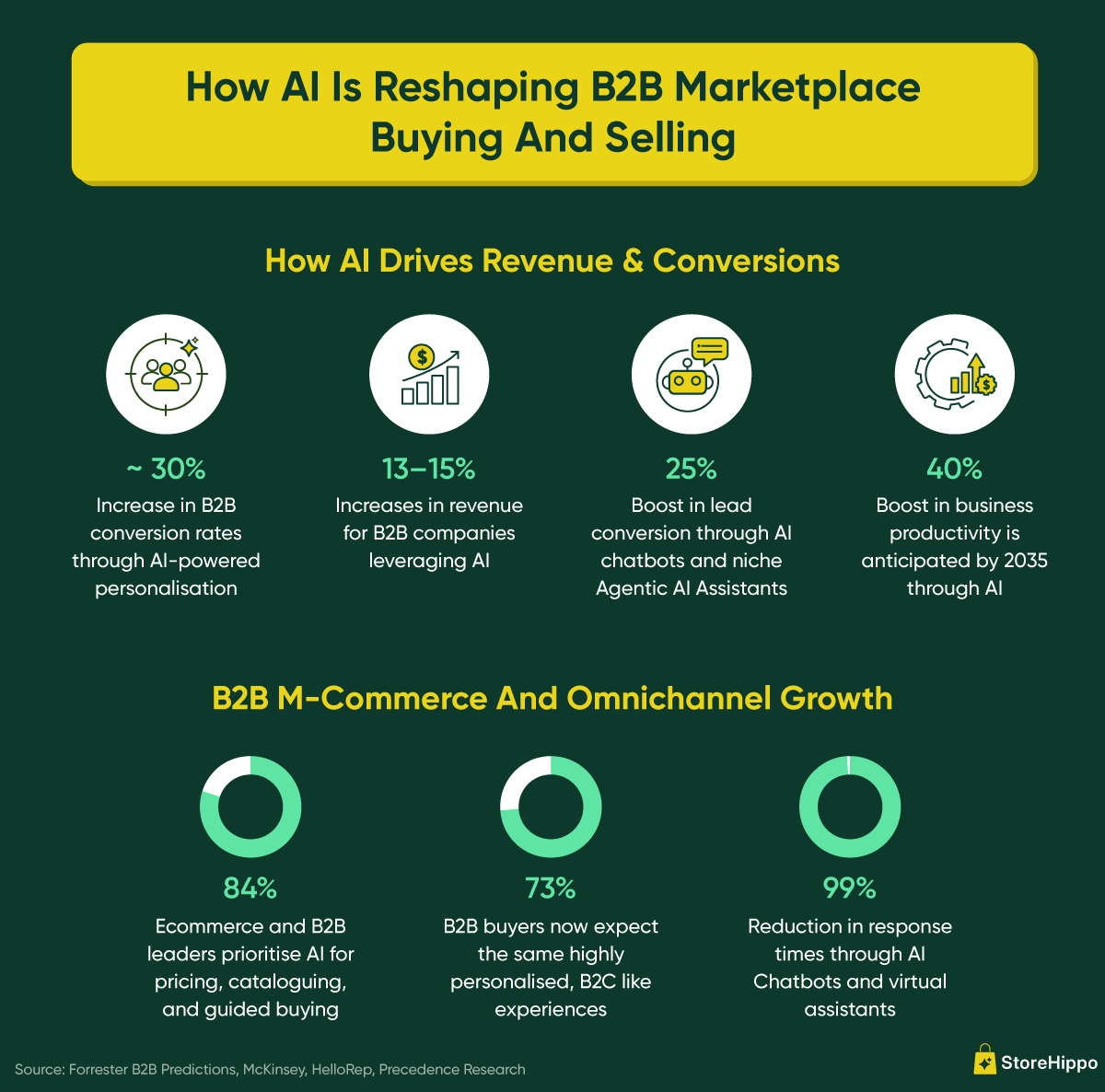
AI is reshaping B2B commerce at every level. Enterprises using AI are not just moving faster, they are operating smarter and driving measurable outcomes.
Let’s see what the data reveals:
How AI Drives Revenue & Conversions
- ~ 30% increase in B2B conversion rates through AI-powered personalisation
- 13–15% increases in revenue for B2B companies leveraging AI
- 25% boost in lead conversion through AI chatbots and niche Agentic AI Assistants
- 40% boost in business productivity is anticipated by 2035 through AI
AI’s Impact on Buyer Experience
- 84% of ecommerce and B2B leaders prioritise AI for pricing, cataloguing, and guided buying
- 73% of B2B buyers now expect the same highly personalised, B2C like experiences
- 99% reduction in response times through AI Chatbots and virtual assistants
Forrester B2B Predictions, McKinsey, HelloRep, Precedence Research
The takeaway is clear: AI is becoming the core driver of growth in B2B ecommerce. It enables businesses to automate complex operations, deliver personalised experiences across channels, and make faster, data-driven decisions at scale. As competition intensifies, adopting an AI-powered ecommerce platform is no longer optional; it is essential to stay competitive, improve conversions, and scale efficiently in global markets.
Let’s now look at the key questions enterprises should ask when selecting a B2B ecommerce platform for global expansion.
10 Key Questions to Evaluate a Global B2B Ecommerce Platform
Here are 10 key questions B2B enterprises should ask when choosing the right enterprise ecommerce platform for global expansion:
1. Can the enterprise ecommerce platform support complex B2B buying workflows like bulk ordering, negotiated pricing, credit terms, and approval hierarchies without heavy custom builds?
Yes, an enterprise ecommerce platform that is built natively for the B2B model can support complex B2B buying workflows without needing custom feature development. Since core B2B functions like approvals, bulk ordering, and pricing rules are already built into the system, it removes the need to stitch together multiple tools or build extra logic from scratch.
B2B operations are usually complex and require flexible, well-structured workflows to manage large-scale and customised transactions efficiently. B2B enterprises need to deal with bulk orders, negotiated deals, and layered approval processes. That’s why the first thing to evaluate before selecting a B2B marketplace platform for global expansion is whether the platform can handle these workflows natively or requires constant custom development.
The StoreHippo enterprise ecommerce platform is natively built to handle complex B2B workflows. It offers B2B features like dynamic pricing, RFQ, MOQ, bulk ordering, bulk invoice generation, tiered pricing, etc. StoreHippo also provides role-based access, personalised storefronts, and self-serve features.
StoreHippo offers built-in solutions to manage vast dealer networks with central control, along with separate vendor dashboards for each vendor. This enables enterprises to manage even the most complex buying journeys without adding operational overhead. It offers 30+ pre-integrated logistics partners for seamless global fulfilment of bulk orders, 60+ pre-integrated international payment gateways, multicurrency payments, etc.
StoreHippo also offers seamless integration with marketing tools, analytics platforms, ERP systems, accounting software, and other systems to build a tailored B2B ecosystem.
2. How does the best B2B ecommerce platform handle multi-country operations like currencies, taxation, compliance, and region-specific catalogues, from a single backend?
To handle multi-country operations, a B2B marketplace platform must have built-in capabilities to adapt to the requirements of different countries. A platform that offers multilingual support, multi-store features, multi-currency payments, international payment gateways, country-specific taxes, and localised storefronts can easily manage cross-border operations from a single dashboard.
Global expansion requires managing multiple cross-border regions without fragmenting operations. B2B enterprises should look for platforms that offer centralised control while enabling localised experiences.
StoreHippo is the best B2B ecommerce platform that offers a host of native B2B features to scale across global markets. It provides built-in multilingual support for 100+ languages, including RTL (right-to-left) languages like Urdu, Hebrew, etc., and supports multi-currency payments and region-specific taxation.
StoreHippo’s Multistore® feature enables B2B enterprises to build multiple location-wise storefronts for different cross-border markets from a single backend. They can customise each storefront with a unique URL, store design, language, currency, catalogues, pricing, and discounts tailored to each location, while ensuring compliance across markets. They can create a central master product catalogue for all stores and manage all sub-stores from a unified admin panel.
3. Does the enterprise ecommerce platform support running multiple business models (B2B, D2C, distributor-led, marketplaces) on the same platform without creating operational silos?
Yes, if the enterprise ecommerce platform supports multiple business models natively. If it is built to support B2B operations, direct-to-consumer selling (D2C), multivendor marketplaces, hyperlocal, and hybrid models from the same backend, it uses one shared system where each model is set up with its own rules and workflows. It enables enterprises to separate rules, pricing, and customer journeys for each model while keeping all data, inventory, and operations unified in one platform.
Most enterprises are already operating across B2B, D2C, distributor networks, and marketplaces, and this only grows over time. Managing each model on separate systems often leads to disconnected data, inconsistent pricing, and slower operations.
StoreHippo, the best B2B ecommerce platform, is built to support multiple business models on a single platform. It enables enterprises to easily pivot to D2C, B2C, B2B2C, or hyperlocal models, or run multiple business models simultaneously from the same backend.
It also enables enterprises to share catalogues, inventory, and reporting while maintaining centralised control, giving brands the flexibility to diversify and scale efficiently.
4. How does the B2B marketplace platform enable omnichannel B2B selling on web, mobile apps, WhatsApp, and conversational commerce from a unified system?
A B2B marketplace platform with built-in omnichannel capabilities enables enterprises to sell seamlessly across websites, mobile apps, sales teams, WhatsApp, and other conversational channels from a single unified system. It should offer real-time data sync to manage orders, inventory, pricing, and customer data in real time to keep all channels connected and deliver a consistent buying experience across every touchpoint.
With 70% of B2B searches beginning on mobile apps, mobile is now a critical growth driver shaping modern B2B commerce. As B2B buyers switch across 4-7 devices and channels, enterprises must deliver consistent experiences across every touchpoint, making omnichannel selling a necessity.
B2B enterprises should evaluate whether the platform they choose is truly mobile-first and supports seamless omnichannel selling. It should enable growth across store, web, mobile apps, WhatsApp, AI-assisted commerce, and more from a single system for consistent and seamless buyer journeys.
StoreHippo’s enterprise ecommerce platform is built on a mobile-first architecture and comes with a built-in mobile app builder. Enterprise brands can build fully functional Android and iOS apps directly from the admin dashboard, without additional costs or coding requirements. With StoreHippo, businesses can also launch Progressive Web App (PWA) stores that deliver app-like experiences even on entry-level devices and in low-connectivity areas. Additionally, StoreHippo offers built-in apps for admins and vendors, along with custom delivery boy apps, enabling all users to manage operations efficiently on the go.
StoreHippo also supports true omnichannel commerce, making it easy to expand across webstore, B2B apps, WhatsApp, AI-assisted commerce, and more. A unified backend connects all buying channels, ensuring consistent customer experiences and complete operational visibility across every touchpoint.
5. What level of AI capability is natively available in the B2B marketplace platform for catalogue management, search, recommendations, and buyer assistance?
AI capabilities should be built into the core ecommerce platform to automate routine business operations, personalise buyer journeys, improve product discovery, and optimise fulfilment efficiency without depending on external plugins or third-party tools. This ensures a unified intelligence layer that continuously learns and improves every stage of the B2B buying journey. This not only improves efficiency but also helps enterprises expand into global markets faster and manage operations more intelligently.
The StoreHippo enterprise ecommerce platform has AI built into its core, offering a host of AI-powered tools for cataloguing, semantic search, personalised recommendations, and buyer assistance. Its AI-powered cataloguing automates bulk catalogue creation by generating engaging product titles and descriptions directly from product images. It also auto-generates categories, tags, and attribute mapping for each product, reducing manual effort at scale.
StoreHippo’s AI image editing tool, Magic Edit, enhances product images to maintain consistent quality and visual appeal across the catalogue. Its AI-powered semantic search delivers intent-based results, while intelligent recommendations offer personalised product suggestions to buyers.
Additionally, StoreHippo enables enterprises to build custom AI chatbots to deliver assisted buying journeys for bulk buyers and businesses, helping engage and convert them through conversational experiences. B2B brands can also build custom support bots for sellers to handle routine queries, reducing the need for constant involvement from human support teams. All these AI features run on a unified intelligence layer, ensuring insights flow seamlessly across catalogues, discovery, operations, and support, rather than remaining siloed in separate tools.
6. Can the enterprise ecommerce platform scale to handle large product catalogues, multiple vendors/distributors, and high transaction volumes without performance trade-offs?
Yes. A robust enterprise ecommerce platform is designed to scale with business growth, handling large product catalogues, multiple vendors, distributors, warehouses, and high transaction volumes without compromising performance. Cloud-native, API-first architectures help ensure fast page loads, seamless transactions, and reliable operations even during peak demand periods.
As B2B businesses grow, they deal with massive catalogues, multiple vendors, and high order volumes. A platform that cannot scale efficiently leads to slow performance, failed transactions, and poor buyer experience.
StoreHippo is built on a cloud-native, microservices-based architecture that ensures high scalability and performance. It can handle large product catalogues, multiple vendors, and high transaction volumes seamlessly. Its auto-scalable architecture and global CDN ensure that traffic spikes, bulk orders, or seasonal demand do not impact performance. This enables enterprises to scale operations confidently without worrying about system limitations.
7. How deeply can we customise our B2B marketplace without becoming dependent on plugins or external development teams?
A modern B2B marketplace platform should allow deep customisation through APIs, built-in workflows, configurable business rules, and modular architecture rather than relying on multiple plugins. This enables businesses to customise pricing, catalogues, approvals, dealer networks, workflows, and buyer experiences while reducing long-term dependency on external developers and costly integrations.
B2B enterprises rarely operate on standard workflows. They need flexibility to customise pricing, discounts, order flows, and business rules based on buyer types, regions, and deal structures. Relying on plugins or external development for every change slows down growth and increases costs.
StoreHippo enterprise ecommerce platform offers extensive customisation capabilities with its API-first, headless architecture. Built on decoupled headless architecture, the StoreHippo platform can be easily customised inside out. Businesses can easily configure complex pricing rules, automate workflows, and tailor business logic without heavy dependency on third-party plugins. Its flexible rule engine enables enterprises to offer tiered pricing, custom checkout flows, and conditional workflows suited to different buyer segments. This ensures faster execution, reduced development costs, and the ability to adapt quickly to evolving B2B requirements.
8. How easily does the enterprise ecommerce platform integrate with existing ERP, CRM, and logistics systems, and are there any API or rate limitations at scale?
A strong enterprise ecommerce platform should offer API-first architecture, pre-built integrations, and flexible connectors for ERP, CRM, payment, and logistics systems. Businesses should also evaluate API scalability, rate limits, and integration flexibility to ensure seamless data flow and reliable performance as transaction volumes, users, and connected systems grow.
Before selecting a B2B marketplace platform for global expansion, enterprises should carefully evaluate its integration capabilities. Do integrations require constant custom development or third-party tools, or does the platform offer native integrations to connect seamlessly with existing systems? If integrations are complex and code-heavy, they quickly become expensive, time-consuming, and difficult to manage at scale, impacting timelines, costs, and long-term maintenance.
The StoreHippo enterprise ecommerce platform offers native integrations that enable seamless connectivity with commonly used systems. It offers 150+ pre-integrations with international payment service providers, logistics partners, ERP, CRM, accounting, and marketing tools, enabling faster go-to-market. Built on an API-first architecture with 350+ APIs, StoreHippo ensures seamless connectivity across critical business systems while supporting flexibility and scalability as enterprises grow.
9. What control do enterprises have on B2B marketplace over user roles, permissions, and enterprise-grade governance across teams, vendors, and geographies?
Enterprises should have complete control over user roles, permissions, and access across teams, vendors, distributors, and geographies from a single central system.
A B2B marketplace platform with detailed role-based access control helps businesses assign the right level of access to the right users, making operations more secure, organised, and easier to manage at scale.
StoreHippo provides robust role-based access control, enabling enterprises to define permissions for admins, vendors, distributors, and internal teams. Businesses can assign specific roles, control data visibility, and manage workflows across multiple geographies from a central system. Vendor-specific dashboards and controlled access ensure smooth collaboration while maintaining data security and operational control.
10. What is the true total cost of ownership for a B2B marketplace over 3–5 years, including customisations, integrations, scaling, and ongoing operational overheads?
Total cost of ownership for a B2B marketplace over 3–5 years is not limited to subscription fees; it also includes the cost of customisations, integrations, scaling, and ongoing operational maintenance.
In B2B marketplace platforms that rely heavily on plugins and external tools, these costs keep increasing over time due to added complexity and continuous dependency on third-party systems.
Platforms that look affordable at the start can become expensive as your business grows. Costs often increase due to third-party plugins, API usage, custom development, and ongoing maintenance. Frequent upgrades and fixes can also add to long-term expenses.
Performance is another factor. Handling high traffic, large catalogues, and global operations may require extra infrastructure or tools, further increasing costs.
Business-to-business enterprises should look beyond subscription fees and evaluate long-term costs like integrations, upgrades, and maintenance. They should look for an enterprise ecommerce platform that has minimum dependency on external tools, offers stable integrations, and allows easy upgrades without breaking existing workflows. This ensures that operational effort and costs do not increase as the business grows.
StoreHippo offers transparent enterprise pricing with most essential B2B and go global features built in, reducing dependency on third-party plugins and external development. Its scalable, cloud-native architecture handles growth without frequent re-platforming, while stable integrations and easy customisation minimise ongoing maintenance costs. This helps enterprises achieve a predictable and lower total cost of ownership while scaling efficiently across markets.
Conclusion
Choosing the right B2B ecommerce platform for global expansion is not just a technology decision, it’s a long-term business decision that defines how efficiently you scale. Cross-border ecommerce brings new markets, languages, currencies, tax rules, and operational complexities all at once. The real difference lies in how well your platform can handle this complexity while keeping operations simple and scalable.
These 10 questions help enterprises look beyond surface-level features and evaluate what truly matters for global growth. A platform that checks all these boxes doesn’t just support your current operations, it prepares your business for future expansion across markets, models, and channels.
StoreHippo brings all of this together with a scalable, API-first architecture, built-in enterprise features, and AI-powered capabilities designed for modern B2B commerce. It enables businesses to simplify operations, reduce dependencies, and grow without limitations.
Book your demo today and explore how StoreHippo helps scale your brand smarter, faster, and more efficiently.
Binny Joseph is a seasoned ecommerce and enterprise growth leader, serving as Senior Vice President of Sales & Alliances with deep experience helping global brands adopt modern commerce solutions. He writes about B2B, B2C, D2C, and global commerce, and helps businesses choose the best ecommerce platform for cross-border growth.