


You have invested in building a powerful ecommerce marketplace.
Your catalogue is vast, your operations are in place, and your business is ready to scale.
But are conversions still inconsistent?
Are buyers dropping off before completing purchases?
Engagement is failing to convert into revenue growth?
The problem is not reach, it is relevance.
Today, buyers expect more than searching for products. They expect personalised, intuitive experiences that simplify discovery and decision-making. Without ecommerce personalisation, even the most advanced platforms struggle to convert and retain customers.
The question is no longer whether to personalise, but how effectively it can be done at scale.
Before exploring how to build hyper-personalised buying journeys, it is important to understand what makes personalisation a must-have for online businesses today.
Table of Contents
- How Ecommerce Personalisation Drives Growth for Enterprises
- 10 Must-Ask Questions to Evaluate Personalisation Capabilities in an Enterprise Ecommerce Platform
- 1. How can enterprises use AI-powered ecommerce personalisation to drive higher conversions and sales?
- 2. What built-in tools does the enterprise ecommerce platform offer to implement ecommerce personalisation without relying on multiple plugins?
- 3. How does real-time data syncing enable accurate ecommerce personalisation across channels and touchpoints?
- 4. How can enterprises deliver ecommerce personalisation across web, mobile apps, WhatsApp, and other channels from a single platform?
- 5. What role do AI-driven search and recommendation engines play in ecommerce personalisation strategies?
- 6. How can ecommerce personalisation be extended to multi-vendor marketplaces and B2B ecosystems?
- 7. How can enterprises automate ecommerce personalisation workflows like offers, product discovery, and engagement?
- 8. What capabilities are required to scale ecommerce personalisation across multiple stores, regions, and customer segments?
- 9. How can agentic AI and conversational assistants enhance ecommerce personalisation for buyers and sellers?
- 10. How can enterprises measure, optimise, and continuously improve ecommerce personalisation using AI-powered insights?
- Conclusion
How Ecommerce Personalisation Drives Growth for Enterprises
Here are the latest ecommerce personalisation trends that show how buyer expectations are evolving and how intelligent, personalised experiences are driving engagement, conversions, and enterprise growth.
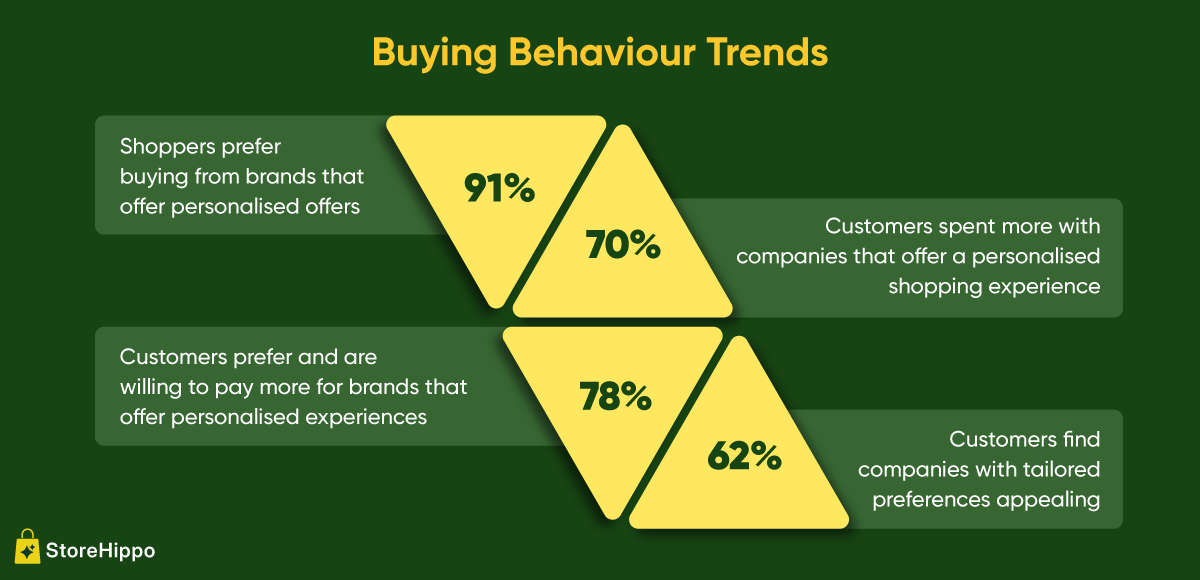
- 91% of shoppers prefer buying from brands that offer personalised offers
- 62% of customers find companies with tailored preferences appealing
- 70% of the customers spent more with companies that offer a personalised shopping experience
- 78% of customers prefer and are willing to pay more for brands that offer personalised experiences
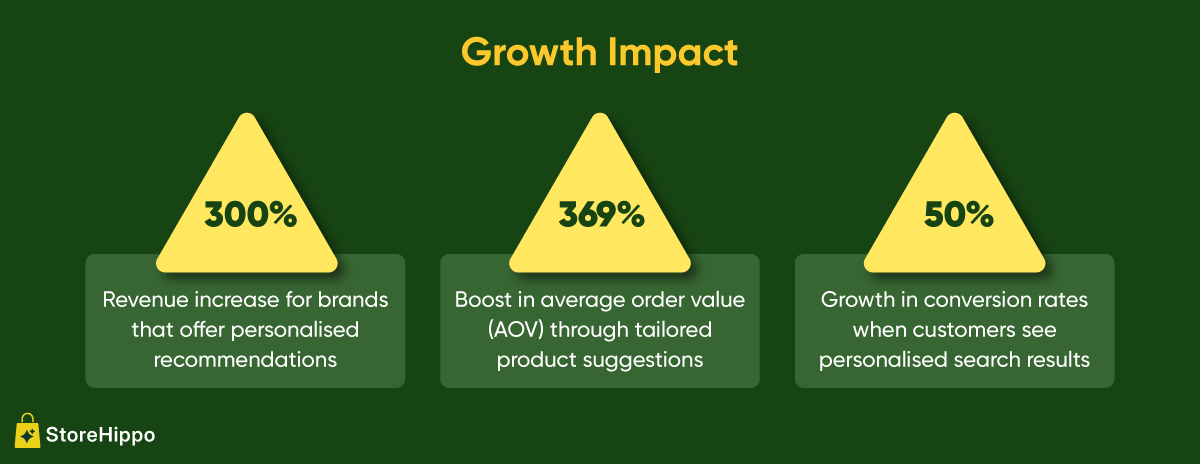
- 300% revenue increase for brands that offer personalised recommendations
- 369% boost in average order value (AOV) through tailored product suggestions
- 50% growth in conversion rates when customers see personalised search results
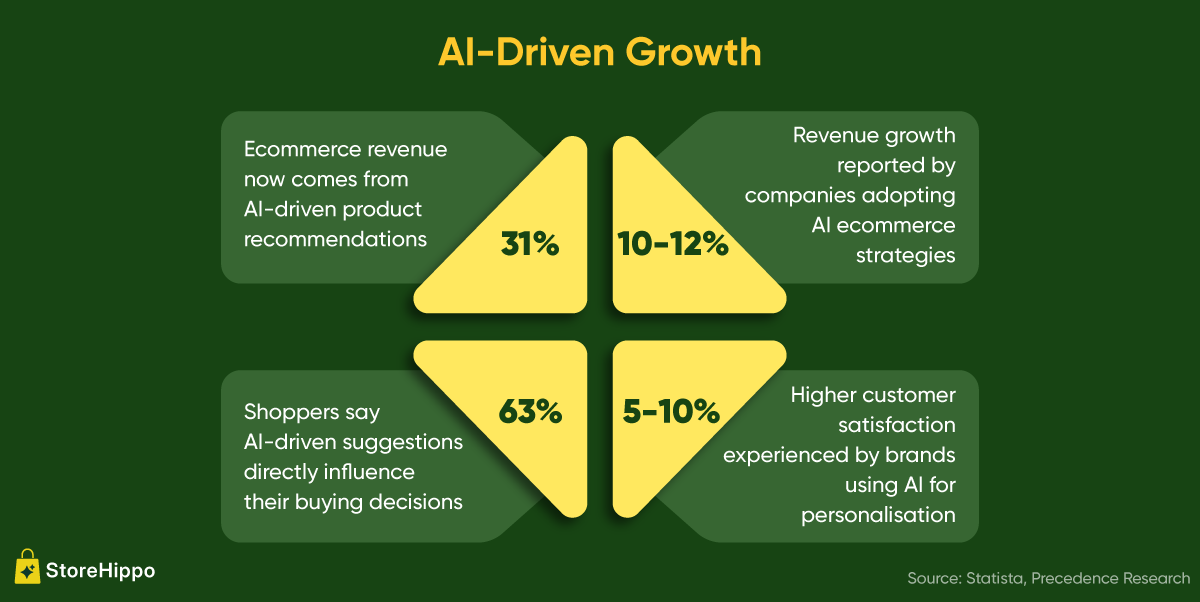
- 31% of ecommerce revenue now comes from AI-driven product recommendations
- 10-12% revenue growth reported by companies adopting AI ecommerce strategies
- 63% of shoppers say AI-driven suggestions directly influence their buying decisions
- 5-10% higher customer satisfaction experienced by brands using AI for personalisation
Source: Statista, Precedence Research
The impact of ecommerce personalisation on engagement, conversions, and revenue is clear. Enterprises implementing AI-driven personalisation can create more relevant experiences and accelerate growth more efficiently.
To leverage these trends effectively, the next step is to evaluate whether your enterprise ecommerce platform has the right personalisation capabilities. Let's now explore the critical questions enterprises must ask.
10 Must-Ask Questions to Evaluate Personalisation Capabilities in an Enterprise Ecommerce Platform
Here are 10 key questions with detailed answers to help you find the right enterprise ecommerce platform for hyper-personalised buying journeys:
1. How can enterprises use AI-powered ecommerce personalisation to drive higher conversions and sales?
Enterprises can use AI-powered ecommerce personalisation to analyse buyer behaviour, browsing patterns, purchase history, and intent in real time to deliver highly relevant product recommendations and guided buying journeys. The right enterprise ecommerce platform should use AI-driven search, recommendations, and conversational commerce to reduce discovery friction, improve engagement, and accelerate purchase decisions across channels.
Driving conversions in enterprise ecommerce is no longer about simply offering a wide catalogue. It depends on how effectively a platform can guide buyers to the right products with minimal friction. Without intelligent personalisation, buyers often struggle to find the right products, leading to drop-offs and lost revenue opportunities.
StoreHippo is an AI-powered ecommerce platform with AI-powered personalisation built into its core. Its AI-powered search and recommendations help surface the most relevant products based on buyer intent and past behaviour, reducing discovery friction and accelerating purchase decisions.
In addition, enterprises can build custom AI chatbots for buyers and sellers to enable guided and conversational commerce. These AI assistants can recommend products in real time, answer queries instantly, assist with product comparisons, and support decision-making throughout the buying journey. By replicating the experience of an in-store assistant, these AI chatbots can help reduce drop-offs, increase buyer confidence, and drive faster conversions.
As a result, enterprises can achieve higher conversion rates, increase average order value and drive more efficient revenue growth across large and complex catalogues.
2. What built-in tools does the enterprise ecommerce platform offer to implement ecommerce personalisation without relying on multiple plugins?
The best enterprise ecommerce platforms should offer built-in tools to offer personalised buying journeys, personalised discounts, targeted promotions, multilingual experiences, customer segmentation, personalised catalogues, and behaviour-based buying journeys without relying on multiple third-party plugins.
By centralising these capabilities within a single ecosystem, enterprises can simplify operations, reduce integration complexity, and deliver consistent, data-driven buyer experiences across every channel.
One of the biggest challenges enterprises face is managing fragmented systems where personalisation depends on multiple third-party tools. This increases operational complexity, slows down execution, and creates inconsistencies across channels. Enterprises should evaluate whether the platform offers native capabilities to handle personalisation end-to-end.
StoreHippo eliminates the need for external dependencies by offering built-in personalisation tools. It offers AI-powered search and recommendations to offer personalised product discovery. The Multistore® architecture enables enterprises to create multiple sub-stores tailored to different buyer segments and locations, each with unique URLs, designs, pricing, and promotions. With multilingual capabilities, brands can seamlessly launch multilingual storefronts while multiple payment gateway integrations ensure flexibility for diverse customer preferences.
Additionally, it's built-in discount engine allows enterprises to run targeted promotions, behaviour-driven campaigns, and complex discount strategies from a single backend.
This unified approach ensures consistent personalisation across touchpoints while reducing operational overhead and improving speed to market.
3. How does real-time data syncing enable accurate ecommerce personalisation across channels and touchpoints?
Real-time data syncing ensures ecommerce personalisation stays accurate, consistent, and updated across every buyer touchpoint.
An enterprise ecommerce platform should instantly synchronise catalogue, inventory, pricing, orders, and customer behaviour data across websites, apps, marketplaces, whatsapp and other sales channels to prevent outdated recommendations, incorrect product availability, pricing mismatches, and disconnected buying experiences.
StoreHippo provides a unified backend with real-time data syncing across all touchpoints. Its centralised admin ensures that any update in catalogue, pricing, inventory, or customer activity is instantly reflected across all channels. This enables enterprises to maintain data accuracy while delivering consistent and relevant experiences.
With real-time synchronisation, enterprises can offer dynamic recommendations, up-to-date product availability, and personalised pricing without delays. This ensures that every interaction is based on the latest data, improving buyer trust, reducing friction, and driving higher conversions.
4. How can enterprises deliver ecommerce personalisation across web, mobile apps, WhatsApp, and other channels from a single platform?
Enterprises should use a unified enterprise ecommerce platform that comes with an AI powered core. This helps brands deliver consistent personalisation across web stores, mobile apps, WhatsApp, marketplaces, and conversational commerce channels.
By centralising catalogue, pricing, promotions, recommendations, and customer data in one system, the platform ensures seamless and connected buyer experiences across every touchpoint.
Modern buyers interact with brands across multiple channels, and personalisation must remain consistent across each of these touchpoints. Fragmented systems often lead to disconnected experiences, where buyers receive different recommendations, pricing, or messaging on different channels. Enterprises should evaluate whether the enterprise ecommerce platform supports omnichannel personalisation from a single backend.
StoreHippo enables seamless omnichannel personalisation through its unified platform. Enterprises can manage web stores, mobile apps, and conversational commerce channels from a single backend while ensuring consistent data, catalogue, and personalisation logic across all touchpoints.
Its built-in no-code mobile app builder and support for conversational commerce enable enterprises to extend personalised experiences beyond websites into mobile-first and chat-based journeys. Buyers can discover products, receive recommendations, and complete purchases across channels without any disruption.
This unified approach ensures that buyers experience a continuous and personalised journey regardless of the channel they choose, leading to higher engagement, improved conversions, and stronger customer relationships.
5. What role do AI-driven search and recommendation engines play in ecommerce personalisation strategies?
AI-driven search and recommendation engines help enterprises deliver more relevant, personalised, and conversion-focused buying experiences.
The best ecommerce platform with an ecommerce personalisation feature uses buyer intent, browsing behaviour, purchase history, and contextual signals to surface accurate search results, intelligent product recommendations, and personalised buying journeys in real time.
Modern ecommerce buyers often use vague or conversational queries, and if the platform cannot interpret intent accurately, it directly impacts engagement and conversions.
Traditional keyword-based search is no longer sufficient, enterprises must evaluate whether the enterprise ecommerce platform supports AI-driven semantic search that understands context, intent, and buyer behaviour. This ensures that search results remain relevant even when queries are incomplete or imprecise.
Similarly, recommendation engines should go beyond static suggestions and dynamically adapt based on browsing patterns, purchase history, and real-time interactions.
StoreHippo integrates AI-powered semantic search and intelligent recommendation engines into its core platform. Its AI-powered recommendation analyses customers' past purchase decisions and browsing history to suggest relevant products, and AI semantic search delivers highly accurate search results based on buyer intent and behaviour. These capabilities enable enterprises to deliver highly relevant product discovery experiences across categories and vendors.
As a result, buyers experience a more guided and hyper-personalised buying journey, leading to improved engagement, higher conversions, and increased average order values.
6. How can ecommerce personalisation be extended to multi-vendor marketplaces and B2B ecosystems?
Ecommerce personalisation can be extended to multi-vendor marketplaces and B2B ecosystems through buyer-specific catalogues, flexible pricing, segmented storefronts, localisation, and vendor-level customisation.
An enterprise ecommerce platform should centrally manage these experiences across different vendors, regions, buyer groups, and business models to deliver relevant and scalable personalisation from a single system.
Extending personalisation in multi-vendor and B2B ecommerce creates additional complexity due to diverse buyer types, multiple sellers, and large-scale catalogues. A one-size-fits-all approach fails to deliver relevance in such ecosystems.
StoreHippo enables enterprises to create segmented storefronts, implement tiered and login-based pricing, and manage vendor-specific experiences from a single backend. It also enables seamless localisation with built-in support for multiple language, currency, and region-specific configurations, enabling enterprises to deliver tailored experiences across diverse markets. Offer buyer -specific content, pricing, and promotions to resonate with local buyers and drive engagement.
Additionally, enterprises can provide volume-based discounts for bulk buyers or B2B customers, encouraging larger transactions. They can also enable B2B buyers to request quotes and negotiate pricing, creating a more personalised and customer-centric buying experience.
7. How can enterprises automate ecommerce personalisation workflows like offers, product discovery, and engagement?
Enterprises can automate ecommerce personalisation workflows using AI-powered recommendations, behaviour-driven targeting, automated promotions, and real-time customer engagement tools.
An enterprise ecommerce platform with true personalisation capabilities continuously analyses buyer interactions and automatically delivers relevant products, offers, search results, and personalised communication across every stage of the buying journey without manual intervention.
Manual personalisation processes are not sustainable for enterprises managing large customer bases and complex operations. Without automation, scaling personalised experiences becomes resource-intensive and inefficient.
StoreHippo enterprise ecommerce platform enables automation through AI-driven recommendations, behaviour-based offers, cart abandonment recovery, and geo-targeted storefronts and real-time promotions via SMS and push notifications. It enables enterprises to showcase products or categories relevant to specific buyer groups, enhancing their shopping experience and boosting conversions. The built-in discount engine further enables targeted promotions such as product-level discounts, flash sales, and group-specific offers.
These automated workflows continuously adapt based on real-time buyer behaviour and interactions, ensuring that every touchpoint remains relevant and contextual.
8. What capabilities are required to scale ecommerce personalisation across multiple stores, regions, and customer segments?
To scale ecommerce personalisation across multiple stores, regions, and customer segments, businesses need centralised customer data, AI-powered segmentation, multilingual and multi-currency support, dynamic content and pricing, localised catalogues, and omnichannel customer journeys. A unified ecommerce platform helps manage these experiences from a single dashboard while maintaining regional relevance and brand consistency.
Scaling personalisation across geographies and customer segments requires more than isolated features. It demands a unified architecture that can manage complexity without fragmenting operations.
With built-in multi-store feature, drag and drop themes, built-in localisation capabilities like multiple languages support, multi-currency, etc., StoreHippo enables enterprises to create location-wise storefronts and manage them from a single backend. They can create unique store-level catalogues and pricing and set up unique URLs, designs, languages and currencies for each store. It also enables seamless audience segmentation by geography, customer type, or product category, helping enterprises deliver relevant experiences across sub-stores. From tailored product recommendations to custom workflows, StoreHippo’s decoupled architecture creates support for the creation of hyper personalised buyer journeys, ensuring relevant experiences for every customer segment.
This enables enterprises to scale personalisation efficiently across regions while maintaining operational control and delivering consistent, localised experiences.
9. How can agentic AI and conversational assistants enhance ecommerce personalisation for buyers and sellers?
Agentic AI and conversational assistants help enterprises deliver guided, contextual, and highly personalised buying experiences across complex ecommerce journeys.
These AI assistants can automate product discovery, answer queries in real time, recommend relevant products, and support buyers and sellers with faster and more informed decision-making.
As buying journeys become more complex, especially in multi-vendor and B2B models, buyers increasingly expect guided assistance rather than self-navigation and static, one-size-fits-all experiences.
Enterprises should evaluate whether the enterprise ecommerce platform supports built-in agentic AI capabilities or if they need to integrate with third-party tools to offer real-time guidance, personalised recommendations, and intelligent decision support throughout the buying journey.
StoreHippo AI powered ecommerce platform enables enterprises to build custom AI assistants that guide buyers through product discovery, comparison, and purchase decisions. These assistants can handle complex queries, provide contextual recommendations, and simplify multi-step buying processes. They can be built as multilingual and voice-enabled assistants, making interactions more intuitive and accessible for diverse user groups across regions.
This not only improves engagement but also accelerates decision-making and reduces drop-offs, resulting in a more personalised ecommerce shopping experience, higher conversions, and improved customer satisfaction.
10. How can enterprises measure, optimise, and continuously improve ecommerce personalisation using AI-powered insights?
Enterprises can improve ecommerce personalisation by using AI to analyse customer behaviour, purchase patterns, search queries, and engagement data. Key metrics include conversion rates, average order value, customer retention, and revenue per visitor. AI-powered insights help brands continuously refine recommendations, content, promotions, and customer journeys to improve business outcomes over time.
Personalisation strategies are only effective when continuously measured and refined. Without actionable insights, enterprises risk relying on assumptions rather than data-driven decisions.
Enterprises should evaluate whether the platform offers advanced analytics and AI-driven insights to track customer behaviour, campaign performance, and engagement metrics.
StoreHippo provides built-in analytics that enable enterprises to segment customers, analyse behaviour patterns, and identify trends. These insights help optimise recommendations, refine targeting strategies, and improve campaign effectiveness.
With a data-driven approach, enterprises can continuously enhance personalisation efforts, ensuring long-term growth, improved conversions, and higher customer lifetime value.
Conclusion
Ecommerce personalisation is no longer limited to targeted offers or basic recommendations. It has evolved into a foundational capability that shapes how enterprises engage buyers, optimise journeys, and drive conversions at scale.
As enterprise ecommerce continues to grow, the ability to deliver consistent and relevant experiences across multiple touchpoints becomes a key competitive advantage. This requires platforms that go beyond surface-level features and offer deeply integrated, AI-powered personalisation capabilities.
The right enterprise ecommerce platform enables businesses to unify data, automate workflows, and deliver intelligent buying experiences without increasing operational overhead. It ensures that personalisation is not managed as a separate function but embedded across catalogue management, discovery, and engagement.
StoreHippo brings this approach to action with its AI-native ecommerce platform, enabling enterprises to scale personalisation across multi-vendor marketplaces, B2B ecosystems, and global storefronts from a single unified system.
Ready to scale personalised ecommerce for your business?
Book your customised demo today and see how StoreHippo can transform your buyer journeys.
Binny Joseph is a seasoned ecommerce and enterprise growth leader, serving as Senior Vice President of Sales & Alliances. He combines deep industry experience and strategic insight to help global brands create meaningful and personalised buyer experiences that strengthen customer engagement, accelerate growth, and deliver long-term business value.