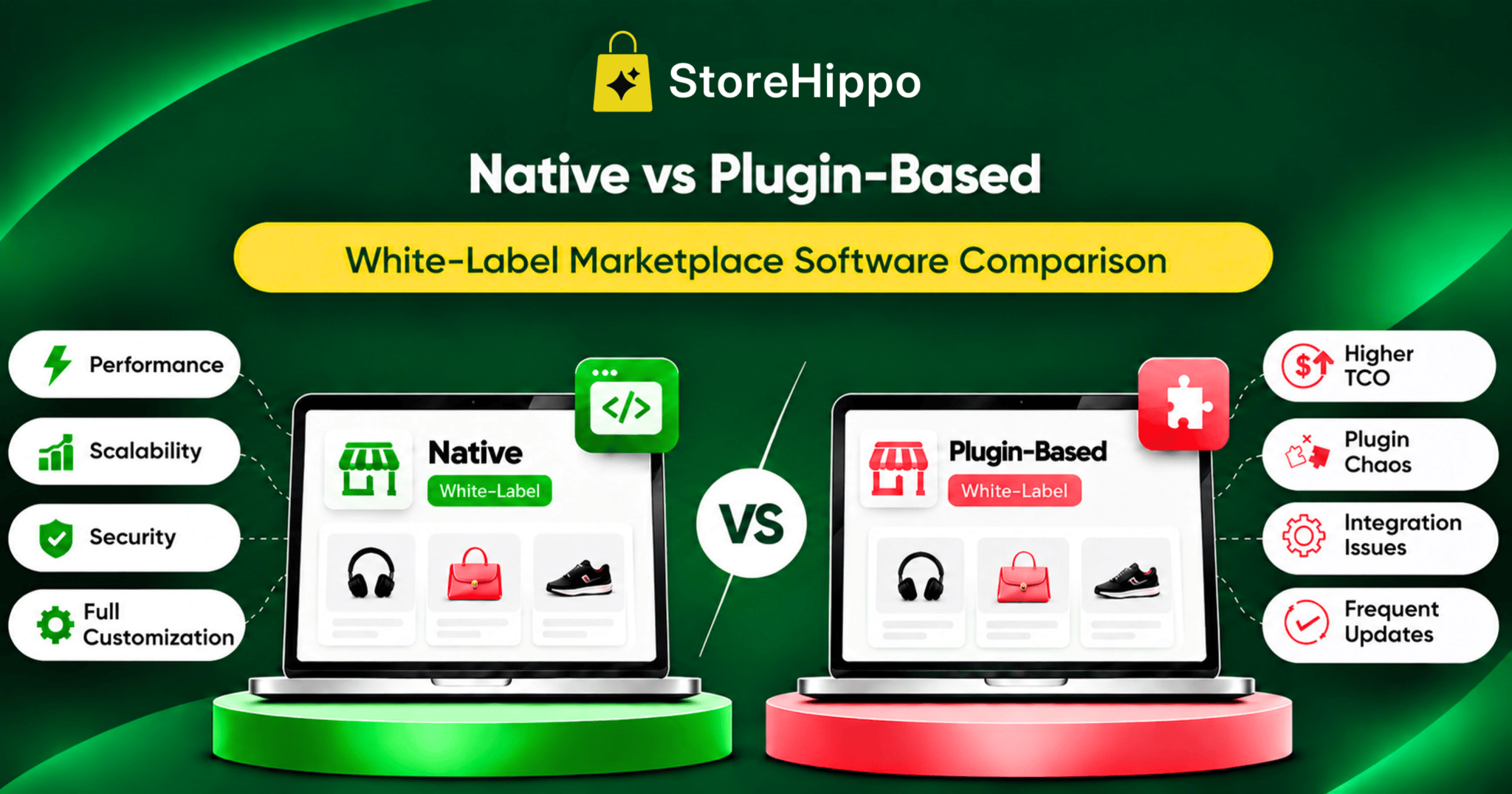



Choosing white-label marketplace software can seem simple at first. You need a platform to onboard sellers, manage products and process orders. But as your marketplace grows, so do the requirements. Different seller types, custom commissions, B2B buying, regional operations and multiple fulfilment models can make things harder to manage.
One of the first decisions is whether to build your marketplace using plugins on an existing ecommerce platform or choose a platform with native multi-vendor capabilities. Both approaches have their advantages, but how well they work for your business depends on what you're building and how you plan to grow.
For enterprises, this choice goes beyond the initial setup. It affects how easily you can manage sellers, introduce new business models, customise workflows and control costs over time.
So, should enterprises choose native marketplace software or build their marketplace using plugins? Before comparing the two approaches, let's look at why online marketplaces are becoming such an important part of B2B and B2C commerce.
Table of Contents
- Why Are Online Marketplaces Becoming a Preferred Business Model?
- What Is the Difference Between Native and Plugin-Based Marketplace Software?
- Native vs Plugin-Based Marketplace Software: Which Is Better for Enterprises?
- How Should Enterprises Evaluate White-Label Marketplace Software Before Investing?
- Why Choose StoreHippo's Native White-Label Marketplace Software?
- How Are Businesses Building Custom Online Marketplaces With StoreHippo?
- Conclusion
- FAQ
Why Are Online Marketplaces Becoming a Preferred Business Model?
Online marketplaces combine convenience and business opportunities, making them an attractive channel for buyers, sellers, wholesalers, and distributors. Buyers get more choices and can compare prices, while sellers can reach new customers and markets without building their own ecommerce infrastructure.
White-label marketplaces are not just for B2C brands. Manufacturers, distributors and enterprises are also using white-label marketplace software to bring different sellers and their products together on one branded platform.
Growing Popularity Of Online Marketplaces
- 98% of surveyed online shoppers worldwide buy from marketplaces. (DHL eCommerce)
- 60% of B2B buyers surveyed were open to purchasing through digital marketplaces, showing their growing acceptance in business procurement. (McKinsey)
- 56% of surveyed B2B retailers were already selling on marketplaces, while 75% expected marketplace sales to grow over the following three to five years. (DHL eCommerce)
- 52% of consumers surveyed had sold an item through an online marketplace, highlighting the growing role of consumer-to-consumer selling. (DHL eCommerce)
With marketplaces becoming a bigger part of enterprise commerce, the question is no longer just how to launch one, but how to build it for long-term growth. And that brings us to an important technology decision: native vs plugin-based marketplace software.
What Is the Difference Between Native and Plugin-Based Marketplace Software?
The main difference is how marketplace features are built into the platform. Native marketplace software comes with built-in seller management, commissions, catalogues and order processing, while a plugin-based marketplace adds these features to an existing ecommerce platform through third-party extensions.
Both approaches can support a multi-vendor marketplace platform, but differ in how businesses manage customisation, integrations, upgrades and ongoing operations.
What Is a Plugin-Based Marketplace?
A plugin-based marketplace uses third-party apps or extensions to add multi-vendor capabilities to an existing ecommerce platform.
Businesses can add plugins for seller onboarding, commissions, vendor dashboards and order management, along with other integrations for payments, logistics or B2B workflows.
This approach can suit businesses extending an existing ecommerce store or testing a marketplace model. However, maintaining multiple plugins and ensuring compatibility can require additional effort as business requirements grow.
What Is Native Marketplace Software?
Native marketplace software comes with built-in capabilities to manage sellers, catalogues, commissions, orders and fulfilment from one platform, without relying on separate marketplace plugins.
With a white-label multi-vendor marketplace, businesses can create a marketplace that looks and feels like their own brand. Everything from storefront design and seller dashboards to buying journeys can be customised with their own themes, logos, colours and branding elements. Native platforms with headless architecture offer greater design flexibility, allowing businesses to build custom frontends without changing core marketplace functions or depending on multiple design plugins.
For enterprises, this means greater control over the marketplace experience and the flexibility to support different business models. With MACH architecture and API-based integrations, businesses can also connect their existing systems and customise marketplace workflows as their needs grow.
Native vs Plugin-Based Marketplace Software: Which Is Better for Enterprises?
Native marketplace software is generally a better fit for enterprises that need to manage multiple sellers, business models and sales channels from one platform. It comes with built-in marketplace features, reducing the need for third-party plugins and separate integrations.
Plugin-based marketplace software can work well for businesses with simpler requirements. However, as seller networks and operations grow, managing multiple plugins can add to costs, maintenance and technical dependencies.
Here's how the two approaches compare across key enterprise requirements.
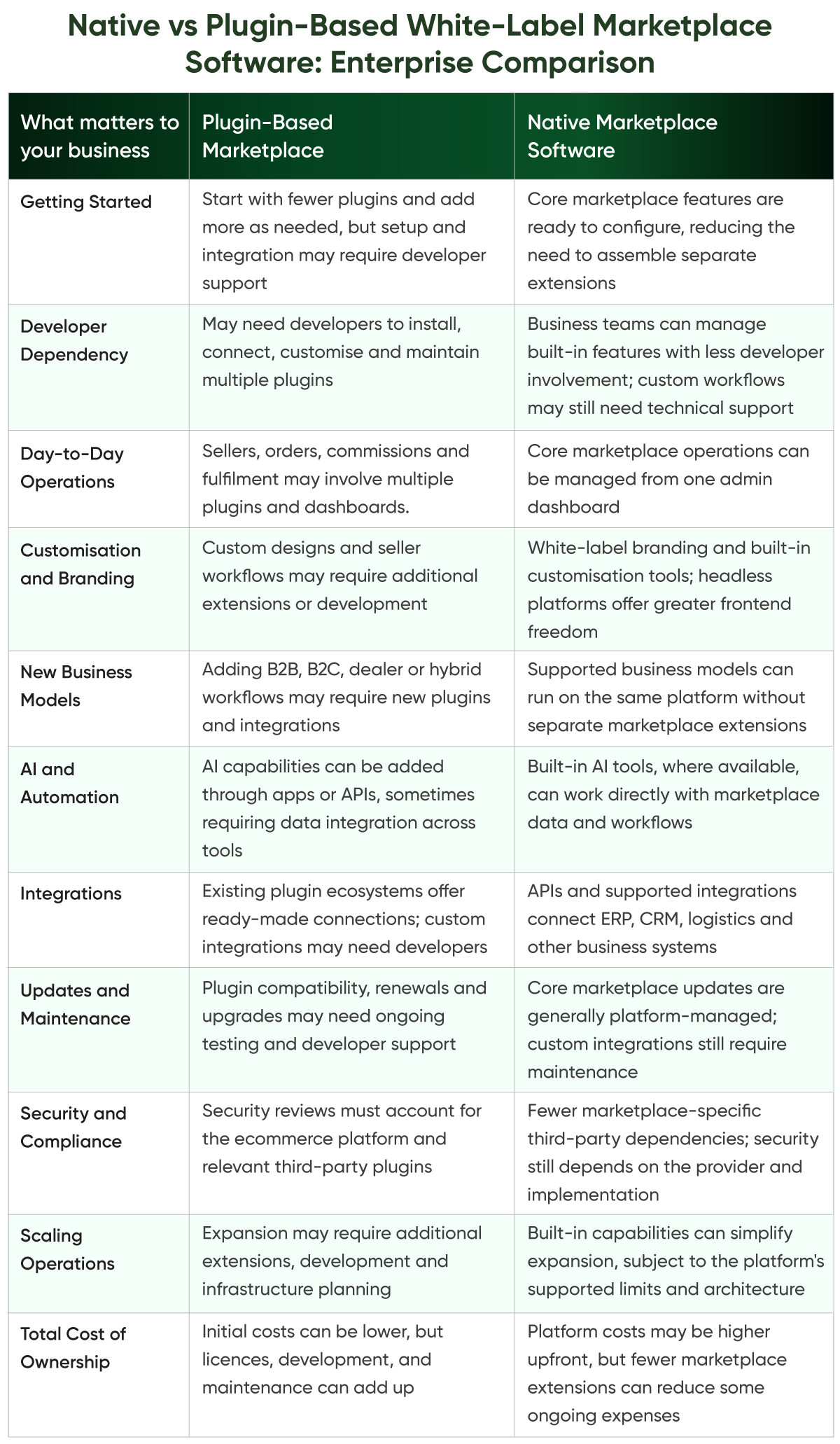
The comparison highlights why choosing marketplace software goes beyond the features available at launch. What matters equally is how easily the platform can support new requirements as the business grows. Enterprises should therefore consider the total cost of ownership, ongoing maintenance, customisation flexibility and the effort required to introduce new features or workflows over time.
A lower upfront cost doesn't always mean lower spending over time. Even small expenses for plugin subscriptions, troubleshooting, upgrades and developer support can add up as the marketplace grows. Comparing these recurring expenses with the cost of a native solution can give enterprises a more realistic picture of their long-term investment.
How Should Enterprises Evaluate White-Label Marketplace Software Before Investing?
Before finalising a white-label marketplace software enterprises need to evaluate how well a platform is aligned with their roadmap to add new markets, seller networks or business models.
Before shortlisting enterprise marketplace software, it's worth asking a few questions that go beyond the standard feature list.
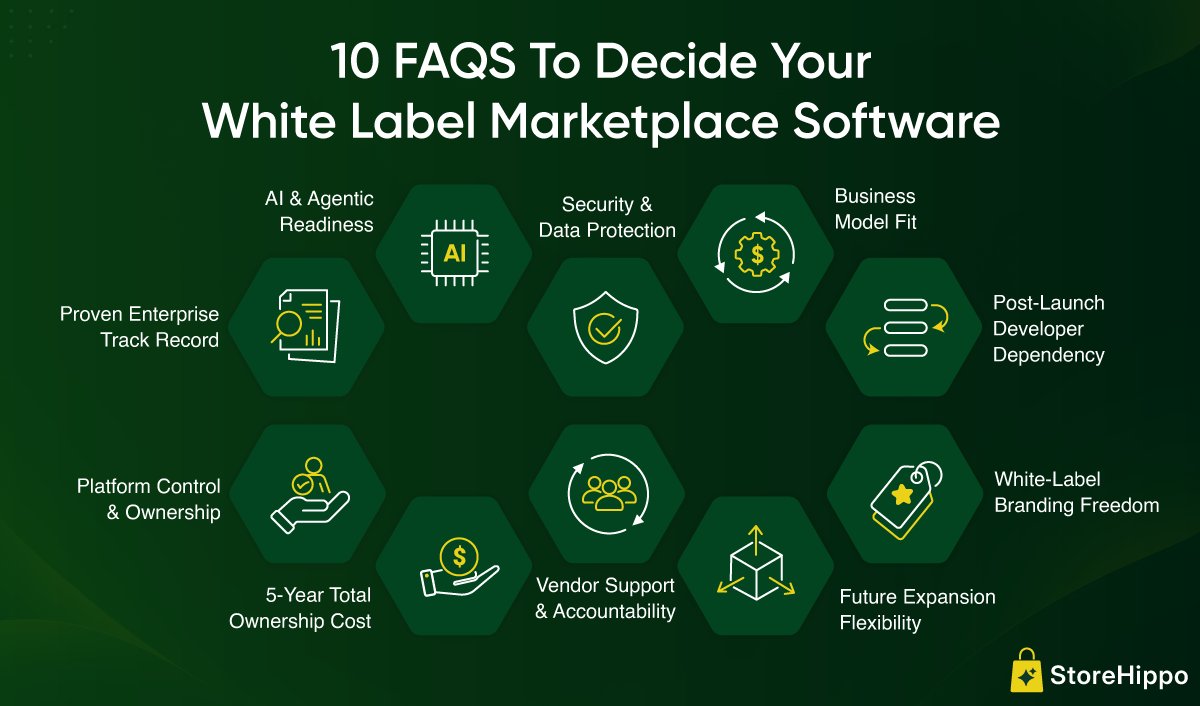
10 Questions to Ask Before Choosing a Marketplace Platform
1. Will the platform fit your business, or will you have to work around it? Check if the marketplace platform canwork for your actual seller, pricing, approval and fulfilment workflows rather than showing only standard features.
2. How much development will you need after launch? Find out which changes your business team can make independently and which will require developers, custom code or additional applications.
3. How much freedom will you have to build a marketplace around your brand? Check whether you can customise storefronts, seller dashboards, domains, themes and buying journeys without depending on fixed templates, additional plugins or extensive development.
4. Can you expand without rebuilding your marketplace? Consider what happens when you add another country, seller network, business model or sales channel. Will your existing setup support it, or require substantial redevelopment?
5. Who will be responsible when something goes wrong? Understand who handles hosting, platform upgrades, plugin compatibility, security issues and integration failures. Multiple technology vendors can also mean divided support responsibilities.
6. What will you actually spend over five years? Compare the marketplace total cost of ownership, including licences, implementation, developer support, integrations, maintenance and future expansion, not just the initial quote.
7. How much control will you have over your marketplace? Check your options for customisation, access to business data, APIs, integrations and exporting information if you decide to change platforms later.
8. Can the vendor prove its platform works for businesses like yours? Ask for relevant customer examples, live implementations and demonstrations of similar marketplace requirements. Promises of scalability and flexibility should be backed by practical evidence.
9. Is the platform ready for AI and agentic commerce? Check whether it supports AI-powered automation, conversational buying and AI agents that can access marketplace data and perform actions securely through APIs.
10. How secure is your marketplace and customer data? Check for recognised security certifications, data protection measures, role-based access, regular security updates and clear responsibility for compliance.
The right multi-vendor marketplace platform should fit your business today without making every future change a new technology project. More importantly, you should know exactly what you're buying, what you'll need to maintain and how much freedom you'll have as your marketplace grows.
Why Choose StoreHippo's Native White-Label Marketplace Software?
Building a marketplace under your own brand should be about growing your business, not managing multiple plugins, integrations and technology vendors. StoreHippo's fully managed, AI-powered multi-vendor marketplace platform brings everything you need to launch, customise and run your marketplace into one integrated solution.
Whether you're building a B2B supplier marketplace, a D2C brand marketplace or a global multi-seller business, StoreHippo offers the flexibility to create a marketplace around your business model.
10 Benefits of StoreHippo's Native Marketplace Solution
- One-Stop Marketplace Solution: Bring seller onboarding, catalogues, commissions, payouts, inventory, orders and fulfilment together in one platform. Manage marketplace operations through a central admin without relying on multiple plugins for essential features.
- Faster Go-to-Market: Launch branded online marketplaces with ready-to-use marketplace features, themes and configurable workflows. Spend less time building basic marketplace functionality and more time getting your sellers and business operations ready.
- Built-In AI and Agentic Commerce: Automate catalogue creation, product image editing and discovery with AI cataloguing, Magic Edit, semantic search, personalised recommendations and multilingual voice search. Build AI superagents and specialised agents for buyer assistance, seller support, conversational shopping and marketplace workflows.
- Complete White-Label Branding and Customisation: Give your marketplace its own identity with custom domains, themes, storefronts and seller experiences. Use low-code tools to make everyday changes and headless architecture to build custom buying journeys without being restricted to predefined templates.
- Multiple Business Models on One Platform: Build B2B, B2C, D2C, B2B2C and multi-vendor marketplaces on one commerce platform. Manage wholesale pricing, RFQs, MOQs, credit terms, dealer networks and different seller arrangements without maintaining separate systems for each business model.
- Unified Omnichannel Commerce: Connect your marketplace website, Android and iOS apps, WhatsApp and other customer touchpoints with shared commerce operations. Build branded mobile apps using the no-code app builder and support conversational buying, customer assistance and order updates across channels.
- Integrated Payments, Logistics and Marketing: Connect with 60+ payment gateways and 30+ logistics providers while managing shipping rules, returns, promotions, discounts and marketing activities through the platform. Reduce the need to assemble separate applications for everyday commerce workflows.
- Global and Hyperlocal Marketplace Capabilities: Build marketplaces for different countries, regions and local markets with multilingual storefronts, multiple currencies and regional tax settings. Use Multistore® to manage different brands and markets, with geolocation-based seller assignment and hyperlocal fulfilment for local delivery networks.
- Enterprise Integrations and Flexibility: Connect ERP, CRM, accounting and other business systems through APIs, webhooks and pre-built integrations. StoreHippo's Microservices, API-first, Cloud-native and Headless architecture gives enterprises more control over custom workflows, integrations and storefront experiences.
- Fully Managed, Secure and Scalable Platform: Reduce the burden of managing marketplace infrastructure with StoreHippo's managed cloud hosting and core platform updates. Role-based access, security controls and cloud-native architecture help enterprises manage growing seller networks, transactions and operational requirements.
How Are Businesses Building Custom Online Marketplaces With StoreHippo?
From global procurement networks to hyperlocal selling, enterprises have used StoreHippo's white-label marketplace software to build marketplaces for different industries and business models.
Here are some examples of how businesses have used StoreHippo's native marketplace capabilities.
- G6 Hospitality - B2B Procurement Marketplace: Built a centralised marketplace connecting hospitality franchise owners with approved suppliers, supported by custom integrations and a headless storefront.
- Dow Master Connect - Hybrid B2B+B2C Marketplace: Brought distributors, sellers and different customer groups together through a centrally managed marketplace with seller sub-stores and tailored buying workflows.
- Syngenta - Distributor-Led Agri Marketplace: Built a multilingual marketplace connecting regional distributors and buyers, with distributor sub-stores, custom ordering workflows and branded mobile apps.
- Workato - Enterprise AI Marketplace: Created a specialised B2B marketplace for discovering enterprise AI solutions, with partner onboarding and customised buying workflows.
- Urvann - Hyperlocal Multi-Vendor Marketplace: Built a location-based marketplace connecting buyers with local plant sellers, using centrally managed city-wise stores and hyperlocal fulfilment.
These examples show how the same multi-vendor marketplace platform can support different selling models and operational requirements without businesses having to build every marketplace capability from scratch.
Explore more StoreHippo enterprise marketplace case studies.
Conclusion
Your marketplace may start with a few sellers and a single business model, but your plans won't necessarily stop there. New markets, more sellers, changing customer expectations and now AI-powered buying are already reshaping how online marketplaces operate.
Choosing the right white-label marketplace software today means thinking beyond launch costs and basic features. You need a platform that gives you the freedom to grow, customise and adopt new technologies without rebuilding your marketplace every few years.
StoreHippo's AI-powered, native multi-vendor marketplace platform brings together built-in marketplace capabilities, white-label customisation, agentic commerce readiness and MACH architecture to help enterprises build marketplaces ready for evolving business needs.
Planning your next marketplace move? Whether you're launching a new marketplace or moving away from a plugin-based setup, book a StoreHippo demo to explore how its enterprise marketplace software fits your business plans.
FAQ
1. Can I migrate an existing plugin-based marketplace to native marketplace software?
Yes, businesses can migrate from a plugin-based setup to native marketplace software. The process typically involves transferring seller accounts, product catalogues, customer information, order history and other relevant data. Before migrating, check data compatibility, existing integrations and how ongoing orders and seller settlements will be handled to minimise disruption. StoreHippo offers built-in marketplace capabilities for different business models and supports phased migration to help enterprises transition smoothly with minimal disruption to existing operations.
2. Can white-label marketplace software support different brands under one business?
Yes, some white-label marketplace software platforms like StoreHippo support multiple branded storefronts with separate domains, designs, catalogues and pricing, managed from a common backend. This can be useful for enterprises operating different brands, business units or regional marketplaces. Look for centralised management capabilities if you want to run these storefronts without maintaining completely separate commerce systems.
3. Do enterprises need a dedicated development team to run a multi-vendor marketplace?
Not necessarily. A multi-vendor marketplace platform like StoreHippo with built-in features and modules for end-to-end marketplace ecosystem and operations can enable brands to manage sellers, products, commissions and everyday operations without a dedicated development team. However, advanced customisation and specialised requirements may still need developer involvement which are offered on a pro rata basis.
4. Can AI agents place orders on a white-label marketplace?
Yes, AI agents can help buyers find products, compare prices, check availability and complete purchases when supported by the platform. StoreHippo's Universal Commerce Protocol (UCP) layer enables AI agents to interact with live marketplace data and supported transaction workflows. This helps businesses make their white-label marketplace software ready for agent-led buying, with secure checkout, order processing and fulfilment handled through the commerce platform.
5. How does AI make managing a multi-vendor marketplace easier?
Running a multi-vendor marketplace platform involves managing multiple sellers, large product catalogues, orders and customer queries. AI makes many of these everyday tasks easier. From creating product listings and improving images to helping buyers find products, answering questions and tracking orders, AI-powered tools and agents reduce manual work. This allows marketplace teams to focus more on seller growth, customer experience and business expansion.
6. Can WooCommerce, Magento or Shopify support an enterprise marketplace?
Yes, WooCommerce, Magento (Adobe Commerce) and Shopify can be used to build online marketplaces, typically with third-party apps, extensions or custom development for multi-vendor features. However, enterprises with large seller networks, multiple business models and custom commission or fulfilment workflows may need additional integrations and ongoing developer support. When comparing these platforms with native marketplace software, consider how much customisation, maintenance and technical effort your business will need as it grows.
7. How long does it take to launch a native white-label marketplace?
The timeline depends on your marketplace requirements, catalogue size, branding, customisation and business integrations. With native white-label marketplace software, essential features like seller onboarding, commissions and order management are already built in, which can reduce development time. StoreHippo offers ready-to-use marketplace capabilities and configurable workflows to help enterprises launch faster. A typical mid-level implementation is estimated at 4-6 weeks, although actual timelines depend on project scope and integrations.
Pallavee Kumar brings over 20 years of hands-on ecommerce experience, having helped B2B, B2C, and enterprise brands scale through strong operations and clear storytelling.
She combines deep industry expertise with practical insights to help enterprises evaluate white-label marketplace software, understand the differences between native and plugin-based solutions, and choose the right technology to build, manage, and scale successful marketplaces.