




Enterprise commerce in 2026 is no longer organised around stores, channels, or even products. It’s organised around how demand meets supply at scale. That’s why most enterprises today aren’t debating whether to build a multi vendor marketplace, they’re trying to figure out which marketplace model actually works for their business structure.
As enterprises grow more complex, single-store ecommerce simply breaks down. Manufacturers, distributors, dealers, service partners, and customers now need to operate inside one connected enterprise marketplace, not across disconnected systems. These marketplaces aren’t built just to add sellers. They’re built to reduce friction across pricing, fulfilment, visibility, and partner coordination using flexible, new-age models rather than rigid templates.
The shift is intentional. Enterprises are designing purpose-driven ecosystems, running B2B and D2C from a single backend, enabling dealer-led fulfilment, or building category-led platforms on a modern multi vendor marketplace platform.
With AI redefining how commerce operates, brands now prefer ecosystems that can evolve into a truly AI powered marketplace, embedding intelligence across discovery, operations, and decisions.
Before we dive into the most trending marketplace models, let us first look at the data shaping this shift and why marketplaces have become central to enterprise commerce.
Table of Contents
- Why Multi Vendor Marketplaces Have Become the Core Growth Engine for Enterprises
- 5 Most Adopted B2B And B2C Enterprise Marketplace Models in 2026
- A Snapshot Of Most Popular B2B And D2C Multi Vendor Marketplace Models in 2026
- How StoreHippo Supports Enterprises in Building Multi-Model Marketplaces
- Why this matters for enterprises
- Conclusion
- FAQs
Why Multi Vendor Marketplaces Have Become the Core Growth Engine for Enterprises
For most enterprises today, marketplaces have become the place where they can create brand value and a loyal customer base with recurring revenue that extends far beyond one-time transactions. Whether it’s B2B buyers sourcing at scale or consumers comparing options, marketplaces now sit at the centre of how commerce actually happens.
The data below shows why multi vendor marketplaces are increasingly shaping growth strategies across industries and why enterprises are taking them seriously
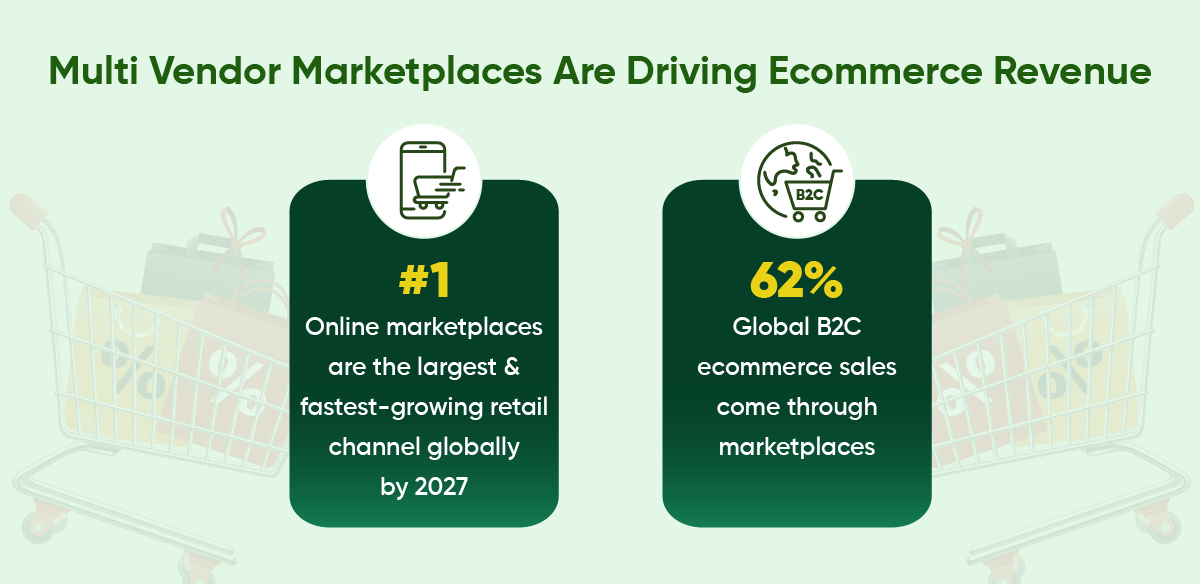
- #1 - Online marketplaces will be the fastest-growing retail channel globally by 2027
- 62% - Global B2C ecommerce sales come through marketplaces
Source: Technavio, Clickpost
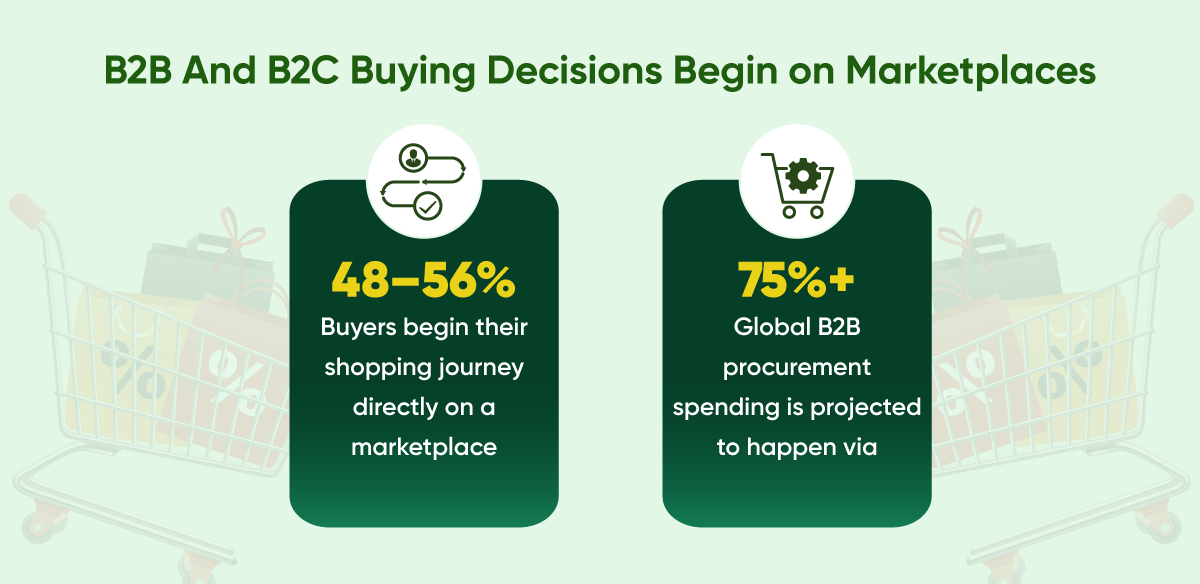
- 48–56% - Buyers begin their shopping journey directly on a marketplace
- 75%+ - Global B2B procurement spending is projected to happen via marketplaces
Source: IoT Analytics, ResearchGate
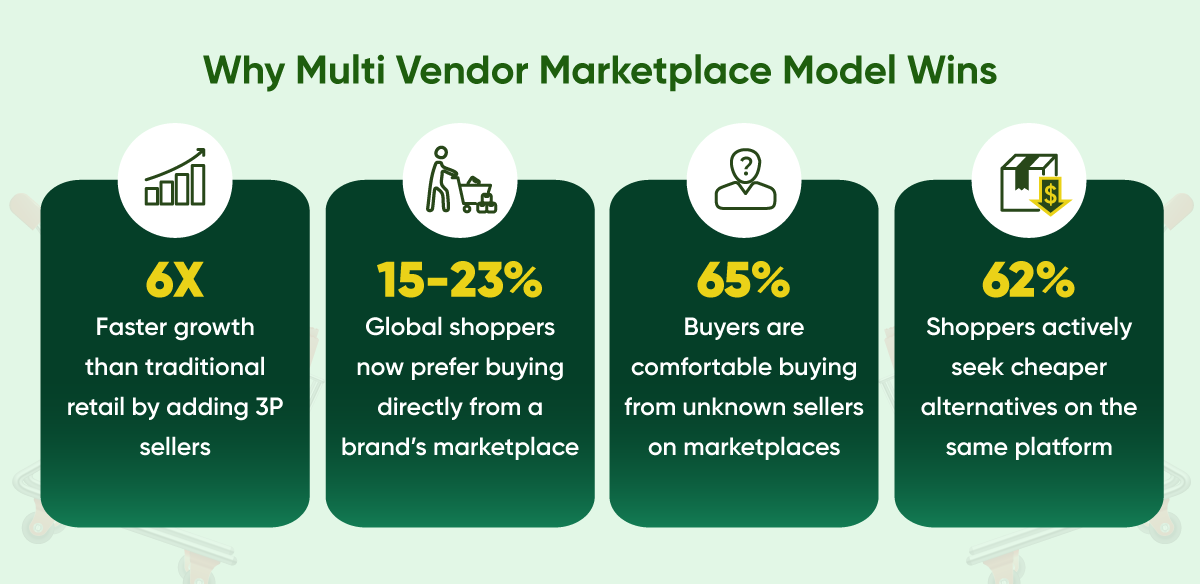
- 6x - Faster growth than traditional retail by adding 3P sellers
- 15-23% of global shoppers now prefer buying directly from a brand’s marketplace
- 65% - Buyers are comfortable buying from unknown sellers on marketplaces
- 62% - Shoppers actively seek cheaper alternatives on the same platform
Source: StartUs Insights 2026, Wunderman Thompson, Digital Commerce 360, Referral Candy
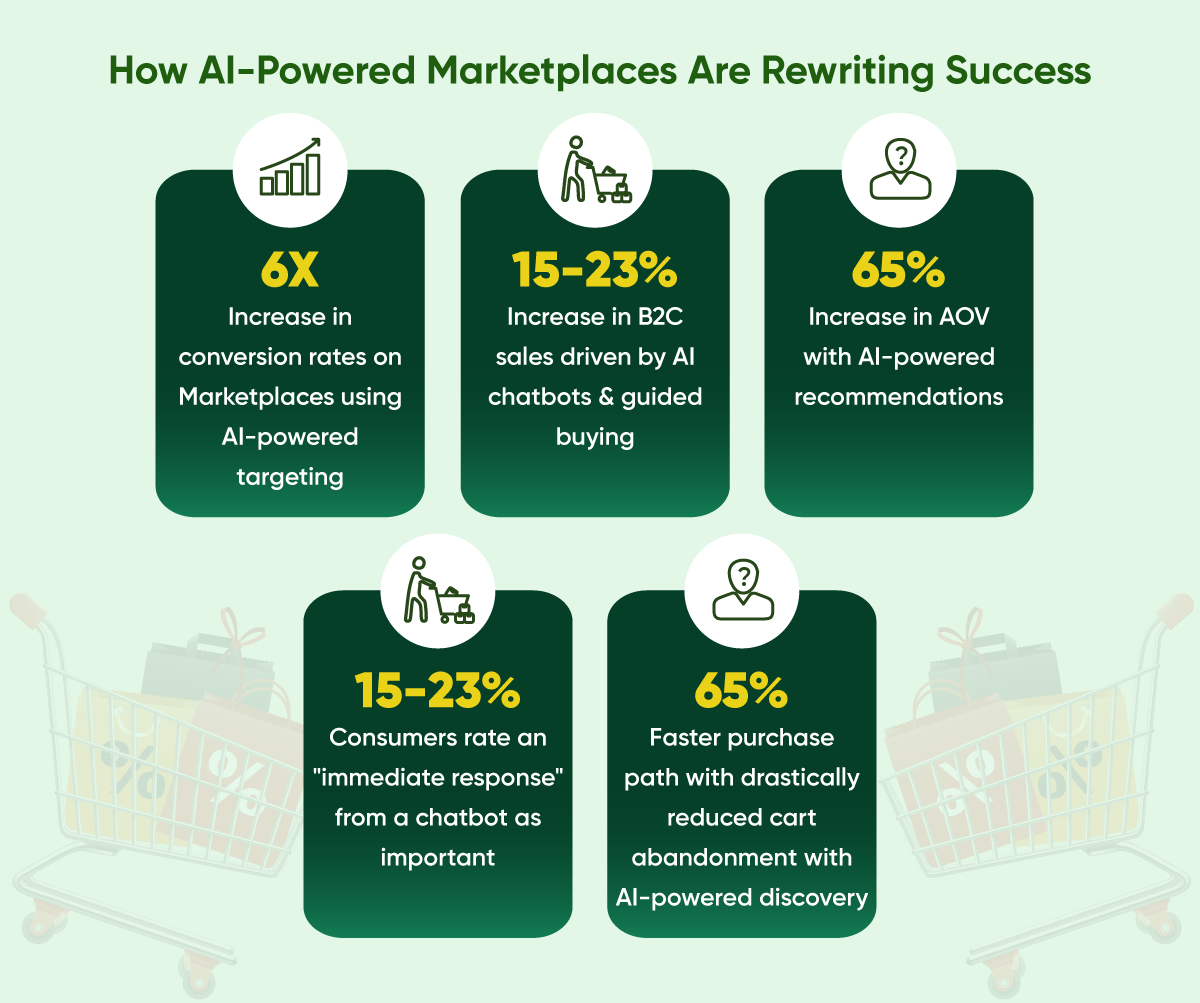
- 25%- Increase in conversion rates on Marketplaces using AI-powered targeting
- 67% - Increase in B2C sales driven by AI chatbots & guided buying
- 20% -Increase in AOV with AI-powered recommendations
- 90% - Consumers rate an "immediate response" from a chatbot as important
- 47% - Faster purchase path with drastically reduced cart abandonment with AI-powered discovery
Source- LinkedIn, Gartner 2025, McKinsey, Jotform, Digital Commerce 360
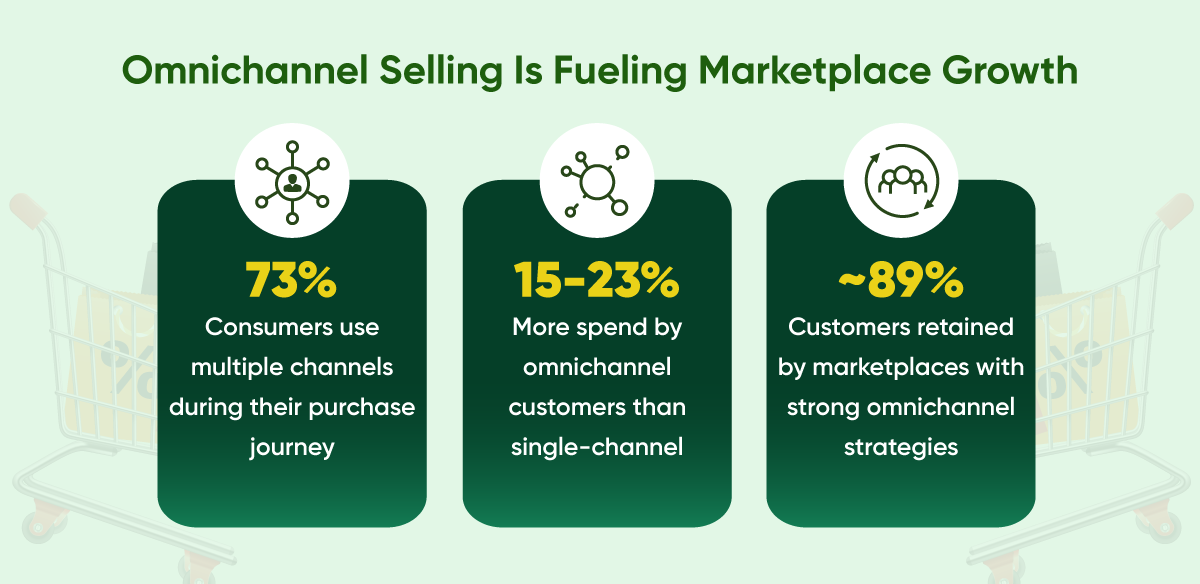
- 73% - Consumers use multiple channels during their purchase journey
- 10–30% -more spend by omnichannel customers than single-channel buyers
- ~89% - Customers retained by marketplaces with strong omnichannel strategies
Source: Harvard Business Review, McKinsey, Aberdeen Group
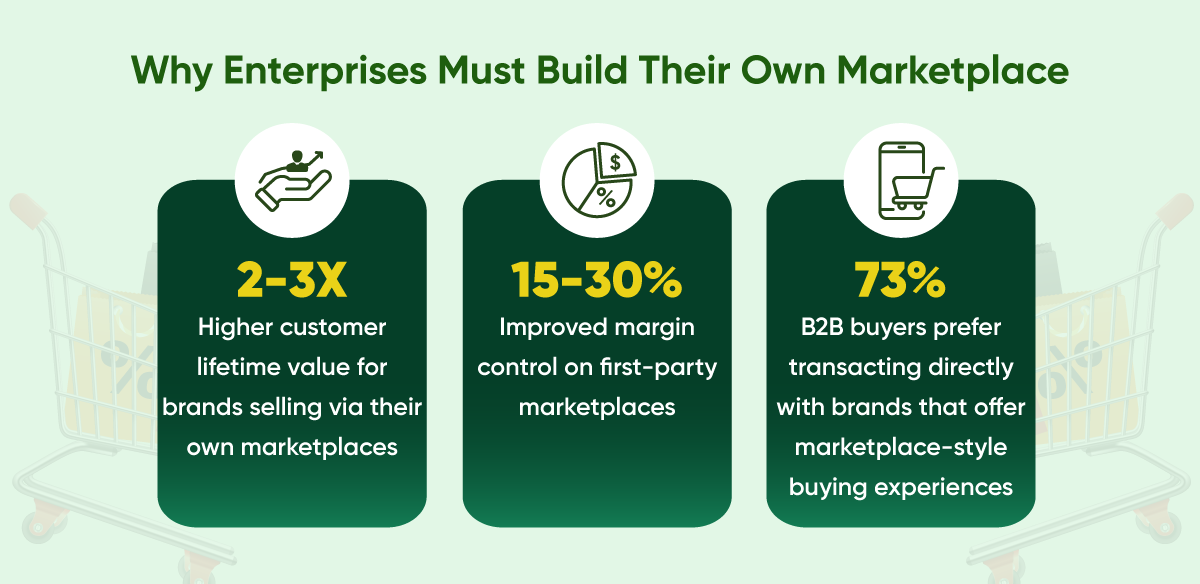
- 2-3× - Higher customer lifetime value for brands selling via their own marketplaces
- 15-30%- Improved margin control on first-party marketplaces
- 73% - B2B buyers prefer transacting directly with brands that offer marketplace-style buying experiences
Source: Accenture, McKinsey, Bain & Company, Gartner
The data points to a clear shift. Enterprises that rely only on traditional ecommerce are risking their growth, margin control, and customer insight. A well-built multi vendor marketplace, especially one designed with AI-powered discovery and omnichannel reach creates stronger engagement, better economics, and longer customer relationships. As buyer behaviour continues to evolve, enterprises that invest in their own marketplace foundation are better positioned to stay relevant, competitive, and in control of their growth.
5 Most Adopted B2B And B2C Enterprise Marketplace Models in 2026
Enterprises today are experimenting with marketplace models more aggressively than ever, testing what truly fits their business, partners, and buyers. The focus has shifted to mixing business models to create out-of-the-box marketplace ecosystems that best fit their present and future growth roadmap.
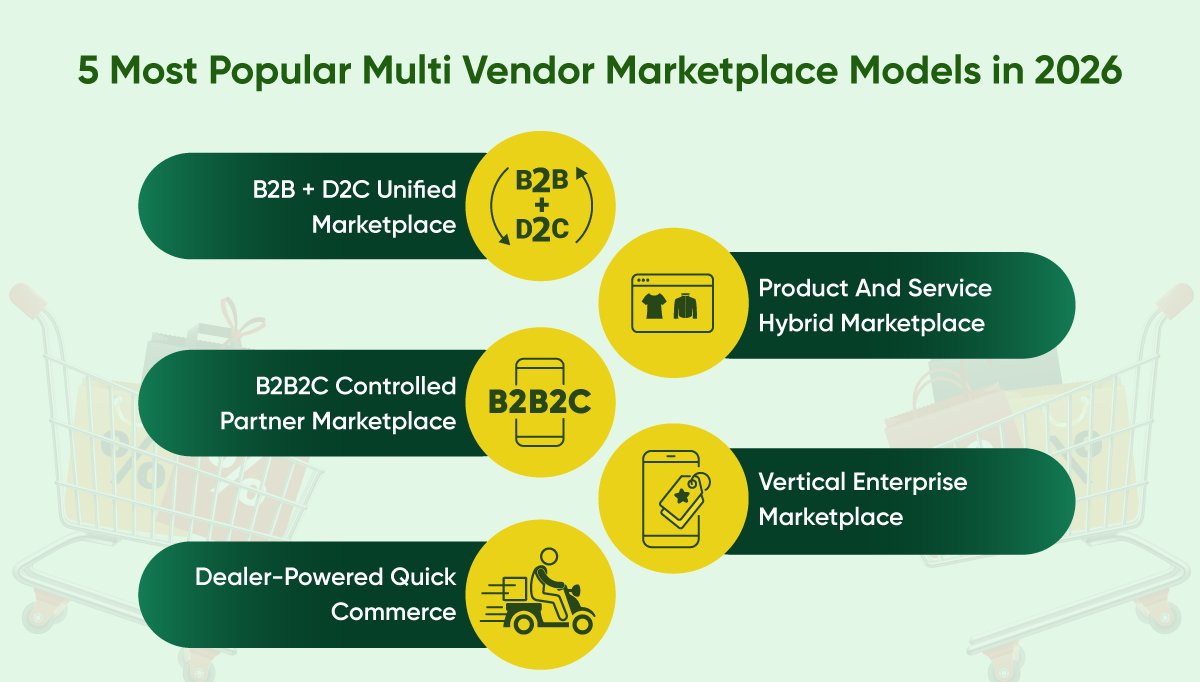
Below are some unique and trending multi vendor marketplace models for 2026 and beyond:
1. B2B + D2C Unified Marketplace
A B2B + D2C unified marketplace allows enterprises to serve distributors, retailers, and end consumers through a single, connected system. While buyer journeys, pricing, and fulfilment logic remain unique for both retail and wholesale buyer groups, inventory, operations, and data stay centralised at a common control layer. This enterprise marketplace model helps manufacturing based B2B brands serve the target end buyers through direct-to-consumer channels without disrupting their existing B2B ecosystem.
How it works
The enterprise runs one platform with multiple buying journeys, designed for different buyer segments of B2B and D2C types.
- Distributors, dealers, or retailers place B2B orders with negotiated pricing, minimum order quantities, credit terms, and bulk workflows on the B2B store and marketplace apps.
- End consumers shop through a D2C storefront with retail pricing and a consumer-friendly checkout experience.
- Products, inventory, partners, customer database and analytics are shared, while access rules and buying logic remain segmented.
This approach turns the marketplace into a coordinated wholesale and retail multi vendor marketplace, not separate B2B and D2C ecosystems stitched together.
Why Enterprises Prefer It
Enterprises adopt this model to simplify operations while retaining control across channels:
- Removes the need to manage separate B2B and D2C platforms
- Reduces channel conflict through controlled access, pricing, and visibility rules
- Creates a common backend for managing vendors, distributors, inventories, customer groups, buyer data and performance
- Enables direct customer insights without bypassing distributor or dealer networks
For large organisations, this model brings structure to growth instead of adding operational layers and complexity.
Use Cases of B2B+D2C Marketplace
- Electronics manufacturers selling through distributors while also running a branded D2C store for accessories or spare parts
- Consumer goods enterprises launching D2C to capture customer data without dismantling their B2B sales network through franchise, dealers and retailers
- Industrial brands that want visibility into end demand while continuing partner-led fulfilment
- Enterprises transitioning from pure B2B to hybrid commerce in a phased, low-risk manner
2. B2B2C Controlled Partner Marketplace
A B2B2C controlled partner marketplace enables enterprises to expand reach through partners while retaining ownership of the customer experience. In this enterprise marketplace model, partners handle fulfilment and local operations, but the brand controls discovery, pricing logic, policies, and customer data. It is widely adopted by enterprises that want to scale without losing control.
How it works
The enterprise marketplace is owned and governed by the brand, while partners operate within defined rules.
- Channel partners, distributors, or franchisees list products and fulfil orders
- The enterprise controls storefront design, product discovery, pricing rules, and promotions
- Customers interact only with the brand, not individual sellers
- Partner visibility, commissions, and fulfilment responsibilities are managed through backend workflows
This structure creates a governed multi vendor marketplace where scale comes from growing the partner network, not platform sprawl.
Why Enterprises Prefer It
Enterprises prefer this model because it balances expansion with brand and data ownership.
- Enables rapid geographic and channel expansion without opening new warehouses
- Maintains a consistent brand experience across all partner-led sales
- Gives enterprises full visibility into customer behaviour and demand patterns
- Reduces operational overhead while keeping pricing and compliance in check
It is especially attractive for brands that want growth without turning into an open marketplace.
Use Cases Of B2B2C Controlled Partner Marketplace
- FMCG brands expanding distribution through regional partners while owning the digital storefront
- Electronics and appliance brands using service partners for last-mile delivery and installation
- Building materials and paint companies where dealers fulfil orders locally under a central brand experience
- Auto and mobility brands enabling partner-led sales with centralised pricing and promotions
3. Dealer-Powered Quick Commerce Hyperlocal Marketplace
A dealer-powered quick commerce hyperlocal marketplace enables enterprises to deliver faster by turning local dealers or distributors into fulfilment nodes. Instead of relying on central warehouses or dark stores, this enterprise marketplace model uses a multi-store structure where proximity, availability, and speed drive conversions. It is increasingly preferred as a more sustainable alternative to traditional quick commerce.
How It Works
This online marketplace operates as a location-based, multi vendor marketplace where dealer inventory and infrastructure are leveraged for fulfilling orders.
- Dealers or distributors act as local stores with their own inventory and service radius
- Customers are shown products based on real-time availability at nearby dealers
- Orders are automatically routed to the nearest eligible dealer for fulfilment
- Pricing, delivery timelines, and service rules can vary by location while remaining centrally governed
This approach allows enterprises to offer fast delivery without owning last-mile infrastructure or inventory in dark stores.
Why Enterprises Prefer It
Enterprises are adopting this model to improve margins and local reach at the same time.
- Enables quick commerce without investing in dark stores or heavy logistics
- Improves delivery speed by leveraging existing dealer networks
- Keeps inventory closer to demand, reducing stockouts and returns
- Strengthens dealer relationships by making them active participants in growth
For many enterprises, this model balances speed, scale, and profitability better than centralised fulfilment.
Use Cases Of Dealer-Powered Quick Commerce Model
- Consumer electronics brands offering same-day delivery through authorised local dealers
- Daily essentials/ FMCG brands fulfilling orders by onboarding local kiranas or nearby distributors
- Gifts and flowers companies enabling rapid local availability through partnerships with local florists, bakeries, gift shops etc.
- Agri-input and hardware enterprises serving rural and semi-urban regions efficiently
4. Product And Service Hybrid Marketplace
A product and service hybrid multi vendor marketplaces allows enterprises to sell physical products alongside related services within a single buying journey. In this enterprise marketplace model, distributors or sellers fulfil product orders, while certified service partners deliver installation, maintenance, or support. It helps enterprises move beyond transactions and own the full customer lifecycle.
How It Works
The marketplace combines product commerce with service orchestration.
- Customers purchase products and associated services in one flow or as linked orders
- Product fulfilment is handled by distributors, dealers, or warehouses
- Services such as installation, inspection, or maintenance are delivered by approved service partners
- Scheduling, pricing, and service eligibility are managed through predefined rules of the multi vendor marketplace platform
This structure transforms a traditional multi vendor marketplace into a lifecycle-driven ecommerce ecosystem.
Why Enterprises Prefer It
Enterprises adopt this model to increase value per customer and improve retention.
- Drives higher lifetime value by bundling products with recurring services
- Reduces post-purchase friction by coordinating fulfilment and service delivery
- Creates new revenue streams without expanding core inventory
- Improves customer satisfaction through accountable, end-to-end ownership
For enterprises, this model works as it turns one-time purchases into long-term relationships.
Use Cases Of Product And Service Hybrid Marketplace
- Home repair and grooming services, selling products through distributors, while certified and trained service providers offer doorstep services
- Solar and renewable energy companies, selling panels, inverters, and batteries via channel partners, while certified installers handle site surveys, installation, and ongoing maintenance.
- Medical equipment manufacturers, supplying devices through distributors, while trained technicians offer installation, calibration, and compliance services to hospitals and clinics.
- Furniture and interior brands, selling furniture and fittings through sellers, while partner carpenters and installers manage assembly, customisation, and on-site setup.
5. Multi-Brand, Single-Category Vertical Enterprise Marketplace
A multi-brand, single-category vertical enterprise marketplace allows an enterprise to own an entire product category by hosting multiple brands on one platform. Instead of selling only its own products, the enterprise becomes the category leader, controlling discovery, standards, and demand. This enterprise marketplace model is increasingly used by brands looking to move from sellers to become leaders in a given industry niche and ecosystem.
How It Works
The enterprise operates the marketplace as a category-first multi vendor marketplace, not a brand-first store.
- Multiple brands list products within a single, niche category
- The enterprise controls onboarding criteria, content standards, pricing rules, and promotions
- Buyers experience a unified category journey rather than fragmented brand storefronts
- Order fulfillment may be handled by brands, distributors, or central warehouses, depending on the model
This structure positions the enterprise marketplace platform as the default destination for a category, not just another online store.
Why Enterprises Prefer It
Enterprises adopt this model to shift power from supply to demand.
- Positions the enterprise as a category authority rather than a single-brand seller
- Attracts wider demand by offering choice without forcing brand switching
- Improves data visibility across competing brands within the same category
- Creates leverage over suppliers through demand aggregation
For large organisations, this multi vendor marketplace model is about owning customer intent, not just transactions.
Use Cases Of Multi-Brand, Single-Category Vertical Enterprise Marketplace
- Beauty and skincare multi vendor marketplace platform hosting multiple makeup, skincare, grooming products brands
- Baby and mom care brands offering baby food, diapers, maternity products, nursing accessories, and wellness items from multiple specialised brands on a single trusted platform.
- Industrial tools and safety equipment marketplaces, aggregating brands for machinery tools, safety gear, and consumables used by factories and contractors.
- Healthcare and wellness product marketplaces, curating medical supplies, wellness products, supplements, and fitness equipment from approved brands.
While there can be several marketplace models depending on a brand’s unique requirements, it becomes imperative for decision-makers to think beyond the model itself. What truly matters is building on a future-ready, agile, and composable AI powered marketplace platform that can evolve as the business grows. The right foundation allows enterprises to start with one model, adapt to new ones, and scale without friction. In 2026, winning marketplaces are built on flexibility, not fixed assumptions.
A Snapshot Of Most Popular B2B And D2C Multi Vendor Marketplace Models in 2026
Below is a quick snapshot of the most widely adopted B2B and D2C multi vendor marketplace models in 2026 and the use cases they fit best. It offers a quick way to compare the diverse models and move faster from evaluation to decision.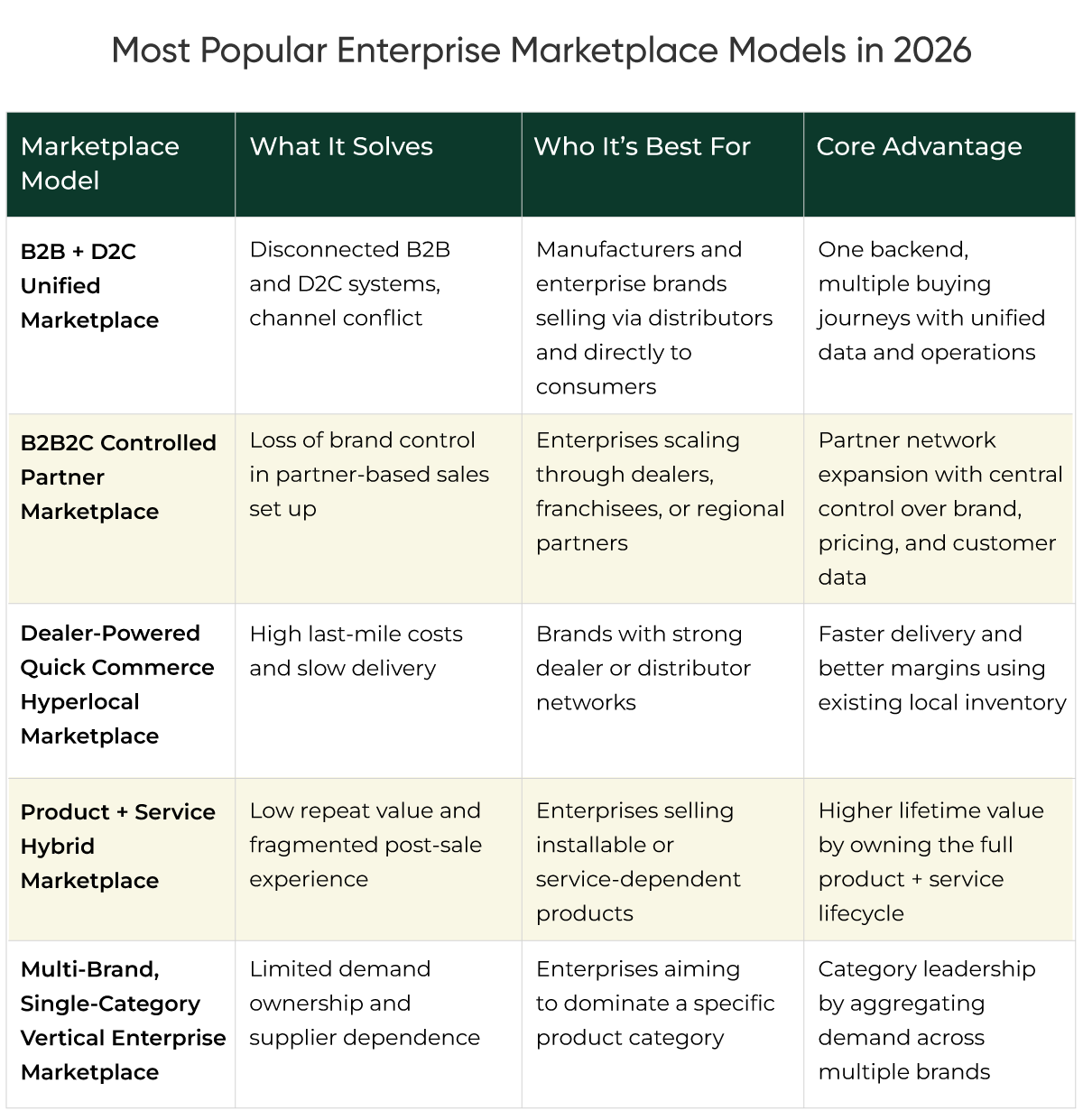
Now that you have evaluated and compared these marketplace models, it’s important to understand what kind of platform can support them as your business evolves.
How StoreHippo Supports Enterprises in Building Multi-Model Marketplaces
StoreHippo is built for enterprises that have diverse growth plans and don’t want to lock themselves into a single marketplace model. It is an enterprise marketplace platform designed to support multiple B2B and D2C marketplace models from a single backend, allowing businesses to start with one model and evolve into others as their ecosystem grows.
Instead of rigid templates, StoreHippo provides a future-ready, composable foundation that adapts to complex partner networks, varied buyer journeys, and changing business priorities, making it easier to build and scale a truly AI powered marketplace.
Key Capabilities That Enable Multi-Model Marketplaces
- Native Multi Vendor Marketplace Solutions: Built-in support for vendors, distributors, dealers, service partners, and brands without plugins or workarounds.
- AI-Powered Marketplace Core: AI at the core of the multi vendor marketplace platform automates and streamlines catalog creation, image enhancement through Magic Edit, semantic search and recommendations, voice- and chat-based discovery, guided buying through custom AI chatbots, AI-driven support assistance, and other automation across large, complex marketplaces.
- Composable and Agile Platform Design: Enterprises can configure workflows, pricing logic, catalogs, and roles without hardcoding, enabling faster experimentation across marketplace models.
- Mobile-first Omnichannel Support: Built-in support for web, mobile apps, AI interface for assisted selling, WhatsApp selling and affiliate and partner stores sales channels with shared data and consistent experiences.
- 300+ Enterprise-Grade Features: Covering various business models, catalog and vendor management, pricing, workflows, payments, logistics integrations, analytics, and compliance needs at scale.
- Built to Support Multiple Business Models: Enables B2B, B2C, D2C, B2B2C, hyperlocal, quick commerce, hybrid and category-specific niche marketplaces from the same platform.
- Unified Backend for B2B and D2C: Run wholesale, retail, and hybrid buying journeys from a single backend on your AI powered marketplace while keeping pricing, access, and fulfilment logic segmented.
- Advanced Vendor/ Distributor/Partner Management: Centralised control over onboarding, commissions, service areas, pricing rules, and performance across the entire marketplace ecosystem.
- Multi-Store Capabilities: Native support for location based, brand-based or dealer-powered hyperlocal multi store network, regional inventory visibility, and smart order routing.
- Product and Service Commerce Support: Ability to manage products, services, scheduling, and split fulfilment within one marketplace flow.
- Workflow Flexibility at Scale: Complex enterprise marketplace processes such as approvals, partner fulfilment, and split orders can be configured without introducing parallel systems.
- Unified Data and Operational Visibility: Inventory, orders, partners, and demand insights remain connected across all channels and marketplace models.
- Built for Evolution, Not One-Time Launches: Enterprises can start with a single marketplace model and progressively expand into multi-model ecosystems without replatforming.
- Enterprise-Grade Scalability and Control: StoreHippo supports large catalogs, multiple partners, and high transaction volumes while maintaining performance and governance.
Why this matters for enterprises
As marketplace strategies become more fluid, enterprises need a multi vendor marketplace platform that doesn’t force early decisions to become long-term constraints. StoreHippo gives enterprises the flexibility to build, adapt, and scale marketplace ecosystems confidently, without replatforming making it a strong foundation for long-term marketplace success in 2026 and beyond.
Conclusion
Enterprise marketplaces in 2026 are no longer about launching a single channel. They are about building flexible, multi-model ecosystems that can adapt as partners, buyers, and operations evolve. From B2B + D2C and dealer-powered marketplaces to category-based vertical and service-aggregator marketplace models, enterprises are choosing multi vendor marketplace platforms that simplify complexity and improve control.
What matters most is having an AI powered marketplace platform that supports governance, intelligence, and scale from day one. As marketplace strategies mature, enterprises are moving away from rigid platforms toward systems that can grow with their business. This is where choosing the right technology partner becomes critical. As one of the best marketplace platform options for enterprises, StoreHippo enables businesses to build, evolve, and operate multi-model marketplaces without replatformingenabling brands to plan long-term growth, not short-term experiments.
Explore how StoreHippo can power your enterprise marketplace strategy. Book your custom demo now.
FAQs
1. How long does it take to launch an enterprise marketplace without rebuilding existing systems?
For most enterprises, launching an enterprise marketplace typically takes a few weeks to a few months, depending on complexity and scope without rebuilding existing systems.
Modern enterprise marketplace platforms like StoreHippo support multiple business models natively and are designed to integrate with existing ERP, CRM, payment, and logistics systems rather than replace them. By using configurable workflows, modular rollout, and phased onboarding, enterprises can go live with a core marketplace use case first and expand gradually. This approach reduces disruption, shortens time-to-market, and allows businesses to validate the marketplace model before scaling further.
2. Can a multi vendor marketplace scale without creating operational complexity for internal teams?
Yes, a multi vendor marketplace can scale without creating operational complexity if it is built with the right management hierarchy, flows and automation.
Scalability depends less on the number of vendors and more on how vendor onboarding, workflows, and visibility are managed. Platforms that centralise vendor management, automate routine tasks such as cataloging, order routing and payouts, and provide unified central dashboards enable enterprises to scale a multi vendor marketplace while keeping internal teams lean and efficient. StoreHippo AI-powered marketplace platform offers all these features for marketplace scalability without complexity.
3. What should enterprises look for in a multi vendor marketplace platform beyond basic features?
Beyond basic features, enterprises should look for a multi vendor marketplace platform that offers flexibility, scalability, seamless integration, and long-term platform updates.
Rather than relying on fixed templates, the platform should allow enterprises to configure pricing logic, workflows, partner roles, and catalog structures without hardcoding. This level of control ensures the marketplace can evolve as business models, partner ecosystems, and customer expectations change over time without requiring replatforming.
StoreHippo composable multi vendor marketplace platform is built on MACH architecture with a decoupled backend and frontend enabling brands to build out-of-box hybrid marketplaces without any platform limitations.
4. How does an AI powered marketplace improve efficiency without replacing human decision-making?
An AI powered marketplace improves efficiency by assisting decision-making, not replacing it.
In enterprise environments, AI works best as an intelligent support layer that automates repetitive tasks and reduces friction. Capabilities such as intelligent cataloging, guided discovery, recommendations, and workflow automation help minimise errors, speed up routine decisions, and improve consistency. At the same time, human teams retain control over strategy, exceptions, approvals, and governance, ensuring that AI enhances operations without removing human oversight.
5. Why is StoreHippo considered one of the best marketplace platform options for enterprises?
StoreHippo is considered one of the best marketplace platform options for enterprises because it combines AI powered, future-ready technology with native, no-plugin marketplace capabilities.
Enterprises value platforms that can support multiple marketplace models from a single backend while continuing to evolve over time. StoreHippo offers built-in multi vendor features, flexible workflows, and an AI powered marketplace core allowing businesses to run B2B, B2C, D2C, and hybrid marketplaces without relying on plugins or rigid templates. This combination makes it well-suited for scalable, long-term enterprise marketplace growth.