


Search “how to build a hyperlocal marketplace,” and you’ll find the same blueprint almost everywhere: choose a category, add a delivery app, charge sellers a commission, and start delivering.
But a real hyperlocal marketplace goes beyond local delivery. It needs to connect nearby sellers with customers, keep product availability and inventory updated, manage orders across locations, and make the entire local shopping experience seamless, not just the final delivery.
This matters because hyperlocal commerce is no longer limited to consumer apps delivering groceries, food or everyday essentials. The model is also gaining momentum in the B2B ecommerce segment, where distributors, dealers and local sellers serve customers across different locations.
While these businesses may work differently, they share a common need: a platform that can bring local sellers, customers, inventory and fulfilment together in one place.
This guide covers how the hyperlocal business model works, what sellers, delivery teams and admins need, which categories are best suited to it, and what it takes to build and scale a hyperlocal marketplace.
Table of Contents
- How is the Fast Delivery Hyperlocal Marketplace is Shaping Up Ecommerce and Buyer Expectations
- What is a Hyperlocal Marketplace
- How Is a Hyperlocal Marketplace Different from a Regular Marketplace?
- How Does a Hyperlocal Marketplace Generate Revenue
- Which Business Categories Can Benefit Most from a Hyperlocal Marketplace?
- What Features Does a Hyperlocal Marketplace Need for Vendors, Delivery partners and Admins?
- How to Build a Hyperlocal Marketplace For The AI Era?
- How Much Time and Money Does It Take to Launch a Hyperlocal Marketplace?
- How to Choose the Right Platform to Build a Hyperlocal Marketplace?
- Conclusion
- FAQs
How is the Fast Delivery Hyperlocal Marketplace is Shaping Up Ecommerce and Buyer Expectations
Speed, convenience, and local availability are at the core of modern ecommerce, and fast-delivery hyperlocal marketplaces are bringing these expectations to the forefront. By enabling faster fulfilment from nearby sellers, they are changing how buyers shop, what they expect from delivery, and how quickly they want their orders.
Here are the latest data points that highlight how quickly buyer expectations and the demand for faster delivery are evolving
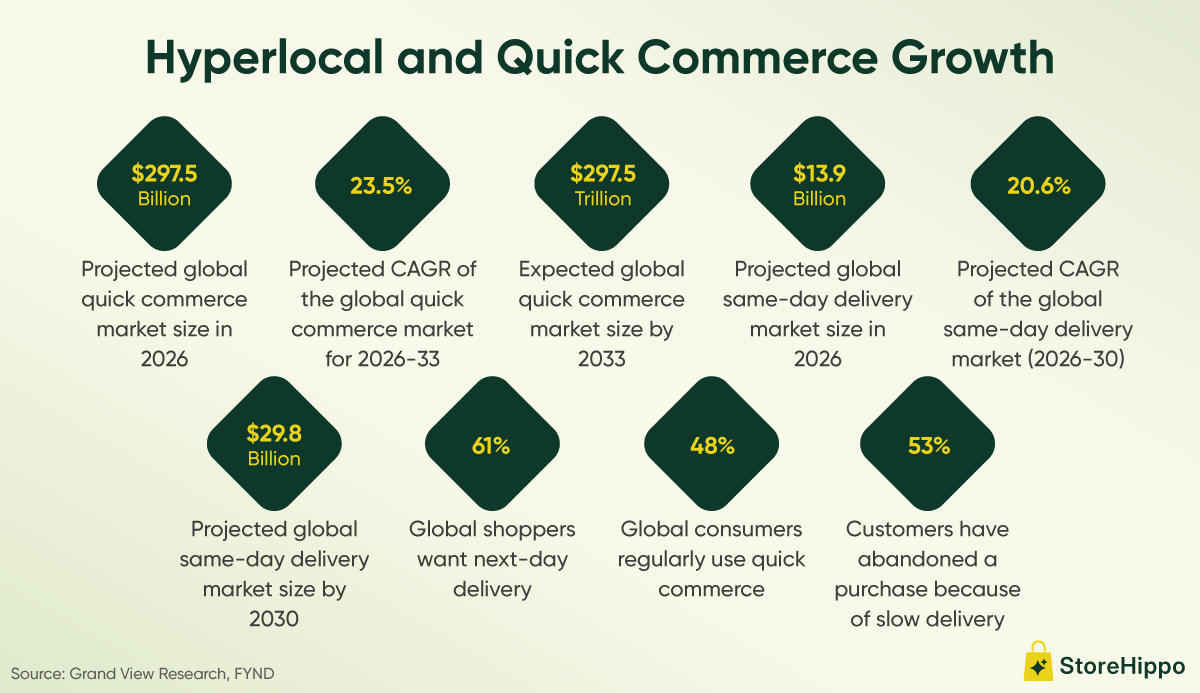
- $297.5 bn is the projected global quick commerce market size in 2026
- 23.5% is the projected CAGR of the global quick commerce market for 2026-33
- $1.3 trillion is the expected global quick commerce market size by 2033
- $13.9 bn is projected global same-day delivery market size in 2026
- 20.6% is the projected CAGR of the global same-day delivery market (2026-30)
- $29.8 bn is the projected global same-day delivery market size by 2030
- 61% of global shoppers want next-day delivery
- 48% of Global consumers regularly use quick commerce
- 53% of customers have abandoned a purchase because of slow delivery
Source: Grand View Research, FYND
The picture is clear: faster delivery is a key part of the modern ecommerce experience, not just an added convenience. As buyer expectations continue to rise, hyperlocal marketplaces are well placed to make shopping faster, more convenient, and closer to where customers live.
What is a Hyperlocal Marketplace
A hyperlocal marketplace is a multi-vendor commerce model that connects customers with nearby sellers, dealers, distributors, or fulfilment locations within a defined geographic area. Enterprises can use it to bring distributed seller networks onto one digital platform while centrally managing seller onboarding, catalogues, inventory, orders, pricing, commissions, payments, and fulfilment workflows.
Because orders are routed to sellers or locations closer to the customer, businesses can use existing local inventory and partner networks to enable faster, more cost-efficient fulfilment without relying entirely on central warehouses.
This is different from a hyperlocal store, where a single brand owns the catalogue and fulfils orders through its own nearby stores or locations. A hyperlocal marketplace brings multiple independent sellers or partners into the same commerce ecosystem while giving the enterprise central visibility and control.
Let’s take a closer look at how the two models differ.
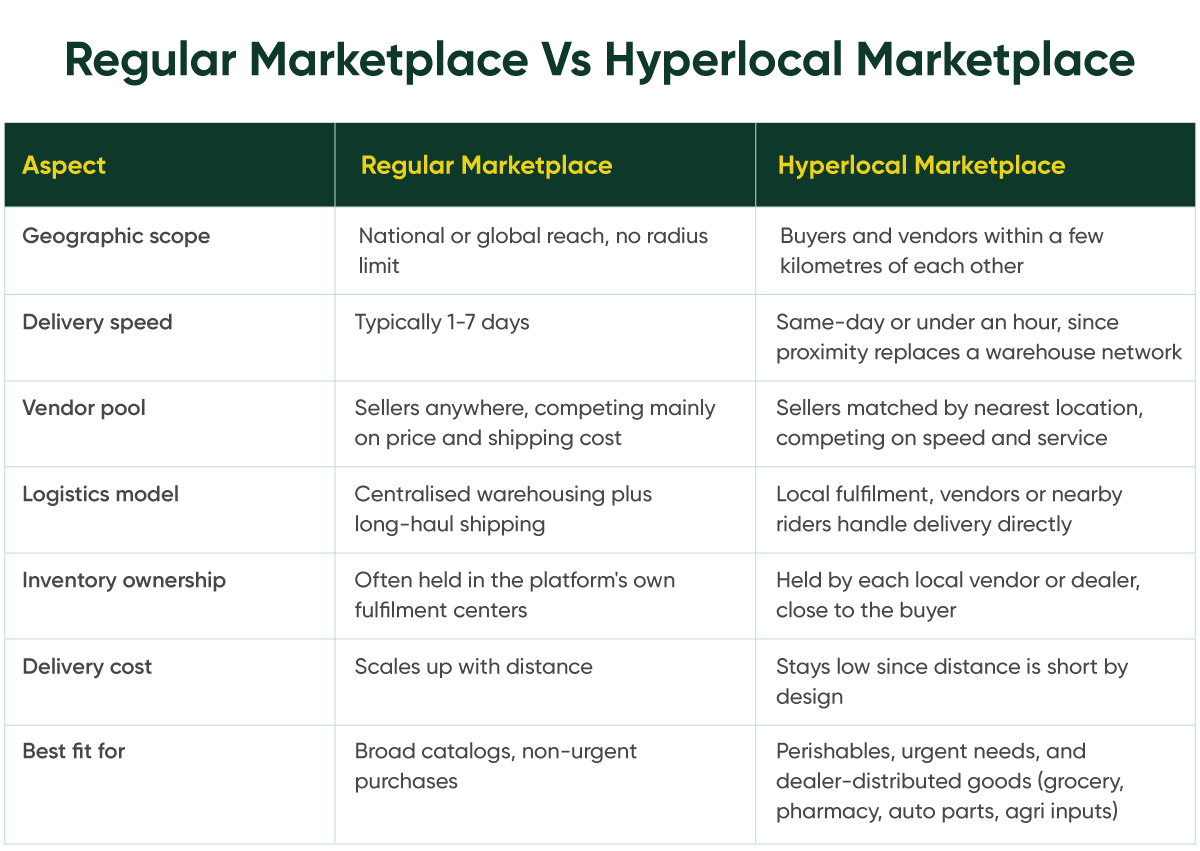
How Is a Hyperlocal Marketplace Different from a Regular Marketplace?
How Does a Hyperlocal Marketplace Generate Revenue
A hyperlocal marketplace generates revenue through commissions on orders, seller subscriptions, paid product listings, delivery margins and other seller-focused services. Unlike a hyperlocal store, it does not need to own products or maintain inventory. Instead, it connects local sellers with customers and earns revenue by facilitating transactions and offering additional services through one platform.
The growing demand for faster, more localised commerce is creating new opportunities for hyperlocal marketplaces across both B2C and B2B models. While quick commerce and same-day delivery are accelerating customer expectations, enterprises are also using hyperlocal models to connect buyers with nearby dealers, distributors, and business sellers for faster, location-based fulfilment.
Here are the key ways a hyperlocal marketplace can generate revenue:
- Commission on Orders: Charge sellers a percentage of every successful order placed through the marketplace.
- Seller Subscriptions: Offer paid subscription plans that provide sellers with additional features, higher usage limits, advanced tools or better platform visibility.
- Paid Product Listings: Let sellers pay to promote selected products or improve their visibility on the platform.
- Delivery Fees: Charge customers for delivery when the marketplace manages or arranges local fulfilment.
- Delivery Margins: Partner with third-party logistics providers and earn a margin on delivery fees charged to the customers.
- Seller-Focused Services: Generate additional revenue by offering sellers services such as advertising, promotions, analytics or other value-added tools.
Which Business Categories Can Benefit Most from a Hyperlocal Marketplace?
Businesses that rely on local inventory, nearby sellers or faster fulfilment can benefit most from a hyperlocal marketplace. Grocery, food, pharmacy, home services, fashion, electronics, building materials and B2B dealer networks are some of the strongest examples. By connecting customers with sellers in their area, these businesses can offer greater convenience, faster fulfilment and more relevant product availability.
Categories That Work Well for a Hyperlocal Marketplaces are:
- Grocery and Daily Essentials: Local grocery stores can list their products on a on a hyperlocal marketplace and fulfil customer orders from nearby locations.
- Food and Restaurants: Restaurants, bakeries and food outlets can reach customers in nearby areas, accept online orders and manage local fulfilment through the hyperlocal marketplace.
- Pharmacy and Healthcare: Local pharmacies can serve customers within their delivery areas, while an AI-powered hyperlocal marketplace can support prescription handling and other applicable compliance requirements.
- Home Services: Cleaning, repair, beauty and maintenance businesses can connect customers with nearby service providers based on location and service availability.
- Fashion and Lifestyle: Local fashion, footwear and lifestyle retailers can sell on hyperlocal marketplace while fulfilling orders from their nearby stores.
- Electronics and Appliances: Local electronics retailers can use their existing inventory to serve customers in surrounding areas instead of relying only on central warehouses.
- B2B Dealer Networks: Distributors and manufacturers can leverage hyperlocal marketplace platforms to connect buyers with nearby dealers for categories such as dairy, auto parts, paints and agricultural products. Dealers can fulfil orders locally while the business manages the wider network.
- Building Materials: Local dealers of cement, tiles, hardware and other construction materials can fulfil orders based on customer location, making this model particularly useful for location-dependent B2B purchases.
The best categories for a hyperlocal marketplace are those where local availability, proximity and faster fulfilment can make a noticeable difference to the customer experience. Once you identify the right category, you can choose the features you need to build a hyperlocal marketplace based on how customers buy, how sellers fulfil orders, and how your business plans to scale.
What Features Does a Hyperlocal Marketplace Need for Vendors, Delivery partners and Admins?
A hyperlocal marketplace needs different tools for vendors, delivery partners and admins to manage selling, deliveries and daily operations efficiently. AI-powered tools, location-based workflows, automation and real-time insights can further improve efficiency, giving vendors better selling tools, delivery partners smoother delivery processes and admins centralised control as the marketplace scales.
- Vendors: Vendors need an easy-to-use order management dashboard to accept or reject orders, manage inventory, update product information and track payouts and commissions. AI-powered cataloguing can help them create and organise product listings faster, while AI-powered semantic search and recommendations can make products easier for customers to discover. B2B dealer networks may also need flexible pricing, dealer-specific discounts and location-wise inventory management.
- Delivery Partners: Delivery partners are needed when the marketplace manages its own deliveries. They need a mobile app to view assigned orders, access navigation, update delivery status and track earnings. Location-based order assignment, real-time tracking and automated delivery updates can make fulfilment more efficient. If vendors or dealers handle their own deliveries, the marketplace may not need a separate delivery partner system.
- Admins: Admins need a central dashboard to approve vendors, manage product listings, monitor orders, configure commissions and payouts, manage service areas and resolve issues. They need an AI-powered core that turns marketplace data into actionable insights, helping them identify sales trends, understand customer behaviour, spot inventory gaps, and address operational issues. They can also use tools such as a discount engine to manage promotions, along with automated workflows, location-based rules and role-based access controls.
With the right features in place, a hyperlocal marketplace platform can simplify everyday operations as your business adds more vendors, orders and locations. This makes it easier to build a hyperlocal marketplace that can grow without making operations harder to manage.
How to Build a Hyperlocal Marketplace For The AI Era?
Building a hyperlocal marketplace for the AI era involves choosing the business model, onboarding local vendors, enabling location-based discovery, integrating payments and logistics, and adding AI in every layer of business operations and buyer journeys.
AI can power semantic search, personalised recommendations, intelligent product discovery, demand forecasting, automated catalogue management, and conversational shopping. It can also help vendors automate routine tasks, optimise inventory, and make faster, data-driven decisions.
Here is the step-by-step process to build an AI-powered hyperlocal marketplace:
1. Choose Your Business Model and Category
Start by deciding what you want to sell, who your sellers will be, where you want to operate and how orders will be fulfilled. You should also decide how the marketplace will make money, whether through commissions, subscriptions, delivery fees or other services. These decisions will determine the features and technology you need later.
2. Set Up Vendor, Delivery Partner and Admin Operations
Give vendors the tools they need to manage products, inventory, orders and payouts. Admins should be able to manage sellers, listings, commissions, service areas and marketplace settings from one dashboard.
If the marketplace manages deliveries, delivery partners can use a mobile app to receive orders, navigate to delivery locations and update order status. For B2B dealer networks where dealers handle their own deliveries, a separate delivery partner app may not be necessary.
3. Connect Payments, Location and Logistics
Set up the services that keep orders moving from checkout to delivery. This includes payment gateway integration, location-based seller matching and logistics partners or your own delivery network.
Location-based operations are particularly important for a hyperlocal model because the platform needs to identify which sellers can serve a customer based on product availability, location and serviceability.
4. Leverage AI to Improve Everyday Operations
AI can help take a hyperlocal marketplace beyond basic automation. Go for an AI-powered marketplace solution that comes with built-in AI tools to speed up, automate and streamline every layer of ecommerce right from onboarding and cataloguing to discovery, personalisation and support. The key should be building an AI-powered hyperlocal marketplace that uses intelligence across every layer of business operations and the buyer journey.
5. Unify Your Sales Channels:
Customers may discover and buy from your business through your website, mobile app, WhatsApp, social channels or new age AI interfaces. Instead of managing each channel separately, connect them through a unified commerce setup.
A shared product catalogue, inventory, order management and customer data can help you maintain a consistent experience across channels. This becomes especially useful as you expand into new locations and add more sellers.
6. Launch a Pilot Before Scaling
Start with one location or a small group of sellers and see how the marketplace performs. Use this stage to identify issues with pricing, inventory, seller onboarding, catalogue management, payments or delivery before expanding to more areas.
Once your ai-powered hyperlocal marketplace works smoothly, you can add more sellers, locations and channels with greater confidence.
How Much Time and Money Does It Take to Launch a Hyperlocal Marketplace?
The cost of launching a hyperlocal marketplace depends on your business model, fulfilment setup, required features and level of customisation. However, on an average, the cost ranges between $ 5000- $100000 and the time can be a few weeks to up to 6 months, depending on the choice of platform, business model and customisation needed.
A marketplace with its own delivery network, advanced AI capabilities and multiple integrations will naturally require more investment than a simpler dealer-led model.
Some of the biggest cost factors include:
- Business model: A B2C marketplace with multiple sellers and customer deliveries typically requires more features than a B2B dealer network where dealers manage their own fulfilment.
- Delivery setup: Managing your own deliveries means investing in delivery partner apps, location-based order assignment, navigation and real-time tracking. If sellers handle fulfilment themselves, these costs can be lower.
- Custom features: Requirements such as location-based pricing, dealer-specific discounts, custom commissions , specialised workflows, AI tools can increase development costs.
- Integrations: Payment gateways, logistics providers, maps and other third-party services can also add to the overall investment.
These same factors also affect how quickly you can launch. The more features, integrations and custom workflows you need to build and test, the longer the implementation will take. Your technology approach also makes a significant difference.
Custom Development vs Platform-Based Approach
With custom development, businesses have to build and test vendor, delivery partner, and admin dashboards, along with geolocation, payment integrations, logistics workflows, and other essential features from scratch. Depending on the scope, the entire process can take several months.
A fully hosted and managed platform-based approach can significantly reduce development time because many core features are already built in and can be configured to fit your business instead of being developed from scratch. These can include:
- Multivendor management
- Geolocation and serviceability
- Mobile apps
- Payment and logistics integrations
- Catalogue and inventory management
- Commission, pricing and discount management
For example, StoreHippo's enterprise implementations typically take 6-8 weeks with built-in features, AI-powered automation and expertise in implementing multiple real world use cases across industries. The timeline can vary depending on the level of customisation, particularly when the business needs layered B2B implementations for pricing, dealer-specific rules or specialised workflows.
So, rather than looking at cost and timeline separately, define your business model, fulfilment approach and feature requirements first. This gives you a clearer picture of how much you need to invest and how quickly you can realistically take your marketplace to market.
How to Choose the Right Platform to Build a Hyperlocal Marketplace?
The right hyperlocal marketplace platform should give you the flexibility to manage vendors, locations, products and orders while supporting the way your business plans to grow. StoreHippo brings these capabilities together in one AI-powered commerce platform, with built-in tools for multivendor commerce, geolocation, AI core, mobile commerce and omnichannel selling.
Here are some of the key capabilities to look for, and how StoreHippo brings them together:
- Built-in multivendor management: As your vendor network grows, managing onboarding, catalogues, inventory, orders, commissions and payouts can become difficult. StoreHippo's built-in multivendor capabilities and seller management tools help businesses manage these operations from one platform.
- Location-based Multi Store: Managed from Central Admin: As your hyperlocal ecommerce business expands across cities or neighbourhoods, managing multiple stores from separate dashboards can become difficult. StoreHippo lets businesses manage location-based stores, products, inventory, orders and fulfilment from a central admin, making it easier to keep local operations connected and organised.
- Easy Store Customisation Based On Location: Different locations may have different products, offers, pricing or fulfilment requirements. StoreHippo enables businesses to customise individual storefronts based on location, helping each store offer a more relevant shopping experience while the wider marketplace remains centrally managed.
- AI-powered core and Agentic Commerce: As a hyperlocal marketplace scales across sellers, products, and locations, AI can help simplify both operations and the buying journey. StoreHippo’s ai-powered hyperlocal marketplace platform combines AI-native commerce capabilities such as AI-powered product cataloguing, image optimisation, semantic search, and intelligent recommendations and Agentic Commerce capabilities. Enterprises can build custom AI agents that assist buyers with product discovery, recommendations, and conversational shopping while supporting sellers and internal teams with routine commerce workflows. This helps create a more intelligent, personalised, and automated marketplace experience.
- Mobile and omnichannel commerce: Customers may discover and purchase products through your website, mobile app, WhatsApp or other channels. StoreHippo's built-in mobile app builder and omnichannel capabilities help businesses create connected shopping experiences while managing their core operations from one platform.
- Flexible pricing and business rules: Different vendors, locations and B2B buyers may require different pricing, discounts and fulfilment rules. StoreHippo supports flexible business rules, including location-based pricing, dealer-specific discounts, commissions and customised workflows.
- Geolocation and local fulfilment: A hyperlocal marketplace needs to connect customers with sellers who can serve their location. StoreHippo supports geolocation and location-based serviceability, helping businesses manage which sellers and products are available in different areas.
- Scalable architecture: Your hyperlocal ecommerce platform should support growth from a small seller network to hundreds or thousands of vendors without requiring a complete technology overhaul. StoreHippo's headless, MACH-based architecture gives enterprises the flexibility to scale and create different commerce experiences as their business evolves.
- Payments and logistics integrations: A marketplace also needs reliable payment and fulfilment processes. StoreHippo supports 150+ payment gateways and 30+ logistics integrations, helping businesses connect checkout, order processing and delivery within the same ecommerce setup. It also offers integrated shipping delivery boy software, enabling businesses to manage delivery operations, assign orders to delivery executives, track shipments and streamline last-mile fulfilment from a unified platform.
With these capabilities working together, businesses can build a hyperlocal marketplace without having to piece together multiple systems for different parts of the operation. StoreHippo provides the flexibility to start with the capabilities you need today and add more vendors, locations, channels and use cases as the marketplace grows.
Conclusion
A successful hyperlocal marketplace is not built around faster delivery alone. It brings local sellers, customers, inventory, payments and fulfilment together in a way that makes everyday commerce easier. As the marketplace grows, businesses also need the flexibility to add more vendors, enter new locations, support different business models and offer customers a consistent experience across web, mobile and other channels.
StoreHippo brings these capabilities together in one connected ecommerce platform, with built-in multivendor management, geolocation, AI, mobile commerce, omnichannel capabilities and flexible business tools. This helps businesses launch faster, manage day-to-day operations more easily and scale into new locations without having to piece together multiple systems.
Ready to build a hyperlocal marketplace that can grow with your business?
Book a personalised demo with StoreHippo now.
FAQs
1. What's the minimum number of vendors needed to launch a hyperlocal marketplace?
There is no fixed minimum number of vendors required to launch a hyperlocal marketplace. Enterprises can start with a small group of vendors in one location and expand as demand grows. The focus should be on having enough sellers to offer useful product variety and reliable local availability, while keeping vendor onboarding, inventory and fulfilment manageable during the initial stage.
2. Is a Delivery Partner App Necessary When Vendors Manage Their Own Delivery?
No, a separate delivery partner app is not necessary when vendors manage their own deliveries. Vendors can receive orders, update fulfilment status and manage deliveries through their existing seller dashboard or app. However, if the marketplace manages deliveries centrally, a dedicated delivery partner app can help with order assignment, navigation, real-time tracking and delivery status updates.
3. Can an existing hyperlocal store be converted into a marketplace later?
Yes, an existing hyperlocal store can be converted into a marketplace by adding multivendor capabilities. The business can onboard local sellers, allow them to manage their own catalogues and inventory, and introduce seller-wise order and commission management. With the right hyperlocal marketplace platform, you can expand the existing store gradually without rebuilding the entire ecommerce setup from scratch.
4. How can AI Help Improve the Performance of a Hyperlocal Marketplace?
AI can improve a hyperlocal marketplace by reducing manual work, improving product discovery and helping businesses make faster decisions. AI-powered cataloguing can speed up product listing, while semantic search and personalised recommendations help customers find relevant products. AI can also support image optimisation, customer assistance and analytics, helping vendors and admins manage marketplace operations more efficiently as the business grows.
5. Can a Hyperlocal Marketplace Support Both B2B and B2C Models?
Yes, a hyperlocal marketplace can support both B2B and B2C models on the same platform. Businesses can serve individual customers while also managing dealers, distributors or business buyers with different pricing, discounts, catalogues and fulfilment rules. This allows enterprises to expand across customer segments and locations without managing separate ecommerce platforms.
6. How Does Unified Commerce Help a Hyperlocal Marketplace?
Unified commerce helps a hyperlocal marketplace keep its website, mobile app, WhatsApp, inventory, orders and customer data connected through one system. This makes it easier to manage multiple sales channels, maintain consistent product availability and deliver a seamless shopping experience while reducing manual work as the marketplace grows.
Author: Pallavee Kumar brings over 20 years of hands-on ecommerce experience, having helped enterprise brands scale through strong operations and clear storytelling.
She brings deep industry expertise and a practical understanding of how hyperlocal marketplaces can help businesses connect with local customers, streamline operations, and drive sustainable growth.