


$3.87 trillion!
Yes, that is the projected global market size of hyperlocal services in 2026.
Impressive, right?
With the rapid rise of quick commerce, neighbourhood fulfilment, and location-based delivery models, one thing is becoming increasingly clear:
Hyperlocal ecommerce is shaping the next phase of digital commerce.
From groceries and pharmacies to electronics, fashion, and food delivery, Enterprises across industries are increasingly adopting hyperlocal business models to meet the growing demand for faster, location-based shopping experiences.
Thinking about launching your own hyperlocal ecommerce business?
Looking for the best ecommerce platform that can help you manage multiple stores, coordinate deliveries, and connect with local sellers across different locations?
You probably have several questions before making the decision.
And rightly so.
Choosing the right enterprise ecommerce platform is one of the most important decisions when building a scalable hyperlocal business.
To help you make an informed choice, this blog compiles 10 important FAQs enterprises should ask before choosing the best ecommerce platform for hyperlocal ecommerce.
Before starting, let us first see how the hyperlocal business model is shaping the future of e-commerce and why more enterprises are choosing this model.
Table of Contents
- Why Hyperlocal Ecommerce Is Driving Enterprise Growth in 2026 and Beyond
- 10 FAQs to Find the Best Ecommerce Platform for Hyperlocal Ecommerce
- 1. What features should enterprises look for when choosing an enterprise ecommerce platform for hyperlocal selling?
- 2. How important is location-based product discovery for a hyperlocal ecommerce setup?
- 3. Can an enterprise ecommerce platform manage multiple neighbourhood stores or local sellers from one system?
- 4. Will it be possible to manage real-time inventory visibility across multiple neighbourhood stores in a hyperlocal ecommerce set up?
- 5. How well does the hyperlocal ecommerce platform support mobile-first and conversational shopping experiences for local customers?
- 6. What role does AI play in improving hyperlocal ecommerce experiences?
- 7. Is it possible to automatically assign orders to the nearest dealer or delivery partner in hyperlocal e-commerce?
- 8. What logistics and delivery integrations are essential for running a successful hyperlocal ecommerce business?
- 9. Can we manage delivery zones, serviceable PIN codes, and delivery time slots on a hyperlocal ecommerce marketplace?
- 10. What should enterprises evaluate to ensure their hyperlocal ecommerce platform can scale to multiple cities in the future?
- Conclusion
Why Hyperlocal Ecommerce Is Driving Enterprise Growth in 2026 and Beyond
The rise of hyperlocal commerce is no longer just a trend; it is becoming a major force shaping the future of ecommerce. Rapid growth in market size, increasing consumer adoption, and rising demand for faster deliveries are pushing enterprises to invest in hyperlocal business models. The following data highlights how hyperlocal ecommerce is expanding globally and why it is becoming a key growth driver for businesses.
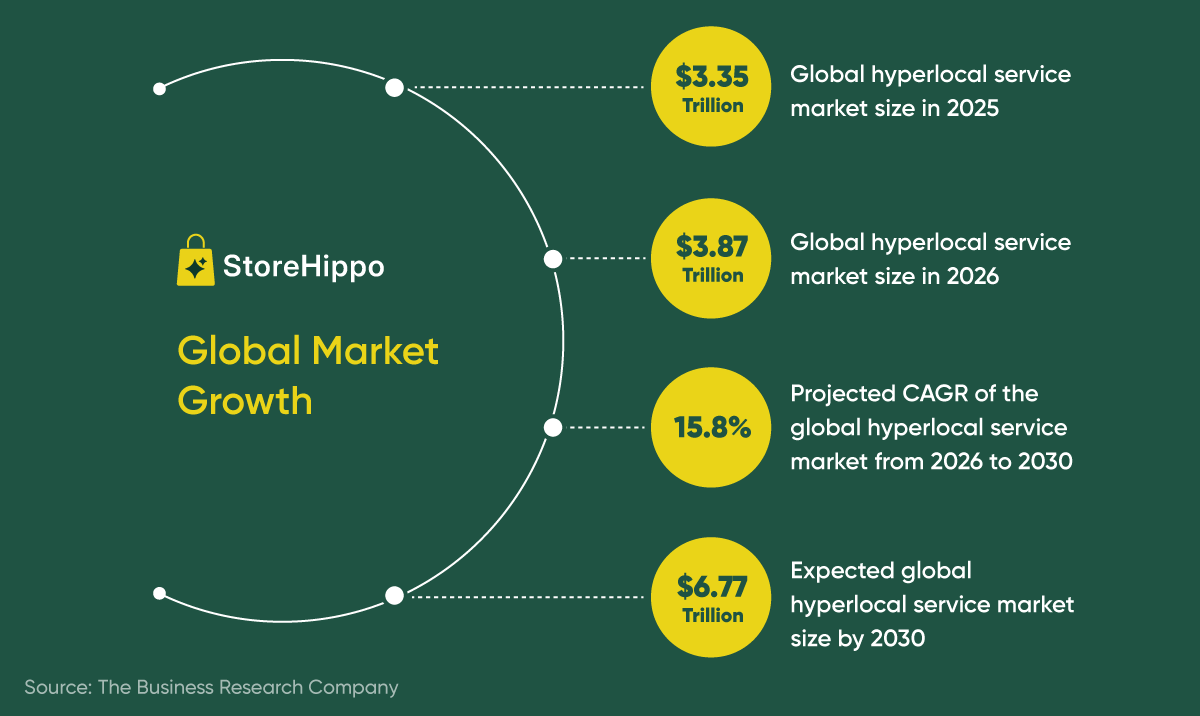
- $3.35 Trillion was the global hyperlocal service market size in 2025
- $3.87 Trillion is the global hyperlocal service market size in 2026
- 15.8% is the projected CAGR of the global hyperlocal service market from 2026 to 2030
- $6.77 Trillion is the expected global hyperlocal service market size by 2030
Source: The Business Research Company
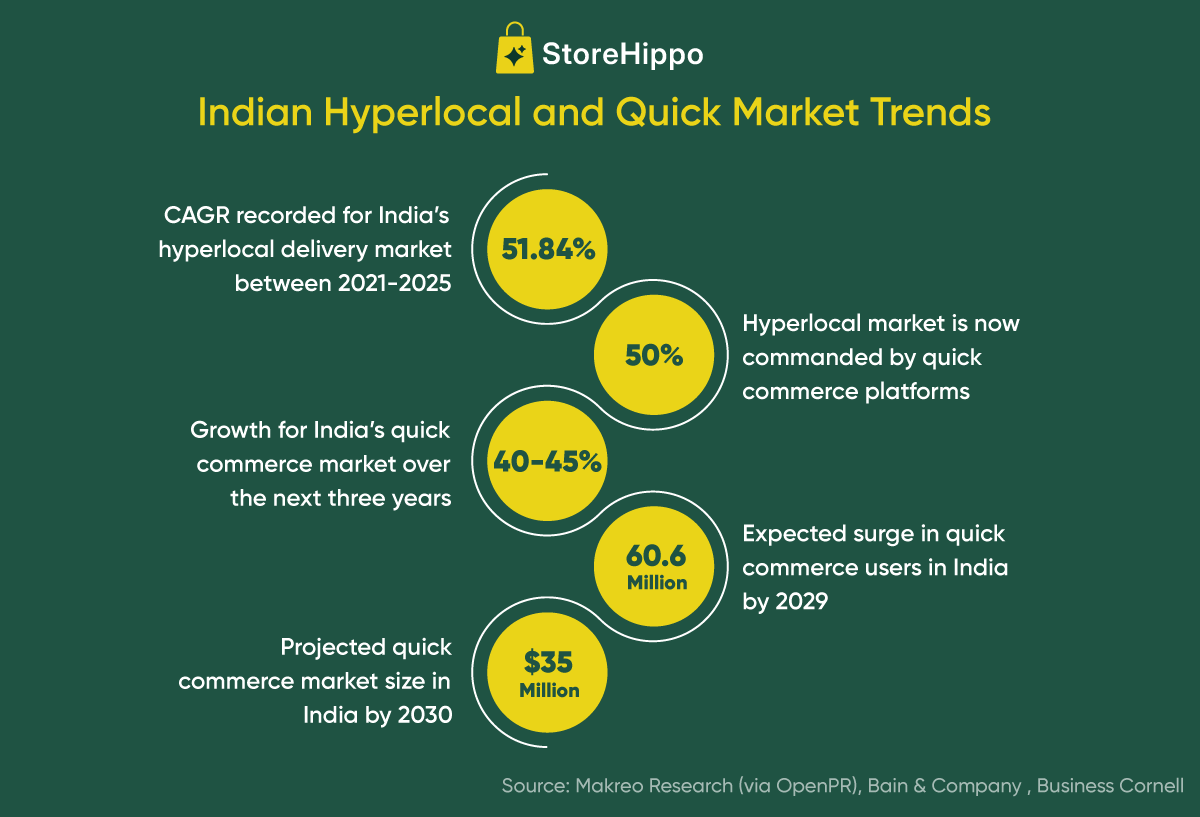
- 51.84% CAGR recorded for India’s hyperlocal delivery market between 2021-2025
- 50% of the hyperlocal market is now commanded by quick commerce platforms
- 40-45% expected growth for India’s quick commerce market over the next three years
- 60.6 million is the expected surge in quick commerce users in India by 2029
- $35 billion is the projected quick commerce market size in India by 2030
Source: Makreo Research (via OpenPR), Bain & Company , Business Cornell
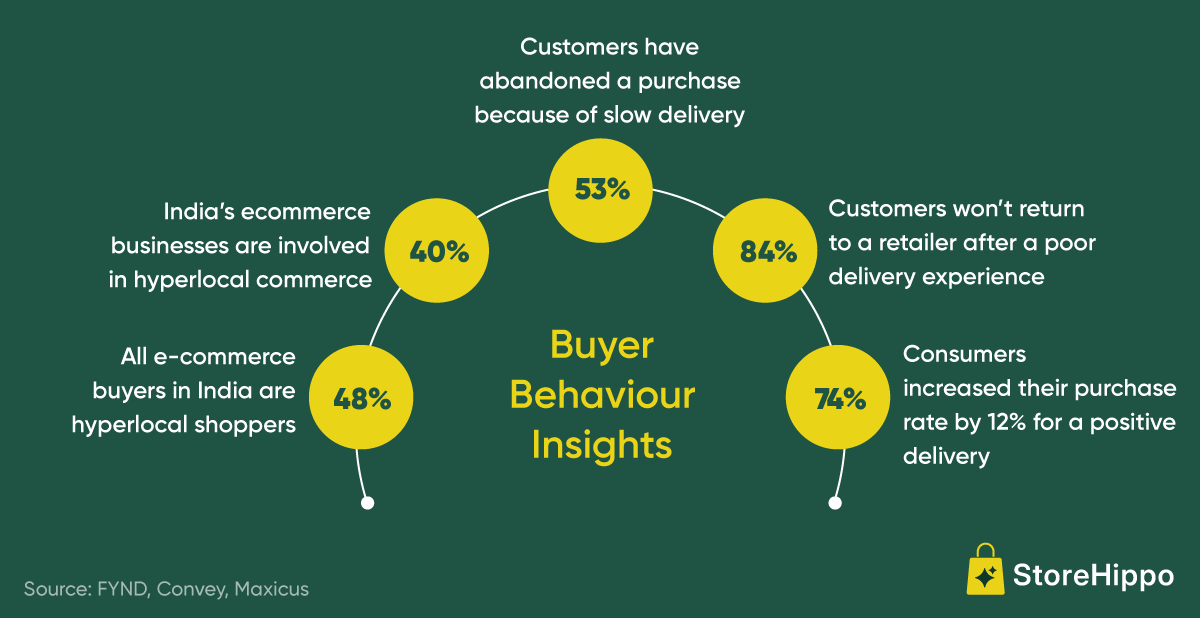
- 48% of all e-commerce buyers in India are hyperlocal shoppers
- 40% of India’s ecommerce businesses are involved in hyperlocal commerce.
- 53% of customers have abandoned a purchase because of slow delivery
- 84% of customers won’t return to a retailer after a poor delivery experience
- 74% of consumers increased their purchase rate by 12% for a positive delivery
Source: FYND, Convey, Maxicus
From these data, one thing is clear: Hyperlocal commerce has all the attention today and is only going to see a surge in the coming years. As modern customers are more conditioned to convenience and expect brands to provide them super-fast deliveries, enterprises that invest in hyperlocal ecommerce can unlock significant growth opportunities. And the journey of building a successful hyperlocal online marketplace starts with choosing the right enterprise ecommerce platform.
10 FAQs to Find the Best Ecommerce Platform for Hyperlocal Ecommerce
Let us look at some of the most important questions enterprises should ask before selecting an enterprise ecommerce platform for their hyperlocal business.
1. What features should enterprises look for when choosing an enterprise ecommerce platform for hyperlocal selling?
Enterprises should look for built in multistore solution, dealer management, real-time inventory visibility, automated order routing, Multilingual support, and hyperlocal delivery solutions, in an enterprise ecommerce platform to build a successful hyperlocal marketplace. They should also look for a central admin dashboard in the platform to get centralised control across multiple stores while delivering localised catalogues, pricing, promotions, and fulfilment experiences for different regions. These features enable hyperlocal selling and help cater to the specific needs of customers in different regions.
Platforms like StoreHippo are designed with native hyperlocal ecommerce capabilities that enable businesses to create multiple storefronts, each with unique layouts, themes, and visibility for different buyer segments and locations, managed from a common central admin. Enterprises can showcase products, inventory, pricing, and offers tailored to specific geolocations or PIN codes. StoreHippo’s multilingual capabilities help enterprises build multilingual stores to connect with buyers in their native language. StoreHippo comes with built in discount engine which enables enterprises to create location-based offers, promotions and deals to attract local customers. Businesses can run targeted campaigns for specific PIN codes, buyer segments, or storefronts while managing everything from a central admin.
StoreHippo also offers pre-integrated hyperlocal and intercity logistics partners that ship across various geographies. Enterprises can also add a custom delivery partner or manage local delivery agencies using API based integrations easily right from their admin panel. It's built-in order routing automatically directs orders to the closest store. These StoreHippo features help enterprises launch scalable hyperlocal ecommerce platforms and manage operations without relying on complex third-party integrations.
2. How important is location-based product discovery for a hyperlocal ecommerce setup?
Location-based product discovery is critical for hyperlocal ecommerce because it enables customers to only see products available within their serviceable area. This improves delivery speed, reduces order cancellations, prevents fulfilment issues, and creates a smoother buying experience by connecting buyers with nearby stores or sellers that can fulfil orders quickly.
An ecommerce platform built for hyperlocal operations should enable businesses to create multiple location-wise online stores or dealer-based substores so that customers only see products available in their serviceable area. This improves delivery efficiency, reduces order cancellations, and ensures a seamless buying experience.
Platforms like StoreHippo enable enterprises to create a master catalogue with complete inventory from all sellers and then allocate location-based product catalogues for different sub-stores. Once location-based substores are set up, diverse products are assigned to specific substores. This ensures customers only discover products available in their location, making hyperlocal shopping faster and more efficient.
3. Can an enterprise ecommerce platform manage multiple neighbourhood stores or local sellers from one system?
Yes, but only if the enterprise ecommerce platform comes with built-in multi-store and multi-vendor capabilities from the start. Hyperlocal businesses often operate through multiple neighbourhood stores and local dealer networks, so managing all stores and sellers from one place becomes essential for smooth operations and delivering a consistent customer experience across regions.
A future-ready hyperlocal ecommerce platform should enable businesses to create multiple location-based stores while managing catalogues, pricing, and operations from one unified admin dashboard.
StoreHippo provides built-in multi-store capabilities that enable enterprises to manage multiple location based sub stores or onboard local sellers from various geographies from a single dashboard. Each store can operate independently while the central admin retains full control over operations, catalogues, and order management.
4. Will it be possible to manage real-time inventory visibility across multiple neighbourhood stores in a hyperlocal ecommerce set up?
Yes. This is possible with a hyperlocal ecommerce platform that offers real-time inventory syncing across all neighbourhood stores and sellers from one central dashboard. The platform automatically updates stock availability across locations whenever customers purchase, restock, return, or transfer products, ensuring accurate inventory visibility across the entire network.
A future ready hyperlocal ecommerce platform should offer real-time inventory syncing across all stores and sellers in the network. This ensures that whenever a product is purchased or restocked, the inventory updates instantly across the system.
Enterprise ecommerce platforms like StoreHippo provide real-time inventory management across multiple stores and vendors, ensuring accurate stock visibility and preventing overselling. This allows businesses to fulfil hyperlocal orders quickly while maintaining a reliable customer experience.
5. How well does the hyperlocal ecommerce platform support mobile-first and conversational shopping experiences for local customers?
Choose an enterprise ecommerce platform built on a mobile-first architecture to offer mobile-ready conversational shopping experiences. The platform should offer built-in capabilities to create mobile apps, PWA storefronts, and AI-powered conversational buying journeys that help customers browse, order, and interact seamlessly across smartphones, low-bandwidth networks, WhatsApp, and chat-based interfaces.
Globally, mobile devices have become the dominant channel for digital commerce. As of early 2026, over 70-78% of all online shopping orders, including hyperlocal services, are placed via smartphones. For hyperlocal businesses, mobile-first experiences are critical as customers expect fast, convenient ordering directly from their phones.
In high-growth markets like India, mobile adoption is even stronger. Nearly 80% of online orders in India are placed through mobile devices, and in many Tier-2 and Tier-3 cities, mobile apps are often the primary or even the only channel used for online shopping and hyperlocal orders.
However, building mobile apps from scratch involves long development cycles, delayed go-to-market timelines, and high maintenance costs. Enterprises planning to choose a hyperlocal business model should therefore choose an ecommerce platform that offers built-in tools to create mobile apps and conversational buying interfaces, such as chat-based shopping.
StoreHippo is built on a mobile-first architecture and offers a built-in mobile app builder that enables businesses to launch Android and iOS apps quickly and directly from the admin dashboard. Enterprises can also create PWA storefronts to deliver seamless hyperlocal services even in remote areas with low network connectivity. StoreHippo also offers built-in apps for admin and sellers, and custom delivery boy app to manage business on the go.
In addition, StoreHippo supports conversational shopping experiences by enabling enterprises to build custom AI shopping assistants that guide customers through product discovery and checkout directly through chat interfaces.
6. What role does AI play in improving hyperlocal ecommerce experiences?
AI helps hyperlocal ecommerce businesses automate operations, personalise buyer journeys, improve product discovery, and optimise fulfilment efficiency. Enterprises should choose an AI-powered ecommerce platform that offers intelligent search, automated cataloguing, personalised recommendations, and conversational shopping capabilities to simplify buying journeys and manage hyperlocal operations more efficiently at scale.
For hyperlocal businesses managing multiple locations, large catalogues, and real-time deliveries, a future-ready enterprise ecommerce platform must include built-in AI capabilities. These include automated catalogue management, intelligent product discovery, personalised recommendations, and conversational shopping assistance that helps buyers quickly find what they need within their local service areas.
AI-powered ecommerce platforms like StoreHippo offer capabilities such as AI-driven cataloguing that help businesses generate product titles and descriptions, automate tagging, and organise catalogue data more efficiently. It also includes semantic search that understands buyer intent and delivers relevant results even when users do not type exact keywords. AI-powered recommendations further personalise the shopping journey by suggesting products based on browsing patterns, past purchases, and location preferences.
Additionally, enterprises can build AI-powered conversational assistants that help buyers search, compare, and discover products through natural interactions. These assistants can guide shoppers through the purchase journey and support multilingual conversations, making hyperlocal ecommerce experiences faster, more intuitive, and easier to manage at scale.
7. Is it possible to automatically assign orders to the nearest dealer or delivery partner in hyperlocal e-commerce?
Yes, if the hyperlocal ecommerce platform comes with built-in automated order routing feature. Automated order routing ensures that each order is assigned to the nearest dealer that has the product in stock. This reduces delivery time, lowers logistics costs, and improves order fulfilment efficiency.
Enterprise ecommerce platform like StoreHippo includes built-in order routing that automatically directs orders to the nearest store or fulfilment centre. This helps hyperlocal businesses deliver faster while optimising operational efficiency.
8. What logistics and delivery integrations are essential for running a successful hyperlocal ecommerce business?
A successful hyperlocal ecommerce business requires a platform that supports multiple logistics integrations, custom delivery management, real-time shipment tracking, and automated fulfilment workflows. The platform should also support same-day, scheduled, and quick delivery models to help enterprises manage faster and more efficient hyperlocal deliveries at scale.
Efficient logistics is critical for hyperlocal ecommerce because deliveries often happen within hours, on the same day, or the next day. Enterprises need flexible delivery options that can support quick commerce, same-day deliveries, and scheduled deliveries.
StoreHippo is one of the best enterprise ecommerce platforms for hyperlocal services. It offers 30+ pre-integrated shipping partners for hyperlocal and intercity deliveries. Enterprises can also integrate their own fleet of delivery boys to ensure smooth and quick shipping of their products. The platform also supports automatic order routing to the nearest dealer or store for faster fulfilment.
Additionally, StoreHippo enables customers and delivery agents to pin exact locations on Google Maps for quicker and more accurate deliveries. This helps hyperlocal businesses streamline delivery operations while ensuring faster order fulfilment.
9. Can we manage delivery zones, serviceable PIN codes, and delivery time slots on a hyperlocal ecommerce marketplace?
Yes. Modern hyperlocal ecommerce marketplace solutions that come with geo-fencing and customisable delivery features allow businesses to manage delivery zones, serviceable PIN codes, delivery radiuses, and delivery time slots from a central dashboard. This helps brands configure location-specific fulfilment rules, optimise delivery operations, and offer accurate delivery experiences across different cities, regions, and service areas..
Managing delivery zones and serviceable areas is one of the most important operational requirements in the hyperlocal ecommerce business model.
This ensures that customers can only place orders from locations where delivery is available.
Platforms like StoreHippo provide built-in tools to configure delivery zones, serviceable PIN codes, and time slots for each store or location. This enables enterprise businesses to maintain complete control over hyperlocal deliveries and avoid logistical inefficiencies.
10. What should enterprises evaluate to ensure their hyperlocal ecommerce platform can scale to multiple cities in the future?
Enterprises should choose a cloud-based, MACH and API based enterprises ecommerce platform that can support expansion across multiple cities without performance issues. The platform should also support multi-store operations, location-based catalogues, regional fulfilment workflows, and centralised management to help businesses scale smoothly across regions.
Hyperlocal businesses often start in one city but quickly expand to multiple regions as demand grows. This makes scalability a critical factor when choosing a hyperlocal ecommerce platform.
Enterprises should evaluate whether the enterprise ecommerce platform supports a location based multi store network, location-specific catalogues, and seamless onboarding of new vendors, sellers, or stores across regions.
StoreHippo is built on MACH architecture and support location-based multi-store networks, enabling enterprises to easily scale their hyperlocal operations across cities. Businesses can launch new city-specific stores, configure regional delivery zones, and onboard local sellers while managing everything from a single unified dashboard. This flexibility allows enterprises to expand rapidly while maintaining operational efficiency and a consistent customer experience. As brands grow further, they can also expand their hyperlocal model globally. With built-in multi-currency, multilingual storefronts, and multiple payment gateway options, enterprises can launch hyperlocal operations across multiple countries while delivering localised buying experiences to customers in different regions.
Conclusion
Hyperlocal ecommerce is rapidly transforming the way businesses connect with customers by offering fast, location-based shopping experiences.
However, to successfully build and scale a hyperlocal business, brands need the best ecommerce platform that can handle complex operations like multi-store management, local deliveries, inventory coordination, and omnichannel selling.
By asking the right questions and choosing a robust enterprise ecommerce platform, businesses can build a powerful hyperlocal ecommerce ecosystem that delivers exceptional customer experiences while driving sustainable growth.
Ready to launch your hyperlocal ecommerce brand?
Explore the advanced capabilities of StoreHippo and book your personalised demo today.
Binny Joseph is a seasoned ecommerce and enterprise growth leader, serving as Senior Vice President of Sales & Alliances with deep experience helping global brands adopt modern commerce solutions.
He writes about hyperlocal ecommerce, enterprise commerce, and the technology strategies businesses need to build scalable, location-aware commerce ecosystems that deliver faster fulfilment and better customer experiences.