


Well, the B2B digital landscape continues to evolve at a breakneck speed.
Wonder what the success mantra is?
Unleashing the full potential of innovation, adaptability, and strategic foresight to keep your business future-ready.
But are you prepared to navigate the constantly shifting tides of B2B ecommerce trends?
Is your enterprise ecommerce platform well-equipped to not just survive but thrive in the ecommerce landscape?
If your answer is yes, join us as we dive deeper into the essential strategies and insights to keep your B2B boat afloat and create a B2B marketplace website that is future-ready.
Table of Contents
B2B Ecommerce Growth and Buying Trends
The B2B ecommerce landscape has rapidly evolved into a highly competitive, digital-first ecosystem driven by AI, personalisation, and omnichannel experiences. What was once a simple online selling model has now transformed into a complex, data-driven marketplace environment where buyer expectations are continuously rising.
Amidst this rapid shift, simply going digital is no longer enough. The real challenge lies in building a B2B marketplace website that delivers seamless, personalised, and consistent experiences across every touchpoint, while scaling efficiently.
To stay ahead and carve a strong niche, enterprises must align their marketplace strategy with evolving buyer behaviour, mobile-first interactions, AI-driven discovery, and composable commerce capabilities.
Here are the key B2B ecommerce trends shaping the future of digital commerce
Here are some insights to help you get started:
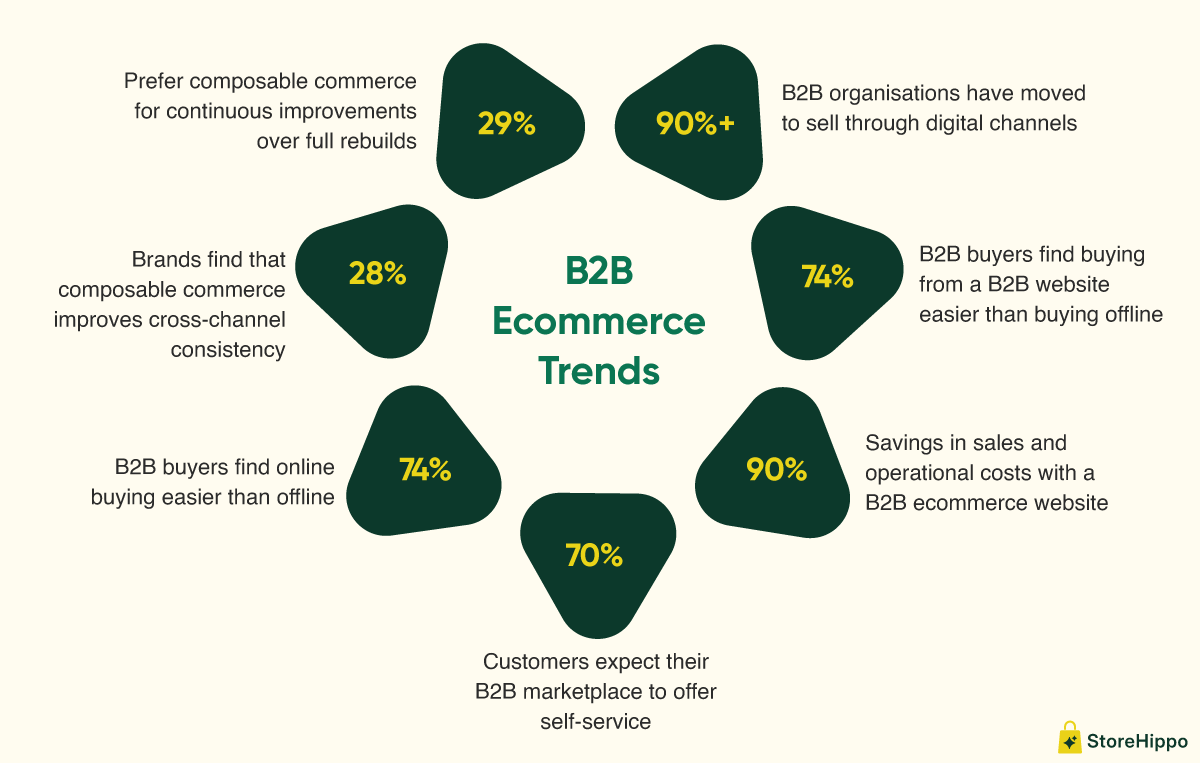
- 90%+ of B2B organisations have moved to sell through digital channels
- 74% of B2B buyers find buying from a B2B website easier than buying offline
- 90% savings in sales and operational costs with a B2B ecommerce website
- 70% of customers expect their B2B marketplace to offer self-service
- 74% of B2B buyers find online buying easier than offline
- 28% of brands find that composable commerce improves cross-channel consistency
- 29% prefer composable commerce for continuous improvements over full rebuilds
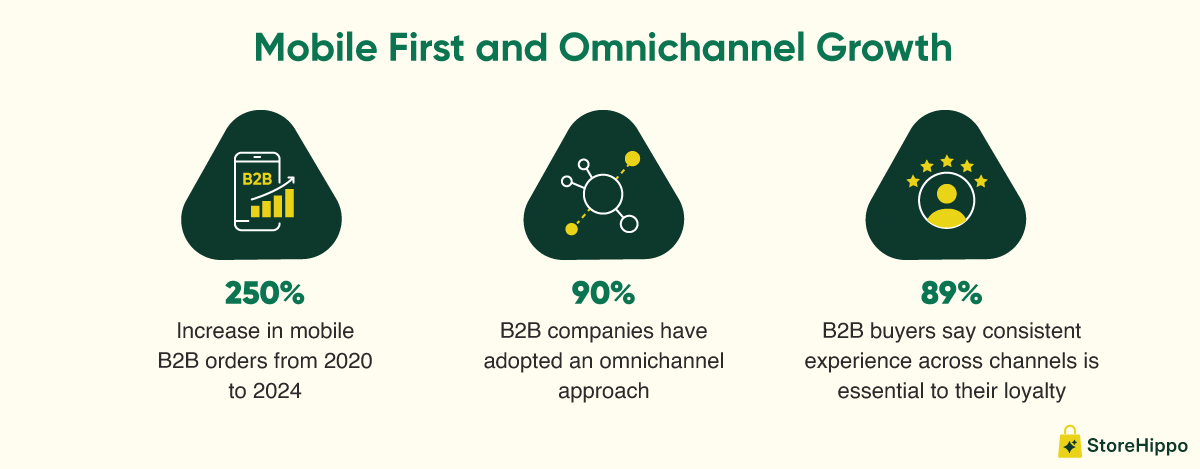
- 250% increase in mobile B2B orders from 2020 to 2024
- 90% of B2B companies have adopted an omnichannel approach
- 89% of B2B buyers say consistent experience across channels is essential to their loyalty
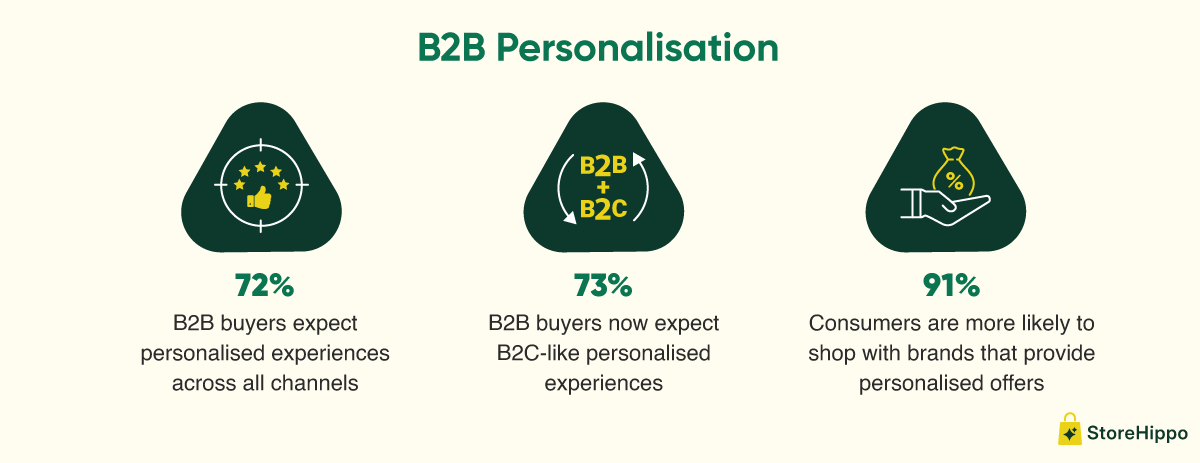
- 72% of B2B buyers expect personalised experiences across all channels
- 73% of B2B buyers now expect B2C-like personalised experiences
- 91% of consumers are more likely to shop with brands that provide personalised offers
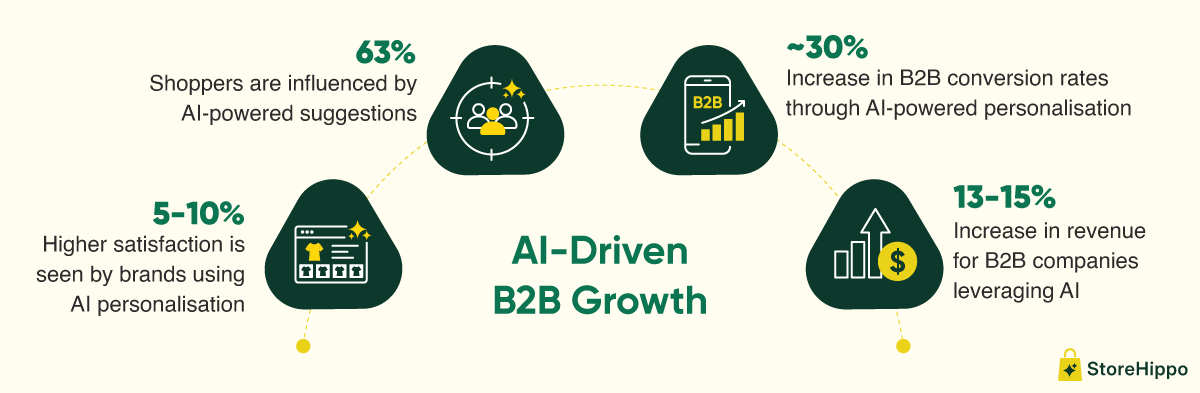
- 63% of shoppers are influenced by AI-powered suggestions
- 5-10% higher satisfaction is seen by brands using AI personalisation
- ~30% increase in B2B conversion rates through AI-powered personalisation
- 13-15% increase in revenue for B2B companies leveraging AI
Source: Forbes, McKinsey & Company, Digital Commerce 360, Gartner, LinkedIn, Priority Research, Statista, HelloRep
The latest B2B ecommerce trends highlight a clear shift towards AI-driven, mobile-first, and highly personalised experiences. To stay competitive, enterprises must build scalable, omnichannel marketplaces that deliver seamless buying journeys and adapt to evolving customer expectations.
Top 5 B2B Ecommerce Trends to Keep Your Enterprise Marketplace Future-Ready
In this blog, we bring you 5 ecommerce trends in the B2B world that are going to make your enterprise marketplace future-ready. It is time to witness the mega-change in your marketplace as you incorporate the top 5 B2B ecommerce trends:
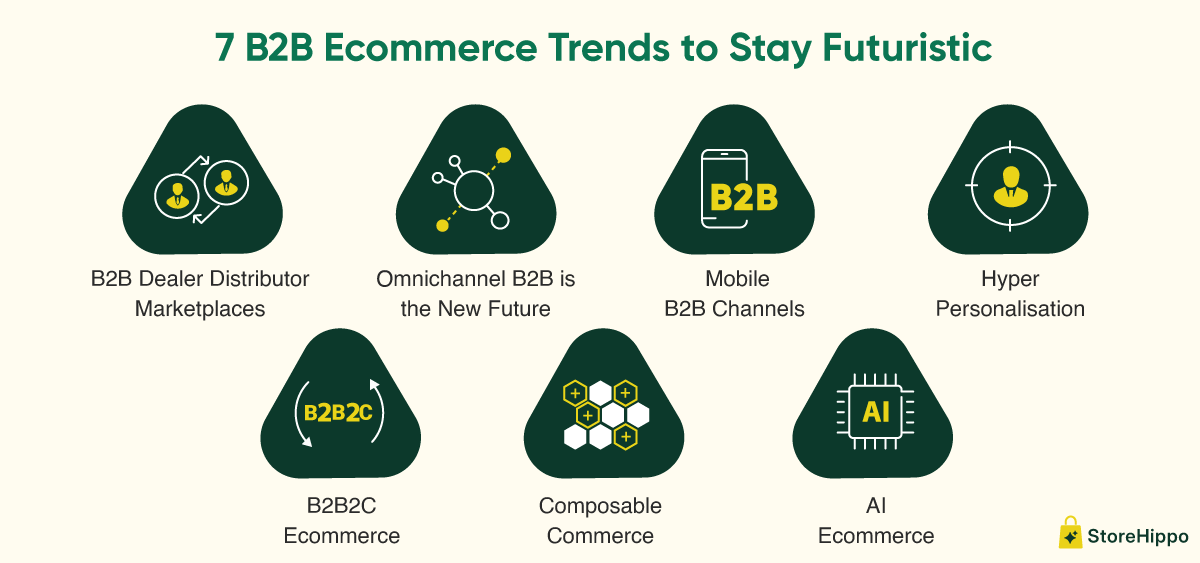
1. B2B Dealer Distributor Marketplaces will Accelerate Growth
As the B2B industry is gravitating towards online means of buying and selling, the key to increased profit margins is building a B2B dealer distributor marketplace. The stepping stone includes understanding market needs and bringing your dealers online. However, once you have done that, you also need to introduce efficiencies and expedite deliveries. You can grow your enterprise B2B marketplace by onboarding multiple dealers, who bring in expertise about the market and help you target buyers better.
StoreHippo B2B ecommerce solution comes with an end-to-end vendor management solution that offers a quick and easy distributor registration process. You can create a unique dashboard for each vendor on your dealer-distributor marketplace. A separate dashboard helps your distributors manage their product catalogue, orders, inventories, returns, etc. As an admin, you can stay on top of the B2B ecommerce trends by easily managing your sellers, payouts, commissions, taxes, discounts, etc. right from your admin dashboard. StoreHippo is built on a future-ready MACH architecture that offers inherent flexibility and scalability for your enterprise business. You can seamlessly tweak the platform inside out to build tailor-made solutions and create new entities without disturbing the entire business ecosystem.
2. Omnichannel B2B is the New Future
B2B ecommerce buying and selling has been influenced by B2C-like shopping experiences. With more and more retail brands offering omnichannel buying experiences, B2B brands are no longer limited to a single sales channel. By selling omnichannel, B2B brands can open up new sales channels and opportunities that help them explore new markets and connect with a wider audience base.
When you create a B2B marketplace website for your business, streamlining seamless buying experiences across different sales channels should be your priority so buyers stay connected and engaged with your brand. To ace omnichannel B2b selling you need the right ecommerce solutions at hand, you can create cutting-edge omnichannel buying experience.
StoreHippo ecommerce solutions are built on a decoupled headless architecture that comes with a ready-to-use omnichannel ecommerce solution. You can seamlessly create new customer touchpoints using the same backend logic and APIs with StoreHippo. You can also manage all your sales channels seamlessly using a common central dashboard on your B2B marketplace with StoreHippo B2B ecommerce solutions. StoreHippo also helps you improve the operational efficiency across all channels and get access to better customer insights so you leverage the best-performing sales channel.
3. Mobile B2B Channels will Rule
Well, long gone are the days when B2B transactions were done traditionally and offline. The B2B buyers today are accustomed to mobile shopping, just as B2C or D2C buyers. With the advancements in the B2B ecommerce trends, you need a marketplace that is also available for your buyers on their mobile phones.
Mobiles have of-late become the primary sales channel for customers all around the world, making mobile presence a must-have feature for B2B brands. To make your brand future-ready you need to be present for your buyers across multiple mobile channels like mobile ready sites, marketplace apps, and PWA sites. To stay ahead of the curve, you need to create a marketplace that also offers mobile-ready solutions for all the parties involved, i.e; the sellers/distributors, buyers as well as the admin(s).
StoreHippo is built on a mobile-first technology that comes with a built-in mobile app builder. You can create multiple mobile apps right from your admin dashboard at zero additional costs and without any coding with StoreHippo enterprise ecommerce platform. You can also offer mobile admin dashboard for admins, vendors, distributors, delivery boys etc with StoreHippo mobile commerce solutions. When you build an online marketplace with StoreHippo, the best multi vendor platform, you create PWA business-to-business stores that look, feel, and work like mobile apps even on entry level devices and in poor internet connectivity.
4. Era of Hyper-Personalisation
Well, the key to making your B2B enterprise marketplace future-ready lies in how you create a long-standing relationship with your customers. The modern-day B2B ecommerce trends are all about personalisation, right from the UI/UX of the website to prices, customised catalogues, discounts, and deals. Buyers expect everything to be tailor-made to their unique needs. Yes, creating a personalized seamless buyer journey allows your enterprise B2B brand to scale to greater heights. The future of ecommerce is faster sales and automated business processes. To future-proof your business, you can offer personalised recommendations to your customers pushing them to buy items related to their search.
Built on MACH architecture, StoreHippo B2B ecommerce solutions give you better creative control and agility to implement multi level personalisations. With StoreHippo’s built-in features like drag-and-drop design tools, pricing overrides, discount engine, multilingual, multi-currency, etc. you can implement multi-level personalisations on your marketplace. The price override feature helps you offer personalised product prices based on customer segments and locations. With the built-in discount engine from StoreHippo, you can create personalised discounts and offers for your buyers. You can send out personalised notifications to your buyers with the PUSH notification feature and recover abandoned carts seamlessly with StoreHippo enterprise ecommerce platform.
5. Diversify with B2B2C Ecommerce
If you are planning to broaden your B2B business’ client base, a simple hack is to go B2B2C. You got it right, this singular decision can grow your business manifold and also give you a goldmine of data and analytics for strategic business growth.
With a dealer/vendor-based set up you already have everything needed to serve the end buyers, you just need to set up a separate store where your vendors can sell directly to the end buyers. For example, if your B2B brand builds security equipment like cameras, alarms, etc, and has builders and property dealers as your clients, you can use your vast network of vendors to sell your products to individual households.
With StoreHippo ecommerce solutions, you can seamlessly create a B2B marketplace website that can be diversified to a B2B2C ecommerce business model. With advanced ecommerce solutions from StoreHippo, you get access to a gamut of analytical tools that help you analyze your customer segmentation and offer direct access to rich customer insights. Using these customer data, you can plan data-centric business growth strategies that help boost orders. The headless architecture from StoreHippo helps brands build a range of horizontal, vertical, B2B, B2C, D2C, B2B2C, hybrid, or custom marketplaces in no time.
B2B Ecommerce Trends 2026- Composable Commerce Ecosystems for B2B Enterprises Of Future
B2B ecommerce is undergoing a fundamental shift and at the heart of it is composable commerce. Gone are the days of one-size-fits-all platforms. Today’s future-ready B2B enterprises are choosing agility over rigidity, modularity over monoliths and innovation over outdated workflows.
As one of the most defining B2B ecommerce trends, composable commerce ecosystems are enabling enterprises to rapidly adapt to changing buyer expectations, integrate best-of-breed solutions and build tailored ecosystems that evolve with their growth. It's not just a trend it's a strategic necessity for businesses that want to scale smarter and stay competitive in a fast-moving digital landscape.
What is Composable Commerce?
Composable commerce is like building your own custom ecommerce ecosystem using the best tools for each job. Instead of relying on a single, inflexible system, you can “compose” unique ecommerce solutions for your brand by integrating best-of-breed components
You pick and plug in the best CMS, payment system, logistics partner, ERP, or marketing tools, whatever fits your unique business flow.
This flexible, plug-and-play model is especially helpful when you are planning to create a B2B marketplace website, where things like bulk orders, dynamic pricing, custom catalogues, and negotiation-based sales are the norm. With composable commerce, businesses can move fast, adapt easily and scale smarter as their needs evolve.
But while ideal and future-ready, composable commerce demands a platform that’s truly open, modular, and built for integration, not every platform can support this level of flexibility. That’s exactly where StoreHippo stands out, offering a fully composable architecture that lets B2B enterprises build, adapt, and scale their commerce ecosystem on their own terms.
StoreHippo isn’t trying to catch up with composable commerce, it was built for it from the start. With a flexible, API-first, headless setup, it lets B2B brands plug in only what they need, like order management, vendor flows, or third-party tools, without being tied to one rigid system. You can scale easily, whether it’s one store or a full network of marketplaces, thanks to its microservices-based architecture. And if your business needs custom pricing, workflows, or approvals, you can set them up quickly without any hacks. It’s a platform that keeps you agile, so you can respond to change without rebuilding from scratch.
Unlike legacy platforms where modularity was an afterthought, StoreHippo was designed from the ground up for composability. With its API-first, headless and microservices-based architecture, it offers an enterprise ecommerce platform for B2B brands to pick and integrate only what they need, be it their software, service providers, languages, currencies or more.
StoreHippo is built to scale effortlessly to millions of users, without compromising performance and staying agile and secure all the while. Whether you are integrating complex supply chains or launching new-age marketplace stores in multiple locations and across channels, StoreHippo offers the flexibility to innovate, adapt and grow without rebuilding from scratch.
This kind of composability ensures that B2B enterprises stay nimble and respond to new market demands every time.
Stay Ahead Of B2B Ecommerce Trends With AI Ecommerce
As B2B buying journeys grow more complex, AI Ecommerce is emerging as a game-changer in streamlining discovery, personalisation and decision-making. From smarter product search to auto-generated catalogues and dynamic product recommendations, AI-powered ecommerce is quickly becoming one of the most important B2B ecommerce trends to watch.
B2B buyers today expect speed, accuracy, and relevance. Whether they are ordering in bulk, negotiating deals or managing repeat purchases, wholesale buyers want same or better experiences than B2C buying. And in a space where time-to-quote and catalogue size can make or break a sale, AI is no longer optional, it is a competitive edge.
StoreHippo helps future-ready B2B enterprises stay ahead of the curve by offering native AI-powered Ecommerce tools right into the platform. Here is what you get on StoreHippo enterprise ecommerce platform:
- AI-Driven Product Cataloguing: Converts simple product images into complete, optimised listings which include titles, descriptions, HSN codes,etc, automatically. This simplifies listing and accelerates time-to-market by eliminating manual cataloguing tasks, ensuring consistency and SEO-ready product content at scale.
- AI Image Editing with Magic Edit: Built-in AI image enhancement tool Magic Edit helps to transform raw product images into stunning, market-ready visuals by clearing the background and adjusting the light and aspect ratio. This improves catalogue quality and buyer engagement without design overhead.
- AI-Powered Product Recommendations: AI powered recommendation suggests relevant products to buyers based on their behaviour, purchase history, and real-time preferences, driving higher conversions and increasing repeat sales.
- AI Semantic Search: AI-powered semantic search goes beyond basic keyword matching by understanding natural language queries and buyer intent, enabling accurate product discovery and driving higher conversions across large B2B catalogues.
- Custom Agentic AI Assistants: Custom AI chatbots can be built to offer a guided buyer journey to shoppers. These AI assistants can be made multilingual and voice-enabled to offer seamless, personalised, and intuitive buying experiences across diverse customer segments.
- AI-Powered Core: All AI capabilities run on a unified intelligence layer, enabling insights to seamlessly flow across catalogues, discovery, operations, and support, eliminating silos and driving more consistent, data-driven experiences.
Together, these AI Ecommerce capabilities don’t just optimise performance but create intuitive, hyper-personalised B2B experiences that further help in monetising B2B ecommerce trends.
Conclusion
Future-proofing your enterprise marketplace goes beyond going digital, it demands a strategic shift to create B2B ecommerce solutions that can keep your brand ahead of the curve. By, blending the flexibility offered by composable commerce with AI- intelligence, a multichannel presence and focus on m-commerce your B2B marketplace can delivers personalised, B2C-like experiences. This empowers your enterprise to stay agile, exceed evolving buyer expectations, and unlock sustainable long-term growth.
StoreHippo enterprise ecommerce platform comes with ecommerce solutions that help you build conversion-oriented B2B marketplace for your brand. It comes with a host of features and tools to help you keep up with the latest B2B ecommerce trends and carve a niche for your enterprise brand in the B2B ecommerce world. The 300+ enterprise-grade features, inherent flexibility and unmatched scalability helps you build tailor-made solutions for your B2B brands.
It's time to future-proof your enterprise ecommerce B2B business with StoreHippo B2B ecommerce solutions. Explore the wide range of features by booking your free demo now.
FAQs
1. How can enterprises identify which B2B ecommerce trends are most relevant to their marketplace growth?
Not every trend delivers equal value for every business. Enterprises must evaluate B2B ecommerce trends based on their business model, buyer behaviour, and operational complexity. For instance, businesses with large distributor networks may benefit more from dealer-distributor marketplace models, while those targeting multiple buyer segments should prioritise personalisation and omnichannel capabilities.
StoreHippo enterprise ecommerce platform is built to support multiple business models. It enables businesses to experiment and scale across B2B, D2C, B2C, B2B2C, hyperlocal and hybrid business models, helping them adopt the market trends without rebuilding their ecosystem.
2. What challenges do enterprises face when trying to create a future-ready B2B marketplace website?
The biggest challenge lies in balancing scalability with flexibility. Many enterprises struggle with rigid platforms that cannot adapt to evolving B2B ecommerce trends like composable commerce, AI-driven personalisation, or multi-channel selling. This leads to slow innovation and fragmented buyer experiences.
StoreHippo is built on MACH architecture, which offers unmatched flexibility and scalability to enterprises. Its API-first, headless architecture allows enterprises to customise their business and build a tailored solution to evolve their marketplace without disrupting existing operations.
3. Why is mobile-first strategy critical for staying attuned to modern B2B ecommerce trends?
B2B buyers today increasingly rely on mobile devices for product discovery, ordering, and communication. A non-optimised mobile experience can directly impact conversions and repeat purchases.
StoreHippo offers advanced mobile solutions to enterprises to build mobile apps without coding and with no technical hassle. With its built-in mobile app builder, enterprises can build Android and iOS apps for their business, along with PWA stores to reach customers in low-connectivity areas. Enterprises can run and manage all the channels from a unified central admin.
4. How does composable commerce contribute to the growth and scalability of an enterprise ecommerce platform?
Composable commerce allows enterprises to build flexible ecosystems by integrating best-fit tools rather than relying on rigid, monolithic systems. This approach ensures faster innovation, easier upgrades, and better adaptability to new B2B ecommerce trends.
StoreHippo’s microservices-based architecture supports composability at scale, enabling enterprises to customise workflows, integrate third-party tools, and expand capabilities without system limitations.
5. Why is hyper-personalisation becoming essential in modern B2B ecommerce solutions?
Modern B2B buyers expect the same level of personalisation as B2C shoppers, including customised pricing, catalogues, and recommendations. Without personalisation, marketplaces risk losing engagement and repeat business.
StoreHippo enables multi-level personalisation through pricing overrides, discount engines, and AI-powered recommendations, helping enterprises deliver tailored experiences at scale.
6. How can enterprises ensure long-term scalability while adapting to evolving B2B ecommerce trends on an enterprise ecommerce platform?
Sustainable growth in B2B ecommerce requires a platform that evolves with changing trends without frequent rebuilds. Enterprises need scalability, flexibility, and automation built into the foundation.
StoreHippo enterprise ecommerce platform combines headless architecture, multi-store capabilities, and AI-driven automation to help businesses stay agile, scale globally, and future-proof their marketplace operations.