


Q-commerce has changed what customers expect from online shopping. They now look for products to be available nearby, orders to be processed quickly and deliveries to reach them within minutes. For enterprises, meeting these expectations requires more than simply offering faster delivery. It requires connected inventory, efficient fulfilment, streamlined logistics and technology that can support operations across multiple locations.
As quick commerce continues to grow, businesses also face a critical challenge: how to deliver speed without allowing operational costs and complexity to rise at the same pace. Expanding dark-store networks, coordinating local sellers, managing last-mile delivery and maintaining consistent customer experiences across channels can become increasingly difficult as the business scales.
This is why modern quick commerce platforms are moving beyond delivery speed alone. Enterprises are exploring dealer-powered hyperlocal models, unified commerce and AI-powered capabilities to build q commerce operations that are more flexible, efficient and scalable.
Before we look at how businesses can address these challenges, let’s first understand how the global quick commerce market is evolving.
Table of Contents
Q-Commerce Market Growth: Key Trends and Statistics
Unlike traditional ecommerce, Q-Commerce is built around speed and convenience. Customers expect products to be available when they need them and delivered quickly. As more people shifted to quick commerce for their everyday purchases, businesses also need to adapt their operations to keep up with these changing expectations.
Here are some key trends showing how the quick commerce industry is growing:
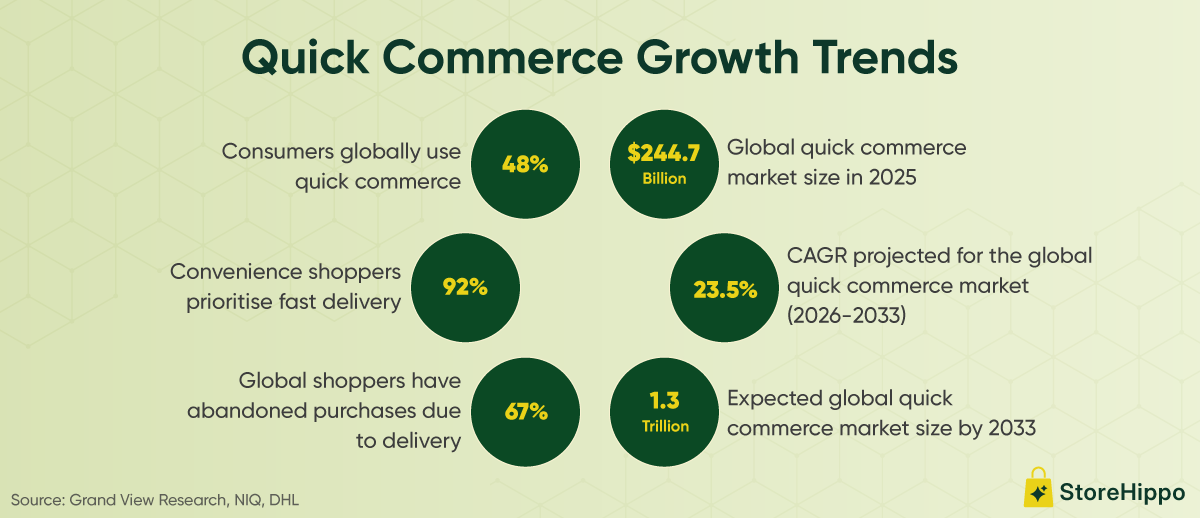
- $244.7 bn was the Global quick commerce market size in 2025
- 23.5% is the projected CAGR for the global quick commerce market from 2026 to 2033
- $1.3 trillion is the expected global quick commerce market size by 2033
- 48% of consumers globally use quick commerce
- 92% of global convenience shoppers prioritise fast delivery
- 67% of global shoppers have abandoned an online purchase because of delivery
Global Q-commerce services are expanding rapidly, driven by rising consumer preferences for speed, convenience, and seamless online shopping experiences. With nearly half of consumers already using quick commerce, delivery speed has become an important part of the overall customer experience. As the market continues to scale, businesses need agile technology, connected operations, and efficient fulfilment capabilities to keep pace with evolving expectations.
5 Q-Commerce Challenges and How StoreHippo Handles Them
With quick commerce platforms thriving on speed and efficiency, challenges like inventory mismanagement, last-mile delivery bottlenecks, real-time order processing etc. can slow down growth. Wondering how to handle them?
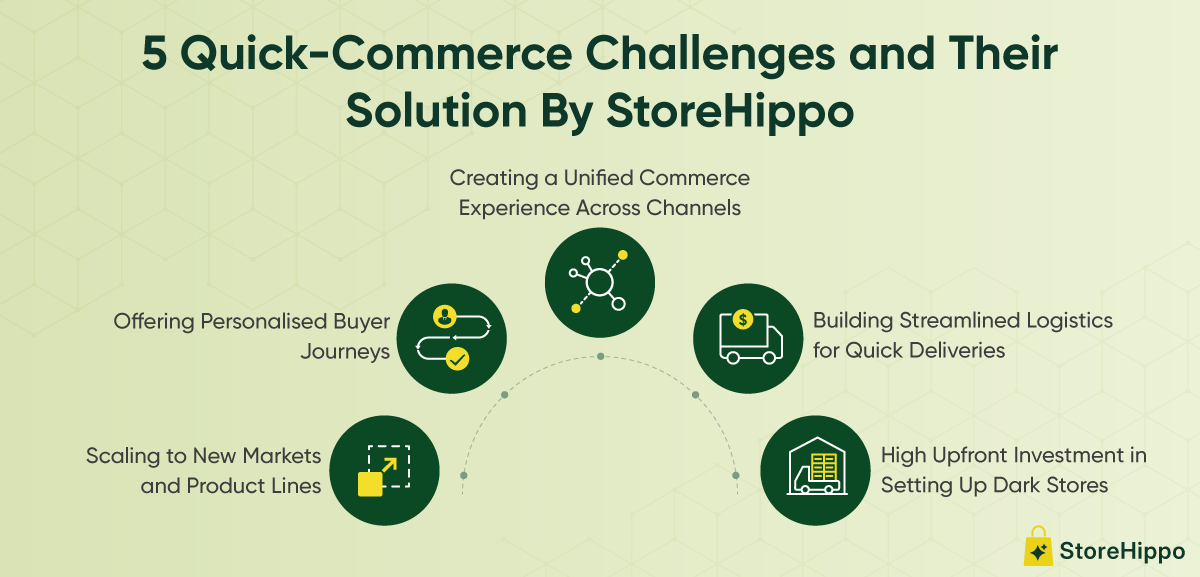
1. High Upfront Investment in Setting Up Dark Stores
One of the biggest challenges in quick commerce is the high cost of setting up and managing dark stores. Unlike traditional ecommerce, where orders can be shipped from a central warehouse, Quick-commerce businesses need inventory to be positioned closer to customers to enable faster deliveries. Setting up multiple dark stores across different locations can therefore require significant investment in commercial space, inventory, staff and daily operations.
For businesses looking to expand their quick-commerce operations, a dealer-powered model can offer a more flexible alternative. Instead of investing heavily in a network of dark stores, businesses can leverage their existing dealer and seller networks to serve customers within local markets.
StoreHippo helps businesses build and manage dealer-powered hyperlocal marketplaces with features such as:
- Multi-Vendor Marketplace: Businesses can onboard multiple dealers and sellers on a single marketplace, expand product availability across locations and leverage local inventory for faster fulfilment.
- Dealer and seller management: Connect multiple dealers and sellers and manage their operations through a centralised platform.
- Built-in Themes: Businesses can use ready-to-customise storefront themes to launch their Q-commerce store faster without investing in separate design and development resources.
- Dealer Network-Based Fulfilment: Businesses can leverage existing dealer and vendor networks, inventory and warehouses to fulfil hyperlocal orders without investing heavily in dedicated dark stores.
- Location-based inventory: Qcommerce enterprises can map inventory to specific locations and sellers to improve local product availability and fulfilment.
- AI-powered cataloguing: Businesses can generate product titles, descriptions, tags, HSN codes and other catalogue details from product images, reducing manual catalogue creation.
- Centralised catalogue management: Enterprises can maintain consistent product information across multiple sellers and locations from a unified master catalogue.
- Unified order management: Manage orders across different dealers and fulfilment locations through a single platform.
- Multi-business model support: Build Q-commerce operations alongside B2B, B2C, D2C, B2B2C and hybrid business models.
2. Building Streamlined Logistics for Quick Deliveries
Q-commerce businesses need to coordinate several operational activities to deliver orders within minutes. Having delivery partners alone is not enough. Businesses also need to manage order assignment, delivery boys, fleet operations and real-time order status while ensuring that the right products are available close to the customer.
As order volumes and fulfilment locations increase across dealer-powered hyperlocal marketplace, managing these activities manually can quickly become difficult. Businesses need a streamlined logistics setup that can assign orders efficiently, track deliveries in real time and coordinate fulfilment across multiple locations. This helps them maintain faster and more reliable deliveries as their qcommerce operations scale.
StoreHippo quick commerce solutions simplify logistics with:
- 30+ Pre integrated Logistics Providers: Enterprises can integrate with 30+ logistics providers which include, giving hyperlocal businesses the flexibility to choose delivery partners based on their operational needs.
- Smart Order Routing: Businesses can route orders efficiently based on factors such as location and fulfilment requirements.
- Automated Order Assignment: Orders can be assigned automatically to the appropriate fulfilment or dealer stores, reducing manual intervention.
- Centralised Inventory Visibility: Enterprises can monitor inventory across dealers and fulfilment locations from a centralised system, helping reduce stock-related inefficiencies and improve order fulfilment.
- Partial Fulfilment: Businesses can process orders based on product availability across different locations, helping fulfil orders efficiently when inventory is distributed.
- Order Tracking: Businesses can track order progress and provide customers with timely delivery updates.
- One-Click WhatsApp Fulfilment: Businesses can speed up dispatch workflows through WhatsApp while keeping customers updated throughout the order journey.
- Custom Delivery Boy Management Apps: Enterprises can build custom delivery boy apps that allow delivery agents to view and manage their assigned deliveries seamlessly.
3. Creating a Unified Commerce Experience Across Channels
Customers now interact with brands through multiple channels, from mobile apps and websites to WhatsApp and other digital touchpoints. For Q-commerce businesses, being available across these channels makes it easier for customers to shop through their preferred channel and enjoy a consistent, convenient experience.
However, keeping the experience consistent across all these channels can be challenging. Businesses need to keep product information, inventory, orders and customer interactions in sync, so customers can move from discovering a product to completing their purchase without any disruption.
StoreHippo quick commerce solutions help enterprises create a unified commerce experience across channels with:
- Built-in Mobile App Builder: Enterprises can build Android and iOS apps without coding requirements and provide customers with a dedicated mobile shopping experience.
- PWA Stores: Businesses can create Progressive Web Apps (PWAs) that offer an app-like shopping experience directly through the web.
- WhatsApp Commerce: Enterprises can extend their quick commerce presence to WhatsApp, enabling customers to discover and purchase products through a familiar channel.
- Voice Commerce: Businesses can enable voice-based shopping experiences, giving customers another convenient way to interact with their stores.
- Agentic AI Interfaces: Enterprises can customise and integrate pre-built agentic AI interfaces to support more intelligent and conversational shopping journeys.
- Location-Specific Mobile Apps: Global Q-commerce businesses can create multiple mobile apps based on location-specific sub-stores, enabling market-specific shopping experiences across countries.
- Unified Backend: Products, inventory, orders and customer experiences remain connected through a central backend, helping businesses maintain consistency across their selling channels.
- API-First, Scalable Architecture: StoreHippo's headless, API-first architecture enables enterprises to connect multiple channels, applications and systems while supporting evolving Q-commerce operations.
4. Offering Personalised Buyer Journeys
Customers expect personalised shopping experiences, especially in Q-commerce, where speed and convenience are crucial. Generic recommendations and one-size-fits-all promotions no longer work. Businesses must leverage data-driven insights to offer tailored product suggestions, customised pricing, and targeted marketing campaigns. However, managing personalisation at scale requires advanced technology, analytics, customer segmentation, and behaviour tracking. Without the right tools, businesses risk losing engagement and failing to convert one-time buyers into loyal customers.
StoreHippo's quick commerce platform helps enterprises deliver personalised buyer journeys with:
- AI-Powered Semantic Search: Shoppers can find relevant products using natural and conversational search terms, making product discovery faster and more intuitive.
- AI-Powered Recommendations: Businesses can recommend products based on buyer behaviour, intent and context, helping shoppers discover products that are more relevant to them.
- Custom AI Shopping Assistant: Enterprises can build custom AI shopping assistants that guide shoppers through product discovery and purchase using conversational interactions.
- AI-Powered Cataloguing: Businesses can create and optimise product content at scale, maintaining richer and more consistent product information across large Q-commerce catalogues.
- Personalised Pricing: StoreHippo’s rule-based pricing system enables businesses to offer customised pricing, discounts and promotions to different customer segments.
- Multi-Level Discount Engine: Businesses can create personalised discounts and coupon codes based on different customer or order-level rules.
- Targeted Marketing: Built-in marketing tools and integrations with marketing and analytics platforms help businesses create targeted campaigns for different buyer groups.
- Abandoned Cart Recovery: Businesses can re-engage shoppers who leave before completing their purchase through personalised emails and push notifications.
5. Scaling to New Markets and Product Lines
Local expansion is a key growth strategy for Q-commerce brands, but scaling operations to new markets and introducing new product categories comes with numerous challenges. Businesses must ensure that their infrastructure can handle increased order volumes and new fulfilment locations, and offer localised customer preferences.
One major challenge faced by brands planning to scale to new markets is overcoming the language barrier and managing supply chain hurdles. As businesses grow, they also need to support more sellers, channels and customer touchpoints without disrupting existing operations. Without a scalable and adaptable ecommerce solution, businesses risk operational bottlenecks, inefficiencies, and customer dissatisfaction as they grow.
StoreHippo dealer-powered hyperlocal marketplace platform helps enterprises scale their quick commerce operations with:
- Cloud-Native, Scalable Infrastructure: Businesses can expand their operations, product selection and customer base without having to re-platform as they grow.
- Multi-Store Ecommerce: Enterprises can create location-based sub-stores for different markets and manage them from a central platform.
- Multi-Language Support: Businesses can offer localised shopping experiences with multilingual ecommerce, helping them serve customers across different regions.
- Location-Based Catalogues: Enterprises can create unique product catalogues for individual stores or markets based on local demand and product availability.
- Store-Specific Pricing: Businesses can configure different pricing strategies for different locations, allowing them to adapt to local market conditions.
- Flexible Payment Options: Enterprises can offer market-specific payment options to make purchasing more convenient for local customers.
- Local Seller Onboarding: Businesses can onboard sellers in different markets and expand their product assortment without having to manage everything through a single fulfilment location.
- Multiple Q-Commerce Models: Enterprises can build B2B2C, horizontal, vertical and inventory-based Q-commerce models on a single platform, allowing them to adapt their business model as they expand.
Conclusion
Q-commerce is no longer just about delivering an order quickly. As customer expectations continue to evolve, businesses need connected operations, smarter product discovery, personalised experiences and the flexibility to scale across locations, sellers and channels.
StoreHippo quick commerce platform brings these capabilities together through its dealer-powered hyperlocal marketplace model, unified commerce capabilities and AI-powered commerce tools. From enabling local fulfilment to helping shoppers discover products through AI, StoreHippo helps businesses build a quick -commerce ecosystem that is ready for both speed and scale.
Ready to power up your quick commerce business with next-gen quick commerce solutions? Explore StoreHippo’s quick commerce platform by booking your free demo now.
FAQs
1. What should enterprises look for when choosing a Q-Commerce platform?
Enterprises should assess scalability, automation, integrations, API flexibility, security and support for multiple business models. The platform should also handle growing product catalogues, sellers, locations and order volumes without creating operational challenges. A future-ready Q-Commerce platform should make it easier to launch new markets, channels and customer experiences while keeping the underlying commerce operations connected.
2. How can enterprises reduce the cost of expanding their Q-Commerce business?
Enterprises can reduce expansion costs by using existing dealers, retailers and local sellers instead of building fulfilment infrastructure from scratch. A dealer-powered hyperlocal marketplace enables businesses to use local inventory and fulfilment capabilities while expanding their geographic reach. This asset-light approach can help enterprises enter new markets faster while reducing dependence on costly dark-store infrastructure.
3. How can enterprises improve customer retention in Q-Commerce?
Enterprises can improve customer retention in Q-Commerce by delivering consistent experiences across speed, product availability, personalisation, pricing and customer service. AI-powered recommendations, personalised offers, real-time inventory visibility and seamless omnichannel experiences can help businesses make every purchase more relevant and convenient, encouraging customers to return.
4. How is AI changing Q-Commerce customer experiences?
AI is making product discovery faster and shopping journeys more personalised. Features such as semantic search can understand natural customer queries, while AI-powered recommendations can suggest products based on intent and behaviour. AI shopping assistants can also guide customers through product selection and purchase. For enterprises, these capabilities can improve discovery, engagement and conversion across growing product catalogues.
5. How does mobile shopping shape the Q-Commerce customer experience?
Mobile shopping makes Q-Commerce more convenient by letting customers discover products, check availability, place orders and track deliveries directly from their smartphones. A mobile-first experience can also support faster navigation, personalised recommendations, easy payments and timely notifications. For Q-Commerce businesses, a smooth mobile journey helps reduce friction and makes it easier for customers to shop whenever they need.
6. How can Q-Commerce brands create a unified omnichannel experience?
Q-Commerce brands can create a unified omnichannel experience by connecting their website, mobile app, marketplaces, social channels, WhatsApp and offline touchpoints through one system. This keeps product information, inventory, pricing and customer data consistent across channels. Customers can then move between touchpoints easily, while businesses gain better visibility and control over the entire shopping journey.
7. How can Q-Commerce businesses scale without building dark stores in every location?
Quick Commerce businesses can scale without building dark stores everywhere by using a dealer-powered hyperlocal marketplace model. Local dealers and sellers can fulfil orders from their existing stores or warehouses, bringing products closer to customers. This helps businesses expand their reach, improve delivery speed and reduce the infrastructure and operational costs associated with setting up new dark stores.
8. How can Q-Commerce brands stand out when competitors offer similar delivery speeds?
Q-Commerce brands can stand out by focusing on more than delivery speed. Personalised recommendations, wider product selection, competitive pricing, reliable availability, easy mobile shopping and consistent customer service can create a stronger overall experience. AI-powered discovery and personalised offers can further help brands understand customer needs and make every interaction more relevant, convenient and valuable.
9. What should enterprises consider before expanding Q-Commerce into new cities?
Before expanding Q-Commerce into new cities, enterprises should assess local demand, customer preferences, product availability, delivery coverage, seller and dealer networks, inventory capacity and operating costs. They should also evaluate local competition and technology readiness. A flexible fulfilment model can help businesses enter new markets gradually, test demand and scale operations without making heavy upfront investments.
10. How can StoreHippo help enterprises build and scale Q-Commerce businesses?
StoreHippo StoreHippo quick commerce solutions helps enterprises build and scale Q-Commerce businesses with a flexible platform for hyperlocal fulfilment, dealer-powered marketplaces, AI-powered personalisation and unified omnichannel commerce. Businesses can manage multiple sellers, locations, inventory and channels from one platform while supporting mobile commerce and faster deliveries. This makes it easier to expand into new markets without adding unnecessary operational challenges.
Binny Joseph is a seasoned ecommerce and enterprise growth leader, serving as Senior Vice President of Sales & Alliances with deep experience helping global brands adopt modern commerce solutions.
He writes about hyperlocal & quick commerce ecommerce, and the technology strategies businesses need to build scalable, location-based commerce ecosystems that deliver faster fulfilment and better customer experiences.