


Five years ago, we were impressed by same-day delivery. Today, we expect groceries, medicines, or a phone charger to arrive before we've even finished our coffee.
India didn't just adopt quick commerce; it revolutionised it. What looked like an experimental niche a few years ago is now a $7 billion industry, projected to nearly double to $35 billion by 2030. We’ve stopped viewing q-commerce as just a fast way to get groceries and started treating it as a hyper-speed replacement for traditional retail.
What’s changed isn't just delivery times; the entire operating logic has matured. Indian q-commerce players are no longer burning cash to prove the model works. Instead, the focus has shifted to improving margins, locking in customer loyalty, and aggressively expanding into high-margin product categories.
Interestingly, there is no longer a single blueprint for success. While dark stores still dominate headlines, innovative businesses are leveraging existing retail partners, local dealer networks, and hybrid fulfilment models. Ultra-fast delivery is finally becoming accessible without requiring massive, independent infrastructure investments.
So, who is actually winning the race today? This guide takes a closer look at five leading quick commerce brands in India, analysing what they've built, how they operate, and what their success can teach businesses looking to conquer this space.
Watch the complete video explanation
Table of Contents
- How Big Is The Quick Commerce Market In India Right Now?
- 1. Market Revenue And Exponential Growth
- 2. User Penetration: From Niche to Mass Adoption
- 3. Quick Commerce User Retention: The "Power User" Phenomenon
- What Is Pushing Quick Commerce In India Into New Categories?
- 1. Margin Pressure as the Primary Driver
- 2. Normalised Impulse Buying at Speed
- 3. Repurposing Scalable Infrastructure
- 4. Strong Brand and D2C Pull
- 5. Medicine Delivery Made Easier
- 6. Untapped Demand in Aspirational Tier-2 Markets
- 5 Quick Commerce Companies In India Reshaping How The Country Buys
- 5 Core Challenges of Traditional Q-Commerce ( And How New Players Can Tap The Market)
- How AI-Powered Dealer-Led Quick Commerce Solves Hyperlocal Delivery Challenges
- What Is the Dealer-Powered Q-Commerce Model and How Does It Work
- 10 Steps to Build an AI-Powered Dealer-Led Quick Commerce Business
- 1. Build a Dealer-Powered Quick Commerce Network
- 2. Centralise Products Catalogue
- 3. Enable Real-Time Inventory Visibility
- 4. Launch Hyperlocal Storefronts
- 5. Offer Omnichannel Buying Experiences
- 6. Automate Dealer Onboarding and Operations
- 7. Use AI for Product Cataloguing
- 8. Optimise Fulfilment with Intelligent Order Routing
- 9. Improve Discovery with AI Search and Recommendations
- 10. Scale with AI-Powered Automation and Insights
- How StoreHippo Helps Build a Dealer-Powered Quick Commerce Business
- 1. Build a Hyperlocal Quick Commerce Network Faster
- 2. Simplify Dealer Onboarding and Product Management
- 3. Create a Unified Inventory and Order Management System
- 4. Offer Mobile-First Omnichannel Quick Commerce Experiences
- 5. Improve Product Discovery and Customer Experience with AI
- 6. Automate Taxation, Billing, and Operational Workflows
- 7. Streamline Hyperlocal Fulfilment and Logistics
- 8. Enable Intelligent Order Routing
- 9. Scale Growth Without Adding Complexity
- 10. Build a Future-Ready AI-Powered Quick Commerce Business
- Conclusion
- FAQs
How Big Is The Quick Commerce Market In India Right Now?
India’s quick commerce market trajectory is not a standard growth curve; it is a vertical takeoff. Driven by a massive post-pandemic behavioural shift and aggressive infrastructure scaling, q-commerce is no longer an experimental added convenience; it is the main channel where modern buyers search first.
1. Market Revenue And Exponential Growth
While early sceptics questioned the long-term viability of ultra-fast delivery, the growth trajectory of quick commerce tells a completely different story. The market has blown past early expectations, fueled heavily by aggressive expansion into Tier-2 cities.
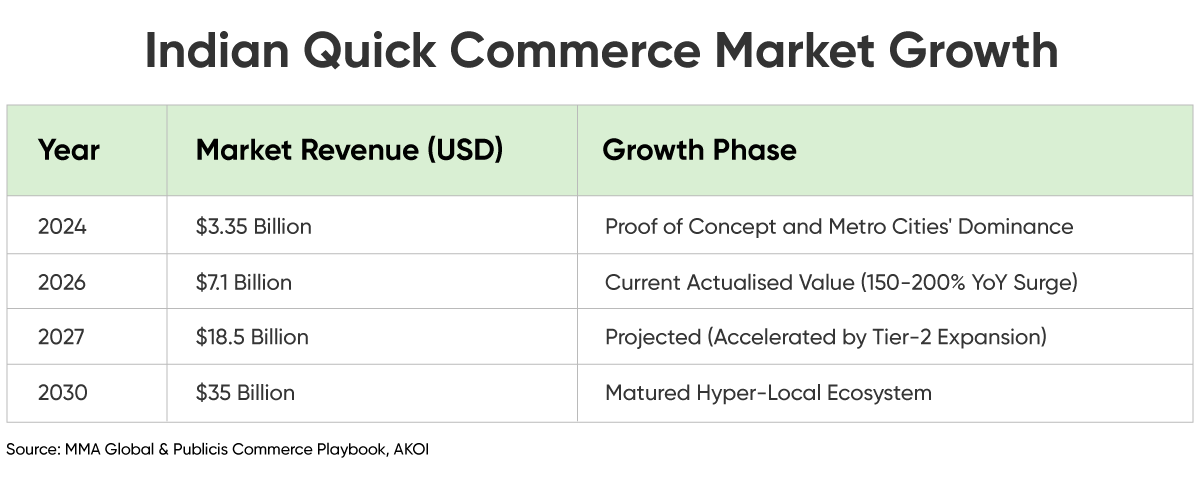
Key Takeaway: Between 2024 and 2030, the Indian q-commerce sector is compounding at an extraordinary 40% to 45% CAGR, making it one of the fastest-growing retail channels in the world.
(Source: MMA Global & Publicis Commerce Playbook, AKOI )
2. User Penetration: From Niche to Mass Adoption
The user base isn't just growing; it is deepening. What started as an app used exclusively by tech-savvy urban professionals has rapidly expanded its demographic reach across 130+ Tier 2 cities.
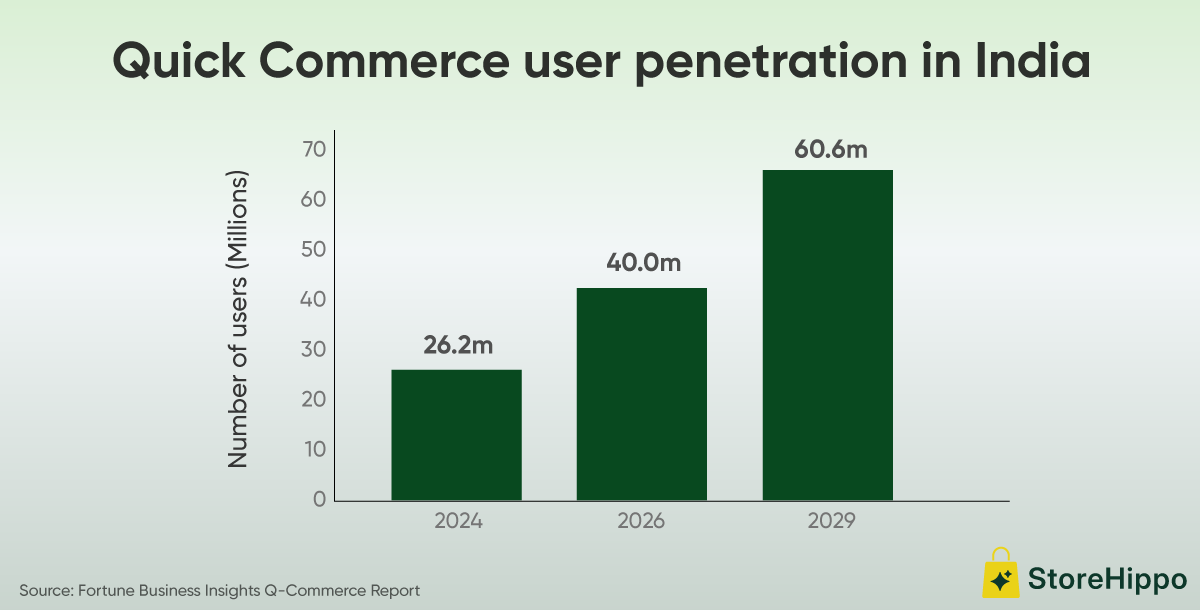
While 2.9% penetration might look modest on paper, in a country with India's population dynamics, it translates to an active digital metropolis of over 42 million high-intent shoppers.
Source: Fortune Business Insights Q-Commerce Report,
3. Quick Commerce User Retention: The "Power User" Phenomenon
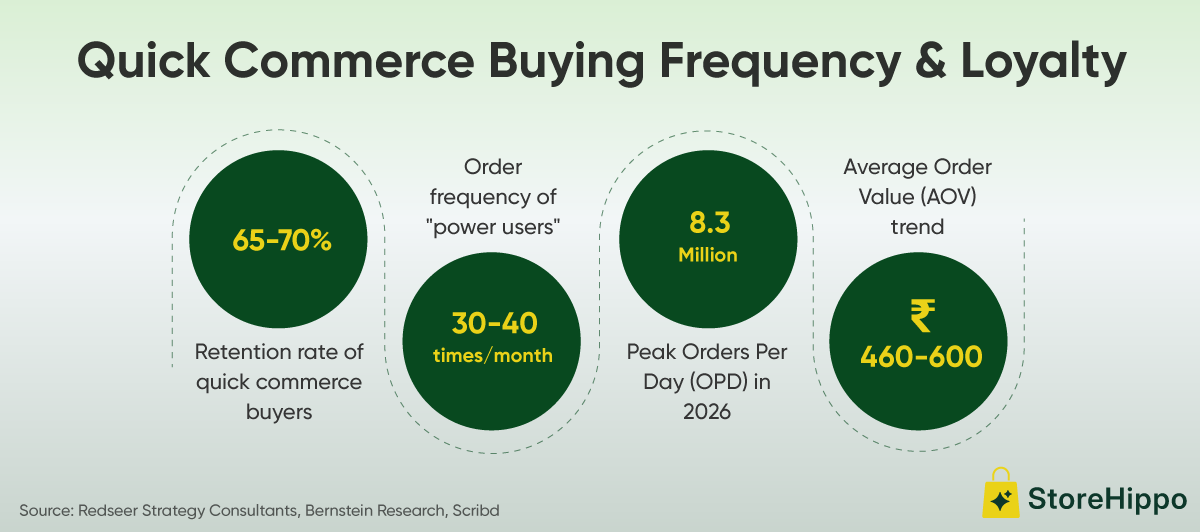
The true …of India’s q-commerce boom lies in consumer psychology. People aren't just trying these services once; they are restructuring their daily habits around them.
The latest behavioural data highlights an incredibly sticky ecosystem:
Source: Redseer Strategy Consultants (2026), Statista (2025), Economic Times Retail (2025), IBEF E-commerce Report (2026)
What Is Pushing Quick Commerce In India Into New Categories?
Quick commerce’s breakout from groceries into high-margin verticals isn't accidental, it is a deliberate profit play backed by shifting consumer behaviour and platform economics.
1. Margin Pressure as the Primary Driver
Groceries alone cannot sustain the tight unit economics of micro-fulfilment dark stores and last-mile delivery fleets. Platforms desperately need higher-margin SKUs to survive. Categories like electronic accessories, beauty products, and over-the-counter (OTC) pharma deliver 2 to 4 times the profit margins of daily staples, making category expansion a financial necessity rather than just a growth story.
2. Normalised Impulse Buying at Speed
Once users trusted q-commerce apps for daily essentials like milk and onions, the psychological barriers to ordering a Rs. 2000 phone charger or premium shampoo "right now" collapsed. "Power users" who already place 30 to 40 orders a month naturally move to buying non-grocery items within the same apps rather than opening new ones.
3. Repurposing Scalable Infrastructure
The massive network of dark store density, routing software, and last-mile logistics built entirely for groceries is now being repurposed for new categories with minimal incremental capital expenditure (Capex). Furthermore, AI-powered quick commerce solutions enable brands to stock hyper-local, high-velocity non-grocery items without ballooning their working capital.
4. Strong Brand and D2C Pull
Premium D2C brands in beauty, baby care, and nutrition are actively partnering with quick commerce brands to capture immediate impulse-purchase windows that traditional 2-day e-commerce completely misses. Electronics accessories like charging cables, earbuds, and phone cases now consistently rank among the top-searched non-grocery items across leading quick delivery platforms.
5. Medicine Delivery Made Easier
Government rules around e-pharmacies have opened up a massive new frontier for quick commerce. By partnering with licensed local pharmacies, platforms can now legally deliver over-the-counter (OTC) medicines, wellness supplements, and chronic care health products right to a buyer's doorstep. In healthcare, convenience becomes an absolute necessity, making pharmacy a category where speed is the most valuable feature.
6. Untapped Demand in Aspirational Tier-2 Markets
Quick ecommerce has expanded aggressively outside major metropolitan areas, to cater to aspirational shoppers in Tier-2 and Tier-3 cities. These consumers possess the disposable income and a strong desire for premium, trending brands, but they often lack local physical access to flagship retail stores. By expanding product categories, q-commerce instantly bridges this gap. The Structural Takeaway: Category expansion is quick commerce's definitive path to profitability. Groceries built the habit; everything else builds the margin.
Key Takeaway: Category expansion is making quick commerce's more profitable for enterprises. Groceries built the habit; niche categories are building the margin for the players.
5 Quick Commerce Companies In India Reshaping How The Country Buys
While dozens of regional players are testing the waters, the Indian quick commerce landscape is dominated by five core players, each executing a distinct operational strategy to win market share.
1. Zepto - Speed as Infrastructure
Zepto launched with a singular aim- deliver groceries in 10 minutes. It has since scaled into one of India’s most valuable tech unicorns by turning pure speed into a science.
- Financial Footprint: ~$1.33 Billion (₹11,110 Crore) revenue in FY25, representing 150% YoY growth. Current valuation sits at ~$10 Billion.
- Network Scale: ~1100 dark stores.
- Geographic Focus: 10+ major metropolitan hubs (including Bengaluru, Mumbai, Delhi-NCR, Chennai, Hyderabad, and Pune).
Zepto’s Unique Quick Commerce Playbook: Zepto’s model relies entirely on micro-warehouse density. Every covered pin code sits within a strict 2-kilometer radius of a fulfilment point, making an average delivery time of 8 minutes and 40 seconds structurally reliable rather than occasionally lucky.
Zepto has invested heavily in the customer experience layer: live order tracking, geo-fenced ETA notifications, instant pickup verification, and a Zepto Café concept that bundles beverages and snacks with grocery orders to lift average basket values. In the quick commerce market, basket size is the margin lever, and Zepto has engineered it very well.
2. Blinkit - The Market Leader Setting The Standard
Formerly Grofers, Blinkit is now owned by Zomato and completely rebranded in 2022. With the majority buyer segment loyal to the brand, the brand is the benchmark every other q-commerce player is measured against.
- Market Share: >50% of the total Indian quick commerce sector.
- Network Scale: 2,200+ dark stores with a staggering 50% weekly customer retention rate.
- Geographic Focus: 35+ Metros and Tier-1 cities.
Blinkit’s Success Formula: Blinkit’s micro-warehouses (typically 2,000 to 3,000 sq. ft.) are managed by a highly sophisticated hyperlocal AI. A Blinkit dark store in Bandra, Mumbai, carries a completely different product mix than one in Dwarka, Delhi, tailored precisely to neighbourhood buying habits.
Hitting an EBITDA-positive milestone proved to the wider financial market that quick commerce could generate real profits. Backed by Zomato’s massive consolidated delivery fleet, Blinkit enjoys massive cost-per-delivery advantages that compound every time they open a new dark store.
3. Swiggy Instamart - The Convenience Bundle
Swiggy Instamart launched in August 2020, extending Swiggy's existing food delivery infrastructure into q-commerce. Swiggy already had dark stores, delivery riders, and customer relationships. Pivoting part of that infrastructure to grocery delivery did not require a ground-up rebuild.
- Growth Metric: 101% YoY Gross Order Value (GOV) growth.
- Network Scale: Massive nationwide reach- 1000+ dark stores utilising a heavily electric-vehicle (EV) transitioned fleet.
- Geographic Focus: 130+ cities, giving it the widest geographic footprint in India.
Swiggy’s Operational Moat: Swiggy Instamart relies on ecosystem stickiness. By allowing users to order restaurant food and household groceries within a single app session, Swiggy drastically eliminates the customer friction of app-switching. This bundled loyalty makes their user acquisition costs incredibly low. Furthermore, their aggressive push into EV delivery partnerships has significantly cut per-delivery fuel costs in highly congested urban centres.
4. BigBasket BB Now - Oldest Player Goes “Instant Delivery”
BigBasket was India's original online grocery category leader. BB Now is its answer to a quick commerce market that moved faster than a scheduled delivery model could follow. It holds a smaller share than the top three, but its share is strategically distinct due to its portfolio of brands.
- Market Share: 5% to 7% of the quick commerce sector.
- Network Scale: Tata Group backing provides stable investment to build out the dark store network at a measured pace.
- Geographic Focus: 40+ cities (including Delhi-NCR, Bengaluru, Mumbai, Hyderabad, Pune, Chennai, and many tier-2 markets)
BB Now’s Success Rule: What BB Now lacks in raw market share, it makes up for in supply chain control. Unlike pure-play startups, BigBasket owns a massive, mature portfolio of private-label brands spanning staples (Fresho), packaged foods, and personal care. Because they control the manufacturing of these goods, they enjoy deep margin structures that are completely insulated from third-party supplier price hikes. The BB Star membership programme drives loyalty through fee waivers and exclusive pricing, turning occasional buyers into weekly customers.
5. Flipkart Minutes - The Category Expander
Flipkart Minutes is the most strategically interesting entrant among quick commerce companies in India right now. Powered by Walmart's global supply chain intelligence and Flipkart's existing marketplace ecosystem it has aggressively pivoted quick commerce away from just food to heavy retail.
- Growth Metric: 16x order growth in recent quarters, attracting over 53 million unique visitors.
- Network Scale: 500 dark stores active, with a strict corporate commitment to hit 1,000 stores by the close of FY26.
- Geographic Focus: 30+ cities, leading with a deliberate, aggressive push into affluent Tier-2 capitals like Lucknow, Jaipur, and Indore.
Flipkart’s Growth Hack:
Flipkart Minutes is fundamentally redefining what fits into a 10-minute dark store. While fresh produce still accounts for 45% of consumer baskets, the platform recorded a staggering 10x surge in electronics and home decor demand.
By successfully figuring out how to deliver an iPhone, a hair dryer, or kitchen appliances in under 20 minutes, Flipkart is capturing massive basket values and high-margin retail profits that grocery-only platforms simply cannot access. Gen Z byers are fuelling its fast adoption and non-grocery items are securing profit margins for the brand.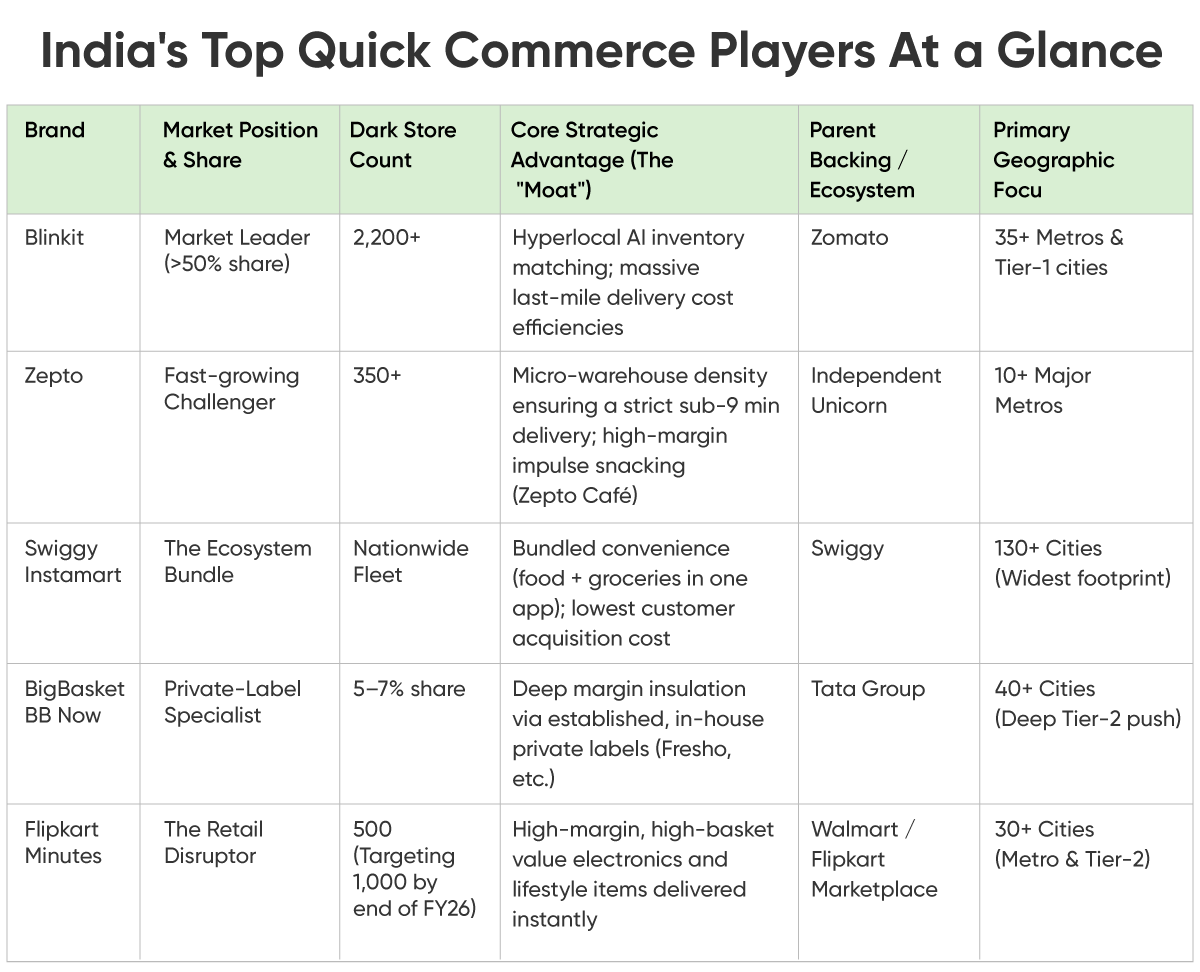
Indian buyers are loving the speed and convenience of ultra-fast delivery, effectively rewiring the country’s retail expectations and substituting ecommerce for quick and fast ecommerce deliveries across segments.
5 Core Challenges of Traditional Q-Commerce ( And How New Players Can Tap The Market)
While Indian customers have lapped up the convenience of quick commerce, the market is still largely dominated by players with extensive fulfilment networks and deep pockets. For mid-sized quick commerce startups, building, operating and scaling the traditional dark store-led playbook poses practical challenges.
The numbers clearly reflect a growing gap between delivery speed and financial efficiency:
1. High Setup Costs And Capex
Building a dark store network is an expensive business model. Every location needs real estate, inventory, staffing, technology, branding, and operational infrastructure before it can process a single order. In a tier-1 Indian city, setting up one dark store can cost anywhere between ₹35 lakh and ₹80 lakh. Scaling that model across multiple neighbourhoods quickly turns into a massive capital commitment for quick commerce startups.
2. Replicating Infrastructure For Scalability
One of the biggest limitations of the traditional dark store model is that growth usually requires more infrastructure. Instead of benefiting from economies of scale, businesses end up replicating the same setup across locations. For quick commerce startups in India, this can make growth expensive and operationally demanding, with costs rising alongside every new market they enter.
3. Hyperlocal Inventory Fragmentation
Managing inventory across a large network of dark stores is much harder than it looks. Each location needs the right products in the right quantities, but local demand can vary widely and change quickly. The result is often a balancing act between excess inventory that ties up capital and stockouts that lead to missed sales and frustrated customers.
4. Rising Operational Burden And Last-Mile Chaos
The real challenge in quick commerce begins after the order is placed. Coordinating multi-location store operations, delivery partners, and last-mile fulfilment becomes increasingly complex. A sudden spike in demand, rush-hour traffic, or an unexpected rainstorm can disrupt carefully planned delivery schedules. Keeping deliveries fast and reliable often requires significant investment in operations and logistics, making last-mile execution one of the most demanding aspects of running a quick commerce business at scale.
5. Profitability Pressure
As a traditional dark store network grows, so do the costs of running it. More locations mean higher spending on real estate, inventory, staffing, utilities, and last-mile delivery operations. While order volumes may increase, expenses often rise just as quickly, putting constant pressure on profit margins.
The q-commerce model has buyers hooked is proved beyond doubt. The bigger question now is whether the traditional dark store model is the most efficient way to deliver it at scale or can brands figure out alternatives to address the huge potential of the model.
How AI-Powered Dealer-Led Quick Commerce Solves Hyperlocal Delivery Challenges
Most conversations about quick commerce in India focus on dark stores. But what if businesses could deliver the same ultra-fast experience without building an entirely new fulfilment network?
The dealer-led quick commerce model starts with a different idea: use inventory that already exists across local dealers, distributors, retailers, and kirana stores.
What Is the Dealer-Powered Q-Commerce Model and How Does It Work
The dealer-powered q-commerce model reimagines ultra-fast delivery by turning existing dealer networks, retail stores, and kirana shops into fulfilment points. This helps businesses offer quick deliveries without investing in large dark store networks.
Instead of building new dark stores and warehouses, businesses use the infrastructure and inventory across their dealer, distributor, retailer, or store network. When a customer places an order, the system identifies the nearest fulfilment location with available stock and routes the order accordingly.
This means businesses can leverage infrastructure they already own rather than investing heavily in creating a parallel fulfilment network. As the business grows, it expands its delivery reach by onboarding more dealers and stores, not by opening more warehouses.
The result is a faster path to market, lower infrastructure costs, and a more scalable way to build a quick commerce business. Rather than relying on a dense network of dark stores, growth is driven by technology, real-time inventory visibility, and intelligent order routing across an existing distribution ecosystem.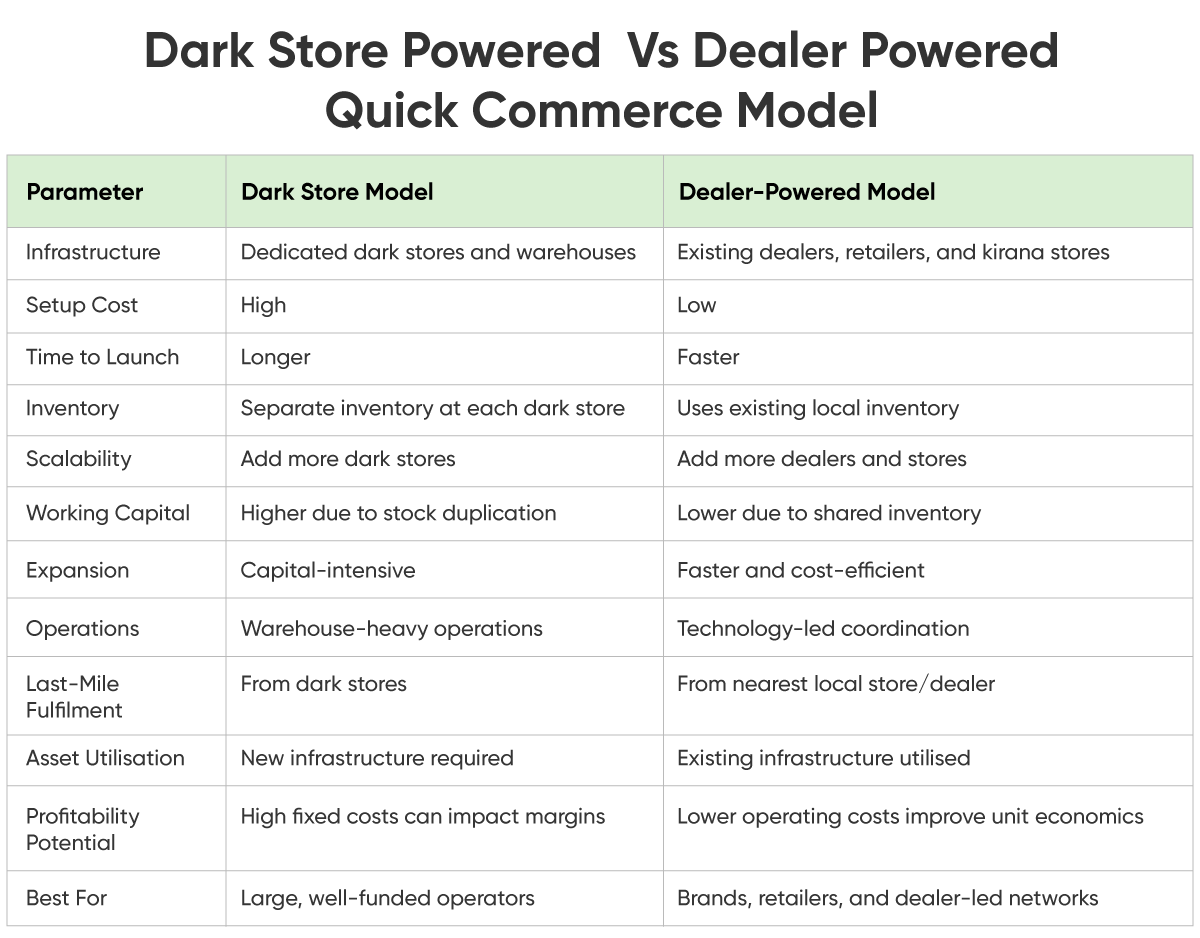
As quick commerce matures, the focus is shifting from building more infrastructure to making better use of the infrastructure that already exists. This is where technology becomes the foundation of scalable, dealer-powered quick commerce.
10 Steps to Build an AI-Powered Dealer-Led Quick Commerce Business
Here is a 10-step blueprint to leverage local inventory, intelligent routing, and AI automation to launch a profitable hyperlocal business without building expensive dark stores.
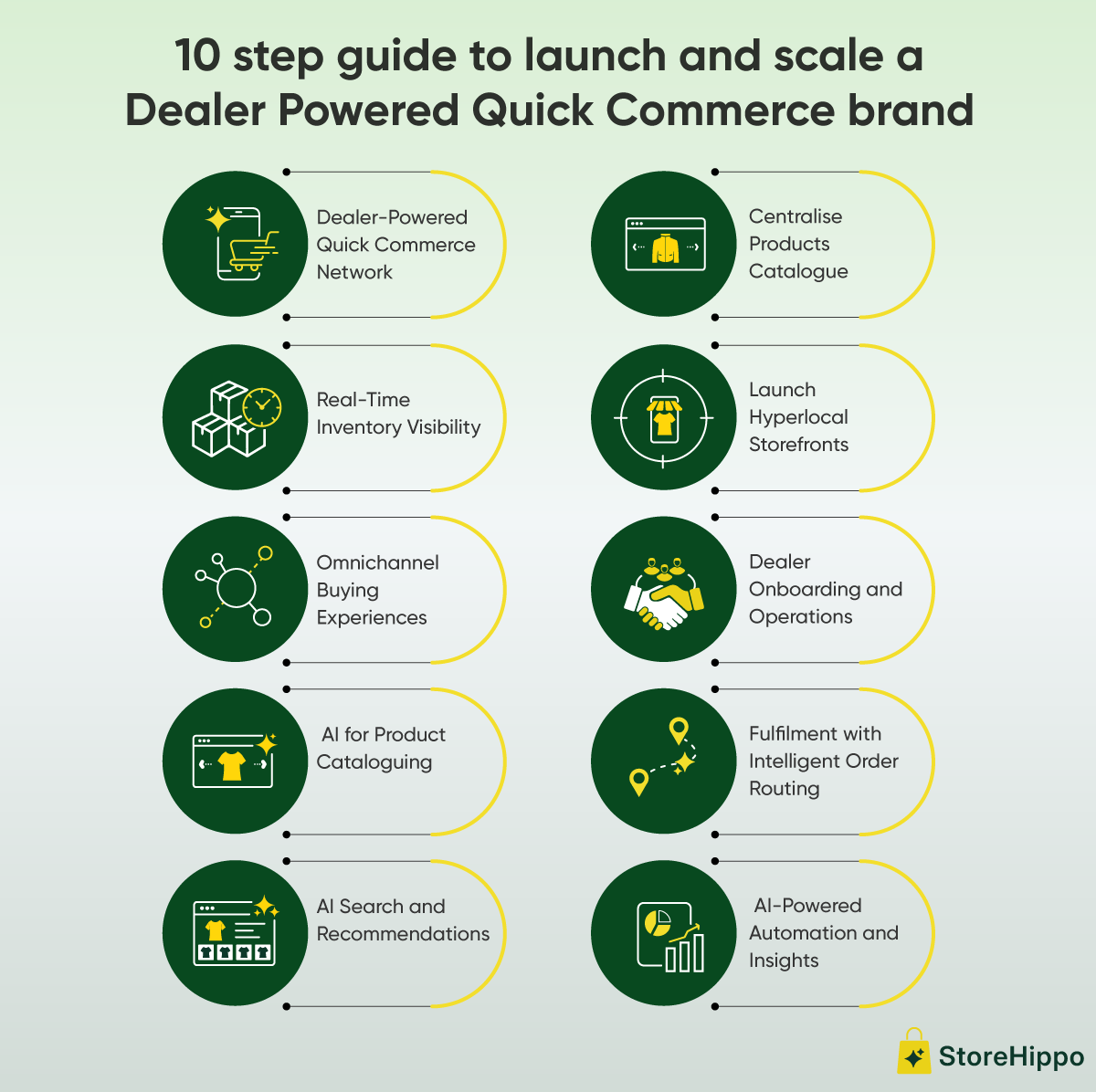
1. Build a Dealer-Powered Quick Commerce Network
Start by identifying the dealers, distributors, retailers, and kirana stores that can act as fulfilment points in your target locations. Instead of investing in dark stores, use existing local inventory to create a distributed quick commerce network.
2. Centralise Products Catalogue
Create a single source of truth for product information across all dealer locations. A unified catalogue helps maintain consistent product data, pricing rules, attributes, and inventory visibility across the network.
3. Enable Real-Time Inventory Visibility
Quick commerce depends on accurate stock information. Sync inventory across all dealer nodes in real time so customers only see products that are actually available nearby.
4. Launch Hyperlocal Storefronts
Create location-based storefronts that automatically show products, pricing, offers, and delivery options relevant to each service area. This helps deliver a local shopping experience at scale.
5. Offer Omnichannel Buying Experiences
Allow customers to order through websites, mobile apps, PWAs, WhatsApp, and AI-powered conversational commerce interfaces. The more channels you support, the easier it becomes to capture demand wherever customers prefer to shop.
6. Automate Dealer Onboarding and Operations
Simplify partner onboarding and give them tools for bulk catalogue uploads, inventory and order management, seller dashboards, mobile admin panels, and automated workflows. This reduces operational overhead as the dealer network grows.
7. Use AI for Product Cataloguing
Leverage AI to create product listings, generate descriptions, map attributes, classify products, and enhance images. This helps dealers go live faster while maintaining catalogue consistency.
8. Optimise Fulfilment with Intelligent Order Routing
Automatically route orders to the nearest dealer with available inventory. Smart order allocation helps reduce delivery times, improve fulfilment efficiency, and maximise inventory utilisation.
9. Improve Discovery with AI Search and Recommendations
Help customers find products faster using semantic search, personalised recommendations, and AI-powered product discovery. Better discovery often translates directly into higher conversions.
10. Scale with AI-Powered Automation and Insights
Use AI assistants to support buyers and sellers, automate routine workflows, handle support queries, and surface operational insights. As order volumes grow, automation becomes critical to maintaining speed and efficiency.
How StoreHippo Helps Build a Dealer-Powered Quick Commerce Business
Building a dealer-powered quick commerce business requires much more than connecting dealers to a marketplace. Success depends on managing distributed inventory, coordinating fulfilment, delivering a seamless customer experience, and scaling operations efficiently. |
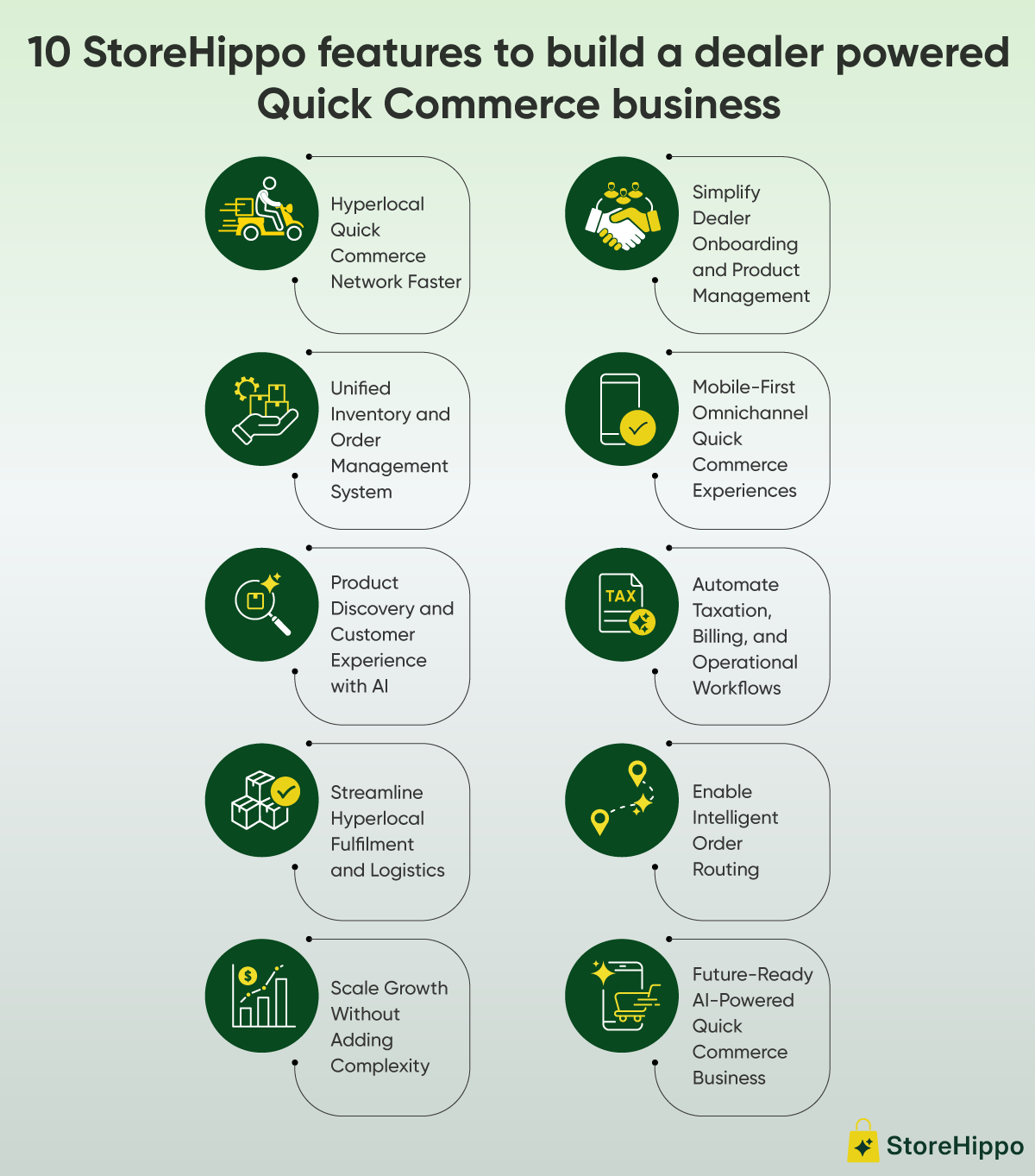
StoreHippo brings these capabilities together through its unified, AI-powered commerce platform.
1. Build a Hyperlocal Quick Commerce Network Faster
Launching a dealer-led quick commerce network starts with bringing dealers, distributors, retailers, and kirana stores onto a single platform.
StoreHippo's built-in multi-vendor marketplace, multi-store architecture, centralised dealer management, and geo-location based multi store capabilities along with a built-in theme designer for localised storefront themes, help brands create and manage large hyperlocal marketplaces and fulfilment networks from a single admin panel.
2. Simplify Dealer Onboarding and Product Management
Managing products across hundreds of dealers can quickly become an operational challenge.
StoreHippo streamlines onboarding with easy forms and verifications, AI-powered cataloguing, AI image editing tool Magic Edit, bulk product uploads, HSN-based category mapping, seller dashboards, and built-in vendor mobile apps that help dealers manage products and inventory with minimal effort.
3. Create a Unified Inventory and Order Management System
A dealer-powered quick commerce business model relies on accurate inventory visibility across every fulfilment location.
StoreHippo's master catalogue, real-time inventory synchronisation, centralised order management, and AI-core for automated workflows ensure inventory, pricing, and order data stay consistent across dealers, stores, and sales channels.
4. Offer Mobile-First Omnichannel Quick Commerce Experiences
Modern buyers expect to find their favourite brands across channels they visit.
StoreHippo headless architecture helps businesses launch websites, mobile apps, PWAs, WhatsApp commerce, and AI-assisted shopping experiences from a single backend, ensuring a consistent customer journey across every touchpoint.
5. Improve Product Discovery and Customer Experience with AI
As catalogues grow, helping customers find the right products faster becomes critical.
StoreHippo combines AI-powered semantic search, personalised AI recommendations and a powerful discount engine to improve product discovery, engagement, and conversions. Brands can also build custom multilingual AI shopping assistants to engage and convert better.
6. Automate Taxation, Billing, and Operational Workflows
With increasing order volumes, manual processes on a hyperlocal marketplace can become difficult to manage.
StoreHippo comes with built-in GST support, invoicing, order processing automation, and operational controls that help businesses scale efficiently.
7. Streamline Hyperlocal Fulfilment and Logistics
Fast hyperlocal delivery depends on intelligent fulfilment and lintelligent ogistics coordination.
StoreHippo integrates with 30+ logistics integrations ( including hyperlocal delivery partners), enables brands to build custom delivery boy management software, offers real-time tracking, and one-click WhatApp fulfilment processes to simplify last-mile operations.
8. Enable Intelligent Order Routing
One of the biggest challenges in quick commerce in India is ensuring orders are fulfilled from the most efficient location.
StoreHippo's AI-powered order routing automatically identifies the nearest fulfilment point with available inventory and allocates orders accordingly, helping reduce delivery times and improve inventory utilisation.
9. Scale Growth Without Adding Complexity
As the business expands, customer acquisition and retention become just as important as fulfilment.
StoreHippo includes built-in SEO capabilities, discount engine and re-targeting tools like abandoned cart recovery, loyalty and store wallets, built-in reporting engine, seamless integrations with popular analytics and marketing tools that help brands compete in the growing quick commerce market.
10. Build a Future-Ready AI-Powered Quick Commerce Business
Unlike traditional dark store based models of quick commerce companies in India, StoreHippo helps businesses leverage existing dealer networks, AI-powered automation, intelligent fulfilment, and omnichannel commerce to build scalable AI-powered quick commerce solutions with lower operational overhead.
The result is a more sustainable and capital-efficient approach to q-commerce that allows businesses to grow their delivery network, customer base, and order volumes without continuously investing in new dark stores.
Conclusion
Quick commerce has already changed how India shops. The real opportunity now lies in building models that can deliver speed without continuously increasing infrastructure costs.
As customer expectations rise and the quick commerce market expands into new categories and cities, businesses will need smarter ways to fulfil orders, manage inventory, and scale operations. Dealer-powered quick commerce offers one such path by combining local inventory, intelligent fulfilment, and AI-driven automation.
If you're exploring how to launch or scale a quick commerce business without the complexity of large dark store networks, StoreHippo can help you understand how a dealer-led model can work for your brand. Book a demo with our hyperlocal commerce experts now.
FAQs
1. Does quick commerce only work for groceries and daily essentials?
Not anymore. Many quick commerce companies in India are expanding into electronics, beauty, healthcare, home products, pet supplies, and lifestyle categories where buyers increasingly expect instant availability.
2. Which businesses are best suited for a dealer-powered quick commerce model?
Businesses that already work with distributors, dealers, retailers, franchisees, or local stores can benefit the most. Categories like electronics, FMCG, pharma, auto parts, home improvement, and D2C brands with offline networks are particularly well-suited.
3. How important is location intelligence in quick commerce?
Location intelligence is critical because delivery promises depend on knowing where inventory, customers, and fulfilment partners are located. Accurate location mapping helps improve delivery efficiency and customer experience.
4. Can dealer-powered quick commerce support seasonal demand spikes?
Yes. Because inventory is distributed across multiple fulfillment locations, and also local sellers are more aware of local spikes and buying patterns, businesses can often absorb sudden demand increases more effectively than relying on a single central warehouse.
5. What role does AI play in the future of quick commerce?
AI is increasingly helping businesses forecast demand, optimise inventory placement, improve product discovery, automate workflows, personalise shopping experiences, and make fulfilment decisions faster and more accurately.