
Menu
B2B wholesale marketplace
What Is a B2B Wholesale Marketplace?
A B2B wholesale marketplace is an ecommerce marketplace where manufacturers, wholesalers, distributors, dealers and business buyers connect and sell products or services in bulk to other businesses.
Unlike a B2C marketplace for retail selling, it is built for wholesale buying workflows such as multiple sellers, bulk ordering, buyer-specific pricing, MOQ, RFQs, custom catalogues, credit terms, negotiated deals and repeat purchases.
For enterprises, a B2B wholesale marketplace brings sellers, buyers, products, pricing, inventory, orders and fulfillment into one connected ecosystem. For buyers, it makes product discovery, ordering and repeat purchases faster while reducing dependence on manual sales processes.
Businesses evaluating the best B2B wholesale platform in India should look for solutions that enable them to build tailored wholesale marketplace ecosystems by connecting their ERP, CRM, payments, logistics and other enterprise systems. AI-powered cataloguing, search, recommendations and custom agentic bots can further simplify product discovery and operations across large wholesale catalogues.
How Are B2B Wholesale Marketplaces Changing Modern Wholesale Commerce?
B2B wholesale marketplaces are making wholesale buying more digital, self-service and connected. Instead of relying on sales teams for every product query, price check or repeat order, business buyers are now expecting B2C-like ease to discover products, compare options, access account-specific pricing and place orders online.
This shift is already visible across B2B enterprise ecommerce:
- Self-service buying: Buyers can research, compare, order and reorder without depending on a sales representative at every stage.
- Personalised buying: Catalogues, prices, discounts, payment terms and product visibility can vary by buyer, account or region.
- Connected selling: Marketplaces, websites, mobile apps, dealer networks and sales teams can work from shared commerce data.
- AI-powered buying: AI search, recommendations and assistants can help buyers find relevant products, ask questions and navigate large wholesale catalogues faster.
- Automated workflows: Orders, approvals, seller management, fulfilment and repeat purchases can move away from calls, emails and spreadsheets.
- Easier expansion: Enterprises can add new sellers, distributors, regions and hybrid B2B-D2C models without building a separate commerce setup for each one.
Driven by India’s rapid ecommerce adoption and the wider push towards Digital India, traditionally offline wholesale businesses are increasingly moving their buying and selling journeys online. This shift is also raising the bar for what a B2B wholesale marketplace needs to deliver. Buyers now expect easier discovery, personalized pricing, self-service ordering and faster support, while businesses need tighter control over sellers, inventory, orders and integrations.
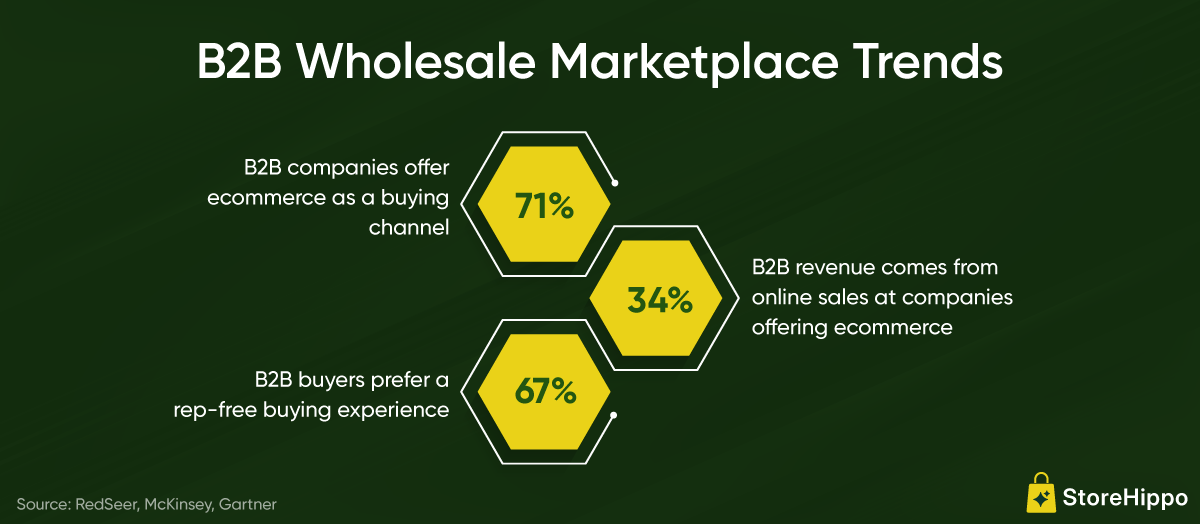
- 71% of B2B companies now offer ecommerce and 34% of their revenue comes from online sales McKinsey's "Five fundamental truths" B2B Pulse report
- 67% of B2B buyers prefer a rep-free experience is real, from Gartner's March 2026 press release.
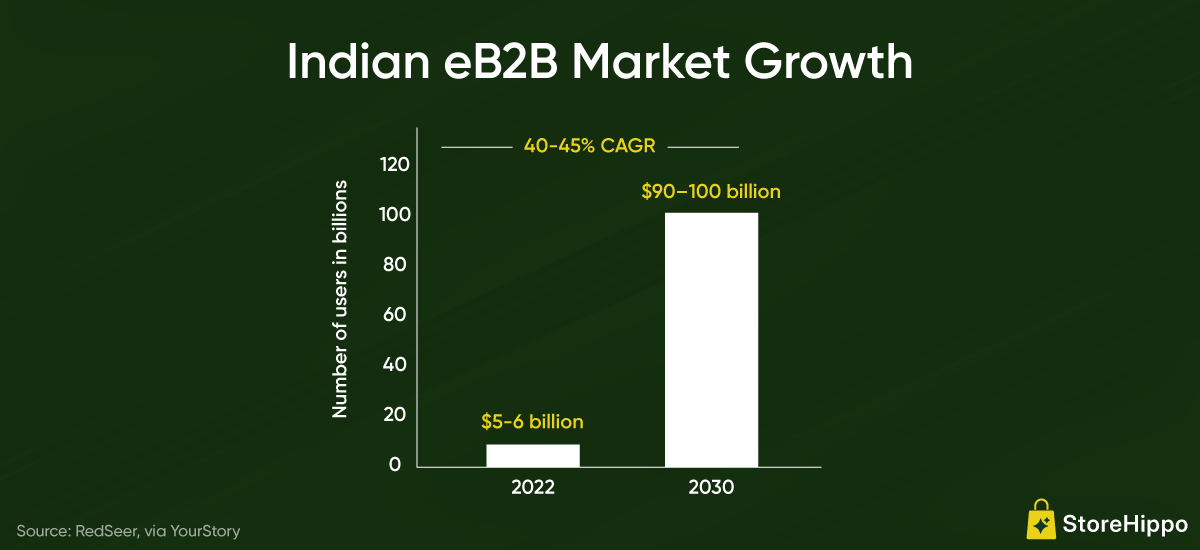
India's eB2B market was worth $5-6 billion in 2022 and is projected to reach $90–100 billion by 2030, growing at a 40-45% CAGR. (Source: RedSeer, via YourStory)
Why Should Enterprises Build a B2B Wholesale Marketplace?
Enterprises should build a B2B wholesale marketplace when they want to digitise wholesale sales, bring buyers and sellers onto one platform, reduce manual processes and create a more scalable way to manage growth across channels and regions.
A well-built marketplace can help enterprises:
- Digitise dealer and distributor networks: Move product discovery, pricing, ordering and repeat purchases online.
- Give buyers more self-service: Let business customers search, compare, reorder and manage purchases without relying on sales teams at every step.
- Manage multiple sellers centrally: Control onboarding, catalogues, commissions, orders, fulfilment and seller performance from one backend.
- Personalise B2B buying: Offer account-specific catalogues, pricing, discounts, payment terms and buying workflows.
- Automate routine operations: Reduce dependence on emails, spreadsheets and manual coordination for orders, approvals and seller management.
- Connect enterprise systems: Integrate ERP, CRM, payments, logistics and other systems with the marketplace.
- Add new revenue channels: Expand into dealer commerce, multi-vendor marketplaces, B2B2C or hybrid B2B-D2C models.
- Scale into new markets: Support regional sellers, currencies, languages, tax rules and market-specific storefronts without creating a separate commerce stack for each region.
- Use AI across the buying journey: Apply AI-powered cataloguing, search, recommendations and agentic assistants to improve discovery and reduce repetitive buyer and seller queries.
For enterprises exploring ecommerce options for B2B wholesale in India, the value goes beyond moving transactions online. A strong B2B enterprise ecommerce foundation can connect sellers, buyers, pricing, inventory, orders and channels while making it easier to expand without adding the same level of operational effort.
This is also where choosing the best wholesale ecommerce platform in India becomes important, because the platform needs to support both current wholesale workflows and future growth.
How to Choose the Right B2B Wholesale Marketplace Model for Your Business?
Choosing the right B2B wholesale marketplace model starts with understanding how your business sells today, who your buyers and partners are, and how pricing, fulfilment and customer relationships need to work. The right setup should fit your current sales model while leaving enough room to add new sellers, channels or markets later.
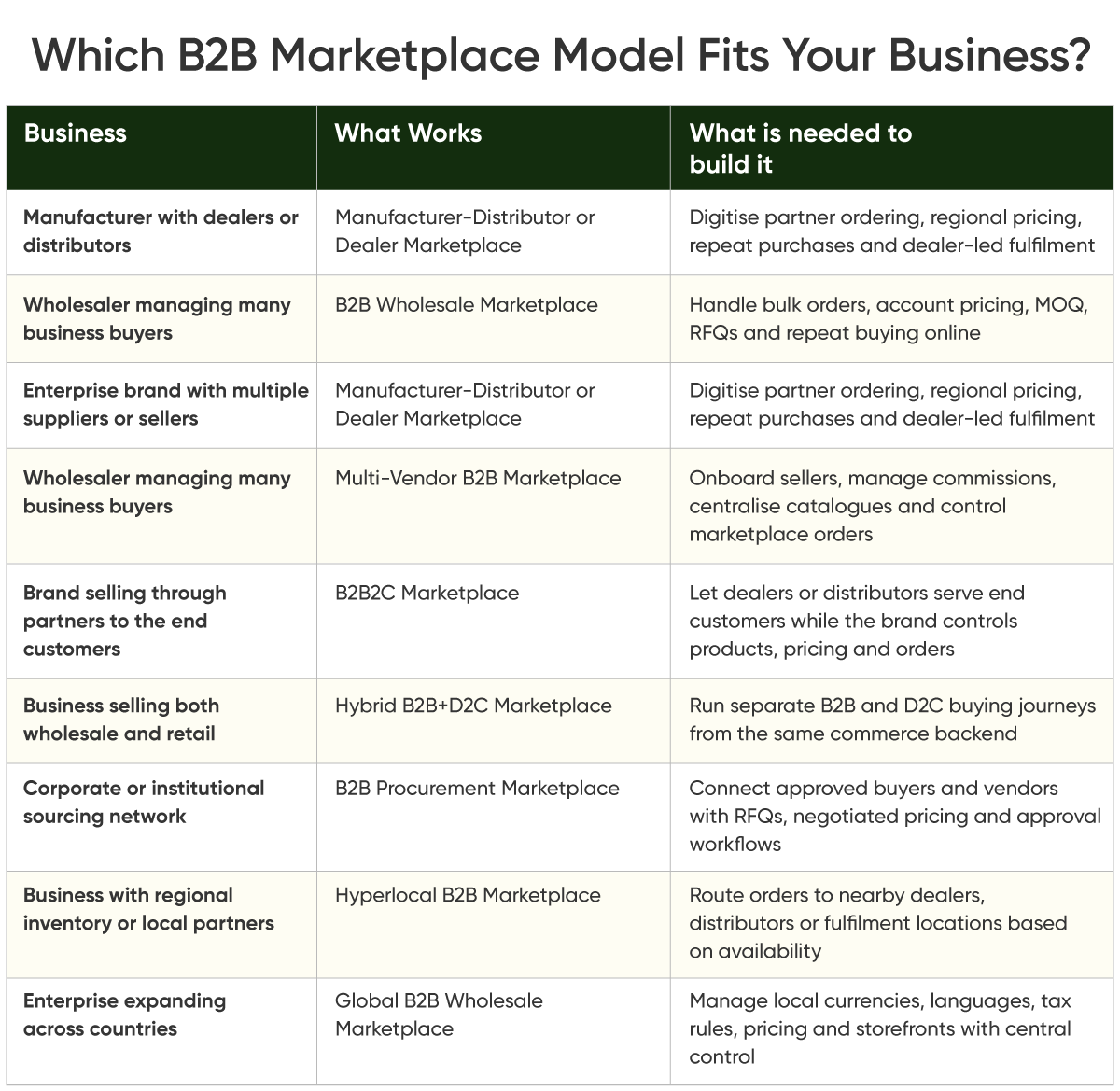
For businesses building B2B enterprise ecommerce, the model does not have to stay fixed. A manufacturer may begin with a distributor marketplace, add dealers or more sellers later, and then expand into D2C, hyperlocal or international commerce.
That is why enterprises exploring B2B wholesale India should choose a wholesale ecommerce platform India solution that can support more than one marketplace model as the business evolves.
What Features Should a B2B Wholesale Marketplace Have?
A B2B wholesale marketplace should cover the full wholesale journey, from buyer experience and seller management to operations, integrations and future expansion. The strongest platforms bring these capabilities together instead of making businesses stitch them across multiple tools.
- Complete B2B wholesale marketplace solutions: Manage buyers, sellers, catalogues, pricing, orders, fulfilment and marketplace operations from one platform.
- Built-in B2B features: Support MOQ, RFQs, bulk pricing, buyer-specific catalogues, credit terms, quick reorders and approval-led buying.
- AI and agentic commerce: Use AI for cataloguing, search, recommendations, buyer assistance, seller support and custom agentic workflows.
- Comprehensive dealer and distributor management: Digitise partner onboarding, regional selling, pricing, order flows and dealer-led customer journeys.
- Mobile-first unified commerce: Connect marketplace websites, mobile apps, dealer networks and other channels through one shared backend.
- Seamless enterprise integrations: Connect ERP, CRM, payments, logistics, PIM and other business systems through APIs and ready integrations.
- Centralised seller and marketplace control: Manage seller onboarding, commissions, catalogues, inventory, orders and performance from one admin.
- Global and regional commerce: Support Multistore®, multiple currencies, languages, tax rules and market-specific storefronts.
- Flexible payments and fulfilment: Support online payments, credit terms, purchase orders, multiple logistics partners and fulfilment models.
- Composable, scalable architecture: Add new sellers, workflows, channels and business models without rebuilding the marketplace as requirements change.
For enterprises building B2B enterprise ecommerce, these capabilities determine how easily the marketplace can grow beyond its initial use case. Businesses comparing the best B2B wholesale platform in India should therefore look for a platform that brings wholesale commerce, AI, partner management and connected operations together.
How to Build a B2B Wholesale Marketplace for Your Business?
Building a B2B wholesale marketplace starts with getting the business model, buyer journeys, seller workflows and technology foundation right before you launch.
- Define your marketplace model: Decide whether you need a multi-vendor, dealer-distributor, procurement, B2B2C or hybrid B2B-D2C setup.
- Map buyer and seller journeys: Outline how buyers discover, negotiate, order and reorder, and how sellers manage products, pricing and fulfilment.
- Set up B2B buying rules: Configure MOQ, RFQs, bulk pricing, buyer-specific catalogues, credit terms and approval workflows.
- Onboard sellers, dealers and distributors: Create role-based access, regional rules, commissions and partner-specific workflows.
- Connect your enterprise systems: Integrate ERP, CRM, payments, logistics and other systems needed for day-to-day operations.
- Add AI-powered commerce: Use AI for cataloguing, search, recommendations, buyer assistance and routine seller or customer support.
- Build marketplace websites and mobile apps: Launch responsive web storefronts and branded mobile apps from the same connected commerce backend.
- Set up unified order and inventory management: Keep products, stock, orders and fulfilment synced across sellers, regions and channels.
- Test real B2B buying journeys: Validate pricing, RFQs, approvals, payments, fulfilment and repeat ordering before going live.
- Launch and scale: Add new sellers, buyer groups, markets, channels and workflows as your B2B enterprise ecommerce business grows.
For businesses evaluating B2B wholesale India, choosing a wholesale ecommerce platform India solution that supports websites, mobile apps, marketplace operations and enterprise integrations from one backend can make expansion much easier.
Why Choose StoreHippo to Build a B2B Wholesale Marketplace?
StoreHippo helps enterprises build, launch and scale a B2B wholesale marketplace from one unified, AI-powered commerce platform. It combines B2B buying workflows, dealer-distributor management, marketplace operations and connected enterprise systems, giving businesses the flexibility to grow across sellers, regions, channels and business models without adding unnecessary operational overhead.
- Built-in B2B commerce with MOQ, RFQs, bulk pricing, buyer-specific catalogues, credit terms, quick reorders and approval-led buying. No plugins needed.
- AI and agentic commerce at the core with connected AI across cataloguing, search, recommendations, buyer and seller assistance, image workflows and custom agents built around live product, pricing, inventory, order and customer data.
- Complete marketplace management for seller onboarding, commissions, catalogues, orders, fulfilment and seller performance.
- Dealer and distributor commerce with role-based access, regional pricing, partner-specific catalogues and dealer-led end-customer journeys.
- GST-support for India with built-in tax rules, support for CGST, SGST and IGST, GSTIN, HSN/SAC and GST-compliant invoicing.
- Mobile-first unified omnichannel commerce across marketplace websites, no-code Android and iOS app builders, PWA stores, custom AI bots that can also act as sales channels, voice commerce and other digital touchpoints from one connected backend.
- Support for multiple business models including B2B, B2B2C, dealer-led commerce, hyperlocal multi-vendor marketplaces and hybrid B2B+D2C setups.
- Composable, API-first architecture that supports custom workflows and integrates with ERP, CRM, PIM, payments, logistics and other enterprise systems.
- Centralised commerce operations with connected catalogue, inventory, orders, fulfilment and multi-warehouse management.
- Global and regional commerce with Multistore®, multilingual, multi-currency, multi-country and market-specific storefront capabilities.
For enterprises comparing the best B2B wholesale platform in India, StoreHippo brings together B2B commerce, marketplace management, AI, mobile commerce and enterprise integrations on one connected platform. This gives businesses a stronger B2B enterprise ecommerce foundation to launch faster, manage more sellers and buyers, and expand without rebuilding their commerce setup as requirements change.
Ready to build a B2B wholesale marketplace for your enterprise brand?
See how StoreHippo’s unified, AI-powered wholesale ecommerce platform India can help you build and scale B2B marketplaces, dealer networks and mobile commerce from one connected backend. Schedule a Demo
FAQ
1. How much does it cost to build a B2B wholesale marketplace in India?
The cost of building a B2B wholesale marketplace can vary widely depending on whether you choose a custom build, plugin-based setup or turnkey wholesale ecommerce platform India solution. Costs are also influenced by seller workflows, integrations, mobile apps, custom pricing, dealer-distributor management and the level of customisation required.
With StoreHippo, businesses can choose from different plans based on their scale and requirements. Refer to the current pricing plans to identify the most suitable option for your marketplace.
2. How long does it take to launch a B2B wholesale marketplace on a turnkey platform?
A B2B wholesale marketplace can typically launch much faster on a turnkey platform than with a custom build. StoreHippo states that marketplaces without major customisations can go live in around 4-6 weeks, while more tailored implementations may take longer depending on workflows and integrations.
3. Can a B2B wholesale marketplace also sell directly to consumers?
Yes. A B2B wholesale marketplace can support hybrid B2B-D2C or B2B2C models where the same enterprise serves dealers, distributors, business buyers and end customers through different buying journeys from one commerce backend.
4. What is the difference between a B2B wholesale marketplace and a regular B2B online store?
A B2B online store usually sells one company’s products to business buyers. A B2B wholesale marketplace can bring multiple sellers, dealers or distributors onto one platform and add capabilities such as seller management, commissions, multi-pricing, bulk ordering and partner-specific workflows.
5. Do B2B wholesale marketplaces support India-specific payments and tax rules?
Yes. A wholesale ecommerce platform India solution can support GST-related tax configurations and India-focused payment options. StoreHippo currently supports gateways including Razorpay, Paytm, PayU and CCAvenue, along with multiple domestic and international payment integrations.
6. Can dealers and distributors place bulk orders from a mobile app?
Yes. Businesses can offer Android, iOS and PWA-based buying experiences where dealers and distributors browse catalogues, check pricing and place orders from mobile devices. StoreHippo also supports separate buyer and seller apps and allows Android and iOS apps to be built from its platform backend.
Resources
Related Topics
- AI Shopping Assistant
- App Builder Without Coding
- B2B Marketplace Builder
- B2B Marketplace Software For Enterprise Brands
- B2B multi-store ecommerce solution
- B2B Sales App
- B2B Wholesale App
- B2B Wholesale App India
- B2C Marketplace Platform
- Best D2C websites
- Best Marketplace Software Large Business
- Best multi vendor marketplace software
- Build Your Own Online Marketplace
- Complete B2B Ecommerce Software
- Create A Multi Vendor Marketplace Website Like Amazon
- Create Mobile Apps Without Coding
- D2C Ecommerce Software
- D2C Portal
- Direct to Consumer (D2C) Ecommerce Platform
- eCommerce Marketplace Software
- Ecommerce marketplace solutions
- Ecommerce Platform for Large Enterprises
- Enterprise multi store ecommerce software
- Enterprise Multi-Store Ecommerce Platform
- Headless B2B Ecommerce
- Multi Vendor E-commerce Marketplace Software
- Multi Vendor Marketplace Mobile App
- Multi Vendor Platform for Enterprises
- Multi Vendor Platform For Wholesale
- No Code Marketplace builder
- Omnichannel Ecommerce Platform
- Online Marketplace for B2C
- Quick Commerce Apps
- Top online B2B marketplace in India
- White label marketplace platform
- White label marketplace software
- White label Multi Store Solution
- White Label SaaS Marketplace
- Wholesale B2B Platform
- Wholesale Platform India