
Menu
Best D2C websites
How Can Enterprise Brands Drive Growth by Building the Best D2C Websites?
A D2C ecommerce website enables enterprise brands to sell their products or services directly to end customers. By building the best D2C websites, enterprise brands can do much more than just selling products online. It allows them to build direct customer relationships, strengthen loyalty, and gain greater control over the buying experience, pricing, promotions, brand presentation, and customer data.
Unlike selling through marketplaces or retail partners where the brand has no direct control over policies, pricing, customer data etc., building a D2C ecommerce website gives businesses direct access to customer data and behaviour to plan strategic business growth. With a well-designed D2C ecommerce website brands can deliver personalised experiences and adapt quickly to changing market demands. This greater visibility and control can improve conversions, encourage repeat purchases, and increase long-term customer value.
A D2C website helps businesses solidify their online presence and tap into otherwise unexplored markets. Brands can benefit by building the best D2C websites in various ways. Some of them are:
- Reduce fixed operating costs and capital expenditure
- Improve margins by reducing dependence on intermediaries
- Test new products, markets, and business models faster
- Maintain greater control over brand identity and customer experience
- Build multiple sales channels through omnichannel ecommerce
- Use first-party customer data to guide business decisions
- Deliver personalised offers and shopping experiences
- Communicate directly with customers across the buying journey
- Pass selected cost efficiencies to customers to support sales growth
Building a scalable D2C ecommerce business can help enterprises create a stronger and more recognisable brand. However, long-term success also depends on the technology powering it. The platform behind a D2C brand must be agile, scalable, and future-ready enough to support changing customer expectations, emerging sales channels, and evolving business models.
Which Are the 10 Best D2C Websites in the World and India?
The top direct-to-consumer (D2C) websites include leading global brands such as Allbirds, Glossier, Gymshark, Warby Parker, and Casper, alongside prominent Indian brands such as The Whole Truth, Minimalist, Nykaa, boAt Lifestyle, and Wakefit. These brands stand out for strong visual identity, mobile-first shopping, personalised discovery, seamless checkout, and connected omnichannel experiences.
The table below compares what each brand does well and the core commerce capabilities needed to build a similar D2C ecommerce experience.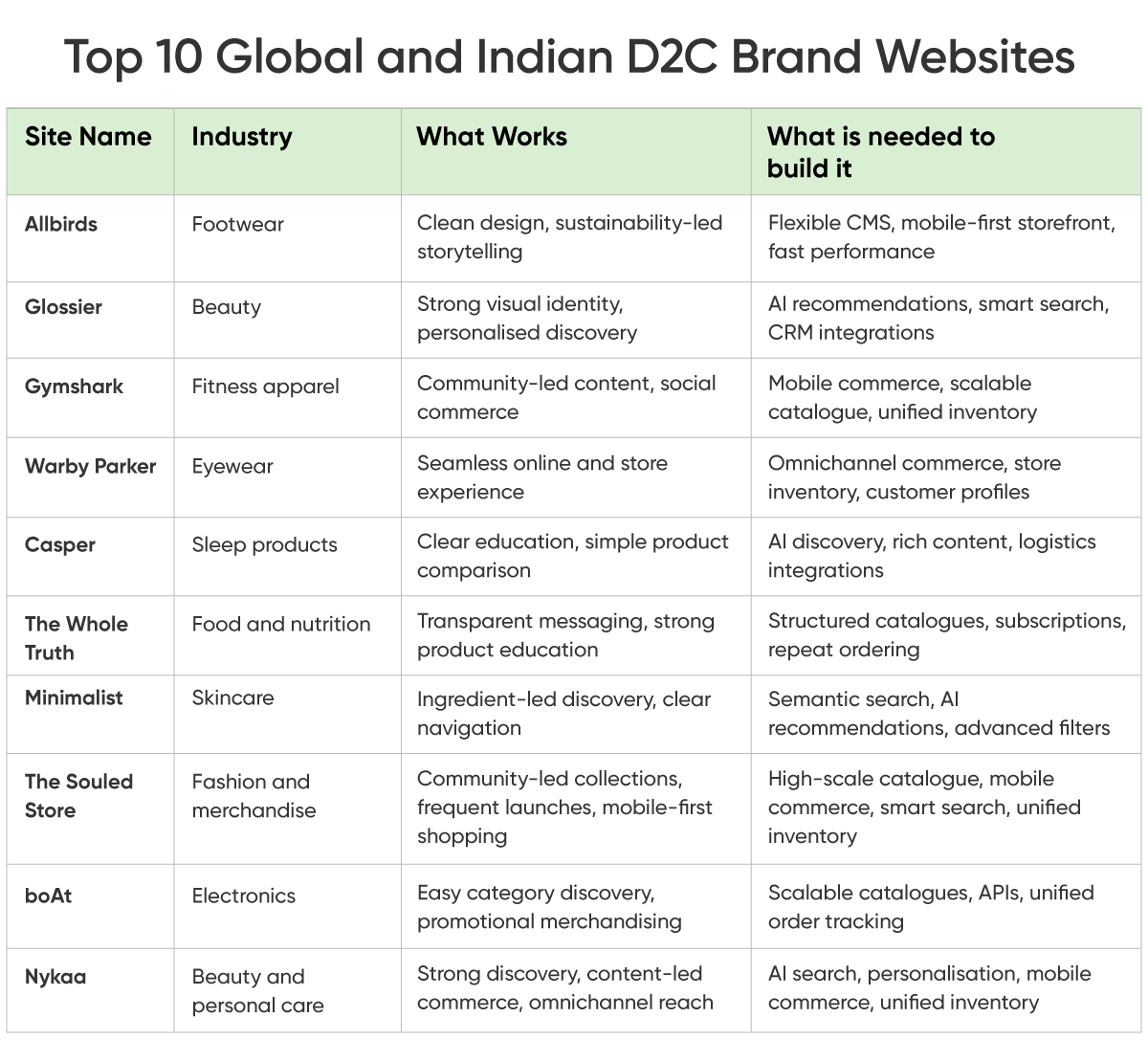
These brands follow different design, content, and growth strategies, but their websites are built around a similar set of commerce capabilities. Looking beyond the visual experience, the real differentiator is how effectively each brand supports discovery, personalisation, mobile buying, omnichannel operations, and scalable backend workflows.
What Features Do the Best D2C Websites Have in Common?
The best D2C websites make shopping easy, look unmistakably like the brand, and help customers move from discovery to checkout without friction. Behind that experience is a flexible commerce setup that connects products, customers, orders, payments, and fulfilment, so the business can grow without the website becoming harder to manage.
Here are the must-have features for successful D2C websites:
1. Storefront And Customer Experience
- Clean, intuitive storefront with rich product information for effortless discovery.
- AI-powered search and recommendations to improve product discovery and conversions.
- Personalisation tools to deliver relevant products, offers and shopping experiences.
- Mobile-first commerce for seamless shopping across every device.
- Fast, secure and flexible checkout to reduce friction and improve purchase completion.
2. Commerce Operations
- Unified inventory and order management for real-time stock visibility and fulfilment.
- Scalable, automated catalogue management for large catalogues, variants and multiple brands.
- Streamlined logistics to speed up fulfilment and keep customers informed.
3. Omnichannel Commerce
- Unified omnichannel commerce connecting web, apps, PWA, WhatsApp, AI channels and social commerce.
4. Platform And Technology
- Agile, composable architecture to adapt quickly, add new capabilities and support evolving business models without rebuilding the platform.
- Easy integrations with ERP, CRM, payments, logistics and marketing systems.
5. Intelligence And Growth
- First-party analytics and marketing tools for smarter business and marketing decisions.
- AI-powered workflow automation to streamline support, operations and fulfilment while reducing manual effort.
The best D2C websites don't succeed because of a single feature. They succeed because every part of the business, from discovery and checkout to inventory, fulfilment, and customer engagement, works together on one connected commerce foundation. That's what enables brands to grow faster while keeping operations simple and customer experiences consistent.
What D2C Models and Trends Will Shape Growth for Brands in 2026 and Beyond?
The global D2C ecommerce market is projected to grow from approximately $91.6 billion in 2025 to $270.2 billion by 2035, at an estimated 11.4% CAGR. This growth will be shaped by the following models and trends:
- AI-led commerce will make search, recommendations, support, and product discovery more personalised.
- Mobile-first D2C models will put apps, PWAs, mobile payments, and faster checkout at the centre of buying journeys.
- Social and conversational commerce will turn WhatsApp, creators, and social channels into direct sales touchpoints.
- Unified omnichannel D2C ecommerce will offer connected buying journeys across websites, apps, stores, WhatsApp, voice commerce, and AI channels.
- Hybrid D2C models will combine direct selling with subscriptions, marketplaces, dealers, retail stores, and quick commerce.
Together, these trends will push D2C brands to build more connected, flexible, and customer-first ecommerce ecosystems that have the potential to establish them as market leaders in their niche.
How Can Enterprise Brands Build the Best D2C Website for Long-Term Growth?
Enterprise brands can build the best D2C website by combining a scalable platform with strong customer experience, AI-led discovery, unified omnichannel operations, integrated logistics, and flexible architecture. Each layer should support growth without making daily commerce harder to manage.
Step 1: Choose a scalable ecommerce platform that can support your business, growing catalogues, multiple brands, new markets, and future changes in your D2C model.
Step 2: Design a mobile-first storefront with intuitive navigation, rich product content, and a seamless shopping experience.
Step 3: Enable AI-powered search, recommendations, and personalised experiences to improve product discovery and conversions.
Step 4: Build a unified omnichannel commerce ecosystem connecting your website, apps, PWA, WhatsApp, marketplaces, AI or new-age digital channels and physical stores.
Step 5: Centralise inventory, catalogue, and order management to maintain real-time visibility across every sales channel.
Step 6: Offer fast, secure, and flexible checkout with multiple payment options to reduce cart abandonment.
Step 7: Integrate multiple logistics and fulfilment partners to streamline shipping, tracking, returns, and customer notifications.
Step 8: Connect ERP, CRM, payments, marketing, customer support, and other enterprise systems through APIs and ready integrations.
Step 9: Use built-in and integrated marketing tools, reports, customer segmentation, and first-party data to run personalized campaigns that improve engagement, retention, and repeat sales.
Step 10: Build your D2C brand on a flexible platform that lets teams test new products, channels, markets, and business models quickly, then scale what works or pivot without replatforming.
Following these steps helps brands build a D2C website that delivers a strong customer experience while keeping commerce, fulfilment, and growth operations connected and manageable.
Why Choose StoreHippo to Build the Best D2C Websites?
StoreHippo helps enterprise brands build, launch, and scale high-performing D2C websites from one unified, AI-powered commerce platform. It combines customer-centric experiences with connected operations, enabling brands to grow across products, markets, channels, and business models without adding operational complexity.
- AI at the core with semantic search, recommendations, voice search, AI cataloguing, image editing, and intelligent automation.
- Unified omnichannel commerce across websites, mobile apps, PWA stores, WhatsApp, marketplaces, social commerce, retail stores, and dealer networks.
- Multi-store and multi-brand management from a single backend with shared catalogues, inventory, pricing, and orders.
- Support for every business model including D2C model, B2C, B2B, B2B2C, marketplaces, and hybrid commerce on one platform.
- Mobile-first commerce with responsive storefronts, Android and iOS apps, and Progressive Web Apps (PWAs).
- Composable, low-code architecture that adapts quickly to new business requirements without rebuilding the platform.
- 300+ APIs and pre-built integrations connecting ERP, CRM, payments, logistics, marketing, and customer support systems.
- Unified inventory, order management, and logistics with multi-warehouse fulfilment, intelligent shipping, and real-time tracking.
- Powerful catalogue and merchandising tools to manage large product catalogues, variants, pricing, and promotions with ease.
- Enterprise-ready global capabilities including multilingual, multi-currency, multi-country, and multi-store support.
StoreHippo brings together everything enterprise brands need to build the best D2C websites, from AI-powered customer experiences and unified commerce to flexible technology and connected operations. The result is a future-ready platform that helps brands launch faster, scale confidently, and adapt to whatever comes next.
Ready to build a D2C website that scales?
See how StoreHippo's unified, AI-powered commerce platform helps enterprise brands launch faster and grow without added complexity. Schedule a Demo
FAQ
1. What is a D2C ecommerce website?
A D2C ecommerce website is a brand-owned online store where products are sold directly to end customers, without relying on distributors, retailers, or third-party marketplaces. The brand controls the storefront, pricing, promotions, checkout, customer experience, and first-party data from end to end.
2. How is a D2C ecommerce website different from an online marketplace?
On a marketplace, the platform controls product visibility, customer access, commissions, and many selling policies. A D2C ecommerce website is owned and managed by the brand, allowing it to control pricing, presentation, checkout, customer relationships, and margins while retaining direct access to customer data.
3. Do brands need coding skills to build the best D2C websites?
No. Low-code and no-code ecommerce platforms allow brands to launch and manage a D2C website without building every feature from scratch. Business teams can manage storefront design, catalogues, pricing, promotions, orders, and content through an admin dashboard, while developers handle only advanced customisation when needed.
4. How much does it cost to build a D2C ecommerce website?
The cost of building a D2C ecommerce website depends on the platform, design, integrations, catalogue size, and custom workflows required. A custom build usually needs a larger development budget and longer timeline, while using a SaaS platform with subscription-based pricing can reduce upfront development and maintenance costs and also ensure faster go-to-market and easy pivot to new business models.
5. Can the best D2C websites also support mobile apps and PWAs?
Yes. Mobile-first ecommerce platforms can power the website, Android and iOS apps, and Progressive Web Apps from the same backend. This helps brands maintain consistent catalogues, pricing, inventory, customer data, and orders across devices without managing separate commerce systems.
6. How can AI improve a D2C ecommerce website?
AI can improve a D2C ecommerce website through semantic search, personalised recommendations, voice-based discovery, automated cataloguing, image enhancement, and smarter customer support. These capabilities help shoppers find relevant products faster while helping brands reduce manual work, improve conversions, and deliver more personalised buying experiences.
7. How can agentic AI help the best D2C websites grow?
Agentic AI can support both buyers and business teams by handling multi-step commerce tasks with minimal intervention. AI shopping agents can guide discovery, compare products, build routines, and answer questions, while operational agents can assist with cataloguing, inventory planning, seller support, order tracking, and customer service workflows.
Resources
Related Topics
- AI Shopping Assistant
- App Builder Without Coding
- B2B Marketplace Builder
- B2B Marketplace Software For Enterprise Brands
- B2B multi-store ecommerce solution
- B2B Sales App
- B2B Wholesale App
- B2B Wholesale App India
- B2C Marketplace Platform
- Best D2C websites
- Best Marketplace Software Large Business
- Best multi vendor marketplace software
- Build Your Own Online Marketplace
- Complete B2B Ecommerce Software
- Create A Multi Vendor Marketplace Website Like Amazon
- Create Mobile Apps Without Coding
- D2C Ecommerce Software
- D2C Portal
- Direct to Consumer (D2C) Ecommerce Platform
- eCommerce Marketplace Software
- Ecommerce marketplace solutions
- Ecommerce Platform for Large Enterprises
- Enterprise multi store ecommerce software
- Enterprise Multi-Store Ecommerce Platform
- Headless B2B Ecommerce
- Multi Vendor E-commerce Marketplace Software
- Multi Vendor Marketplace Mobile App
- Multi Vendor Platform for Enterprises
- Multi Vendor Platform For Wholesale
- No Code Marketplace builder
- Omnichannel Ecommerce Platform
- Online Marketplace for B2C
- Quick Commerce Apps
- Top online B2B marketplace in India
- White label marketplace platform
- White label marketplace software
- White label Multi Store Solution
- White Label SaaS Marketplace
- Wholesale B2B Platform
- Wholesale Platform India