


Choosing a composable commerce platform is no longer just a technology decision, it’s a long-term business strategy.
As enterprise marketplaces become more complex, spanning multiple vendors, geographies, and customer touchpoints, the limitations of rigid, monolithic systems become more evident. At the same time, adopting composable commerce without the right foundation can introduce operational chaos instead of agility.
So how do you evaluate what truly matters?
The answer lies in asking the right questions.
Before selecting a composable commerce platform, enterprises must look beyond flexibility and assess how well the platform supports scalability, integration, AI-driven operations, and long-term growth.
Table of Contents
- How Composable Commerce Platforms Accelerate Enterprise Marketplaces Growth
- 10 FAQs Enterprises Must Ask Before Choosing Composable Commerce Platforms
- 1. What strategic business outcomes should enterprises expect from adopting a composable commerce platform?
- 2. Will the composable commerce platform scale efficiently across geographies, channels, and peak transaction volumes?
- 3. How quickly can enterprises launch and iterate new business models, storefronts, or market expansions on the composable commerce platform?
- 4. How much control do enterprises have on the enterprise ecommerce platform to customise commerce experiences, workflows, and business logic?
- 5. Does the composable commerce platform leverage AI and automation to improve efficiency, personalisation, and decision-making?
- 6. Can the composable commerce platform enable seamless omnichannel selling across web, mobile apps, marketplaces, sales teams, and conversational channels from a single unified system?
- 7. How does the platform handle global expansion requirements such as multi-region deployments, localisation, and regulatory compliance within a composable setup?
- 8. How does the enterprise ecommerce platform ensure consistent data flow and unified visibility across distributed services, vendors, and customer touchpoints?
- 9. How seamlessly can the composable ecommerce platform integrate with existing enterprise systems and data workflows?
- 10. What is the long-term total cost of ownership compared to traditional or plugin-driven platforms?
- Conclusion
How Composable Commerce Platforms Accelerate Enterprise Marketplaces Growth
Enterprise marketplaces today are growing faster and becoming more complex than ever. Composable commerce platforms help businesses keep up by enabling faster launches, easier scaling, and the flexibility to adapt to changing market needs without disruption.
Let us have a look at a few growth trends of composable commerce:
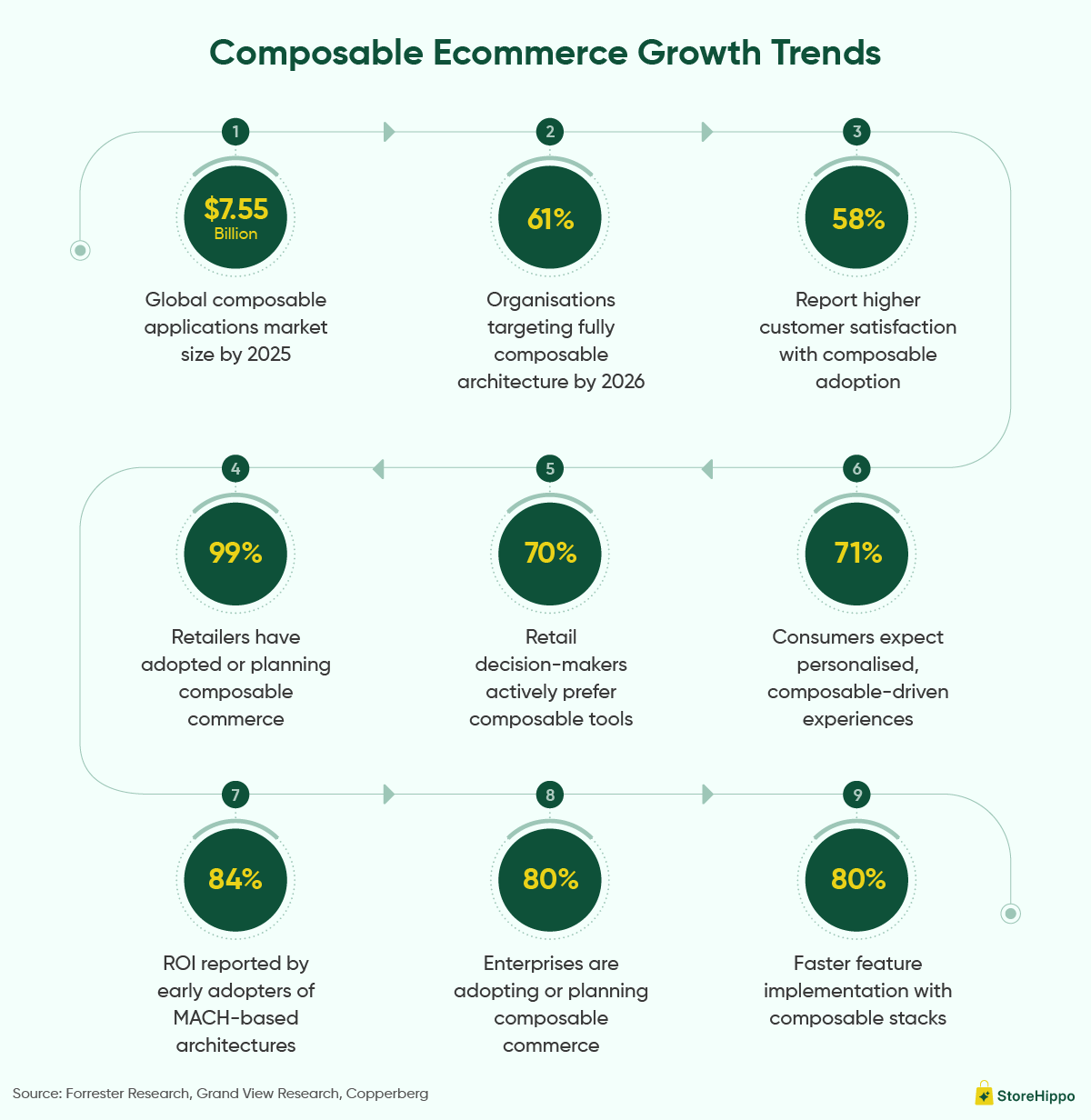
- $ 7.55 Bn is the estimated global composable applications market size in 2025
- 61% of organisations expect to achieve a fully composable architecture by 2026
- 58% of business owners adopting a composable approach report improved customer satisfaction
- 99% of retailers have either adopted or are planning to adopt a composable approach to commerce
- 70% of retail decision-makers now prefer and actively seek composable tooling
- 71% of consumers expect personalised interactions, effectively delivered through composable systems
- 84% ROI is reported by early retail adopters of MACH-based composable architectures
- 80% of enterprises have either adopted or are planning to adopt composable commerce
- 80% faster feature implementation is achieved by brands using composable stacks
Source:Gartner, McKinsey & Company, Forrester, Global Insight Services
The growing adoption of composable commerce highlights a clear shift: enterprise marketplaces are prioritising flexibility, speed, and adaptability over rigid systems. As marketplace ecosystems become more complex, the ability to scale, integrate, and innovate without disruption is no longer optional.
To stay competitive and drive long-term growth, enterprises need a composable commerce platform that combines modular flexibility with unified operations, built-in AI tools, and enterprise-grade scalability from the ground up.
10 FAQs Enterprises Must Ask Before Choosing Composable Commerce Platforms
Here are the 10 must-ask questions every enterprise should consider before choosing a composable commerce platform:
1. What strategic business outcomes should enterprises expect from adopting a composable commerce platform?
When evaluating a composable commerce platform, enterprises should move beyond feature checklists and focus on measurable business outcomes. The best enterprise ecommerce with a composable solution helps businesses move faster, reduce operational complexity, and adapt easily as requirements evolve.
At a strategic level, enterprises should expect:
- Faster go-to-market for new business models, product lines, or regions
- Reduced dependency on multiple third-party tools and plugins
- The ability to continuously innovate without disrupting core operations
- Improved customer experiences through deeper personalisation and faster iterations
- Seamless operational efficiency by eliminating repetitive processes
Built on MACH architecture, StoreHippo comes with 300+ native features, ensuring enterprises don’t have to build everything from scratch or rely heavily on external tools and innovate easily without disrupting current operations. StoreHippo is an API-first platform that enables seamless integrations with third-party software, such as CRM, ERP, and more, helping them streamline their daily operations. StoreHippo also offers 150+ pre-integrations across payment service providers, logistics providers, ERP, accounting, and marketing tools, enabling enterprises to build and scale their unique ecommerce ecosystems with speed and confidence.
2. Will the composable commerce platform scale efficiently across geographies, channels, and peak transaction volumes?
Scalability is one of the most critical factors for enterprise ecommerce, yet it is often underestimated during platform selection. What works for a growing business today may fail under the pressure of high traffic, large catalogues, or global expansion tomorrow. Enterprises should evaluate whether scaling causes performance issues. They should ensure that scaling does not increase downtime risk and maintenance complexity.
Enterprises should evaluate whether the platform can:
- Handle sudden traffic spikes during sales campaigns or peak seasons
- Support large and complex product catalogues without performance slowdowns
- Manage increasing number of vendors and their operations efficiently
- Expand across multiple geographies without requiring replatforming
- Maintain consistent performance even as operations grow
This ensures that growth does not slow down operations but is supported seamlessly by the platform.
StoreHippo multivendor marketplace platform is built on cloud native infrastructure, which offers inherently scalable solutions to enterprises. Its inherent scalability, along with auto-provisioning of servers make the ecommerce marketplace ready for peak load tolerance and can grow exponentially. It enables enterprises to scale individual components like catalogue, checkouts, vendor management, and order processing independently.
For enterprises looking to expand globally, StoreHippo offers a powerful go-to-market advantage. With built-in support for multi-currency, multilingual, and geo-targeted storefronts, businesses can launch and manage international operations without rebuilding their technology stack. Its multi store architecture enables enterprises to build region-specific storefronts for cross-border markets with localised languages, pricing, taxation, and compliance, making global expansion faster and more efficient.
It ensures that growth does not slow down operations, but maintains stable performance, fast response times, and zero downtime.
3. How quickly can enterprises launch and iterate new business models, storefronts, or market expansions on the composable commerce platform?
In a competitive ecommerce landscape, the ability to launch quickly and iterate continuously can determine market leadership. Enterprises need a composable ecommerce platform that enables them to act on opportunities without being delayed by technical limitations. Enterprises exploring new markets or seasonal opportunities should consider speed a critical factor, as it directly impacts revenue.
A composable commerce platform should enable:
- Rapid deployment of new storefronts and marketplaces
- Faster testing of new business models, pricing strategies, or regions
- Continuous experimentation without affecting current operations
- Quick rollout of features and updates
StoreHippo is natively built to support diverse business models and industry use cases out of the box, including B2B, B2C, B2B2C, D2C, hyperlocal, multi-vendor, hybrid marketplaces and more. This built-in flexibility enables enterprises to launch and scale new business models without requiring extensive custom development.
As a fully hosted and managed platform, StoreHippo ensures that enterprises do not have to worry about infrastructure, maintenance, or upgrades. New features, enhancements, and updates are continuously rolled out, enabling businesses to stay competitive without additional effort.
4. How much control do enterprises have on the enterprise ecommerce platform to customise commerce experiences, workflows, and business logic?
One of the biggest promises of composable commerce platforms is flexibility, but not all platforms deliver true control. Enterprises should evaluate whether the enterprise ecommerce platform they are selecting really offers the flexibility and control or imposes limitations on design, workflows, or business logic.
Enterprises should evaluate:
- Whether they have full control over frontend experiences and branding
- The ability to customise backend workflows according to business needs
- Flexibility in pricing models, discount strategies, and checkout flows
- Control over vendor operations
Without this level of control, enterprises may find themselves restricted even within a “flexible” system.
StoreHippo provides complete control through its headless architecture, drag-and-drop design tools, and 300+ APIs. Its decoupled headless architecture enables enterprises to completely tweak the platform inside out to implement out-of-the-box solutions that align with their unique business requirements. With StoreHippos easy to use drag and drop tools, enterprises can customise storefront designs, update themes and layouts in minutes, that too without coding. StoreHippo offers built-in solutions for pricing overrides to customise prices based on customer segments, locations, and business rules, and a discount engine to create personalised offers for different buyer segments. This level of flexibility is essential for enterprises looking to differentiate their marketplace and deliver unique customer experiences.
5. Does the composable commerce platform leverage AI and automation to improve efficiency, personalisation, and decision-making?
AI has become a defining factor in modern ecommerce, but its effectiveness depends on how deeply it is integrated into the platform.
Enterprises should look for AI capabilities that go beyond surface-level automation and support:
- Intelligent product discovery and recommendations
- Automated cataloguing, tagging, and content generation
- Advanced search that understands user intent and context
- Image optimisation to enhance product presentation
- Conversational commerce through AI assistants
When AI is treated as an add-on, it often requires additional tools, integrations, and management overhead. However, when it is embedded into the platform, it becomes a powerful operational layer that improves efficiency and decision-making. This is what StoreHippo offers. StoreHippo is a composable commerce platform where AI is built into its core. StoreHippo AI-powered e-commerce platform enables automated cataloguing to reduce manual effort, enhances product visuals with Magic Edit for better consistency and appeal, and improves product discovery through AI-driven semantic search. It also enables enterprises to build custom AI assistants that support multilingual, voice-enabled, and conversational shopping, creating more intuitive and engaging buyer journeys. This ensures that AI is not just a feature but a core capability that drives growth and efficiency.
6. Can the composable commerce platform enable seamless omnichannel selling across web, mobile apps, marketplaces, sales teams, and conversational channels from a single unified system?
Modern ecommerce is all about having a presence across multiple channels. Having a website, mobile apps, strong social media presence, marketplaces and emerging channels like WhatsApp, chat interfaces, etc is non-negotiable to stay competitive and meet evolving customer expectations. Enterprises should ensure the composable commerce platform they choose has omnichannel capabilities. They must have a unified system to manage all the channels without data loss and fragmentation.
A composable platform should have:
- Built-in omnichannel selling across multiple sales channels
- Centralised management of all channels from a single backend
- Consistent pricing, inventory, and promotions across platforms
- Seamless customer journeys across all touchpoints
- Quick launch of new channels without duplicating infrastructure
StoreHippo’s omnichannel capabilities allow businesses to manage all touchpoints from a single platform. Enterprises can launch and control multiple storefronts, mobile experiences, and channels while maintaining consistency and efficiency. This unified approach not only enhances customer experience but also simplifies operations at scale.
StoreHippo enterprise marketplace platform offers built in omnichannel capabilities enabling enterprises to be present across channels where buyers are. With StoreHippo’s built-in mobile app builder enterprises can easily launch their Android and iOS apps and PWA stores directly from the admin dashboard. They can connect customers through Whatsapp, and build agentic AI interfaces for smart selling. Enterprise can manage products, pricing and orders across every channel from a unified backend and offer personalised buying experience across every channel.
7. How does the platform handle global expansion requirements such as multi-region deployments, localisation, and regulatory compliance within a composable setup?
Enterprises scaling across multiple global markets should look for multi vendor marketplace platform that offers built-in cross-border features. Expanding into global markets introduces multiple layers of complexity, including language, currency, taxation, and regional preferences. Relying on plugins for these global capabilities often leads to inconsistencies and increased operational overhead. Enterprises should evaluate whether the platform offers built-in tools for these global features.
Enterprises should evaluate whether the composable commerce platform supports:
- Multi-currency transactions and pricing
- Multilingual storefronts for different geographies
- Region-specific catalogues and promotions
- Localised user experiences
StoreHippo offers built-in global solutions for enterprises to expand into new international markets. With its multi-store architecture, enterprises can launch location-based stores for various international markets. They can easily customise the stores with unique store designs, URLs, language, and manage products, pricing, discounts, orders, shipment from a single dashboard. StoreHippo offers built in multilingual solutions that support 100+ languages, including RTL languages like Urdu, Hebrew, etc. Brands can add location-specific currency detection or give their customers the option to pay in preferred currency. StoreHippo is integrated with 150+ payment gateways and accepts payments in multiple currencies. It also comes with built-in tax management and compliance support to ensure smooth and regulation-ready cross-border operations.
8. How does the enterprise ecommerce platform ensure consistent data flow and unified visibility across distributed services, vendors, and customer touchpoints?
One of the biggest risks in composable commerce is the creation of data silos across different services and systems. Without proper integration, businesses may struggle with inconsistent data and limited visibility. A fragmented system can lead to inefficiencies, errors, and missed opportunities.
Enterprises need:
- Unified visibility across vendors, customers, and operations
- Seamless data flow across all components
- Real-time insights for better decision-making
StoreHippo ensures a centralised data ecosystem, where vendor management, orders, inventory, and customer data are all connected. This unified approach provides better visibility, improves operational efficiency, and enables faster, data-driven decision-making.
9. How seamlessly can the composable ecommerce platform integrate with existing enterprise systems and data workflows?
Enterprises should carefully evaluate the integration capabilities of the composable commerce platform. They should check whether they can seamlessly integrate their existing system into the platform or if they have to invest significant time and effort in custom integrations.
Key factors to evaluate include:
- Availability of robust APIs
- Pre-integrated tools and services
- Flexibility to add or replace components as needed
Built on API+ architecture, StoreHippo multi vendor marketplace platform can be easily connected with a wide range of enterprise tools. With 350+ well-documented APIs, it enables enterprises to seamlessly connect with their existing tools like ERP, CRM, accounting, marketing, logistics, etc. They can also integrate with the best software and services in their tailored ecommerce environment. StoreHippo offers 150+ pre-integrations with payment service providers, logistics providers, and more. This ensures that businesses can build a customised ecosystem without being constrained by platform limitations or excessive development effort.
10. What is the long-term total cost of ownership compared to traditional or plugin-driven platforms?
The total cost of ownership goes far beyond the platform subscription. Enterprises must consider:
- Costs of third-party apps and integrations
- Maintenance and upgrade expenses
- Scalability-related costs
- Operational inefficiencies
StoreHippo helps reduce long-term costs by offering 300+ built-in features that minimise the need for multiple third-party tools and integrations. Its fully managed infrastructure reduces maintenance and upgrade overhead, allowing teams to focus on growth instead of technical maintenance. In addition, StoreHippo’s transparent enterprise pricing eliminates hidden costs, giving businesses better control over their budgets. Together, this creates a more predictable and cost-efficient ecommerce setup, enabling enterprises to invest more in innovation and expansion rather than ongoing maintenance.
Conclusion
Composable commerce offers flexibility, but without the right foundation, it can introduce complexity that slows down growth.
For enterprises, the goal is not just flexibility, it is controlled, scalable, and intelligent flexibility that supports long-term success.
By asking these 10 critical questions, decision-makers can move beyond surface-level comparisons and choose a platform that truly aligns with their growth strategy.
StoreHippo brings together composable architecture, built-in enterprise capabilities, and AI as the operational layer, enabling businesses to scale globally, customise deeply, and operate efficiently without fragmentation.
Are you ready to move beyond limitations and build a future-ready ecommerce ecosystem? Explore StoreHippo solutions by booking your personalised demo today.