


Global ecommerce growth today is no longer limited by market demand. It is increasingly defined by how fast enterprises can build, adapt, and scale their digital commerce ecosystems.
This is where the low code ecommerce platform is becoming a strategic advantage. Instead of relying on long development cycles and fragmented tools, enterprises are shifting towards platforms that allow faster execution, easier customisation, and unified control across operations.
For brands evaluating an enterprise ecommerce platform, the decision is no longer just about features. It is about choosing a system that can support multiple business models, scale across regions, and evolve continuously without creating operational bottlenecks.
This shift is even more significant for businesses looking for a headless ecommerce platform or a no plugin ecommerce platform, where flexibility, performance, and long-term stability become critical.
To understand why low code ecommerce is gaining momentum, it is important to look at how it is transforming enterprise growth globally.
Table of Contents
- How Low Code Ecommerce Solutions Are Driving Global Enterprise Growth
- How AI-Powered Low-Code Ecommerce Platforms Deliver Faster, Smarter Growth
- 12 Smart Questions to Choose the Right Low-Code Ecommerce Platform
- 1. What should enterprises prioritise when evaluating a low code ecommerce platform beyond speed of deployment?
- 2. How can a low code ecommerce platform eliminate dependency on plugins and fragmented tools?
- 3. Can a single low code platform unify B2B, D2C, and marketplace operations without separate systems?
- 4. How does a low code ecommerce platform support real-time operational control at scale?
- 5. What role does AI play in enhancing low code ecommerce platforms?
- 6. How can enterprises assess whether a low code ecommerce platform is truly omnichannel-ready?
- 7. How does a low code ecommerce platform enable faster expansion into new markets or regions?
- 8. Can low code platforms handle complex workflows like tiered pricing, bulk orders, and custom fulfilment logic?
- 9. How do low code ecommerce platforms reduce total cost of ownership for enterprises?
- 10. What differentiates a truly enterprise-ready low code ecommerce platform from basic builders?
- 11. How can enterprises evaluate the flexibility of a low code platform for future business changes?
- 12. Why is a unified backend critical in a low code ecommerce platform?
- Why StoreHippo Is the Best Fit Low Code Ecommerce Platform for Scalable Enterprise Growth
- Conclusion
How Low Code Ecommerce Solutions Are Driving Global Enterprise Growth
Low code ecommerce infrastructure is not just improving development speed. It is fundamentally changing how enterprises build, manage, and scale their digital commerce operations.
The following data highlights how enterprise ecommerce platforms built on low code architecture are enabling faster innovation, reducing costs, and improving agility for enterprise teams.
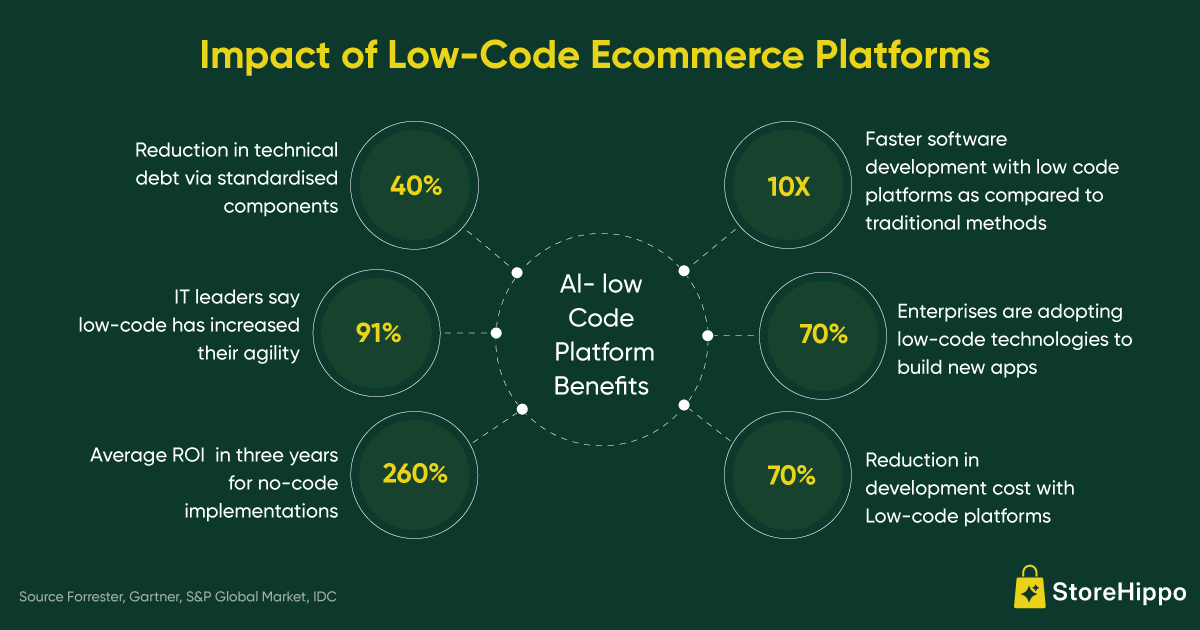
- 10x faster software development with low code platforms as compared to traditional methods
- 70% of enterprises are adopting low-code technologies to build new apps
- 70% reduction in development cost with Low-code platforms
- 260% average ROI in three years for no-code implementations
- 91% of IT leaders say low-code has increased their agility
- 40% reduction in technical debt via standardised components
Source Forrester, Gartner, S&P Global Market, IDC
These numbers clearly show that low code platforms are not just a convenience layer. They are becoming the foundation for faster, more efficient enterprise commerce execution.
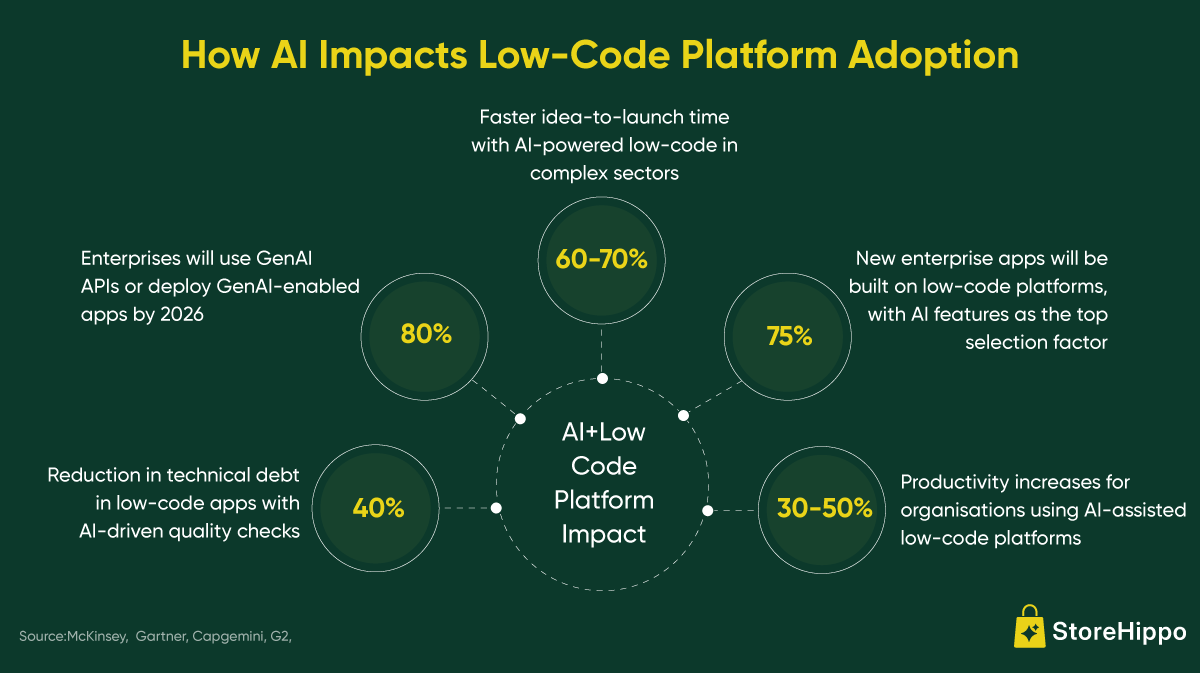
- 30%- 50% productivity increases for organisations using AI-assisted low-code platforms
- 75% of new enterprise apps will be built on low-code platforms, with AI features as the top selection factor
- 60–70% faster idea-to-launch time with AI-powered low-code in complex sectors
- 80% of enterprises will use GenAI APIs or deploy GenAI-enabled apps by 2026
- 40% reduction in technical debt in low-code apps with AI-driven quality checks
Source:McKinsey, Gartner, Capgemini, G2,
AI is no longer an add-on capability. It is becoming the operational layer that enhances development, automates workflows, and improves decision-making across ecommerce systems.
Together, low code and AI are reshaping how quickly enterprises can launch, scale, and optimise their ecommerce ecosystems.
How AI-Powered Low-Code Ecommerce Platforms Deliver Faster, Smarter Growth
To better understand the impact of AI-powered low-code platforms, let's see the table below, which compares how traditional development, standard low-code, and AI-augmented low-code platforms perform across key enterprise metrics.
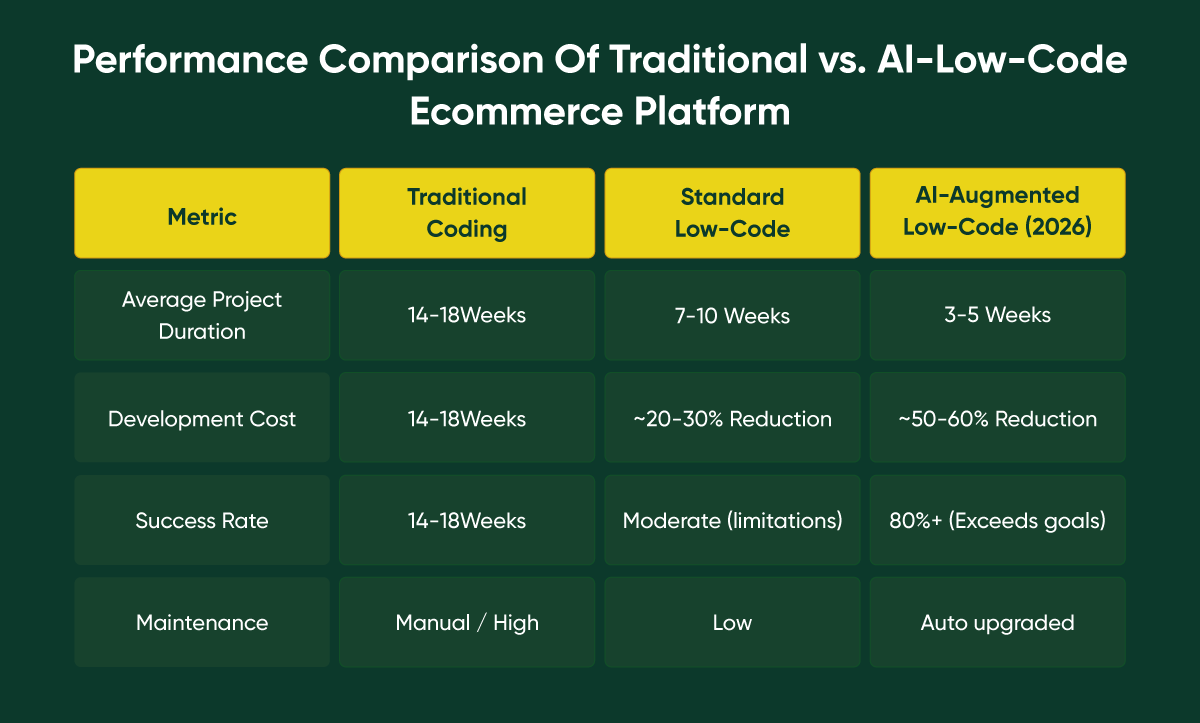
AI-powered low-code ecommerce platforms are redefining how enterprises execute, turning fragmented, complex commerce ecosystems into streamlined, intelligent operations. They enable businesses to move from reactive management to proactive, data-driven growth at scale.
Let’s now explore some key questions that help enterprises evaluate the real capabilities of a low-code ecommerce platform.
12 Smart Questions to Choose the Right Low-Code Ecommerce Platform
Choosing the right low-code ecommerce platform goes beyond ease of use or quick deployment. It requires a clear understanding of how well the enterprise ecommerce platform can support evolving business needs as enterprises expand across markets, channels, and models.
These questions address the key concerns enterprises must consider when selecting a low code ecommerce platform that can handle scale, flexibility, and long-term operational complexity.
1. What should enterprises prioritise when evaluating a low code ecommerce platform beyond speed of deployment?
Enterprises should prioritise architectural flexibility, ability to support multiple business models, and long-term scalability rather than just faster go-live timelines. For example, a brand may start with a D2C model and later expand into B2B bulk selling or a marketplace with multiple sellers. The platform should support this shift without requiring a new system. Similarly, if the business enters new regions, it should be able to launch new storefronts with local pricing, language, and fulfilment from the same backend.
Enterprises should evaluate whether the low code ecommerce platform:
- Offers no plugin, native solutions for various business models
- Handles multiple stores, complex pricing, and high order volumes smoothly
- Allows easy updates to products, pricing, and user journeys without heavy coding
- Scales easily as your business grows, even during peak demand
- Comes with built-in tools/integrations for payments, logistics, localisation, marketing, etc (no need for plugins)
- Enable teams to make changes without breaking current workflows
- Supports smooth updates without affecting your setup or integrations
- Connects easily with your existing systems like ERP, CRM, payments, and logistics
2. How can a low code ecommerce platform eliminate dependency on plugins and fragmented tools?
The best platforms offer built-in capabilities for core functions like marketplace management, integrations, and workflows, reducing reliance on third-party apps and lowering operational complexity. Many platforms labelled low code ,depend on multiple plugins as quick fixes, but as they scale, managing multiple tools becomes difficult.
For example, a brand may begin with plugins for payments, logistics, and workflows, but as it grows, handling multiple tools becomes complex and error-prone. Updates can break integrations, increase costs, and slow operations. A no-plugin ecommerce platform with built-in enterprise-grade tools avoids these challenges and keeps everything running seamlessly within one system.
Enterprises should evaluate whether the low code ecommerce platform:
- Offers built-in features to manage vendors, catalogues, pricing, and workflows
- Reduces dependency on third-party plugins for core business functions
- Manages all work flows within one system instead of multiple patchy plugins
- Ensures smooth updates without breaking existing features
- Reduces maintenance effort and dependency on external systems
3. Can a single low code platform unify B2B, D2C, and marketplace operations without separate systems?
The best low code no plugin platform is one that enables multiple business models to run on one backend, allowing shared catalogues, pricing logic, and operations without duplication.
For instance, a brand may sell directly to customers in domestic markets,through a retail hyperlocal marketplace and offer cross border bulk selling to other businesses through a B2B multivendor marketplace at the same time. Running these models on separate systems creates confusion, delays, and data mismatches.
Enterprises should evaluate whether the low code ecommerce platform:
- Supports B2B, D2C, marketplace, hyperlocal, international marketplace and other business models from one backend
- Offers built-in tools to launch new business models without extra setup
- Uses shared catalogues and inventory across all business models
- Allows different catalogues, pricing and payment options for different customer groups
- Supports localisation and internationalisation for robust brand reach
- Avoids duplication of data and systems for better consistency, accuracy and easier management
4. How does a low code ecommerce platform support real-time operational control at scale?
Enterprises should evaluate if the platform offers centralised dashboards, automated workflows, and real-time visibility across orders, inventory, and fulfilment.
For instance, when orders spike during peak sales, delays in tracking inventory or fulfilment across channels can lead to stockouts or missed deliveries. Without real-time data, teams struggle to prioritise orders, manage logistics, and resolve issues quickly, impacting both efficiency and customer experience.
Enterprises should evaluate whether the low code ecommerce platform:
- Offers real-time visibility into orders, inventory, and payments
- Reduces manual work and improves accuracy
- Provides a centralised dashboard to manage operations across channels
- Automates routine tasks like catalogue creation, order routing, and support queries
- Helps teams track performance across regions and channels
5. What role does AI play in enhancing low code ecommerce platforms?
Modern no plugin ecommerce platforms embed AI into core workflows like cataloging, search, recommendations, and support, enabling automation and continuous optimisation without manual intervention.
For instance AI-powered low code ecommerce platforms may offer AI to automatically create product titles and descriptions, along with tagging and categorisation, making large catalogues easier to manage at scale. AI search results and recommendations can find relevant products for customers, helping them find what they need faster. At the same time, AI bots can be engineered to automate vendor and buyer support by handling common queries and speeding up customer support responses.
Enterprises should evaluate whether the low code ecommerce platform:
- Have AI built in its core for smarter automation and better decision-making
- Automates repetitive tasks and workflows to reduce manual effort and save time
- Uses AI for product cataloguing, tagging, and image optimisation to make cataloging and scaling faster and error-free
- Offers AI-powered personalisation and product discovery to help customers find relevant products faster
- Provides AI-driven support to customer, sellers and internal teams to improve response time and efficiency
6. How can enterprises assess whether a low code ecommerce platform is truly omnichannel-ready?
A strong headless ecommerce platform with low code capabilities built-in should seamlessly connect web, mobile apps, WhatsApp, and other channels while maintaining consistent data, inventory, and customer experience.
Customer today browse multiple channels before making a final purchase decision. They may browse a product on mobile app, place an order via a website, and track it on WhatsApp. If systems are not connected, this leads to inconsistent pricing, wrong inventory, and poor customer experience.
Enterprises should evaluate whether the low code ecommerce platform:
- Offers built-in omnichannel capabilities to run business across multiple channels
- Built on a mobile-first architecture to deliver seamless mobile experiences
- Connects website, mobile app, marketplaces, WhatsApp, and other channels in one system
- Keeps orders, pricing, inventory, and data consistent across all channels
- Delivers smooth and consistent customer experiences across all channels
7. How does a low code ecommerce platform enable faster expansion into new markets or regions?
Enterprises should look for capabilities like multi-store architecture, localisation, and region-specific configurations in the no plugin ecommerce platform they are looking to launch and manage global storefronts.
For example, a brand expanding into new international markets may need separate storefronts for each region with local language, currency, and region-specific offers. Without a unified system, teams often end up duplicating catalogues and manually adjusting pricing for every market, which slows down expansion and increases operational effort. A flexible platform allows such launches from a single backend without rebuilding systems for every new market.
Enterprises should evaluate whether the low code ecommerce platform:
- Offers a built-in multistore feature to launch multiple region-specific stores
- Manage multiple location wise, product-wise, and customer-wise stores from one backend
- Has built-in multilingual, multicurrency, and multiple payment gateways to enable smooth global expansion
- Native tools to set up different catalogues, pricing, and offers for different stores
- Handles tax and shipping rules for different local and global markets
- Offers themes and design tools to create unique designs and customise storefronts easily
- Enables quick launch of new product lines, stores, offers, etc., without rebuilding systems
8. Can low code platforms handle complex workflows like tiered pricing, bulk orders, and custom fulfilment logic?
Enterprise-grade no code ecommerce platforms should support advanced workflows for large scale businesses natively, allowing brands to configure unique workflows and rules without custom development.
For instance, a wholesale electronics business selling need different pricing for bulk buyers, repeat customers, or region-based partners. Large orders may also require approval before processing and may be delivered in parts over time. If the enterprise ecommerce platform doesn’t support this natively, businesses end up managing it manually or using multiple tools, which can lead to delays and pricing mistakes.
Enterprises should evaluate whether the low code ecommerce platform:
- Supports tiered pricing and customer-specific pricing rules for different buyer groups
- Handles bulk orders and large transactions smoothly to ensure fast processing and uninterrupted operations at scale.
- Allows custom fulfilment and delivery workflows to meet different customer needs
- Supports different workflows for different customer segments to improve operational efficiency and customer experience
9. How do low code ecommerce platforms reduce total cost of ownership for enterprises?
Enterprise ecommerce platforms with low code capabilities should have built-in tools to run large-scale businesses. Enterprises must evaluate whether the low code ecommerce platform offers pre-built modules and pre-integrations with payments, logistics, marketing, etc to reduce expensive custom builds and operational expenses. The platform must require minimal integrations and have a unified infrastructure to significantly reduce development, maintenance, and scaling costs over time.
For example, an enterprise using multiple external tools for payments, logistics, analytics, and catalogue and vendor management often faces rising subscription costs and constant integration maintenance. As order volumes grow, even small updates require coordination across multiple systems, increasing dependency on technical teams and slowing down execution.
Enterprises should evaluate whether the low code ecommerce platform:
- Offers built-in tools to manage most enterprise operations efficiently without relying on multiple external systems.
- Reduces dependency on multiple tools and plugins to lower overall operational cost
- Minimises development and maintenance effort to save long-term engineering time
- Avoids repeated integration costs by keeping systems unified
- Automates key operations to reduce manual workload and improve efficiency
- Keeps scaling costs predictable and manageable as business grows
10. What differentiates a truly enterprise-ready low code ecommerce platform from basic builders?
Enterprise-ready low-code ecommerce platforms go beyond basic website builders by combining scalability, deep customisation, native enterprise-grade features, and AI-driven automation. Enterprise ecommerce platforms with low code capabilities are designed to support complex business operations, high transaction volumes, and multistore management and multi-channel growth while maintaining flexibility and performance at scale.
For example, during high-demand events like festive sales or flash promotions, enterprise brands often experience sudden traffic spikes across multiple channels. A basic website builder may struggle with performance drops or require external plugins to manage scaling, whereas enterprise-ready low code ecommerce platforms are designed to handle high traffic spikes, multiple workflows, and complex business operations without disruption.
Enterprises should evaluate whether the low code ecommerce platform:
- Comes with built-in enterprise features instead of relying on plugins
- Offers deep customisation without heavy development effort
- Supports high traffic and large order volumes without performance issues
- Handles complex business models like B2B, D2C, B2B2C , hyperlocal , multivendor marketplaces together
- Has multistore and localisation tools to scale across local and international market
- Uses AI and automation to improve operations and efficiency
11. How can enterprises evaluate the flexibility of a low code platform for future business changes?
Enterprises should evaluate whether the low code enterprise ecommerce platform self-hosted control with automatic updates and upgrades, supports multiple business models, enables easy changes to workflows, channels, and business models without replatforming or major redevelopment.
For example, a retail business may start with D2C sales but later want to expand into wholesale business, connect with local dealers for hyperlocal selling or launch multivendor marketplace to reach wider audience. If the platform is rigid, every new change requires redevelopment and system restructuring. This slows down the business and increases dependency on technical teams for even small updates.
Enterprises should evaluate whether the low code ecommerce platform:
- Allows easy changes to workflows, catalogues, and business rules without coding
- Supports new channels and business models without rebuilding the system
- Enables quick updates and upgrades without affecting existing business operations
- Adapts to changing business requirements smoothly over time
- Reduces dependency on developers for everyday changes
12. Why is a unified backend critical in a low code ecommerce platform?
In a headless ecommerce platform with low code features, a unified backend is critical to ensure all operations, stores, channels, and data are managed centrally. This enables enterprises to execute faster operations, gain better visibility, and deliver consistent customer experiences across their sales channels and customer touchpoints.
For example, enterprises running multiple storefronts in different locations or different channels often face issues when inventory, orders, and customer data are managed in separate systems. This can lead to wrong stock information, delays in order processing, and inconsistent communication with customers. An enterprise ecommerce platform with a unified backend solves this challenge by updating everything in real time across all channels.
Enterprises should evaluate whether the low code ecommerce platform:
- Manages all operations from one unified system to improve control and visibility
- Keeps data consistent across all channels and business functions
- Eliminates duplication of systems and reduces operational complexity
- Provides a unified backend to manage orders, inventory, and customers for faster decisions
- Improves efficiency by connecting all workflows in one platform
Why StoreHippo Is the Best Fit Low Code Ecommerce Platform for Scalable Enterprise Growth
Enterprises looking to scale beyond disconnected systems need an ecommerce platform that brings all their business models, sales channels, customer data and operations into one unified system. StoreHippo enterprise ecommerce platform delivers exactly this with its AI-powered, headless, and low-code architecture.
With 300+ enterprise-grade native features, 150+ pre-integrations across payments, logistics, ERP, accounting, and marketing tools, and 350+ APIs for seamless connectivity, StoreHippo enables businesses to manage everything from a single platform. This unified approach reduces dependency on multiple tools, simplifies operations, and helps enterprises scale faster with greater efficiency and control.
Enterprises can leverage StoreHippo to:
1. Run Multiple Business Models from a Single Platform: Enterprises can run B2B, D2C, B2B2C, multivendor marketplaces, hyperlocal, and international commerce from one backend. They don't need to manage separate systems for different models, which reduces operational complexity and data fragmentation.
2. Launch New Storefronts Faster: With built-in multi-store capabilities, businesses can quickly launch new storefronts for different regions or segments without rebuilding infrastructure every time they expand.
3. Centralised Management for Better Control: StoreHippo's low-code ecommerce platform enables enterprises to manage catalogues, pricing, inventory, and customer groups from one centralised admin, helping them keep everything consistent across all channels and business models.
4. Scale Globally with Built-in Localisation tools: StoreHippo comes with native go-global features to scale across cross-border markets without relying on multiple third-party tools or complex integrations. Enterprises can set up multiple storefronts tailored to different international markets. They can configure multiple languages and currencies and integrate with global payment gateways to make international operations easier to manage and scale.
5. Eliminate Plugin Dependency: With built-in tools and ready integrations for payments, logistics, marketing, and workflows, StoreHippo’s headless ecommerce platform brings all key operations into one system.
This removes the need for multiple external plugins, reducing complexity and manual effort.
6. Support Complex Enterprise Workflows: From tiered pricing and bulk ordering to custom fulfilment processes, StoreHippo supports advanced business requirements without the need for additional development.
7. Improve Efficiency with AI-Powered Automation: StoreHippo is an AI powered ecommerce platform that helps businesses automate and manage daily operations more efficiently. It offers AI tools to handle catalogue management, product tagging, search, recommendations, and enable businesses to launch custom AI bots for customer and seller support, enabling faster operations, reduced manual effort, and more accurate outcomes at scale.
8. Deliver Consistent Omnichannel Experiences: StoreHippo offers a unified architecture that brings all channels into one system. This ensures a smooth and consistent customer experience across websites, mobile apps, marketplaces, and other touchpoints.
9. Reduce Total Cost of Ownership: StoreHippo’s no-plugin ecommerce platform reduces overall costs by removing the need for multiple systems, repeated integrations, and heavy maintenance. It is also a fully hosted enterprise ecommerce platform with automatic updates and upgrades, so businesses don’t have to worry about maintenance or system management. This allows businesses to focus more on growth instead of managing technical complexities.
10. Make Faster, Data-Driven Decisions: With real-time data on orders, inventory, customers, and deliveries, enterprises can have complete visibility across their entire operations. This helps them take faster actions and make better decisions without delays. It also reduces guesswork and improves overall efficiency.
Conclusion
Low code ecommerce platforms are no longer just tools for faster development; they are becoming the core for scalable, future-ready enterprise commerce ecosystems. As businesses expand across markets, channels, and business models, the ability to adapt quickly without adding complexity becomes critical. Evaluating an enterprise ecommerce platform through the right questions helps enterprises to choose the best fit low code ecommerce platform and move beyond surface-level benefits and focus on long-term flexibility, unified operations, and cost efficiency.
Choosing a headless, no plugin, low code ecommerce platform like StoreHippo ensures that enterprises can build, scale, and optimise their businesses from a single, unified backend. This not only helps businesses grow faster but also makes their operations more consistent, efficient, and reliable in an increasingly competitive ecommerce landscape.
Book a demo to explore how StoreHippo can help you build, customise, and scale your ecommerce business with ease.