


The world of B2B enterprise ecommerce is evolving faster than ever.
As technology and buyer expectations shift, businesses must adapt to stay competitive.
But what will define the future of ecommerce for B2B marketplaces in 2026?
It’s more than just adopting the latest tools, it’s about embracing trends that reshape the way companies connect, sell, and grow.
From the rise of personalisation to the increasing dominance of B2B marketplaces, the B2B ecommerce landscape is transforming.
Businesses are moving towards solutions that enable seamless scalability, faster operations, and deeper customer engagement.
Well, keeping up with these trends is essential for success.
Ready to discover what’s ahead and how your business can lead the way?
Table of Contents
- The Future of Ecommerce: B2B Trends And Industry Insights
- 10 Trends Reshaping B2B Enterprise Ecommerce In 2026
- 1. Hyper-Personalised Buyer Journeys
- 2. Mobile as the Primary Sales Channel
- 3. AI-Native, Headless Commerce Core
- 4. Omnichannel Commerce
- 5. Seamless Integrations
- 6. Multi-Vendor Marketplaces for StandardisedStandardized Business Operations
- 7. Hybrid Business Models
- 8. Localised B2B Ecommerce Experiences
- 9. Subscription-Based Selling Models
- 10. Data-Driven Strategic Growth
- Conclusion
- FAQs
The Future of Ecommerce: B2B Trends And Industry Insights
B2B ecommerce is evolving at an unprecedented pace, driven not only by digital adoption but by the growing role of AI in shaping how enterprises sell, scale, and compete. As buyer behaviour shifts decisively from offline to online, B2B marketplaces are expected to deliver faster, more intuitive, and more personalised buying experiences. Understanding these ecommerce trends is critical for B2B enterprises looking to stay ahead in an increasingly competitive digital landscape.
Here is a quick look at the B2B trends and customer behaviour:
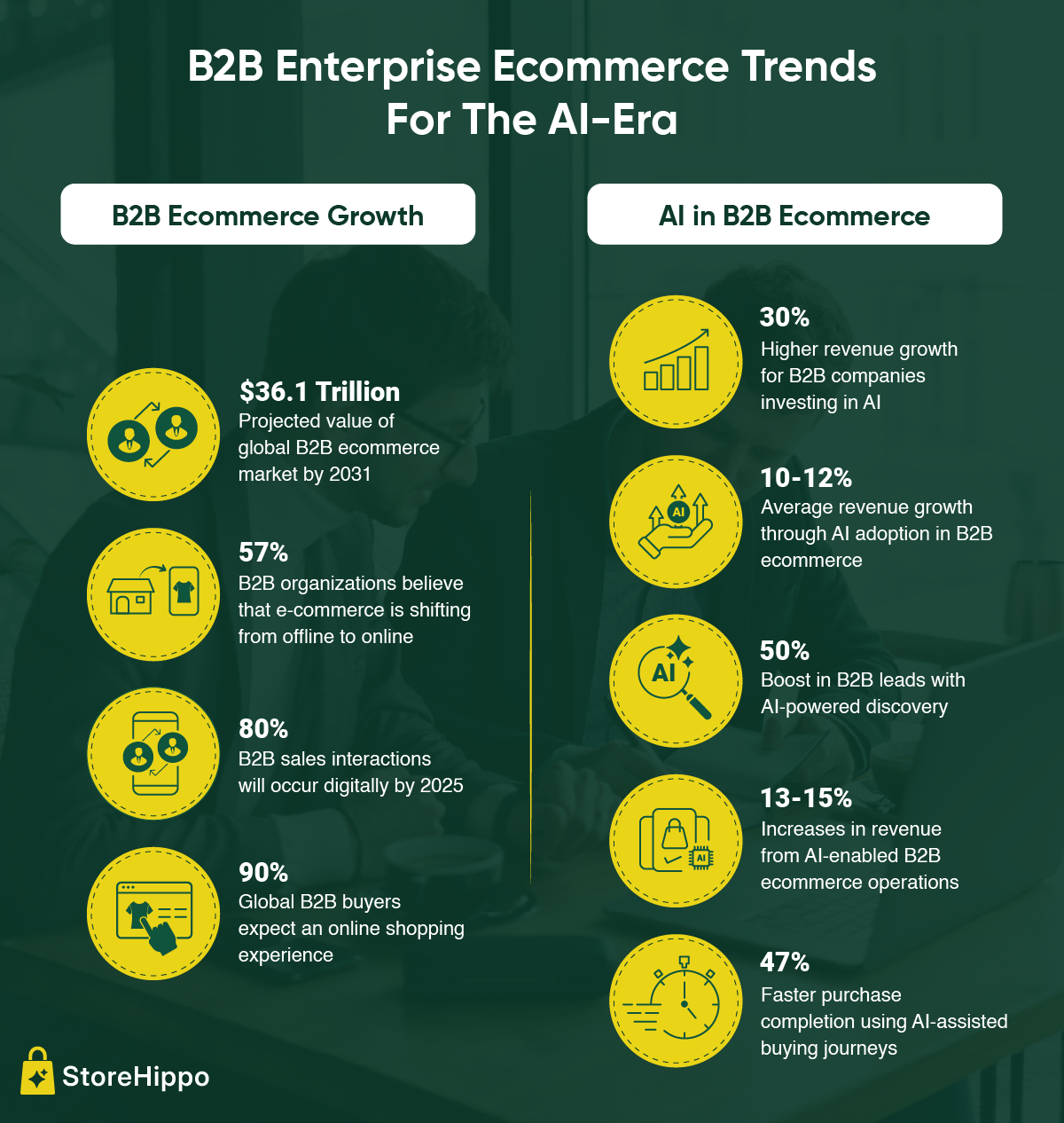
B2B Ecommerce Growth
- $ 36.1Trillion is the projected value of the global B2B ecommerce market by 2031
- 57% of B2B organisations believe that e-commerce is shifting from offline to online
- 80% of all B2B sales interactions will occur digitally by 2025
- 90% of global B2B buyers expect an online shopping experience
AI in B2B Ecommerce
- 30% higher revenue growth for B2B companies investing in AI
- 10-12% average revenue growth through AI adoption in B2B ecommerce
- 50% boost in B2B leads with AI-powered discovery
- 13-15% increases in revenue from AI-enabled B2B ecommerce operations
- 47% faster purchase completion using AI-assisted buying journeys
Source: Statista, Accenture, Gartner, Persana AI, McKinsey, HelloRep
The data clearly highlights a fundamental shift in B2B enterprise ecommerce, from manual, sales-led processes to digital-first and intelligence-led commerce. While online buying expectations and digital interactions continue to rise, AI is emerging as a key growth driver, improving conversions, accelerating purchasing decisions, and unlocking measurable revenue gains. For B2B enterprises, staying competitive in 2026 will depend on how effectively they combine AI-driven capabilities with scalable ecommerce infrastructure to deliver faster, smarter buying experiences.
These shifts signal a clear direction for B2B enterprise ecommerce in 2026, shaped by smarter technology, faster operations, and more personalised buying journeys. Let’s explore the key trends that are reshaping how B2B enterprises build, scale, and future-proof their ecommerce marketplaces.
10 Trends Reshaping B2B Enterprise Ecommerce In 2026
The future of ecommerce, in the B2B industry is defined by greater scalability, faster operations, and deeper customer engagement, making it essential for businesses to stay ahead of ecommerce trends to remain competitive. Understanding these trends is key to thriving in the ever-changing market.
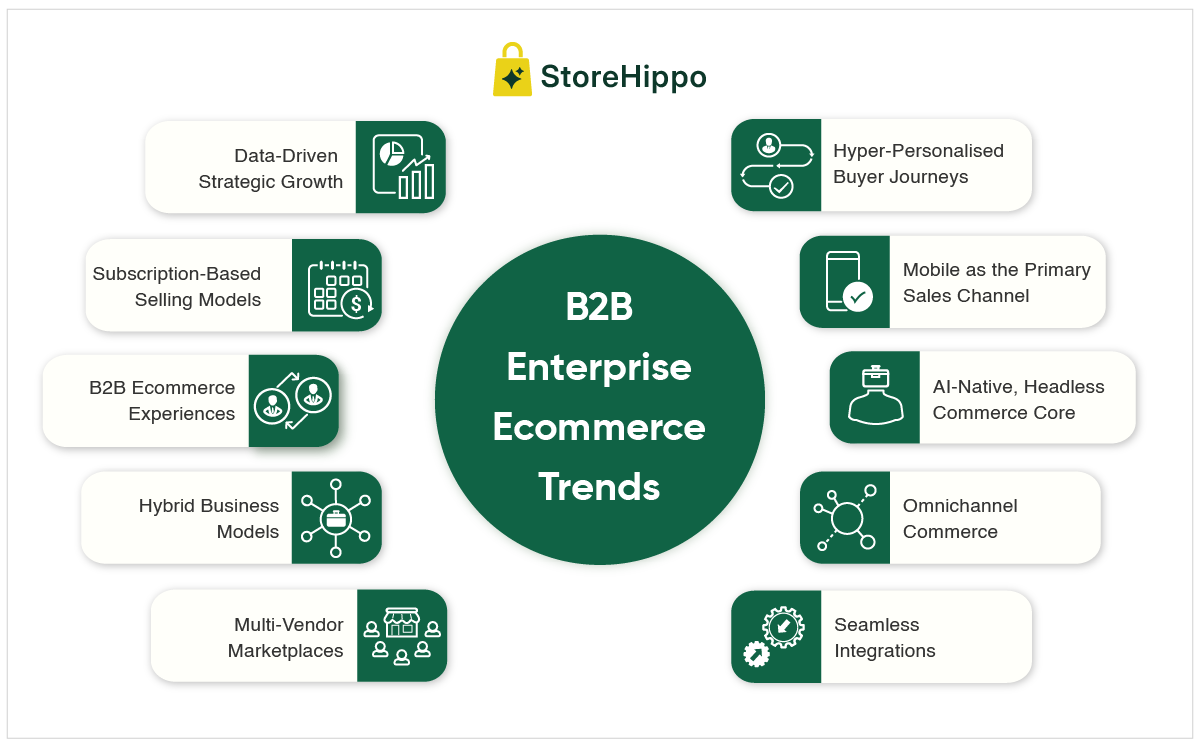
Here are 10 B2B ecommerce trends to watch in 2026:
1. Hyper-Personalised Buyer Journeys
In B2B ecommerce, personalisation is no longer just a value addition, it’s a necessity. Buyers today expect tailored experiences that cater to their unique needs. From personalised catalogues and pricing to product recommendations, every touchpoint should align with the buyer’s preferences. This approach not only enhances engagement but also builds trust and loyalty. The future of ecommerce lies in creating hyper-personalised buyer journeys that adapt dynamically based on customer behaviour and intent.
The flexible enterprise ecommerce platform StoreHippo is built on the decoupled headless architecture, which can be tweaked inside out. You can implement multi-level personalisations like building multiple storefronts/sub-stores for your B2B marketplace for different locations, audiences, or different categories. From customising your shipping solutions and digital payments to offering localisation with multilingual content and personalised pricing, different store designs, discounts, etc., you get a wide range of features and tools with StoreHippo.
What's more?
StoreHippo's AI-powered intent analysis and behaviour-driven recommendations enable hyper-personalisation to move beyond static rules. AI-powered search and recommendation engine helps marketplaces deliver highly accurate search results beyond keyword-based filtering and relevant product recommendations in real time based on buyer context and purchase patterns. In addition, you can integrate voice-based product discovery and ordering powered by AI that understands natural language, enabling buyers to search, compare, and place orders using conversational, multilingual voice commands, making complex B2B purchasing faster, more intuitive, and accessible across regions.
2. Mobile as the Primary Sales Channel
With mobile devices becoming the preferred buying channel, mobile-first strategies are reshaping the ecommerce industry. Buyers increasingly rely on their smartphones to browse products, place orders, and track deliveries. You must ensure your platform ismobile-optimised, offering fast-loading pages, intuitive navigation, and mobile-friendly payment options. The future of ecommerce demands responsive designs that provide a seamless experience across all devices. By prioritising mobile as the primary sales channel, you can cater to modern buyers who demand convenience and accessibility in their shopping journeys.
StoreHippo’s ecommerce platform is built on the mobile-first principle and offers a variety of mobile-ready solutions. Stores built on StoreHippo are PWAs, which means your ecommerce websites will work, look, and feel like mobile apps. StoreHippo’s inbuilt mobile apps builder builds mobile apps right from the admin dashboard at zero additional costs without any coding. You can easily create separate apps for different sub-stores from the admin dashboard. StoreHippo enterprise ecommerce solutions also offer a variety of apps for admins, vendors, delivery boys, etc., making it easy for brands to run their business on the go.
3. AI-Native, Headless Commerce Core
AI is rapidly becoming the intelligence layer that defines how modern B2B marketplaces operate, scale, and compete. As catalogues grow larger and buyer journeys become more complex, enterprises can no longer rely on manual processes or rigid, rule-based systems. In 2026, AI moves beyond experimentation to become a core driver of efficiency, smarter discovery, guided buying, and faster decision-making across B2B ecommerce.
StoreHippo’s AI-powered core embeds this intelligence across the entire B2B ecosystem, from AI-assisted cataloguing and image enhancement with Magic Edit to intelligent search, recommendations, and hyper-personalised buyer journeys that improve as the system learns. Multilingual voice search makes large catalogues easier to discover across regions, while custom agentic AI chatbots for buyers, sellers, and support teams enable guided purchasing, faster issue resolution, and reduced operational load.
This intelligence is amplified by StoreHippo’s headless, decoupled architecture, which gives enterprises the flexibility to design tailored experiences across multiple touchpoints without disrupting backend operations. With 300+ APIs, marketing and development teams gain the agility to integrate best-of-breed tools, experiment with new storefronts, and evolve quickly as business needs change, allowing B2B marketplaces to scale intelligently with both AI-driven decision-making and headless flexibility at the core.
4. Omnichannel Commerce
B2B buyers today expect a seamless journey across multiple channels, from online stores to physical locations.Omnichannel commerce bridges the gap by integrating these channels into a cohesive experience. Whether a buyer is researching a product on a mobile app, ordering through a web portal, or interacting with a sales rep, the shopping experience across all devices should be effortless. The future of ecommerce thrives on consistency, and omnichannel strategies ensure that businesses meet buyers wherever they are.
StoreHippo ecommerce platform comes with an intuitive omnichannel solution that helps you add new customer touchpoints using the same backend logic and APIs. You can create consistent buyer experiences across multiple channels to boost engagement on your marketplace. You can also offer a personalised shopping experience to your customers on all the sales channels and centrally control them from a common admin dashboard. StoreHippo also offers 300+ API endpoints that enable seamless integrations with best-in-breed tools to create unforgettable omnichannel buying experiences.
StoreHippo’s AI-powered enterprise ecommerce solutions help your B2B marketplace to maintain consistency across channels by unifying buyer behaviour, preferences, and interaction history across touchpoints, ensuring buyers receive relevant experiences whether they engage via web, app, sales-assisted, or support-driven channels. StoreHippo enables B2B enterprises to add custom AI interfaces as a new omnichannel sales touchpoint. These AI-driven conversational interfaces are chat and voice-enabled, intuitive, conversational, and multilingual, supporting your buyers across product discovery, bulk ordering, and post-purchase interactions. By integrating AI into the buying journey, B2B enterprises can improve engagement, streamline complex B2B transactions, and drive conversions at scale without increasing sales or support overhead.
5. Seamless Integrations
For B2B enterprise ecommerce businesses, seamless integrations are the backbone of operational efficiency. You need a host of tools such as CRMs, ERPs, and payment gateways to manage your business operations, ensuring smooth data flow, real-time updates, and minimised errors. With seamless integrations, your business processes, such as inventory management and order processing, become more streamlined, leading to better customer experiences. To navigate the future of ecommerce, seamless integrations are essential in a rapidly evolving landscape.
StoreHippo offers seamless integrations with your choice of software to build innovative solutions using headless APIs. You can manage your business by seamlessly integrating your B2B marketplace with software like CRM, ERP, accounting, and so on. You can integrate with multiple delivery partners, payment channels, chatbots, live chat, etc. StoreHippo comes with 120+ built-in integrations and integrates easily with the preferred software and service providers of enterprise marketplace brands. With its integrated logistics and payment gateways StoreHippo makes it easier for brands to implement faster checkouts and streamlined fulfilment.
6. Multi-Vendor Marketplaces for StandardisedStandardized Business Operations
Multi-vendor marketplaces are transforming how B2B enterprise ecommerce businesses streamline their operations. A multi vendor marketplace brings multiple sellers under one roof, offering your buyers a diverse product range while standardising business processes like invoicing, shipping, and returns. By leveraging this model, you can scale rapidly and adapt to changing market demands offering a wide product catalogue to your customers. For B2B businesses, multi-vendor marketplaces represent a practical solution for managing complex supply chains and expanding market reach.
StoreHippo offers a comprehensive admin dashboard that reflects the overview of everyday business activities and vendor performance. The admin can access the fine details of your B2B enterprise ecommerce business like vendor-specific sales, revenue, best-selling products, etc. from the admin dashboard of their marketplace website. The marketplace admin also has the power to add, approve, or reject vendors and their products, view complete vendor details, calculate their commission and payouts, and analyse the performance of the vendor, their sales, etc.
7. Hybrid Business Models
Hybrid business models combining B2B and B2C strategies, hyperlocal business models, etc, are gaining traction as enterprises look to diversify their revenue streams. These models allow you to cater to wholesalers as well as direct consumers through a unified platform. By blending bulk ordering capabilities with personalised shopping experiences, B2B marketplaces can maximise their reach and profitability. Hybrid business models help you efficiently serve multiple customer segments and adopt a hybrid approach that ensures flexibility and resilience in an ever-changing market environment.
StoreHippo offers a fully hosted and managed enterprise ecommerce platform with built-in solutions to create disruptive hybrid business models. With battle-tested solutions for B2B, B2C, D2C, B2B2C, Quick commerce, and other hybrid business models StoreHippo enables B2B enterprise brands to go to market in record time. Switching or combining any new business model with their existing model is also easy with StoreHippo’s inherent flexibility and adaptability.
8. Localised B2B Ecommerce Experiences
The future of ecommerce lies in localisation, amplifying the need for localised ecommerce experiences in B2B markets. Customers prefer platforms that cater to their language, currency, and cultural preferences.Localisation also involves tailoring product offerings, payment methods, and marketing strategies to resonate with specific markets and the target audience. Offering localised experiences plays a crucial role in building trust and fostering customer loyalty. For businesses operating in a B2B industry, prioritizing localization is a strategic move to capture diverse market opportunities.
StoreHippo comes with a host of in-built marketing tools like a powerful discount engine that enables the brand to offer multi-level discounts based on the product, vendors, or customers’ order value, location, etc. You can also offer personalised product recommendations based on your user’s order history and other demographics. StoreHippo’s AI-powered cataloguing automates catalogue creation, product tagging, categorisation, attribute mapping, and content optimisation, making it easier to manage large, multi-seller catalogues across regions without manual effort. Built-in Magic Edit automatically enhances product images to ensure improved catalogue quality. These catalogues can be further converted into multilingual content using StoreHippo's multilingual capabilities, helping B2B marketplaces deliver more engaging and localised discovery experiences at scale.
With StoreHippo you can also personalise your web, push or mobile notifications about the latest arrivals, discounts, etc, based on your customers’ preferences. To create a localised look, and feel on your B2B marketplace, you can seamlessly translate your marketplace in 100+ languages including right-to-left languages with multilingual support from StoreHippo.
9. Subscription-Based Selling Models
Subscription-based models are becoming essential in B2B enterprise ecommerce, offering predictable revenue streams and strengthening client relationships. By refilling supply needs, the subscription model for B2B ecommerce enable businesses to establish long-term partnerships with retailers, distributors and resellers of a variety of goods like FMCG products, industrial goods, lubricants, ink and printing material, clothes and apparel, disinfectants for hospitals and many more items. By delivering a curated selection of products or services regularly, enterprises offer convenience and reliability. Tailored subscription plans aligned with client-specific requirements further enhance engagement, demonstrating a deep understanding of their business needs.
StoreHippo offers the provision of subscription-based products to capture more recurring orders. You can sell products and services with recurring payments once the customer opts for this.
When you create a B2B marketplace with StoreHippo, you can automate the flow of orders, and create and manage products with recurring payments. You also have the provision to choose the packages for the subscription for your users. You can provide them with a subscription for days, weeks, months, and years.
10. Data-Driven Strategic Growth
Data is the driving force behind strategic decision-making in B2B enterprise ecommerce. By leveraging analytics, you can gain insights into buyer behaviour, market trends, and operational efficiency. This data-driven approach enables proactive engagement, better inventory management, and refined marketing strategies. For businesses operating in a B2B landscape, data analysis can lead to smarter, more agile growth strategies, ensuring sustained success. You therefore need solutions that offer robust analytics and rich customer insights at your fingertips.
StoreHippo comes with a gamut of marketing tools and analytical solutions to help you analyze your customer segmentation and make data-centric marketing plans for business growth. You can create personalised landing pages, and custom forms using the built-in form builder and capture rich customer data. With StoreHippo enterprise ecommerce solutions, you can also seamlessly integrate with several data tools like Google Analytics, Zoho, etc. that provide rich customer data. The gamut of marketing tools from StoreHippo like email, push notifications, SEO tools, data analytics, etc helps you to drive sales on your beauty marketplace.
Various AI capabilities operate on a unified intelligence layer, bringing together data from buyer behaviour, search activity, and transactions. This helps enterprises gain clearer insights, automate decision-making, and drive data-driven growth without adding operational complexity.
Conclusion
The B2B enterprise ecommerce landscape in 2026 is set to be defined by groundbreaking trends, from hyper-personalisation to omnichannel strategies, subscription-based models, and AI-powered operations. Embracing these trends is essential for businesses aiming to thrive in a competitive, digital-first and AI-driven landscape.
You can seamlessly leverage the flexible and scalable platform StoreHippo with 300+ enterprise-grade features , 120+ built-in integrations, and native AI capabilities to future-proof your business and stay ahead of the curve. StoreHippo is an AI-powered Enterprise Ecommerce Ecosystem that helps B2B enterprises to streamline operations, drive smarter sales, and deliver personalised buying experiences at scale.
Are you ready to embrace the B2B enterprise ecommerce trends and leverage AI-powered capabilities on your marketplace?
Explore StoreHippo by booking your free demo now.
FAQs
1. How can enterprises stay ahead of evolving B2B buyer expectations?
As B2B buyers demand faster, more personalised experiences, marketplaces must scale operations while maintaining engagement. StoreHippo enterprise ecommerce solutions provide AI-powered workflows, personalised catalogues, and flexible storefronts to help enterprises anticipate and meet buyer needs effectively.
2. What operational levers should I focus on to build a scalable B2B marketplace?
Scaling a B2B marketplace requires streamlined vendor management, robust inventory and order control, and seamless fulfilment processes. StoreHippo centralises these operations, giving admins full visibility while enabling vendors to manage their own inventory and orders independently, ensuring smooth growth.
3. How can AI improve both operational efficiency and buyer engagement in a B2B marketplace?
AI reduces manual catalogue work, optimises product discovery, and guides buyers with intelligent recommendations. With StoreHippo’s AI-native B2B ecommerce solutions, enterprises can automate workflows, scale support without extra headcount, and deliver a frictionless, personalised experience that drives conversions.
4. What’s the best way to offer personalised pricing and discounts in a multi-vendor marketplace?
Consistency in pricing across sellers is critical to maintaining trust and loyalty. StoreHippo enables tiered pricing, customer-specific discounts, and volume-based offers while maintaining centralised control, allowing enterprises to balance flexibility and operational efficiency seamlessly.
5. How can B2B marketplaces handle complex payment and invoicing requirements?
B2B transactions often involve credit lines, partial payments, or multiple billing cycles. StoreHippo simplifies these workflows with automated invoicing, support for 60+ payment gateways, and vendor management, ensuring accurate, transparent, and timely financial operations.
6. Why is omnichannel and mobile-first strategy critical for B2B enterprise ecommerce?
Buyers now expect seamless experiences across devices and channels. StoreHippo supports mobile-first storefronts, PWAs, and multi-channel integrations, allowing B2B marketplaces to deliver consistent engagement and reduce friction in the buyer journey.
7. How can enterprises make multi-vendor operations more efficient?
Managing multiple sellers can quickly become complex without centralised oversight. StoreHippo provides unified dashboards, seller performance analytics, and automated settlements, allowing enterprises to scale marketplaces while keeping vendor operations smooth and transparent.
8. What role does data-driven decision-making play in future-proofing a B2B marketplace?
Analytics are essential to understanding buyer behaviour, market trends, and operational efficiency. StoreHippo offers built-in analytics and seamless integrations with tools like Google Analytics, empowering enterprises to optimise operations and make proactive, strategic decisions.
9. How can marketplaces expand into new regions or buyer segments without operational disruption?
Cross-region expansion introduces complexities in tax, compliance, pricing, and logistics. StoreHippo supports multi-region operations, multi-store setups, and automated tax management, allowing enterprises to grow geographically or by segment efficiently.
10. Why should enterprises choose a unified platform over plugin-based solutions for their B2B marketplace?
Fragmented, plugin-heavy systems increase maintenance overhead and operational risk. StoreHippo offers a unified, enterprise-grade platform where critical marketplace functions like pricing, inventory, fulfilment, AI, and analytics are built in, ensuring scalability, reliability, and operational consistency.