



Omnichannel commerce is no longer about being present on multiple channels. It is about making every channel work together so buyers can move from web to mobile, marketplace, WhatsApp, store, or support without losing context.
For enterprises, this shift changes more than customer experience. It impacts inventory visibility, order fulfilment, pricing, promotions, buyer engagement, support, and data-driven decision-making across the business. The real challenge in building an omnichannel e-commerce platform is not adding more channels, but connecting them in a way that feels simple for customers and manageable for teams.
That is where the right questions become important. Before evaluating platforms or building an omnichannel roadmap, it helps to understand how omnichannel strategies are shaping buyer journeys and redefining enterprise commerce requirements.
Table of Contents
- How Omnichannel Strategies Are Redefining Digital Commerce Growth
- How to Build an Omnichannel Brand for the AI Era
- 10 FAQs to Evaluate the Right Omnichannel E-commerce Platform for Scalable Brand Growth
- 1. How do I unify data, inventory, and customer experience across all channels in an omnichannel ecommerce marketplace without creating operational complexity?
- 2. What is the real cost of running an omnichannel ecommerce brand with multiple tools vs a unified platform?
- 3. How can AI automate and optimise omnichannel commerce at scale?
- 4. How do built-in agentic AI solutions change how enterprises run omnichannel ecommerce?
- 5. How do I manage real-time inventory across warehouses, multi location stores, and multiple sales channels in an omnichannel ecommerce setup?
- 6. How quickly can I launch an omnichannel ecommerce marketplace and scale across channels like mobile apps, AI-assisted channels, and WhatsApp commerce?
- 7. How do I ensure a seamless customer journey across web, mobile, offline, and conversational channels in an omnichannel ecommerce setup?
- 8. Why is unified commerce crucial for scaling omnichannel ecommerce?
- 9. Can my omnichannel ecommerce platform support hybrid models like B2B, D2C, and marketplaces within the same ecosystem?
- 10. How can I get real-time performance insights across all channels using an omnichannel ecommerce platform?
- Conclusion
How Omnichannel Strategies Are Redefining Digital Commerce Growth
Modern enterprises are increasingly focusing on building connected commerce ecosystems where every interaction, whether on mobile, web, marketplaces, or physical stores, contributes to a unified buying experience. This shift is reshaping how brands attract, convert, and retain customers at scale.
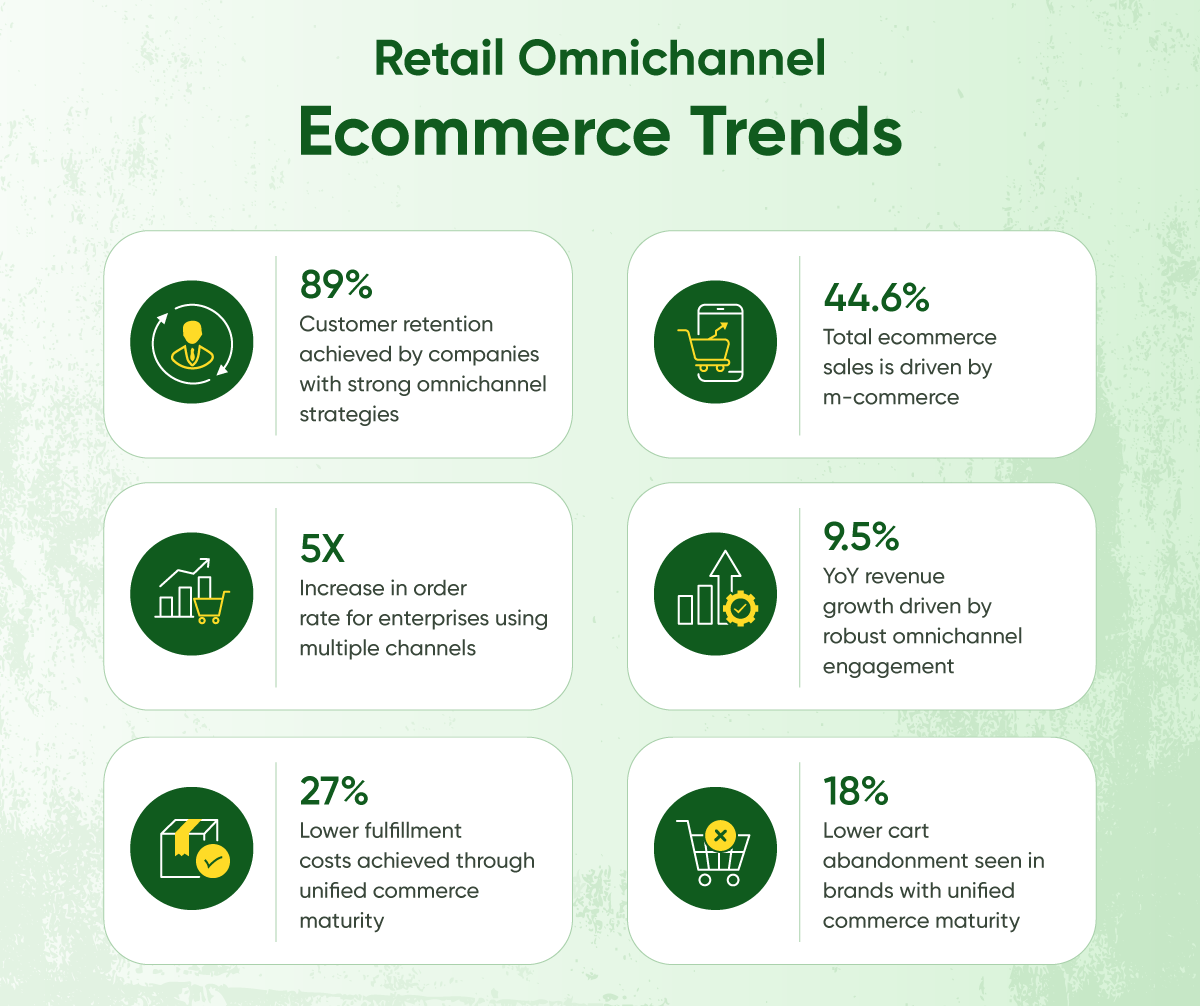
- 89% customer retention achieved by companies with strong omnichannel strategies
- 44.6% of total ecommerce sales is driven by m-commerce
- 5X increase in order rate for enterprises using multiple channels
- 9.5% YoY revenue growth driven by robust omnichannel engagement
- 27% lower fulfilment costs achieved through unified commerce maturity
- 18% lower cart abandonment seen in brands with unified commerce maturity
Source: McKinsey B2B Pulse, IDC, Deloitte
Key takeaway - Retailers using omnichannel strategies are seeing higher growth, better retention, and smoother operations by unifying customer touchpoints.
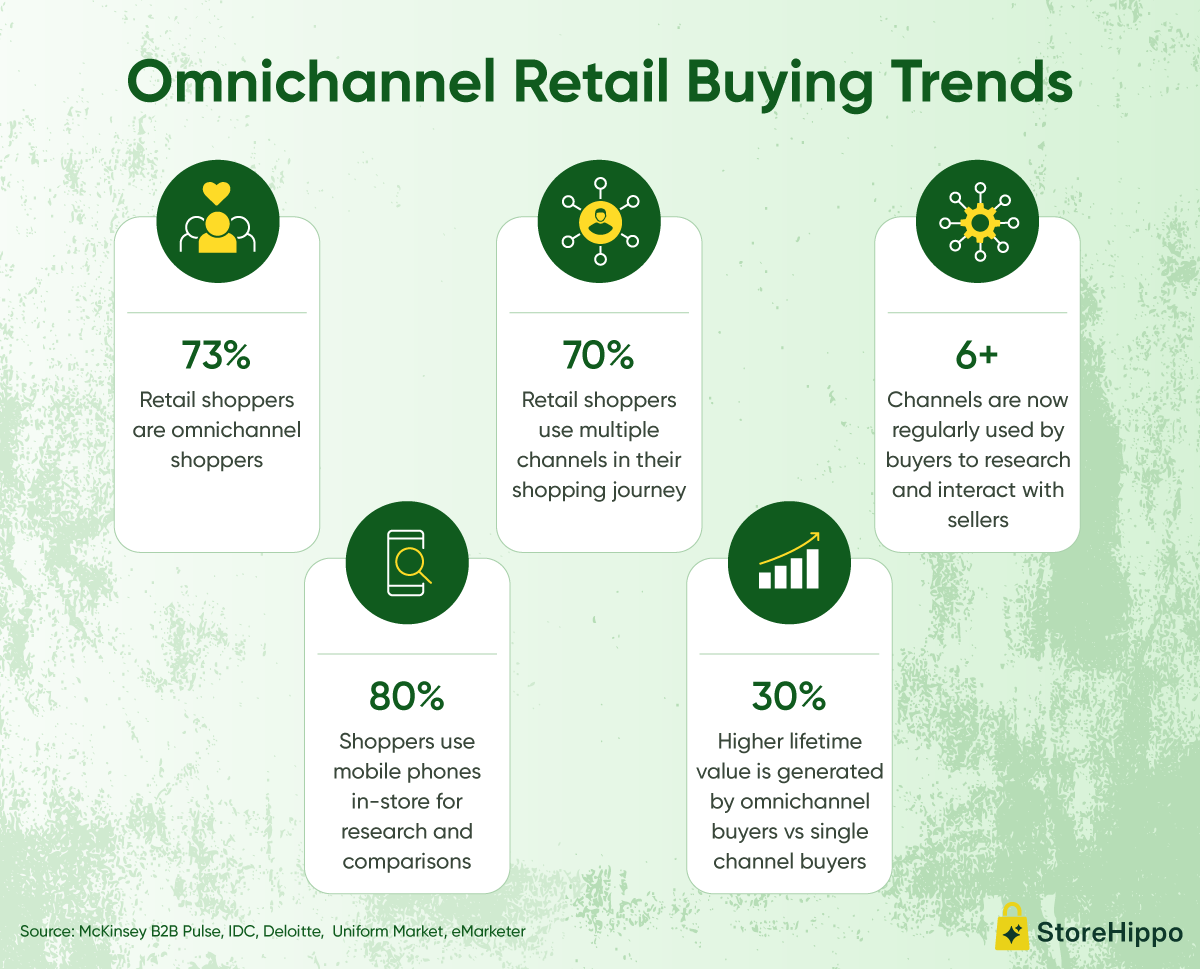
- 73% of retail shoppers are omnichannel shoppers
- 70% of retail shoppers use multiple channels in their shopping journey
- 6+ channels are now regularly used by buyers to research and interact with sellers
- 80% shoppers use mobile phones in-store for research and comparisons
- 30% higher lifetime value is generated by omnichannel buyers vs single-channel buyers
Source: Uniform Market, eMarketer
Key takeaway - Modern shoppers are highly channel-agnostic, and brands that offer multi-touch journeys see higher engagement and lifetime value.
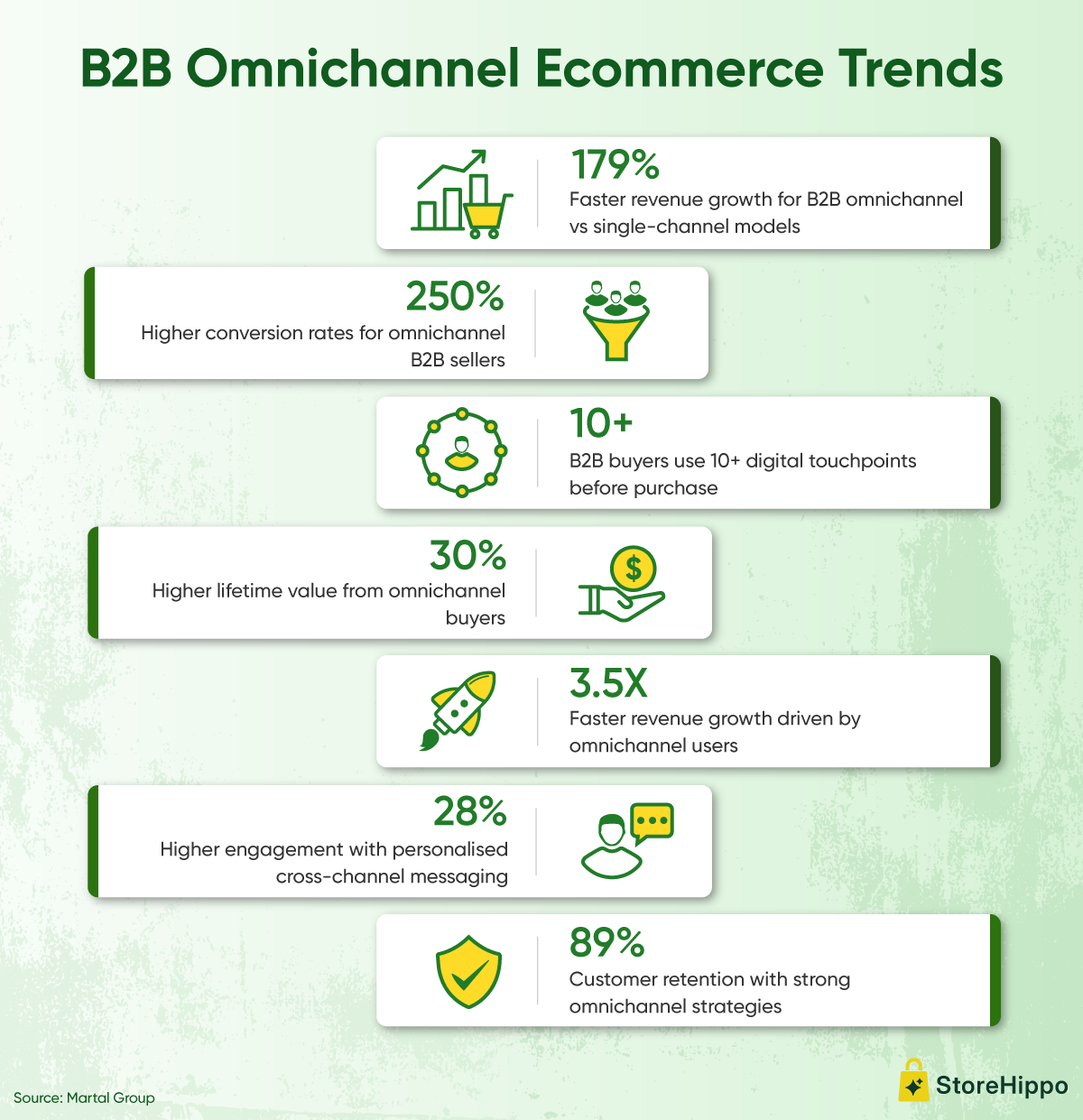
- 179% faster revenue growth for B2B companies using omnichannel strategies vs single-channel models
- 250% higher conversion rates for omnichannel B2B sellers than single-channel outreach
- 10+ digital touchpoints are used by B2B buyers before making a purchase decision
- 30% higher lifetime value is delivered by omnichannel buyers, and drives revenue growth
- 3.5x faster revenue growth driven by omnichannel buyers than single-channel users
- 80% of B2B buyers are more likely to engage when messaging is personalised across channels
- 89% customer retention achieved by B2B companies with strong omnichannel strategies
Source : Martal Group
Key takeaway - B2B buyers today expect a B2C-like multi-channel experience, and B2B enterprises using omnichannel approaches are seeing faster growth and higher conversions.
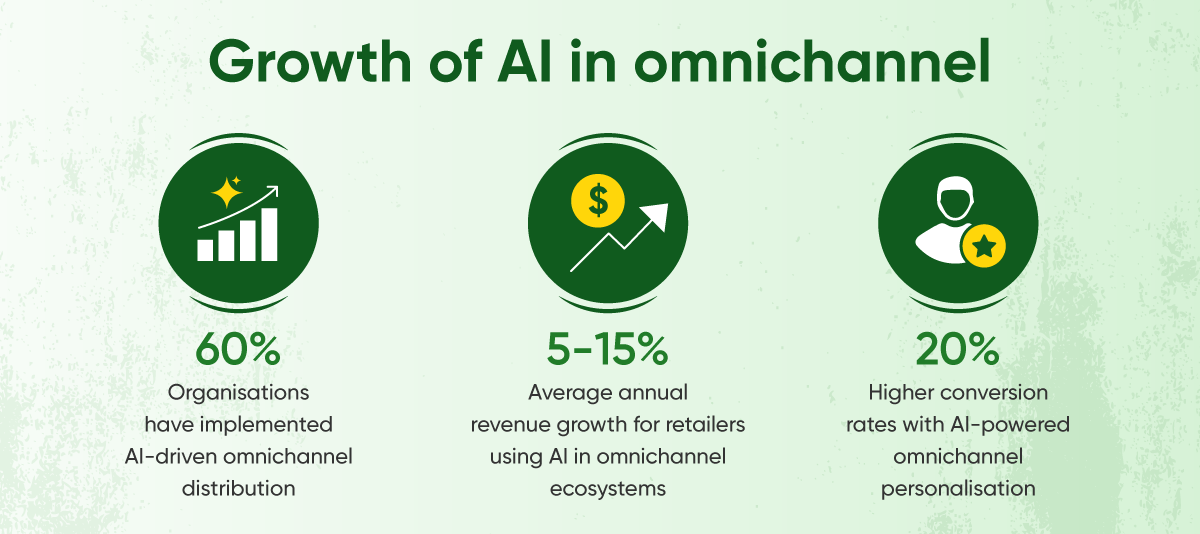
- 60% of organisations have implemented full AI-driven omnichannel distribution
- 5-15% average annual revenue growth reported by retailers using AI across their omnichannel ecosystem
- 20% higher conversion rates with AI-powered personalisation in omnichannel strategies
Source: MIT Center of Transportation & Logistics
Key takeaway - AI amplifies omnichannel performance by enabling enterprises to offer AI-based personalisation, discovery and support, improving conversions, and driving measurable revenue growth.
These insights clearly show that omnichannel commerce drives stronger growth, higher retention, and better efficiency across retail and B2B ecosystems. With AI further enhancing personalization and decision-making, omnichannel strategies are becoming essential for scalable and sustained enterprise growth.
How to Build an Omnichannel Brand for the AI Era
Successful omnichannel is when customers don’t even notice the channels, they simply experience your brand. Every interaction feels so smooth, consistent, and seamless that what stays with them isn’t where they shopped, but who they shopped from.
Here’s a step-by-step process to building an AI-powered omnichannel brand that delivers seamless, connected experiences across every touchpoint:
Step 1: Define your omnichannel strategy and identify the key channels you want to start with, such as your ecommerce website, mobile apps, marketplaces, offline stores, and conversational channels like WhatsApp.
Step 2: Choose an AI-powered omnichannel ecommerce platform with a unified backend that connects inventory, orders, customer data, and pricing across all channels in real time, while also supporting easy expansion to new touchpoints.
Step 3: Integrate with the best-in-breed software (ERP, CRM, accounting, marketing, analytics, etc.) to manage all your channels from a centralised admin.
Step 4: Leverage AI capabilities to automate catalogue management, product discovery, personalise customer journeys, and streamline customer and seller support across channels.
Step 5: Add trusted payment methods, fulfilment partners, and logistics integrations to ensure fast, reliable deliveries, flexible payment options, and a smooth checkout experience across all channels.
Step 6: Test your entire omnichannel journey from browsing to checkout to fulfilment across all touchpoints, optimise using real-time insights, and continuously refine the experience as you scale.
Send personalised marketing messages on all channels and start getting orders on your omnichannel platform.
10 FAQs to Evaluate the Right Omnichannel E-commerce Platform for Scalable Brand Growth
Here are 10 key questions enterprises should ask when choosing the right omnichannel ecommerce platform for building a scalable, unified commerce ecosystem that delivers consistent experiences and supports growth across all channels and business models:
1. How do I unify data, inventory, and customer experience across all channels in an omnichannel ecommerce marketplace without creating operational complexity?
To unify data, inventory, and customer experience across all channels in an omnichannel ecommerce marketplace without complexity your brand needs A scalable omnichannel ecommerce platform that offers a unified backend where inventory, orders, and customer data across all channels are synced in real-time.
Instead of depending on multiple tools and plugins, enterprises should choose an enterprise ecommerce platform that provides built-in omnichannel capabilities with a single powerful dashboard to manage products, pricing, and orders across all channels seamlessly. This reduces manual coordination, prevents stock mismatches, and ensures consistent customer experiences across web, app, offline, social, conversational and emerging sales channels.
For example, a brand selling through its website, mobile app, and retail stores may face stock mismatches and inconsistent customer experiences if each channel operates separately. A unified omnichannel commerce platform enables enterprises to keep inventory updates, order data, and customer interactions consistent across all touchpoints.
Enterprises should evaluate whether the omnichannel ecommerce platform:
- Offers built-in omnichannel features rather than depending on external tools
- Offers a centralised backend to manage operations across all channels from one system
- Syncs inventory, pricing orders, and customer data across all channels in real time
- Deliver consistent, personalised customer experience across all touchpoints
2. What is the real cost of running an omnichannel ecommerce brand with multiple tools vs a unified platform?
The visible cost of tools for running an omnichannel ecommerce brand is only a fraction of total expense. Platforms with fragmented systems increase overall costs through integrations, maintenance, upgrades, and operational inefficiencies. Enterprises using multiple separate tools and plugins to run an omnichannel business have to spend more time managing systems than growing the business. On the other hand, a unified omnichannel ecommerce platform simplifies operations by bringing everything into one system. This reduces dependency on plugins, lowers technology overhead, and helps teams move faster with fewer resources.
For example, a retailer using separate tools for website, mobile app, inventory, and order management may face constant integration issues and higher maintenance costs. A unified omnichannel ecommerce platform reduces these challenges by bringing everything into one system.
Enterprises should evaluate whether the omnichannel ecommerce platform:
- Offers built-in omnichannel tools instead of relying on plugins
- Reduces dependency on multiple tools and integrations
- Improves operational efficiency by unifying workflows
- Reduces maintenance effort and dependency on technical teams
- Enables faster time-to-market for new features and channels
- Keeps operational and scaling costs predictable as the business grows
3. How can AI automate and optimise omnichannel commerce at scale?
AI plays a critical role in reducing manual effort and improving decision-making across channels. It can automate catalogue creation, enhance product discovery, personalise customer journeys, and streamline support through conversational interfaces. At scale, AI powered omnichannel solutions enable enterprises optimise operations and deliver relevant, consistent experiences across every touchpoint, improving conversion rates without adding operational complexity.
For example, an omnichannel enterprise business managing thousands of SKUs across multiple channels can use AI to automate product tagging and categorisation, recommend relevant products, and personalise experiences for different users, improving engagement and driving higher sales.
Enterprises should evaluate whether the omnichannel ecommerce platform:
- Offers built in AI solutions for smarter decision-making and operational efficiency
- Automates catalogue management, image enhancement and product tagging and categorisation
- Offers AI-driven product discovery and recommendations to help customers find relevant products faster
- Provides AI powered customer and vendor support to handle queries and improve response time
- Automates repetitive tasks and workflows to reduce manual effort and save time
4. How do built-in agentic AI solutions change how enterprises run omnichannel ecommerce?
Built-in Agentic AI solutions move an enterprise beyond basic automation and recommendations to actively manage and execute tasks across the commerce ecosystem. Omnichannel ecommerce platforms with agentic AI solution not just assists users, it can understand context, take actions, and complete workflows across channels in real time.
In an AI powered ecommerce solutions, AI can manage conversations, resolve queries, guide product discovery, and handle tasks like order updates or support resolutions, all while maintaining context as customers move across channels like website, mobile app, WhatsApp, or voice.
For example, an enterprise handling customer queries across chat, email, and WhatsApp may rely on separate tools and manual intervention to resolve issues. This often leads to delays and inconsistent experiences. With agentic AI solutions, enterprises can manage conversations centrally, understand customer intent, carry context across channels, and take actions like updating orders, recommending products, or resolving requests without constant human input.
Enterprises should evaluate whether the omnichannel ecommerce platform:
- Enables AI to take action and complete tasks, not just provide responses
- Maintains context across conversations and channels for seamless experiences
- Supports unified conversation management across chat, voice, messaging, and other touchpoints
- Automates end-to-end workflows like support, discovery, and post-purchase interactions
- Allows human intervention when needed while keeping most processes autonomous
5. How do I manage real-time inventory across warehouses, multi location stores, and multiple sales channels in an omnichannel ecommerce setup?
Real-time inventory management requires a centralised system that syncs stock levels across all locations and channels. This prevents overselling, stockouts, and manual errors. Enterprises should look for omnichannel ecommerce platforms that support multi-location inventory, automated updates, and intelligent allocation of orders based on proximity, availability, and fulfilment efficiency.
For example, a brand with multiple warehouses and retail stores may face overselling or stockouts if inventory is not synced. A unified platform with built in omnichannel capabilities ensures accurate stock visibility and efficient order fulfilment.
Enterprises should evaluate whether the omnichannel ecommerce platform:
- Offers built-in inventory management to manage stock across all locations and channels from one system
- Updates stock in real time across channels to prevent stockouts and overselling
- Provides a centralised dashboard for complete inventory visibility across all locations
- Supports multi-warehouse and multi-store inventory tracking at scale
- Offers alerts and notifications for low stock or inventory mismatches
- Enables intelligent order routing for faster fulfilment and efficient order allocation across locations
6. How quickly can I launch an omnichannel ecommerce marketplace and scale across channels like mobile apps, AI-assisted channels, and WhatsApp commerce?
Speed to launch is a key competitive advantage in omnichannel commerce. Enterprises need an omnichannel ecommerce platform that allows them to launch new channels quickly without heavy development or long deployment cycles. A modern unified commerce platform with built-in capabilities for mobile apps, conversational commerce, and AI-assisted channels enables faster go-to-market and easier expansion. This helps omnichannel brands respond quickly to changing customer behaviour and market demands without operational delays.
For example, a brand looking to launch a mobile app and WhatsApp sales channel alongside its website may face long development timelines with traditional systems. An advanced e-commerce platform with built-in capabilities to unify multiple channels enables enterprises to launch and manage these channels quickly from the same backend.
Enterprises should evaluate whether the omnichannel ecommerce platform:
- Is built on a headless, API-based architecture to enable flexible launch and scaling of new channels
- Supports fast rollout of new channels by using the same backend code
- Enables rapid deployment of storefronts and channelss without rebuilding systems from scratch
- Maintains consistent data, pricing, and inventory across all channels
- Offers built-in mobile app builder and capabilities to implement conversational commerce
7. How do I ensure a seamless customer journey across web, mobile, offline, and conversational channels in an omnichannel ecommerce setup?
A seamless customer journey depends on continuity of data across all touchpoints. True omnichannel selling means customers can start their journey on one channel and continue it on another without losing context. Modern omnichannel ecommerce platforms must offer unified carts, synchronised order history, and consistent personalisation across channels to help enterprises achieve this level of continuity, ensuring smooth transitions and a connected experience throughout the buying journey.
For example, a customer browsing products on a mobile app may expect to complete the purchase later on a website. Without a unified system, this journey breaks, leading to friction and drop-offs. An omnichannel ecommerce platform ensures continuity across all interactions.
Enterprises should evaluate whether the omnichannel ecommerce platform:
- Maintains unified cart and order history across all channels to enable a consistent and uninterrupted shopping experience
- Delivers consistent personalisation across every touchpoint to ensure relevant and engaging customer experiences
- Tracks customer journeys across channels for complete visibility to support better decision-making and optimisation
- Enables seamless transitions between channels without data loss to reduce friction and improve conversions
- Ensures continuity of customer data and interactions across all touchpoints to deliver a connected customer journey
8. Why is unified commerce crucial for scaling omnichannel ecommerce?
Unified commerce is the foundation that makes omnichannel work at scale. While omnichannel expands presence across multiple touchpoints, unified commerce connects them through a single system for data, inventory, and operations. Without this, businesses face data silos, inconsistencies, and operational delays. A unified approach ensures real-time synchronisation, complete visibility, and seamless customer experiences across channels, making omnichannel execution efficient and scalable.
For example, a business managing webstores, marketplaces, and offline sales separately may struggle with inconsistent data and reporting. A unified commerce platform brings all operations into one system, improving visibility and making scaling easier.
Enterprises should evaluate whether the omnichannel ecommerce platform:
- Provides a single backend for managing all operations to ensure unified control across channels
- Syncs inventory, orders, and customer data across channels in real time to maintain consistency and accuracy
- Offers centralised reporting and analytics for complete visibility to enable faster and better decision-making
- Supports scalable operations without adding system complexity to enable seamless growth across channels
- Allows easy integration with ERP, CRM, and other enterprise systems to keep operations connected
- Ensures consistent customer experience across all touchpoints to strengthen brand trust
9. Can my omnichannel ecommerce platform support hybrid models like B2B, D2C, and marketplaces within the same ecosystem?
A future-ready omnichannel ecommerce platform should support B2B, D2C, B2B2C, multi-vendor, and hybrid marketplace models within a single ecosystem. However, many platforms that claim to be omnichannel still rely on fragmented systems and patchy plugins to manage multiple business models, leading to complexity and inefficiencies.
A true omnichannel ecommerce platform offers built-in capabilities such as role-based access, custom pricing, multi-vendor management, and flexible checkout experiences. This enables enterprises to manage all business models from a single backend, maintain consistency across channels, reduce duplication, and scale seamlessly across different business lines.
For example, a brand selling directly to consumers while also managing distributors and third-party sellers may face data inconsistencies and operational delays if each model runs on a separate system. An omnichannel commerce platform with multi-model support brings everything into one system, ensuring smoother operations and easier expansion.
Enterprises should evaluate whether the omnichannel ecommerce platform:
- Supports B2B, D2C, and marketplace models from a single backend to enable unified operations
- Offers role-based pricing and workflows to manage different customer segments effectively
- Enables multi-vendor and multi-store capabilities to support diverse business models
- Shares catalogues, inventory, and data across models to reduce duplication and errors
- Supports seamless expansion into new business models without additional systems
10. How can I get real-time performance insights across all channels using an omnichannel ecommerce platform?
End-to-end visibility is essential for managing omnichannel operations effectively. Enterprises need centralised dashboards that track orders, inventory, customer behaviour, and channel performance in real time. This enables faster decision-making, better demand forecasting, and proactive issue resolution. Without unified visibility, scaling omnichannel operations becomes reactive and inefficient.
For example, a global brand managing multiple regions and channels may struggle to track performance if data is scattered across systems. A unified omnichannel commerce platform provides a single dashboard with real-time insights, helping teams monitor performance and optimise operations continuously.
Enterprises should evaluate whether the omnichannel ecommerce platform:
- Offers a centralised analytics dashboard to manage performance across all channels
- Provides real-time insights into orders, inventory, and sales to enable quick decisions
- Tracks customer behaviour and channel performance for deeper business insights
- Supports data-driven decision-making with AI-powered analytics and reporting
- Delivers unified reporting across regions and channels for complete business visibility
Conclusion
Enterprises don’t struggle with adopting omnichannel commerce, they struggle with scaling it without operational complexity. True growth comes from unifying systems, not multiplying them, so that every channel works on a single, connected system.
A future-ready omnichannel ecommerce platform like StoreHippo enables exactly this shift with a unified backend for managing products, pricing, orders, and customers across all channels. It supports B2B, D2C, B2B2C, and multi-vendor marketplace models from one system, along with built-in mobile apps, WhatsApp commerce, and other emerging channels.
With its headless, API-first architecture, enterprises can launch and scale new channels quickly while maintaining consistency across inventory, data, and customer experience. StoreHippo’s AI powered omnichannel solutions further help automate operations, improve decision-making, and deliver real-time insights across the entire commerce ecosystem.
Ready to build your own market-defining omnichannel brand? Book a demo with StoreHippo now.