


Global ecommerce growth is no longer limited by demand; it is defined by how effectively brands can localise experiences across markets. As enterprises expand into new regions, ecommerce localisation has become a core growth driver rather than a supporting function.
Modern buyers expect more than translated websites. They expect native language content, local currencies, familiar payment methods, and culturally relevant experiences. This makes localisation a critical capability for any enterprise ecommerce platform operating globally.
However, not all ecommerce platforms are built for true localisation at scale. Many offer surface-level features like language translation and currency display, while failing to support deeper operational needs such as regional pricing, compliance, UX adaptation, and multi-store management.
Before exploring ecommerce localisation capabilities in an enterprise ecommerce platform in detail, let’s look at how localisation is shaping customer buying behaviour and global ecommerce growth.
Table of Contents
- How Ecommerce Localisation Capabilities Drive Enterprise Ecommerce Growth
- 10 FAQs Enterprises Should Ask About Ecommerce Localisation for Scalable Global Growth
- 1. What defines true ecommerce localisation beyond language translation?
- 2. How can we manage multiple regional storefronts for our global marketplace without operational complexity?
- 3. Can a multi location marketplace platform handle region-specific pricing, taxation, and compliance requirements seamlessly?
- 4. How does localisation impact conversion rates for global marketplaces ?
- 5. What level of control can we have over content and catalogues across regions while using the multi location marketplace features?
- 6. How does a global marketplace solution support local payment and shipping preferences?
- 7. Can ecommerce localisation strategies be scaled quickly across new markets?
- 8. What role does automation and AI play in ecommerce localisation?
- 9. Can a single enterprise ecommerce platform support cross-border and domestic localisation simultaneously?
- 10. What differentiates enterprise-grade ecommerce localisation capabilities from basic global features?
- Why Enterprises Should Choose StoreHippo For Scalable Ecommerce Localisation
- Conclusion
How Ecommerce Localisation Capabilities Drive Enterprise Ecommerce Growth
Localisation is directly influencing how customers discover, evaluate, and purchase across ecommerce marketplaces. From language and currency to design and payment preferences, every localised touchpoint shapes buying decisions and conversion outcomes.
The following insights highlight how ecommerce localisation capabilities are impacting buyer behaviour, reducing friction, and enabling enterprises to scale more effectively across regions.
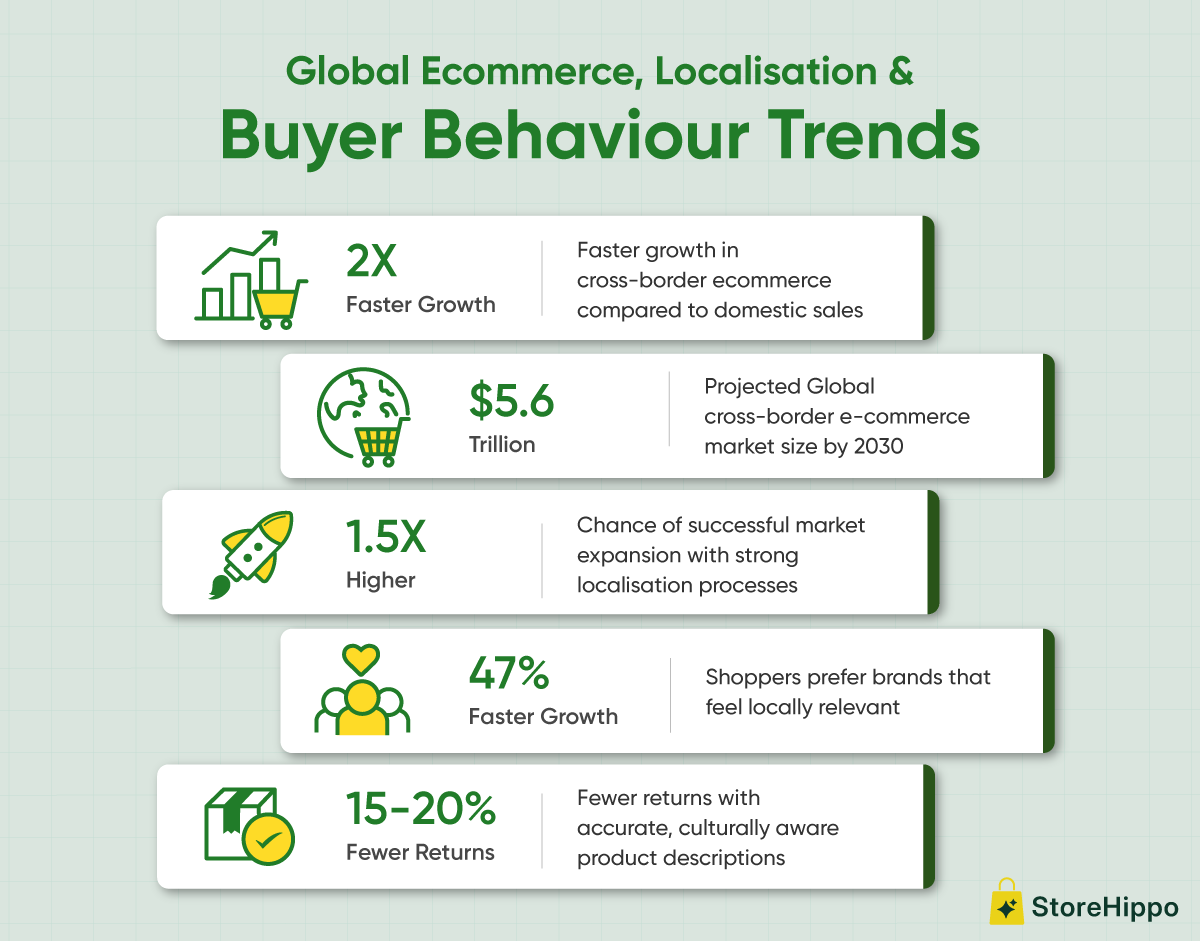
- 2x faster growth in cross-border ecommerce compared to domestic sales
- $5.6 trillion is the projected global cross-border e-commerce market size by 2030
- 1.5x higher chance of successful market expansion with strong localisation processes
- 47% of shoppers prefer brands that feel locally relevant
- 15–20% fewer returns with accurate, culturally aware product descriptions
The takeaway - Localisation is no longer a support layer; it is a core growth driver that determines how fast enterprises can scale in new markets and convert demand into revenue.
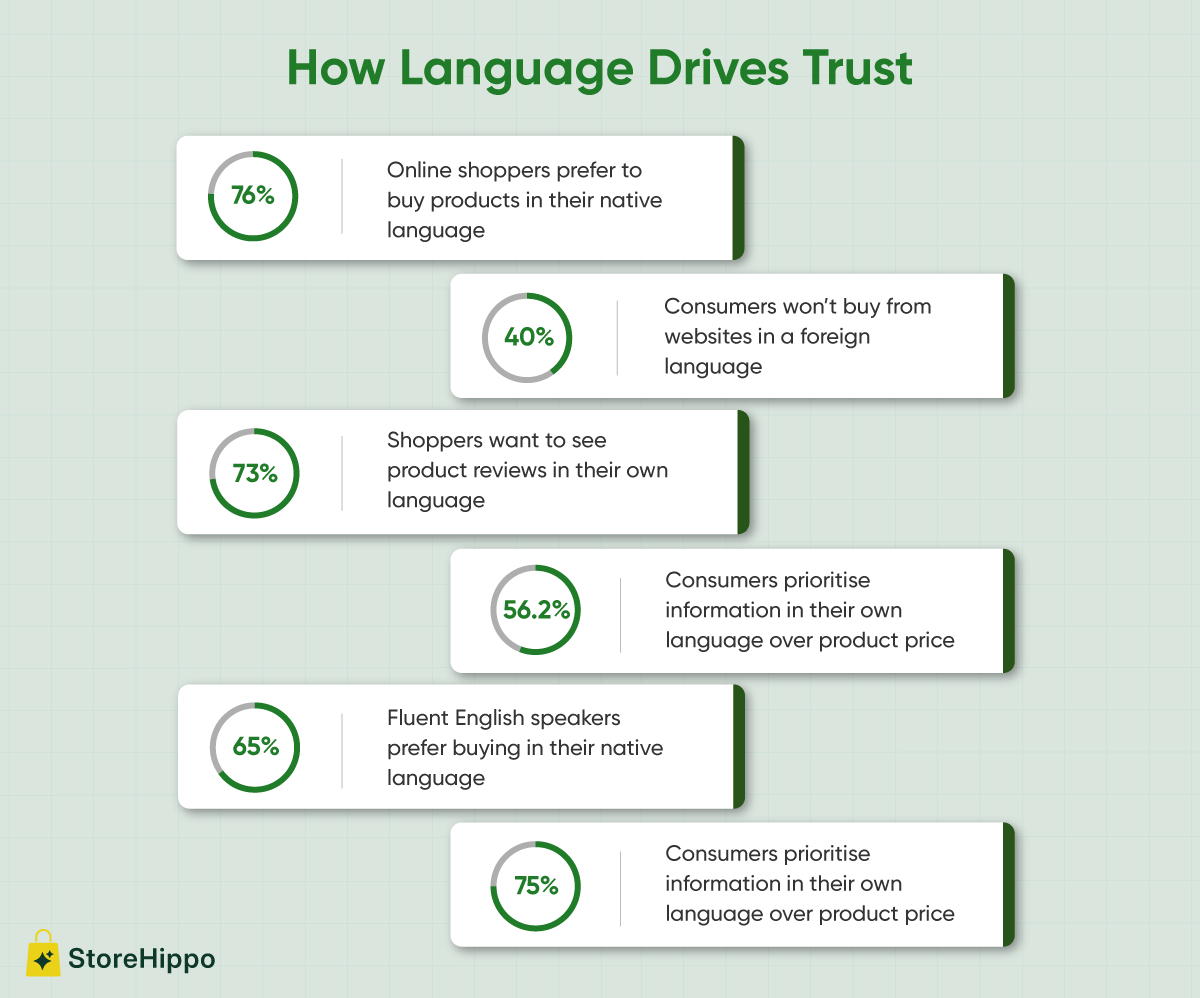
- 76% of online shoppers prefer to buy products in their native language
- 40% of consumers won’t buy from websites in a foreign language
- 73% of shoppers want to see product reviews in their own language
- 56.2% of consumers prioritise information in their own language over product price
- 65% of fluent English speakers prefer buying in their native language
- 75% are more likely to repurchase from a brand with local-language support
The takeaway - Buyers decide faster when they clearly understand what they are buying, making language a critical factor in reducing confusion and building confidence in buying.
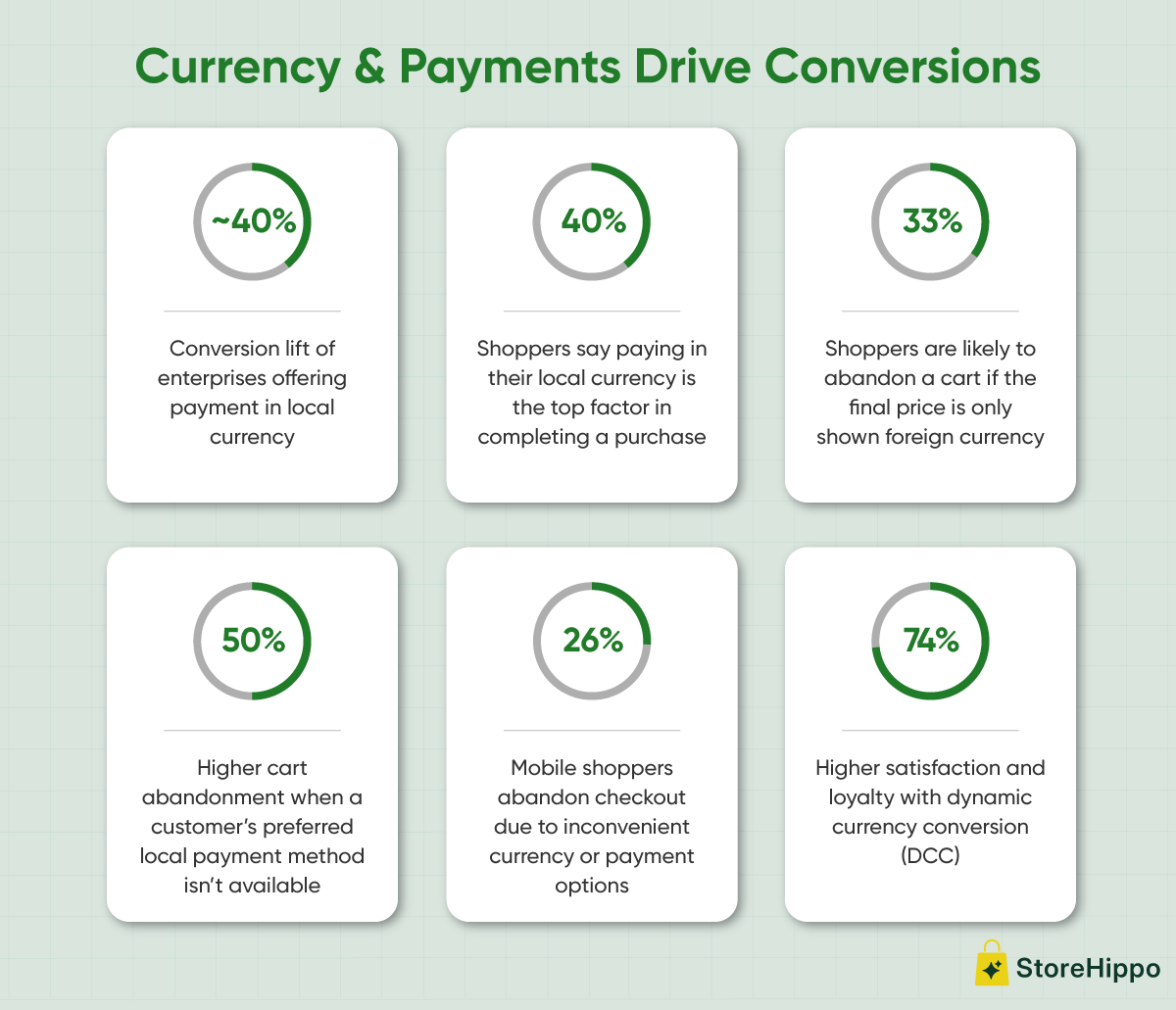
- ~40%conversion lift for enterprises offering payment in local currency
- 40% of shoppers say paying in their local currency is the top factor in completing a purchase.
- 33% of shoppers are likely to abandon a cart if the final price is only shown in foreign currency
- 50%+ higher cart abandonment when a customer’s preferred local payment method isn’t available
- 26% of mobile shoppers abandon checkout due to inconvenient currency or payment options
- 74% higher satisfaction and loyalty with dynamic currency conversion (DCC)
The takeaway - Most drop-offs happen at checkout, and aligning with local currency and preferred payment methods is what turns intent into completed transactions.
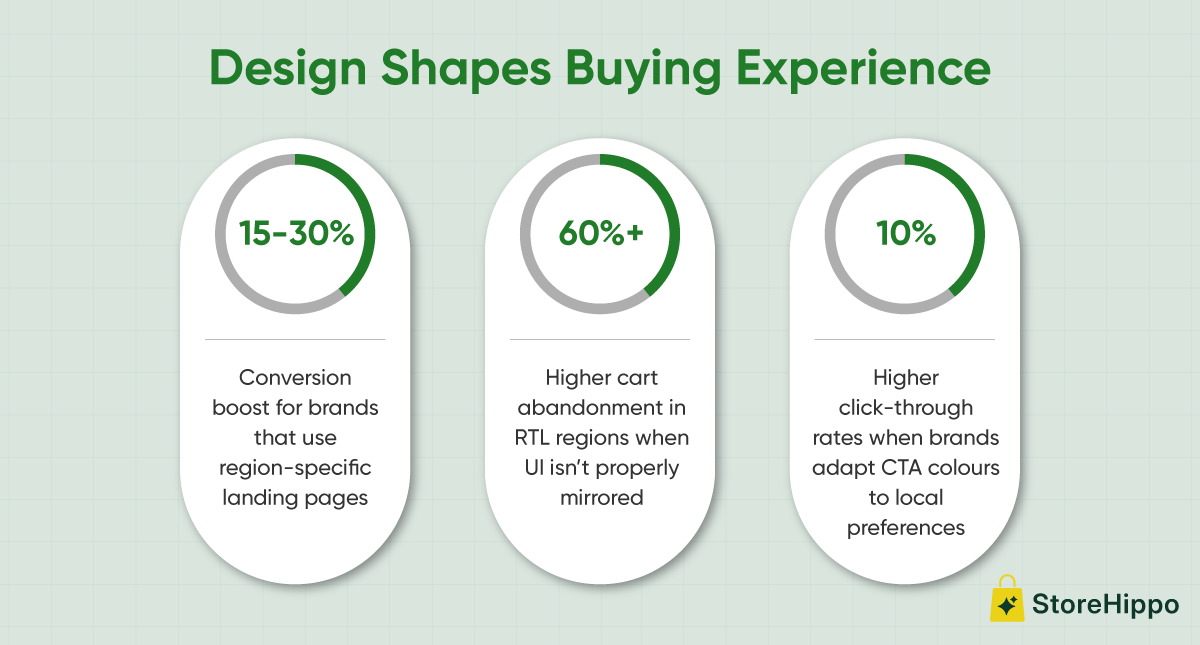
- 15–30% conversion boost for brands that use region-specific landing pages
- 60%+ higher cart abandonment in RTL regions when UI isn’t properly mirrored
- 10% higher click-through rates when brands adapt CTA colours to local preferences
The takeaway- Even small UX mismatches can disrupt the buying journey, while design customised to specific regions helps customers move smoothly from discovery to purchase.
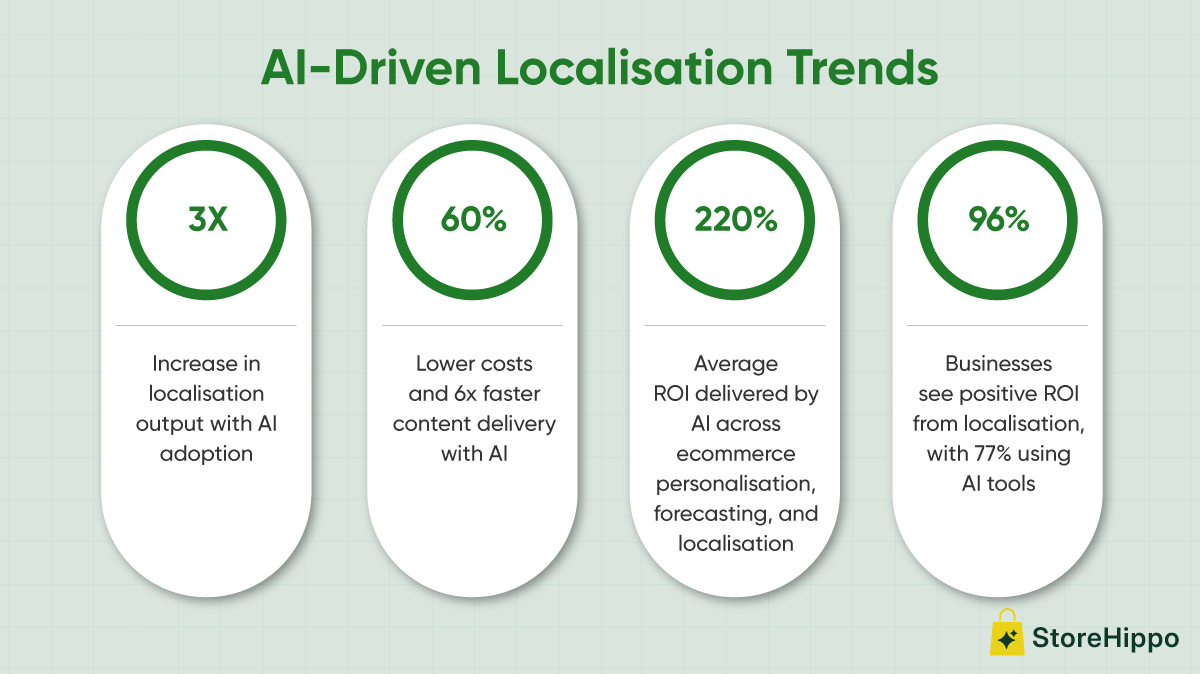
- 3x increase in localisation output with AI adoption
- 60% lower costs and 6x faster content delivery with AI
- 220% average ROI delivered by AI across ecommerce personalisation, forecasting, and localisation
- 96% of businesses see positive ROI from localisation, with 77% using AI tools
The takeaway- AI is turning localisation into a faster, more scalable, and revenue-driving factor, enabling enterprises to expand across markets with greater speed, efficiency, and consistency.
Source : Weglot, ITA, CSA Research, Gartner, Statista
10 FAQs Enterprises Should Ask About Ecommerce Localisation for Scalable Global Growth
Here are 10 must-ask questions to help enterprises evaluate ecommerce localisation capabilities and choose the right enterprise ecommerce platform for driving consistent and localised customer experiences across markets:
1. What defines true ecommerce localisation beyond language translation?
True ecommerce localisation for an enterprise marketplace means it offers multiple languages, currencies, pricing rules, offers, promotions, taxes, and logistics for each target market, region, and customer segment it serves. An enterprise ecommerce platform with localisation capabilities must enable enterprises to offer customer experiences tailored to each region in domestic and international markets.
For example, a fashion brand selling in both domestic and global markets may offer multiple languages to show different product catalogues, set region-based pricing, and run local festive deals and offers to match local preferences and expectations. They may offer payment options and delivery options to make the shopping experience more relevant and trustworthy for buyers.
Enterprises should evaluate whether the enterprise ecommerce platform:
- Supports multiple languages, currencies, taxes, payments, etc for domestic and international markets
- Offers flexible design tools and customisable themes to create localised storefronts for different regions
- Allows region-specific catalogues, pricing, and promotions to match local demand and buying behaviour
- Adapt checkout and fulfilment flows for local expectations to improve conversions and delivery experience
- Enable consistent brand experience across regions with local flexibility
2. How can we manage multiple regional storefronts for our global marketplace without operational complexity?
To launch multiple regional storefronts for a global marketplace operating in different cross-border markets and control them from a unified central admin, brands should opt for ecommerce platforms with localisation features and multi-store capabilities. Ecommerce localisation means your teams can create customised design, catalogues, and workflows for each region without adding operational complexity.
For example, a global brand can run separate storefronts for the UAE and India with region-specific catalogues, pricing, and offers. At the same time, it can manage catalogues, inventory, orders, and workflows from a single backend system. This ensures central control while maintaining local relevance.
Enterprises should evaluate whether the global marketplace platform:
- Offers a built-in multi-store feature to launch multiple storefronts in global markets
- Enables centralised management of design themes, catalogues, vendors, pricing, and workflows
- Offers customisation capabilities to set unique URL, designs, catalogues and pricing, without duplicating systems
- Enables enterprises to run targeted marketing campaigns and promotions for region-specific storefronts
- Ensures consistent data flow across all storefronts to maintain accuracy and enable real-time decision-making
3. Can a multi location marketplace platform handle region-specific pricing, taxation, and compliance requirements seamlessly?
The right platform with ecommerce localisation capabilities should simplify how enterprises manage pricing, taxes, and compliance across regions. Instead of handling these variations manually, it should offer built-in capabilities to automate region-specific rules and ensure accuracy at scale. Many multi location ecmmerce platforms rely on external tools, plugins or manual configurations, which can lead to errors, delays, and compliance risks as the business grows.
For example, a product sold across various local markets globally may have different GST rules, pricing structures, and shipping charges based on local regulations. The enterprise e-commerce platform should manage these differences automatically so that enterprises can maintain accuracy and stay compliant.
Enterprises should evaluate whether the enterprise ecommerce platform:
- Supports dynamic pricing based on region, customer group, or sales channels
- Automates tax and compliance rules for different regions and regulatory requirements
- Supports multi-currency payments with real-time accuracy to ensure consistent pricing across regions
- Integrated with multiple domestic and international payment gateways to enable seamless regional payments
4. How does localisation impact conversion rates for global marketplaces ?
Localised experiences aligned with user preferences, language, and payment methods significantly improve trust, engagement, and conversion rates. When buyers see their regional languages, relevant offers, and preferred payment options on the global marketplace, they are more likely to stay, explore, and complete their purchase.
For example, a shopper is more likely to convert when they find product information in their language, prices are shown in local currency, and checkout includes trusted regional payment methods. These small but critical ecommerce localisation features on the enterprise ecommerce platform enable enterprises to reduce friction and improve the overall buying experience.
Enterprises should evaluate whether the enterprise ecommerce platform:
- Delivers personalised, region-specific shopping experiences to increase relevance and conversions
- Supports localisation across design, content and checkout to reduce friction in the buying journey
- Enables region-wise currency, payment and delivery preferences to match local buyer expectations
- Improves engagement through culturally relevant storefronts to build trust and drive repeat purchases
5. What level of control can we have over content and catalogues across regions while using the multi location marketplace features?
A strong enterprise ecommerce platform should enable large-scale enterprises to create region-wise catalogues, pricing, promotions, and content strategies from a centralised system. True ecommerce localisation capabilities should give enterprises the flexibility to manage uniform experiences across global markets while adapting content and strategies to meet local market needs.
For example, a brand can run festive campaigns, banners, and product selections for India, while showing different products, pricing, and offers in other countries. This helps the brand stay relevant in each market without losing its identity.
Enterprises should evaluate whether the enterprise ecommerce platform:
- Enables region-wise control of banners, promotions, and catalogues to run relevant content for each market
- Enables a centralised master catalogue with flexibility to implement location-based catalogues to be managed from one place while adapting for each region
- Supports targeted promotions for different regions and customer segments to increase engagement and conversions
- Maintains consistent brand experience across all storefronts to ensure a unified brand identity globally
6. How does a global marketplace solution support local payment and shipping preferences?
The right global marketplace solution should integrate with region-specific payment gateways and international shipping logistics partners to ensure seamless checkout and fulfilment experiences. A strong enterprise ecommerce platform should make it easy for buyers to pay and receive orders using payment methods and delivery options they trust and prefer in their region.
For example, buyers in India may prefer UPI or wallets, while customers in other regions may choose cards or local payment methods. Similarly, delivery expectations, timelines, and partners may vary across regions. The multi-location marketplace platform should support these ecommerce localisation capabilities to enable enterprises to offer seamless, region-specific checkout and delivery experiences without increasing operational complexity.
Enterprises should evaluate whether the enterprise ecommerce platform:
- Integrates with multiple domestic and international payment gateways to enable seamless and secure transactions across regions
- Supports region-specific payment methods and preferences to improve checkout experience and conversions
- Connects with local and global logistics partners to ensure reliable and timely deliveries across regions
- Enables flexible shipping options based on region and delivery expectations to meet local delivery needs and improve customer satisfaction
7. Can ecommerce localisation strategies be scaled quickly across new markets?
Enterprises should look for ready-to-use storefront templates and configurable settings that allow faster rollout into new geographies. A scalable enterprise ecommerce platform should help businesses expand into new markets without starting from scratch every time.
For example, a brand entering a new country can reuse existing storefront designs, workflows, and configurations, while making small changes for language, pricing, offers, etc. This reduces the launch time of new storefronts across regions and ensures consistency across global markets.
Enterprises should evaluate whether the enterprise ecommerce platform:
- Offers ready-to-use storefront templates for faster market launches
- Provides configurable settings for quick regional customisation
- Easily replicates stores to reduce the time and effort required to enter new markets
- Ensures consistency while scaling across multiple regions
8. What role does automation and AI play in ecommerce localisation?
AI can automate content adaptation, product discovery, and user journeys based on regional behaviour, reducing manual effort and improving relevance. It can also support buyers, sellers, and internal teams by resolving queries in real time and improving overall response efficiency.
For example, an enterprise managing multiple regional storefronts may need to update product descriptions, categorise large catalogues, and personalise search results for each market. Doing this manually can slow down operations and lead to inconsistencies. AI-powered enterprise ecommerce platforms can automate these tasks by generating product content directly from images, tagging products accurately, enhancing product images and delivering personalised recommendations based on user behaviour in each region.
Enterprises should evaluate whether the enterprise ecommerce platform:
- Has AI built into its core to automate localisation and improve decision-making
- Automates content, catalogue, and localised buying assistance to reduce manual effort and errors
- Offers AI-powered discovery and personalisation to show relevant products across regions
- Has provision to build AI-driven support for buyers and sellers to improve experience and response time
9. Can a single enterprise ecommerce platform support cross-border and domestic localisation simultaneously?
Enterprise-ready platforms with ecommerce localisation capabilities should handle both global expansion and hyperlocal strategies within the same ecosystem. Many platforms that offer localisation features still depend on patchy plugins and third-party systems to run domestic and international markets together, making operations difficult to manage for global brands. Enterprises should look for platforms with built-in features to run and manage both local and global markets seamlessly from a single central admin.
For example, a brand can run region-specific storefronts for different domestic cities while also managing global storefronts across multiple countries. It can customise catalogues, pricing, and offers for each market, while controlling everything from a single centralised admin. This helps businesses scale faster without adding operational complexity.
Enterprises should evaluate whether the enterprise ecommerce platform:
- Supports both domestic and cross-border localisation from a single system
- Enables region-specific catalogues, pricing, and promotions across local and international markets
- Manages multiple languages, currencies, and tax rules together to ensure smooth operations across domestic and global markets
- Provides centralised control without the need for multiple platforms to reduce complexity and improve operational efficiency
10. What differentiates enterprise-grade ecommerce localisation capabilities from basic global features?
Enterprise-grade ecommerce localisation goes beyond basic features like language translation and currency display. It focuses on enabling deep regional customisation, operational control, and scalability to deliver truly localised experiences across markets. Basic ecommerce platforms often provide surface-level localisation, which may not be sufficient for enterprises managing complex global operations.
For example, basic ecommerce platforms may only translate content and display different currencies. In contrast, enterprise ecommerce platforms with true localisation capabilities enable businesses to customise themes, catalogues, pricing, promotions, checkout flows, and fulfilment processes for each region. This helps enterprises to create more relevant and seamless experiences for buyers in every market.
Enterprises should evaluate whether the enterprise ecommerce platform:
- Offers deep localisation beyond language and currency
- Enables region-specific control over catalogues, pricing, and workflows
- Supports scalable multi-region operations without added complexity
- Uses automation and AI to enable localisation and hyper personalisation
Why Enterprises Should Choose StoreHippo For Scalable Ecommerce Localisation
Enterprises expanding across global and domestic markets need more than basic localisation features. They need a unified ecommerce platform that can manage operational complexity, regional variations, and customer expectations across multiple regions and markets without creating fragmented systems or additional integration overhead.
StoreHippo enterprise ecommerce platform is built to support true ecommerce localisation at scale with a headless, low-code, and AI-powered architecture. It enables businesses to manage hyperlocal and global expansion from a single system while maintaining complete control and consistency across markets.
Enterprises can leverage StoreHippo to:
- Run Global and Domestic Localisation from One Platform: Enterprises can manage cross-border and hyperlocal storefronts from one platform without relying on separate tools or patchwork integrations.
- Launch Region-Specific Storefronts Faster: With StoreHippo’s advanced multistore ecommerce solutions, enterprises can quickly launch multiple storefronts for different cities, states, or countries with localised experiences tailored to each market.
- Centralised Control Across Markets: Enterprises can manage catalogues, pricing, promotions, taxes, and workflows from one central admin while enabling region-specific customisation.
- Native Multilingual and Multicurrency Support: StoreHippo enterprise ecommerce platform offers native support for 100+ languages (including RTL), and multiple currencies to enable seamless, localised experiences across markets.
- No-Plugin, Fully Integrated System: StoreHippo offers a fully integrated ecommerce ecosystem with built-in 300+ core enterprise features and 150+ pre-integrations for payments, logistics, marketing, and more, enabling seamless operations with minimal dependency on external tools.
- AI-Powered Automation: StoreHippo is an AI-powered ecommerce platform that automates core business operations through built-in AI tools. Its AI-powered cataloguing tool, and AI image editing tool, Magic Edit, automate catalogue creation for multiple location-based stores. It also offers powered search and recommendations, and enables enterprises to build custom AI bots to support buyers, sellers, and internal teams.
- Omnichannel Consistency Across Markets: With StoreHippo’s built-in omnichannel capabilities, enterprises can deliver seamless and consistent experiences across web, mobile apps, marketplaces, WhatsApp, AI chat interfaces, and other digital touchpoints, ensuring unified customer journeys across regions.
- Real-Time Operational Visibility: Enterprises can gain complete visibility into orders, inventory, and fulfilment across all regions from a unified dashboard, enabling faster decisions and better operational control.
- Lower Total Cost of Ownership: StoreHippo multi location marketplace platform reduces integration complexity, maintenance effort, and overall operational costs by managing everything through a single, scalable platform.
StoreHippo enables enterprises to move beyond fragmented localisation setups and build a future-ready ecommerce ecosystem that scales seamlessly across geographies, channels, and business models.
Conclusion
Ecommerce localisation looks simple on a roadmap, but becomes complex in execution. Global expansion means managing languages, currencies, taxes, payments, fulfilment, and buyer expectations all at once.
That’s why the enterprise ecommerce platform you choose cannot be a short-term tool or a set of disconnected systems. It must be a long-term foundation that supports continuous expansion across regions, channels, and business models without operational friction.
As enterprises scale across a global marketplace and multi location marketplace models, the platform should enable seamless localisation without repeated replatforming or heavy custom builds. The strongest enterprise ecommerce platforms simplify global complexity through unified operations, consistent data, and scalable localisation.
Ready to scale your business across global markets?
Explore how seamless localisation and unified commerce can simplify international expansion. Book your personaliseddemo with StoreHippo now.