


Is your enterprise ecommerce platform actually simplifying your operations, or are plugins making things more challenging behind the scenes?
You add a new payment option, introduce a marketing tool, or expand your product catalogue, and suddenly another plugin is needed. One update creates a compatibility issue, another slows down your website, and your team ends up spending more time fixing integrations than managing business growth.
This is a common challenge for growing enterprises. While plugins may seem convenient initially, managing too many of them can make everyday operations unnecessarily frustrating.
That's why businesses are exploring no-plugin ecommerce platforms that bring essential commerce capabilities together natively. But can these platforms support different business models, AI capabilities, custom workflows, and enterprise-level growth?
Before investing in one, here are 10 FAQs to help you evaluate your options and choose a plugin-free ecommerce platform that meets your business needs at present and as you grow.
Table of Contents
- Why No-Plugin Ecommerce Platforms Are Becoming an Enterprise Priority
- 10 FAQs to Ask Before Choosing a No-Plugin E-commerce Platform for Your Enterprise
- 1. What does plugin-free ecommerce platform really mean? Does it mean we won't need any plugins at all?
- 2. What are the benefits of using a plugin-free ecommerce platform for enterprises?
- 3. Can a plugin-free ecommerce platform handle all our B2B, B2C and marketplace operations?
- 4. Can we connect our existing ERP, CRM and other business tools to the enterprise ecommerce platform without using plugins?
- 5. Do we get AI features as part of the no-plugin ecommerce platform, or do we need to pay for separate AI tools?
- 6. Will going plugin-free on an enterprise ecommerce platform limit what we can customise or add later?
- 7. How does a plugin-free ecommerce platform manage inventory, orders and multiple business models?
- 8. Does having fewer plugins actually make an enterprise ecommerce platform more secure and easier to maintain?
- 9. Can a no-plugin ecommerce platform support enterprise scalability and high traffic?
- 10. Is a plugin-free ecommerce platform really cheaper in the long run, or are we just paying for things differently?
- Conclusion
Why No-Plugin Ecommerce Platforms Are Becoming an Enterprise Priority
Many enterprises use plugins to add new features to their ecommerce platforms. But managing too many plugins can create problems and make everyday work harder.
Let's look at some statistics that show why enterprises need to rethink their dependence on third-party tools.
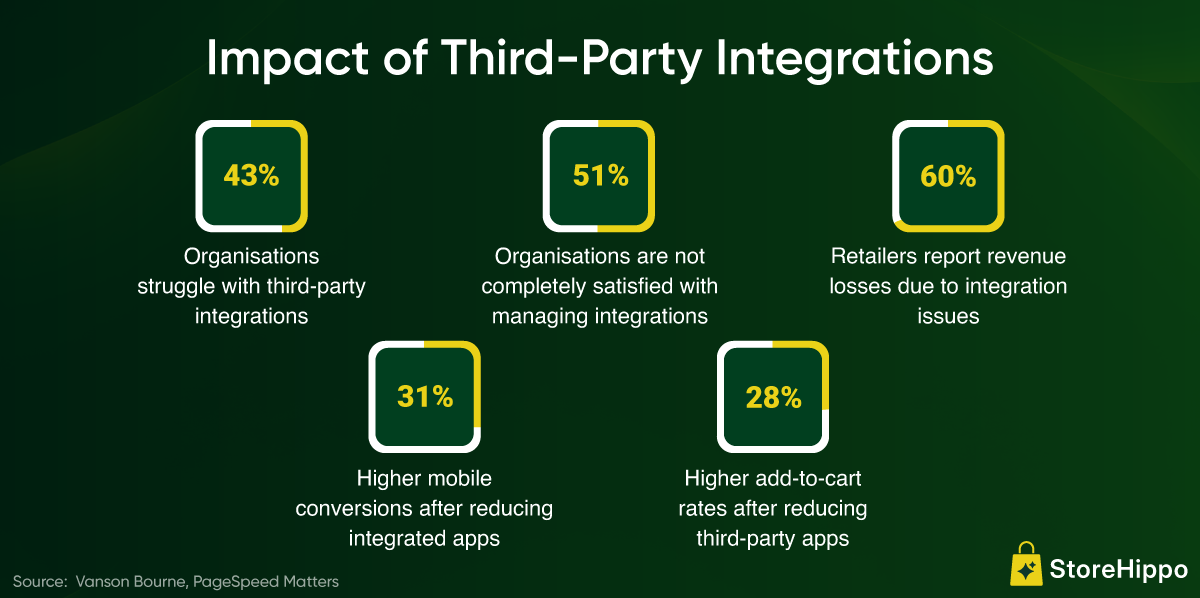
- 43% of organisations struggle with third-party integrations.
- 51% of organisations are not completely satisfied with managing integrations
- 60% of retailers report revenue losses due to integration issues
- 31% higher mobile conversions after reducing integrated apps
- 28% higher add-to-cart rates after reducing third-party apps
Source: Vanson Bourne, PageSpeed Matters
The picture is clear: relying on multiple third-party integrations can add unnecessary operational overhead, increase costs, and affect customer experiences. A no-plugin ecommerce platform helps enterprises bring essential capabilities under one roof, simplify day-to-day operations, and scale without constantly depending on external tools.
10 FAQs to Ask Before Choosing a No-Plugin E-commerce Platform for Your Enterprise
Choosing a no-plugin ecommerce platform involves more than simply checking which features come built in.
Here are 10 important questions to help you assess its capabilities, flexibility, security, and ability to support your enterprise as it grows.
1. What does plugin-free ecommerce platform really mean? Does it mean we won't need any plugins at all?
Plugin-free ecommerce platform simply means that most essential ecommerce features come built into the platform rather than being added through separate plugins. You can manage everyday operations such as payments, marketing, inventory, and logistics from one place. However, you may still need external integrations to connect specific business tools or meet unique requirements.
Let's consider a fashion retailer selling clothing and accessories through its website and mobile app. It needs to manage product listings, inventory, discount campaigns, payments and order tracking across both channels. Instead of installing separate plugins for each function, a plugin-free ecommerce platform enables the retailer to manage these activities through built-in features from one backend. However, if the retailer uses a separate ERP for accounting or warehouse management, it can still connect that system through an integration.
StoreHippo's no-plugin enterprise ecommerce platform brings essential ecommerce features together, so enterprises don't have to rely on separate plugins for everyday operations. With 300+ built-in enterprise-grade features, teams can manage product catalogues, inventory, orders, payments, marketing and shipping from one backend. It also comes with built-in AI capabilities that make product listing, discovery and customer engagement easier. And when businesses need to connect their existing tools or add specific functionality, they can use pre-built integrations and API endpoints to do so.
2. What are the benefits of using a plugin-free ecommerce platform for enterprises?
A plugin-free ecommerce platform helps enterprises simplify daily operations by bringing essential features together in one place. It reduces dependency on third-party tools, lowers maintenance costs, and saves time spent managing multiple plugins. Teams can work more efficiently, avoid integration issues, and focus on business growth instead of constantly managing different tools.
Let's say an enterprise running a home appliance multi-vendor marketplace uses different plugins to manage seller inventory, run promotional campaigns, handle shipping and send order notifications. Whenever it introduces a new discount offer across multiple sellers, the team has to check whether all these tools are working together and updating information correctly. This adds extra work and can lead to delays if something doesn't sync properly. With a plugin-free ecommerce platform, the enterprise can manage inventory, promotions, logistics and order notifications through built-in features, making marketplace operations easier to coordinate.
StoreHippo helps enterprises reduce operational overhead by bringing essential commerce features together in one platform. With built-in inventory management, order processing, discount management, marketing tools, and logistics capabilities, teams can manage everyday activities without coordinating multiple applications. Its centralised backend also makes it easier to manage different storefronts and sales channels. This reduces the effort involved in managing disconnected systems, helping businesses improve team productivity and focus more on sales and customer experience.
3. Can a plugin-free ecommerce platform handle all our B2B, B2C and marketplace operations?
Yes, a plugin-free ecommerce platform can support B2B, B2C and marketplace operations if it comes with the right built-in features. Look for capabilities such as bulk ordering, flexible pricing, multi-vendor management, dealer management, and multi-store ecommerce solutions. These features let you manage different business models from one platform without relying on separate plugins for each requirement.
Imagine a furniture brand selling individual pieces to retail customers while supplying bulk orders to interior designers and dealers. It also wants to onboard independent furniture sellers to its multi vendor marketplace. A platform with built-in B2B pricing, bulk ordering and multi-vendor management can support all three operations without requiring separate plugins for each business model.
StoreHippo’s enterprise ecommerce platform supports multiple business models through its native B2B, B2C, D2C, B2B2C and multi-vendor marketplace capabilities. Enterprises can create dedicated storefronts for different buyer segments, manage vendors through separate dashboards, and maintain central control over products and business policies. Features such as tier-based pricing, RFQ and inquiry forms, and seller management also support advanced B2B buying requirements. This makes it easier to serve retail customers, bulk buyers, distributors and marketplace sellers through one connected commerce ecosystem.
4. Can we connect our existing ERP, CRM and other business tools to the enterprise ecommerce platform without using plugins?
Yes, you can connect your existing ERP, CRM, and other business tools to the enterprise ecommerce platform through APIs or built-in integrations. This means you can continue using the systems your teams already rely on without adding multiple plugins. Your business data stays connected, everyday tasks become easier to manage, and teams can work without switching between disconnected tools.
Consider a pharmaceutical company that sells medicines and healthcare products to hospitals, clinics, pharmacies and distributors through its ecommerce portal. It already uses an ERP system to manage stock, a CRM to track customer relationships and an accounting system to manage invoices and payments.
When a hospital places a bulk medicine order, the ecommerce platform needs to check product availability, apply the right B2B pricing, process the order and update inventory. Without proper integrations, employees may have to enter the same information into multiple systems, increasing the chances of errors and delays. By connecting the ecommerce platform with its existing ERP and CRM through APIs, the company can automate these data exchanges, keep inventory and order information updated, and manage customer interactions more efficiently.
StoreHippo's no-plugin ecommerce platform makes it easier for enterprises to retain their existing technology investments while building a connected ecommerce ecosystem. Its 150+ pre-built integrations simplify connections with ERP, CRM, accounting, payment, shipping and marketing systems. For specific business requirements, 300+ API endpoints and webhook capabilities eables enterprises to connect custom applications and automate data exchange. This reduces manual data entry, minimises disconnected workflows, and helps teams work with more consistent business information across systems.
5. Do we get AI features as part of the no-plugin ecommerce platform, or do we need to pay for separate AI tools?
A no-plugin enterprise ecommerce platform can offer built-in AI capabilities across various aspects of commerce, from business operations and marketing to customer experience and sales. However, the scope of these capabilities and their pricing vary across platforms. When evaluating a platform, check which AI features are included in your subscription, whether usage-based charges apply, and if you need third-party AI tools to meet your business requirements. This will give you a clearer picture of the long-term cost of adopting AI across your ecommerce operations.
Imagine a beauty brand getting ready to launch 200 new skincare products before the festive season. The team has to write product descriptions, enhance images and organise hundreds of new listings. Doing all this manually can take a lot of time. With built-in AI tools for cataloguing and image enhancement, the team can get these tasks done faster without having to pay for separate AI tools for each activity.
StoreHippo's AI-powered ecommerce platform helps enterprises take the manual effort out of everyday commerce operations while making shopping easier for customers. Its AI image editing tool, Magic Edit, helps enhance product images, while AI cataloguing makes it easier to create product catalogues directly from images. Features like AI semantic search and AI recommendations help customers find products that match their needs without spending too much time browsing.
StoreHippo also brings Agentic AI capabilities with built-in agents that enterprises can customise to suit their business needs. Businesses can create AI agents for sales, customer support, catalogue management and other workflows, helping teams handle routine tasks more efficiently. Together, these capabilities reduce manual work, save time and help enterprises manage their ecommerce operations more effectively.
6. Will going plugin-free on an enterprise ecommerce platform limit what we can customise or add later?
No, going plugin-free does not mean giving up customisation or flexibility. A good no-plugin ecommerce platform should let you customise storefronts, add new features, create business-specific workflows and connect external tools as your needs change. Look for flexible APIs and a scalable architecture that allow you to make changes and introduce new capabilities without depending on plugins for every requirement.
Consider an enterprise running an electronics brand that initially has one online storefront for the entire business but later decides to launch dedicated storefronts for its regional distributors. It may also want different pricing, product visibility, and promotional campaigns for each region. An enterprise ecommerce platform built on a scalable architecture with built-in APIs can support this expansion through flexible storefront customisation and configurable workflows. This allows the brand to accommodate new business requirements without having to install additional plugins every time its operations grow or change.
StoreHippo’s plugin free enterprise ecommerce platform is built on a composable, API-first MACH architecture that gives enterprises the flexibility to shape their ecommerce ecosystem around changing business requirements. Its headless capabilities enable businesses to customise the frontend independently of backend commerce operations, while its drag-and-drop storefront designer helps teams create tailored shopping experiences. Enterprises can also extend the platform using custom entities, APIs and customised process flows. This makes it possible to launch new storefronts, customer experiences and business-specific functionality without having to rebuild the entire commerce infrastructure.
7. How does a plugin-free ecommerce platform manage inventory, orders and multiple business models?
A no plugin enterprise ecommerce platform manages inventory, orders and multiple business models through one central dashboard. It lets you track stock, process orders, set different pricing rules, and handle B2B, B2C, and multi vendor marketplace operations in one place. Built-in tools help keep everything organised without depending on separate plugins.
For instance, consider a grocery retailer that sells products directly to individual customers (B2C), supplies bulk grocery orders to restaurants (B2B), and also operates a marketplace where multiple local grocery sellers list their products. The business needs to manage different stock levels, order types, pricing rules, and seller operations across these models. A plugin-free enterprise ecommerce platform can bring these activities together through one central dashboard, enabling the retailer to track inventory, process orders, and manage B2B, B2C, and marketplace operations without relying on separate plugins or systems.
StoreHippo helps enterprises maintain better control over inventory and order operations through a centralised management system. Businesses can track stock across locations and sales channels, manage orders, configure pricing and handle different fulfilment requirements from one backend. Its multi-store and multi-vendor capabilities also make it easier to coordinate operations across distributors, dealer partners and marketplace sellers. This reduces manual coordination, improves inventory visibility and helps businesses manage growing order volumes more efficiently.
8. Does having fewer plugins actually make an enterprise ecommerce platform more secure and easier to maintain?
Yes, fewer plugins mean fewer third-party tools to update, monitor, and manage. This reduces the chances of compatibility issues and potential security gaps caused by outdated plugins. Your team spends less time fixing technical problems and more time managing the business. However, the platform should also have strong security measures, regular updates, and proper access controls.
Let's say an enterprise retailer relies on separate plugins for customer logins, payment processing, order tracking, and marketing campaigns. Each tool needs its own updates and regular maintenance. If one becomes outdated or stops working properly after a platform update, it can affect other connected operations and even create security vulnerabilities. The IT team then has to spend time identifying the issue, checking compatibility and getting everything back on track. If the enterprise had chosen an ecommerce platform with these features built in or available through pre-integrations, it would have fewer tools to worry about, less maintenance work and fewer technical issues. This would save the IT team time and let them focus on other important business tasks instead of fixing plugin-related problems.
StoreHippo’s no plugin enterprise ecommerce platform helps enterprises simplify security and maintenance by bringing essential ecommerce capabilities together in one platform. It comes with built-in features for payments, marketing, order management, and other everyday operations, reducing the need to depend on multiple third-party plugins. For additional business requirements, enterprises can use its 150+ pre-built integrations and 300+ API endpoints to connect their existing systems. StoreHippo also offers PCI DSS compliance, ISO and SOC certifications, SSL, two-factor authentication, role-based access controls, and audit logs to help protect business and customer data. This gives IT teams fewer disconnected tools to manage and more time to focus on keeping business operations running smoothly.
9. Can a no-plugin ecommerce platform support enterprise scalability and high traffic?
Yes, a no-plugin ecommerce platform can handle enterprise growth and high traffic if it is built on scalable and cloud native infrastructure. It supports increasing website visitors, larger product catalogues, more orders, and multiple storefronts without slowing down. Look for an enterprise ecommerce platform that can manage growing business demands while keeping your store fast, stable, and reliable.
For example, imagine a consumer electronics brand running a major festive sale. Its website traffic increases significantly as customers browse products, compare prices, and place orders at the same time. The platform must handle this traffic, process transactions, and keep inventory updated without affecting the shopping experience. Scalable infrastructure and efficient built-in tools and features become essential during such high-demand periods.
StoreHippo ecommerce platform is built on a cloud-native, microservices-based MACH architecture designed to support growing enterprise commerce requirements. Its headless infrastructure enables businesses to add new digital touchpoints without rebuilding their entire backend, while its global CDN helps maintain storefront performance across regions. Enterprises can expand product catalogues, onboard more sellers, launch new storefronts and handle seasonal traffic surges as their business grows. With a stated 99.99% uptime SLA, StoreHippo provides enterprises with a technology foundation designed to support business continuity and growth.
10. Is a plugin-free ecommerce platform really cheaper in the long run, or are we just paying for things differently?
Yes, a plugin-free enterprise ecommerce platform can be more cost-effective in the long run because you spend less on multiple plugin subscriptions, updates, and maintenance. It also reduces the time and effort spent managing different tools and fixing integration issues. Instead of paying for separate features, you get essential capabilities in one platform, making costs easier to manage as your business grows.
For example, a growing D2C brand might start with separate tools for product recommendations, inventory management, shipping, and analytics. Initially, these subscriptions may seem manageable, but as the business grows, so do the recurring costs. Switching to a no-plugin ecommerce platform with these capabilities built in can help reduce subscription expenses and make cost management easier. Before making the move, businesses should look beyond the platform price and consider the overall cost of ownership, including integrations, implementation and ongoing support.
StoreHippo offers flexible pricing plans designed to support businesses as they grow. Its Business, Enterprise, and Platinum plans come with different features and capabilities, allowing enterprises to choose what best fits their requirements. From B2B functionality and multi-store management to custom roles and developer support, businesses can access the capabilities they need without investing in multiple standalone tools. This makes it easier to manage technology expenses, avoid unnecessary subscriptions and keep the overall cost of running an ecommerce business under control.
Conclusion
Choosing the right ecommerce technology is not just about having fewer plugins; it is about building an ecosystem that can keep pace with your business without adding unnecessary overhead. As enterprises expand across sales channels, business models and markets, managing disconnected tools can slow down operations, increase technology costs and make scaling more difficult.
A no-plugin ecommerce platform should bring essential commerce capabilities, customisation, integrations and AI-powered automation together while leaving room for future growth. This is where StoreHippo stands out. Its AI-native architecture, 300+ built-in features, flexible APIs, and integrated B2B, B2C, and marketplace capabilities give enterprises greater control over their commerce operations through one unified backend.
Looking for an AI-powered enterprise ecommerce platform built for long-term growth?
Explore StoreHippo and book your expert demo now.
Binny Joseph is a seasoned ecommerce and enterprise growth leader, serving as Senior Vice President of Sales & Alliances with deep experience helping global brands adopt modern commerce solutions.
He shares practical insights and strategies to help enterprises evaluate no-plugin ecommerce platforms, simplify marketplace operations, reduce dependence on third-party integrations, and build scalable commerce experiences that support long-term business growth.