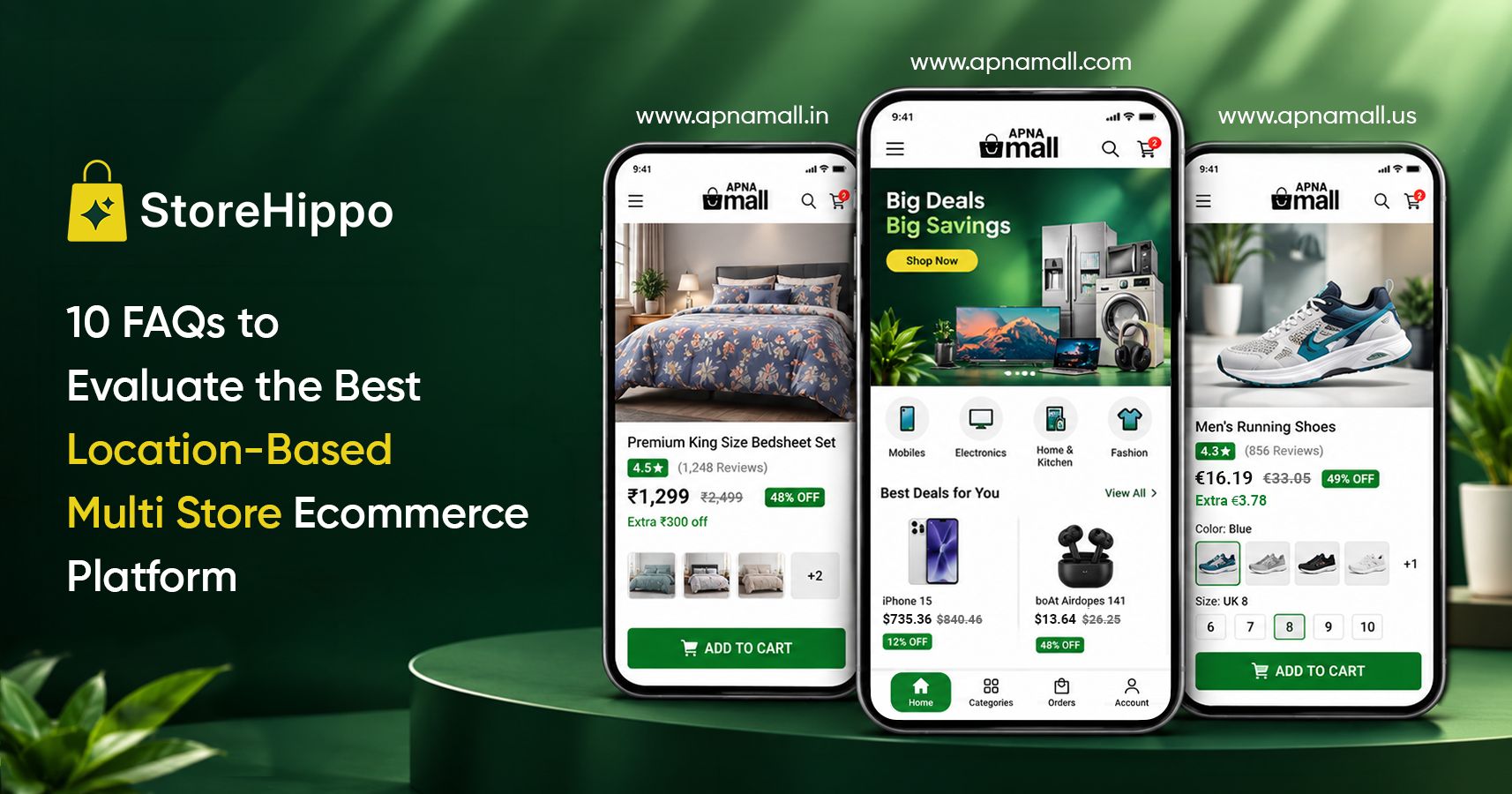



Choosing the right Location-Based Multi Store Ecommerce solution can make a big difference when your business operates across multiple cities, regions, or markets.
Imagine running stores across 20 cities. Each location has its own customers, product demand, inventory, pricing, and delivery requirements. You want the flexibility to manage each store according to its local market, but you certainly don't want 20 separate systems to manage them.
That's where multi store ecommerce solutions come in. But not every platform offers the same flexibility. Can you launch new location-specific stores without starting from scratch? Can you manage all your stores from one dashboard while keeping local operations independent? And will the platform support your business as you expand into new markets?
Before investing in a platform, it's worth asking a few important questions. Here are 10 FAQs to help you evaluate location-based multi store ecommerce platforms and choose a solution that fits your current operations and future expansion plans.
Table of Contents
- How Multi-Store Ecommerce Helps Enterprise Brands Grow Across Markets
- 10 FAQs to Ask Before Choosing a Location-Based Multi Store Ecommerce Solution
- 1. Do I need a separate backend for each store in a location-based multi store ecommerce setup?
- 2. Can I customise each store’s URL, branding and design using multi-store ecommerce solutions?
- 3. How does a multi-store with central admin help me manage all my location-based stores?
- 4. Can multi store ecommerce solutions support different product catalogues, pricing and promotions for each store?
- 5. Can I manage and synchronise inventory across locations using a location-based multi store ecommerce platform?
- 6. Can location-based multi store ecommerce automatically direct customers to the right store based on their location?
- 7. Can my dealers, franchisees, or regional teams manage their stores independently in a multi-store with a central admin setup?
- 8. Can each store have its own payment, shipping and fulfilment settings with a multi store ecommerce solution?
- 9. How can I add more locations to my existing location-based multi store ecommerce setup?
- 10. How can an AI-powered ecommerce platform improve my multi-store operations?
- Conclusion
How Multi-Store Ecommerce Helps Enterprise Brands Grow Across Markets
For enterprise brands, a one-size-fits-all online store may not be enough to serve customers across different regions. Customer preferences, languages, product demand, and buying behaviour can vary from one market to another. A multi store ecommerce solution helps businesses address these differences by creating tailored shopping experiences for different locations while maintaining control over their overall ecommerce operations.
Here are some industry trends that highlight the growing role of multi-store ecommerce in enterprise growth.
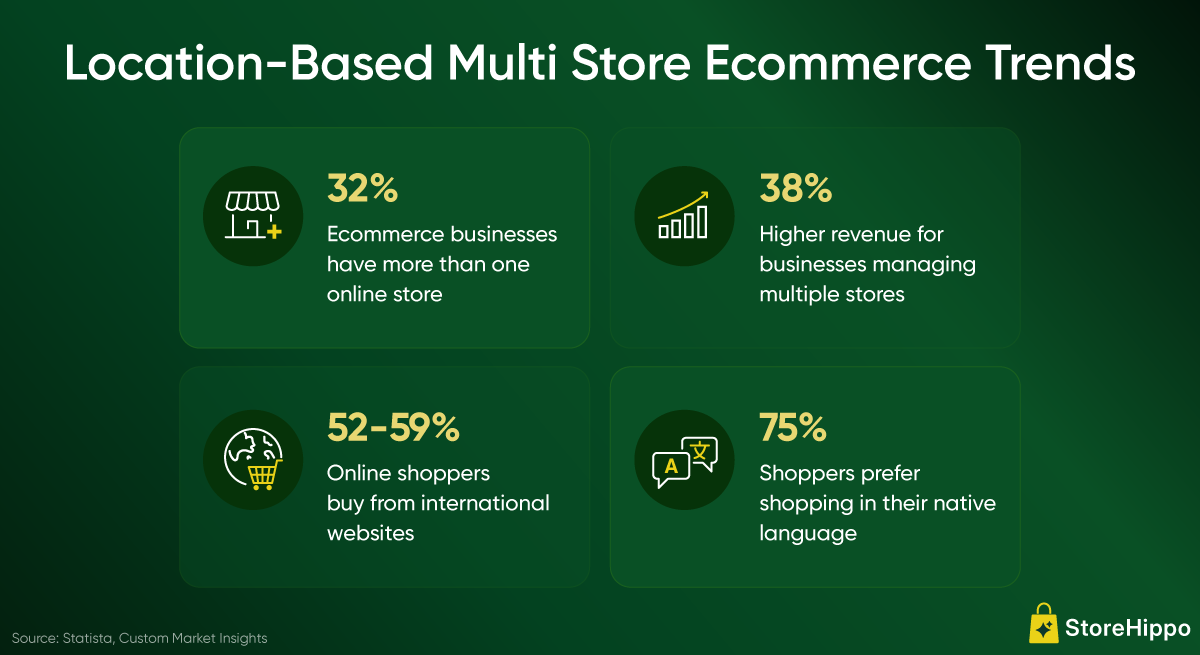
- 32% of ecommerce businesses have more than one online store
- 38% higher revenue for businesses managing multiple stores
- 52%-59% of online shoppers buy from international websites
- 75% of shoppers prefer shopping in their native language
Source: Statista, Custom Market Insights,
These trends point to a clear opportunity for enterprise brands: serving diverse customer groups can open up new revenue opportunities. However, meeting the needs of different regions requires more than launching additional storefronts. Businesses also need to maintain consistent product information, coordinate inventory, and ensure smooth operations as they grow.
A multi store ecommerce solution gives enterprises the flexibility to adapt their ecommerce strategy to different markets without losing sight of the bigger picture. By balancing local market requirements with consistent brand standards, businesses can respond to changing customer expectations, identify new growth opportunities, and build a stronger presence across regions.
10 FAQs to Ask Before Choosing a Location-Based Multi Store Ecommerce Solution
Choosing the right location-based multi store ecommerce solution requires more than comparing features. Enterprises should consider how well the platform supports multiple storefronts, adapts to local customer needs, and scales as the business expands into new markets.
Here are 10 FAQs to help enterprises choose the right location-based multi store ecommerce platform:
1. Do I need a separate backend for each store in a location-based multi store ecommerce setup?
No, you don’t need a separate backend to manage each store in a location-based multistore ecommerce setup. A Location-Based Multi Store Ecommerce solution lets you manage all your storefronts from one place while giving you the flexibility to meet local needs. You can manage product catalogues, update store settings, and oversee daily operations of each store through a shared system, without the hassle of maintaining separate setups for every location.
For example, a global fashion ecommerce brand operating in the US, UK, and India can manage all three storefronts centrally while offering region-specific products, pricing and promotions. This helps the business maintain consistent operations while catering to different markets.
StoreHippo Multistore® ecommerce platform enables enterprises to create and manage multiple sub-stores through a common admin dashboard. Businesses can customise each store to offer localised shopping experiences while managing all their stores and daily operations from one platform.
2. Can I customise each store’s URL, branding and design using multi-store ecommerce solutions?
Yes. Advanced multi store ecommerce solutions enable businesses to give each storefront its own identity. Depending on the platform, you can customise URLs, branding, themes, layouts banners, pricing, promotions and language settings to suit different markets and customer preferences. This helps businesses create distinct shopping experiences while maintaining consistent brand values across all their stores.
Let’s take the example of a beauty brand serving customers in multiple countries. It can create storefronts that reflect local beauty trends and shopping habits. The brand can highlight popular skincare products in one country, promote makeup collections in another and offer local discounts, prices in local currencies and content in regional languages. This makes it easier for customers to discover relevant products and enjoy a shopping experience that feels familiar to them.
With StoreHippo’s advanced location-based multi store ecommerce platform, enterprises can bring this approach to life by creating customised storefronts for different locations and customer groups. They can configure unique domains or subdomains, customise themes and navigation, and manage store-specific pages, blogs, logos and language settings. This gives brands the flexibility to tailor each storefront to its target market while managing their entire store network through a shared backend.
3. How does a multi-store with central admin help me manage all my location-based stores?
A Multi-store with central admin setup lets your brand manage all your business locations from one place while giving each store manager the freedom to meet local customer needs. You can keep business operations consistent across stores while allowing local teams to update products, run offers, and make decisions based on what works best in their area. This makes it easier to manage multiple stores as your business grows.
Imagine a home appliances brand selling to customers across India, Australia and other global markets. While the business manages its operations centrally, local teams can tailor their stores to regional demand. For example, during June and July, the India team can promote air coolers and refrigerators to beat the summer heat, while the Australia team highlights room heaters and other winter essentials. Each store can also feature locally popular brands, regional pricing and exclusive offers, helping customers discover products that match their location and seasonal needs.
To manage this kind of setup, StoreHippo Multistore® ecommerce platform offers a unified admin dashboard where enterprises can manage sub-stores, products, banners and store configurations. Brands can also group stores like all location based stores in Australia and India from the above example can be grouped together based on their respective countries. Its integration capabilities also enable businesses to connect their ecommerce operations with preferred/existing ERP and POS, depending on their requirements. This gives enterprises the built-in tools to manage their storefronts in different locations from one place while supporting the specific needs of each location.
4. Can multi store ecommerce solutions support different product catalogues, pricing and promotions for each store?
Yes. Multi store ecommerce solutions with centralised catalogue management and store-level controls let businesses customise product catalogues, pricing and promotions for each location. Businesses can manage product information from one dashboard while adjusting product availability, prices and offers to match customer demand in different regional markets. This helps them maintain consistency across stores while giving each location the flexibility to meet its customers’ needs.
For example, a fashion retailer selling across India and the UK can tailor its product catalogues and promotions to customer preferences in each market. During the festive season, its India stores can highlight ethnic wear, festive collections and special Diwali offers, while its UK stores can promote autumn fashion, winter jackets and seasonal discounts. Each store can also feature locally popular brands, region-specific pricing and exclusive deals, making the shopping experience more relevant to customers in each location.
StoreHippo’s location-based multi store ecommerce platform supports this flexibility by offering a master catalogue that lets enterprises manage products across multiple stores. Businesses can choose which products to display in each sub-store, set different prices for the same product across locations, and run store-specific promotions or set minimum order values. This allows businesses to manage their product catalogue centrally while adapting product selections, prices and offers to local customer needs.
5. Can I manage and synchronise inventory across locations using a location-based multi store ecommerce platform?
Yes, you can manage and synchronise inventory across multiple locations using a location-based multi store ecommerce platform. It lets you track stock levels, update product availability and monitor inventory across storefronts from a central dashboard. This helps reduce manual work, prevent overselling, and maintain accurate stock information for each location.
For example, a consumer electronics retailer operating multiple city-based stores may have high demand for smartphones in Delhi and laptops in Bengaluru. With centralised inventory management, the retailer can track stock availability at each location, identify products running low and plan timely replenishment. If a particular smartphone model sells out in Delhi but is available in another location, the business can check stock across its stores and arrange a transfer or fulfilment from another location. This helps prevent lost sales, avoid unnecessary overstocking and keep product availability accurate for customers.
StoreHippo’s location-based multi store ecommerce platform offers centralised multi-store management, inventory tracking and inventory synchronisation capabilities. Enterprises can manage their storefronts from one dashboard, configure inventory for individual sub-stores and use inventory synchronisation to keep stock information updated across storefronts. This helps businesses monitor product availability, manage stock more efficiently, and provide customers with up-to-date product information.
6. Can location-based multi store ecommerce automatically direct customers to the right store based on their location?
Yes. A location-based multi store ecommerce platform helps customers find the right store for their location. Depending on the platform’s features, customers can select their preferred location or use location settings to view the relevant store, product availability and prices. This makes it easier for customers to find products available in their area and enjoy a more convenient shopping experience.
For example, imagine a hyperlocal grocery retailer with multiple stores across Delhi NCR. When a customer in Noida visits the website, they are directed to the storefront serving their area, showing groceries available at nearby stores, local discounts and delivery options. Meanwhile, a customer in Gurugram sees products, offers and delivery availability specific to their location. The retailer manages all its stores from one central dashboard while ensuring customers shop from the store serving their neighbourhood.
StoreHippo Multistore® supports IP-based sub-store selection, helping businesses show customers the relevant storefront based on their location. Enterprises can also choose which products to display in each sub-store and set delivery availability by PIN code, area or city. This helps customers find products available in their area, check whether delivery is possible and enjoy a more convenient shopping experience.
7. Can my dealers, franchisees, or regional teams manage their stores independently in a multi-store with a central admin setup?
Yes, dealers, franchisees and regional teams can manage their respective stores independently in a multi-store with central admin setup, provided the platform supports role-based access and permissions. They can handle store-level tasks such as updating product details, managing inventory and running local promotions, while you retain central oversight of the entire store network. This allows each team to manage its responsibilities more efficiently.
For example, an automotive brand with multiple dealerships can allow each dealer to manage their own store, update product listings and handle customer orders. Meanwhile, the admins can oversee all dealerships, maintain consistent product information and ensure that each store follows the brand’s guidelines. This enables dealers to manage their day-to-day activities while the admin maintains control over its overall operations.
StoreHippo Multistore® supports this setup through its Substore Managers feature, which allows enterprises to assign specific sub-stores to individual managers. Dealers, franchisees and regional teams can manage their assigned stores, while custom user roles and permissions help control access to different store functions. This gives local teams the flexibility to handle their responsibilities while helping enterprises maintain centralised control over their store network.
8. Can each store have its own payment, shipping and fulfilment settings with a multi store ecommerce solution?
Yes. A multi store ecommerce solution can let you set up different payment methods, shipping options and fulfilment processes for each store, depending on the platform’s features. You can choose the payment options and delivery services that are available in a particular location. This makes it easier to manage local requirements while keeping all your stores organised through one central system.
Let’s consider a global ecommerce brand with stores in the US and India. It can offer different payment methods and delivery options based on what works best in each market. For example, the US store might offer local courier services, while the Indian store provides delivery partners and payment options commonly used by Indian customers. This helps the brand meet local needs while managing both stores from one platform.
StoreHippo Multistore® helps businesses support these different market requirements by offering 60+ domestic and international payment gateways, giving businesses a range of payment options to serve customers across different markets.
For shipping and fulfilment, StoreHippo integrates with 30+ logistics providers, helping businesses choose suitable delivery partners based on their operational and location-specific requirements.
9. How can I add more locations to my existing location-based multi store ecommerce setup?
You can expand your location-based multi store ecommerce setup by extending your business to new cities, regions, or countries without rebuilding your existing ecommerce operations. Depending on your platform's capabilities, you can introduce location-specific storefronts, customise product offerings, pricing and delivery options, and manage new locations alongside existing ones.
For example, a furniture retailer can expand its business by creating additional storefronts through its ecommerce platform’s admin dashboard. As it enters new markets, it can set up each storefront with relevant product collections, local pricing and suitable delivery options. This allows the retailer to serve more customers while managing all its storefronts from one central dashboard.
StoreHippo’s multi store ecommerce solutions enables enterprises to add new sub-stores through a central admin panel as their business expands. They can assign unique URLs to new storefronts, set layouts and designs, customise content, select the products available in each store, and configure settings such as pricing, themes, payment methods, and shipping options. This helps businesses expand into new markets while managing their growing network of storefronts from one dashboard.
10. How can an AI-powered ecommerce platform improve my multi-store operations?
An AI-powered ecommerce platform can simplify multi-store operations by automating routine tasks, improving product discovery and providing personalised shopping experiences. AI-powered tools can help businesses optimise product catalogues, recommend relevant products and understand customer preferences across locations. These capabilities reduce manual work, help teams make informed decisions, and make it easier to manage growing store networks while delivering a consistent shopping experience.
For example, a global fashion retailer managing thousands of products across multiple location-based sub-stores can use AI-powered content creation to streamline catalogue updates and intelligent search to help customers find products based on their preferences. Personalised recommendations can further improve product discovery across its regional storefronts.
StoreHippo is an AI-powered ecommerce platform with built-in AI capabilities that help simplify multi-store operations. Its AI cataloguing tool automates product titles and descriptions, while Magic Edit enhances product images. AI-powered semantic search helps customers find relevant products, and AI recommendations improve product discovery. Enterprises can also build custom AI assistants to guide shoppers, answer queries, and support routine tasks.
Conclusion
Expanding into new markets takes more than opening additional storefronts. Businesses need the right technology to balance local customer preferences with consistent operations across locations. The right Location-Based Multi Store Ecommerce solution makes this easier by bringing store management, catalogue control, inventory and regional customisation together.
When evaluating multi store ecommerce solutions, look for features that support your current business model and future expansion plans. A Multi-store with central admin can simplify coordination across locations, while an AI-powered ecommerce platform can help streamline catalogue management and improve product discovery. With StoreHippo Multistore®, enterprises can manage multiple storefronts through a shared backend while tailoring each store to its market.
Ready to simplify multi-store management and expand your business into new locations?
Book your demo with StoreHippo now.
Binny Joseph is a seasoned ecommerce leader and Senior Vice President of Sales & Alliances with extensive experience helping businesses adopt modern commerce solutions.
He shares practical insights on choosing and scaling location-based multi-store ecommerce solutions that help businesses manage regional operations, maintain centralised control, and deliver localised shopping experiences as they grow.