


Most pharma distribution companies don't actually have a distribution problem. They have a visibility gap that gets mistaken for one.
Their pharma distribution network is already in place, with pharmaceutical distributors, stockists, and chemists actively moving orders. But these orders happen outside any system the brand truly controls.
A typical flow looks like this: a chemist sends a WhatsApp message to a sales rep, a stockist calls a logistics partner for pickup, and an indent gets recorded and entered into a spreadsheet days later.
Orders get fulfilled. Payments come in. It seems to work, until it doesn't.
A new product fails to reach large parts of the network in time. A scheme expires before most distributors even hear about it. A key stockist shifts to a competitor, and the drop is noticed only when volumes fall.
In the next board meeting, the obvious solution comes up: build a B2B pharma marketplace.
This is where most brands get it wrong. Digitising a pharma dealer network is not about launching an online store.
It is about building a B2B pharma marketplace that acts as the control layer for your entire distribution, and rolling it out in a way your dealers actually adopt.
That's what makes the difference.
Table of Contents
- What is a B2B pharma marketplace?
- Why do pharmaceutical distribution companies struggle to digitize their dealer networks?
- How StoreHippo Helps Pharmaceutical Distribution Companies Digitise Dealer Networks
- Can every wholesale medicine distributor get their own location-specific storefront?
- How can pharmaceutical brands manage huge drug catalogs, regulated SKUs, and dealer-specific pricing through a pharma B2B ecommerce marketplace?
- What happens when pharmaceutical distribution moves from manual ordering to B2B pharma marketplace?
- How can pharmaceutical brands enable faster medicine fulfilment and last-mile delivery across cities?
- How can field medical sales reps place and track orders digitally during chemist visits?
- How does AI improve B2B Pharma Marketplace performance over time?
- Why AI Starts Becoming Critical as Pharma Networks Scale
- Conclusion
- Frequently Asked Questions
What is a B2B pharma marketplace?
A B2B pharma marketplace is a digital commerce platform that helps pharmaceutical brands connect and manage distributors, stockists, chemists, and field sales operations through one centralized system. It allows pharmaceutical companies to automate dealer onboarding, ordering, pricing, catalogs, fulfillment, and compliance workflows across large distribution networks.
Why do pharmaceutical distribution companies struggle to digitize their dealer networks?
Most pharmaceutical distribution companies struggle to digitise their dealer networks because the channel is not built around one type of buyer. Distributors, stockists, chemists, and field sales teams all work differently. They follow different pricing structures, ordering patterns, credit cycles, and catalog access rules.
This is where many digitisation projects fail. Brands try to manage the entire network through one common system or storefront, but the complexity of the channel quickly outgrows it.
The real challenge is not building an online ordering portal. It is creating a B2B pharma marketplace architecture that can handle different dealer layers, workflows, and regional operations without making the system difficult to use.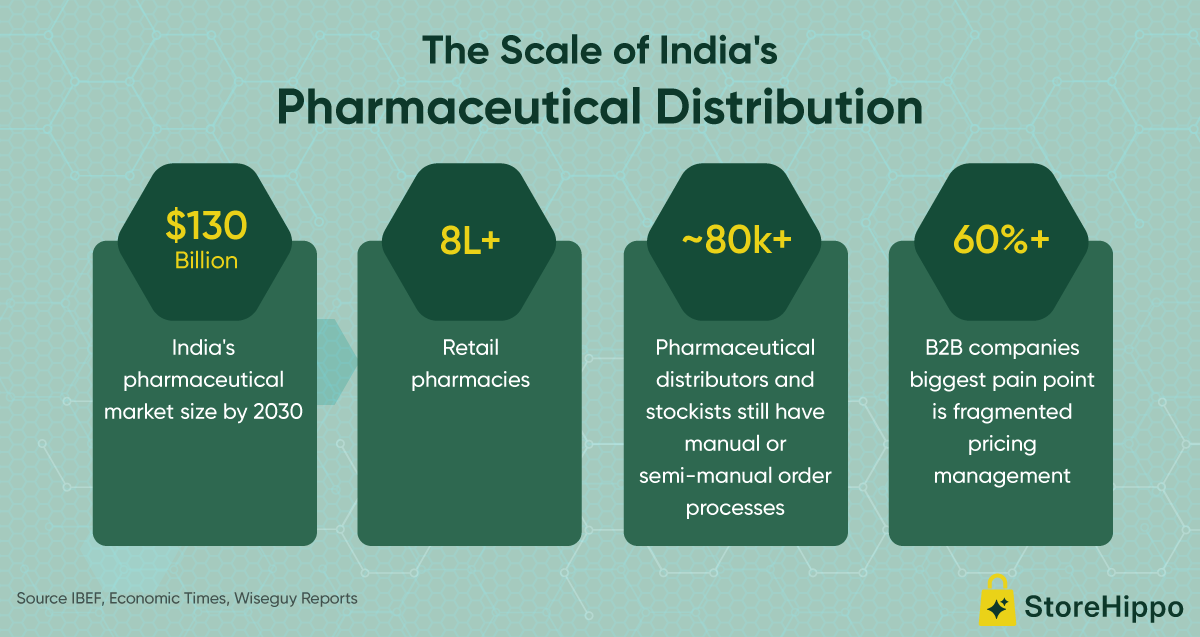
- India's pharmaceutical market is projected to reach $130 billion by 2030, yet the distribution infrastructure moving these products remains overwhelmingly offline, creating growing operational risk for brands that haven't started their digital transition (Source : IBEF)
- India has over 800,000 retail pharmacies served by an estimated network of 80,000+ pharmaceutical distributors and stockists, most still running on manual or semi-manual order processes (Source : Economic Times)
- Over 60% of B2B companies cite fragmented pricing management across customer tiers as their top operational pain point, and in pharma, where pricing layers across channel tiers, GST slabs, and scheme windows, the complexity is even sharper (Source : Wiseguy Reports )
The pharma distribution chain has always been relationship-driven. A pharmaceutical distribution company rarely sells directly to the chemist. Products move through C&F agents, distributors, stockists, and finally to the pharmacy counter. Every layer works differently, with its own pricing logic, credit cycle, catalog visibility, and way of doing business.
That is why most standard ecommerce rollouts struggle in pharma. A single storefront with one catalog and one pricing structure cannot handle the operational realities of a large dealer network. Soon, regional schemes are still being shared over email, pricing sheets continue circulating as Excel files, and teams manually control schedule-drug visibility because the platform cannot support dealer-level logic properly.
Consider MedPrime Pharma* , a hypothetical brand used purely for illustration. It manages OTC and Rx products across 12 states through 4 C&F agents, 600+ wholesale medicine distributors, and nearly 8,000 chemists. Orders arrive through WhatsApp, calls, and emails. Scheme updates move through PDFs. Pricing approvals sit in spreadsheets. The business continues to operate, but with very little real-time visibility across the channel.
This is not a people problem. It is an infrastructure problem. And solving it requires more than an online ordering portal. It requires a B2B pharma marketplace and pharma B2B ecommerce architecture designed around how pharmaceutical distribution actually works in the real world.
How StoreHippo Helps Pharmaceutical Distribution Companies Digitise Dealer Networks
StoreHippo helps pharmaceutical distribution companies digitise complex dealer ecosystems without disrupting existing channel structures.
Instead of forcing distributors, stockists, chemists, and field teams into one common workflow, StoreHippo’s AI-powered B2B ecommerce platform allows brands to create role-based experiences for every dealer layer from one unified backend.
A pharma brand can manage different pricing structures, catalogs, GST rules, territories, credit cycles, and scheme visibility for each distributor or retailer while maintaining complete central control.
Here is what pharma brands get with StoreHippo:
- Multi-level dealer management for CNF agents, distributors, stockists, chemists, and hospitals
- Dealer-specific pricing, margins, schemes, and credit workflows
- Region-wise multi-stores network (with unique inventory, pricing etc), managed from one admin dashboard and a central master catalogue with all items listed
- WhatsApp and product QR based ordering for chemists and distributors without separate apps
- API-based ERP integrations without replacing existing systems
- Hyperlocal order routing to nearest warehouse or distributor
- Role-based catalog visibility for OTC and restricted products
- Quick rollout of mobile apps for dealers and field teams
- Real-time visibility across orders, inventory, logistics, and payouts
With StoreHippo, pharmaceutical brands can digitise operations gradually while preserving existing dealer relationships and workflows.
Instead of managing orders through calls, PDFs, WhatsApp messages, and spreadsheets, the entire distribution network operates through one connected pharma B2B ecommerce infrastructure with better visibility, faster operations, and tighter control at scale.
How can pharmaceutical brands onboard distributors, stockists, and chemists without disrupting existing dealer networks?
Pharmaceutical brands can digitise dealer onboarding without disrupting existing distribution networks by using structured verification workflows, role-based buyer groups, and controlled access systems. Instead of treating onboarding like a simple registration process, pharma B2B ecommerce platforms need to verify drug licenses, GST details, territories, pricing eligibility, and credit rules before activating dealer accounts.
Different stakeholders like distributors, stockists, and chemists operate under different regulatory, commercial, and regional conditions. That is why each approved buyer needs to automatically inherit the right catalog visibility, pricing structure, order permissions, and territory rules based on their role in the distribution chain.
For example, a pharmaceutical distributor may require access to full product catalogs, state-specific schemes, and higher credit limits, while a chemist chain may only need OTC visibility and lighter approval workflows. Managing this manually across hundreds of dealer accounts quickly becomes operationally unscalable.
How StoreHippo Helps Pharmaceutical Brands Digitise Dealer Onboarding
StoreHippo helps pharmaceutical brands onboard distributors, stockists, chemists, and field partners through a structured, compliance-first onboarding workflow designed for layered pharma distribution operations.
The platform supports mandatory verification flows for drug licenses, GSTIN, KYC details, bank information, and territory mapping before activating accounts. Once approved, buyers are automatically assigned to predefined groups like C&F agents, distributors, stockists, hospitals, or chemist chains.
Each buyer group automatically inherits:
- Role-based catalog access
- State-wise pricing and schemes
- MOQ and credit rules
- Territory-level restrictions
- OTC and Rx product visibility
- Order approval workflows
StoreHippo also supports:
- WhatsApp and QR-based ordering for chemists
- ERP integrations with existing pharma systems
- Hyperlocal distributor routing based on location
- Dedicated dashboards for distributors and retailers
- Multi-region dealer management from one backend
This allows pharmaceutical brands to digitise dealer onboarding and ordering workflows while preserving existing distributor relationships, operational hierarchies, and regional supply chain structures.
Can every wholesale medicine distributor get their own location-specific storefront?
Yes, and for large pharmaceutical distribution companies, this becomes essential as dealer networks expand across states, pricing structures, and regulatory conditions.
Most pharma ecommerce projects struggle because they try to manage every distributor, scheme, language, and catalog variation from one common storefront using layers of filters and manual exceptions. Over time, the platform becomes difficult to manage, and regional operations continue running outside the system through spreadsheets, PDFs, and WhatsApp updates.
The more scalable approach is to give each distributor network or region its own location-specific storefront while still managing everything from one central backend.
For example, distributors in Maharashtra can see different schemes, pricing, language preferences, and product availability than distributors in Telangana or Rajasthan. If a product is unavailable or restricted in a specific state, it simply does not appear in that portal. Regional schemes stay region-specific without creating operational confusion.
How StoreHippo Helps Pharmaceutical Brands Run Location-Specific Distributor Storefronts
StoreHippo’s multi-store ecommerce architecture helps pharmaceutical brands operate at scale. Brands can manage multiple state-wise distributor portals, regional catalogs, pricing structures, and multilingual storefronts from one unified admin dashboard and one master catalog.
Brands can control state-wise pricing, regional schemes, multilingual catalogs, distributor-specific visibility, and product availability from one master catalog and admin dashboard. This helps pharmaceutical companies scale regional operations cleanly without managing multiple disconnected systems or manual catalog exceptions.
How can pharmaceutical brands manage huge drug catalogs, regulated SKUs, and dealer-specific pricing through a pharma B2B ecommerce marketplace?
Pharmaceutical brands can manage complex drug catalogs and dealer-specific pricing by controlling product visibility, pricing, GST rules, and schemes through predefined buyer groups. This set up ensures licensed distributors only see approved Rx products, pricing stays distributor tier-specific, and promotional schemes are auto applied based on configured business rules.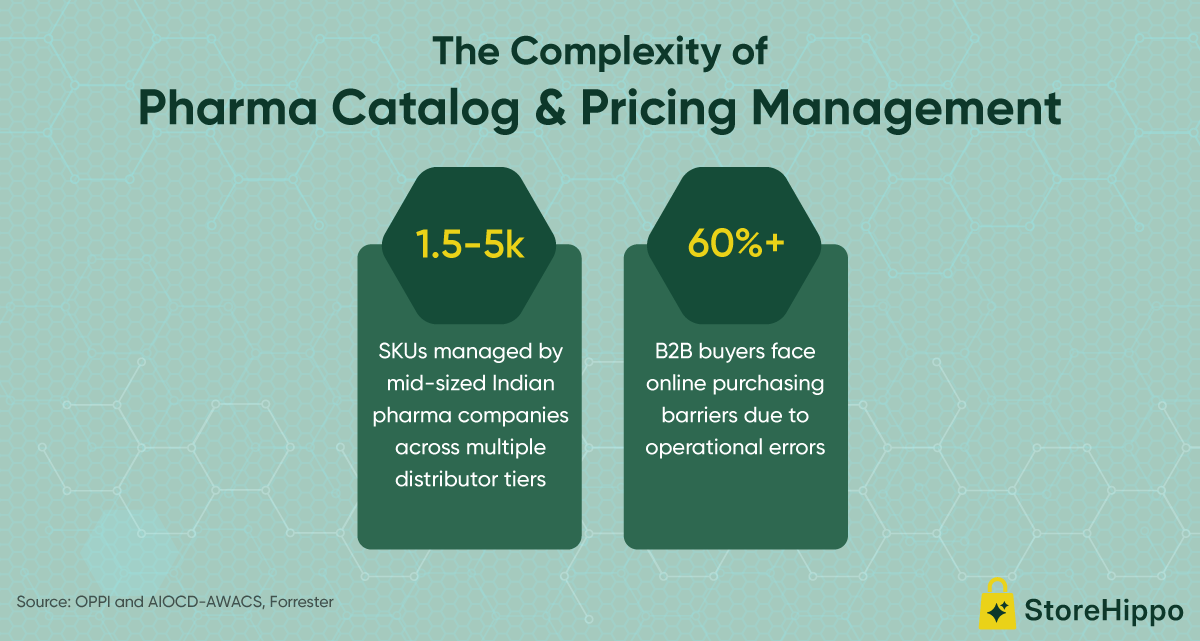
- A mid-size Indian pharmaceutical company typically manages between 1,500 and 5,000 active SKUs across formulations, pack sizes, and variants with different commercial terms across multiple distribution tiers (Source: OPPI and AIOCD-AWACS)
- Pricing errors in pharma B2B ecommerce like, wrong MRP, incorrect GST slab, scheme miscalculation can trigger distributor disputes and regulatory scrutiny that take weeks to resolve, with downstream volume impact on affected accounts
- According to data from Forrester, over 60% of B2B buyers face online purchasing barriers driven by operational errors, making catalog and pricing accuracy a critical customer retention issue, not just a backend ops problem.
Take MedPrime Pharma, for example. Its catalog includes 2,200 active SKUs. Around 600 are Schedule H and H1 drugs that should only be visible to verified buyers with valid licenses. Another 1,400 are OTC products available across dealer tiers, while 200 products are promotional combo packs and scheme bundles that activate only during configured campaign periods.
Managing this through spreadsheets or manual catalog controls becomes risky very quickly. A restricted SKU accidentally becoming visible to the wrong wholesale medicine distributor is not just an operational error, it is a regulatory problem.
That is why pharma B2B ecommerce marketplaces need rule-based catalog control. Rx SKUs should automatically stay restricted to licensed buyer groups. OTC products should remain visible to approved dealer categories. Scheme bundles should activate and expire automatically without teams manually changing settings every week.
Pricing follows the same logic. A distributor should only see distributor pricing. A stockist should only see stockist pricing. GST should apply automatically based on product category, while discounts and promotional schemes should run consistently across all dealer groups without manual intervention.
How StoreHippo Helps Pharmaceutical Brands Manage Drug Catalogs and Dealer-Specific Pricing
StoreHippo helps pharmaceutical brands manage large drug catalogs, regulated SKUs, and dealer-specific pricing through rule-based access on the pharma B2B ecommerce marketplace with complex distribution operations.
The platform supports:
- Role-based or group-based catalog visibility across dealer groups
- License-based access control for Rx products
- Tier-specific pricing for distributors, stockists, and chemist chains
- Automatic GST calculation by product category
- Built-in discount engine to add diverse promotional schemes and bundles
- Centralized master catalog and dealer catalog control from one admin dashboard
This helps pharmaceutical brands reduce pricing errors, control regulated product visibility, and manage complex dealer pricing structures at scale without depending on spreadsheets or manual catalog operations.
What happens when pharmaceutical distribution moves from manual ordering to B2B pharma marketplace?
When pharmaceutical distribution companies move to a B2B pharma marketplace, the ordering process becomes faster, traceable, and operationally controlled. Pharmaceutical distributors can place orders, access dealer-specific pricing, pass real-time credit checks, generate invoices, and trigger warehouse workflows digitally without depending on calls, emails, spreadsheets, or WhatsApp coordination.
Traditionally, most pharmaceutical orders do not happen during office hours. A stockist checks inventory late at night. A chemist places a replenishment order after closing. A wholesale medicine distributor finalizes next-day requirements early Sunday morning.
Many pharmaceutical distribution companies still depend on calls, WhatsApp messages, PDFs, and manual approvals to process routine dealer orders. Teams re-enter orders into ERP systems manually, verify pricing over calls, and coordinate inventory through spreadsheets. As dealer networks scale, delays and operational errors increase quickly.
That is where traditional ordering systems start breaking down. In contrast building a B2B pharma marketplace streamlines and automates things with clear visibility.
Take MedPrime Pharma, for example. A distributor in Pune logs into the regional portal at 9:30 PM and places an order for OTC and Schedule H products. The platform automatically checks available credit limits, validates product eligibility, flags out-of-stock SKUs, and generates a proforma invoice instantly.
By morning, the warehouse team already has a system-generated pick list. The regional sales manager sees the order status in real time. No one manually processed the order. No follow-up calls were needed.
This is what a properly built pharma B2B ecommerce workflow looks like. The platform automatically handles:
- Dealer-specific pricing
- MOQ enforcement
- Credit validation
- Partial order processing
- Real-time inventory checks
- Auto-generated invoices
- Order tracking and fulfillment workflows
Every order becomes traceable, faster to process, and easier to manage across large dealer networks.
How StoreHippo Helps Pharmaceutical Distribution Companies Digitise Order Workflows
StoreHippo helps pharmaceutical distribution companies automate and digitise complex dealer ordering cycles through a scalable B2B pharma marketplace and built-in features to run and manage the entire B2B ordering workflows across multi-tier large distributor ecosystems.
The platform has built-in features and supports easy customisations for:
- Real-time credit checks during checkout
- Dealer-specific catalogs and pricing visibility
- Automated proforma invoice generation
- MOQ and order-rule enforcement
- Seamless ERP, warehouse and other software integration for automating order workflows and pick up automation
- Role-based ordering access for distributors and stockists
- WhatsApp and mobile-based dealer ordering
- Real-time order and fulfillment tracking
This helps pharmaceutical distributors and wholesale medicine distributors move from fragmented manual ordering to a connected, traceable, and scalable pharma B2B ecommerce workflow with better operational visibility and faster fulfillment cycles.
How can pharmaceutical brands enable faster medicine fulfilment and last-mile delivery across cities?
Pharmaceutical brands can enable faster medicine fulfillment by using hyperlocal delivery routing that automatically sends orders to the nearest stocked distributor hub or warehouse. Instead of dispatching every order from one central location, the system routes orders based on inventory availability, buyer location, and delivery capability in real time.
For most pharmaceutical distribution companies, the challenge is not stock availability, it is fulfillment coordination.
A chemist in South Mumbai may place an urgent OTC replenishment order, but the system still routes it from a warehouse outside the city because the platform cannot identify nearby stock availability. A wholesale medicine distributor in Bengaluru may see products marked out of stock even when inventory is available at a nearby fulfilment hub.
This is where manual coordination starts taking over. Teams begin handling deliveries through calls, WhatsApp coordination, local runners, and operational overrides to close fulfilment gaps. That approach may work for smaller networks, but it quickly becomes unsustainable when pharmaceutical brands start managing same-day or next-day fulfillment across multiple cities simultaneously.
Hyperlocal delivery routing changes this completely.
Instead of manually deciding where orders should ship from, the platform automatically identifies the nearest fulfilment point with available inventory. That could be a regional warehouse, a distributor hub, or a city-level dark store.
For example, when a chemist in Hyderabad places a replenishment order at 10 AM, the order gets routed directly to the Hyderabad fulfillment hub instead of the central warehouse in Delhi. The order ships the same day, delivery timelines shrink dramatically, and the central warehouse focuses on bulk inventory movement instead of managing city-level dispatches.
The routing logic can also handle specialized fulfilment conditions automatically. Temperature-sensitive medicines can be assigned to cold-chain-enabled delivery partners, while general OTC products route through the fastest available delivery option in that geography.
This becomes increasingly important as pharmaceutical buyers expect faster fulfilment timelines across urban markets. According to RedSeer, India’s hyperlocal delivery market is growing rapidly as businesses and consumers increasingly expect same-day and sub-4-hour fulfilment experiences.
How StoreHippo Helps Pharmaceutical Brands Enable Hyperlocal Medicine Fulfilment
StoreHippo helps pharmaceutical brands automate hyperlocal order routing and last-mile fulfilment across multi-city dealer and distributor networks through its AI-powered pharma B2B ecommerce infrastructure.
The platform supports:
- Hyperlocal order routing based on buyer pin code and automated nearest-hub order allocation
- Distributor-wise and city-wise inventory visibility
- Seamless integrations for multi-warehouse and dark-store fulfilment management
- Real-time inventory and fulfilment tracking
- Zone-based shipping logic and delivery rules
- 30+ pre-integrated logistics and courier partners
- Unified logistics dashboard that makes every order visible and trackable without switching tabs
- Same-day and next-day medicine fulfilment workflows
This helps pharmaceutical distribution companies reduce fulfillment delays, improve service levels for chemists and distributors, and manage multi-city delivery operations without depending on manual coordination workflows. Pick, pack, dispatch, tracking, returns, all visible from one dashboard.
How can field medical sales reps place and track orders digitally during chemist visits?
Field sales reps can place and track chemist orders digitally through a mobile-first pharma B2B ecommerce system that connects reps, chemists, distributors, and warehouses on one platform. Reps can check live inventory, view past orders, place confirmed orders instantly, and route them directly to the right distributor account without relying on paper notes, calls, or WhatsApp follow-ups.
For many pharmaceutical distribution companies, the field sales process is still one of the most manual parts of the entire dealer network.
A medical representative visits a chemist, checks inventory manually, notes replenishment requirements on paper or WhatsApp, and forwards the request later to a distributor or backend team. Somewhere between the chemist, rep, distributor, and warehouse, delays, pricing mismatches, and missed orders start creeping in.
That creates a major visibility gap for pharmaceutical brands.
A chemist may agree to place an order during the visit, but the order might get processed hours later, routed incorrectly, or never placed at all. For large B2B pharma marketplace operations managing thousands of chemists and distributors, these gaps become difficult to track manually.
Let us see how building a B2B pharma marketplace for our example brand MedPrime Pharma, changes the ops. Its 180 field reps now use a branded mobile app during chemist visits. A rep opens the chemist account, checks the last few orders, reviews live stock availability, and places the order directly into the system while standing at the counter.
The order automatically links to the chemist’s assigned distributor account and enters the fulfilment workflow immediately. No relay calls. No handwritten notes. No manual order re-entry.
The workflow also stays functional in low-connectivity areas. In rural markets or low-signal dispensaries, orders get stored locally on the device and sync automatically once internet connectivity returns. That means orders are not lost because of network limitations during field visits.
This becomes especially important for wholesale medicine distributors and pharmaceutical brands trying to improve secondary sales visibility and reduce dependency on disconnected manual workflows.
How StoreHippo Helps Pharmaceutical Brands Digitise Field Sales Ordering
StoreHippo helps pharmaceutical distributors and field sales teams digitise chemist ordering workflows through mobile-first pharma B2B ecommerce marketplace and apps designed for large dealer and distributor networks.
The platform supports:
- Branded mobile apps for field sales reps
- Real-time stock visibility during chemist visits
- Chemist-wise order history and account access
- Direct order placement linked to distributor accounts
- Offline order capture and auto-sync functionality
- Mobile and PWA marketplace storefront and backend simplifies ordering for chemists and distributors even in low connectivity zones
- Real-time order tracking and fulfilment visibility
- Centralised order management from one backend
- Whitelabelled Android and iOS app building through no-code mobile app builder
This helps pharmaceutical distribution companies reduce order leakage, improve field sales visibility, and digitise the last mile of dealer ordering without disrupting existing distributor relationships.
How does AI improve B2B Pharma Marketplace performance over time?
AI improves a B2B pharma marketplace by making large distributor operations faster, more searchable, and easier to manage as the network grows. Over time, AI helps pharmaceutical distributors and pharmaceutical distribution companies reduce manual dependency across catalog management, product discovery, reordering, buyer support, and operational decision-making.
Why AI Starts Becoming Critical as Pharma Networks Scale
The real value of digitisation and AI powered core in pharma B2B ecommerce does not appear on day one. It starts building over time as every distributor order, chemist reorder, sales rep visit, pricing update, and scheme redemption gets captured inside one connected operational layer.
That is when pharmaceutical brands stop reacting manually and start operating with real visibility.
For example, in a large pharma catalog with thousands of SKUs, product discovery itself becomes difficult for dealers. A wholesale medicine distributor searching for a product may type partial names, molecule abbreviations, pack-size variations, or local shorthand terms. If the platform cannot understand intent properly, distributors go back to calling sales reps instead of using the marketplace independently.
Catalog operations become equally difficult as pharmaceutical brands expand product lines. Launching dozens of new SKUs across multiple therapeutic categories often means manually assigning categories, attributes, buyer visibility, pricing structures, and distributor mappings. As catalogs grow, these workflows become slower and more error-prone.
Reordering patterns also become harder to track manually. Dealers may forget frequently purchased SKUs, seasonal replenishment cycles, or scheme-linked products unless the system actively surfaces those recommendations during ordering.
Over time, AI helps solve these operational gaps by connecting catalog intelligence, buyer behavior, ordering history, and support workflows into one continuously improving system.
Instead of teams manually coordinating every process, the platform starts assisting distributors, chemists, field reps, and backend teams with faster search, smarter recommendations, automated catalog workflows, and conversational support experiences.
How StoreHippo Helps Pharmaceutical Brands Use AI in Pharma B2B Ecommerce
StoreHippo helps pharmaceutical distribution companies improve operational efficiency through an AI-powered core built into its platform architecture.
The platform supports:
- AI powered image cleanup through built-in Magic Edit tool
- AI-assisted one click catalog creation and product mapping through product image
- AI-powered semantic product search and personalised recommendations
- Conversational product discovery and order tracking
- Capability to build custom Agentic AI assistants for assisting dealer distributor networks with business and support queries
- Centralized AI-driven data visibility across dealer operations
- AI-powered commerce workflows built on scalable infrastructure
- AI powered unified dashboard to manage conversations from different channels under one common dashboard with full context
This helps pharmaceutical brands manage large catalogs more efficiently, improve dealer self-service, reduce manual operational dependency, and make pharma B2B ecommerce workflows smarter as the dealer network grows.
Conclusion
Building a B2B pharma marketplace is only the first step. The bigger shift begins when a pharmaceutical distribution company finally starts seeing what was previously invisible.
Every distributor order, scheme redemption, return pattern, delayed payment, and chemist reorder now leaves a digital trail. For the first time, pharmaceutical brands get real visibility into how their dealer network is actually operating.
But visibility alone does not change operations. The real value comes when teams start using that data to make faster pricing, inventory, distribution, and fulfillment decisions across the network.
If your current pharma B2B ecommerce operations still run across disconnected systems, spreadsheets, calls, and WhatsApp coordination, it may be time to see what a connected commerce infrastructure actually looks like.
Explore how leading pharmaceutical distribution companies are digitising dealer operations at scale. Book a personalized StoreHippo demo for your pharma brand.
Frequently Asked Questions
1. How long does it take for a pharmaceutical distribution company to go to market with its B2B pharma marketplace?
A mid-complexity pharma B2B ecommerce deployment covering pharmaceutical distributor onboarding, multi-store setup, catalog configuration, and logistics integrations typically takes 4 to 8 weeks on a well-architected, no plugin platform like Storehippo . The main variables are how clean your existing product data is and how many ERP integrations need configuring. Brands with structured catalog data and clear tier definitions tend to land at the faster end.
2. Can a pharma brand run a distributor B2B portal and a D2C consumer pharmacy on the same platform?
Yes. Large pharmaceutical brands can run both B2B ecommerce and D2C operations from the same commerce infrastructure with separate storefronts, pricing, catalogs, and buyer experiences for pharmaceutical distributors and end consumers while managing inventory centrally without duplicate product management.
StoreHippo supports B2B, D2C, B2B2C, multi-store, and marketplace commerce models from one unified backend.
3. How does StoreHippo handle GST compliance and e-invoicing for pharma orders?
StoreHippo has inbuilt support for GST compliance and e-invoicing workflows in pharma B2B ecommerce operations. The platform can automatically apply GST rules based on product categories, dealer locations, and buyer types while generating tax-compliant invoices during the order workflow.
It also supports seamless ERP and accounting integrations along with built-in invoicing and E-way bill management for automated e-invoice generation, invoice syncing, GST calculations, and order-level compliance across large pharmaceutical distributor networks.
4. Can we restrict Schedule H and H1 products from appearing to unverified wholesale medicine distributors?
Yes. Schedule H and H1 products can be restricted through buyer-group-based catalog visibility rules. Only verified buyers with approved drug licenses can access these SKUs, while unverified wholesale medicine distributors or unauthorized dealer groups simply do not see them on the portal.
The rules are configured once at the platform level and automatically enforced across every login, catalog view, and order workflow.
5. What happens if a pharmaceutical distributor's drug license expires mid-year?
The B2B pharma marketplace can be customised to trigger renewal alerts to both the distributor and the regional sales manager as expiry approaches. Schedule H access can be restricted pending renewal while the distributor's OTC ordering remains active so you don't have to choose between compliance and disrupting their regular business.
6. How can the B2B pharma marketplace manage credit limits and payment terms per distributor account?
Credit limits are set per account during onboarding and can be revised by the admin team at any time. The platform can have a custom rule for real-time credit check at checkout, if the order would breach the available limit, the buyer can be notified before confirmation, not after. Payment terms can be configured per buyer group and apply automatically to every order in that group.
Pallavee Kumar brings over 20 years of hands-on ecommerce experience, having helped B2B, B2C, and enterprise brands scale through strong operations and clear storytelling. She blends strategic thinking with practical execution to help complex commerce ecosystems grow with clarity, speed, and real business impact.