


With the convenience, trust and flexibility offered by online multi vendor marketplaces, modern buyers are rapidly shifting from visiting multiple physical stores to discovering and comparing furniture on furniture marketplaces.
What’s changing is not just where people buy furniture, but how they make the decision. Buyers are researching styles, dimensions, materials, reviews, prices and delivery options long before they step into a showroom, if they visit one at all. For furniture brands and retailers, this means competing for attention earlier in the buying journey, where digital discovery, personalised recommendations and a seamless shopping experience can influence the final purchase.
This shift is also opening a bigger play for businesses that can bring fragmented furniture sellers, regional manufacturers and established brands onto one digital destination. A well-designed multi vendor marketplace can turn this fragmented supply into a scalable shopping ecosystem while giving sellers access to wider markets and customers a richer, more relevant selection.
Before we explore the top 5 furniture multi vendor marketplaces in India and the strategies behind their growth, let’s look at the data that reveals just how quickly online furniture shopping is gaining momentum.
Table of Contents
- How Furniture Multi Vendor Marketplaces in India Are Growing
- Top 5 Furniture Multi Vendor Marketplaces in India
- What Can Businesses Learn From These Furniture Multi Vendor Marketplaces?
- How to Build a Successful Furniture Multi Vendor Marketplace in India
- How Does StoreHippo Help You Build a Feature-Rich Furniture Marketplace?
- Conclusion
- FAQs
How Furniture Multi Vendor Marketplaces in India Are Growing
Furniture multi vendor marketplaces in India are growing because both buyers and sellers are changing how they approach furniture shopping. Buyers want more variety, easier comparison and convenient delivery, while sellers want to reach customers beyond their local markets. Together, these changing expectations are giving furniture marketplaces a strong push.
Here are some numbers that show how quickly online furniture shopping is growing in India:
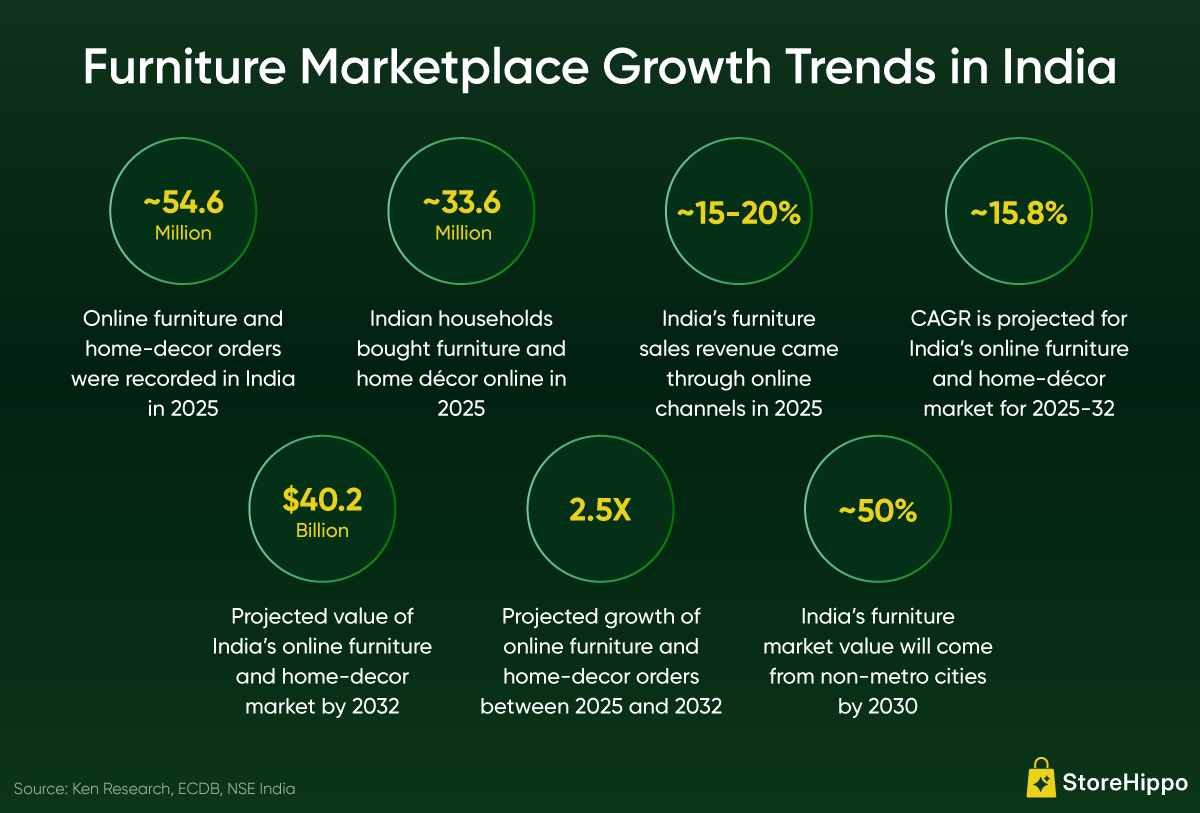
- ~54.6 million online furniture and home-decor orders were recorded in India in 2025
- ~33.6 million Indian households bought furniture and home décor online in 2025
- ~15–20% of India’s furniture sales revenue came through online channels in 2025
- ~15.8% CAGR is projected for India’s online furniture and home-décor market for 2025-32
- $40.2 billion is the projected value of India’s online furniture and home-decor market by 2032
- 2.5× is the projected growth of online furniture and home-decor orders between 2025 and 2032
- ~50% of India’s furniture market value will come from non-metro cities by 2030
Source: Ken Research, ECDB, NSE India
Ken Research, ECDB - India Furniture E-Commerce Market
Ken Research - India Furniture Market
Ken Research - India Online Home Décor & Furniture E-Commerce Market
India’s furniture market is rapidly shifting online, and the numbers say it all. The rising online purchases and strong growth projections creating a clear opportunity for furniture brands.
Several platforms are already tapping into this growing demand and making furniture shopping easier for Indian customers. Let’s look at five successful furniture multi vendor marketplaces that are making a mark in the industry.
Top 5 Furniture Multi Vendor Marketplaces in India
Explore the top 5 furniture multi vendor marketplaces in India and the strategies they use to capture the country's growing online furniture market. From furniture-focused platforms such as Pepperfry and WoodenStreet to large ecommerce marketplaces Amazon and Flipkart, these online marketplaces have made it easier for customers to discover furniture from multiple brands and sellers.

1. Pepperfry
Founded in 2011, Pepperfry has become one of India’s most recognised online furniture marketplaces. It brings together furniture and home brands across categories such as sofas, beds, dining sets, wardrobes, office furniture, outdoor furniture and home decor. Its marketplace model enables vendors to list their products online and give them access to a large customer base, logistics support, and multiple fulfilment options.
Pepperfry Growth Stats
- 1.2 crore potential customers reached each month
- 200+ Pepperfry experience stores
- 18,000+ pincodes covered through its logistics network
- 3,000+ furniture options listed in its best-seller section
- Multiple seller fulfilment models, including Pepperfry Fulfilled, Manage Direct Ship and Direct Ship
Source: Pepperfry
Pepperfry’s Key Strengths
- Wide range of furniture and home decor products across categories such as sofas, beds, wardrobes, dining sets, office furniture and outdoor furniture.
- Large seller network that brings multiple furniture brands and sellers onto one platform.
- 200+ physical experience stores where customers can see and experience furniture before buying.
- Strong logistics network that helps sellers manage deliveries across India.
- Mobile-friendly shopping experience for browsing, comparing and buying furniture on the go.
- AI-powered recommendations and product discovery to help customers find relevant furniture more easily.
- Personalised shopping experiences based on customer preferences and browsing behaviour.
- Online and offline shopping options that create a more connected omnichannel commerce experience.
2. WoodenStreet
WoodenStreet is a furniture-focused multi vendor marketplace offering products across furniture, décor and home categories. Unlike a conventional furniture retailer, it also allows independent merchants to register, list products, manage orders and sell through the platform. Sellers can choose from different fulfilment options, while WoodenStreet supports marketplace logistics and customer reach across India.
WoodenStreet Growth Stats
- Millions of customers reached across India
- Multiple furniture and home categories open to marketplace merchants
- 24x7 merchant and customer support
- 2 major seller fulfilment options: WoodenStreet shipping or vendor-managed shipping
- Twice-weekly seller remittances
Source: WoodenStreet
WoodenStreet’s Key Strengths
- Wide range of furniture, home décor and furnishing products across different categories.
- Marketplace access for independent sellers and furniture merchants to list and sell their products.
- Seller dashboard that makes it easier to manage products, orders and day-to-day marketplace activities.
- Multiple fulfilment options, including WoodenStreet shipping and vendor-managed shipping.
- 24x7 support for sellers and customers to help resolve queries quickly.
- Regular seller payments with twice-weekly remittances.
- Mobile-friendly shopping that lets customers browse and buy furniture conveniently from their phones.
- Personalised product recommendations that help customers discover furniture based on their interests.
- AI-assisted product discovery that can make finding the right furniture faster and easier.
- Omnichannel commerce that connects online shopping with physical stores and other customer touchpoints.
- Secure online payment options that make it convenient for customers to pay for furniture orders.
3. Urban Ladder
Urban Ladder is a well-known furniture and home decor platform where customers can shop for sofas, beds, dining furniture, wardrobes, storage, mattresses, study furniture, lighting and décor. The platform offers products from Urban Ladder and other brands, giving shoppers a wide range of styles and price options. Along with online shopping, its physical stores let customers see and feel products, get expert help and place orders in-store.
Urban Ladder Growth Stats
- 1,000+ furniture and home products available across categories
- Presence across multiple major Indian cities
- Wide range of furniture, décor and home furnishing categories
- Multiple product and furniture brands available through the platform
- Online and offline customer touchpoints through its retail network
Source: Urban Ladder
Urban Ladder Key Strengths
- Wide range of furniture and home décor products across sofas, beds, dining, wardrobes, storage, mattresses, study furniture, lighting and décor.
- Products from multiple brands, giving customers more styles and price points to explore.
- Physical stores where customers can see and feel furniture before making a purchase.
- Expert assistance in stores to help customers choose products that fit their space and needs.
- Online and offline shopping options that give customers more flexibility.
- Mobile-friendly shopping that makes it easy to browse furniture and décor from anywhere.
- Personalised recommendations that help customers discover products based on their interests and preferences.
- AI-powered product discovery that can make finding suitable furniture quicker and easier.
- Omnichannel commerce that connects online browsing with physical store experiences.
- Multiple payment options that give customers flexibility when paying for furniture purchases.
4. Amazon India
Amazon India is a large multi vendor marketplace where furniture brands, manufacturers and suppliers can sell directly to customers. Its furniture category includes products such as beds, sofas, mattresses, recliners and coffee tables. Sellers can list their products through Seller Central and choose from fulfilment options such as FBA, Easy Ship or Self-Ship.
Amazon India Growth Stats
- 5,000+ furniture items sold every day on average
- 65%+ year-on-year growth reported for the furniture category
- 2 million furniture units sold on Amazon in India in 2018
- 12 lakh+ businesses selling on Amazon.in
- Multiple furniture fulfilment options through FBA, Easy Ship and Self-Ship
Source: Amazon India
Amazon India Key Strengths
- Massive customer reach that helps furniture sellers showcase their products to buyers across India.
- Large seller network that allows furniture brands, manufacturers and suppliers to sell on the platform.
- Multiple fulfilment options through FBA, Easy Ship and Self-Ship, giving sellers more control over deliveries.
- Easy seller management through Seller Central for handling products, orders and day-to-day selling.
- Mobile shopping experience that lets customers browse, compare and buy furniture conveniently from their phones.
- Personalised recommendations that help shoppers discover furniture based on their interests and browsing behaviour.
- AI-powered search and product discovery that makes it easier for customers to find relevant products.
- Strong fulfilment and delivery network that supports furniture sellers across different locations.
- Omnichannel commerce capabilities that help sellers connect online shopping with other customer touchpoints.
5. Flipkart
Flipkart is one of India’s largest multi vendor marketplaces, with furniture being one of the many categories available to sellers. Furniture businesses can join the platform, list their products and reach customers across the country. Its wide customer base, strong delivery network and seller tools make it a useful channel for furniture brands and retailers looking to grow their online sales.
Flipkart Growth Stats
- 11 lakh+ sellers on the marketplace
- 45 crore+ customers across India
- 19,000+ pincodes served
- 3,000+ product categories available to sellers
- 2.8× average seller growth reported by Flipkart
Source: Flipkart Seller Hub
Flipkart Key Strengths
- Strong furniture and home product selection that gives customers plenty of styles and price options to explore.
- Easy seller tools that help furniture businesses manage listings, products and orders.
- Fulfilment support that helps sellers handle deliveries across different locations.
- Advertising solutions that help sellers increase product visibility and reach more shoppers.
- Mobile-friendly shopping that makes it easy to browse, compare and buy furniture on smartphones.
- AI-powered product discovery that helps customers find relevant furniture more quickly.
- Personalised recommendations that make product discovery more relevant to individual shoppers.
- AI-powered shopping assistance that helps customers explore products and make purchase decisions.
- Automated seller operations that make everyday marketplace management easier.
- Omnichannel commerce capabilities that help sellers connect with customers across different shopping touchpoints.
- Multiple payment options that make it easier for customers to complete furniture purchases online.
What Can Businesses Learn From These Furniture Multi Vendor Marketplaces?
These successful furniture multi vendor marketplaces show that selling furniture online takes more than simply having a big catalogue. You need the right tools to manage sellers, products, orders and deliveries while making it easy for customers to find and buy what they need. If you’re planning to build your own furniture multi vendor marketplace, let’s look at the key features you’ll need to grow it successfully.
The best furniture marketplaces bring the right tools and features together to make selling easier for sellers and shopping simpler for customers:
- Multiple furniture brands, manufacturers and sellers
- Wide product catalogues across furniture and home categories
- Detailed product information, images and specifications
- Easy product discovery, filtering and comparison
- AI-powered search, recommendations and product discovery
- Transparent pricing, offers and delivery information
- Multiple seller fulfilment and shipping options
- Mobile-first shopping and marketplace app experiences
- Unified catalogue and inventory management
- Omnichannel selling across website, app, social and other channels
- Seller dashboards for catalogue, orders and fulfilment management
- Built-in marketing, promotions and customer engagement tools
- Secure payments and flexible checkout options
- Scalable technology for managing sellers, products and orders
How to Build a Successful Furniture Multi Vendor Marketplace in India
To build a successful furniture multi vendor marketplace in India, you need to make the entire buying and selling journey easy, from bringing sellers on board to helping customers find the right furniture and get it delivered on time. You should choose the future-ready, AI-powered marketplace platform that offers the built in tools sellers, catalogues, inventory, orders, payments, commissions and deliveries from one place.
Furniture buyers typically take more time to evaluate their options before making a purchase. They may compare dimensions, materials, colours, designs, prices and delivery timelines to find the right product. A mobile-friendly marketplace can simplify this process with advanced filters, product comparisons, wishlists, personalised recommendations and a streamlined checkout. AI-powered search can further improve discovery by helping customers find relevant products based on their intent.
As the furniture marketplace grows, businesses should also be ready to sell across more than one channel. Customers may discover a product on a website, app, social media or in a physical store, so connecting these touchpoints can create a smoother shopping experience. Choosing the right best marketplace builder also matters, as the platform should be able to handle multiple sellers, large product catalogues, flexible payment options, integrations and growing order volumes without making everyday management difficult.
How Does StoreHippo Help You Build a Feature-Rich Furniture Marketplace?
StoreHippo helps enterprises build scalable furniture marketplaces where they can manage sellers, products, customers and day-to-day marketplace operations from one unified platform.
From onboarding sellers and managing catalogues to handling payments, logistics, marketing and analytics. StoreHippo offers 300+ enterprise-grade features,150+ pre-integrations and 350+ APIs to help businesses build, customise and scale their furniture multi vendor marketplace with greater flexibility. Its built-in AI core also helps businesses improve product discovery and create more relevant shopping experiences.
Here’s how StoreHippo helps enterprises build and scale a successful furniture marketplace:
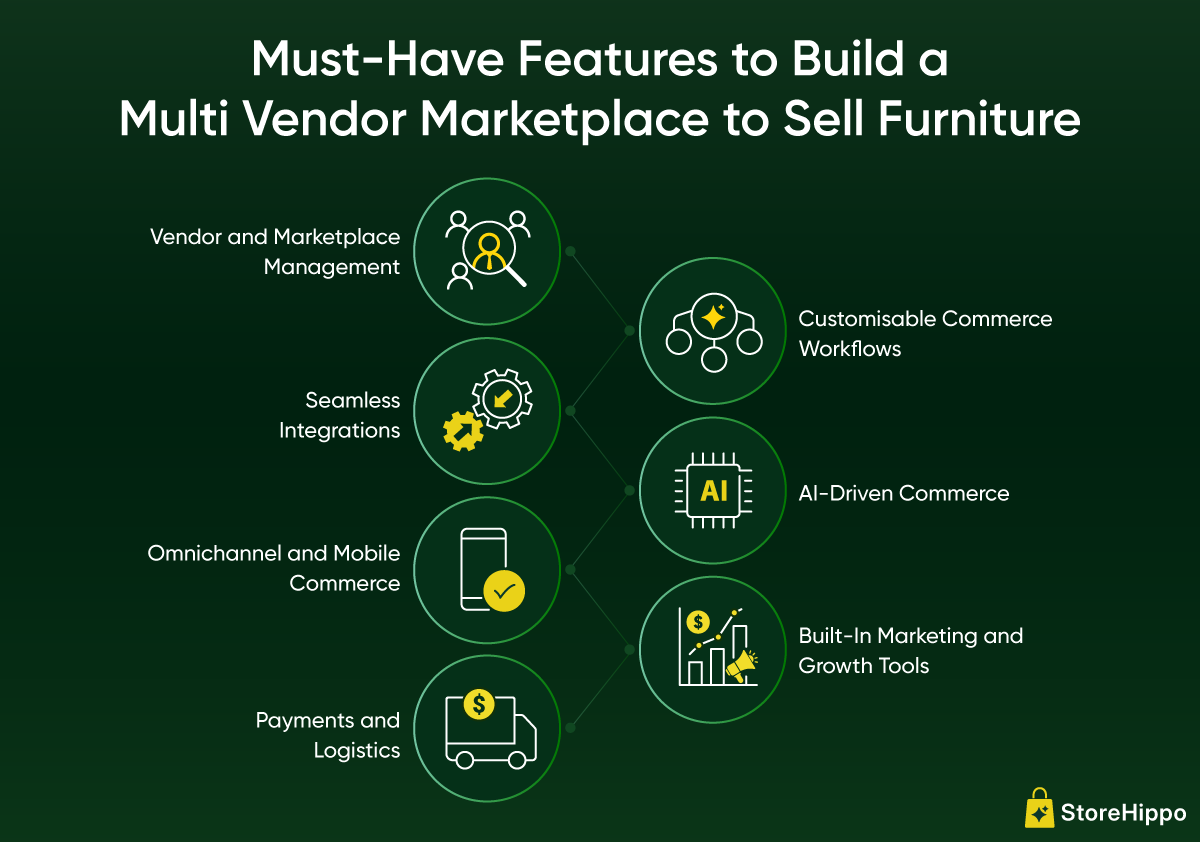
1. Vendor and Marketplace Management
StoreHippo AI-powered marketplace platform gives marketplace owners a central admin dashboard to handle sellers, products, orders, inventory and approvals. Each seller gets a dedicated vendor dashboard to manage their own catalogue and day-to-day business operations, while admins can oversee and control the entire marketplace.
StoreHippo also offers bulk catalogue uploads, seller controls and approval workflows to make it easier to manage a growing network of furniture brands and vendors.
2. Customisable Commerce Workflows
Every furniture business has its own way of handling pricing, selling and fulfilment, especially when working with multiple sellers and product categories.
StoreHippo lets enterprises customise storefronts, checkout, seller processes, pricing and fulfilment workflows to match their business needs. Its API-first architecture also makes it easier to add new capabilities as the furniture marketplace grows.
3. Seamless Integrations
As a furniture marketplace scales, it typically integrates multiple systems across payments, inventory, customer management, accounting and fulfilment. Keeping these systems connected and working together becomes increasingly essential as the seller numbers expand and transaction volumes grow.
StoreHippo comes pre-integrated with multiple payment, logistics, ERP, CRM, accounting systems and other enterprise tools. With 150+ pre-integrations and 350+ APIs, enterprises can easily connect their furniture marketplace with existing business systems and keep their operations running smoothly as they scale.
4. AI-Driven Commerce
Managing thousands of furniture listings manually can quickly become difficult, particularly when every seller provides different product details, images, specifications and information in a different format.
StoreHippo's AI-powered marketplace platform helps enterprises streamline catalogue creation. Its AI image editing tool, Magic Edit helps enterprises edit product images quickly to create cleaner, more appealing product visuals. Its AI-powered cataloguing automatically generates the right category, attributes, HSN coding, titles and descriptions directly from product images.
StoreHippo’s AI Semantic search and personalised recommendations can make product discovery more relevant, while custom AI shopping assistants can help customers find furniture based on their requirements. For example, a shopper could look for a compact three-seater sofa for a small living room within a specific budget and receive more relevant results without navigating through multiple filters.
StoreHippo also enables enterprises to create custom AI agents for buyers, sellers and internal teams, helping automate routine interactions and support marketplace operations.
5. Omnichannel and Mobile Commerce
Furniture discovery doesn't always happen on a single channel. Customers may browse on a website, check products through an app, interact on WhatsApp or continue their journey through another digital touchpoint.
StoreHippo, the best marketplace builder, enables enterprises to create omnichannel commerce experiences across webstores, Android and iOS apps, PWAs, WhatsApp commerce, voice commerce and custom AI interfaces. Enterprises can manage all these channels through one unified commerce system and keep product, pricing, inventory, order and customer information in sync across every touchpoint.
6. Built-In Marketing and Growth Tools
Launching a furniture multi vendor marketplace is just the first step. The bigger challenge is attracting customers, turning visits into sales and giving them enough reasons to come back. Businesses need the right marketing tools to keep shoppers engaged and grow repeat purchases.
StoreHippo comes with built-in marketing tools such as a discount engine, SEO capabilities, abandoned-cart recovery, personalised recommendations, loyalty programmes, push notifications, built-in blog engine, etc. These marketing tools make it easier for marketplace owners to promote festive sales, category offers, new collections and personalised deals without having to rely on several different tools.
7. Payments and Logistics
Furniture orders often involve different sellers, delivery timelines and fulfilment needs, so smooth payments and reliable delivery are essential for a multi vendor marketplace. StoreHippo supports 60+ payment gateways, including UPI, wallets, net banking and COD, giving customers multiple ways to pay.
It also connects with 30+ logistics providers, including hyperlocal partners, to help businesses manage deliveries across sellers and locations. Real-time shipment tracking keeps both sellers and customers updated on the order from dispatch to delivery.
Conclusion
India's furniture market is moving steadily towards digital-first buying, creating a strong opportunity for businesses to bring furniture brands, manufacturers and independent sellers together through online marketplaces. The success of top furniture multi vendor marketplaces shows that scale alone is not enough. Strong seller management, product discovery, fulfilment, personalised experiences, AI-commerce, mobile commerce and omnichannel commerce all contribute to a marketplace that can compete effectively.
For businesses entering this market, choosing the best marketplace builder can make the journey much easier. The right platform should handle the everyday work behind a marketplace while giving you the flexibility to add new channels, improve customer experiences and scale as your seller network and order volumes grow.
StoreHippo helps enterprises build and scale furniture marketplaces with built-in multi-vendor capabilities, AI-powered commerce, mobile-first experiences, unified operations, marketing tools and flexible integrations.
Want to build your own furniture online marketplace and bring multiple sellers onto one digital platform?
Book a demo with StoreHippo now.
FAQs
1. What should enterprises evaluate before investing in a furniture marketplace?
Enterprises should evaluate market demand, target customers, seller acquisition potential, category profitability, operational complexity, scalability and technology requirements before investing in a furniture marketplace. They should also assess the platform’s ability to support evolving business models, integrations, data-driven decision-making and future expansion. The right technology investment should align with both immediate business objectives and long-term marketplace growth.
2. How can enterprises attract quality sellers to a new furniture marketplace?
Enterprises can attract quality sellers on the newly launched furniture marketplace by offering access to new customer segments, competitive commercial terms, easy onboarding, flexible selling options and strong marketplace visibility. Exclusive partnerships, seller incentives, promotional opportunities and timely payouts can further strengthen the value proposition. A reliable multi vendor marketplace should make selling simple while giving furniture brands and manufacturers clear opportunities to grow their business.
3. How can enterprises make their furniture marketplace stand out in a crowded market?
Enterprises can make their furniture marketplace stand out by offering a clear value proposition that goes beyond price. Curated collections, exclusive brands, regional products, expert buying guidance, personalised experiences and reliable post-purchase support can create stronger differentiation. Marketers should also use customer insights to identify underserved segments and build campaigns around specific furniture needs, styles and buying occasions.
4. How can enterprises improve customer acquisition for a new multi vendor marketplace?
Enterprises can improve customer acquisition by combining SEO, paid advertising, social media, content marketing, referrals, influencer partnerships and seller-led promotions. Marketing teams should segment audiences based on interests, location and purchase intent, then personalise campaigns accordingly. Tracking customer acquisition cost, conversion rates and channel-level performance helps businesses identify the most effective acquisition strategies and optimise marketing investments.
5. How can an AI-powered marketplace platform make furniture product discovery more relevant?
An AI-powered marketplace platform can make furniture discovery more relevant by understanding customer intent, preferences and browsing behaviour. It can surface products based on factors such as style, size, budget and room requirements, while personalised recommendations help shoppers discover suitable options faster. This can improve engagement, reduce search friction and increase the likelihood of conversion.
6. How can enterprises measure the performance of a furniture marketplace?
Enterprises can measure a furniture marketplace by tracking metrics such as GMV, sales growth, conversion rate, average order value, customer acquisition cost, repeat purchases, seller activation, cancellation rates and fulfilment performance. Looking at these metrics by category, seller and customer segment can help decision-makers identify growth opportunities, improve marketing investments and address operational gaps.
7. When should a business choose a marketplace platform over a traditional ecommerce platform?
A business should choose a marketplace platform when it plans to bring multiple sellers, brands or suppliers onto one digital platform. It is particularly suitable when the business needs seller-level management, commissions, diverse product catalogues and scalable operations. A traditional ecommerce platform is generally better suited to businesses selling their own products through a single-merchant model.
8. How can enterprises prepare a furniture marketplace for expansion into new cities and categories?
Enterprises can prepare a furniture marketplace for expansion by analysing customer demand, seller availability, local competition, delivery costs and category performance in each target market. They should onboard relevant local sellers, standardise operational processes and use scalable technology to support growing catalogues and order volumes. Testing one city or category first can help validate demand before wider expansion.
9. What should enterprises look for in an AI-powered marketplace platform for long-term growth?
In an AI-powered marketplace platform, enterprises should look beyond individual AI features and evaluate whether AI is embedded across the customer and business journey. The right AI-powered marketplace platform should help teams understand customer intent, improve discovery, personalise experiences, optimise merchandising and support experimentation while remaining flexible enough to evolve as AI-commerce matures.
Binny Joseph is a seasoned ecommerce and enterprise growth leader, serving as Senior Vice President of Sales & Alliances with deep experience helping global brands adopt modern commerce solutions.
He brings a practical, market-led perspective on building scalable marketplaces and delivering seamless digital commerce experiences for both sellers and customers.