


The marketplace model has evolved from being just another ecommerce format to becoming a practical way for businesses to scale. Instead of expanding inventory, warehouses, and operations every time they want to grow, brands can bring sellers, distributors, dealers, suppliers, or service providers onto a single platform and expand their business through a connected ecosystem.
The shift makes sense from the buyer's perspective too. Customers increasingly prefer multi-vendor marketplaces because they offer more choice, better price discovery, and the convenience of finding everything they need in one place.
But building a successful multi vendor ecommerce website isn't as simple as onboarding vendors. The real challenge lies in creating an ecosystem where buyers can shop effortlessly, sellers can grow their business, and operations continue to scale without adding unnecessary complexity.
In this guide, we'll look at what it takes to build a scalable multi-vendor marketplace, the capabilities that matter most, and the strategies that help businesses create sustainable, long-term growth.
Table of Contents
- What is a Multi-Vendor Marketplace
- How Does A Multi-Vendor Marketplace Work
- How Every Stakeholder Benefits from a Multi-Vendor Marketplace
- What are the Different Types Of Multi-Vendor Marketplace Models
- Why Enterprise Brands Should Build a Multi-Vendor Marketplace
- What are The Must-Have Features In A Modern Marketplace Platform
- 1. Built for Multi-Vendor Commerce from Day One
- 2. Mobile-First Experiences Across Every Channel Sell OmniChannel
- 3. AI That Powers Growth and Efficiency Grow Faster with AI
- 4. Support For Multiple Business Models Multi Model Support
- 5. Logistics That Scale With Your Business Streamlined Logistics at Scale
- 6. Expand into New Domestic and International Markets Faster Built for Global Expansion
- 7. Easy Integrations With Your Existing Ecosystem
- 8. Enterprise-Grade Security
- 9. Built-In Marketing Tools
- 10. Scalable Architecture for Future Growth Future-Ready Scalability
- How to Launch and Scale a Multi-Vendor Marketplace in 2027
- Step 1: Choose the Right Multi-Vendor Marketplace Platform
- Step 2: Define Your Marketplace Business Model
- Step 3: Plan Your Seller Ecosystem
- Step 4: Create Your Revenue Strategy
- Step 5: Set Up Catalogue and Product Management
- Step 6: Configure Payments, Payouts, and Tax Rules
- Step 7: Create Omnichannel Mobile-First Buyer and Seller Experiences
- Step 8: Set up Logistics and Fulfilment Operations
- Step 9: Add AI-Powered Discovery and Automation
- Step 10: Launch, Optimise, and Expand
- How StoreHippo Helps Enterprises to Build a Scalable Multi-Vendor Marketplace
- Conclusion
- FAQs
What is a Multi-Vendor Marketplace
A multi-vendor marketplace is an ecommerce platform where multiple sellers, suppliers, distributors, or service providers offer products and services through a single digital storefront. Similar to a shopping mall that brings different stores under one roof, a marketplace gives customers access to a wide range of offerings in one place.
Popular examples include Amazon, eBay, and Flipkart. However, today's marketplace model has evolved far beyond consumer shopping platforms.
For enterprise brands, a marketplace is no longer just an Amazon-like selling portal. It can also function as a dealer network, distributor ecosystem, service aggregator, B2B procurement hub, D2C partner marketplace, or hyperlocal fulfilment network. Businesses can build multi-vendor marketplaces to connect multiple sellers, partners, and buyers on a single platform while centralising operations, customer experiences, and transactions.
This model enables enterprises to expand product offerings, onboard partners faster, enter new markets more efficiently, and scale without carrying all inventory themselves. The result is a scalable digital ecosystem that drives growth, extends market reach, and improves operational efficiency.
How Does A Multi-Vendor Marketplace Work
A multi-vendor marketplace connects multiple sellers with buyers through a single online platform. It manages the complete commerce journey, including seller onboarding, catalogue management, order processing, logistics, payments, and payouts, helping businesses scale efficiently while simplifying day-to-day operations.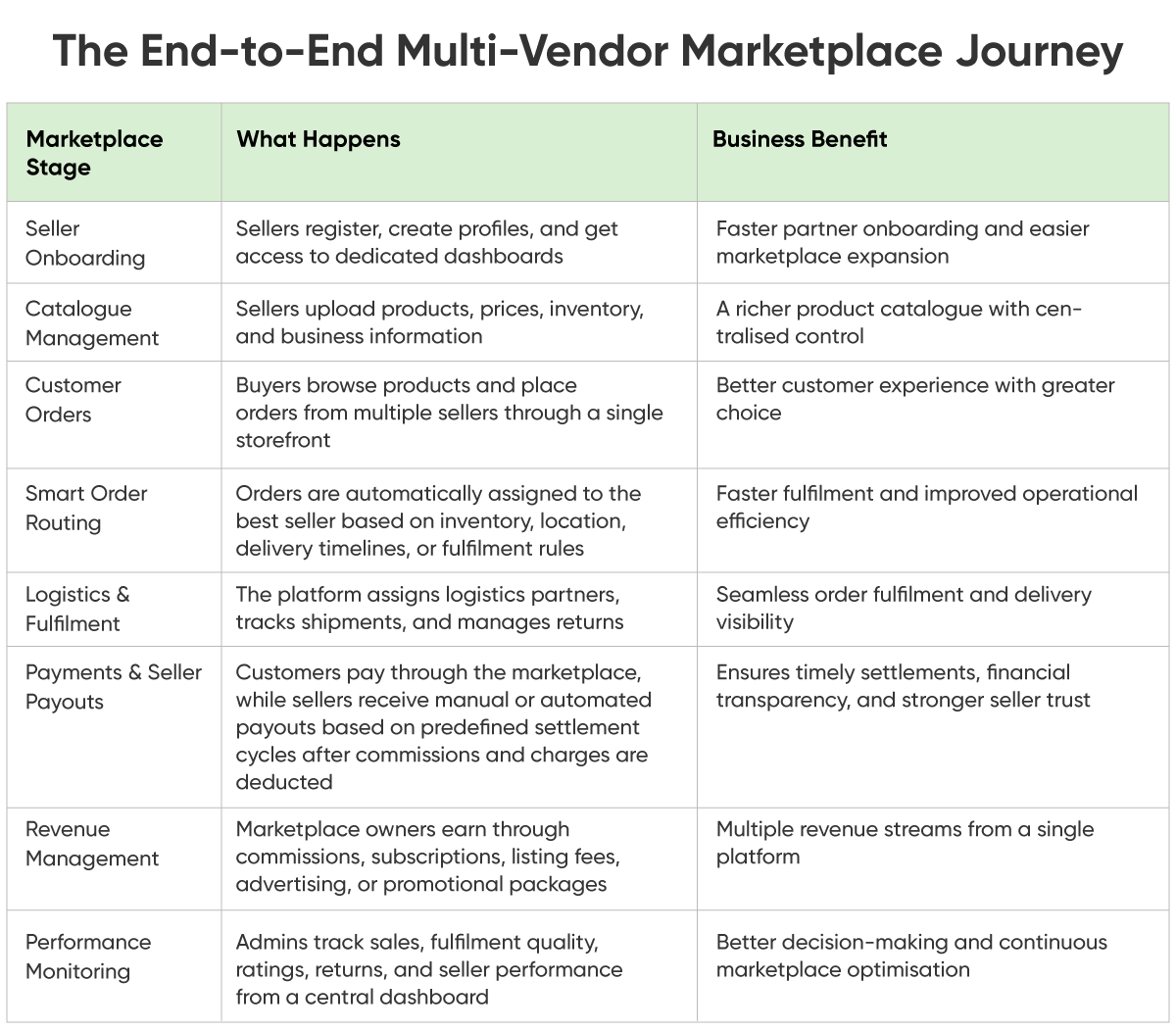
A well-designed multi-vendor marketplace simplifies every stage of the commerce journey, from onboarding sellers to fulfilling orders and managing payouts. As the business grows, these connected workflows help improve efficiency, deliver better customer experiences, and make scaling much easier.
How Every Stakeholder Benefits from a Multi-Vendor Marketplace
A successful multi-vendor marketplace creates value for everyone involved, not just the marketplace owner. Buyers enjoy greater choice and convenience, sellers gain access to new customers, and businesses build scalable revenue streams while keeping operations centralised.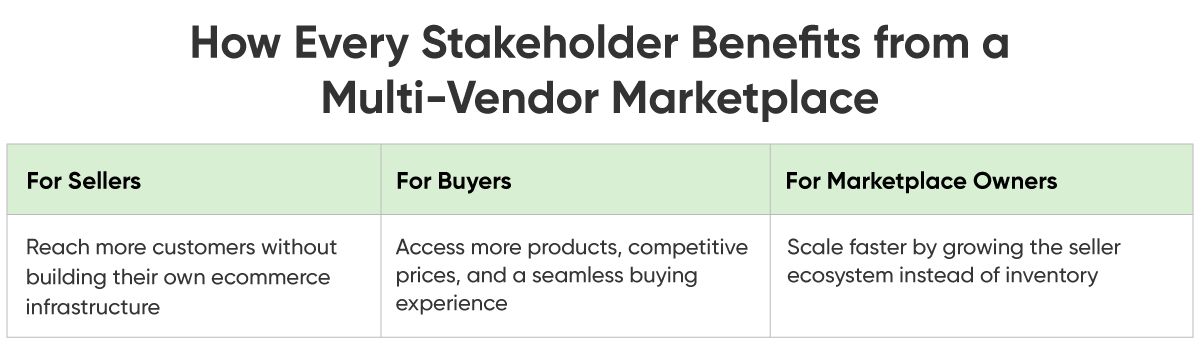
This creates a win-win ecosystem for all stakeholders. Sellers gain access to a larger customer base without building their own ecommerce infrastructure, buyers enjoy greater choice and competitive pricing, and marketplace owners can scale faster by bringing multiple buyers and sellers together on a single platform.
What are the Different Types Of Multi-Vendor Marketplace Models
The best thing about a multi-vendor store is that you can work out a variety of use cases and even come up with a disruptive model of your own. Some of the popular and time-tested use cases of a multi-seller ecommerce website are;
1. Niche Vertical Marketplace
This e-commerce setup targets a specific audience segment by offering a single niche product or service category. By creating this type of marketplace, a retailer can get the undivided attention of the target audience and create a brand value in the given category. Multi-vendor ecommerce marketplaces for beauty products, health and fitness, apparel, etc., come under this category.
Example: Nykaa, Firstcry etc.
2. Horizontal Marketplace
This setup can be used for B2B or B2C model where products and services from a variety of business verticals are sold on a single platform by multiple sellers. This setup is the most common and also the most popular form of an online marketplace. Such online shopping hubs usually enjoy very good traffic as they have something for every buyer.
Example: Amazon, Flipkart etc.
3. Service Aggregation Marketplaces (B2B2C)
This multi vendor ecommerce marketplace setup has gained much popularity of late thanks to the popular food delivery and entertainment show booking platforms. Under this multi-vendor ecommerce setup, various vendors come together on a single platform to offer products and services to a wider customer base. The business owner earns by commissions and the vendors are able to reach a wider audience base.
Example: Swiggy, Zomato, Urban Company
4. Hybrid Marketplace
A hybrid marketplace is a marketplace website that targets both B2B and B2C audiences and combines multi vendor features along with some other popular models to create a unique marketplace.
Example: A pharmacy marketplace can have two or three separate sub-stores catering to end customers(B2C), big hospitals (B2B) and end customers of big hospitals (B2B2C). Such hybrid business models give enterprise brands the opportunity to cater to a wide audience base.
5. Hyperlocal Marketplace
Hyperlocal marketplaces have become very popular in recent times as they offer quick deliveries in a short time span for customers in a small geography. Enterprise brands can build successful hyperlocal multi-vendor marketplaces by onboarding local sellers as their vendors.
Example: BigBasket, MilkBasket
6. Dealer-Powered Quick Commerce Marketplace
This marketplace setup uses an existing network of dealers, distributors, retailers, or stockists to fulfil orders quickly. Instead of storing inventory in dark stores or central warehouses, orders are routed to the nearest authorised dealer for faster delivery.
This model helps brands expand their reach, improve inventory utilisation, reduce logistics costs, and enable quick deliveries without investing in additional fulfilment infrastructure.
Example: Electronics, automotive parts, pharmaceuticals, FMCG, and building materials marketplaces.
With so many models to experiment with, the multi vendor ecommerce set-up is an ideal tool in the hands of enterprises planning to grow their business quickly and without investing too much in CapEX or inventory.
Why Enterprise Brands Should Build a Multi-Vendor Marketplace
The numbers clearly show that buyer behaviour has shifted. Customers now expect greater choice, faster fulfilment, competitive pricing, and seamless experiences without switching between multiple websites. As a result, enterprise brands are increasingly adopting multi-vendor marketplace models to meet these expectations while scaling their product assortment and ecosystem more efficiently.
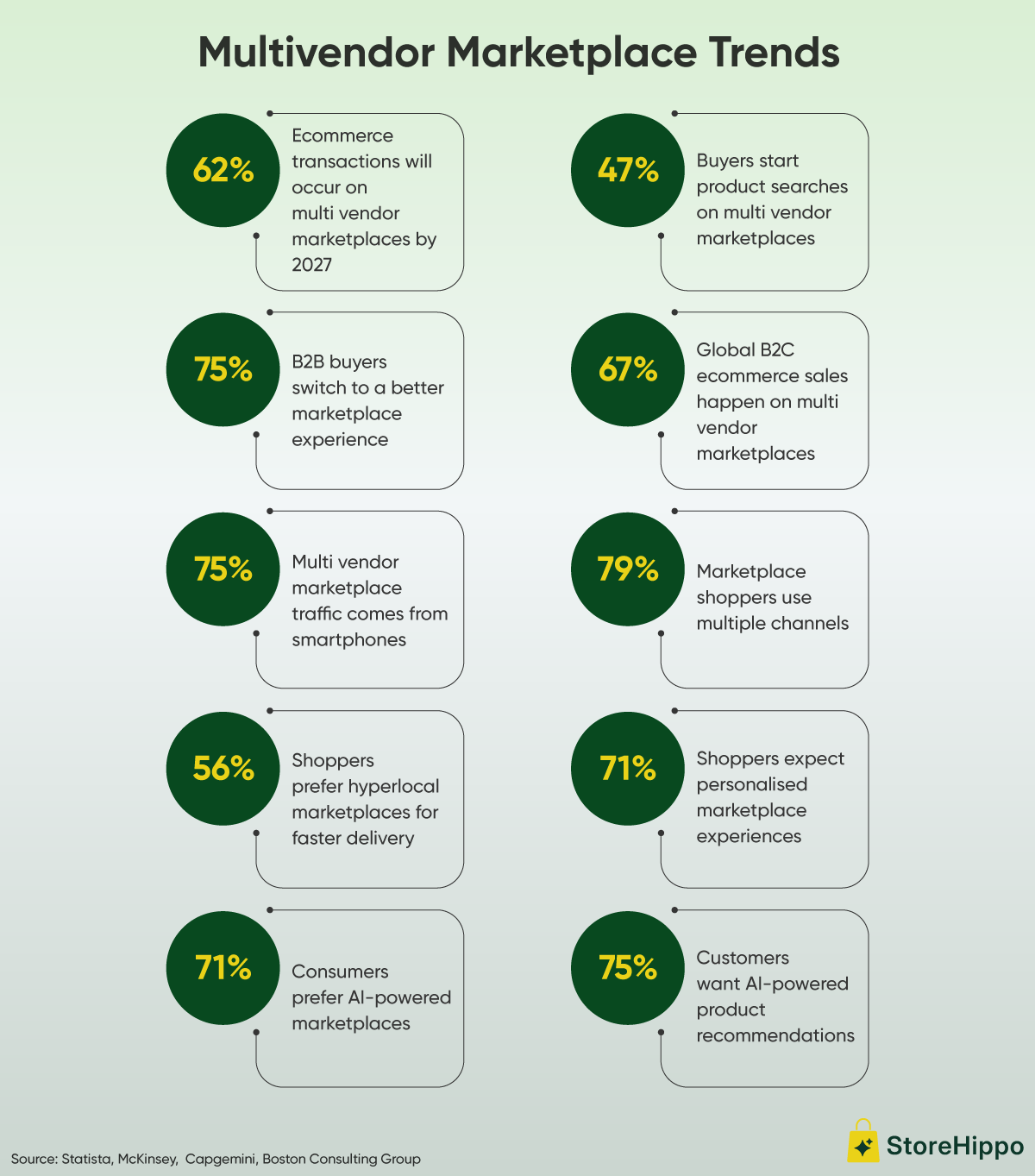
- 62% of ecommerce transactions will occur on multi vendor marketplaces by 2027
- 47% of buyers start product searches on multi vendor marketplaces
- 75% of B2B buyers switch to a better marketplace experience
- 67% of global B2C ecommerce sales happen on multi vendor marketplaces
- 75% of multi vendor marketplace traffic comes from smartphones
- 79% of marketplace shoppers use multiple channels
- 56% of shoppers prefer hyperlocal marketplaces for faster delivery
- 71% of shoppers expect personalised marketplace experiences
- 71% of consumers prefer AI-powered marketplaces
- 75% of customers want AI-powered product recommendations
Source: Statista, McKinsey, Capgemini, Boston Consulting Group
Multi-vendor marketplace has rapidly become the preferred model for digital commerce growth. However, success in this space depends on much more than simply bringing multiple sellers onto a single platform.
The growing adoption of multi-vendor marketplaces reflects a broader shift in digital commerce. As competition increases, enterprise brands need ecommerce platforms that can support faster vendor onboarding, intelligent automation, omnichannel experiences, and scalable operations while maintaining a seamless experience for both buyers and sellers.
What are The Must-Have Features In A Modern Marketplace Platform
Choosing the right marketplace platform is one of the most important decisions you will make. The features built into your platform determine how easily you can onboard sellers, manage operations, deliver great buyer experiences, and scale your multi vendor ecommerce website as it grows.
Here are the must-have features to look for in a modern marketplace platform.
1. Built for Multi-Vendor Commerce from Day One
As seller numbers grow, managing onboarding, catalogues, commissions, and orders can quickly become complex. An enterprise ecommerce platform built specifically for multi-vendor commerce keeps these processes centralised and streamlined, making it easier to onboard new sellers, maintain operational visibility, and scale without creating additional administrative overhead.
2. Mobile-First Experiences Across Every Channel Sell OmniChannel
Buyers and sellers increasingly expect to interact with marketplaces on the go. Whether they are browsing products, placing orders, managing inventory, or responding to enquiries, the experience should remain consistent across websites, mobile apps, and conversational touchpoints. A mobile-first approach helps marketplaces stay accessible wherever business happens.
3. AI That Powers Growth and Efficiency Grow Faster with AI
As marketplaces expand, managing large catalogues and delivering relevant buying experiences becomes more challenging. Intelligent automation helps simplify routine tasks, improve product discovery, and make shopping journeys more relevant for buyers. This enables teams to operate more efficiently while helping customers find what they need faster.
4. Support For Multiple Business Models Multi Model Support
Marketplace businesses often evolve over time. A platform that only supports one business model can limit future opportunities. Whether you plan to serve businesses, consumers, dealers, distributors, or a combination of segments, the platform should provide the flexibility to support new business models without requiring a major technology overhaul.
5. Logistics That Scale With Your Business Streamlined Logistics at Scale
Operational complexity tends to increase with every new seller, customer, and order. Managing fulfilment, shipping partners, delivery tracking, returns, and order routing from a single system helps maintain efficiency as volumes grow. Strong logistics capabilities ensure operational scalability without compromising the customer experience.
6. Expand into New Domestic and International Markets Faster Built for Global Expansion
Reaching new markets requires more than launching a new storefront. Different regions often have unique languages, currencies, and operational requirements. A multi vendor ecommerce marketplace platform should make expansion easier by supporting localised buying experiences, helping businesses enter and manage multiple markets without creating disconnected operations.
7. Easy Integrations With Your Existing Ecosystem
Marketplace success depends on how well different business systems work together. From ERP and CRM to payment gateways, logistics providers, and accounting tools, seamless integrations help eliminate manual processes, improve data accuracy, and ensure teams can operate efficiently across the entire business.
8. Enterprise-Grade Security
Multi vendor ecommerce websites handle large volumes of customer, seller, transaction, and business data every day. Strong security measures are essential for protecting sensitive information, maintaining trust, and reducing operational risk. As the marketplace grows, security should remain a built-in foundation rather than an afterthought.
9. Built-In Marketing Tools
Attracting buyers and supporting seller growth requires ongoing visibility and engagement. Built-in marketing capabilities help marketplace operators run promotions, improve discoverability, encourage repeat purchases, and support seller success without relying heavily on external tools or fragmented marketing workflows.
10. Scalable Architecture for Future Growth Future-Ready Scalability
Multi vendor ecommerce marketplace growth can bring sudden increases in traffic, sellers, products, and transactions. The underlying platform should be able to accommodate this growth without performance bottlenecks or costly replatforming projects. A scalable architecture provides the flexibility to support both current requirements and future expansion plans.
How to Launch and Scale a Multi-Vendor Marketplace in 2027
Launching a successful marketplace requires more than onboarding sellers and listing products. Here are 10 steps to build a multi vendor marketplace that delivers value to buyers, sellers, and your business:
Step 1: Choose the Right Multi-Vendor Marketplace Platform
The first step to launch a scalable multi-vendor marketplace is to choose the right enterprise ecommerce platform that makes scaling easier as your marketplace grows. The platform you choose will shape how easily you can launch, manage, and grow your marketplace. Look for an ecommerce solution that offers built-in support for multi-vendor operations, mobile commerce, automation, integrations, and evolving business needs.
Step 2: Define Your Marketplace Business Model
The next step is to define the business model of the marketplace you want to build. This is the stage you need to decide whether you want to build a B2B marketplace, B2C marketplace, dealer network, hyperlocal platform, or a hybrid business model. A clear business model helps you define your target audience, seller ecosystem, revenue strategy, and long-term growth plans.
Step 3: Plan Your Seller Ecosystem
Your multi-vendor marketplace can only succeed if you have sellers from the beginning. It helps you offer more products, maintain competitive prices, and deliver a better shopping experience for buyers. Identify the suppliers, brands, distributors, dealers, or service providers you want to onboard and create a clear plan to bring them on board.
Step 4: Create Your Revenue Strategy
Planning your revenue strategy before launch is a major step in building a successful multi vendor ecommerce website. Decide whether you want to earn through commissions, subscriptions, listing fees, transaction charges, or value-added services. A clear revenue model from the start helps create a sustainable marketplace that can support long-term growth.
Step 5: Set Up Catalogue and Product Management
As more sellers join your marketplace, product information can quickly become difficult to manage. Create a structured catalogue with clear categories, filters, attributes, and seller-specific listings. A well-organised catalogue improves product discovery for buyers and makes catalogue management easier for sellers.
Step 6: Configure Payments, Payouts, and Tax Rules
After the catalogue settlement, the next step is to set up payments, taxes, invoicing, and seller payouts. Integrate your Multi vendor ecommerce website with trusted payment gateways and automate settlement processes to ensure smooth transactions for buyers and timely payments for sellers. Having these systems in place from day one helps create a seamless and reliable marketplace experience.
Step 7: Create Omnichannel Mobile-First Buyer and Seller Experiences
Modern buyers and sellers expect the flexibility to engage with your multi vendor marketplace from anywhere, anytime. Launch responsive storefronts and mobile apps that make it easy for buyers to browse and purchase products while enabling sellers to manage orders, inventory, and business operations on the go.
Step 8: Set up Logistics and Fulfilment Operations
Reliable logistics is essential for the success of any multi vendor marketplace. Before launching, decide how orders will be processed, fulfilled, shipped, tracked, and returned across your platform. Build fulfilment strategy and partner with trusted logistics providers for faster deliveries, smoother operations, better customer experiences, and support marketplace growth as order volumes increase.
Step 9: Add AI-Powered Discovery and Automation
As your Multi vendor marketplace grows with more sellers, products, orders, and customers, managing everything manually becomes difficult. AI and automation can help simplify everyday tasks such as product management, seller onboarding, customer support, and product recommendations. This helps buyers find the right products faster, reduces manual work for your team, and makes it easier to scale your marketplace efficiently.
Step 10: Launch, Optimise, and Expand
Once your marketplace goes live, focus on continuous improvement. Track buyer behaviour, seller performance, operational efficiency, and business growth to identify opportunities for optimisation. Successful marketplaces continuously refine their operations, onboard new sellers, expand into new markets, and introduce new revenue opportunities.
How StoreHippo Helps Enterprises to Build a Scalable Multi-Vendor Marketplace
To build a future-ready and scalable multi-vendor marketplace, enterprises need a flexible, scalable, and robust multivendor marketplace platform that can simplify operations, onboard sellers efficiently, deliver seamless buyer experiences, and support evolving business models.
StoreHippo comes with 300+ enterprise-grade features, 350+ API endpoints, and 150+ pre-integrated business solutions to help enterprises launch, manage, and scale multi-vendor marketplaces faster.
Here are 10 key capabilities that make StoreHippo a preferred marketplace platform for modern enterprises:
1. Built-In Multi Vendor Marketplace Solution
StoreHippo comes with built-in multi-vendor ecommerce capabilities that help enterprises launch and manage marketplaces without relying on extensive custom development or third-party plugins.
2. Vendor and Admin Dashboards
StoreHippo offers a separate dashboard for each vendor to manage catalogues, prices, orders, shipments, etc independently. Admins can oversee and manage the vendors' activities from central admin access.
3. Unified Master Catalogue
With StoreHippo, enterprises can create a unified master catalogue that brings together listings from multiple sellers, ensuring consistent product information and simplified catalogue management across the marketplace.
4. AI-Powered Core
StoreHippo's AI powered ecommerce platform helps businesses automate catalogue management, deliver personalised product discovery, and offer intelligent recommendations. It also enables enterprises to build custom chatbots to offer conversational buying journeys that make shopping faster, more relevant, and more engaging.
5. Built-In Mobile App Builder
StoreHippo comes with a built-in no-code mobile app builder, which enables enterprises to launch Android and iOS apps for their multi vendor ecommerce website without any coding or technical requirements. Enterprises can directly create apps from the admin dashboard while delivering a seamless omnichannel shopping experience across web, app, PWA, AI chat interfaces, social and other emerging channels from a single platform.
6. Multi-Model Support
StoreHippo natively support diverse business models including B2B, B2C, D2C, B2B2C, hyperlocal, quick commerce, etc. Enterprises can launch and run multiple business models from the same backend logic.
7. Global Commerce Ready
StoreHippo Multi vendor ecommerce platform come natively with global commerce features to help businesses expand into international markets. It supports 100+ languages, multicurrency payment, pre-integrated international payment gateways and shipping solutions to deliver localised shopping experiences tailored to different regions, languages, and customer segments.
8. Integrated Logistics Solutions
StoreHippo simplifies logistics management by integrating with multiple logistics providers, enabling businesses to automate shipping, track orders in real time, and streamline fulfilment operations.
9. Enterprise-Grade Security
StoreHippo is certified with ISO and SOC standards and is a PCI DSS-compliant platform, ensuring secure transactions, robust data protection, regulatory compliance, and reliable marketplace operations for enterprises.
10. Seamless Integrations
StoreHippo's headless and API-first architecture enables businesses to build customised multi-vendor marketplaces and integrate seamlessly with ERP, CRM, payment, logistics, and other business systems, ensuring the flexibility to adapt and scale with evolving business needs.
Conclusion
A multi-vendor marketplace can help your business expand faster, offer greater choice to customers, and unlock new revenue opportunities without the burden of managing all inventory yourself. Whether you are building a B2B marketplace, dealer network, hyperlocal platform, or service marketplace, the right platform can make scaling much easier.
All you need is a future-ready multi vendor ecommerce platform like StoreHippo to power your growth. With built-in multi-vendor capabilities, mobile-first commerce, AI-powered automation, and enterprise-grade scalability, StoreHippo helps you launch and grow your marketplace with confidence.
Ready to launch your marketplace?
Discover how to build and scale a future-ready multi-vendor marketplace with StoreHippo. Book your free demo now.
FAQs
1. How does a multi-vendor marketplace make money?
A multi-vendor marketplace can earn through seller commissions, subscription fees, listing fees, promoted product placements, advertising, logistics partnerships, premium memberships, and value-added services. The right revenue model depends on the marketplace category, seller base, buyer behaviour, and transaction volume.
2. How can AI improve the performance of a multi-vendor marketplace?
AI improves the performance of a multi-vendor marketplace by automating catalogue management, enhancing product discovery, delivering personalised recommendations, and streamlining buyer and seller interactions. It also helps optimise operations, improve search relevance, increase conversions, and create more engaging shopping experiences, enabling marketplaces to scale efficiently while serving diverse customer and vendor needs.
3. Can one multi vendor marketplace support B2B, B2C, D2C, and B2B2C models?
Yes, a modern multi-vendor marketplace can support B2B, B2C, D2C, and B2B2C business models on a single platform. By enabling flexible pricing, customised storefronts, role-based access, diverse buyer journeys, and centralised operations, businesses can serve multiple customer segments while managing all commerce activities from one unified system.
4. What features should a multi vendor ecommerce platform have?
A multi vendor marketplace platform should offer built-in vendor management, commission rules, payout management, AI-powered tools, omnichannel support, APIs connector, headless flexibility, multi-store support, multilingual commerce, multi-currency payments, logistics integrations, analytics, security, and support for different business models.
5. How is a dealer-powered quick commerce marketplace different from a dark-store model?
A dealer-powered quick commerce marketplace uses existing dealers, retailers, or distributors to fulfil orders instead of building dark stores. This helps brands expand faster, reduce infrastructure costs, improve local inventory utilisation, and reach more locations efficiently through an established dealer and distributor network.
Binny Joseph is a seasoned ecommerce and enterprise growth leader, serving as Senior Vice President of Sales & Alliances with deep experience helping global brands adopt modern commerce solutions. He writes from hands-on experience, helping businesses understand what it takes to build, scale, and grow successful enterprise multi vendor marketplaces.