


Omnichannel is no longer a growth driver; it’s the baseline expectation.
Customers no longer engage in isolated channels; they expect a connected experience across every touchpoint, whether it’s the web, mobile apps, marketplaces, chat platforms, or offline interactions.
For enterprises, this shift changes how commerce is built and scaled.
Omnichannel ecommerce is no longer about being present across channels. It is about ensuring every interaction connects, continues, and contributes to a single, unified journey. When experiences are fragmented, growth slows. When they are connected, operations become more efficient, and conversions improve.
This shift from channels to journeys is what defines enterprise ecommerce success in 2026.
Table of Contents
- How Omnichannel Ecommerce Has Become the Key Growth Driver for Enterprises
- 10 Ways Omnichannel Ecommerce has Transformed from Channels to Journeys
- 1. Unified Customer Journeys Across Channels
- 2. Seamless Channel Switching Without Context Loss
- 3. Build a Unified, Real-Time View of Customers
- 4. Shift From Channel Metrics to Journey Insights
- 5. Deliver Consistent Pricing, Inventory, and Messaging Everywhere
- 6. Streamlined Journeys Through a Unified Backend
- 7. Use AI to Personalise the Entire Journey
- 10. Move from Transactional Commerce to Relationship-Led Growth
- Why StoreHippo Omnichannel Ecommerce Solutions Are the Best Choice for Scalable Multi-Channel Growth
- Conclusion
How Omnichannel Ecommerce Has Become the Key Growth Driver for Enterprises
Enterprise commerce has fundamentally shifted from isolated transactions to connected journeys.
Buyers today don’t follow a linear path. They discover products on marketplaces, validate options on brand websites, interact via chat or sales teams, and complete purchases across different channels. This transformation has turned omnichannel ecommerce into a core growth driver.
Enterprises that deliver seamless journeys across touchpoints see measurable gains in engagement, retention, and revenue. Let's see the latest omnichannel trends validating this shift.
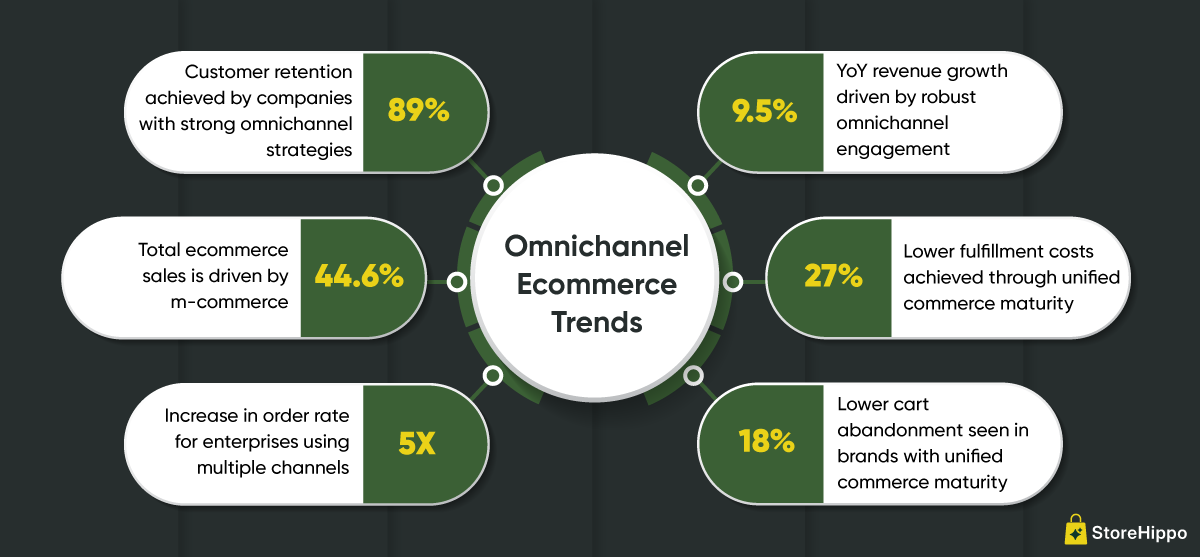
- 89% customer retention achieved by companies having strong omnichannel strategies
- 5X increase in order rate for enterprises using multiple channels
- 9.5% YoY revenue growth registered by companies with strong omnichannel engagement
- 27% lower fulfilment costs and 18% lower cart abandonment are reported by brands reaching “Unified Commerce” maturity
- 44.6% of total ecommerce sales is driven by m-commerce
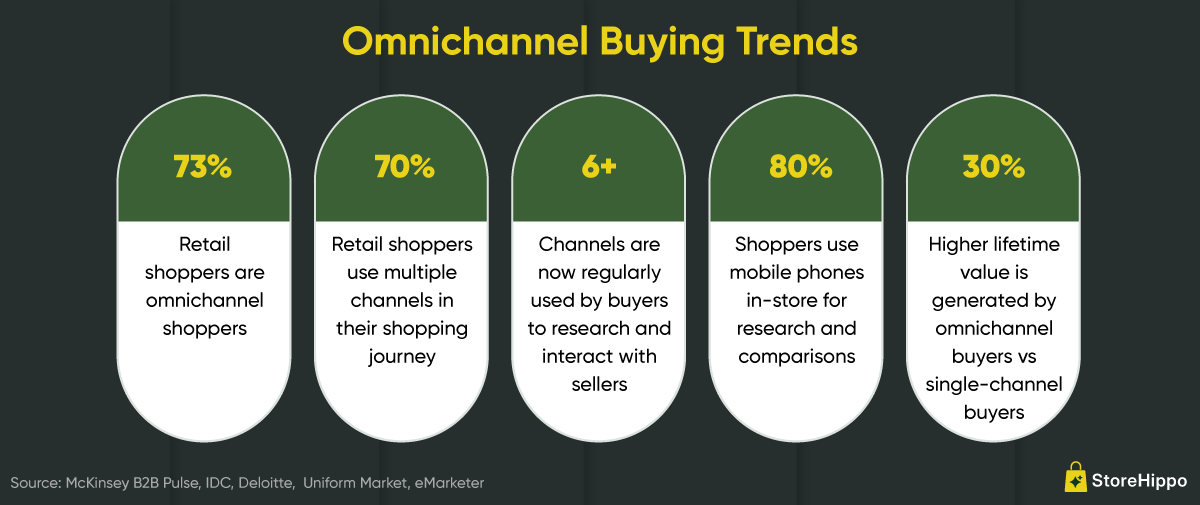
- 73% of retail shoppers are omnichannel shoppers
- 70% of retail shoppers use multiple channels in their shopping journey
- 6+ channels are now regularly used by buyers to research and interact with sellers
- 80% shoppers use mobile phones in-store for research and comparisons
- 30% higher lifetime value is generated by omnichannel buyers vs single-channel buyers
Source: McKinsey B2B Pulse, IDC, Deloitte, Uniform Market, eMarketer
The data points to a clear shift: ecommerce growth is now driven by continuity, not channels. Customers today expect a single, uninterrupted journey across mobile, web, marketplaces, social and emerging sales channels.
Enterprises that connect all their channels consistently perform better in retention, revenue, and efficiency. The real advantage today lies in removing friction between channels and creating one smooth, connected shopping experience.
10 Ways Omnichannel Ecommerce has Transformed from Channels to Journeys
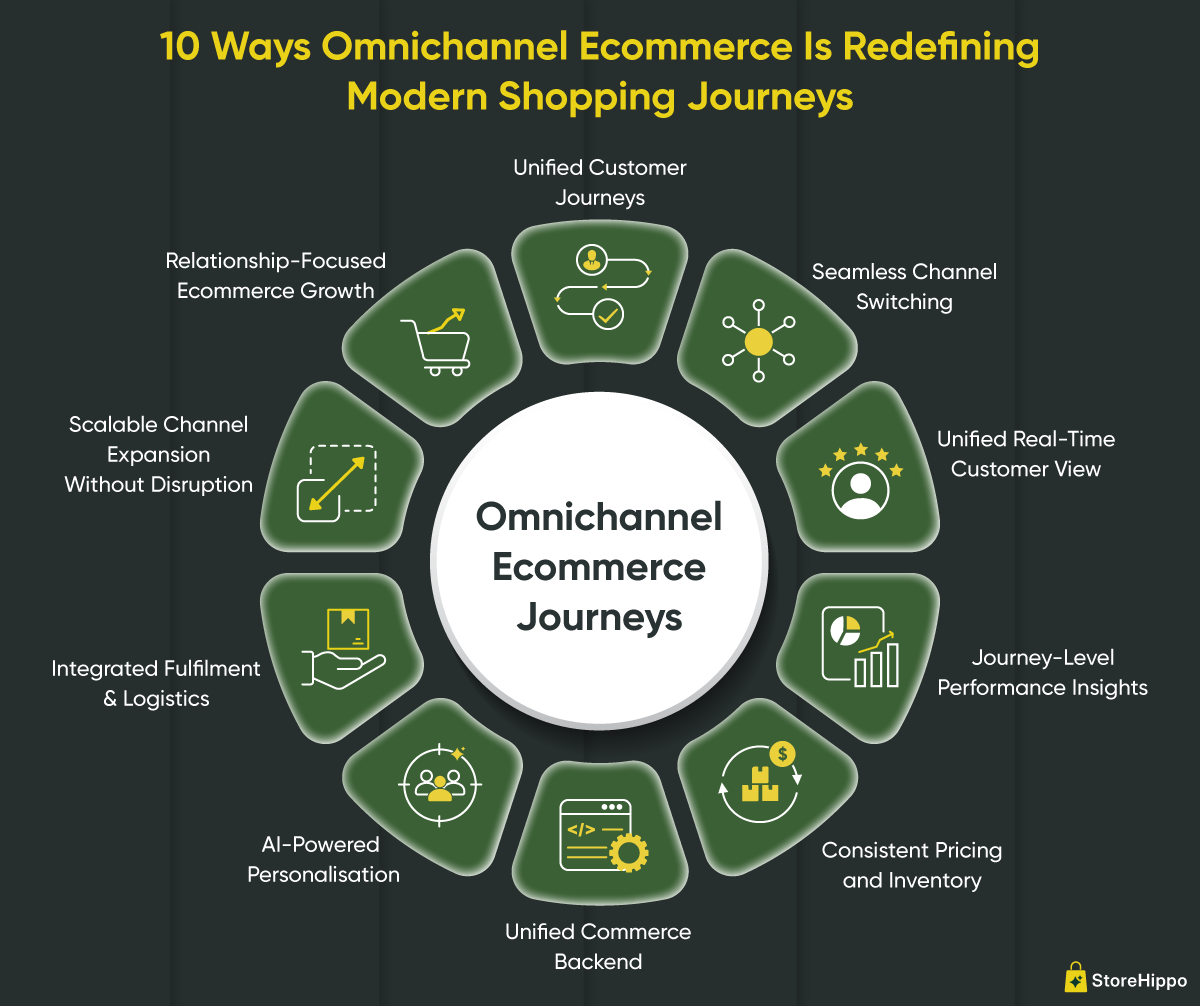
These shifts clearly show that omnichannel ecommerce is no longer about managing channels, it is about designing and delivering connected customer journeys. Here’s how this transformation is reshaping enterprise growth:
1. Unified Customer Journeys Across Channels
Omnichannel is no longer about presence; it’s about continuity. Enterprises must ensure that discovery, engagement, and purchase flow seamlessly across touchpoints without fragmentation.
Now, enterprises can no longer treat websites, mobile apps, marketplaces, WhatsApp, social and conversational sales channels as separate touchpoints. Instead, every interaction must connect to form a single, continuous journey. When a customer discovers a product on a marketplace, explores it on a brand website, and completes the purchase via mobile or assisted channels, the experience should feel uninterrupted.
For example, a B2B buyer discovers a heavy machinery part on a third-party marketplace. They use a QR code to jump to the Brand’s Portal, where their negotiated corporate discount is automatically applied. They eventually finish their purchase on WhatsApp after further doing some inquiries about delivery timelines, etc.
2. Seamless Channel Switching Without Context Loss
Omnichannel ecommerce has moved from interacting with customers across multiple channels to how to interact with customers across channels. As modern buyers switch between devices and channels multiple times before making a decision, their journey must continue without resets or repeated inputs.
When systems are disconnected, customers are forced to repeat steps or re-enter information, which leads to frustration and drop-offs. An enterprise ecommerce platform with true omnichannel capabilities ensures that customer context stays consistent across every interaction by synchronising customer data in real time. From browsing activity and preferences to past interactions and purchase history, every action is updated across channels in real time, enabling enterprises to deliver a smooth and continuous customer journey.
For instance, A fashion retailer’s customer adds a dress to their cart on the Mobile App while commuting. Later, they call customer support to ask about delivery timelines. The agent sees the "Live Cart" immediately and offers a matching accessory and discount code.
3. Build a Unified, Real-Time View of Customers
When customer data is scattered across channels in an omnichannel ecommerce setup, it creates gaps in the customer experience, leading to missed opportunities and slower growth. Enterprises need synchronised customer data across all channels so every interaction is captured, connected, and accessible in a single unified view.
This shared visibility ensures every interaction is informed and relevant, enabling teams to respond faster and improve conversion possibilities. Instead of working with fragmented data, marketing, sales, and support teams can act on the same real-time insights, leading to quicker decisions, more relevant communication, and better customer experiences.
For example, a B2B electronics distributor notices that a retailer has been browsing bulk pricing on its website, downloading product catalogues, and later enquiring via WhatsApp. When the sales team connects, they already have full visibility into the retailer’s interests and can immediately offer a tailored bulk deal.
4. Shift From Channel Metrics to Journey Insights
Channel-specific metrics like website traffic or app conversions only reflect fragmented performance. What matters for modern omnichannel selling now is understanding how customers discover products, evaluate options, switch between channels, and place orders.
An enterprise ecommerce platform with a true omnichannel business model enables enterprises to move beyond isolated channel tracking to end-to-end journey visibility. This shift helps businesses identify real friction points and optimise the complete journey, leading to more consistent and higher conversions.
For example, an automotive ecommerce enterprise brand gets strong traffic on its website but low conversions. By tracking insights, they analyse that customers discover products on marketplaces, visit the website to review details, and then drop off due to unclear delivery timelines. By fixing this gap, the brand improves conversions across the entire journey, not just one channel.
5. Deliver Consistent Pricing, Inventory, and Messaging Everywhere
As omnichannel ecommerce shifts from managing channels to managing journeys, consistency becomes critical at every step of the customer experience. As customers now move across channels, what they see across these touchpoints must remain aligned throughout the journey.
Enterprises running multiple channels on disconnected systems often face gaps in pricing, offers, stock availability, or messaging. These inconsistencies create confusion and disrupt the buying flow. Modern omnichannel ecommerce solutions for enterprises address this by synchronising data across all channels in real time, ensuring customers receive accurate and consistent information everywhere they engage.
For example, a customer discovers a laptop offer on a brand’s Instagram page, compares specifications on the website, and later visits the offline store to place the order. Since pricing, discounts, and inventory are synced across all channels, the customer experiences the same information everywhere without any confusion or mismatch. Since pricing, discounts, and inventory are synced across all channels, the customer experiences the same information everywhere without any confusion or mismatch.
6. Streamlined Journeys Through a Unified Backend
Modern omnichannel ecommerce is no longer just about connecting customer-facing channels. Enterprises also need their backend systems to work together as one connected system. Inventory, orders, fulfilment, and customer data should stay in sync across every touchpoint to support uninterrupted customer journeys.
When backend systems are disconnected, it leads to delays, extra manual work, and inconsistent information across channels. An omnichannel commerce platform with a unified backend ensures that every channel works from the same real-time data, enabling faster operations and better visibility across the business.
For example, a furniture brand receives orders from its Website, Marketplace App, and multi-location stores. When a customer places an order, the system instantly checks stock, assigns the nearest fulfilment centre, and updates tracking details across all channels in real time.
This helps businesses operate faster, stay organised, and deliver a more consistent customer experience.
7. Use AI to Personalise the Entire Journey
Personalisation can’t be limited to a single channel anymore. It needs to work across the entire customer journey.
Earlier, businesses focused on showing basic product recommendations. But today, customers move across channels, and their expectations change as they go. A disconnected experience feels irrelevant and often gets ignored.
In this era where ecommerce is ruled by AI, enterprises need an omnichannel ecommerce platform with built-in AI tools to make every step of the journey more relevant.
AI-powered omnichannel ecommerce solutions help businesses deliver smarter product discovery, more accurate search, and personalised recommendations based on customer behaviour across channels. This enables enterprises to improve product discovery, increase engagement, and guide customers more effectively towards conversion.
For example, a skincare D2C brand built on an AI-powered ecommerce platform can easily detect that a customer is repeatedly viewing anti-ageing products on the Mobile App. When the customer later visits the website and interacts with the AI assistant, it automatically suggests relevant product bundles and tailored recommendations based on their past behaviour.
8. Aligned Fulfilment and Logistics with Omnichannel Expectations
Omnichannel journeys don’t end at checkout. Today, customers expect fast, flexible, and transparent delivery, along with real-time order updates across every channel.
When fulfilment systems are not connected, it often leads to delays, stock mismatches, and inconsistent delivery experiences. Modern omnichannel ecommerce solutions solve this by connecting warehouses, stores, and logistics partners into one system, so orders move smoothly from placement to delivery without gaps. This makes fulfilment faster, operations more efficient, and the overall experience more reliable for customers.
For example, a grocery retailer receives an urgent order through WhatsApp. Instead of shipping it from a central warehouse, the system automatically routes it to the nearest store, ensuring faster delivery and live order tracking for the customer.
9. Scale New Channels Without Disrupting Existing Journeys
As enterprises expand across new digital channels, the focus is no longer just on adding more touchpoints. Businesses must ensure that every new channel connects seamlessly into the existing customer journey.
Traditional ecommerce systems often create silos whenever new channels are added, leading to disconnected experiences and operational complexity. Modern omnichannel ecommerce solutions for enterprise solve this issue through flexible, API-first architectures that connect all channels to the same backend.
For example, a fashion brand with a website wants to expand its business by pivoting to the quick commerce model and social commerce to drive more traffic during the festive season. If they choose an ecommerce platform that supports quick commerce and social commerce channels like WhatsApp from the same backend, customers continue to see the same pricing, loyalty benefits, and inventory availability across every touchpoint. This allows enterprises to scale faster while maintaining continuity and consistency across the customer journey.
10. Move from Transactional Commerce to Relationship-Led Growth
Omnichannel ecommerce is no longer just about completing a sale. It is about building lasting relationships with customers even after they buy.
Enterprises can’t treat a purchase as the final step anymore. The real value comes from staying connected with customers through useful updates, personalised offers, and timely support across channels. Modern omnichannel ecommerce solutions make this possible by keeping customer data connected, so every interaction feels relevant and continuous.
For example, after buying fitness equipment from a brand’s Website, the customer keeps receiving helpful workout tips, related product suggestions, and maintenance reminders through the app and email. The brand stays connected with the customer long after the purchase.
This helps businesses build trust, encourage repeat purchases, and grow stronger customer relationships over time.
Why StoreHippo Omnichannel Ecommerce Solutions Are the Best Choice for Scalable Multi-Channel Growth
As enterprises move toward journey-based commerce, they need an ecommerce platform that unifies operations across every touchpoint. StoreHippo enables this by bringing inventory, pricing, orders, customer data, and workflows into a single backend across web, mobile apps, marketplaces, WhatsApp, and social channels.
Built on a MACH and API-first headless architecture, StoreHippo enables enterprises to build new touchpoints using the same backend logic. StoreHippo is natively built to support multiple business models. Enterprises can pivot to new channels, regions, and business models like B2B, D2C, B2B2C, multi store and multivendor marketplaces, and manage them from a unified dashboard without breaking existing customer journeys.
StoreHipo is an AI native ecommerce platform where every core operation is powered by AI. Its AI tools help improve product discovery, search, enhance products’ images, automate catalogue generation, etc, enabling more relevant and efficient customer experiences across channels. Enterprises can manage, monitor and act on conversations across all channels from a built in, context-aware, unified conversation dashboard.
Enterprises can also build custom AI bots for buyers, sellers, and support teams to resolve queries and streamline interactions while enabling conversational commerce, assisted buying, and automated support across the entire customer journey.
StoreHippo is built on a PCI DSS-compliant architecture and is backed by globally recognised ISO and SOC certifications, ensuring enterprise-grade data protection, secure transactions, and compliance-ready operations at scale.
StoreHippo also offers native multilingual support, built-in no-code mobile apps builder, PWA, GST-compliance, and seamless integrations with ERP, payment, and logistics systems, making it enterprise-ready for both India and global markets.
With unified control, 300+ native features, 150+ pre-integrations, an AI-powered core, and scalable architecture, StoreHippo helps enterprises deliver consistent omnichannel journeys while growing without operational complexity.
Conclusion
Omnichannel ecommerce has moved from managing channels to delivering connected customer journeys. Enterprises today need to ensure continuity across every interaction, from discovery to post-purchase engagement.
Growth now depends on unifying operations, synchronising data, and delivering consistent experiences across all touchpoints. Businesses that adopt this journey-led approach can reduce friction, improve engagement, and build long-term customer relationships.
With the right enterprise ecommerce platform and AI-powered capabilities, enterprises can scale efficiently without complexity.
Ready to transform your commerce strategy?
Explore StoreHippo's omnichannel ecommerce solutions for seamless, scalable customer journeys. Book your free demo now.