


In 2025, digital commerce changed faster than anyone predicted, led by the rapid, often chaotic, adoption of AI for ecommerce. Ecommerce trends were not only evolving, they were redefining the rules of speed, scale, and customer experience.
But 2026 brings a different kind of shift.
This year isn’t about experimenting with AI; it’s about rebuilding the digital foundation so enterprises can operate with intelligence at the core. The ecommerce trends for 2026 signal a turning point where large brands aiming for accelerated growth need an all-round strategic shift, one that makes their processes automated, their systems agile, and their decisions data-driven. Channel-specific fixes and fragmented workflows must give way to intelligence woven into every layer of ecommerce.
For enterprise leaders, this is the moment to redefine what enterprise ecommerce for large brands should be: multi-model, AI-native, composable, and capable of real-time orchestration across products, channels, and customer journeys.
The winners will be the ones who treat AI not as an add-on, but as the operating engine behind search, personalisation, fulfilment, and growth. Together, these signals point to ten transformative trends that will shape how enterprises build, scale, and lead in 2026.
Table of Contents
- Ecommerce Trends To Guide Enterprise Brands in 2026
- The 10 Ecommerce Trends Every Large Brand Must Act On in 2026
- 1. Agentic AI Becomes the Core Operating Layer
- 2. Hyper-Personalised Shopping Powered by AI Agents
- 3. Mobile-Channel Becomes the Revenue Engine
- 4. Multi-Model Brands are Norm
- 5. GTM Speed Becomes Strategic Differentiator
- 6. B2B Promises B2C Flexibility And Ease
- 7. Global-First, Hyper-Local Execution
- 8. Dealer-Powered Quick Commerce
- 9. Personalisation of Payments
- 10. Omnichannel Fulfilment With Unified Inventory
- Conclusion: 2026 Belongs to Intelligent, Adaptive Enterprises
- FAQ
Ecommerce Trends To Guide Enterprise Brands in 2026
As enterprise commerce enters a new phase, data reveals where growth, risk, and opportunity truly lie. These insights highlight how AI, personalisation, mobile, and composable architectures are reshaping ecommerce and what enterprise brands must prepare for as they plan for 2026.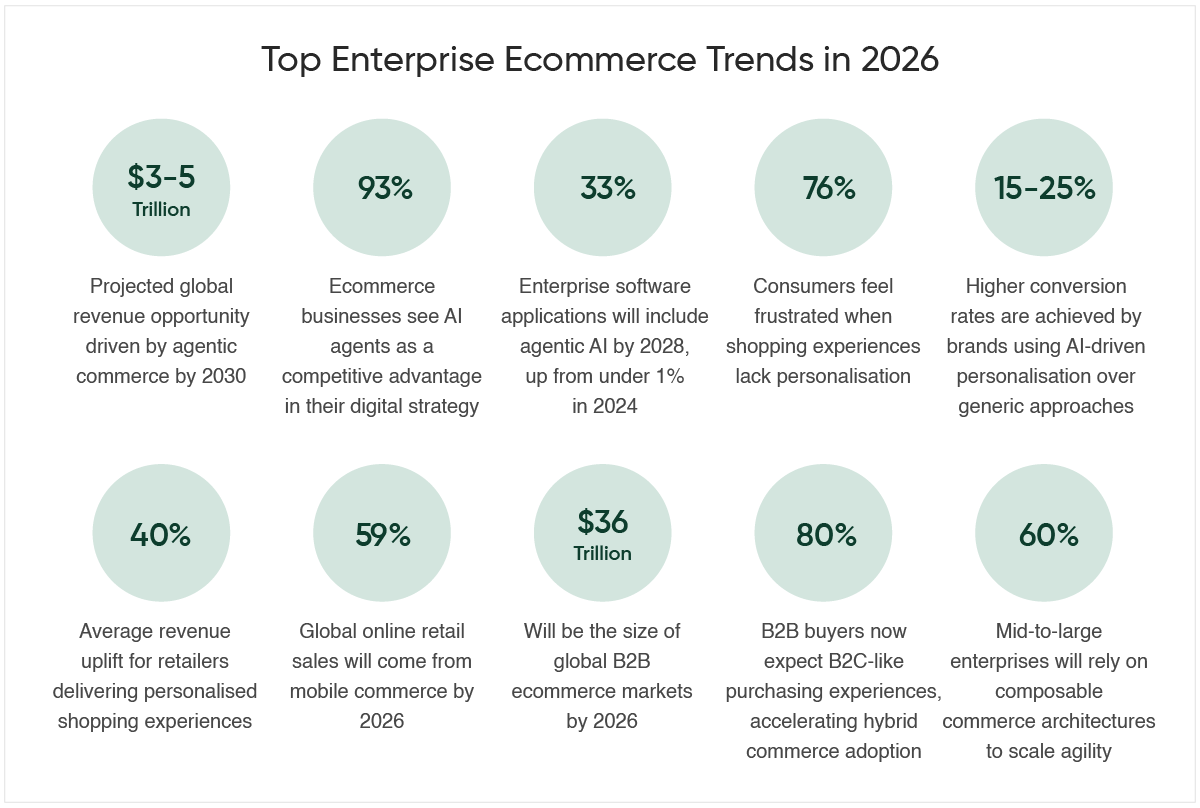
- $3–$5 trillion is the projected global revenue opportunity driven by agentic commerce by 2030 (McKinsey & Company).
- 93% of ecommerce businesses see AI agents as a competitive advantage in their digital strategy (Capgemini).
- 33% of enterprise software applications will include agentic AI by 2028, up from under 1% in 2024 (Gartner).
- 76% of consumers feel frustrated when shopping experiences lack personalisation (McKinsey & Company).
- 15–25% higher conversion rates are achieved by brands using AI-driven personalisation over generic approaches (Bloomreach).
- 40% is the average revenue uplift for retailers delivering personalised shopping experiences (McKinsey & Company).
- 59% of global online retail sales will come from mobile commerce by 2026 (Statista).
- $36 trillion will be the size of global B2B ecommerce markets by 2026 (Statista).
- 80% of B2B buyers now expect B2C-like purchasing experiences, accelerating hybrid commerce adoption (McKinsey).
- 60% of mid-to-large enterprises will rely on composable commerce architectures to scale agility (Gartner).
Together, these numbers tell a clear story: enterprise ecommerce in 2026 will be led by brands that move faster, personalise smarter, and build flexible, AI-native foundations.
The 10 Ecommerce Trends Every Large Brand Must Act On in 2026
2026 will reward brands that make bold, intelligent shifts rather than incremental changes because the market is no longer patient with slow evolution.
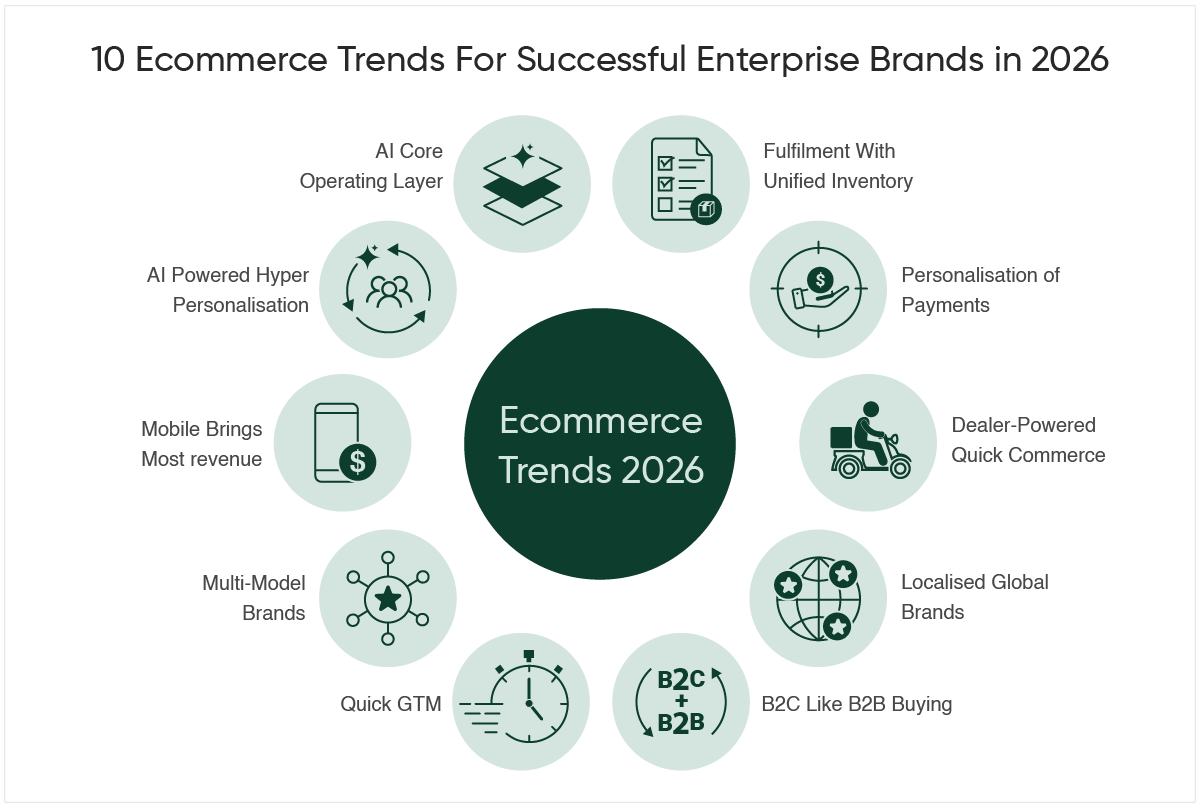
Here is a curated list of ecommerce trends for 2026 that demand action from every enterprise this year.
1. Agentic AI Becomes the Core Operating Layer
In 2026, AI in ecommerce can no longer exist as a stitched-on patchwork of tools and plugins. It becomes the core operating layer of digital commerce, guiding decisions, interpreting buyer intent, enriching product data, and powering interfaces that learn continuously. This shift marks the first time enterprises move from “AI-assisted workflows” to “AI-orchestrated commerce,” where intelligence flows through every touchpoint instead of sitting at the edges.
For large brands, this changes the fundamentals of how business is run.
Catalogue creations become automated. Search becomes conversational. Personalisation becomes real-time. Support becomes always-on and contextual. Instead of teams juggling dozens of disconnected tools, enterprises gain a unified, self-optimising AI commerce engine capable of scaling across multiple touchpoints, business models, geographies, and channels. The result is lower operational load, faster GTM, and sharper customer experiences, all happening simultaneously on your enterprise ecommerce platform.
How StoreHippo aligns with this shift:
- AI-Native Commerce Engine - Embeds AI for ecommerce into search, recommendations, buyer interactions and support to boost conversion.
- AI Catalog Automation Tools- Auto-tagging, description generation, and image editor tool Magic Edit reduce manual catalogue work dramatically.
- Headless, API-First Architecture - Makes it easy to integrate agentic AI across storefronts, apps, and custom interfaces.
- Unified Backend - Gives AI clean, consistent data across B2B, D2C, multi-vendor, multi store and hyperlocal setups for accurate decision-making so enterprises scale across business models and geographies seamlessly.
2. Hyper-Personalised Shopping Powered by AI Agents
Online shopping trends 2026 clearly signal that personalisation moves beyond static rules and recommendation widgets. AI agents become active participants in the buying journey, understanding context, detecting intent, and shaping each interaction in real time. Whether a buyer connects through mobile, voice, chat, or a webstore, or converses in different languages, the experience adapts instantly. These agentic AI bots don’t just answer queries; they guide discovery, compare products, refine choices, and upsell based on behavioural patterns that evolve with every tap, search, or message.
For enterprises, this unlocks a level of precision that human teams or rule-based systems simply cannot deliver. Large catalogues become easier to navigate, repeat purchases grow, and buyers receive a level of assistance once possible only in high-touch offline stores. Multilingual and multimodal interfaces, voice + text, extend reach across diverse regions and customer profiles. The result is deeper engagement and higher conversion without expanding support teams.
How StoreHippo aligns with this shift:
- Conversational AI Shopping Assistant- Enables brands to create multilingual voice+text-based agentic AI shopping assistants that guide buyers through search, comparison, and checkout, boosting discovery and conversions in line with hyper-personalised online shopping trends 2026.
- AI-Powered Support for Vendors- Enables brands to create AI assistants that help sellers with onboarding, setup, and daily operations, reducing support load and improving vendor efficiency.
- Support AI for Customers- Brands can build custom AI support agents that instantly resolve buyer queries, assist with orders, and help with regular queries so enterprises can work with leaner customer support teams and keep buyers happy.
- Niche AI for Industry Verticals- Enables brands to create sector-specific AI assistants-like agriculture-based AI that helps farmers compare products, seek loans and get mandi rates, or similar for other sectors like banking and financial institutions, automobile brands, etc.
All these chatbots can be built by StoreHippo enterprise ecommerce platform’s native AI commerce engine as a customisation on a pro rata basis.
3. Mobile-Channel Becomes the Revenue Engine
Ecommerce trends for 2026 further highlight that mobile is no longer just a convenient channel; it has become the primary revenue engine for large brands. With buyers spending more time on phones than any other device, enterprises need mobile experiences that are fast, intuitive, and deeply personalised. Native Android and iOS apps, PWAs, WhatsApp storefronts, and voice-led interfaces become standard, not optional. Customers expect to discover, compare, and complete purchases within seconds, all from the device they use most.
For enterprises operating across regions, business models and diverse product lines on multiple channels, mobile-first commerce solves a major challenge: reducing friction. Whether it’s quick reorders for B2B buyers, product discovery for D2C shoppers, or hyperlocal fulfilment journeys, mobile becomes the most efficient way to capture intent and convert it instantly. It also fits well with online shopping trends and unlocks new engagement layers like push notifications, in-chat checkout, and conversational buying, fueling repeat purchases and loyalty at scale.
How StoreHippo aligns with this shift:
- Built-In No-Code Mobile App Builder- Enables brands to create Android and iOS apps quickly without custom development, helping them keep pace with online shopping trends 2026.
- Storefronts That Are PWAs- All stores built on StoreHippo are PWAs, enabling brands to create lightning-fast, app-like shopping experiences that boost mobile engagement and conversions across all devices.
- WhatsApp Commerce* - Enables brands to create seamless chat-based buying journeys where customers discover, compare, and complete purchases within WhatsApp.
- Custom Mobile Micro-Experiences-Enables brands to quickly create targeted mobile micro-stores or collection pages for seasonal targeted campaigns, for example; festival stores, regional stores, promotional or login-based stores, etc.
*WhatsApp Commerce* is coming soon in 2026.
4. Multi-Model Brands are Norm
In 2026, one of the biggest shifts, beyond the rise of AI for ecommerce, is the move toward multi-model commerce. Enterprises can no longer afford to operate with a single business model. Brands are now combining models like B2B + D2C, or enabling quick commerce through multi-vendor and hyperlocal setups. Many are also running marketplace + retail hybrids or pairing D2C + services model to expand reach and increase recurring revenue. The shift is clear: enterprises that once scaled linearly now grow through parallel models, each serving a different segment, geography, or buying behaviour.
For large brands, this unlocks unprecedented agility and also aligns with online shopping trends. Hyperlocal models allow same-day deliveries, marketplaces enable wider assortment, B2B modules streamline recurring orders, and D2C storefronts strengthen direct customer relationships. The advantage lies not in choosing one model, but in orchestrating many without duplicating infrastructure. This reduces operational overhead and helps enterprises pivot rapidly to market changes, launching new micro-stores, customer touchpoints, or fulfilment flows with minimal effort.
How StoreHippo aligns with this shift:
- Unified Backend for Multiple Models- Lets brands run B2B, D2C, multi-vendor, hyperlocal, and quick commerce models from one platform and central admin control without juggling separate systems.
- 300+ Built-In Enterprise Features-Helps brands pivot to new, hybrid or never before models effortlessly with native features, zero plugin overload and tested solutions in real world use cases.
- Composable Architecture- Allows brands to build tailored enterprise ecommerce platforms and branded ecosystems by adding, removing, or replacing ERPs, CRMs, marketing tools, payment gateways, logistics partners or any other integrations with ease.
- Flexible Workflow And Role Management- Offers built-in tools like for assigning roles and access control, custom permissions, operations, and create custom user journeys for each model without additional builds or complex development.
5. GTM Speed Becomes Strategic Differentiator
By 2026, speed is no longer a competitive advantage- speed is the new moat that determines which brands lead and which ones fall behind. Markets now evolve in weeks, not quarters; customer expectations shift overnight; and new business models emerge faster than traditional enterprise ecommerce platforms can support. Enterprises can’t afford long development cycles or dependency on heavy custom code. They need the ability to launch new stores, channels, micro-sites, and business models in days, all while keeping operations scalable and stable.
For large brands, this means rethinking the very structure of their digital ecosystem. Agility becomes the new moat. The platforms that enable rapid configuration, low-code extensibility, and plug-and-play feature activation will outperform those stuck in monolithic or plugin-heavy architectures. Fast GTM reduces operational cost, supports experimentation, and lets enterprises capture new customer segments before competitors even react.
How StoreHippo aligns with this shift:
- MACH Architecture (Microservices, API-first, Cloud-native, Headless)- Allows rapid launches, flexible scaling, and customisation, helping enterprises go live faster with stable, future-ready enterprise ecommerce platforms that offer flexibility, scalability and agile development.
- Low-Code Platform- The composable, multi-model support and low-code platformlets teams tweak both backend and frontend quickly for any business model, including multi-vendor, multi-store, and global commerce setups, without long development cycles.
- AI-Powered Storefront And Cataloguing Tools- Speeds up go-live timelines with store creation in minutes and automated cataloguing, product content generation, image refinement, and quick launch of new stores, brands or reaching new markets.
- Theme Designer with Multilingual Support- Enables fast creation of branded storefronts, customised layouts, and region-ready multilingual experiences with minimal effort.
6. B2B Promises B2C Flexibility And Ease
Ecommerce trends in 2026 mark a major turning point for wholesale commerce. B2B buyers increasingly expect the same simplicity, speed, and personalisation they experience in D2C. Catalogues must be easier to navigate, pricing must be tiered, dynamically decided or adapt to client requirements quickly along with frictionless reorders. Complex workflows, RFQs, MOQs, tiered pricing, credit limits, dealer-specific catalogues must be part of the system and operate so smoothly that they are literally invisible and offer B2C like ease of buying.
For enterprises, this shift in ecommerce trends for 2026 is transformative. It reduces dependence on large sales teams, accelerates recurring orders, and builds trust with distributors and partners. AI-driven personalisation, self-service journeys, and branded micro-stores make B2B interactions smoother and more efficient. The brands that treat their B2B ecosystem with the same design aesthetics and intelligence as their B2C stores will earn deeper loyalty and higher lifetime value from business customers.
How StoreHippo aligns with this shift:
- Advanced B2B Modules (RFQ, MOQ, Tiered Pricing)- Automate complex wholesale workflows while keeping the buying experience simple, aligned with evolving B2B ecommerce trends 2026.
- Custom Dealer And Distributor Stores- Create focused, distraction-free buying spaces for each partner segment with tailored catalogues, pricing, and permissions.
- AI-Personalised Search And Recommendations- Surface relevant SKUs instantly in large catalogues, helping B2B buyers make faster, more informed decisions.
- Self-Service Workflows- Host of built-in B2B features, custom forms and quick reorder feature, credit wallets offer seamless B2B payments and credit management, along with order trackinck etc. create frictionless B2b setups alike B2C aligning enterprise B2B brands with online shopping trends of 2026.
7. Global-First, Hyper-Local Execution
In 2026, global expansion for enterprise ecommerce platforms is no longer about launching a single international website; it’s about tailoring every market presence with precision. Large brands must operate as global entities while behaving like local businesses in each region. This means different currencies, pricing, catalogues, languages (including RTL), taxes, shipping rules, payment gateways, and even distinct storefront designs. Success comes from delivering hyper-local trust at global scale.
For enterprises, managing this complexity manually becomes impossible. They need platforms that can spin up regional stores instantly, offer unified backend control, and maintain consistency across dozens, or hundreds of digital touchpoints. This approach ensures operational efficiency without compromising the unique nuances each market demands. When done right, enterprises unlock faster entry into new geographies, improved conversion, and deeper customer relevance across regions.
How StoreHippo aligns with this shift:
- Multi-Store Architecture- Launch region-based, brand-based, or buyer segment-based substores managed from one backend, aligning with evolving ecommerce trends for scalable global growth.
- Multi-Currency, Multi-Lingual (Including RTL) And Tax Engine- Leverage built-in multilingual and multi-currency solutions to deliver localised shopping experiences across geographies, matching buyer expectations shaped by modern online shopping trends. StoreHippo’s built-in tax-engine also enables brands to seamlessly manage tax compliance by setting automated, multi-level tax rules.
- Store-Specific Pricing, Designs And Workflows- Customise substore URLs, layouts, inventories, discounts, payment rules, and checkout flows for each market without creating separate systems.
- Centralised Master Catalogue And Operations- Manage all vendors, regions, and storefronts from a unified admin with a single master catalogue that has all products from all sellers, geographies, brands, etc, helping in creating differentiated regional strategies with centralised control.
8. Dealer-Powered Quick Commerce
Quick commerce has been the hottest ecommerce trend for the last couple of years, and many enterprise brands are testing the waters, given the high success rate of this model. However, large enterprise brands are shifting from the cost-intensive dark store model to decentralised distributed fulfilment networks powered by existing dealer, distributor, and franchise infrastructures. For large brands with strong offline footprints, this model is a game-changer,it turns every dealer into a hyperlocal fulfilment node, shortening delivery times and reducing the massive capital and operational expense associated with traditional quick commerce setups.
For enterprises, the benefit is twofold: fulfil orders faster while strengthening relationships with on-ground partners. Dealers gain more visibility and higher throughput, while brands unlock faster market penetration aligned with online shopping trends with minimal new investment. Inventory becomes fluid, mapped to the nearest or most efficient location/dealer in real time. Instead of building new logistics layers, enterprises leverage the networks they already own.
How StoreHippo aligns with this shift:
- Built-In Multi-Vendor Support- Helps enterprise ecommerce brands to onboard dealers and distributors as hyperlocal fulfilment partners while giving them individual dashboards, controls, and automated shipping solutions to facilitate local deliveries.
- Dealer Sub-Stores, Inventory And Order Routing- Seamlessly create dedicated dealer stores and auto-route orders to the nearest dealer for faster, low-cost quick commerce fulfilment.
- Hybrid B2B2C Workflows- Support dealer-managed pricing, catalogues, and deliveries while the brand maintains full governance across the ecosystem.
- Real-Time Location-Based Delivery- Enable hyperlocal delivery with pre-integrated logistics partners, intelligent order assignment and delivery boy solutions for using dealers’ delivery agents for last-mile fulfilment.
9. Personalisation of Payments
In 2026, ease of payments becomes a core pillar of conversion, not just an ecommerce trend. Customers, whether B2C or B2B, expect payment options that are localised, secure, and tailored to their buying preferences. Multi-currency support, digital wallets, instant UPI, credit and store wallets, buy on EMI, and secure B2B payment flows must all work seamlessly across devices. Checkout experiences that once ended in friction now decide whether an enterprise ecommerce brand wins or loses buyer trust.
For large brands, personalised payments reduce abandonment, bring in new domestic and global customers, and create smoother recurring purchase cycles. Brands now need to offer payment models aligned with different ecommerce models supported on their enterprise ecommerce platform. The brands that deliver payment flexibility aligned to buyer behaviour will see higher trust, retention, and order values across markets in 2026.
How StoreHippo aligns with this shift:
- 60+ Global And Domestic Payment Integrations- Gives brands the ability to offer preferred payment options; netbanking, UPI, wallets, cards, EMI, supporting diverse buyer needs shaped by ecommerce trends 2026.
- Multi-Currency Checkout - Supports seamless global selling with real-time currency conversion, enabling brands to serve international buyers without additional development/integration efforts.
- Custom Payment Rules - Lets brands configure payment methods by region, cart value, buyer type, or purchase model across their enterprise ecommerce platform.
- Enterprise-Grade Security (PCI DSS, SOC, ISO)- Ensures secure, compliant transactions at scale, building trust with both B2B and B2C buyers.
10. Omnichannel Fulfilment With Unified Inventory
By 2026, omnichannel fulfilment is no longer defined by traditional buy online and pick up from store; it has evolved into a unified commerce model where every inventory source is integrated into a centralised network. Dealer stores, offline retail outlets, social and marketplace stores all have a shared inventory and order management system. The dealer locations become connected nodes, and the system determines the best fulfilment route in real time based on proximity, cost, availability, and speed. The result: faster delivery, lower logistics expense, and consistently high customer satisfaction.
For enterprises, this shift eliminates one of the biggest challenges, inventory silos. Instead of maintaining multiple stock pools with high carrying costs, brands gain a single, real-time view of everything they own. This enables hyperlocal fulfilment, reduces overstocking, and improves profitability in an era where instant delivery expectations continue to climb.
How StoreHippo aligns with this shift:
- 30+ Pre-Integrated Shipping Providers- Let brands fulfil orders seamlessly across regions with a wide network of delivery partners.
- Built-In OMS With Unified Inventory View- Provides complete visibility across dealers and store locations to ensure accurate and efficient fulfilment.
- Smart Order Routing- Automatically selects the optimal fulfilment node based on distance, availability, delivery speed, and cost.
- Seamless Carrier Integrations- Supports easy integration with preferred shipping, courier, and last-mile partners to streamline omnichannel delivery operations.
Conclusion: 2026 Belongs to Intelligent, Adaptive Enterprises
The ecommerce trends shaping 2026 are more than signals, they are structural shifts redefining how large brands build, operate, and grow. AI for ecommerce is no longer an enhancement, mobile is not just a channel, and business models can’t live in silos. Enterprises that treat intelligence as their foundation, not a layer, will scale with clarity and speed while others struggle with fragmented systems and legacy workflows.
Success in 2026 won’t come from adopting more tools. It will come from building ecosystems that think, adapt, and evolve on their own.
StoreHippo enterprise ecommerce platform brings this future within reach with native AI tools, built-in enterprise features, and a composable architecture designed to help brands innovate without complexity. The brands that embrace AI-native foundations, agile solutions and offer personalised buyer experiences will move ahead, not by running faster, but by running smarter.
Build your next growth curve with StoreHippo’s enterprise ecommerce platform. Book a Demo now.
FAQ
1. Do we need to rebuild our enterprise ecommerce foundation to stay competitive in 2026?
Yes. The patchwork tools and channel-specific fixes won’t scale. Enterprises need an AI-native, composable foundation where intelligence, data, and workflows are unified across models and channels.
2. How quickly can an enterprise adapt to new ecommerce trends in 2026 without disrupting existing operations?
Speed matters in 2026. Platforms that support low-code changes, modular features, and multi-model setups allow enterprises to launch new channels or business models without rebuilding their core systems.
3. Can one enterprise ecommerce platform realistically support B2B, D2C, marketplace, and quick commerce together?
Yes, but only if the platform is built for multi-model commerce from day one. The blog highlights that running parallel models from a unified backend is now essential to reduce overhead and improve agility.
4. How do we launch in multiple global location at once in 2026 without building from scratch for every county?
Enterprises need a single, central ecommerce foundation that can power multiple region-specific storefronts. With a multi-store architecture, brands can launch country-wise or region-wise stores from one backend,each with its own currency, language, pricing, tax rules, payments, and fulfilment logic without duplicating systems or rebuilding code. This approach enables faster global rollouts while maintaining central control with a single enterprise ecommerce platform.
5. What should enterprise ecommerce platforms prioritise first in 2026: AI, mobile, or fulfilment transformation?
The key takeaway is integration. AI, mobile-first experiences, and unified fulfilment must evolve together. Treating any one of them in isolation limits impact and slows enterprise-scale growth.