


The e-commerce market is transforming rapidly, and multi-vendor marketplaces have become immensely popular. Who doesn’t want to be the next Amazon, right?
The ability to offer various products and services under one virtual roof makes multi-vendor marketplace platforms a significant cornerstone in the future of e-commerce.
But it is a highly competitive market and as competition grows, how do you stand out and keep your customers engaged?
The answer is ecommerce personalisations.
Shoppers today expect tailored experiences and businesses that deliver on this expectation have a clear edge.
So, let’s delve deeper into the world of ecommerce personalisations and explore how they can transform your multi-vendor marketplace into a successful customer-centric hub.
Table of Contents
- How Personalisation Fuels the Growth of Multi-Vendor Marketplaces
- 7 Personalisation Hacks to Skyrocket Multi Vendor Marketplace Engagement
- 1. Build a Multilingual Website
- 2. Segment Buyer Groups With Multiple Stores
- 3. Customised Pricing Strategies to Boost Customer Engagement
- 4. AI-Powered Recommendations, Search And Conversational Buying
- 5. Data-Driven Personalised Marketing And Smart Targeting
- 6. Product Bundles and Loyalty Rewards
- 7. Engage Buyers with Seamless Payments
- How StoreHippo Helps You Implement Ecommerce Personalisation On Your Marketplace
- Conclusion
- FAQs
How Personalisation Fuels the Growth of Multi-Vendor Marketplaces
User engagement is key to the success of a multi-vendor marketplace. In today’s competitive digital landscape, keeping buyers engaged requires more than broad marketing strategies, it demands personalised experiences that make product discovery simple, relevant, and efficient.
In 2026, personalisation has become a game changer for businesses, shaping how they engage buyers, improve product discovery, and increase conversions across digital channels. It’s no longer just a marketing add-on; it plays a critical role in helping buyers find t the right products and make faster decisions.
Before we look at the top personalisation tactics for your multi-vendor marketplace, let’s first understand the latest ecommerce trends and how AI- powered personalisation is impacting revenue, loyalty, and long-term growth.
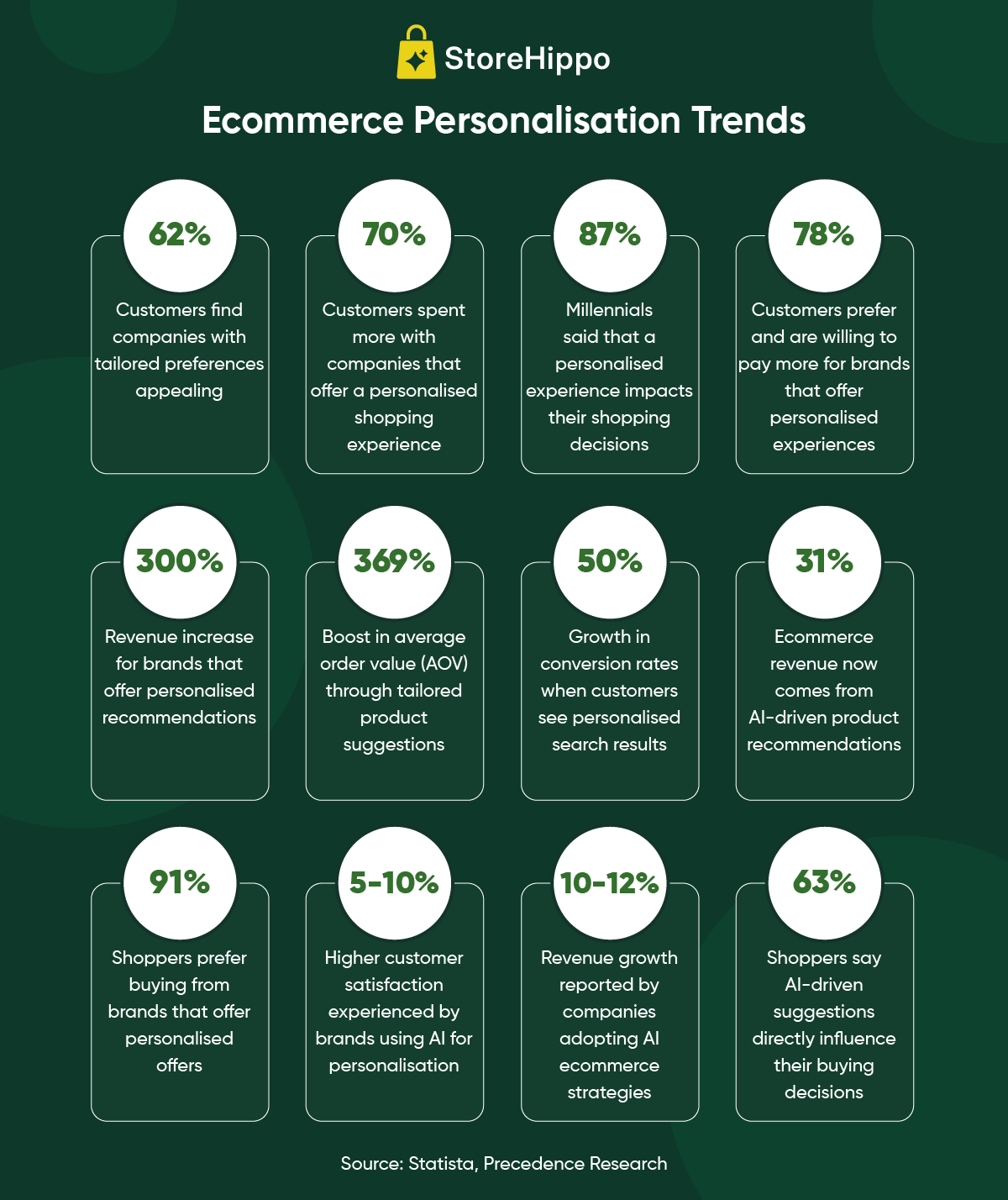
- 62% of customers find companies with tailored preferences appealing
- 70% of the customers spent more with companies that offer a personalised shopping experience
- 87% of millennials said that a personalised experience impacts their shopping decisions
- 78% of customers prefer and are willing to pay more for brands that offer personalised experiences
- 300% revenue increase for brands that offer personalised recommendations
- 369% boost in average order value (AOV) through tailored product suggestions
- 50% growth in conversion rates when customers see personalised search results
- 31% of ecommerce revenue now comes from AI-driven product recommendations
- 91% of shoppers prefer buying from brands that offer personalised offers
- 5-10% higher customer satisfaction experienced by brands using AI for personalisation
- 10-12% revenue growth reported by companies adopting AI ecommerce strategies
- 63% of shoppers say AI-driven suggestions directly influence their buying decisions
Source: Statista, Precedence Research
The impact is clear: when buyers see relevant products, useful recommendations, and content that actually matches their needs, they stay longer and buy more. For multi-vendor marketplaces managing large catalogues and different types of buyers, personalisation is one of the most practical ways to keep the experience relevant without adding manual effort.
Today, personalisation isn’t a fancy add-on. It’s becoming a core part of running a competitive marketplace. The multi-vendor marketing strategies below will show how you can use AI and data in simple, practical ways to drive engagement, conversions, and steady marketplace growth.
7 Personalisation Hacks to Skyrocket Multi Vendor Marketplace Engagement
Modern buyers are choosy and have a shorter attention span, making personalisation a must-have for eCommerce success. They expect tailored experiences that cater to their unique preferences, and businesses that deliver stand out in the competitive ecommerce domain.
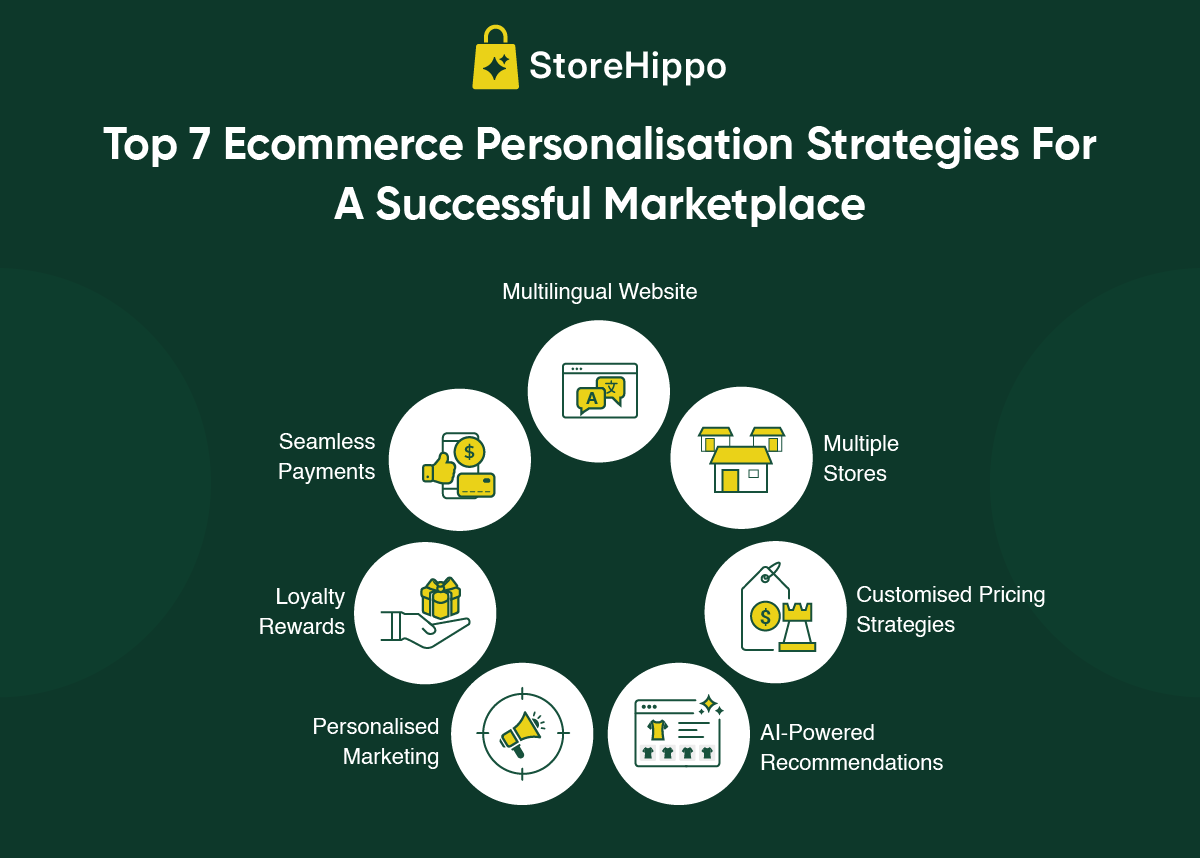
Here are 7 powerful personalisation strategies that can transform your multi-vendor marketplace and drive exceptional engagement.
1. Build a Multilingual Website
As your business grows, breaking language barriers becomes essential to reaching a broader, more diverse audience. A multilingual website or application allows your marketplace to connect with customers across different regions, creating a seamless and inclusive shopping experience.
Key strategies for an effective multilingual multi-vendor marketplace website:
- Automatic Translations: Use AI-powered tools for instant translations into multiple languages, ensuring customers can browse and shop comfortably in their preferred language.
- Manual Fine-Tuning: Enhance translation accuracy and cultural relevance by refining content to match the tone and preferences of specific regions.
- RTL Language Support: Incorporate Right-to-Left language compatibility for Arabic, Hebrew, and similar scripts to cater to diverse global audiences effectively.
- Geographic Language Detection: Automatically display the appropriate language based on a user’s location or saved preferences to personalise the experience and send a message that your business is ready for the future of e-commerce.
By incorporating these strategies, you not only improve user engagement but also establish your marketplace as a global player. A multilingual website signals that your business is ready to meet the expectations of an interconnected world, fostering trust and driving conversions in new markets.
2. Segment Buyer Groups With Multiple Stores
In a competitive multi-vendor marketplace environment, catering to diverse buyer segments is crucial for sustained growth. Segmenting your audience through multiple storefronts allows you to create tailored experiences for different customer groups, industries, or regions, making your platform more relevant and engaging.
Key strategies for segmenting buyers with multiple stores:
- Customised Storefronts: Create unique stores for different customer segments, such as wholesale buyers, retail shoppers, or region-specific audiences, with personalised layouts, catalogs, and offerings.
- Localised Ecommerce Personalisations: Offer region-specific content, pricing, and promotions to resonate with local buyers and drive engagement.
- Flexible Product Catalogs: Showcase products or categories relevant to specific buyer groups, enhancing their shopping experience and boosting conversions.
- Centralised Management: Use a single backend to manage multiple stores effortlessly, ensuring operational efficiency and consistency across all touchpoints.
By segmenting buyer groups with multiple stores, your multi-vendor marketplace can deliver personalised shopping experiences that cater to the unique needs of each audience. This approach not only increases customer satisfaction but also positions your marketplace as a leader in eCommerce personalisations, fostering loyalty and driving revenue across diverse markets.
3. Customised Pricing Strategies to Boost Customer Engagement
In a multi-vendor marketplace, one-size-fits-all pricing often falls short of meeting diverse customer needs. Customised pricing strategies allow you to cater to various buyer groups, whether individual shoppers, bulk buyers, or regional customers, by offering tailored pricing that resonates with their preferences and purchasing patterns.
Key strategies for implementing customised pricing:
- Location-Based Pricing: Use IP detection to offer region-specific prices that align with local market demands and purchasing power.
- Tiered Pricing Models: Provide volume-based discounts for bulk buyers or B2B customers, encouraging larger transactions.
- Login-Based Pricing: Offer exclusive pricing for premium members, loyal customers, or specific buyer segments to enhance engagement.
- Pricing Override: Implement rule-based pricing that adapts to customer login, or seasonal user segmentation.
- RFQ Features: Allow B2B buyers to request quotes and negotiate prices, creating a personalised and customer-centric buying experience.
By adopting these customised pricing strategies, your online marketplace can be ready for the future of e-commerce where delivering highly relevant and engaging experiences for customers is the norm. These ecommerce personalisations not only improve customer satisfaction but also drive loyalty and maximise revenue by aligning pricing with buyer expectations and market conditions.
4. AI-Powered Recommendations, Search And Conversational Buying
Ecommerce discovery is changing fast. Buyers don’t want to scroll endlessly or guess the right keywords anymore. They expect the platform to understand what they’re looking for and guide them naturally, almost like a smart sales assistant would. On a multi-vendor marketplace with thousands of products and sellers, that intelligence makes a real difference.
Here are practical AI-driven strategies to focus on:
- AI Product Recommendations:
Show buyers products based on what they browse, compare, and purchase. Smart recommendations not only improve average order value but also help surface products from different sellers across your marketplace. - AI Semantic Search:
Move beyond basic keyword search, semantic search understands intent and context, so even vague or conversational queries return relevant results, reducing frustration and improving conversions. - AI Chat And Assisted Buying:
Build custom AI assistants that help buyers discover products, compare options, and even place orders. A conversational interface makes complex buying journeys simpler and keeps users engaged.
When AI becomes part of search, discovery, and buying, your multi-vendor marketplace feels easier to use, more responsive, and ultimately more conversion-focused.
5. Data-Driven Personalised Marketing And Smart Targeting
In a competitive multi-vendor marketplace, personalisation begins with understanding your buyers' behaviour. By combining analytics with targeted marketing automation, you can deliver highly relevant offers that increase engagement and drive conversions.
Key strategies for implementing data-driven personalised marketing:
- Customer Segmentation: Group customers based on browsing behaviour, purchase history, location, and demographics to create targeted experiences across your marketplace.
- Behavior-Based Offers: Use real-time data to trigger personalised discounts, product recommendations, or exclusive deals based on customer interactions.
- Cart Abandonment Recovery: Send personalised reminders with real-time, personalised incentives to recover lost sales and re-engage high-intent buyers.
- Geo-Targeted Campaigns: Run region-specific promotions and localised campaigns that resonate with diverse customer groups.
- Predictive Insights: Leverage analytics to anticipate customer preferences and proactively promote relevant products, bundles, or offers.
By combining analytics with intelligent marketing automation, your multi-vendor marketplace can move beyond generic campaigns and deliver meaningful ecommerce personalisations that improve ROI, increase loyalty, and boost revenue.
6. Product Bundles and Loyalty Rewards
Combining product bundles with loyalty rewards is a powerful personalisation strategy to drive sales and encourage repeat purchases on a multi-vendor marketplace. By offering bundled deals and rewarding loyal customers, you can create value-packed experiences that boost engagement and customer satisfaction.
Key strategies for product bundles and loyalty rewards:
- Tailored Bundles: Offer product bundles based on customers’ past purchases or browsing history to meet their specific needs.
- Dynamic Discounts: Provide special pricing for bundles, such as “Buy 2, Get 1 Free,” or percentage-based discounts for bundled products.
- Loyalty Points System: Reward customers with points for every purchase, which can be redeemed for discounts, freebies, or exclusive offers.
- Tiered Loyalty Rewards: Create tiered programs where higher spending unlocks better rewards, encouraging increased purchases.
- Seasonal Bundles: Promote holiday or event-specific bundles to align with customer buying trends.
By integrating product bundles and loyalty rewards into your marketplace strategy, you can enhance customer retention, boost average order values, and build long-term relationships with your buyers. Personalising these offers ensures customers feel valued and incentivised to shop frequently.
7. Engage Buyers with Seamless Payments
In a multi-vendor marketplace, a smooth and hassle-free payment process is essential for creating a positive shopping experience. Seamless payment options not only enhance customer satisfaction but also encourage repeat purchases, fostering long-term loyalty.
Key strategies for implementing seamless payments:
- Multiple Payment Options: Offer a variety of payment options, including credit/debit cards, UPI, wallets, net banking, COD, and EMI, to cater to diverse customer preferences.
- Localised Payment Methods: Integrate region-specific payment gateways to make transactions easier for international buyers.
- Store Wallets: Enable customers to store funds securely in a digital wallet, allowing instant refunds, cashback rewards, and hassle-free transactions.
- Real-Time Currency Conversion: Provide multi-currency support to offer seamless transactions for global customers.
By implementing these seamless payment solutions, your marketplace can deliver exceptional ecommerce personalisations, reduce cart abandonment rates, and increase buyer satisfaction. Prioritising an intuitive and secure payment experience builds trust, drives loyalty, and strengthens your multi-vendor marketplace’s reputation as a customer-centric platform.
How StoreHippo Helps You Implement Ecommerce Personalisation On Your Marketplace
StoreHippo’s future-ready technology and multi-vendor marketplace solutions are designed to empower your marketplace with advanced ecommerce personalisations.
Here’s how StoreHippo helps you deliver tailored experiences that boost engagement and drive sales:
- Mobile-First Technology: Engage mobile shoppers with PWA (Progressive Web Apps) stores and inbuilt mobile apps that deliver app-like experiences across devices.
- Built-in Design Tools: StoreHippo’s intuitive drag-and-drop tools and customisable themes allow you to create visually appealing and user-friendly storefronts for your multi-vendor marketplace. Tailor layouts, colors, and content to reflect your brand and enhance customer engagement.
- Multi-Store Solutions: Manage multiple storefronts from a single backend with StoreHippo’s multi-store architecture. Segment your audience by geography, customer type, or product category, delivering personalised ecommerce experiences across sub-stores.
- Comprehensive Marketplace Solutions: StoreHippo’s feature-rich marketplace solutions include multi-vendor management, real-time analytics, vendor-specific dashboards, and automated commission calculations. These tools simplify operations for admins and vendors while improving the overall customer experience.
- Headless Architecture for Customisation: StoreHippo’s decoupled frontend and backend allow you to build personalised buyer journeys, from tailored product recommendations to custom workflows, ensuring unique experiences for each customer segment.
- Dynamic Pricing and Discounts: Implement location-based, tiered, or login-specific pricing using StoreHippo’s versatile pricing engine. The built-in discount engine lets you create targeted promotions like product-level discounts, flash sales, and group-specific offers.
- Multilingual and Multi-Currency Support: Reach global audiences with seamless localisation features, including automatic translations, RTL language support, and multi-currency payments, ensuring a personalised shopping experience for every customer.
- AI-Native Search and Recommendations: StoreHippo offers AI-powered search and recommendations, which offer highly accurate search results and behaviour-based, context-aware hyper-personalised product suggestions that increase AOV and improve vendor discoverability.
- Agentic AI Commerce Assistants: StoreHippo enables you to build custom AI assistant for your multi-vendor marketplace to create assisted buying journeys. These AI agents help buyers discover products, compare options, and place orders more easily, making the entire purchasing process faster, smoother, and more intuitive.
- Built-in Marketing Tools: StoreHippo’s SEO-friendly platform comes with a host of native marketing tools like discount engine, blog engine, abandoned cart follow up, push notifications, and more that keep your marketing game ready for the future of ecommerce.
- Vendor-Specific Tools: Empower vendors with dedicated dashboards for managing inventory, sales analytics, and customised pricing. Features like vendor-specific discounts and personalised seller pages enhance the marketplace’s appeal.
- Multiple Payment Options: StoreHippo integrates with 60+ payment gateways, offering diverse payment methods such as UPI, wallets, EMI, credit/debit cards, and multi-currency support. This ensures seamless and localised payment experiences for customers globally. Encourage repeat purchases with secure wallet systems and customisable loyalty rewards, creating lasting relationships with your customers.
- Inbuilt Analytics for Insights: Use StoreHippo’s advanced analytics to segment customers, track behavior, and identify trends. Leverage these insights to implement hyper-personalised strategies like tailored recommendations or targeted marketing campaigns.
StoreHippo combines cutting-edge technology and next-gen solutions to future-proof your multi-vendor marketplace. By enabling seamless personalisation, it helps you cater to diverse buyer needs, foster loyalty, and stay ahead in the competitive world of eCommerce.
Conclusion
Personalisation is no longer just a feature, it’s the cornerstone of success for any multi-vendor marketplace in 2026 and beyond. By implementing the above listed ecommerce personalisation strategies, you can enhance customer experiences, drive engagement, and significantly boost marketplace sales on your marketplace website.
With the right approach to multi-vendor marketing and a powerful multi vendor solution provider like StoreHippo, your marketplace can stand out in the competitive landscape, offering tailored solutions that foster customer loyalty and increase revenue. Embrace these strategies to position your business as a leader in the future of ecommerce, ensuring long-term growth and success.
Explore 300+ enterprise grade features of StoreHippo that enable your brand to implement the most innovative ecommerce personalisation strategies.
Begin your personalised demo now.
FAQs
1. Why is personalisation critical for a multi-vendor marketplace in 2026?
Multi-vendor marketplaces manage multiple sellers and vast catalogues, making discovery complex for different buyer segments. Without personalised experience, buyers struggle to find relevant products quickly, leading to lower engagement, reduced conversions, and declining retention over time.
StoreHippo’s AI-powered enterprise ecommerce platform enables enterprises to offer behaviour-based recommendations, intelligent search, and assisted buying journeys, helping multi-vendor marketplaces deliver relevant experiences that improve engagement, retention, and drive sustained marketplace growth.
2. How can multilingual capabilities improve engagement on a multi-vendor marketplace?
Customers now not only want fast shipping in their locations, they also expect to browse, search, buy in their preferred language. Having multilingual capabilities helps multivendor marketplaces to expand into diverse regions and engage customers in their own languages
StoreHippo offers built in multilingual solutions that support 100+ languages, including RTL (right-to-left ) languages like Arabic and Hebrew. Enterprises can create a website and translate it into multiple languages with automatic translation tool. This enables enterprises to create localised store experiences that increase buyer comfort and conversions without operational complexity.
3. Can Enterprises segment buyers effectively without creating backend complexity?
Serving different buyer groups among retail, wholesale, regional, or industry-specific often requires separate experiences. Managing this manually can increase operational overhead.
StoreHippo offers built in multi-store feature that enables multi-vendor marketplaces to create audience-specific storefronts from a single backend. With centralised control and unified management, enterprises can create custom URLs, personalise catalogues, pricing, shipping rates, promotions and payment options for various sub stores.
4. How does AI-powered search and recommendations improve marketplace engagement?
Traditional keyword search often shows results based only on exact keyword matches. If buyers misspell a term, use synonyms, or enter vague or conversational queries, they struggle to find what they are looking for, leading to frustration and abandoned sessions.
StoreHippo offers AI-powered semantic search, which offers highly accurate search results based on buyer intent and context, while AI-powered recommendations suggest relevant products based on buyers' browsing history and past purchase behaviour. This reduces search friction, improves product discovery, and increases average order value across sellers.
5. How can customised pricing strategies increase buyers' loyalty?
Static pricing models don't meet the needs of diverse buyer segments such as bulk buyers, individual shoppers, or regional customers.
StoreHippo offers customised pricing strategies tailored to different buyer segments. With built-in capabilities like tiered pricing, login-based pricing, location-based pricing, and RFQ workflows, enterprises can offer structured, segment-specific pricing and negotiated deals with ease.
These flexible pricing controls help multi-vendor marketplaces deliver relevant offers to the right buyers while maintaining centralised control, operational accuracy, and long-term profitability.
6. Can AI-driven conversational buying enhance multi-vendor marketplace conversions?
Complex buying journeys often slow decision-making, especially when buyers need assistance comparing products or clarifying specifications.
StoreHippo supports custom agentic AI assistants that guide buyers through product discovery, comparisons, cart building, and order tracking via conversational interfaces. These assisted buying journeys simplify complex transactions and help accelerate purchase decisions.
7. How can data-driven marketing improve engagement across multiple vendors?
Generic campaigns usually don’t work well in a multi-vendor marketplace where buyers have different needs and sellers offer varied products.
StoreHippo’s built-in analytics and marketing tools help enterprises to understand buyer behaviour and run targeted campaigns. They can send personalised offers, recover abandoned carts, and launch region-specific promotions. By using real buyer insights, marketplace owners can run more relevant campaigns that increase conversions and encourage repeat purchases.
8. How do seamless payments contribute to marketplace personalisation?
Complicated or limited payment options can disrupt the buying experience, leading to cart abandonment.
StoreHippo integrates with 60+ payment gateways and supports multiple payment methods store wallets, and multi-currency transactions. These capabilities ensure frictionless, ersonalised checkout experiences that reduce cart abandonment and strengthen buyer trust.
9. Can a multivendor marketplace personalise both buyer and vendor experiences simultaneously?
Focusing only on buyers can create inefficiencies for vendors, while ignoring vendor needs limits marketplace growth.
StoreHippo provides vendor-specific dashboards, commission management, customised pricing controls, and analytics tools. This ensures vendors can manage inventory, pricing, and performance effectively while buyers get self-service tools and tailored discovery and purchasing experiences.
10. How can enterprises implement ecommerce personalisation at scale without increasing operational costs?
Manual segmentation, pricing adjustments, and catalogue management can quickly become resource and time-intensive as a marketplace grows.
StoreHippo’s AI-powered commerce solutions automate catalogue listing, search optimisation, and intelligent discovery through a shared intelligence layer. This enables enterprises to scale personalisation across thousands of SKUs and vendors without increasing operational complexity.