



Enterprise commerce is no longer linear. The default operating model for modern brands is Omnichannel commerce.
Buyers discover products on marketplaces, compare on brand websites, check availability on mobile apps, interact on WhatsApp, and sometimes complete purchases offline. For B2B buyers, the journey is even more layered - researching online, negotiating pricing with sales teams, reordering through portals, and tracking deliveries across systems.
In this environment, omnichannel ecommerce is no longer about presence across touchpoints. Most enterprises already operate on multiple channels.
The real challenge is continuity, consistent pricing, unified inventory, synchronised customer data, and seamless order fulfilment across every interaction.
When systems operate in silos, growth creates friction. Teams are busy switchinga nd scyncronising dashboards instead of focusing on customers and business growth. Expanding into new regions, enabling hybrid B2B+D2C models, or scaling mobile commerce becomes operationally heavy.
For enterprises, seamless omnichannel ecommerce is now an architectural decision not just a marketing initiative. It requires a foundation built to unify operations and scale without fragmentation.
And the performance gap between enterprises that get this right and those that do not is no longer marginal; it is measurable.
Table of Contents
- Why Enterprises Can No Longer Treat Omnichannel Commerce As Optional
- The Hidden Cost of Channel Silos in Enterprise Omnichannel Ecommerce
- What Getting Omnichannel Commerce Right Actually Looks Like
- The Future of Omnichannel Commerce Will Be Unified, Intelligent, and Scalable
- The Building Blocks of Scalable Omnichannel Commerce for Enterprises
- 1. Centralised Operations For All Channels
- 2. Real-Time Inventory Sync and Order Routing
- 3. Unified Pricing and Business Logic
- 4. Support For Multi-Model Commerce
- 5. AI-Powered Ecommerce Platform
- 6. Pure Headless Architecture For Channel Expansion
- 7. Scalability and Flexibility for Enterprise Growth
- 8. Composable Architecture for Continuous Innovation
- 9. Seamless Integrations Across Enterprise Systems
- 10. Hyper-Personalisation Across Channels
- 10 Steps to Build a Successful Omnichannel Commerce Strategy for Enterprises
- 1. Map All High-Intent Customer Touchpoints
- 2. Adopt a Headless Omnichannel Platform
- 3. Centralise Real-Time Inventory Visibility
- 4. Harmonise Pricing and B2B Business Rules
- 5. Seamless API Based Integrations
- 6. Scale via a Unified Multi-Store Backend
- 7. Implement Intelligent Order Routing (IOR)
- 8. Unify Data for 360-Degree Customer Insights
- 9. Rapidly Deploy Emerging Channels
- 10. Continuous Optimization with AI-Powered Analytics
- Why StoreHippo Is the Best Choice for Enterprises Pivoting to Omnichannel Ecommerce
- Conclusion
- FAQs
Why Enterprises Can No Longer Treat Omnichannel Commerce As Optional
The shift is not theoretical.
Enterprise data shows clear performance differences between siloed models and mature omnichannel environments:
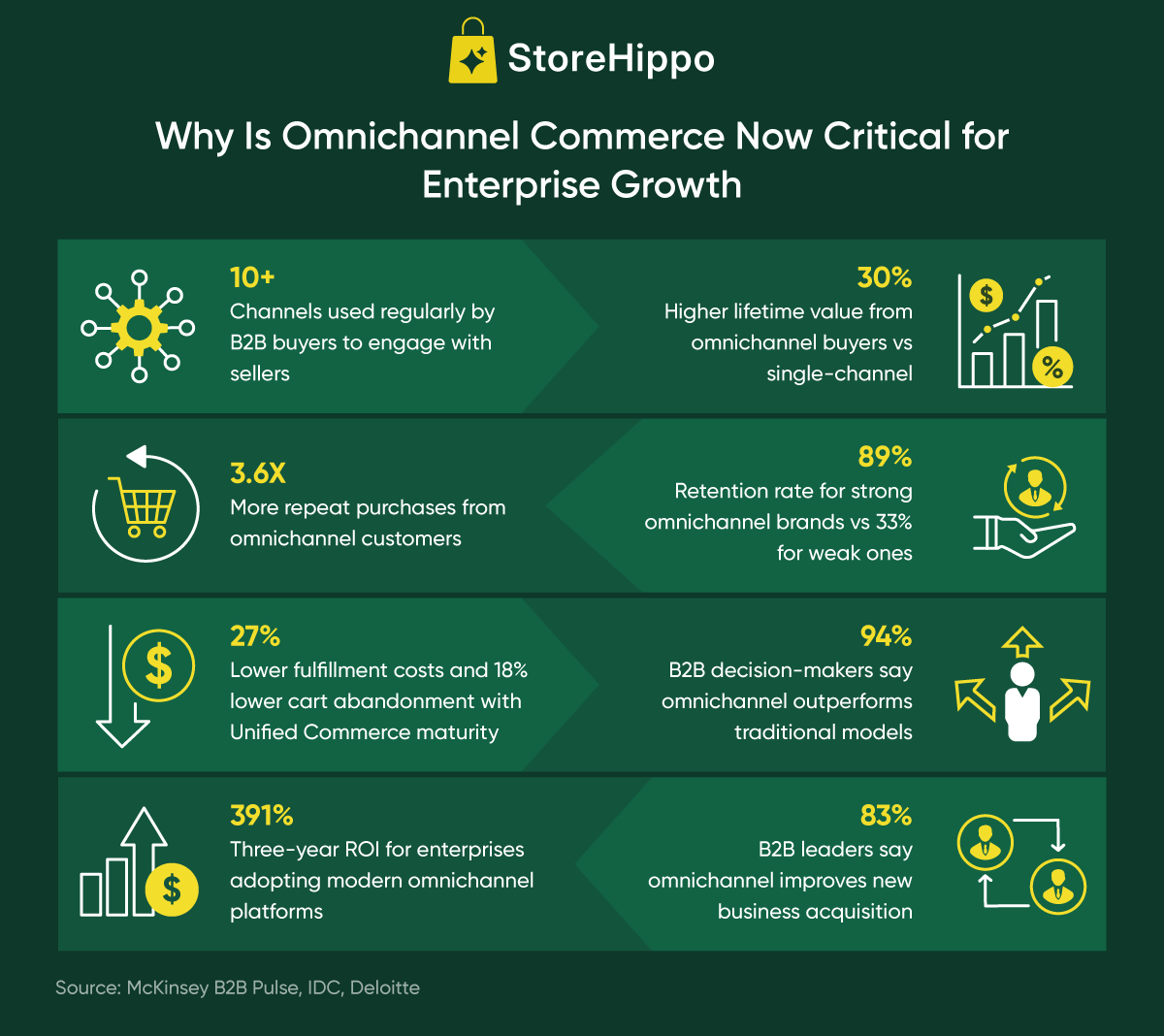
- B2B buyers now use 10+ channels regularly to research and interact with sellers.
- Omnichannel buyers generate 30% higher lifetime value than single-channel buyers.
- Customers engaging across channels are 3.6x more likely to make additional purchases.
- Companies with strong omnichannel presence retain 89% of customers, compared to 33% for weak implementations.
- Brands reaching “Unified Commerce” maturity report 27% lower fulfillment costs and 18% lower cart abandonment.
- 94% of B2B decision-makers say omnichannel models outperform pre-pandemic selling approaches.
- Enterprise B2B businesses adopting modern omnichannel platforms report 391% three-year ROI.
- 83% of B2B leaders find omnichannel selling more effective for securing new business.
Source: McKinsey B2B Pulse, IDC, Deloitte
The numbers make one thing clear: this is no longer about incremental improvement. The gap between fragmented selling and true omnichannel execution is widening fast.
The real question now is not whether omnichannel drives growth, but how enterprises should architect it correctly to capture these gains without multiplying complexity.
The Hidden Cost of Channel Silos in Enterprise Omnichannel Ecommerce
Imagine a large industrial equipment manufacturer selling through distributors, a B2B portal, a D2C spare-parts website, and dedicated mobile apps for dealers. On paper, it looks like omnichannel commerce is in place.
But beneath the surface, operational cracks begin to show:
- Inventory on dealer apps doesn’t reflect real-time warehouse availability
- Custom B2B pricing varies between web and mobile interfaces
- Marketplace orders sit outside centralised reporting
- Customer data remains fragmented across systems
- Finance teams manually reconcile payouts and commissions
Nothing is visibly broken, yet scaling feels heavy and complex.
This is where many omnichannel ecommerce strategies start to strain. Channels may exist, but the backend remains fragmented. As volumes grow, disconnected dashboards, inconsistent pricing, and siloed workflows slow execution. Expanding into new regions, enabling B2B+D2C models, or scaling mobile commerce, becomes more complex than strategic.
For a truly successful omnichannel commerce presence, enterprises need a unified enterprise ecommerce platform where web, marketplaces, and mobile apps operate from the same core, with the flexibility to add emerging channels like voice commerce and agentic AI shopping assistants without reworking the foundation.
Without architectural alignment, omnichannel adds complexity. With the right foundation, it drives predictable, scalable growth.
What Getting Omnichannel Commerce Right Actually Looks Like
Let’s return to the industrial equipment manufacturer.
The number of channels was never the problem- distributors, a B2B portal, a D2C spare-parts site, dealer mobile apps. On the surface, it looked like omnichannel e-commerce software was already in place.
The real issue was not expansion. It was disconnection.
When each channel runs on separate logic, separate dashboards, and separate data layers, complexity grows faster than revenue. What looks like scale externally often feels heavy internally.
Here’s how fragmented execution compares to mature omnichannel ecommerce and what enterprises must do differently:
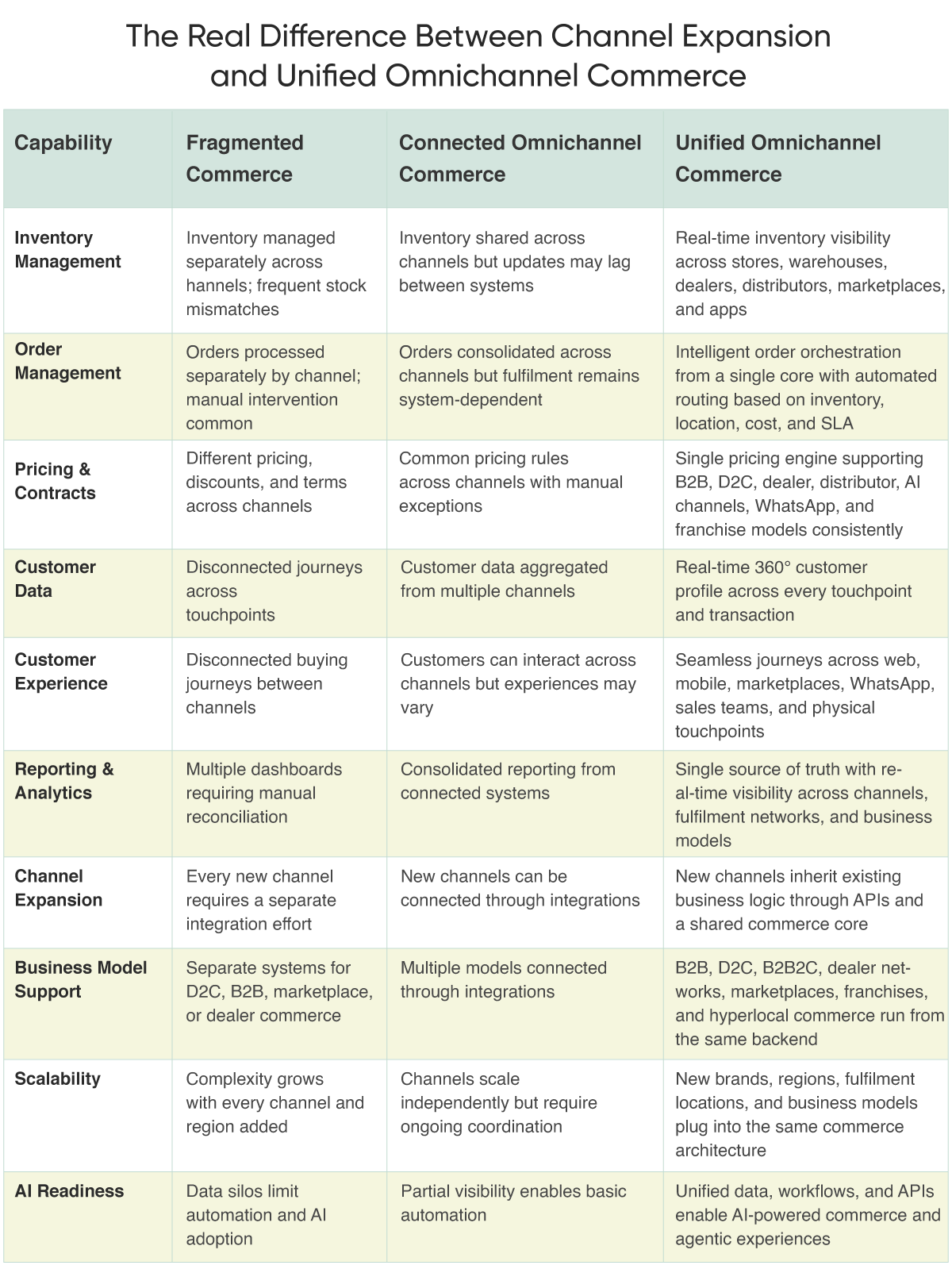
That is what mature omnichannel commerce looks like in practice.
The Future of Omnichannel Commerce Will Be Unified, Intelligent, and Scalable
For years, enterprise brands focused on connecting channels. The next phase is about unifying them.
As buyers move seamlessly between websites, mobile apps, dealer networks, marketplaces, sales teams, WhatsApp, and emerging AI-driven touchpoints, enterprises can no longer afford disconnected operations behind the scenes.
The real challenge is not launching more channels. It is ensuring that every channel runs on the same inventory, pricing, customer, and fulfilmen logic.
This is where a modern enterprise ecommerce platform becomes critical. By creating a single operational backbone for commerce, enterprises gain real-time visibility, intelligent order orchestration, consistent customer experiences, and the flexibility to support new business models without adding complexity.
When combined with the capabilities of an AI-powered ecommerce platform, this foundation enables faster decisions, smarter automation, and the agility to respond to changing buyer expectations at scale.
In this environment, omnichannel commerce is no longer a channel strategy. It becomes the architecture that powers sustainable growth.
The enterprises that will lead tomorrow are not those with the most channels. They are the ones with a unified commerce core capable of supporting every channel, fulfilment network, and business model from a single foundation.
The Building Blocks of Scalable Omnichannel Commerce for Enterprises
The comparison above highlights an important shift.
Enterprises that succeed with omnichannel ecommerce are not simply adding more channels. They are redesigning how commerce operations work underneath those channels.
In other words, omnichannel success is less about storefronts and more about infrastructure.
For the industrial equipment manufacturer in our example, solving the problem did not mean launching another app or integrating another marketplace. It meant building a foundation where every sales channel could operate from the same system.
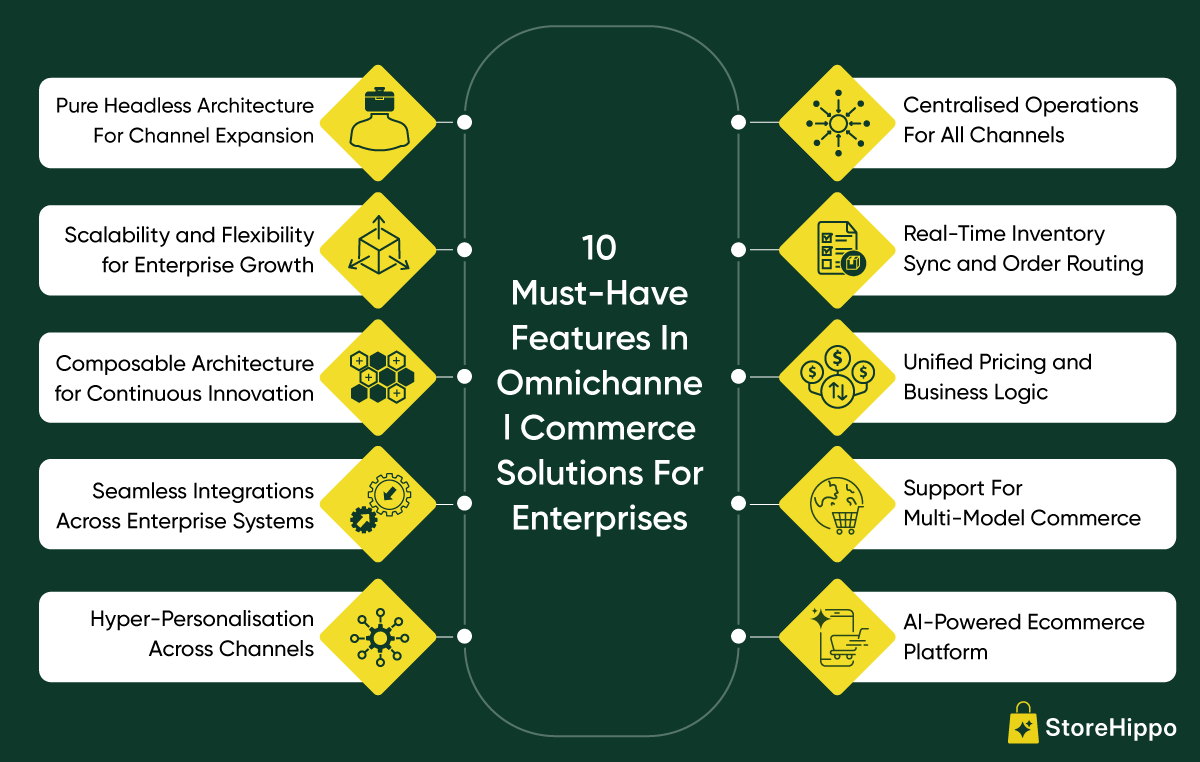
Across industries, the enterprises that scale omnichannel commerce consistently tend to rely on the following core capabilities.
1. Centralised Operations For All Channels
All channels, webstores, marketplaces, distributor portals, mobile apps, and emerging touchpoints must operate from the same operational core.
A modern enterprise ecommerce platform that gives a central admin to enable businesses to manage inventory, pricing, orders, and workflows centrally rather than through channel-specific systems is a must have.
2. Real-Time Inventory Sync and Order Routing
For true omnichannel ecommerce, inventory cannot live in separate systems. Stock availability must remain accurate across warehouses, stores, vendors, and online channels.
An enterprise ecommerce platform with features for real-time inventory visibility and intelligent order routing is the best fit solution for brands so they can fulfill the right orders from the nearest or best fit location without manual intervention.
3. Unified Pricing and Business Logic
Enterprises running B2B and D2C models simultaneously cannot afford inconsistent pricing across channels. Contract pricing, promotions, and approval workflows must remain aligned everywhere a transaction happens.
An enterprise ecommerce platform with a central pricing control can implement consistent business rules across web, mobile, marketplaces, and distributor portals.
4. Support For Multi-Model Commerce
Most enterprises today operate multiple commerce models simultaneously ; B2B, D2C, distributor networks, and marketplaces. Managing these through separate platforms quickly creates operational complexity.
With a scalable enterprise ecommerce platform with native support for these models from the same backend can enable businesses to diversify into more sales channels without duplicating systems.
5. AI-Powered Ecommerce Platform
As channel complexity increases, manual processes slow operations and limit scalability. This is where capabilities from an AI-powered ecommerce platform become critical.
AI-driven automation can support intelligent order orchestration, predictive inventory allocation, workflow automation, and real-time operational insights across channels, helping enterprises manage omnichannel commerce efficiently.
6. Pure Headless Architecture For Channel Expansion
In enterprise environments, new channels are added continuously mobile apps, new storefronts, partner portals, or emerging touchpoints like voice commerce and AI assistants. Without the right architecture, every new channel requires backend duplication or heavy redevelopment.
Having a pure headless enterprise ecommerce platform separates the frontend experience from backend commerce logic, allowing businesses to launch new channels quickly without rebuilding the operational core.
7. Scalability and Flexibility for Enterprise Growth
Enterprise commerce systems must handle fluctuating demand, seasonal spikes, and expanding product catalogues while maintaining performance across channels. Platforms that are not built for scale often struggle as traffic, SKUs, and transaction volumes grow.
A cloud-based enterprise ecommerce platform with built-in scalability and flexible infrastructure ensures businesses can expand into new regions, onboard more vendors, and support growing order volumes without operational disruption.
8. Composable Architecture for Continuous Innovation
Enterprise commerce environments evolve constantly. New technologies, integrations, and customer experiences must be introduced without disrupting existing operations. Rigid systems slow innovation and make upgrades risky.
Opting for a composable enterprise ecommerce platform allows businesses to adopt new capabilities, services, or tools as needed while keeping the core commerce system stable and future-ready.
9. Seamless Integrations Across Enterprise Systems
Omnichannel commerce rarely operates in isolation. Enterprise businesses depend on ERP systems, CRM platforms, logistics partners, payment gateways, and marketing tools to run daily operations.
Finding an enterprise ecommerce platform with robust APIs and integration capabilities ensures these systems remain connected, allowing data to flow seamlessly across the entire commerce ecosystem.
10. Hyper-Personalisation Across Channels
Modern buyers expect experiences tailored to their preferences, behaviour, and purchase history. Delivering this consistently across web, mobile apps, marketplaces, and other touchpoints requires access to unified customer data.
An AI-powered ecommerce platform enables hyper-personalised experiences by analysing customer behaviour across channels and delivering relevant product recommendations, content, and offers in real time.
10 Steps to Build a Successful Omnichannel Commerce Strategy for Enterprises
Let’s look at a real-world scenario of the earlier-mentioned industrial equipment manufacturer aiming for digital transformation.
Initially, the brand chased rapid growth by launching isolated sales channels. Without a unified system, they faced high operational friction and fragmented data. The turning point came when they shifted from "multi-channel" expansion to building a unified omnichannel commerce foundation.
Here is the 10-step framework used to transition from fragmented sales to true omnichannel excellence:
1. Map All High-Intent Customer Touchpoints
The first step was identifying where the buyers actually live. For this manufacturer, that meant distributor portals, B2B ordering systems, field service teams, mobile apps, and spare-parts D2C site. By mapping these, they identified "experience gaps" where the transition between offline and online was breaking.
2. Adopt a Headless Omnichannel Platform
To eliminate silos, the brand replaced legacy software with a headless enterprise ecommerce platform. By decoupling the frontend (user experience) from the backend (business logic), they created a central "command center" capable of pushing consistent data to any device or interface via APIs.
3. Centralise Real-Time Inventory Visibility
Fragmented stock levels are the enemy of omnichannel. The brand integrated its warehouses, vendors, and dealer networks into a single backend. Centralised inventory management ensured that whether a customer checked an app or visited a distributor, the stock data was 100% accurate in real-time.
4. Harmonise Pricing and B2B Business Rules
Enterprise commerce often involves complex variables. The manufacturer unified its pricing logic so that contract-specific pricing, volume discounts, and multi-level approvals remained consistent across the web, PWA (Progressive Web Apps), and distributor sub-stores.
5. Seamless API Based Integrations
Rather than a "rip and replace" approach, the brand used API-first integration to connect existing ERP, CRM, and logistics systems to the ecommerce core. This allowed operational data to flow bi-directionally, ensuring the finance and sales teams were always in sync.
6. Scale via a Unified Multi-Store Backend
With a robust core, the brand launched new digital storefronts and marketplace integrations on the same backend. This enabled them to manage D2C, B2B, and B2B2C models from a single dashboard, preventing the creation of new technology silos.
7. Implement Intelligent Order Routing (IOR)
To optimise fulfillment, orders from any channel, be it a WhatsApp bot or a distributor portal, now got automatically routed to the nearest or most cost-effective warehouse. Using automated workflows, they reduced delivery times and shipping costs significantly.
8. Unify Data for 360-Degree Customer Insights
By consolidating data from all touchpoints, the business gained a comprehensive record of each customer. These data-driven insights allowed for predictive demand forecasting and personalised product recommendations, increasing the Average Order Value (AOV) across the omnichannel ecommerce ecosystem.
9. Rapidly Deploy Emerging Channels
Because the architecture was future-ready, the brand could add new "composable" touchpoints, like voice-enabled ordering, AI shopping assistants, and WhatsApp Shop without rebuilding the core system. This agility provided the brand with a truly scalable enterprise strategy.
10. Continuous Optimization with AI-Powered Analytics
Finally, the brand leveraged the AI capabilities of their platform to automate repetitive tasks. From predictive inventory allocation to real-time operational audits, AI-driven insights ensure the strategy evolves as fast as market demands.
While the manufacturer’s journey highlights the strategic roadmap, the technical execution is where most enterprises stumble. Fragmented legacy systems and complex, plugin-heavy architectures often stall growth before it begins.
StoreHippo was built specifically to solve these enterprise-grade frictions. Having empowered diverse global brands to transition from chaotic multi-channel setups to streamlined, unified omnichannel commerce ecosystems, we understand that the right platform isn't just a tool, it’s the backbone of your enterprises’s digital transformation.
Why StoreHippo Is the Best Choice for Enterprises Pivoting to Omnichannel Ecommerce
Fragmented systems, plugin-heavy platforms, and disconnected tools often make omnichannel ecommerce harder to scale for enterprises.
This is where choosing the right enterprise ecommerce platform becomes critical. StoreHippo is built to simplify this transition by providing a unified foundation for scalable omnichannel commerce.
Here are some of the capabilities that make StoreHippo a strong choice for enterprises building future-ready omnichannel ecommerce ecosystems.
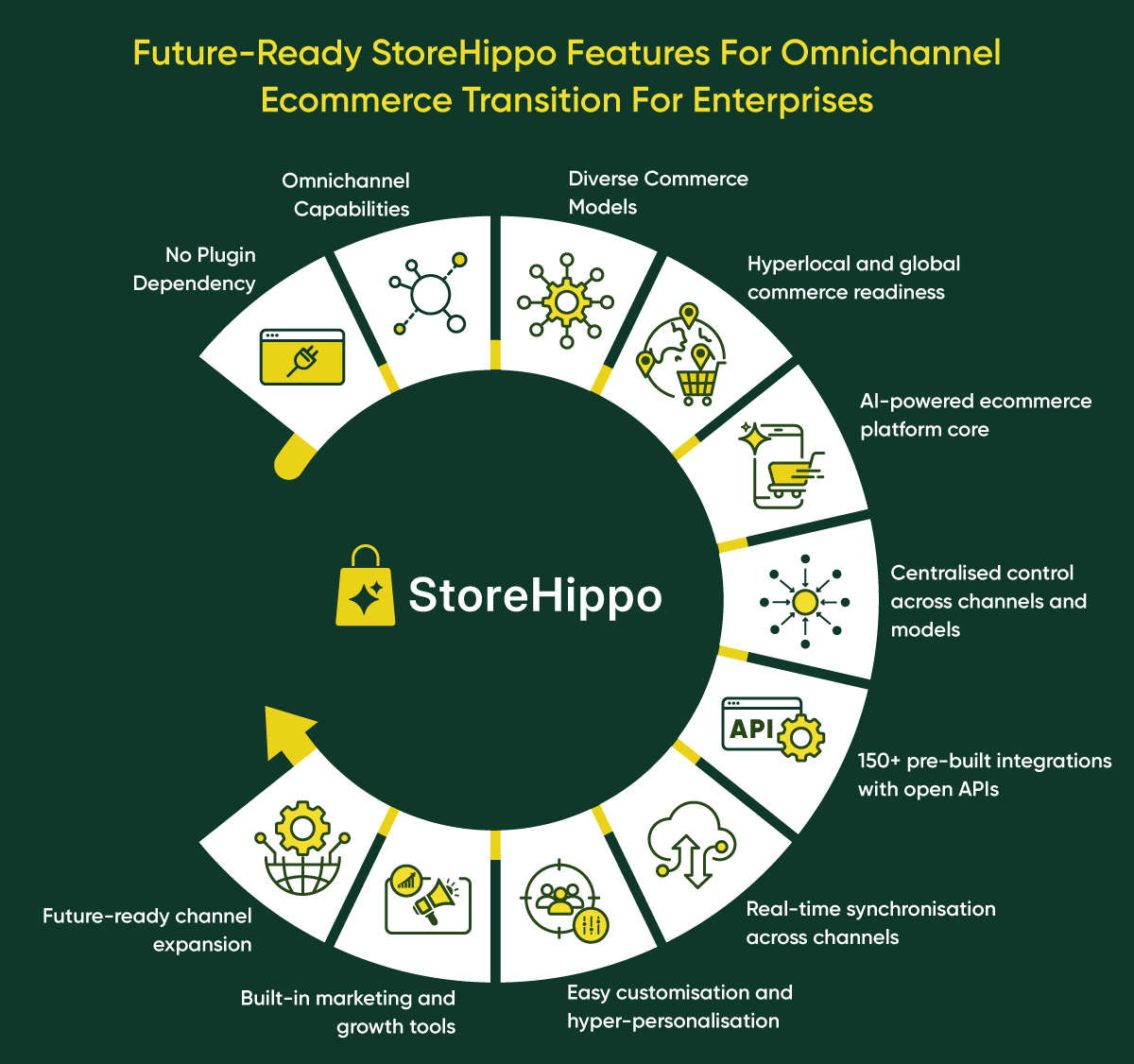
- 300+ native features, no plugin dependency - Build and scale omnichannel ecommerce operations without relying on fragmented third-party extensions.
- Built-in omnichannel capabilities - Launch webstores, mobile apps, WhatsApp commerce, voice commerce, and even custom AI shopping assistants from the same platform.
- Native support for diverse commerce models - Run B2B, D2C, B2B2C, and multi-vendor marketplace ecosystems from one enterprise ecommerce platform.
- Hyperlocal and global commerce readiness - Support local delivery networks, regional storefronts, and cross-border commerce from the same backend.
- AI-powered ecommerce platform core - Intelligence embedded across catalogue management, search, workflows, and decision-making for smarter operations.
- Centralised control across channels and models - Manage products, catalogs, inventory, pricing, orders, and workflows across all touchpoints from a single admin.
- 150+ pre-built integrations with open APIs - Connect seamlessly with ERP, CRM, payment gateways, logistics partners, and marketing systems.
- Real-time synchronisation across channels - Maintain consistent inventory, pricing, and customer experiences across web, mobile apps, marketplaces, and partner portals.
- Easy customisation and hyper-personalisation - Adapt storefronts, workflows, and user journeys to match enterprise business requirements.
- Built-in marketing and growth tools- Run promotions, loyalty programs, discounts, and engagement campaigns directly within the platform.
- Future-ready channel expansion - Extend omnichannel commerce to emerging touchpoints like conversational commerce, voice interfaces, and AI-driven shopping experiences without rebuilding systems.
Conclusion
Enterprise buyers already move across webstores, mobile apps, marketplaces, distributor portals, and emerging channels. For brands, delivering a consistent experience across all these touchpoints requires more than adding new channels, it requires a unified foundation.
A modern enterprise ecommerce platform brings inventory, pricing, orders, and customer data into one operational core. When strengthened with an AI-powered ecommerce platform, enterprises can automate workflows, optimise fulfilment, and run scalable omnichannel ecommerce operations without increasing complexity.
Enterprises that build this foundation today will be able to expand channels, introduce new business models, and adapt to evolving buyer journeys with confidence.
Want to see how your enterprise can build scalable omnichannel commerce?
Book a demo with StoreHippo and explore how an AI-powered enterprise ecommerce platform can power your growth across every channel.
FAQs
1. What are the top 3 non-negotiables in an enterprise ecommerce platform for successful omnichannel commerce?
The three non-negotiables are a unified operational core, flexible architecture, and enterprise-grade scalability. An enterprise ecommerce platform must centralise inventory, pricing, orders, customer data, and fulfilment across channels while supporting new business models and growing transaction volumes without adding complexity.
For enterprises building omnichannel commerce across webstores, mobile apps, marketplaces, dealer networks, and emerging channels, these capabilities ensure consistent customer experiences, operational efficiency, and the flexibility to scale without rebuilding systems as the business evolves.
For enterprises implementing omnichannel ecommerce across web, mobile apps, marketplaces, and distributor networks, three capabilities are critical.
- Unified operational core to manage inventory, pricing, and orders across channels
• Flexible architecture that supports multiple commerce models like B2B, D2C, and marketplaces
• Scalable infrastructure that can support high transaction volumes and new channel expansion
An enterprise ecommerce platform designed for large-scale omnichannel commerce operations should bring these capabilities together so enterprises can expand channels without duplicating systems.
2. What are the biggest red flags when choosing an enterprise ecommerce platform for omnichannel ecommerce?
The biggest red flags are heavy dependence on third-party plugins, separate systems for different business models, limited integration flexibility, and inconsistent inventory or order visibility across channels. These issues often create operational silos, increase costs, and make scaling difficult.
A robust enterprise ecommerce platform should provide a unified foundation for omnichannel ecommerce, bringing inventory, orders, pricing, customer data, logistics and integrations together in one system rather than relying on fragmented tools and disconnected workflows.
Several warning signs indicate a platform may struggle to support enterprise-scale omnichannel commerce.
- Heavy reliance on third-party plugins for core capabilities
- Separate systems required for B2B, D2C, or marketplace models
- Limited integration flexibility with ERP, CRM, and logistics platforms
- Inconsistent inventory or order visibility across channels
A strong enterprise ecommerce platform for omnichannel ecommerce architecture should provide built-in capabilities and unified operational control rather than relying on fragmented integrations.
3. Is an enterprise ecommerce platform without a large plugin ecosystem a problem for omnichannel commerce?
Not necessarily. In many enterprise scenarios, fewer plugins can actually be an advantage.
Plugin-heavy ecosystems often create operational risk because critical features like inventory, pricing, or order orchestration depend on external extensions. This can lead to compatibility issues and fragmented workflows.
An enterprise ecommerce platform with native omnichannel commerce capabilities reduces dependency on plugins by providing built-in features for multi-store management, mobile apps, integrations, and automation. This approach simplifies omnichannel ecommerce operations at enterprise scale.
4. How does an AI-powered ecommerce platform improve enterprise omnichannel ecommerce operations?
An AI-powered ecommerce platform helps enterprises automate decisions, optimise operations, and deliver more personalised customer experiences across channels. An AI-core adds intelligence across multiple operational layers.
AI capabilities can automate catalog creation, optimise order routing, analyse buyer behaviour across channels, and enable hyper-personalised shopping experiences through personalised recommendations. For enterprises managing thousands of SKUs and multiple sales channels, this intelligence improves operational efficiency and decision-making across the entire omnichannel ecommerce ecosystem.
5. How can enterprises future-proof their omnichannel commerce strategy when new channels keep emerging?
Enterprises can future-proof omnichannel commerce by choosing an enterprise ecommerce platform that separates customer-facing experiences from backend operations. This makes it easier to adopt new channels without disrupting existing systems.
A modern platform with headless, API-first architecture allows enterprises to launch new storefronts, mobile apps, marketplaces, AI-powered shopping experiences, and future touchpoints while continuing to use the same inventory, pricing, customer, and fulfilment infrastructure. This ensures long-term flexibility as buyer behaviour and technology continue to evolve.
Pallavee Kumar brings over 20 years of hands-on ecommerce experience, helping B2B, B2C, and enterprise brands scale through strong operations and clear storytelling.
She writes about enterprise ecommerce, unified omnichannel commerce, and building flexible, AI-ready commerce ecosystems that can adapt to new customer touchpoints and evolving business models.