


Running a B2B ecommerce business today isn’t just challenging; it’s a battlefield.
Keeping up with evolving markets, unpredictable buyer demands and ever-changing technology feels like chasing a moving target.
What worked yesterday is outdated today.
And tomorrow? Well, that’s a whole new game.
B2B buyers no longer tolerate slow, clunky, and outdated systems.
They want the speed of B2C shopping, the precision of enterprise solutions, and the flexibility of ecommerce, all together and more. And with AI rewriting the growth playbook standing still is no longer safe.
If you’re struggling to modernise your B2B business, keep up with evolving buyer expectations, and not get lost amidst disruptive models, you’re not alone.
The B2B landscape is shifting fast, and staying ahead requires more than just an online presence, it demands agility, innovation, and the right B2B platform to power your brand.
In this blog, we’re not just listing the top 7 challenges holding B2B businesses back, we’re giving you actionable solutions to overcome them.
From scalability and expansion concerns to pivoting to disruptive hybrid models, we have covered a broad spectrum of challenges and suggested strategic solutions to future-proof your business.
But before we dive in, let us first check the top B2B ecommerce trends.
Table of Contents
Navigating Modern B2B Ecommerce: Trends, Challenges, and Fixes
Modern B2B ecommerce is evolving rapidly, driven by digital transformation, AI advancements, and changing buyer expectations. As enterprises move toward self-service portals, mobile-first journeys, and omnichannel engagement, multiple challenges continue to create operational bottlenecks.
AI is now reshaping how B2B businesses personalise experiences, optimise operations, and drive revenue growth. To stay competitive, brands need agile ecommerce platforms that combine flexibility with AI-driven intelligence and a future-ready approach.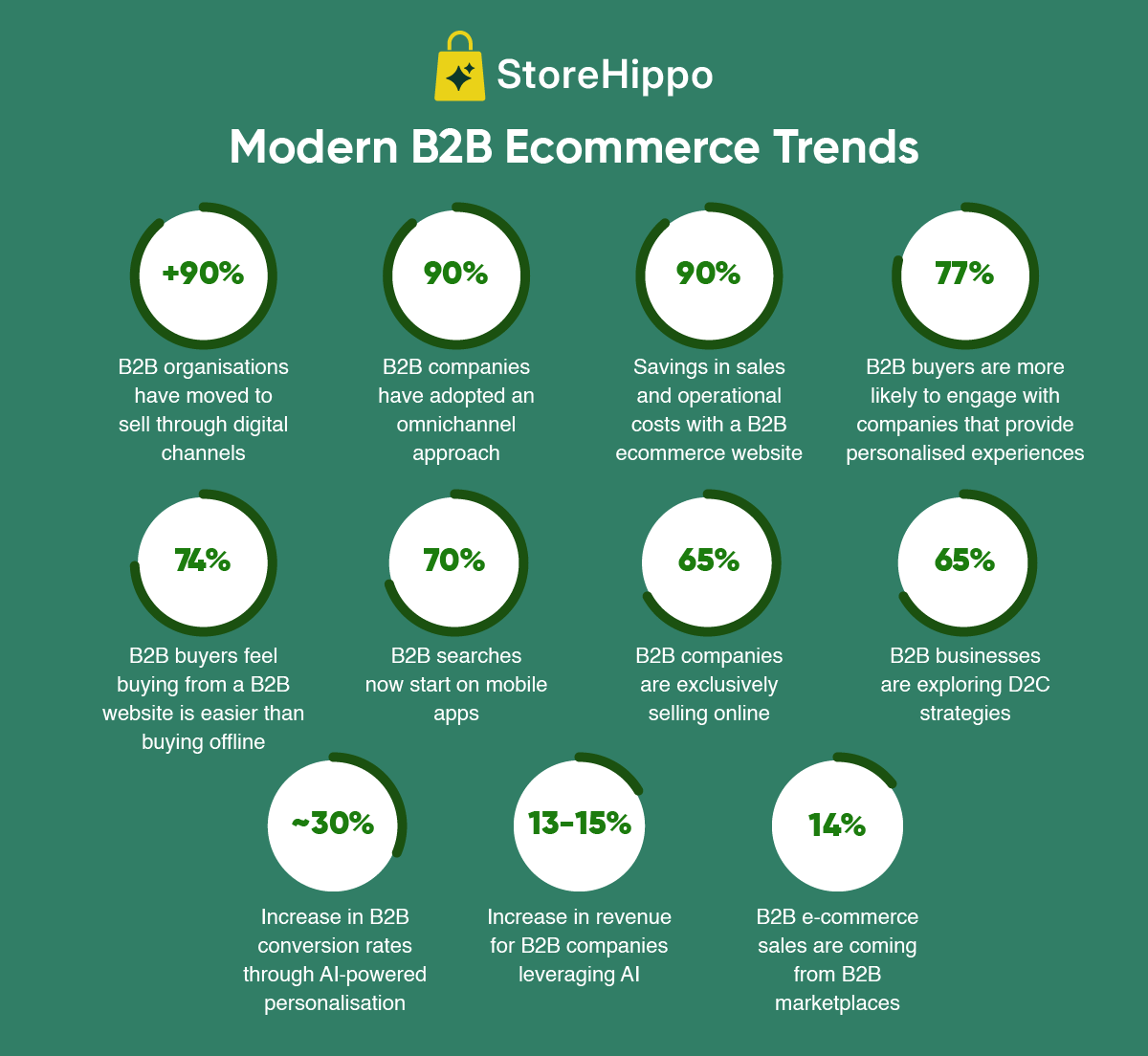
Here are a few trends to watch out for:
- 90%+ of B2B organisations have moved to sell through digital channels
- 65% of B2B companies are exclusively selling online
- 74% of B2B buyers feel buying from a B2B website is easier than buying offline
- 70% of B2B searches now start on mobile apps
- 90% of B2B companies have adopted an omnichannel approach
- 14% of all B2B e-commerce sales are coming from B2B marketplaces
- 65% of B2B businesses are exploring D2C strategies
- 77% of B2B buyers are more likely to engage with companies that provide personalised experiences
- 13-15% increase in revenue for B2B companies leveraging AI
- ~30% increase in B2B conversion rates through AI-powered personalisation
- 90% savings in sales and operational costs with a B2B ecommerce website
Source: McKinsey, McKinsey & Company, Statista, DHL Express
From rapid digital adoption and mobile-first buying to the growing importance of marketplaces, omnichannel strategies, and personalised experiences, the data highlights a broader shift in B2B ecommerce. While AI is playing an increasingly important role in driving conversions and efficiency, it is part of a larger transformation shaping how B2B businesses sell and scale.
To stay competitive, enterprises must strengthen their digital presence, adopt multichannel strategies, and AI-powered tools to create real impact. Businesses that align their ecommerce strategy with these evolving trends will be better positioned to expand into new markets, improve buyer loyalty, and drive sustainable growth.
While these trends signal massive opportunity, they also bring new challenges, making it crucial for enterprises to identify the key roadblocks standing in their way.
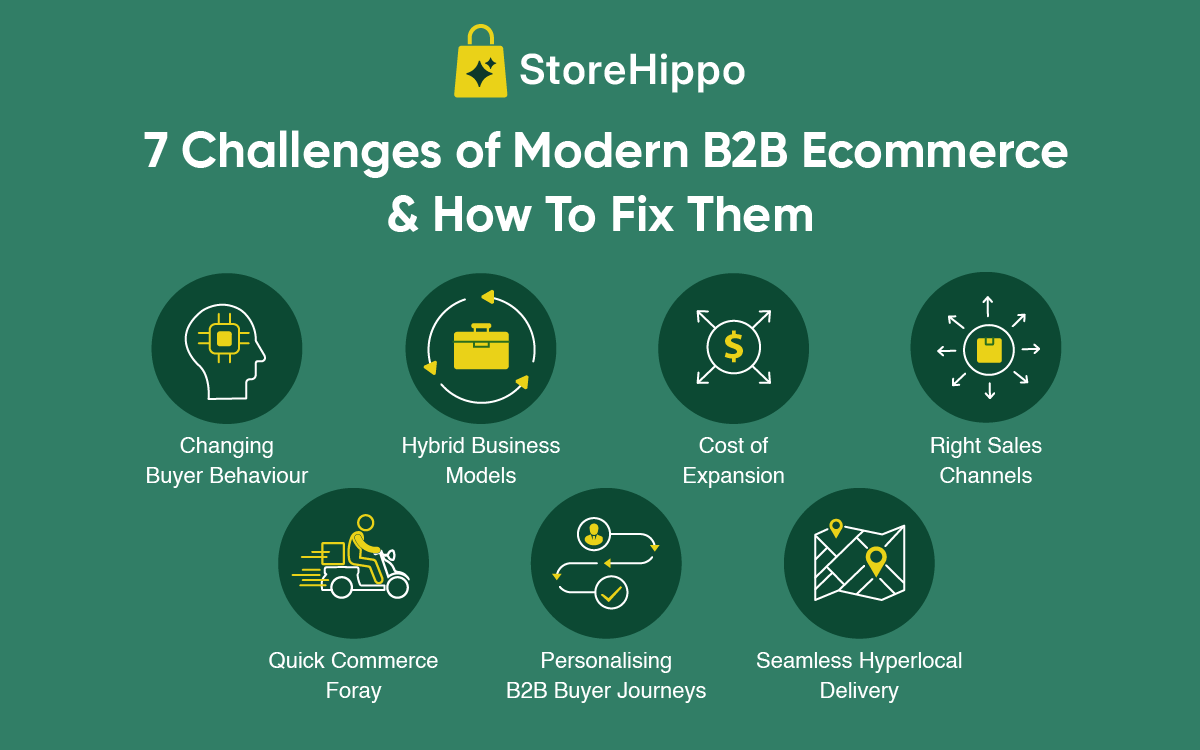
7 Unique Challenges of Modern B2B ecommerce And How to Overcome Them
B2B ecommerce is booming. And as it happens with every rapid transformation, new challenges emerge just as fast as new opportunities.
From tackling the shifting buyer expectations, managing hybrid business models, and balancing scalability with cost efficiency, businesses must adapt or risk being left behind. To stay competitive and future-proof your business in the fast-evolving digital landscape, overcoming key challenges is essential.
Let’s explore seven major roadblocks in modern B2B ecommerce and the best ways to tackle them for long-term success.
1. Adapting to Changing Buyer Behaviour
B2B buyers are no longer satisfied with slow, traditional purchase cycles. They expect intuitive digital experiences, self-service portals, and personalised interactions similar to B2C shopping. Faster order fulfillment is becoming a critical expectation for the buyers today, pushing B2B businesses to rethink logistics. To stay competitive, enterprises must offer seamless ordering, real-time negotiation options, and quick deliveries while catering to diverse payment preferences and bulk order requirements.
To meet these evolving expectations at scale, enterprises need intelligence embedded into their B2B ecommerce operations. StoreHippo’s AI-native commerce engine enables marketplaces to move beyond static workflows by powering intent-aware buying experiences. AI-driven discovery, personalised recommendations, and assisted buying journeys help enterprises respond dynamically to buyer behaviour instead of relying on rigid, rule-based systems.
StoreHippo B2B ecommerce solutions help businesses build a marketplace that aligns with the modern buyer behaviour. Built on the decoupled headless architecture, StoreHippo helps you implement multi-level personalisations like creating multiple B2B ecommerce storefronts based on various locations, audiences, or different categories. You can customise your shipping solutions and digital payments and offer localisation with multilingual content and personalised pricing, create different store designs, discounts, etc. The RFQ feature from StoreHippo helps buyers request quotes from vendors, get pricing and approve or reject quotes. The B2B vendors can use a 3-way admin-buyer-vendor chat solution to answer queries and close negotiations in real-time. StoreHippo helps streamline logistics with its 30+ pre-integrated logistics solutions.
2. Pivoting to Hybrid Business Models
The traditional B2B model is evolving, and enterprise ecommerce marketplaces can no longer rely on a single business model. Enterprises need to blend multiple business models like B2B, B2C, D2C, etc, to maximise their reach and boost conversions. This shift, however, requires an agile platform that supports different business models, buyer segments, and fulfillment workflows while ensuring a unified experience across all channels. Managing multiple business models without a flexible architecture can become a logistical and operational challenge.
The fully hosted and managed enterprise ecommerce platform, StoreHippo comes with inbuilt support for diverse business models. It also comes with battle-tested solutions to help you build your B2B enterprise marketplace in record time. StoreHippo B2B ecommerce solutions come with native support for various business models that make it easy to pivot to new business models or combine two or more models to create a hybrid business model. With the plug-and-play solutions from StoreHippo, you do not require any additional apps or extensions to build hybrid solutions for your unique business needs. StoreHippo’s flexible architecture supports hybrid commerce, allowing you to operate multiple models from a single platform.
3. Balancing Scalability And Cost of Expansion
Scaling a B2B business requires significant investment in infrastructure, logistics, and workforce. Expanding your enterprise ecommerce marketplace to new regions or adding new product lines demands high operational efficiency while keeping costs under control. Businesses must optimise backend operations, streamline order management, and leverage cloud-based solutions to scale without unnecessary expenses. When expanding to foreign regions, managing multi-currency transactions and region-specific catalogs further adds to the complexity.
StoreHippo’s enterprise ecommerce marketplace platform is built for scalability. The cloud-native architecture from StoreHippo ensures high performance even with large product catalogues and high order volumes. The elastic scalability of the cloud-native infrastructure along with the auto-provisioning of servers ensures that enterprise brands need not worry about peak load tolerance or growing exponentially. The built-in multi-currency and multi-lingual features help you scale your marketplace beyond borders and engage with your buyers seamlessly. You can create multiple language specific sub-stores to offer a personalised buyer journey to your customers. With the multi-currency feature from StoreHippo, you can offer your customers the ease of paying in their local currency, thus making it easy to capture global customers.
StoreHippo further reduces the cost of expansion through AI-powered cataloguing, which speeds up GTM by making vendor cataloguing faster and accurate. Native AI also automates product tagging, categorisation, and optimisation at scale, enabling enterprises to onboard thousands of SKUs and regional assortments without increasing operational effort.
Its AI image editing tool, Magic Edit, transforms raw product images into market-ready visuals by enhancing lighting, refining clarity, and removing backgrounds automatically.
This AI powered automation helps B2B businesses scale faster, maintain catalogue consistency, and keep operational costs predictable.
4. Choosing the Right Sales Channels
With multiple sales channels including apps, websites, social commerce, you must identify the most effective platforms for maximum visibility and conversions. Selling across too many channels without a strategic approach can dilute brand presence and lead to inefficiencies. B2B ecommerce brands need a data-driven approach to analyse channel performance, optimise inventory distribution, and ensure a consistent experience for buyers. Choosing the right sales channels can be challenging for enterprises without the right set of analytical tools.
StoreHippo comes with a gamut of marketing tools and analytical solutions to help you analyse your customer segmentation and buyer behaviour. You can make data-centric marketing plans for overall business growth and leverage the best-selling channel. Built on decoupled headless architecture, StoreHippo gives the creative freedom to create personalised landing pages, and a consistent buyer journey across channels for your enterprise ecommerce marketplace buyers. With StoreHippo, you can seamlessly integrate with several data tools like Google Analytics, Zoho, etc. that help decide the right market-product-channel mixes for business growth.
Beyond analytics dashboards, StoreHippo offers AI-powered semantic search and recommendations to improve how products are surfaced. With StoreHippo’s AI-powered semantic search, you can deliver highly accurate search results to your buyers. AI-enabled recommendations help you offer relevant products based on buyer intent, context, and past purchase behaviour, helping you drive better conversions without constant manual intervention.
5. Planning Quick Commerce Foray
Quick commerce is no longer limited to B2C, it is gaining traction in B2B as well. Businesses dealing in FMCG, pharmaceuticals, industrial supplies, etc, are under pressure to offer same-day or two-hour deliveries. This shift in B2B businesses poses a major challenge as it requires a robust hyperlocal supply chain, smart inventory placement, and last-mile delivery optimisation. Without an agile logistics network, implementing quick commerce in B2B enterprise ecommerce marketplace at scale can be a major hurdle.
StoreHippo’s hyperlocal commerce capabilities make quick commerce feasible for B2B enterprises. You no longer need to set up warehouses and stock them up with inventory. You can use the turnkey marketplace solution combined with multi-store set-up and have your q-commerce brand up and running. StoreHippo’s multi vendor solutions help you onboard multiple local vendors to create a quick commerce setup for your audience. Each of your vendors get a unique dashboard on your dealer-powered marketplace. A separate dashboard helps your distributors manage their product catalog, orders, inventories, returns, etc. Your vendors can seamlessly manage their respective inventories and delivery agents from a common central admin dashboard.
6. Personalising B2B Buyer Journeys Across Channels
Modern B2B buyers expect seamless, personalised experiences across websites, mobile apps, and every digital touchpoint. From tiered pricing and tailored catalogues to behaviour-based product recommendations, personalisation is no longer optional , it is core to driving engagement, trust, and long-term loyalty.
With StoreHippo’s advanced personalisation tools, you can build a B2B marketplace with pricing override, customised catalogs, and personalised product recommendations. Built on MACH architecture, StoreHippo B2B ecommerce solutions give you better creative control and agility to implement multi level personalisations. With StoreHippo’s built-in features like drag-and-drop design tools, pricing overrides, discount engine, you can implement multi-level personalisations on your marketplace. The price override feature helps you offer personalised product prices based on customer segments and locations. With the built-in discount engine from StoreHippo, you can create personalised discounts and offers for your buyers. You can send out personalised notifications to your buyers with the PUSH notification feature from StoreHippo B2B ecommerce solutions.
As AI has become the critical growth driver in recent years, its role in personalisation is reshaping how B2B marketplaces engage modern buyers.
With AI built into its core, StoreHippo enables AI-powered personalisation through unified search, intelligent recommendations, and the ability to build custom AI agents for assisted buying journeys.
Its AI-powered search and recommendations help showcase relevant products based on buyers’ browsing history and past purchase behaviour. You can also build custom AI agents to guide buyers through product discovery, selection, and order placement, reducing dependency on manual support while improving responsiveness.
7. Building a Seamless Hyperlocal Delivery Network
The rise of hyperlocal commerce has made fast and efficient deliveries a top priority for B2B enterprises. Businesses must coordinate with dealers, distributors, and local fulfillment centers to ensure smooth order processing. Without a well-integrated delivery network, fulfilling hyperlocal demand becomes challenging, leading to delayed shipments and dissatisfied customers. Additionally, managing region-specific pricing, compliance, and logistics partners adds complexity, making it crucial to have a streamlined approach to hyperlocal fulfillment.
With StoreHippo’s 30+ pre-integrated shipping solutions, your vendors can meet modern buyer expectations with fast and efficient hyperlocal deliveries. Vendors on your quick commerce platform can also manage their own fleet of delivery boys with the built-in delivery boy management solution from StoreHippo.
Conclusion
Modern B2B ecommerce is becoming more complex as buyer expectations rise and operations expand across multiple channels. Businesses today must manage large catalogues, personalised pricing, hybrid models, and faster fulfilment, all while maintaining efficiency and control. Increasingly, AI is playing a critical role in helping enterprises streamline operations, improve efficiency, decision-making, and buyer experiences.
StoreHippo B2B ecommerce solutions are built as an AI-native commerce engine, enabling enterprises to build scalable, agile, and future-ready B2B marketplaces. With a unified intelligence layer spanning catalogues, discovery, operations, and support, StoreHippo helps businesses overcome modern B2B challenges while delivering consistent buyer and seller experiences.
Ready to tackle the modern B2B ecommerce challenges with StoreHippo? Explore the wide range of features by booking your custom demo now.
FAQs
1. Why do enterprise B2B marketplaces struggle to scale operations smoothly?
As a B2B marketplace grows, operational complexity increases across seller onboarding, inventory coordination, pricing rules, and fulfilment workflows. Enterprises often rely on fragmented systems and manual processes, which leads to delays, errors, and poor visibility as scale increases. This makes consistent execution difficult and directly impacts buyer experience.
StoreHippo B2B ecommerce solutions address this by unifying vendor management, orders, pricing, payments, and fulfilment into a single operational framework. This allows enterprises to scale marketplace operations without adding complexity or operational overhead.
2. How can enterprises modernise B2B marketplace operations without disrupting ongoing business?
Large enterprises often delay modernisation due to fear of disrupting existing seller and buyer workflows. The key is to evolve operations incrementally while maintaining continuity across core processes.
StoreHippo enables modernisation through intuitive dashboards for admins, sellers, self-serve features for buyers, along with role-based access controls, and also enables enterprises to make custom AI agents for industry or business niche. Its API-first, headless, and microservices-based architecture enables B2B enterprises to enable automation and new workflows without breaking existing operations.
3. Why is a unified platform critical for managing multi-vendor B2B marketplace operations?
Managing sellers, inventory, commissions, and fulfilment across disconnected systems creates operational silos and increases dependency on manual coordination. As seller count grows, lack of centralised control becomes a major scalability risk.
StoreHippo’s native multi-vendor architecture provides centralised control while allowing vendors to operate independently. Seller dashboards, automated settlements, configurable commission rules, and unified order visibility ensure smooth and scalable B2B marketplace operations.
4. How can enterprises maintain pricing consistency while allowing flexibility for B2B buyers?
In B2B marketplaces, inconsistent pricing and unstructured discounting can weaken trust and margins. Enterprises need structured pricing controls without limiting negotiation flexibility for bulk buyers and key accounts.
StoreHippo B2B ecommerce solutions offer built-in tiered pricing, MOQ rules, RFQ workflows, and multilevel discount engine. This ensures controlled, consistent pricing across sellers while supporting negotiated and customer-specific pricing models.
5. How does AI improve B2B marketplace operations and buyer engagement?
AI enhances B2B marketplace operations by reducing manual effort in catalogue management, improving product discovery, and guiding buyers through large and complex assortments. It also helps marketplaces scale support and decision-making without increasing headcount.
With StoreHippo, AI is built into the core platform, powering catalogue automation, intelligent discovery, assisted buying journeys, and support to build custom AI agents for buyers, sellers, and internal teams. This results in faster execution, higher conversions, and more consistent buyer experiences at scale.
6. How can enterprises improve fulfilment efficiency in multi-vendor B2B marketplaces?
B2B fulfilment often involves split shipments, partial fulfilment, multiple vendors, and diverse logistics partners. Without integrated fulfilment workflows, coordination becomes slow and error-prone.
StoreHippo offers built-in logistics management with integrations across 30+ shipping providers. Wholesalers can manage pickups, shipments, bulk labels, and real-time tracking from a single dashboard, simplifying fulfilment across vendors and regions.
7. Why is real-time operational visibility important for enterprise marketplace leaders?
Enterprise decision-makers need real-time insights into sales performance, vendor efficiency, inventory health, and fulfilment bottlenecks. Delayed or fragmented data leads to reactive decisions and missed growth opportunities.
StoreHippo provides real-time dashboards and built-in analytics for sales, vendors, orders, and regions. This enables leadership teams to proactively optimise B2B marketplace operations and improve performance continuously.
8. How can enterprises future-proof their B2B marketplace operations for 2026 and beyond?
Buyer expectations, pricing models, and operational complexity evolve rapidly in B2B commerce. Marketplaces that rely on rigid or plugin-heavy systems struggle to adapt at speed.
StoreHippo’s composable, low-code architecture combined with native AI capabilities enables enterprises to continuously evolve workflows, automate operations, and personalise experiences. This makes the marketplace adaptable, resilient, and future-ready.
9. Which operational capabilities matter most when expanding into new regions or buyer segments?
Expansion introduces complexity around tax compliance, logistics, pricing rules, and seller management. Without a scalable backend, growth becomes expensive and operationally risky.
StoreHippo B2B ecommerce solutions support multi-region expansion through multi-store setups, a built-in tax engine, multi-currency support, and configurable fulfilment workflows, enabling enterprises to scale geographically with operational control.
10. Why are enterprises moving away from plugin-based systems for B2B marketplaces?
Plugin-heavy platforms increase maintenance overhead, integration risks, and performance issues as marketplaces scale. Over time, this leads to instability and higher operational costs.
StoreHippo offers a no-plugin, enterprise-grade platform where core marketplace capabilities are built-in. This ensures greater stability, security, and scalability, key requirements for running modern, high-volume B2B marketplace operations.