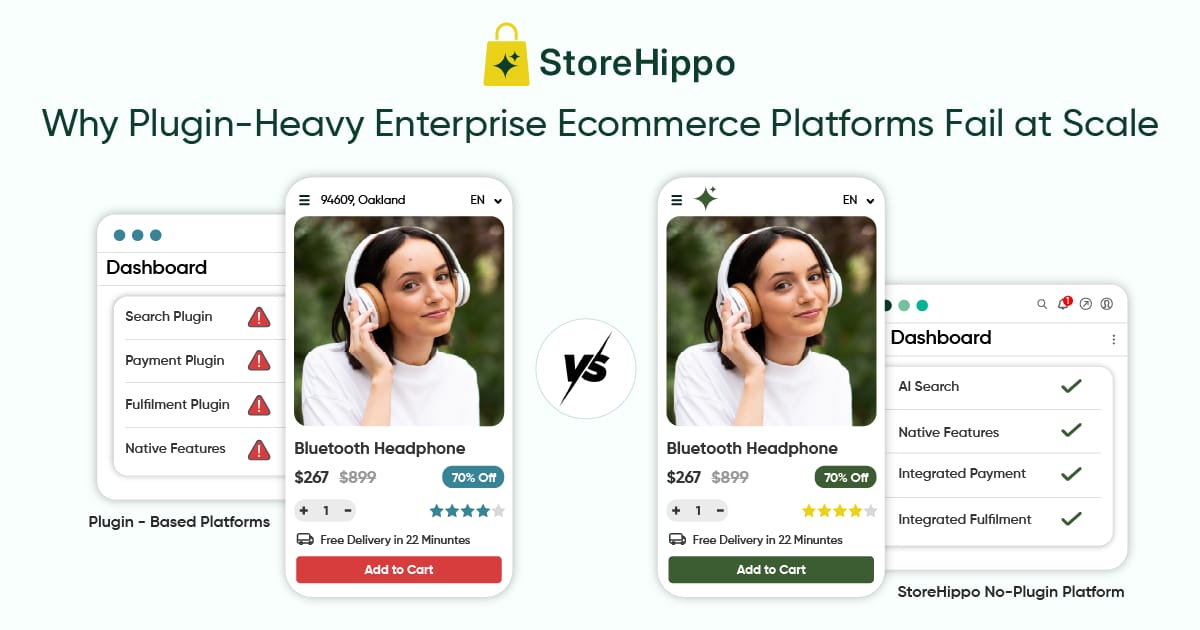



Why Plugin-Heavy Enterprise Ecommerce Platforms Start to Break at Scale
Most enterprise ecommerce challenges today don’t start with broken systems; they start with capable platforms surrounded by too many tools.
Every plugin-based enterprise ecommerce platform looks impressive on paper, but no two of them struggle in quite the same way.
For years, adding plugins and tools was the fastest way to move forward. Each new requirement- search, checkout, personalisation, fulfilment-was solved by layering another solution.
That approach worked until scale began exposing the cracks.
Today, many enterprise teams face the same pattern:
- Multiple tools doing overlapping jobs
- Data spread across disconnected systems
- Simple changes taking weeks instead of days
- Teams managing integrations more than growth
Irrespective of the industry or the model, the underlying enterprise ecommerce challenges remain the same.
The problem is no longer capability. It’s COMPLEXITY.
As ecommerce trends in 2026 push enterprises toward speed, AI-driven experiences, and multi-model operations, this patchwork approach begins to work against them.
Table of Contents
- Why Plugins Became the Default Fix For Enterprise Ecommerce Platforms (And Why That Made Sense Then)
- When Plugin-Based Enterprise Ecommerce Platform Turns Into a Scalability Bottleneck
- Why Optimising Plugin-Heavy Enterprise Ecommerce Stops Working in 2026
- What Enterprise Ecommerce Platforms Must Be Built For in 2026
- How StoreHippo Solves the Enterprise Ecommerce Challenges of 2026
- Comparison Of Plugin-Heavy Ecommerce Platforms vs AI-Native Enterprise Ecommerce Platform StoreHippo (2026)
- Conclusion
- FAQs: How To Choose Enterprise Ecommerce Platforms in 2026
Why Plugins Became the Default Fix For Enterprise Ecommerce Platforms (And Why That Made Sense Then)
Before plugin-heavy structures became a liability, they were a practical solution for many enterprise ecommerce platforms.
Most legacy systems were not designed for rapid change. As enterprises began expanding their digital presence, new requirements kept emerging-additional storefronts, vendor management modules, payments, regional fulfilment rules, marketing tools, and analytics.
Plugins offered a way to respond quickly. Instead of rebuilding the core, teams could extend functionality incrementally. At the time, this felt like the most sensible way to manage growing enterprise ecommerce challenges.
For early-stage enterprises and simpler operating models, plugin-based ecommerce platforms delivered clear advantages:
- Features could be added without long development cycles
- Business teams gained agility without heavy engineering effort
- Platforms evolved step by step, avoiding large, risky rebuilds
This approach prioritised speed and short-term flexibility. Enterprises could keep moving forward without making hard architectural decisions too early.
What’s important to understand is that plugins were never designed to act as a coordinating layer. They were built to solve specific problems in isolation. As long as scale was limited and systems remained relatively contained, this distinction didn’t matter. The real consequences only began to surface as an enterprise ecommerce platform’s operations grew larger, more connected, and more demanding.
When Plugin-Based Enterprise Ecommerce Platform Turns Into a Scalability Bottleneck
The real strain of plugin-based ecommerce doesn’t show up as a dramatic failure. It builds quietly as enterprises scale.
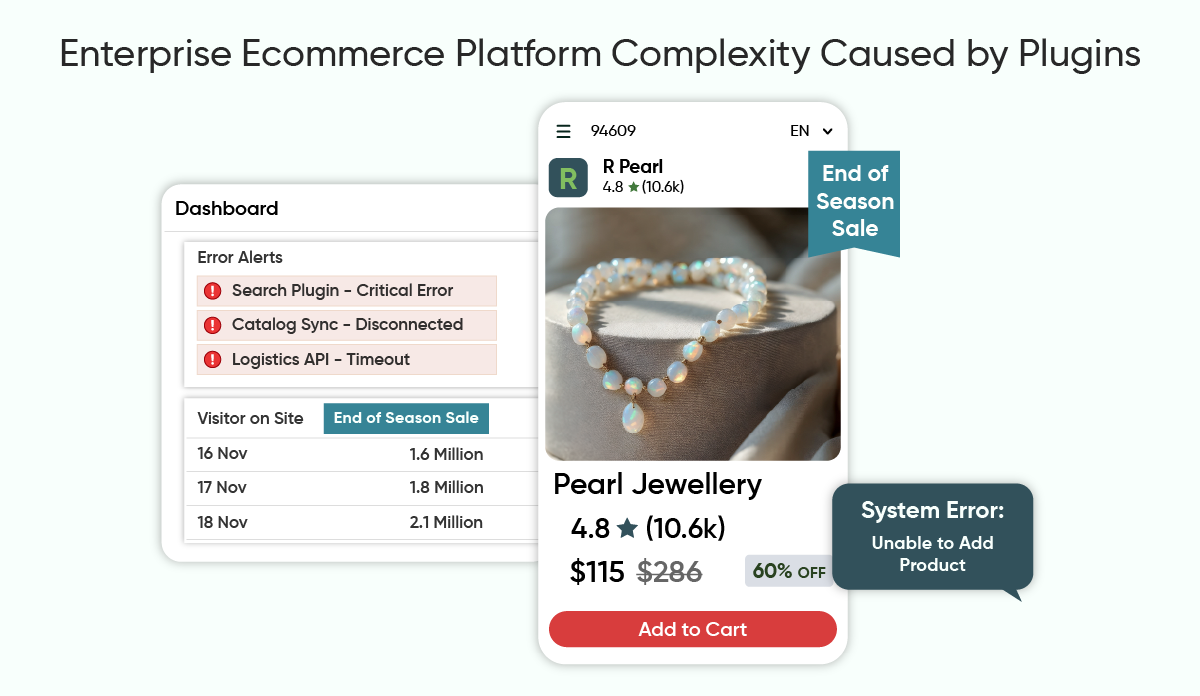
What once felt like a flexible enterprise ecommerce platform begins behaving inconsistently. A search plugin pulls data from one source, while a personalisation tool relies on another. Payments, fulfilment, vendor management, and analytics each operate in their own logic loops. Individually, these tools work. Together, they introduce operational complexity in ecommerce that’s difficult to trace and even harder to resolve.
Enterprise teams start noticing familiar friction:
- The same data behaving differently across tools
- New launches delayed due to integration dependencies
- Performance issues triggered by plugin conflicts
- Engineers spending more time maintaining connections than improving experiences
This is where ecommerce system integration challenges stop being technical inconveniences and become operational constraints. Simple decisions-launching a new sub-store, enabling a new business model, rolling out updates-now require coordination across multiple tools and vendors.
At scale, this friction translates into business impact.
Go-to-market slows. Dependency on external vendors increases. Performance risks rise as more scripts and services interact in real time. Teams find themselves managing systems instead of building, innovating and orchestrating growth.
As ecommerce trends 2026 push enterprises toward speed, AI-driven cores, and multi-model operations, the plugin-based enterprise ecommerce platforms struggle to keep up.
The issue is no longer missing features; it’s that the system itself can’t scale cleanly. This is why problems with plugin-heavy ecommerce platforms become unavoidable, and why many enterprises begin rethinking their foundations altogether.
Why Optimising Plugin-Heavy Enterprise Ecommerce Stops Working in 2026
At this point, the issue is no longer whether plugin-heavy systems can be optimised further. Most enterprise teams have already tried that, fine-tuning integrations, refining workflows, and adding layers to manage growing complexity. These efforts can stabilise systems temporarily, but they don’t change how the platform fundamentally behaves.
The real question enterprise ecommerce leaders now face is this:
Do you continue managing complexity created by disconnected parts, or do you move toward a system designed to coordinate everything by default?
In 2026, ecommerce trends demand enterprise ecommerce platforms that can think across channels, adapt across business models, and respond in real time without constant manual intervention.
When systems are stitched together, intelligence stays fragmented. Coordination becomes reactive. And every new capability adds more weight to an already strained foundation.
This is the moment where incremental plugin fixes stop delivering returns, and a rethink of core architecture, ecommerce replatforming, and no-plugin enterprise ecommerce solutions becomes unavoidable.
What Enterprise Ecommerce Platforms Must Be Built For in 2026
By 2026, enterprise ecommerce platforms that fail big brands won’t be the ones lacking tools, they’ll be the ones unable to make fragmented systems work as one. The challenges enterprises face today are structural, not incremental, and platforms must be built to address them at the foundation level.
At the centre of this shift is intelligence. As AI for ecommerce moves from experimentation to core operations, it depends on shared, real-time context across the system. Search, personalisation, fulfilment decisions, and operational workflows can only improve when data flows through a unified, intelligent core.
When information remains scattered across plugins, intelligence breaks down. When systems operate as one, decisions become faster, more consistent, and more effective across the business.
This is where architecture starts to matter more than optimisation.
Enterprises can no longer afford platforms that grow by adding layers. They need systems designed to scale in a coordinated way where growth doesn’t introduce new friction at every step.
Enterprise ecommerce platforms must also be built to solve for scale without multiplying complexity:
- Disconnected data needs to give way to a single, consistent core powering every layer of ecommerce
- Integration-heavy workflows must be replaced by coordinated system behaviour
- Slow GTM caused by dependencies requires platforms that adapt without rebuilds
- Multi-model expansion demands one system supporting B2B, D2C, marketplaces, and global multi-store operations together
- Operational overhead from tool management calls for platforms designed to orchestrate, not just integrate
- An AI-driven core must run through all of this, enabling smarter decisions, faster execution, and continuous efficiency across customer experiences, operations, and internal teams
This is where ecommerce trends 2026 make the shift unavoidable. Speed, intelligence, and scale can no longer be layered on through tools or integrations. They have to be inherent to how the enterprise ecommerce platform is built, with an AI-driven core that connects data, workflows, and teams into a single operating system for commerce.
How StoreHippo Solves the Enterprise Ecommerce Challenges of 2026
As ecommerce trends 2026 continue to reshape how large brands operate, the gap between what enterprises need and what traditional platforms can support has become impossible to ignore. The challenges facing enterprise ecommerce today- fragmented systems, slow execution, rising operational overhead, and difficulty scaling across models and markets, are not isolated problems. They are symptoms of platforms that were never designed to operate as a unified system.
This is where the difference between adding capabilities and designing foundations becomes clear. Enterprise ecommerce platforms that succeed in 2026 are not built around plugins or patchwork integrations. They are designed to coordinate intelligence, workflows, and scale from the core, using AI for ecommerce as an operating layer rather than an add-on.
StoreHippo was built with this mind shift. Instead of helping enterprises manage complexity, it focuses on eliminating it at the architectural level. The platform addresses the exact structural challenges modern enterprises face by replacing fragmented tools with a unified, AI-native foundation that can adapt, scale, and evolve as one system.
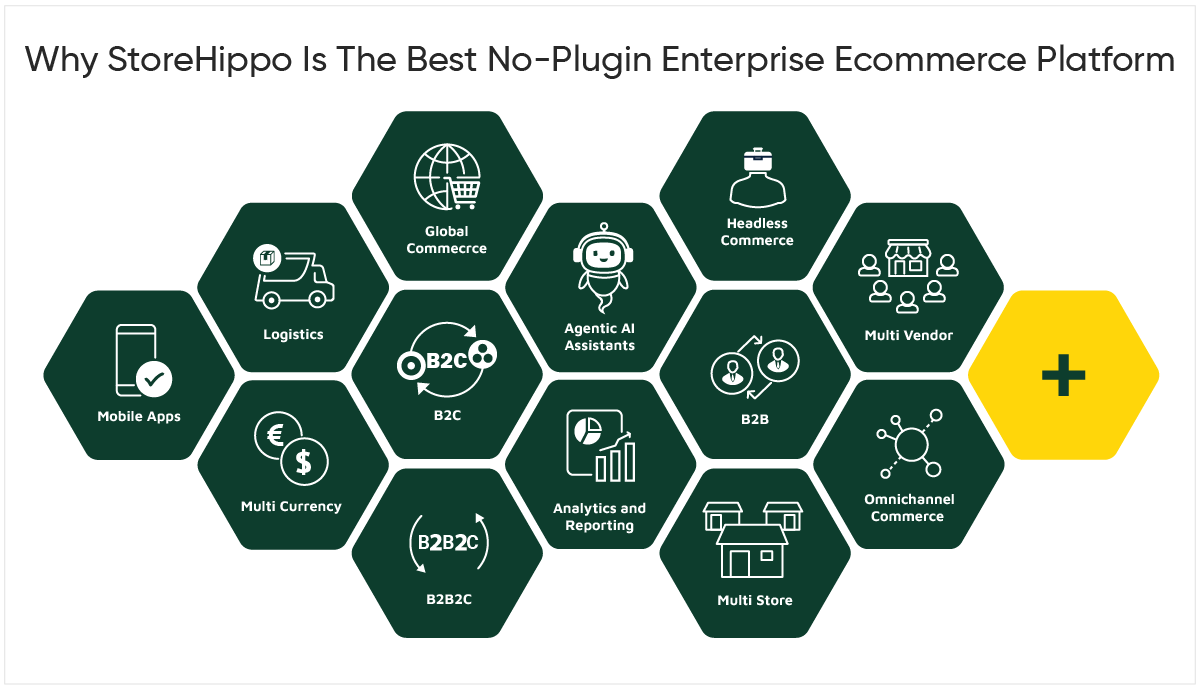
Here’s how StoreHippo translates these requirements into a future-ready enterprise ecommerce platform.
I ) No-Plugin Enterprise Ecommerce Platform
- No-Plugin Ecommerce Platform For Enterprises
With 300+ built-in enterprise ecommerce features, StoreHippo eliminates plugin dependency, removing integration and operational complexity at scale. - MACH Architecture (Microservices, API-First, Cloud-Native, Headless)
MACH-based platform architecture makes it easy for brands to build bespoke solutions while keeping the core stable and future-ready. - Pure Headless Ecommerce Architecture
A headless ecommerce architecture gives enterprises complete creative and experience control without backend constraints or performance trade-offs. - Composable Enterprise Ecommerce Platform
Brands can quickly add, remove, or substitute components, enabling agile adaptation without rebuilding or replatforming. - Inherently Flexible and Scalable by Design
Built to scale horizontally and vertically across geographies, traffic, and business models, supporting long-term enterprise growth with ease.
By removing plugin dependency at the platform level, StoreHippo turns complexity into coordination. This native-features architecture creates the stable base enterprises need to scale faster, adapt smarter, and build future-ready ecommerce ecosystems ligned with ecommerce trends 2026.
II ) AI at the Core of Enterprise Ecommerce Operations
- AI-Native Enterprise Ecommerce Platform
StoreHippo is built as an AI-native enterprise ecommerce platform, where intelligence is embedded into the core instead of layered on as external tools. - AI for Ecommerce Search and Recommendations
Native AI for ecommerce improves search relevance and product recommendations by understanding buyer intent across large, complex catalouges. - AI-Powered Cataloguing and Image Edit
AI automates cataloging, product descriptions, tagging, and optimisation, helping enterprises maintain catalog quality at scale with minimal manual effort. Built-in AI image editor Magic Edit enhances product image to engage buyers better. - AI-Driven Personalisation at Scale
Built-in AI enables real-time, contextual personalisation through multilingual voice and text based interactions and personalised recommendations eliminating the need for plugin-based personalisation. - Shared Intelligence Across Teams and Channels
With a unified AI core, insights flow seamlessly across customer journeys on different touchpoints and channels, seller operations, and internal teams eliminating fragmented decision-making. - Agentic AI Assistants
StoreHippo powers a suite of agentic AI assistants designed for real-world commerce use cases. Mystore Genie enables conversational AI shopping experiences for buyers, Mystore Kisan supports agriculture-focused commerce journeys, and Mystore Mitra assists MSMEs with onboarding and day-to-day operational queries. In addition, StoreHippo offers AI-powered support assistants for end customers. Enterprises can also collaborate with StoreHippo to design custom AI assistants tailored to their unique workflows, industries, and business models.
With AI embedded at the core, StoreHippo turns data into coordinated intelligence rather than isolated insights. This enables enterprises to scale personalisation, efficiency, and decision-making without adding complexity to the system.
III) Omnichannel, Mobile-First Enterprise Ecommerce
- True Omnichannel Enterprise Ecommerce Platform
StoreHippo enables brands to operate across web, mobile apps, PWAs, WhatsApp and conversational AI channels from a single unified backend. - Mobile-First Ecommerce Architecture
Built with a mobile-first approach, the platform delivers fast, responsive buying experiences aligned with modern online shopping behaviour. - Built-In Mobile Apps Builder and PWA Storefronts
Enterprises can launch Android, iOS apps with built in apps builder and turn storefronts into PWA without third-party plugins, ensuring consistent performance across devices. Laong with these StoreHippo also offers native admin, vendor and delivery boy apps. - Agentic Shopping Interfaces
With custom, agentic AI interfaces that handle search, product discovery, payments, and order updates within a single chat window, enterprises can seamlessly add AI for ecommerce as a high-conversion sales channel.
- Unified Inventory and Order Management Across Channels
Inventory, pricing, and orders remain synchronised across all touchpoints, eliminating channel silos and fulfilment mismatches. - Consistent Buyer Experiences Across Touchpoints
With storeHippo enterprise ecommerce platform, personalisation, search, and checkout logic remain uniform across channels, powered by the same AI-driven core. - Channel Expansion Without System Duplication
New channels and touchpoints can be added without creating duplicate codes, integrations, or operational overhead.
By unifying all channels on a mobile-first foundation, StoreHippo’s AI-powered ecommerce platform removes the complexity traditionally associated with omnichannel commerce. Enterprises gain speed, consistency, and control across every buyer touchpoint without multiplying systems.
IV) Multi-Model, Global-Ready Enterprise Ecommerce
- Multi-Model Enterprise Ecommerce Platform
StoreHippo is a multi-model enterprise ecommerce platform that natively supports B2B, D2C, B2C, B2B2C, multi vendor marketplaces, multi store, Quick Commerce and hybrid commerce from a single platform. - Unified Enterprise Ecommerce Backend
A unified ecommerce backend allows enterprises to run parallel business models with different pricing, workflows, and buyer journeys while maintaining central control. - White Labelled Multi Vendor Marketplaces
StoreHippo enables enterprises to launch fully white-labelled multi-vendor marketplaces across business models with complete brand control, without relying on third-party marketplace plugins. - Multi-Store Ecommerce Solutions
With built-in multi-store enterprise ecommerce solutions, brands can launch region-specific, brand-based or custom segment based stores across geographies from one backend, enabling scalable global expansion. - Globally Localised Ecommerce at Scale
Built-in support for store-wise design, multilingual, multi-currency, region-wise catalogs, pricing logic, fulfilment rules, and workflows helps enterprises align with local market expectations without duplicating systems. - Dealer- and Partner-Powered Quick Commerce
Built-in capabilities allow enterprises to onboard and leverage dealers and partners as fulfilment nodes, enabling fast, local deliveries without building new infrastructure. - Central Control for Global Enterprise Ecommerce
Centralised governance combined with local autonomy ensures enterprise ecommerce platforms scale globally without losing brand consistency or operational discipline.
By enabling multi-model ecommerce and global-ready enterprise ecommerce operations from a single foundation, StoreHippo removes many enterprise ecommerce challenges of plugin-based systems and allows enterprises to scale in parallel, not sequentially. Growth across markets and models becomes coordinated, controlled, and efficient.
v) End-to-End Enterprise Ecommerce Solutions
- Pre-Integrated Payments
StoreHippo comes with 60+ pre-integrated payment gateways supporting multiple payment modes, currencies, and enterprise checkout flows without relying on plugin-based payment solutions. - 30+ Pre-Integrated Logistics and Fulfilment Partners
Native ecommerce logistics integrations enable seamless shipping, delivery, and fulfilment operations across regions, partners, and business models from a unified system. - Powerful Tax Engine
A built-in tax engine simplifies complex tax rules across regions by enabling automated tax calculation, compliance handling, and region-specific tax configurations from a single system. - Enterprise-Grade Security and Compliance
StoreHippo's no plugin enterprise ecommerce platform ensures security with PCI DSS, SOC, and ISO compliance, supported by multi-layer authentication, audit logs, and robust access controls to protect data, transactions, and operations at scale. - Built-In Marketing Tools
With built-in marketing tools like discount engine, blog engine, SEO support, coupons, abandoned cart follow-up, dynamic landing pages etc., enterprises can run personalised promotions eliminating dependency on external marketing plugins. - Seamless Enterprise Integrations
An API-first architecture enables seamless integrations with ERPs, CRMs, accounting, and external enterprise systems without compromising platform stability. - Analytics and Reporting
Native ecommerce analytics and reporting deliver real-time insights into sales, inventory, performance, and operations across channels and business models. Enterprises can also integrate seamlessly with popular marketing and analytics tools like Google Analytics, Tag Manager, Facebook Pixel and more.
By delivering end-to-end ecommerce solutions as native capabilities, StoreHippo removes majority of enterprise ecommerce challenges by eliminating the need for fragmented tools and plugins. Enterprises gain faster execution, clearer visibility, and tighter operational control across the entire commerce lifecycle.
Comparison Of Plugin-Heavy Ecommerce Platforms vs AI-Native Enterprise Ecommerce Platform StoreHippo (2026)
As enterprise ecommerce platforms scale in 2026, the difference between adding more tools and redesigning the foundation becomes impossible to ignore. The contrast is clearest when plugin-heavy and AI-native platforms are viewed side by side.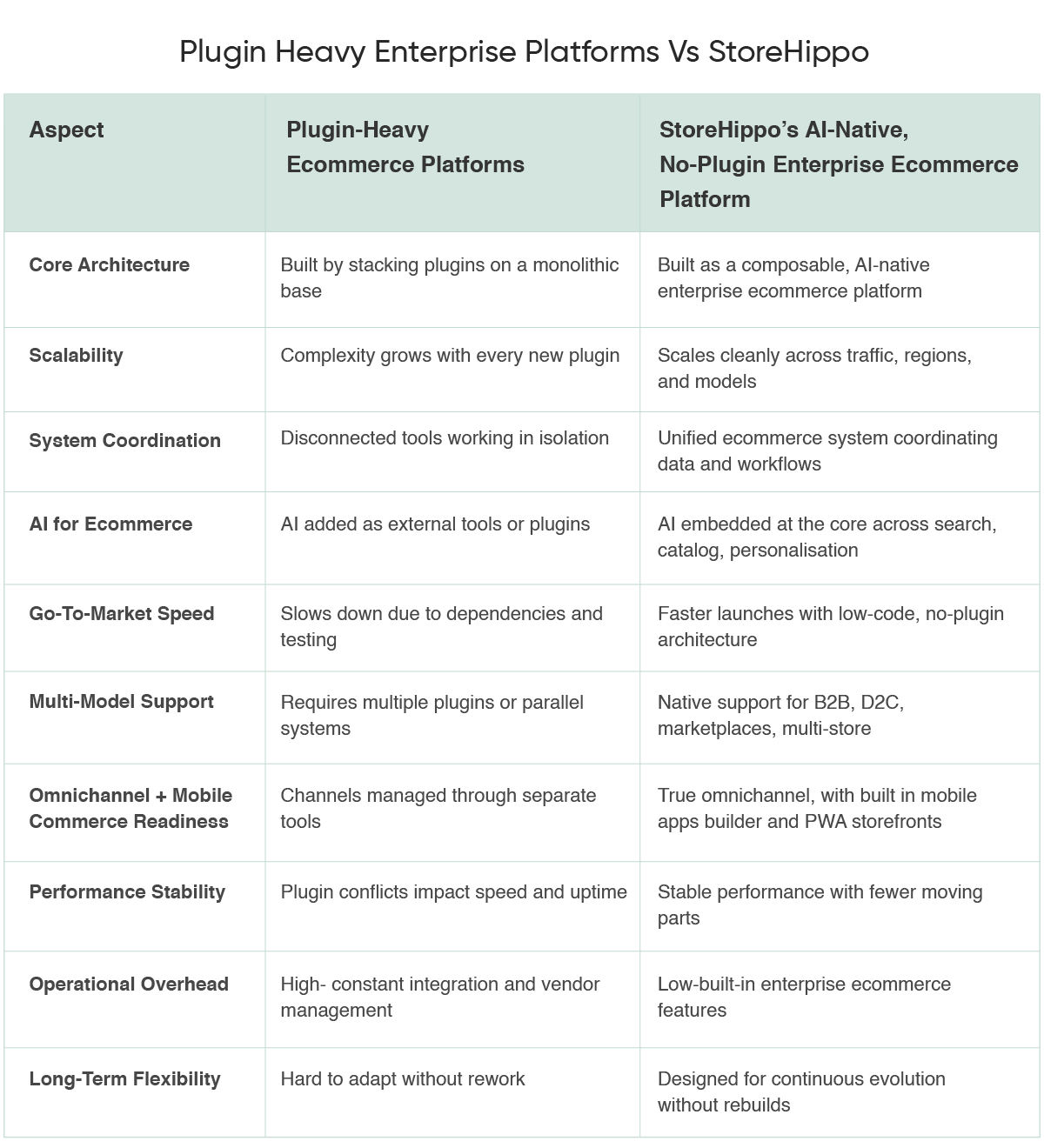
Conclusion
As ecommerce trends 2026 push enterprises toward AI-driven experiences, multi-model operations, and faster scale, the limits of plugin-heavy enterprise ecommerce platforms become impossible to ignore. Growth today depends on systems that operate as one, where intelligence, data, and workflows move together, not through disconnected tools.
This is why modern enterprise ecommerce platforms must be AI-native, composable, and built for coordinated scale from the core.
StoreHippo delivers this foundation, helping enterprises replace complexity with clarity and control in 2026 and beyond.
Ready to step into the future of ecommerce with StoreHippo? Experience it in action, book a personalised demo now.
FAQs: How To Choose Enterprise Ecommerce Platforms in 2026
1. Why are plugin-heavy enterprise ecommerce platforms struggling at scale in 2026?
Plugin-heavy platforms struggle because disconnected tools create data silos, slow execution, and rising operational overhead as enterprises scale across channels and business models.
2. Is adding more plugins a sustainable way to support AI for ecommerce?
No. AI for ecommerce depends on unified, real-time data. When information is spread across plugins, AI insights fragment and fail to deliver consistent results.
3. When should an enterprise consider ecommerce replatforming in 2026?
Enterprises should consider replatforming when integrations slow go-to-market, multi-model expansion becomes complex, or AI initiatives fail due to fragmented systems.
4. Can one enterprise ecommerce platform support B2B, D2C, marketplaces, and global operations together?
Yes, but only platforms built as unified, multi-model enterprise ecommerce platforms can support parallel operations without duplicating systems or workflows.
5. What should enterprise leaders prioritise when evaluating ecommerce platforms for the future?
Enterprise leaders should prioritise AI-native architecture, unified data flow, scalability without plugins, and the ability to adapt quickly to evolving ecommerce trends in 2026.