


Not long ago, B2B buyers accepted slow ordering, manual pricing discussions, and complex procurement processes as part of doing business.
That expectation has changed.
Today's buyers expect a B2B online marketplace to understand their business, surface relevant products, apply personalised and tiered pricing automatically, and enable seamless self-service purchasing. They want the speed and convenience of modern B2C ecommerce without sacrificing the complexity, controls, and flexibility that B2B transactions demand.
For enterprises, this creates a new challenge: delivering B2B personalization across thousands of products, buyer groups, pricing agreements, and fulfilment scenarios without adding operational complexity.
Businesses now need intelligent and scalable B2B ecommerce solutions that can personalise buyer journeys while managing complex operations across customer segments, pricing models, and fulfilment networks.
Table of Contents
- How Personalisation Is Driving Growth in B2B Online Marketplaces
- How to Implement Personalisation on Your B2B Online Marketplace
- 1. Personalised Catalogues by Buyer Type
- 2. Tiered Pricing And Personalised Offers
- 3. AI-Driven Search And Product Recommendations
- 4. Personalised Journeys Across Channels
- 5. Location-Based Order Routing And Fulfilment
- 6. AI Support Bot for Assisted Buying And Faster Decisions
- 7. Personalised Checkout Across Devices
- How StoreHippo B2B Ecommerce Solutions Simplify B2B Personalisation For Enterprises
- Conclusion
How Personalisation Is Driving Growth in B2B Online Marketplaces
B2B marketplaces are rapidly evolving as buyers now expect experiences tailored to their role, business needs, and buying patterns. Personalisation has become a key driver of faster decisions, higher engagement, and improved conversions in enterprise commerce.
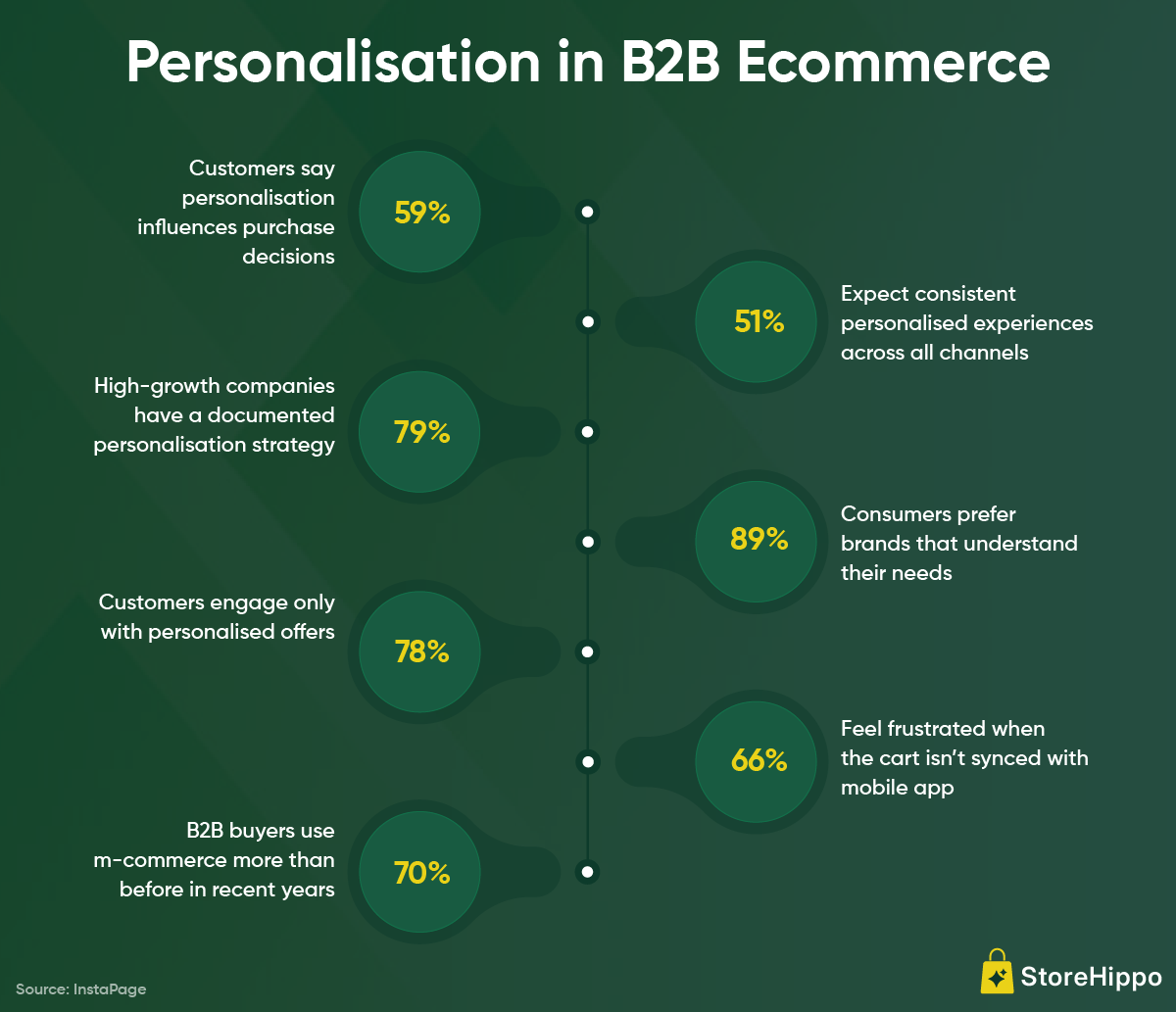
- 59% of customers say personalisation directly influences purchase decisions
- 51% customers expect a consistent personalised experience across all digital channels
- 79% of high-growth organisations have a documented personalisation strategy
- 89% of consumers prefer brands that understand and respond to their needs
- 78%+ of customers engage only with personalised offers
- 66% buyers feel frustrated when a company’s shopping cart isn’t synced with its app
- 70% of B2B buyers started using m-commerce channels more in the past 2-3 years
Key takeaway: Personalisation is now central to how B2B buyers discover and engage with products, and enterprises are using it to deliver more relevant, faster, and higher-converting buying journeys.
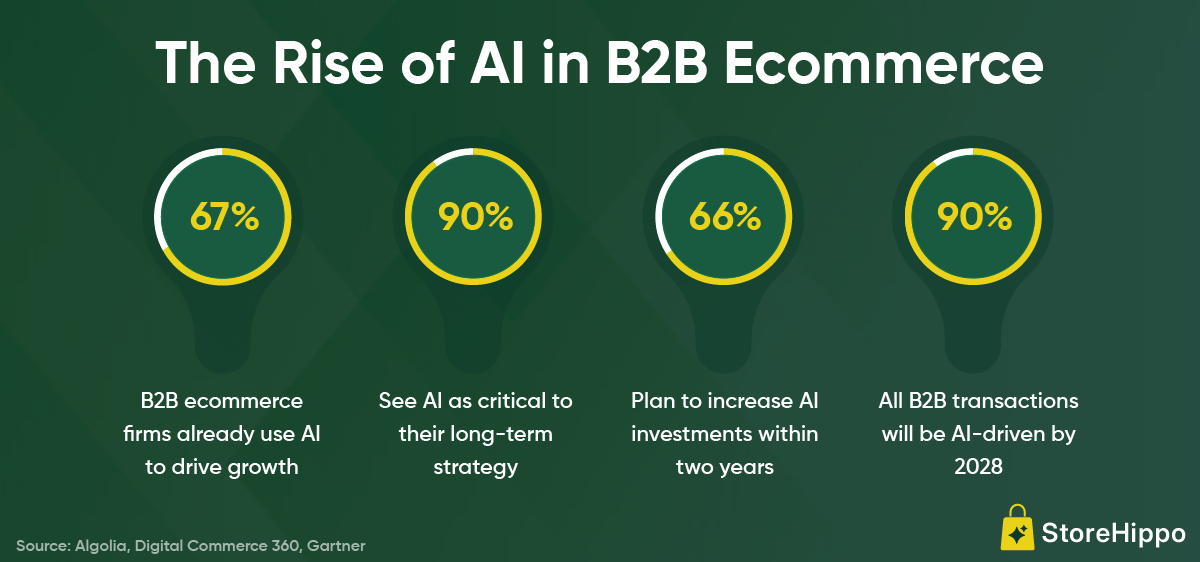
- 67% of B2B ecommerce firms already use AI to drive growth
- 90% see AI as critical to their long-term strategy
- 66% plan to increase AI investments within two years
- 90% of all B2B transactions will be AI-driven by 2028
Source: Algolia, Digital Commerce 360, Gartner
Key takeaway: AI has enabled real-time personalisation across search, recommendations, and interactions, helping enterprises scale relevance across large and complex B2B catalogues.
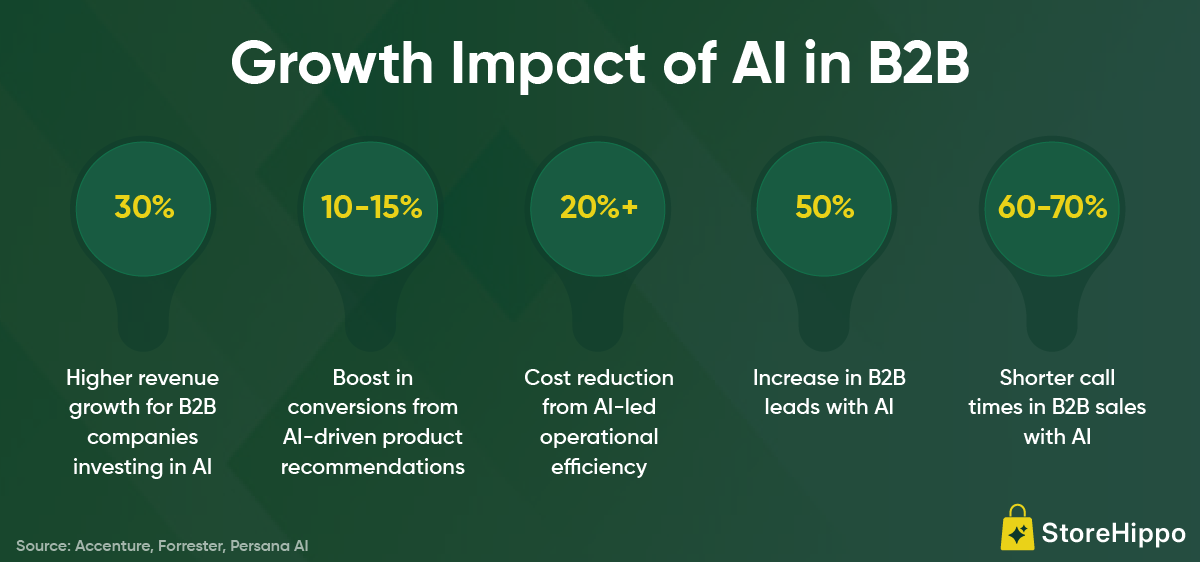
- 30% higher revenue growth for B2B companies investing in AI
- 10-15% boost in conversions from AI-driven product recommendations
- 20%+ cost reduction from AI-led operational efficiency
- 50% increase in B2B leads with AI
- 60-70% shorter call times in B2B sales with AI
Source: Accenture, Forrester, Persana AI
Key Takeaway: Enterprises adopting AI-driven personalisation are seeing stronger revenue growth, better conversion rates, and improved operational efficiency across their B2B commerce ecosystem.
B2B personalisation is now essential for scaling modern digital commerce experiences. Enterprises need AI-powered, scalable B2B ecommerce solutions to deliver consistent, connected, and intelligent buying journeys across channels.
How to Implement Personalisation on Your B2B Online Marketplace
There’s no second-guessing the fact that personalisation helps B2B brands scale to newer heights of success. However wonderful the idea of implementing personalization is, it is quite an arduous task. B2B brands not only need cutting-edge solutions but also a future-ready B2B ecommerce solution that supports agile changes.
Let us look at the top 7 ways to implement personalisation on your business-to-business marketplace:
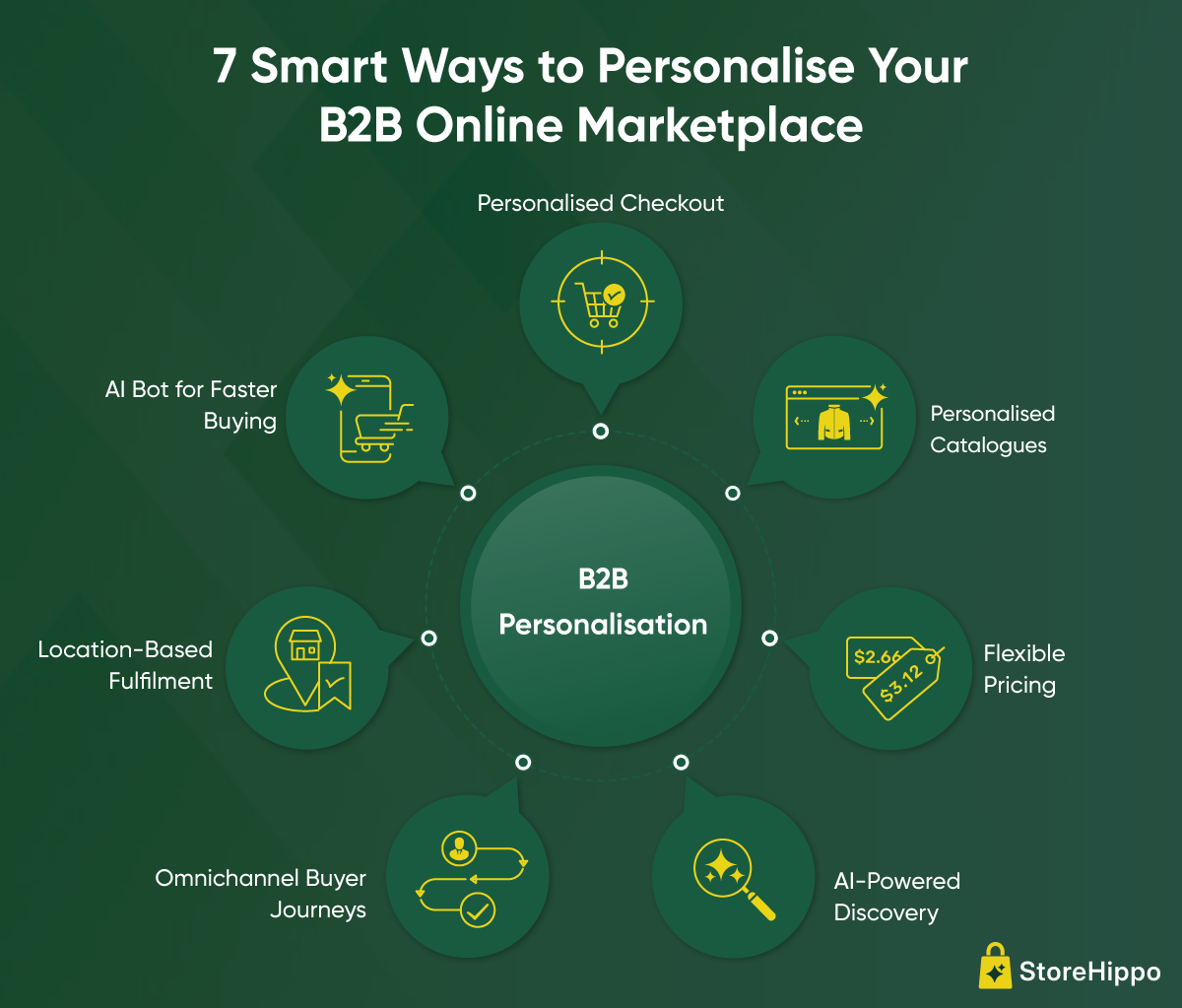
1. Personalised Catalogues by Buyer Type
If every buyer on your B2B online marketplace sees the same catalogue, finding relevant products becomes slower and more complicated. Different buyers have different purchasing needs, pricing agreements, and reorder patterns. A generic catalogue only adds more clutter to the buying journey.
You can simplify procurement by segmenting buyers based on industry, business type, purchase history, or contract terms and showing each buyer group a tailored catalogue. This helps your buyers see only the products, assortments, and pricing on your marketplace that are relevant to their business needs.
Imagine you run a B2B office supplies marketplace. When a buyer regularly purchases laptops, monitors, and networking equipment from your marketplace, you can show related accessories, printers, and bulk IT supplies more prominently in their catalogue. Similarly, when buyers order office furniture, you can prioritise desks, chairs, storage units, and workspace solutions in their buying journey.
Instead of making buyers search through thousands of unrelated products, you create a more focused purchasing experience that helps them find products faster, reorder easily, and make quicker buying decisions.
2. Tiered Pricing And Personalised Offers
B2B buyers do not expect one standard price for every purchase. Different business customers often operate under different contracts, order volumes, payment cycles, and negotiated agreements. Showing the same pricing to every buyer can make the buying experience feel rigid and less aligned with how B2B relationships actually work.
To create a more personalised buying experience, your B2B online marketplace should support flexible pricing models based on customer type, order quantity, business agreements, and purchase history. You can offer bulk discounts, customer-specific pricing, volume-based rates, flexible payment terms, and tailored promotions that adapt to different buyer relationships.
Imagine you run a B2B industrial supplies marketplace. A large enterprise buyer placing high-volume monthly orders can automatically receive negotiated bulk pricing and extended payment terms. At the same time, smaller businesses purchasing lower quantities can see standard pricing with offers tailored to their buying frequency and order size.
Instead of forcing buyers to renegotiate pricing repeatedly, personalised pricing simplifies purchasing, improves buyer trust, encourages repeat orders, and strengthens long-term business relationships.
3. AI-Driven Search And Product Recommendations
When business-to-business customers cannot quickly find the products they need, purchasing becomes slower and less efficient. In large B2B online marketplaces with thousands of SKUs, basic keyword search often struggles to deliver accurate and relevant results.
Search on a B2B marketplace should work more like an experienced sales assistant than a simple keyword tool. AI-powered search can understand buyer intent, industry-specific terms, previous searches, and related product queries to help buyers discover relevant products faster, even when they use different names, abbreviations, or technical terms
Imagine an enterprise running a B2B electronics marketplace. A buyer searching for “wireless office setup” may actually need routers, docking stations, wireless keyboards, monitors, and cable management products. Instead of showing unrelated results based only on exact keywords, the marketplace can recommend a complete set of relevant products based on the buyer’s intent, browsing activity, and past purchases.
Your B2B marketplace should be built on AI powered B2B ecommerce platform that can offer a built-in AI engine to recommend products based on previous orders, frequently purchased items, and buying behaviour patterns. This helps buyers discover relevant products faster, improves cross-selling opportunities, and increases conversions across the marketplace.
4. Personalised Journeys Across Channels
Just like in B2C ecommerce, B2B buyers today also expect personalised and connected buying experiences across every channel they use during the purchasing process. Whether they interact through marketplace websites, mobile apps, social, or conversational channels, buyers expect consistency in product discovery, pricing, support, and overall experience. When these interactions feel disconnected, the buying journey becomes slower, more complex, and inefficient.
To create a smoother buying experience, your B2B marketplace should offer a unified, mobile-first journey across app, web, and conversational channels. You can use AI tools to personalise product discovery, recommendations, pricing, and support in real time while keeping carts, buyer preferences, and purchase context synced across every touchpoint.
Imagine a buyer browsing industrial equipment on your marketplace app during work hours. Later, the same buyer visits your website to compare products and connects with your sales team on WhatsApp to complete the order. Instead of restarting the journey each time, your B2B online marketplace can retain the buyer’s cart, pricing, preferences, and browsing history across every channel, creating a faster and more convenient buying experience.
This creates a more connected buying experience that helps buyers move seamlessly between channels, reduces purchase friction, and makes ordering faster and more convenient for enterprise customers.
5. Location-Based Order Routing And Fulfilment
In B2B commerce, fulfilment expectations often vary based on buyer location, warehouse availability, regional distributors, and delivery capabilities. Showing the same inventory availability or delivery timelines to every buyer can create confusion, delays, and operational inefficiencies.
To create a more reliable buying experience, your B2B online marketplace should personalise inventory visibility, delivery timelines, shipping options, and fulfilment routes based on the buyer’s location. Buyers should see products available in nearby warehouses, region-specific catalogues, local dealers, and accurate delivery estimates relevant to their business location.
Imagine you run a B2B construction materials marketplace serving multiple cities and industrial zones. A buyer in Delhi may see products available for same-week delivery from a nearby warehouse, while a buyer in another region may view different stock availability and delivery timelines based on the nearest fulfilment centre or authorised distributor.
Instead of creating uncertainty around deliveries and stock availability, location-based fulfilment helps buyers make faster purchasing decisions, improves delivery accuracy, and creates a more dependable buying experience across regions.
6. AI Support Bot for Assisted Buying And Faster Decisions
Modern B2B buyers don't want to manually browse large catalogues or wait for sales teams to respond to every query. In many cases, bulk buyers already know their requirements and simply need faster answers, product guidance, pricing clarity, or help comparing options before making a purchase decision.
You can offer this level of B2B personalisation on your marketplace by launching a custom AI-powered support bot that can guide buyers throughout their purchasing journey. Leverage your custom-built AI bots to help buyers discover products, compare specifications, check availability, understand pricing, recommend alternatives, and even assist with order placement in real time.
Let us take the previous example of a buyer visiting a B2B electronics marketplace looking for networking equipment for a new office setup. Instead of searching through hundreds of SKUs manually, the buyer can interact with the AI bot to identify suitable products based on office size, usage needs, budget, and delivery location. The bot can also recommend compatible accessories, suggest bulk purchase options, and answer queries instantly.
Instead of increasing dependency on manual support teams, AI-assisted buying helps B2B enterprises to offer faster responses, simplify decision-making, improve buyer engagement, and deliver a more personalised purchasing experience at scale.
7. Personalised Checkout Across Devices
Even after buyers find the right products, complex or disconnected checkout experiences can slow down purchasing and increase drop-offs. In B2B commerce, buyers often switch between devices and channels during the buying journey, making consistency at the checkout stage especially important.
To create a smoother purchasing experience, you should offer personalised checkout flow on your B2B online marketplace that works seamlessly across mobile apps, websites, and assisted sales channels. Buyers should be able to continue their purchase journey seamlessly across devices and channels without entering their information repeatedly.
Your online marketplace can simplify checkout by automatically saving buyer details, preferred payment methods, delivery addresses, negotiated pricing, GST information, and credit terms. It should also support buyer-specific payment workflows, approval hierarchies, and flexible payment options based on existing business agreements.
Imagine a business buyer adding products to the cart through a mobile app while travelling. Later, the same buyer logs into the website from the office to complete the order approval process. Instead of restarting the checkout journey, the marketplace can retain saved carts, payment preferences, pricing agreements, and delivery details across both devices.
Instead of creating friction at the final stage of purchase, personalised checkout experiences help businesses speed up order completion, reduce cart abandonment, simplify repeat purchases, and deliver a more convenient buying experience across every channel.
How StoreHippo B2B Ecommerce Solutions Simplify B2B Personalisation For Enterprises
Creating personalised B2B buying experiences requires a flexible, scalable, and future-ready ecommerce platform. StoreHippo is an AI powered B2B ecommerce platform that offers future-ready solutions that help enterprises personalise buyer journeys across channels, customer segments, and regions. Here’s how StoreHippo enables businesses to deliver scalable B2B personalisation:
- Built on MACH and headless architecture, StoreHippo enables enterprises to fully customise buyer journeys, storefronts, workflows, and business logic based on unique B2B requirements.
- Offers built-in omnichannel commerce capabilities to create unified buying experiences across websites, marketplace apps, WhatsApp, social channels, and conversational commerce platforms.
- Comes with a built-in mobile app builder that helps enterprises launch Android and iOS B2B marketplace apps directly from the admin dashboard.
- Built on an AI-native commerce engine that helps enterprises automate catalogue management, enhance images, personalise search and recommendations, optimise operations, and improve buyer engagement across large catalogues.
- Enables enterprises to build custom AI-powered assistants for guided buying, product discovery, order support, and real-time customer and seller assistance.
- Supports personalised pricing with tiered pricing models, customer-specific catalogues, bulk discounts, and dynamic pricing for different buyer groups.
- Offers a built-in discount engine and promotional tools to run personalised offers, loyalty programs, and targeted campaigns for different customer segments.
- Pre-integrated with 60+ payment gateways to offer flexible and buyer-specific payment experiences across regions and business models.
- Integrated with 30+ logistics partners to support location-based fulfilment, regional inventory visibility, and faster deliveries.
- Enables multilingual and multi-region commerce experiences with localised storefronts, multilingual catalogues, and AI-powered multilingual buyer journeys.
Conclusion
B2B buyers today expect faster, more personalised, and connected buying experiences across every stage of the purchasing journey. From personalised catalogues and pricing to AI-driven product discovery, assisted buying, and seamless checkout journeys, implementing effective B2B personalisation can help businesses improve buyer engagement, simplify purchasing, and increase conversions.
To deliver these experiences at scale, enterprises need future-ready B2B ecommerce solutions that combine AI-driven capabilities with operational flexibility. StoreHippo AI powered B2B ecommerce platform enables enterprises to build scalable and personalised B2B online marketplaces with AI-powered features, multilingual capabilities, mobile-first experiences, and built-in multi-vendor marketplace solutions.
Ready to build a personalised B2B marketplace? Book a demo with StoreHippo today.